
Life, 1913-12-18 · page 17 of 40
Life — December 18, 1913 — page 17: what you’re looking at
What you’re looking at
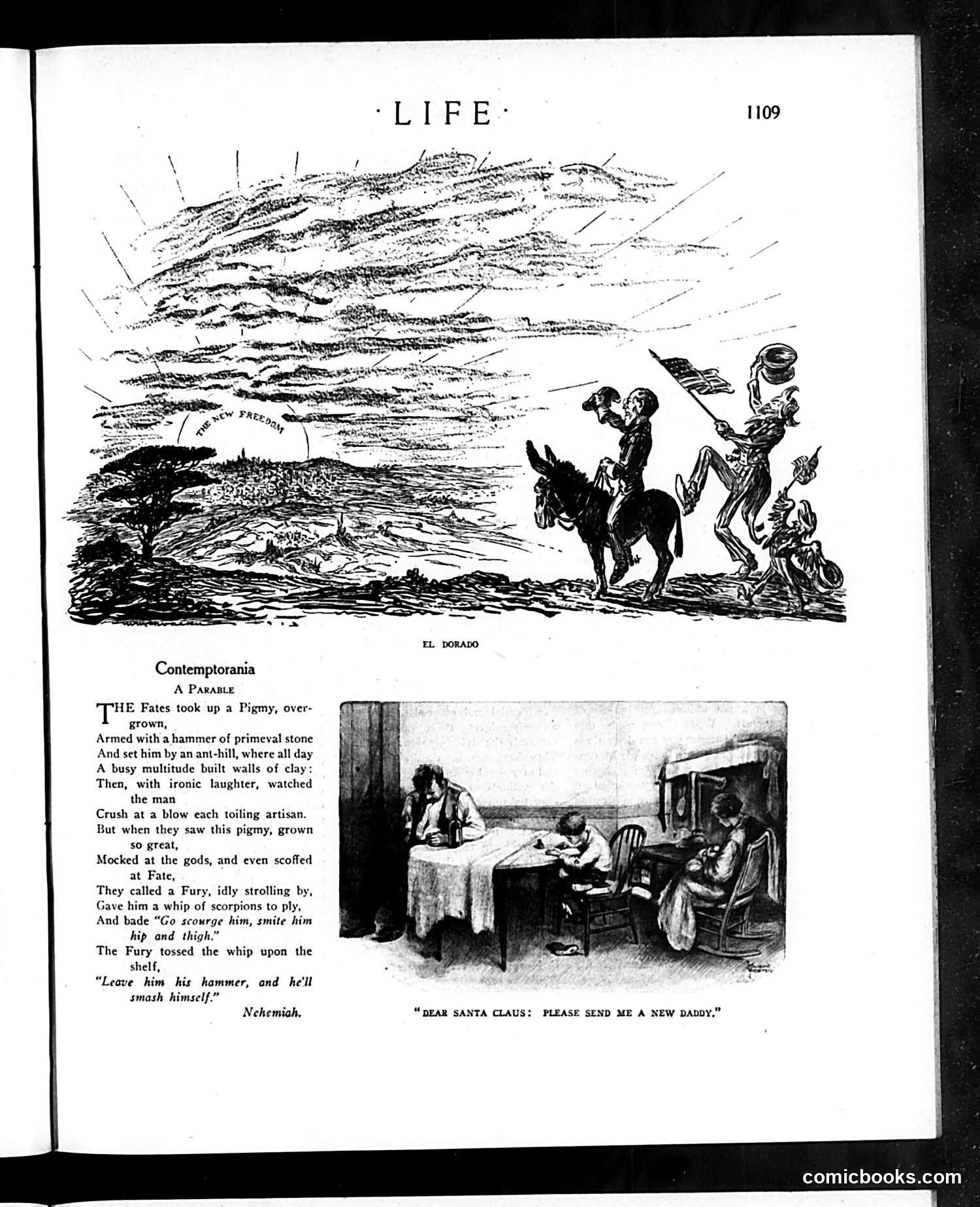
This page contains two distinct works: **"El Dorado" (top illustration)**: A Goya-style engraving depicting Don Quixote-like figures—a man on a donkey and fantastical characters—pursuing an illusory golden city on the horizon. It references the legendary "El Dorado," symbolizing futile pursuit of impossible wealth or dreams. **"Contemporania: A Parable" (text and lower cartoon)**: The poem warns against unchecked power. The narrative describes a "Pigmy" given destructive force (a hammer) who grows arrogant, mocking gods and fate. When summoned, a Fury chooses not to punish him directly but leaves the hammer—implying the powerful will self-destruct through their own ambition and hubris. **The lower cartoon** shows a child writing to Santa Claus requesting "a new daddy," likely commentary on social problems—absent fathers, poverty, or family dissolution—presented as what children actually need versus material gifts. Together, the page satirizes human folly: the pursuit of impossible dreams, the corruption of power, and unmet basic social needs.
📄 Transcribed text from this page (OCR, searchable)
Machine-transcribed from the original scan — historical spelling and the odd misread are preserved.
CSE Mp Contemptorania A ParaBLe TH Fates took up a Pigmy, over- grown, Armed with a hammer of primeval stone And set him by an ant-hill, where all day A busy multitude built walls of clay: Then, with ironic laughter, watched the man Crush at a blow each toiling artisan. But when they saw this pigmy, grown so great, Mocked at the gods, and even scoffed at Fate, They called a Fury, idly strolling by, Gave him a whip of scorpions to ply, And bade “Go scourge him, smite him hip and thigh.” The Fury tossed the whip upon the shelf, “Leave him his hammer, and he'll smash himself.” Nehemiah, Soe aa Sas —— ee) sont ages, “DEAR SANTA CLAUS: PLEASE SEND ME A NEW DADDY,” comicbooks.com