
Life, 1913-12-18 · page 18 of 40
Life — December 18, 1913 — page 18: what you’re looking at
What you’re looking at
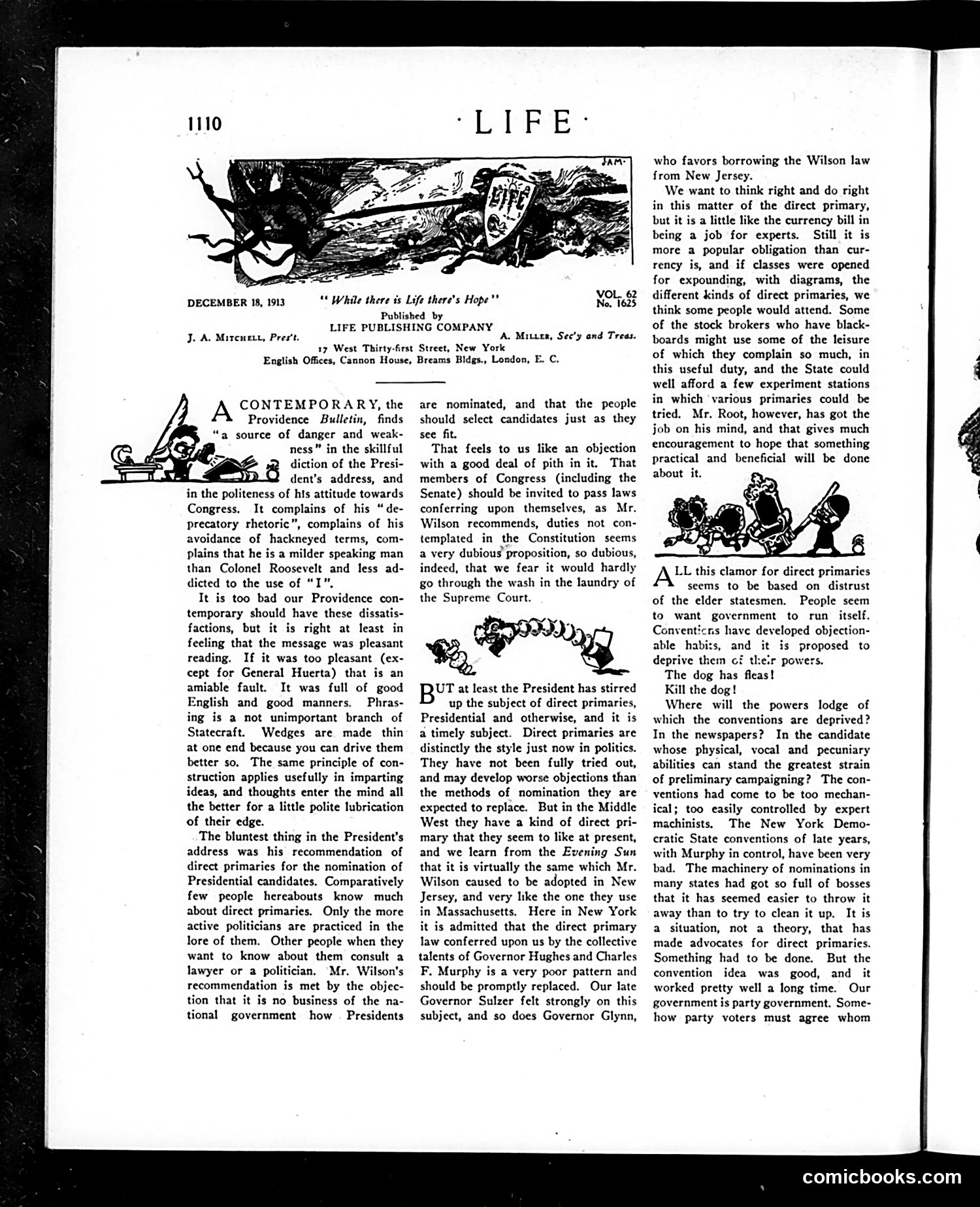
This Life magazine editorial discusses President Wilson's recommendation for direct primaries in presidential nominations. The top cartoon depicts a dog with fleas, illustrating the article's metaphor about removing problematic systems. The piece critiques objections to federal involvement in primary elections, noting that while concerns about constitutional authority have merit, the issue deserves serious consideration. The editorial acknowledges that direct primaries are trendy in politics but remain untested. It references **Governor Hughes and Charles F. Murphy** (New York political figures), **Governor Sulzer** (recently removed), and **Governor Glynn** (current), noting New York's primary system is inferior to Wilson's New Jersey model. The article sardonically suggests stock brokers with chalkboards might educate the public on different primary methods—implying most people don't understand the mechanics of these nomination processes. The satire targets both political elites who resist reform and ordinary citizens' ignorance of electoral mechanics.
📄 Transcribed text from this page (OCR, searchable)
Machine-transcribed from the original scan — historical spelling and the odd misread are preserved.
DECEMBER 18, 1913 “« While there ts Life there's Hope"’ Published by LIFE PUBLISHING COMPANY J. A. Mircustt, Pres't. A. Muier, Sec’y and Treas. 17 West Thirty-first Street, New York English Offices, Cannon House, Breams Bldgs., London, E. C. CONTEMPORARY, the Providence Bulletin, finds “a source of danger and weak- ness” in the skillful diction of the Presi- dent’s address, and in the politeness of his attitude towards Congress. It complains of his “de- precatory rhetoric”, complains of his avoidance of hackneyed terms, com- plains that he is a milder speaking man than Colonel Roosevelt and less ad- dicted to the use of “I”. It is too bad our Providence con- temporary should have these dissatis- factions, but it is right at least in feeling that the message was pleasant reading. If it was too pleasant (ex- cept for General Huerta) that is an amiable fault. It was full of good English and good manners. Phras- ing is a not unimportant branch of Statecraft. Wedges are made thin at one end because you can drive them better so, The same principle of con- struction applies usefully in imparting ideas, and thoughts enter the mind all the better for a little polite lubrication of their edge. The bluntest thing in the President’s address was his recommendation of direct primaries for the nomination of Presidential candidates. Comparatively few people hereabouts know much about direct primaries. Only the more active politicians are practiced in the lore of them. Other people when they want to know about them consult a lawyer or a politician. Mr. Wilson's recommendation is met by the objec- tion that it is no business of the na- tional government how — Presidents are nominated, and that the people should select candidates just as they see fit. That feels to us like an objection with a good deal of pith in it, That members of Congress (including the Senate) should be invited to pass laws conferring upon themselves, as Mr. Wilson recommends, duties not con- templated in the Constitution seems a very dubious’ proposition, so dubious, indeed, that we fear it would hardly go through the wash in the laundry of the Supreme Court. UT at least the President has stirred up the subject of direct primaries, Presidential and otherwise, and it is a timely subject. Direct primaries are distinctly the style just now in politics. They have not been fully tried out, and may develop worse objections than the methods of nomination they are expected to replace. But in the Middle West they have a kind of direct pri- mary that they seem to like at present, and we learn from the Evening Sun that it is virtually the same which Mr. Wilson caused to be adopted in New Jersey, and very like the one they use in Massachusetts. Here in New York it is admitted that the direct primary law conferred upon us by the collective talents of Governor Hughes and Charles F. Murphy is a very poor pattern and should be promptly replaced. Our late Governor Sulzer felt strongly on this subject, and so does Governor Glynn, who favors borrowing the Wilson law from New Jersey. We want to think right and do right in this matter of the direct primary, but it is a little like the currency bill in being a job for experts. Still it is more a popular obligation than cur- rency is, and if classes were opened for expounding, with diagrams, the different kinds of direct primaries, we think some people would attend. Some of the stock brokers who have black- boards might use some of the leisure of which they complain so much, in this useful duty, and the State could well afford a few experiment stations in which various primaries could be tried. Mr. Root, however, has got the job on his mind, and that gives much encouragement to hope that something practical and beneficial will be done about it. Att this clamor for direct primaries seems to be based on distrust of the elder statesmen. People seem to want government to run_ itself. Conventicns have developed objection- able hab and it is proposed to deprive them cf their powers, The dog has fleas! Kill the dog! Where will the powers lodge of which the conventions are deprived? In the newspapers? In the candidate whose physical, vocal and pecuniary abilities can stand the greatest strain of preliminary campaigning? The con- ventions had come to be too mechan- ical; too easily controlled by expert machinists. The New York Demo- cratic State conventions of late years, with Murphy in control, have been very bad. The machinery of nominations in many states had got so full of bosses that it has seemed easier to throw it away than to try to clean it up. It is a situation, not a theory, that has made advocates for direct primaries. Something had to be done. But the convention idea was good, and it worked pretty well a long time. Our government is party government. Some- how party voters must agree whom =~ comicbooks.com