
A complete issue · 44 pages · 1913
Life — September 11, 1913
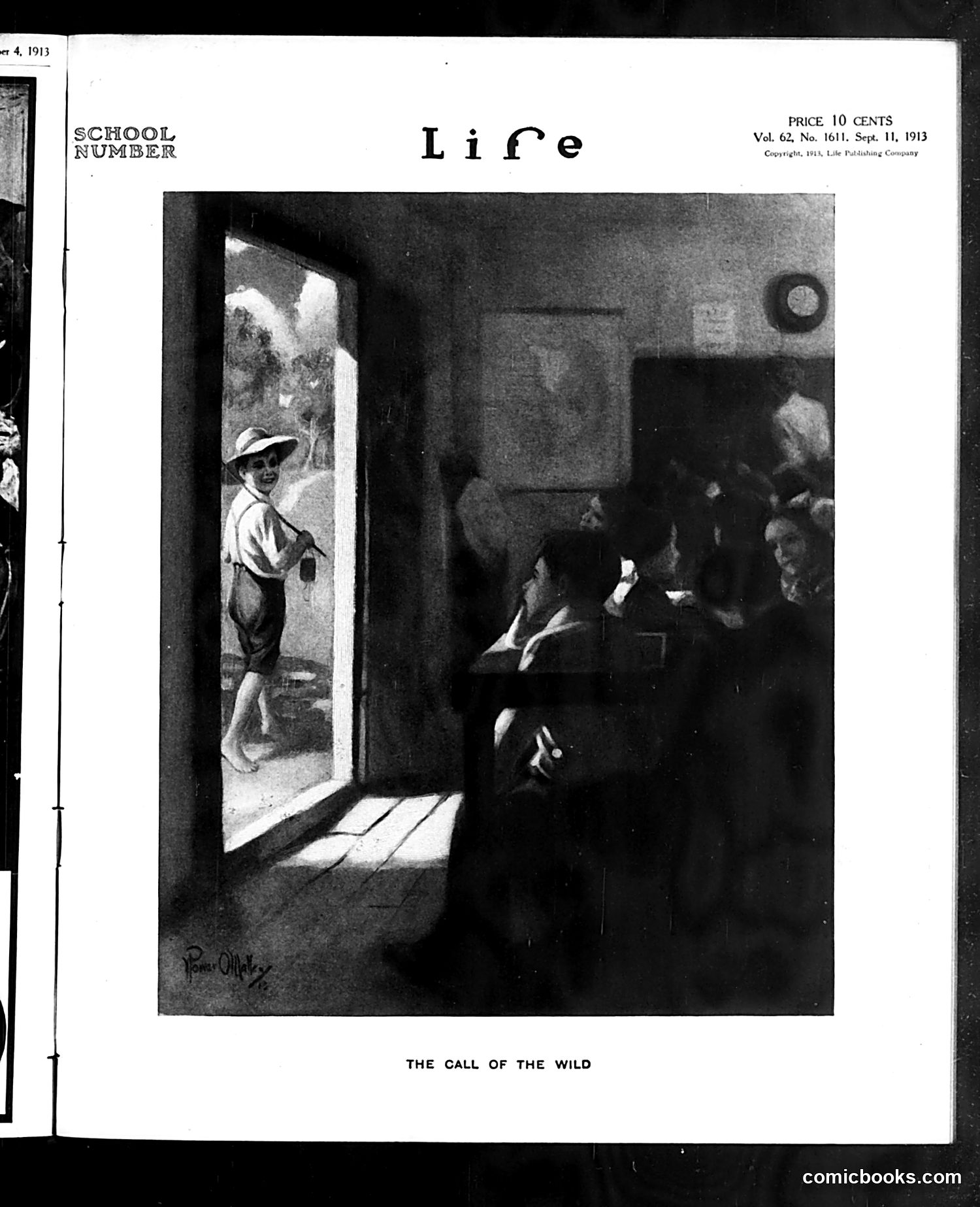
This illustration depicts a humorous domestic scene. A man wearing outdoor/hunting attire and a hat stands outside a doorway, appearing to beckon or invite someone. Inside, a woman and what appear to be other family members look out at him with apparent skepticism or disapproval. The title "The Call of the Wild" is a literary reference (likely to Jack London's 1903 novel) used ironically here. The joke satirizes the conflict between a husband's desire to pursue outdoor adventures or hunting expeditions versus his family's domestic expectations and resistance to his departure. The woman's expression suggests she's unimpressed by his wilderness aspirations, making this social commentary on masculine leisure pursuits versus family obligations in early 20th-century American life.
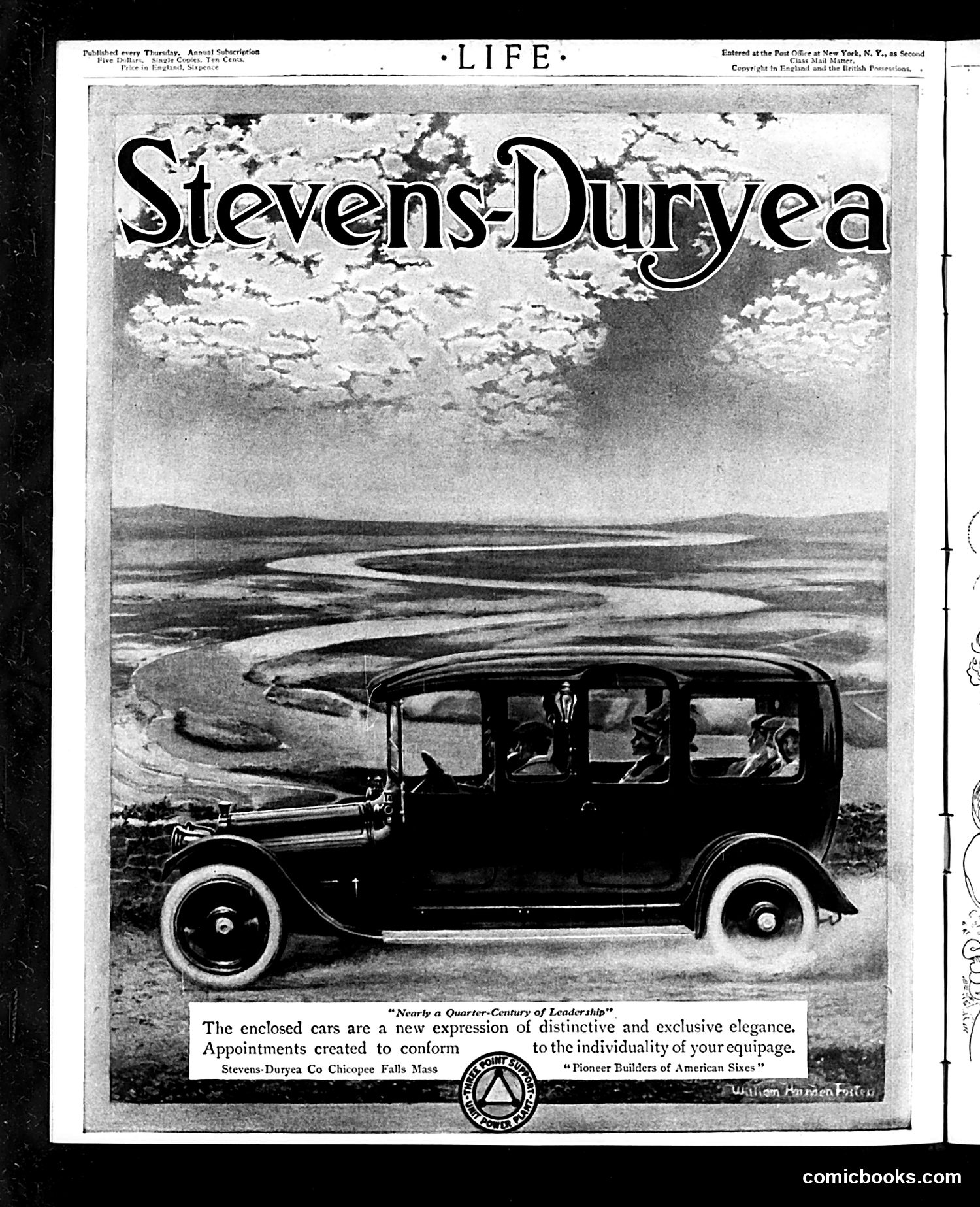
This is primarily a **car advertisement**, not political satire. The Stevens-Duryea Company of Chicopee Falls, Massachusetts advertised their enclosed automobile as representing "a new expression of distinctive and exclusive elegance." The ad emphasizes that their cars offer "appointments created to conform to the individuality of your equipage"—marketing luxury customization to wealthy buyers. The scenic landscape background and silhouetted passengers suggest comfort and leisure travel. The company's tagline, "Pioneer Builders of American Sixes," references their six-cylinder engine technology. This appears to be a prestige auto advertisement from the early 1920s era, targeting affluent consumers. The Life magazine placement suggests such ads were standard editorial content in this publication.
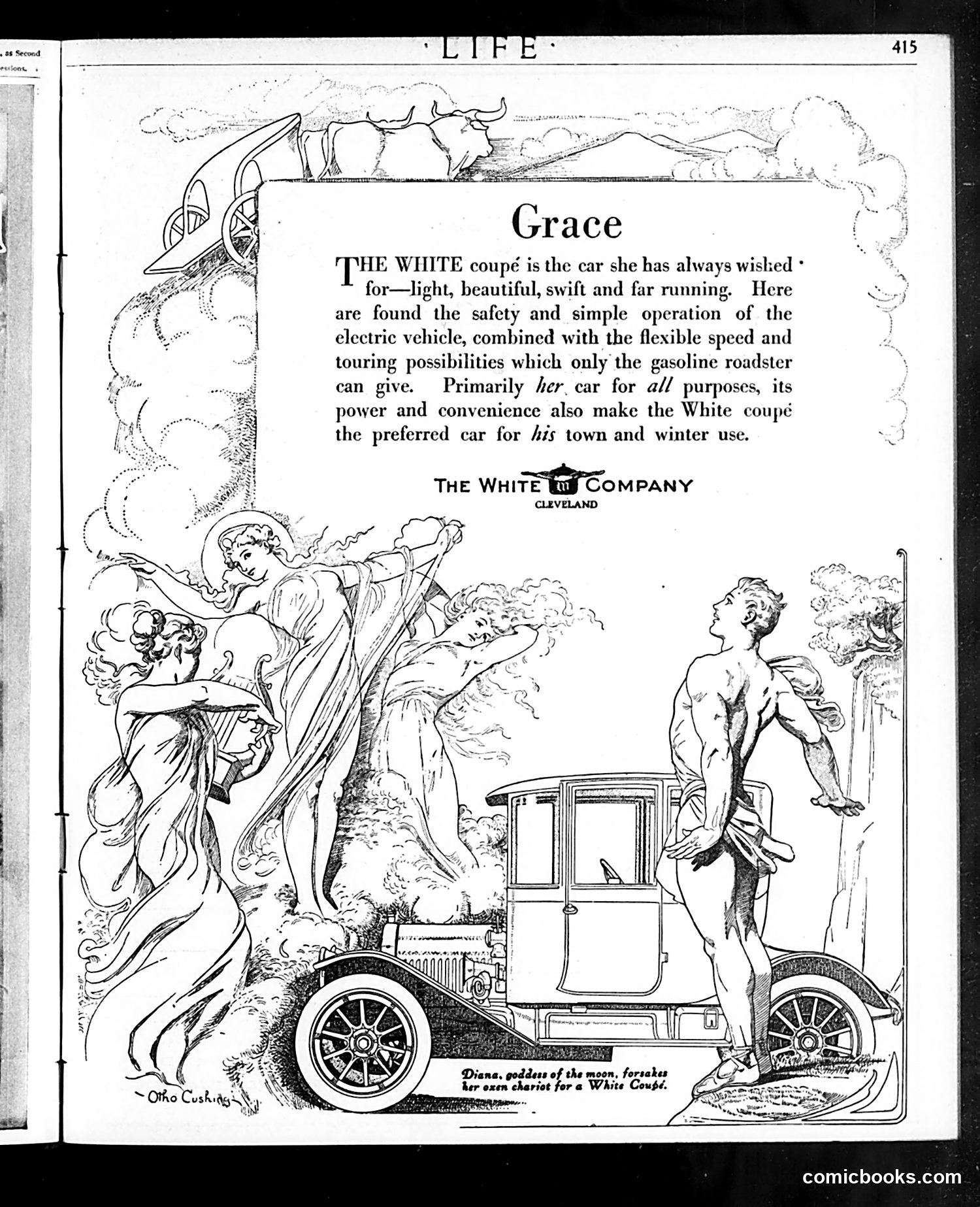
This is primarily a **product advertisement** for the White Company's electric automobile, disguised as editorial content in Life magazine's satirical style. The classical allegorical figures—winged female forms (likely representing Grace, Favor, or similar virtues)—flank a White electric coupe to suggest the car embodies elegance and refinement. The caption credits "Diana, goddess of the moon" as endorsing the vehicle. The ad positions the electric car as ideal for women ("**her** car for all purposes") while claiming its power and convenience also suit men's "town and winter use." This reflects early 1900s marketing that marketed electric vehicles as particularly suitable for female drivers due to their ease of operation, before gasoline cars eventually dominated the market.
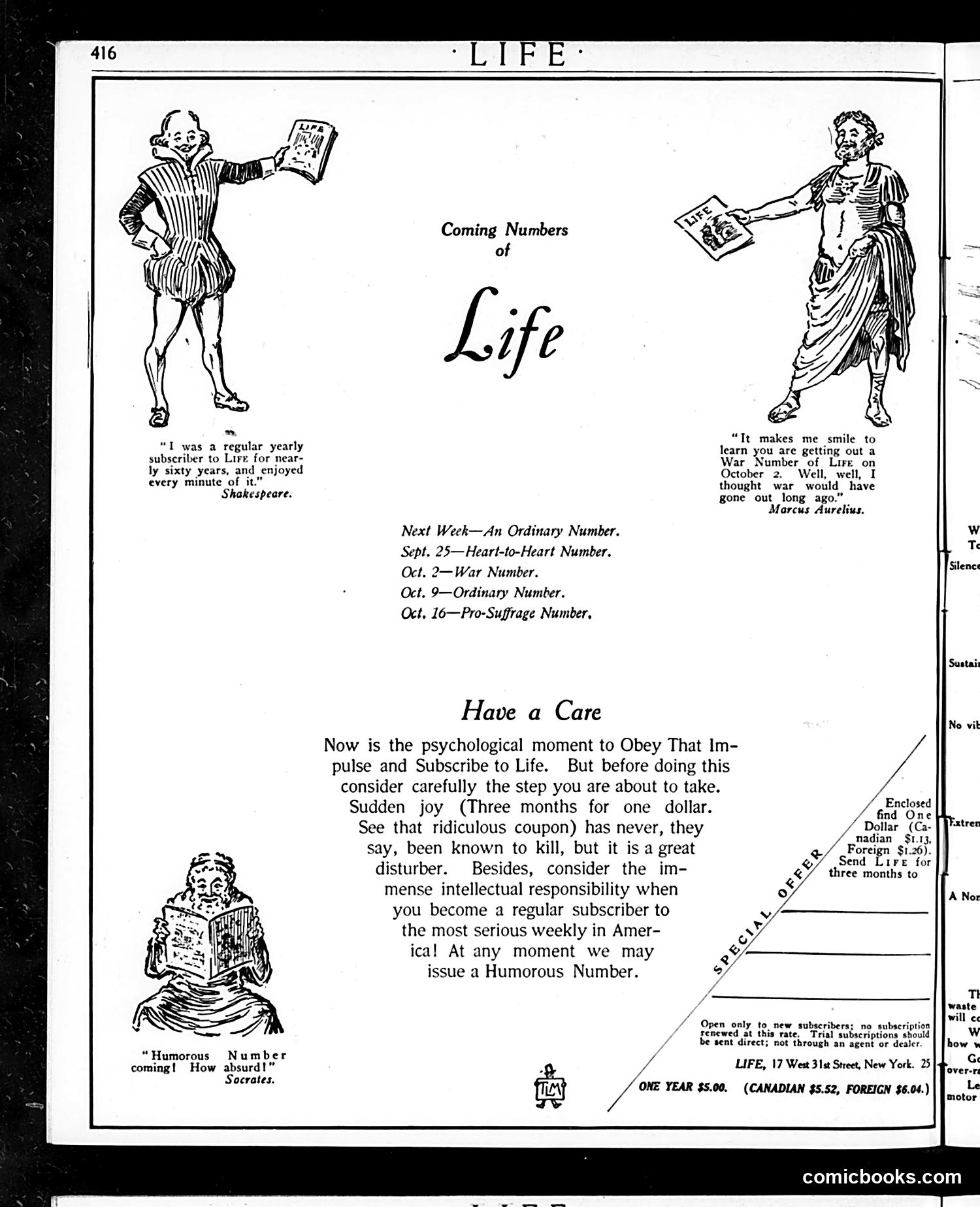
This page promotes subscriptions to *Life* magazine through satirical testimonials and upcoming issue previews. The classical figures (appearing to reference Shakespeare and Marcus Aurelius) endorse the publication—Shakespeare praising nearly sixty years of readership, Aurelius anticipating a "War Number." The page announces upcoming special issues: a "Heart-to-Heart Number," "War Number," and notably, a "Pro-Suffrage Number" (October 16), indicating this appeared during the women's suffrage movement campaign. The "Have a Care" section humorously warns subscribers about the "psychological moment to Obey" the impulse to subscribe, joking that the dollar coupon "has never been known to kill, but it is a great disturber." The satire targets subscription pressure tactics while suggesting *Life* is serious enough to warrant careful consideration.
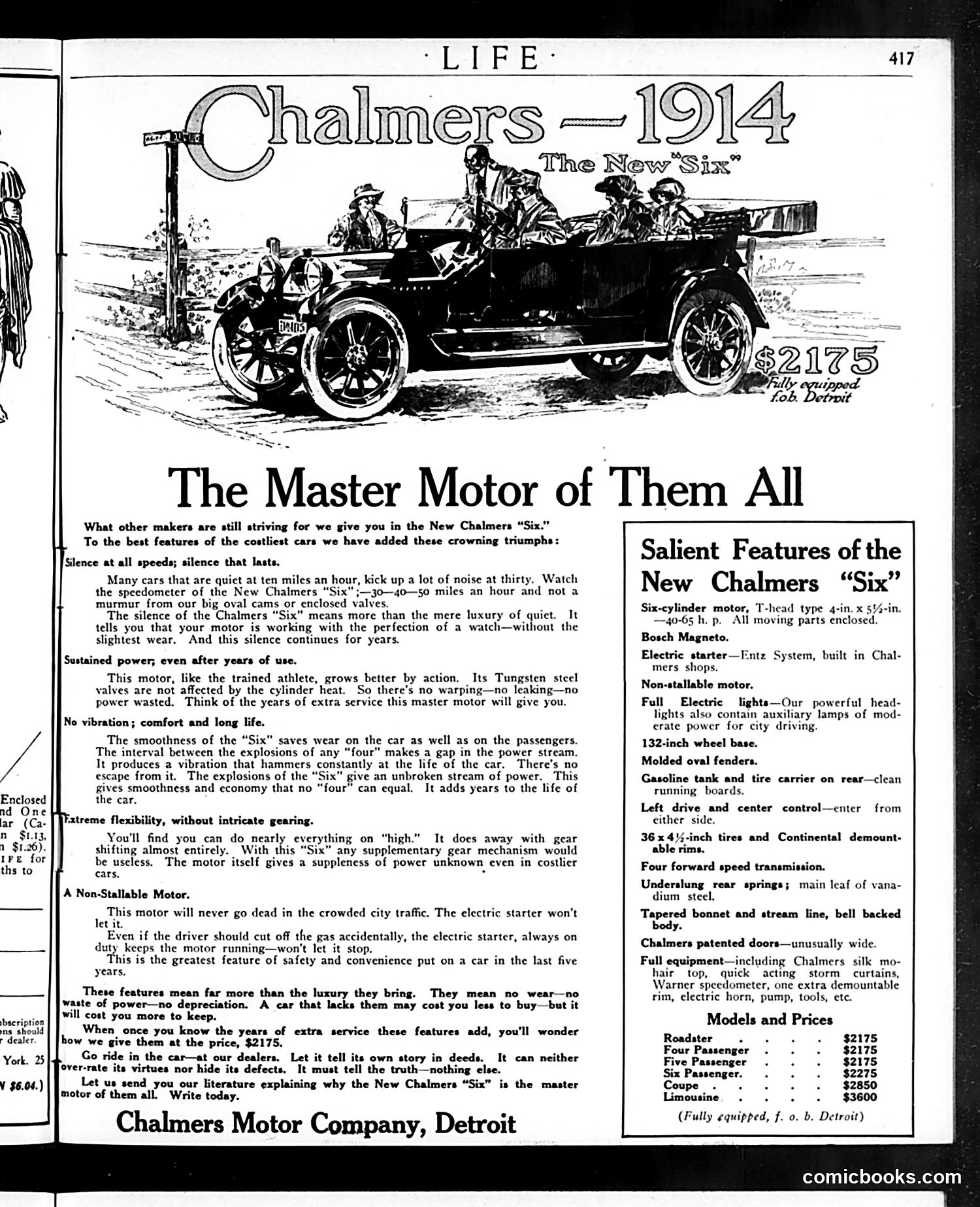
This is **not a political cartoon or satire**—it's a straightforward automobile advertisement for the 1914 Chalmers "Six" automobile, published in *Life* magazine. The page features a sketch of the car with multiple well-dressed passengers and emphasizes engineering features like the silent motor, electric starter, and durable Tungsten steel construction. The text celebrates the vehicle as "The Master Motor of Them All," highlighting practical innovations valuable to early 20th-century drivers: reliability, quietness, and electric starting (which eliminated dangerous hand-cranking). The "$2175" price and models listed (Roadster, Touring, Six Passenger, etc.) reflect the luxury automobile market of 1914. This represents mainstream automotive advertising, not editorial content or satire.
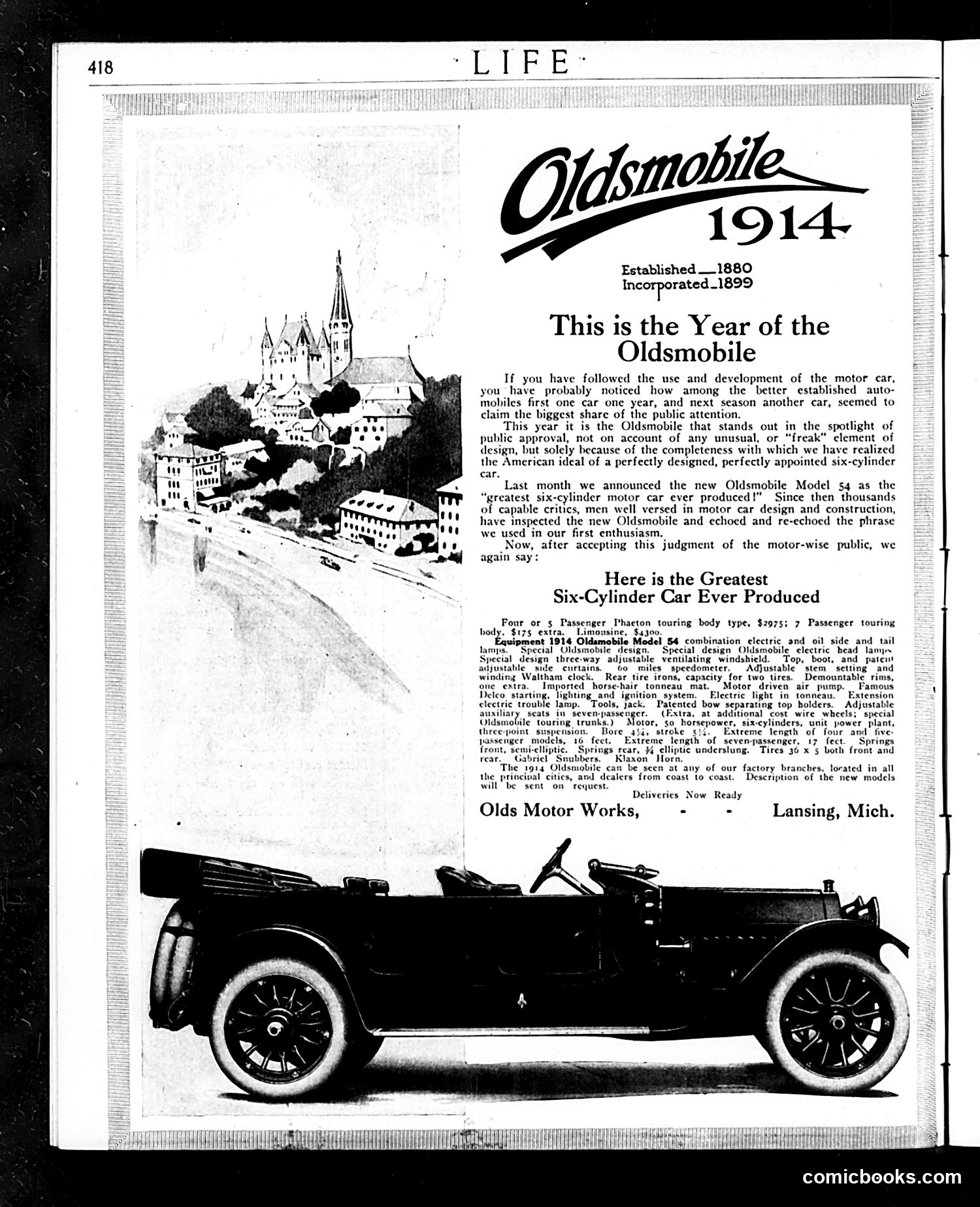
This page is **primarily a product advertisement**, not political satire. It's a 1914 Oldsmobile automobile advertisement from *Life* magazine. The ad claims 1914 is "the Year of the Oldsmobile" and promotes their new Model 54 six-cylinder car as "the Greatest Six-Cylinder Car Ever Produced." The advertisement includes: - A decorative illustration of a European cathedral city (upper left) - Detailed technical specifications of the vehicle - A photograph of the actual Model 54 touring car (center-bottom) - Information that the Olds Motor Works was located in Lansing, Michigan There is **no political cartoon or satire** on this page. It's straightforward commercial advertising typical of early 20th-century automotive marketing.
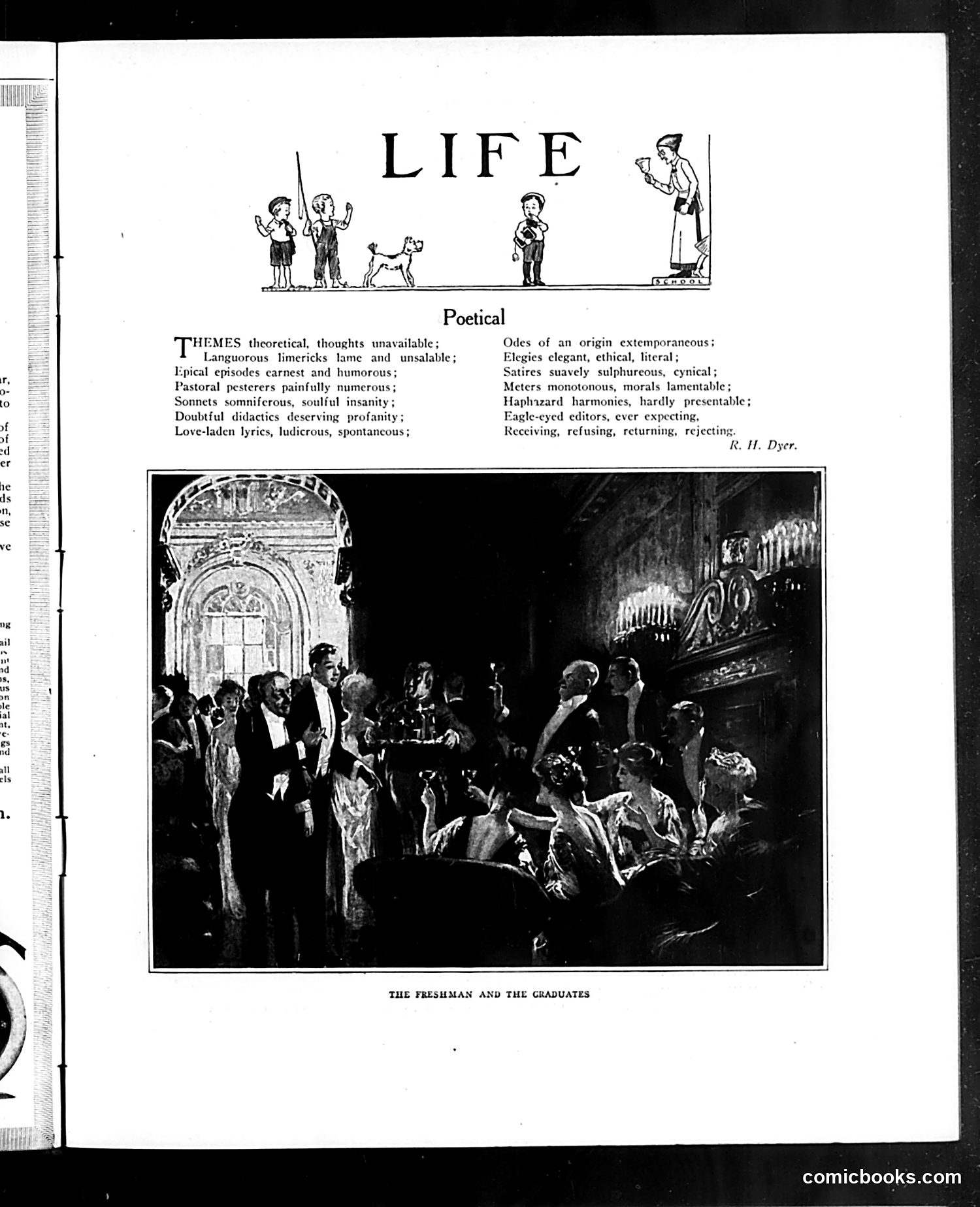
This page from *Life* magazine presents a "Poetical" section with verse definitions of literary themes—describing sonnets as "somniferous," love-laden lyrics as "ludicrous"—written by R.H. Dyer. The definitions are deliberately unflattering and cynical about poetic conventions. The illustration below, titled "The Freshman and the Graduates," depicts an indoor social gathering with formally dressed men and women in what appears to be an elegant venue with an organ visible. The scene suggests a college or university social event. The juxtaposition of the poetic definitions above—mocking literary pretense—with this image of social aspiration likely satirizes the artificiality and pretension of academic or collegiate social life, where formality masks genuine feeling.
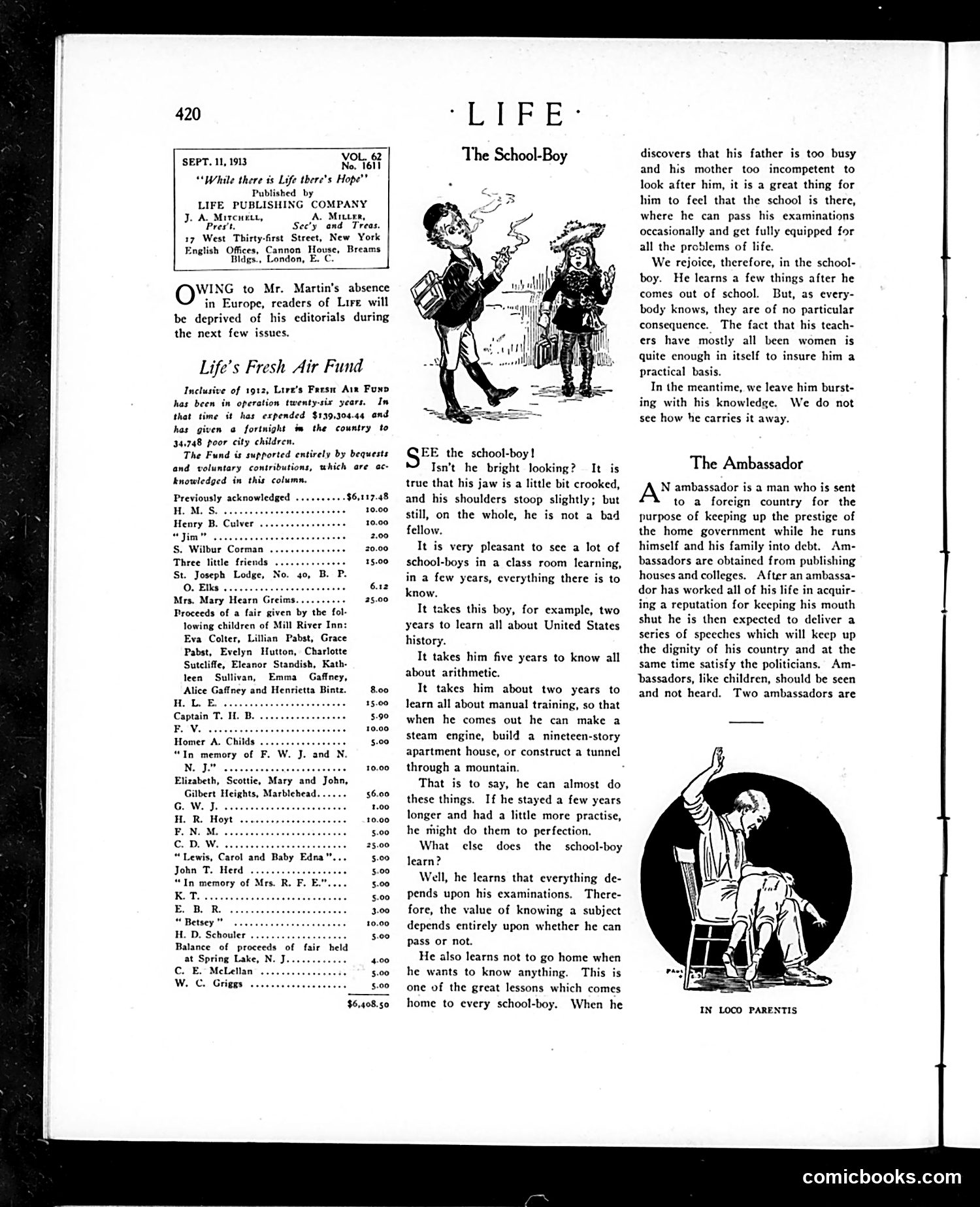
This page contains two distinct sections: **"The School-Boy"** (left): A satirical article with accompanying illustration showing a boy and girl. The text humorously catalogs what school-boys actually learn—examining their crooked jaws and stooped shoulders, then ironically praising schools for equipping students "for all the problems of life." The satire mocks the gap between education's promises and its practical outcomes. **"The Ambassador"** (right): A brief article with an illustration labeled "IN LOCO PARENTIS" showing a figure gesturing dramatically. The piece satirizes ambassadors as men sent abroad to maintain national prestige while their families go into debt—suggesting ambassadorships are performative positions requiring appearance over substance. Both pieces exemplify *Life*'s characteristic early-20th-century satirical commentary on institutions and social pretense.
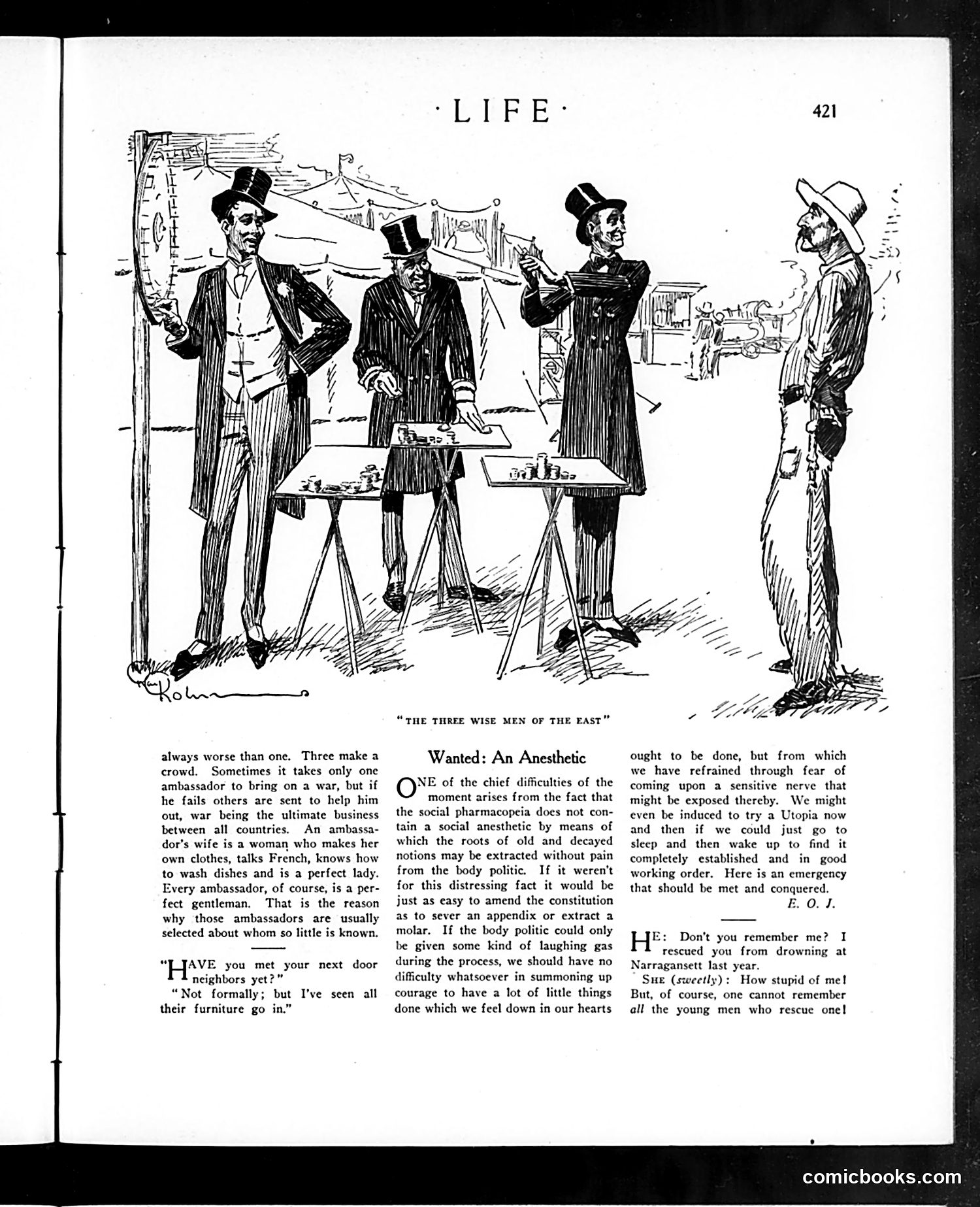
The main cartoon, titled "The Three Wise Men of the East," depicts four men in formal attire at what appears to be a harbor or dock setting, examining what looks like maps or plans on tables. The accompanying text discusses an "Anesthetic" solution to social and political problems—specifically proposing a laughing gas to make difficult reforms (like constitutional amendments or tooth extractions) more palatable to the public. The satirical point appears to be critiquing how citizens resist necessary but painful social changes, and suggesting that if government could anesthetize the population to these difficulties, reform would proceed smoothly. The smaller dialogue exchanges are generic social humor unrelated to the main cartoon's political commentary.
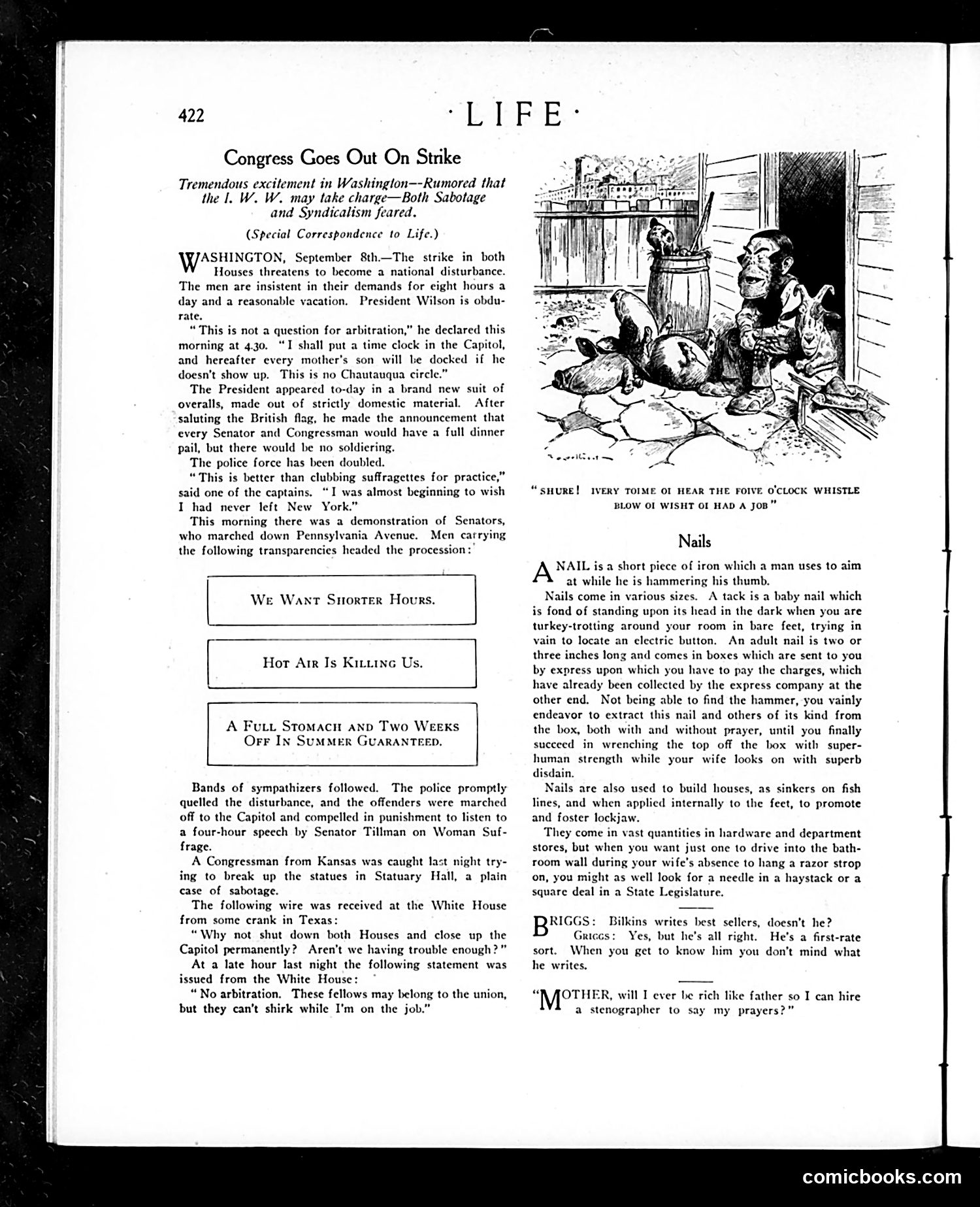
This Life magazine page satirizes a 1919 Congressional strike over working conditions. The headline reports that both Houses threatened a "national disturbance" when workers demanded eight-hour days and reasonable vacation time. The cartoon (captioned "Shure! Ivery toime of hear the foive o'clock whistle blow of wisht id had a job") depicts working-class figures, likely Irish immigrants (suggested by the dialect), envying those with employment. The satire is double-edged: it mocks Congressional workers' strike demands while sympathizing with the unemployed masses who would welcome any job. The three protest signs—demanding shorter hours, cooler temperatures, and guaranteed summer vacations—present the strike demands as comically excessive, suggesting the privileged nature of government employment compared to ordinary laborers struggling to find work.
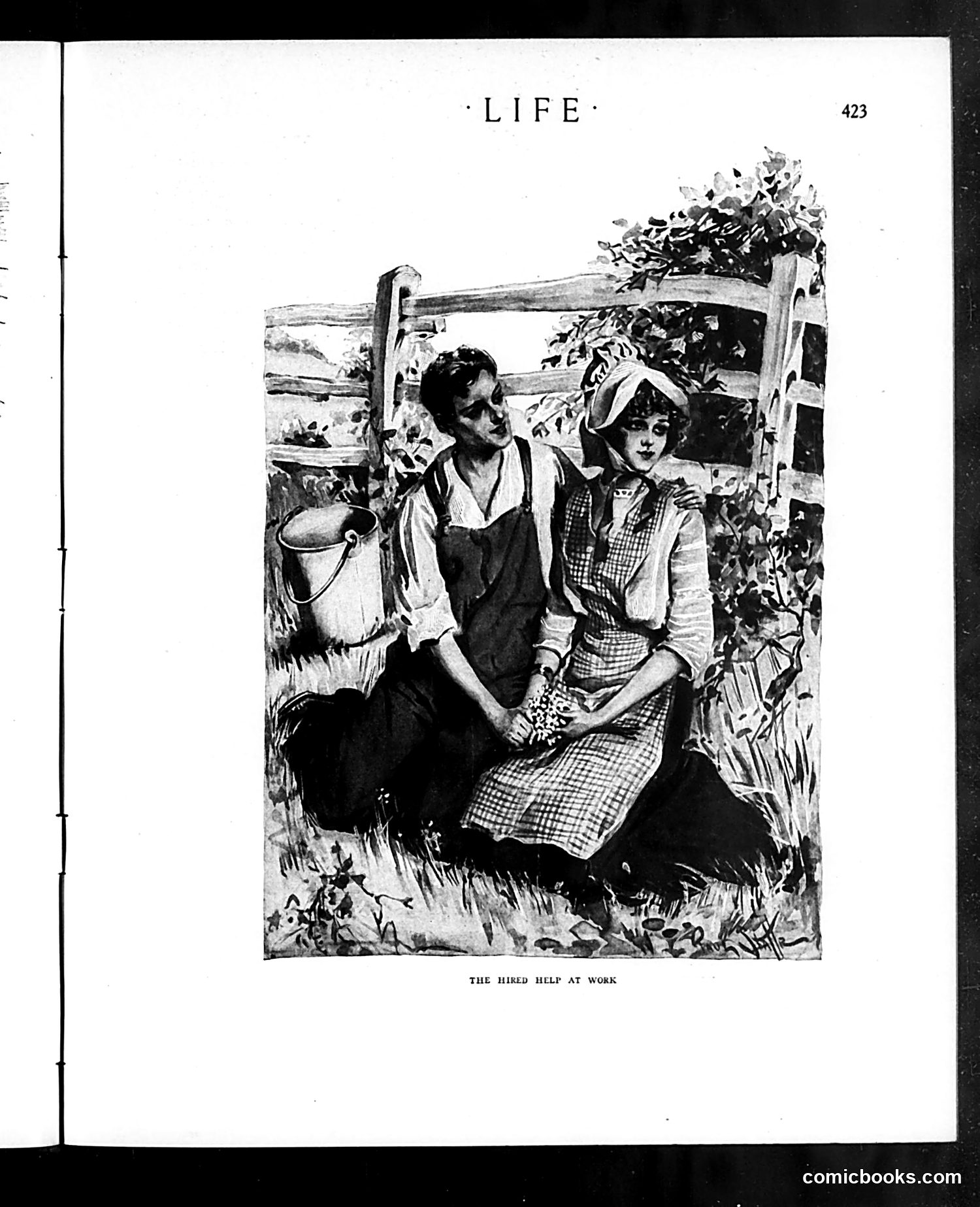
This page from *Life* magazine (page 423) features an illustration titled "THE HIRED HELP AT WORK." The image depicts a rural scene with a man and woman in a vegetable garden near a wooden gate. The woman wears a checkered dress and bonnet, while the man wears work clothes and suspenders. The illustration appears to be satirizing agricultural labor or farm work during the early 20th century. The caption "hired help" suggests commentary on domestic or farm servants. Without additional context about the specific date or accompanying article text, the exact satirical point is unclear—it may address labor conditions, rural life, class dynamics, or social attitudes toward hired workers. The naturalistic style is typical of *Life's* editorial illustrations from this era.
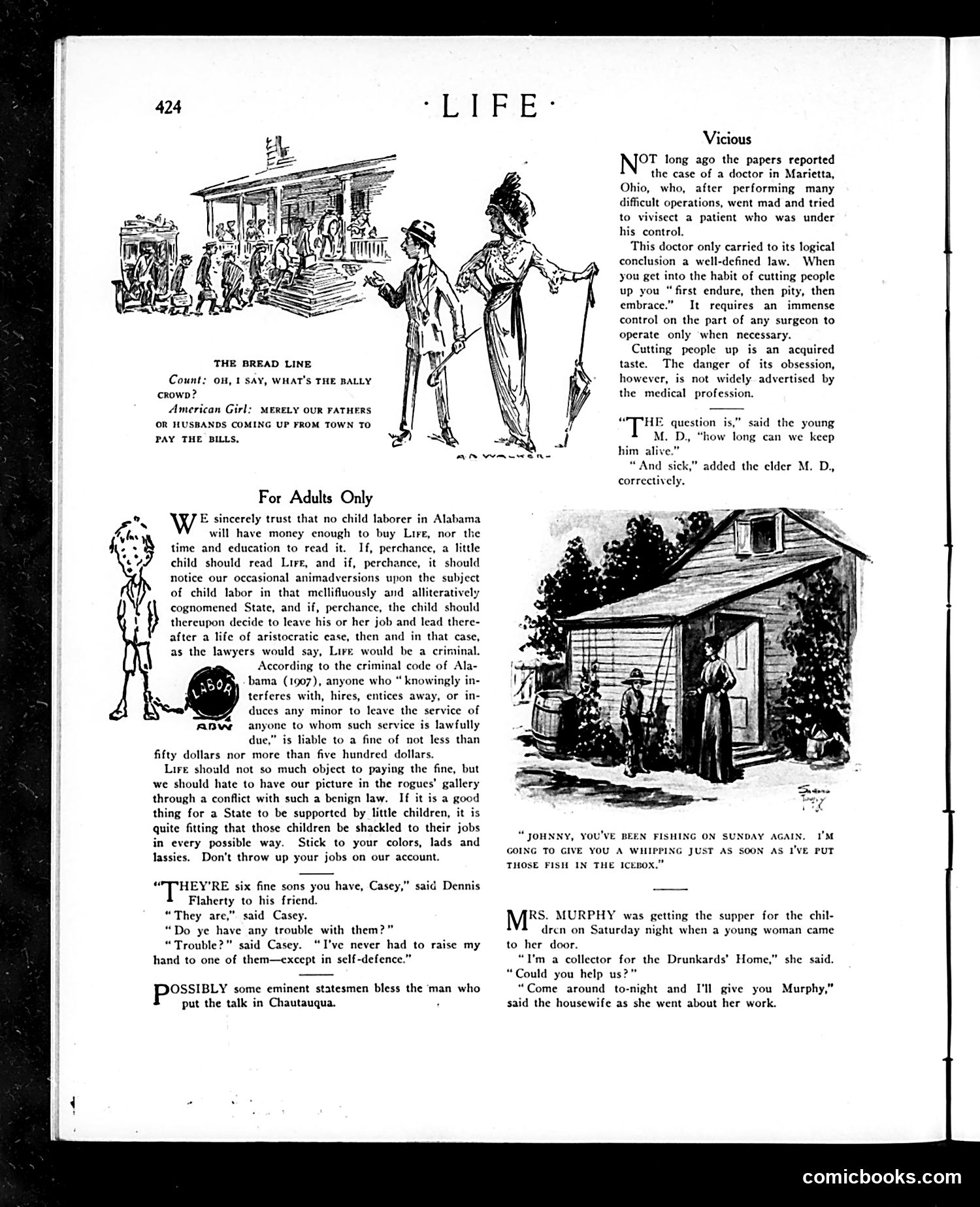
This page contains three satirical pieces on early 20th-century American society: **"The Bread Line"** mocks upper-class concerns, showing wealthy people observing a bread line (unemployed/poor seeking free food) as entertainment—captioning it as fathers and husbands "coming up from town to pay the bills." **"For Adults Only"** criticizes Alabama's child labor laws as inadequate, sarcastically suggesting children should read *Life* magazine and noting that removing child workers would be criminalized under state law (1927). The piece argues the laws protect exploitative labor practices. **Remaining sketches** depict working-class domestic scenes, including a father threatening to whip his son for fishing on Sunday, and Mrs. Murphy receiving a charity collector—illustrating poverty and moral discipline in poorer households. The overall tone critiques class disparities and inadequate labor protections.
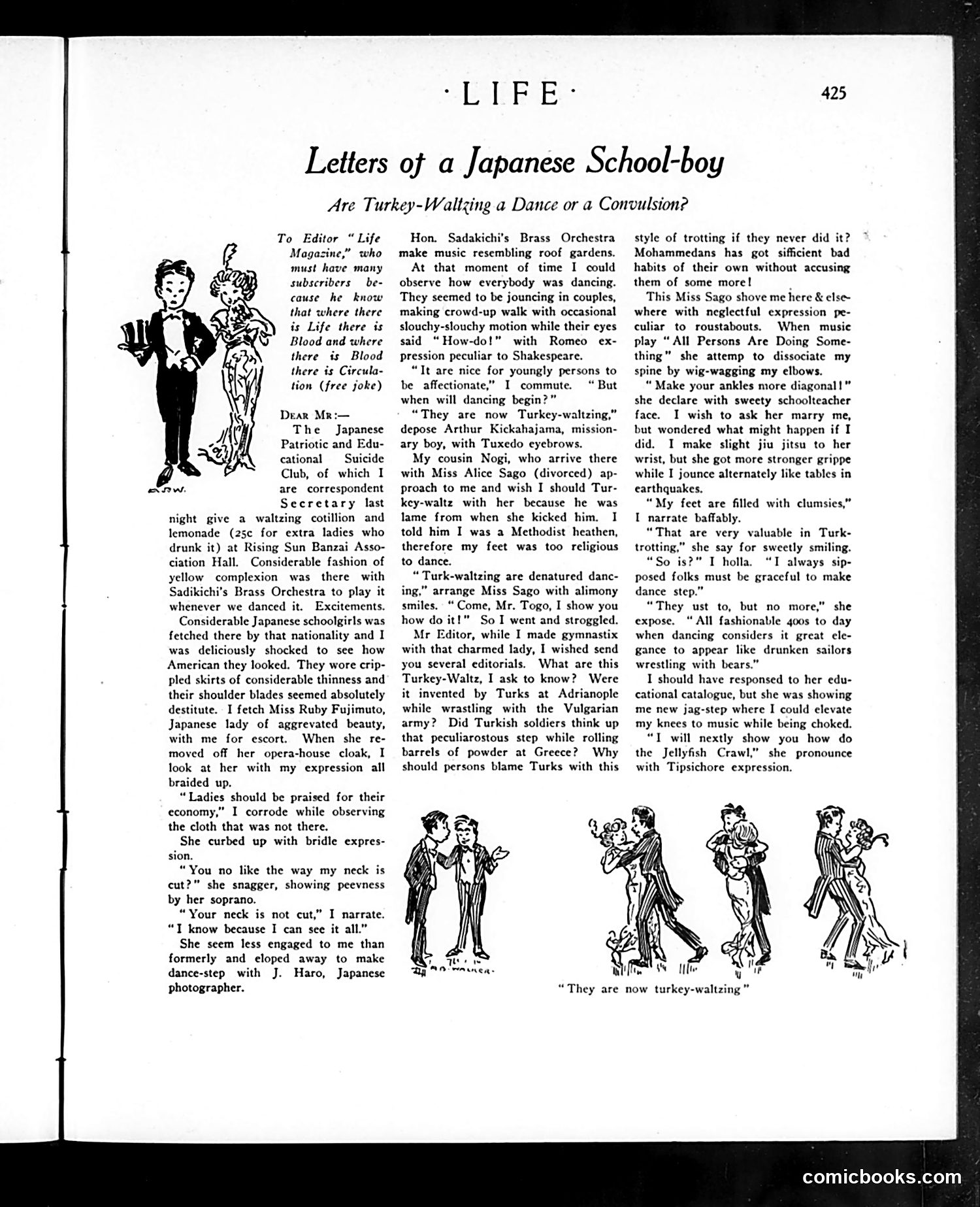
This satirical letter describes a Japanese visitor's confused observations of American social dancing. The writer attends a dance at Russell Hall where he observes couples performing the "Turkey-Trot"—a contemporary American dance craze of the 1910s characterized by jerky, strutting movements. The humor derives from the fish-out-of-water perspective: the Japanese narrator misinterprets the dance as either a "convulsion" or imitation of Turkish walking. He compares dancers' movements to animals and describes the style as undignified, contrasting it with what he considers proper decorum. The accompanying sketches show couples performing the exaggerated, jerky Turkey-Trot movements. The satire mocks both the dance's awkwardness and contemporary American customs through foreign eyes.
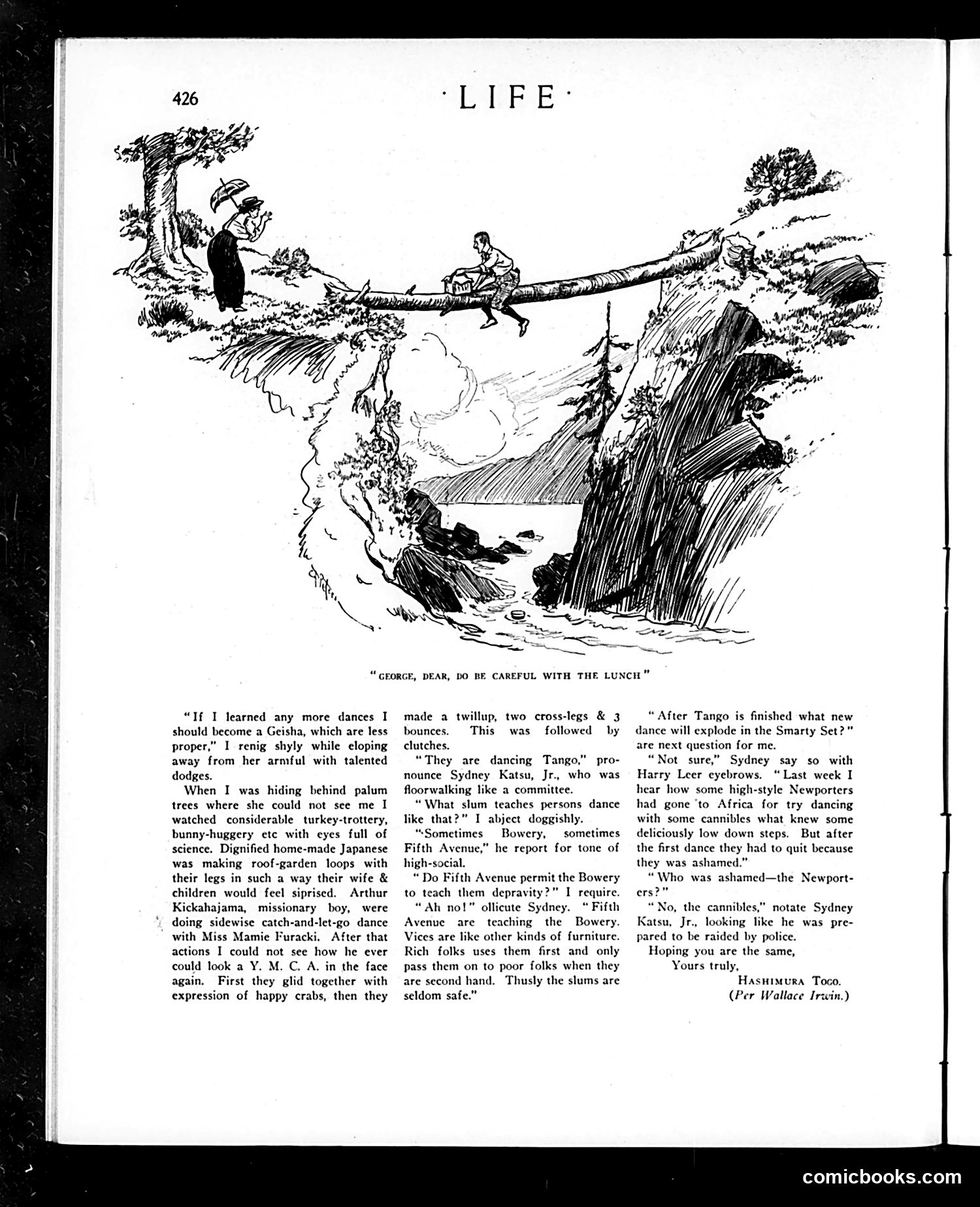
This page from *Life* magazine presents a satirical illustration and accompanying text about modern dance in 1920s America. The cartoon depicts two figures balanced on a fallen log over water, with the caption "GEORGE, DEAR, DO BE CAREFUL WITH THE LUNCH." The illustration and letter satirize the Tango and contemporary "high-society" dances becoming fashionable in places like Fifth Avenue and Newport. The correspondent describes learning various dance styles and critiques how wealthy New Yorkers adopt these dances as status symbols while dismissing them as entertainment for the poor. The satire targets class hypocrisy: the wealthy practice dances associated with working-class venues and immigrants (the Bowery, Japanese dance halls), while maintaining social superiority. The precarious log-balancing metaphor suggests the danger of these social pretensions and the absurdity of fashionable excess during this period.
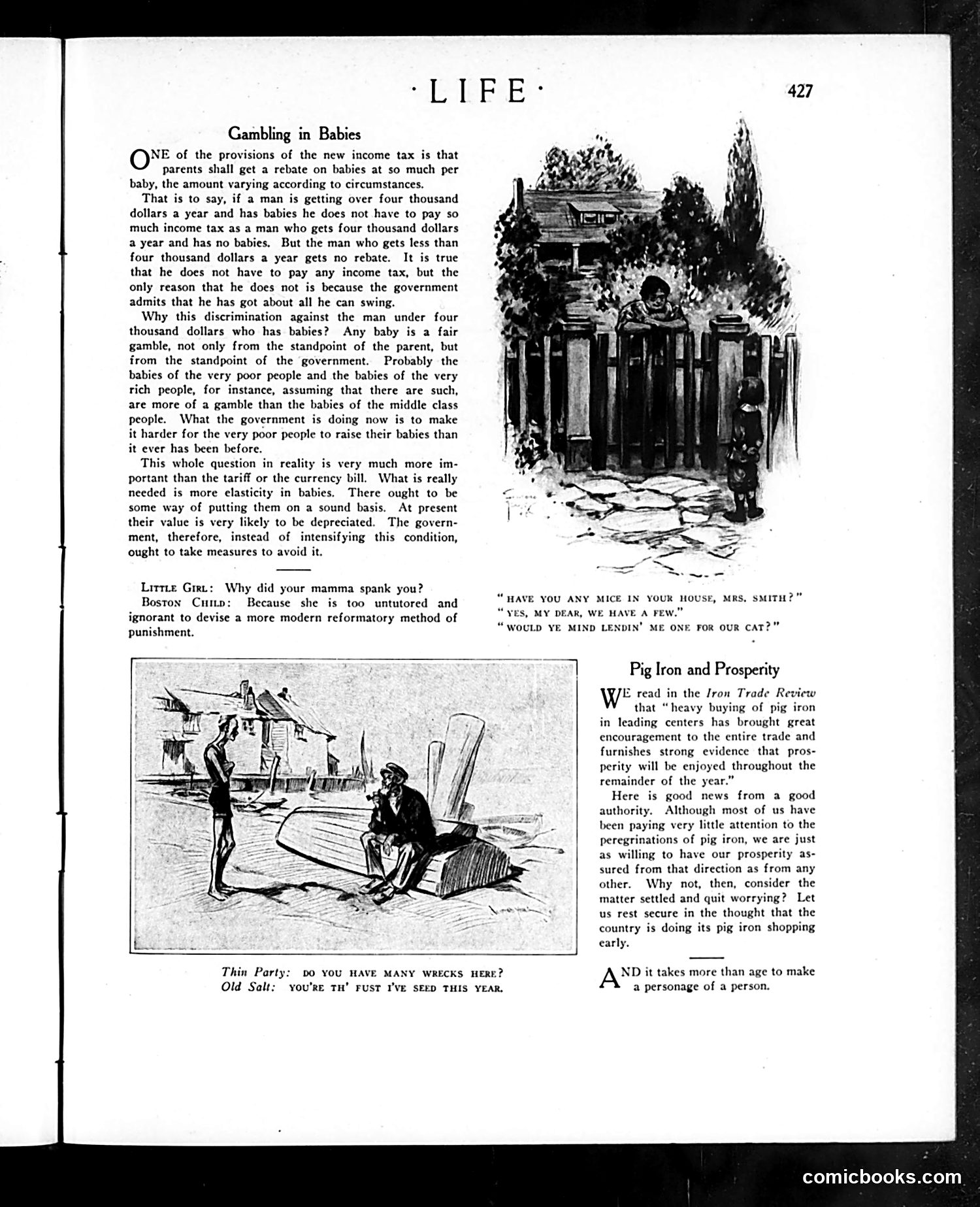
This page contains three separate satirical pieces critiquing American policy and social attitudes circa the early 1900s. **"Gambling in Babies"** attacks the newly enacted income tax's provision giving child rebates only to earners above $4,000 annually. The satire argues this penalizes poor families with children while benefiting the wealthy—calling it unfair "gambling" on babies' value. A dialog jokes that modern parents avoid spanking for progressive "reformatory methods," mocking contemporary educational trends. **The illustrated vignettes** include a seaside scene (caption about wrecks) and an exchange about borrowing a mouse for a cat, appearing to be unrelated comic sketches. **"Pig Iron and Prosperity"** sarcastically celebrates news that increased pig iron purchases signal economic recovery, mocking the absurdity of pinning national prosperity hopes on a single industrial commodity. The piece suggests Americans should simply accept reassurance from iron trade data rather than genuinely assess economic conditions. Overall, the page ridicules government taxation inequity, changing parenting philosophies, and superficial economic optimism.
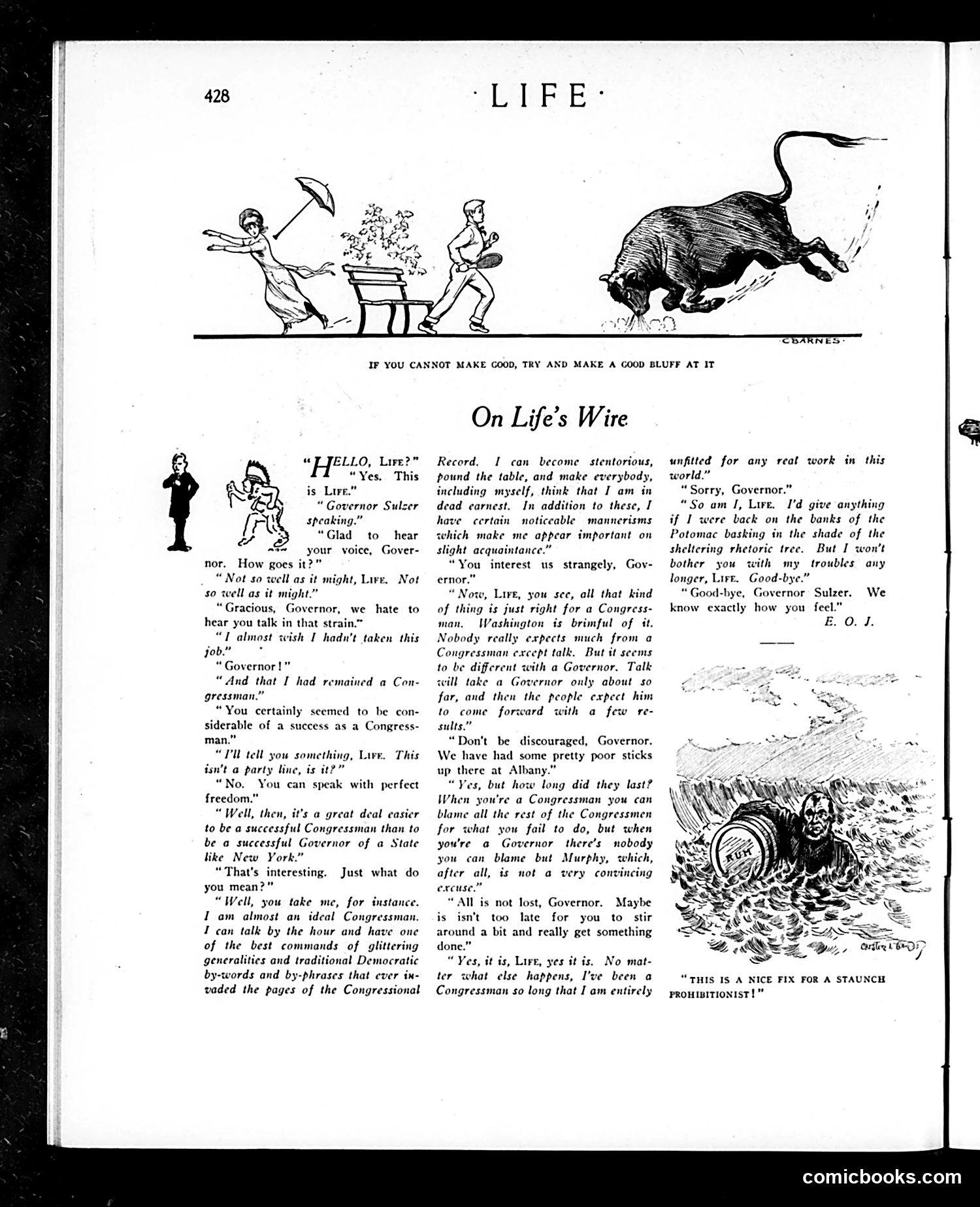
This satirical dialogue features Governor William Sulzer of New York complaining to "Life" (the magazine personified) about his job. Sulzer claims he excelled as a Congressman through eloquent bluffing and "glittering generalities"—rhetoric that works fine in Washington. However, as Governor, constituents expect *actual results*, not mere talk. He laments that he lacks real-world competence and nostalgically wishes to return to flowery speechmaking by the Potomac. The satire targets Sulzer's reputation as an all-talk politician unsuited for executive responsibility. The bottom cartoon caption ("nice fix for a staunch prohibitionist") likely references Sulzer's prohibition stance—the accompanying image suggests some compromising situation. This reflects Sulzer's actual 1913 governorship, which proved troubled and brief, ending in impeachment.
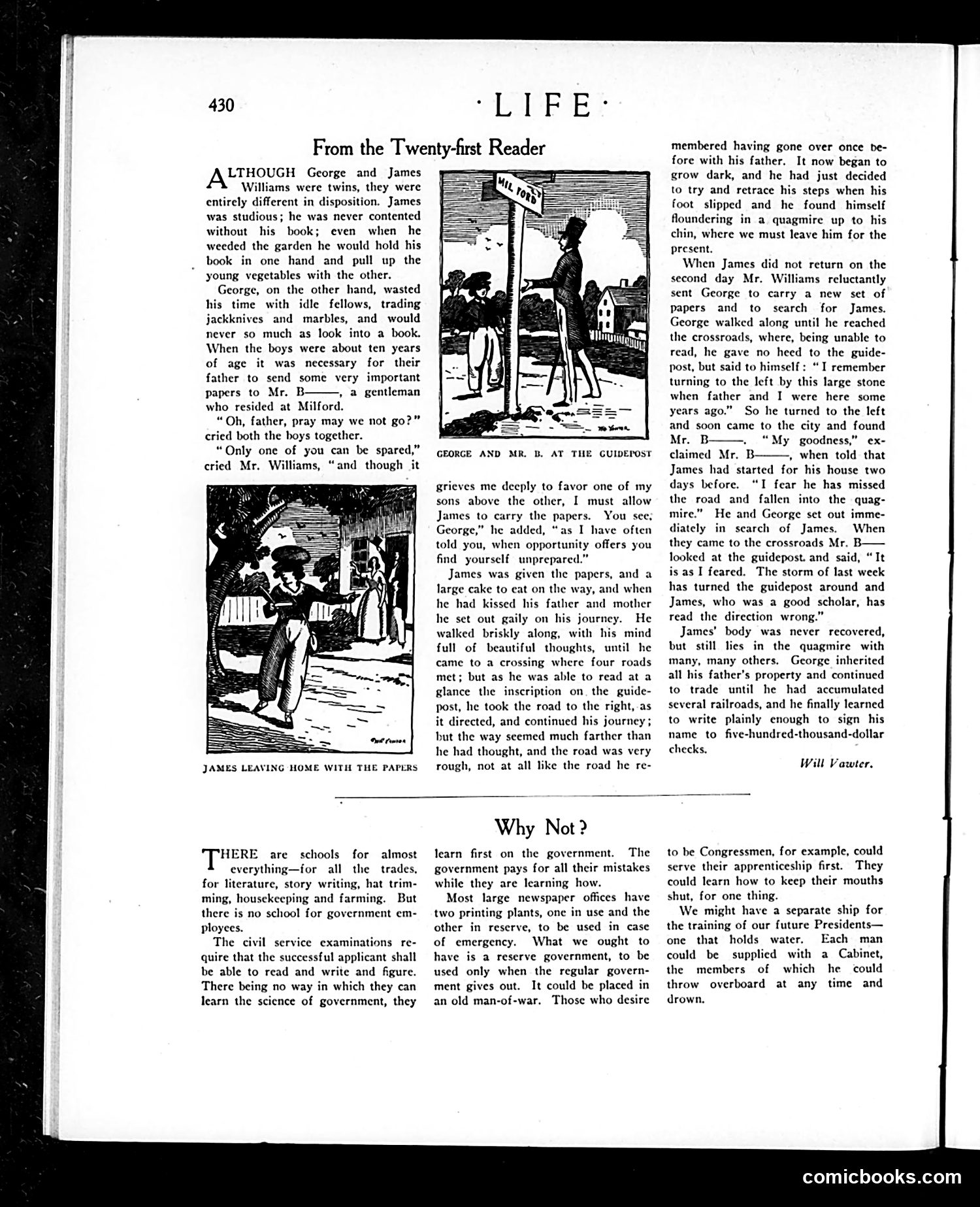
This page contains a moral fable from *Life* magazine's "Twenty-first Reader" section. The story contrasts two twin brothers: James (studious, literate) and George (idle, illiterate). **The Satire:** When James, the educated son, is sent on an important errand, he can read the guidepost at a crossroads and follows its directions—but the post has been turned around by a storm, and he falls into a quagmire and dies. George, unable to read, relies on memory instead and successfully reaches his destination. **The Point:** This is a critique of blind faith in education and reading without practical judgment. The story suggests that literacy alone doesn't guarantee success; common sense and experience matter equally. It's a Victorian-era satire mocking educational pretension—the irony being that the "studious" boy's reliance on reading kills him, while the "idle" boy survives through practical thinking. The accompanying "Why Not?" section advocates for a "reserve government" trained separately, extending this theme to institutional reform.
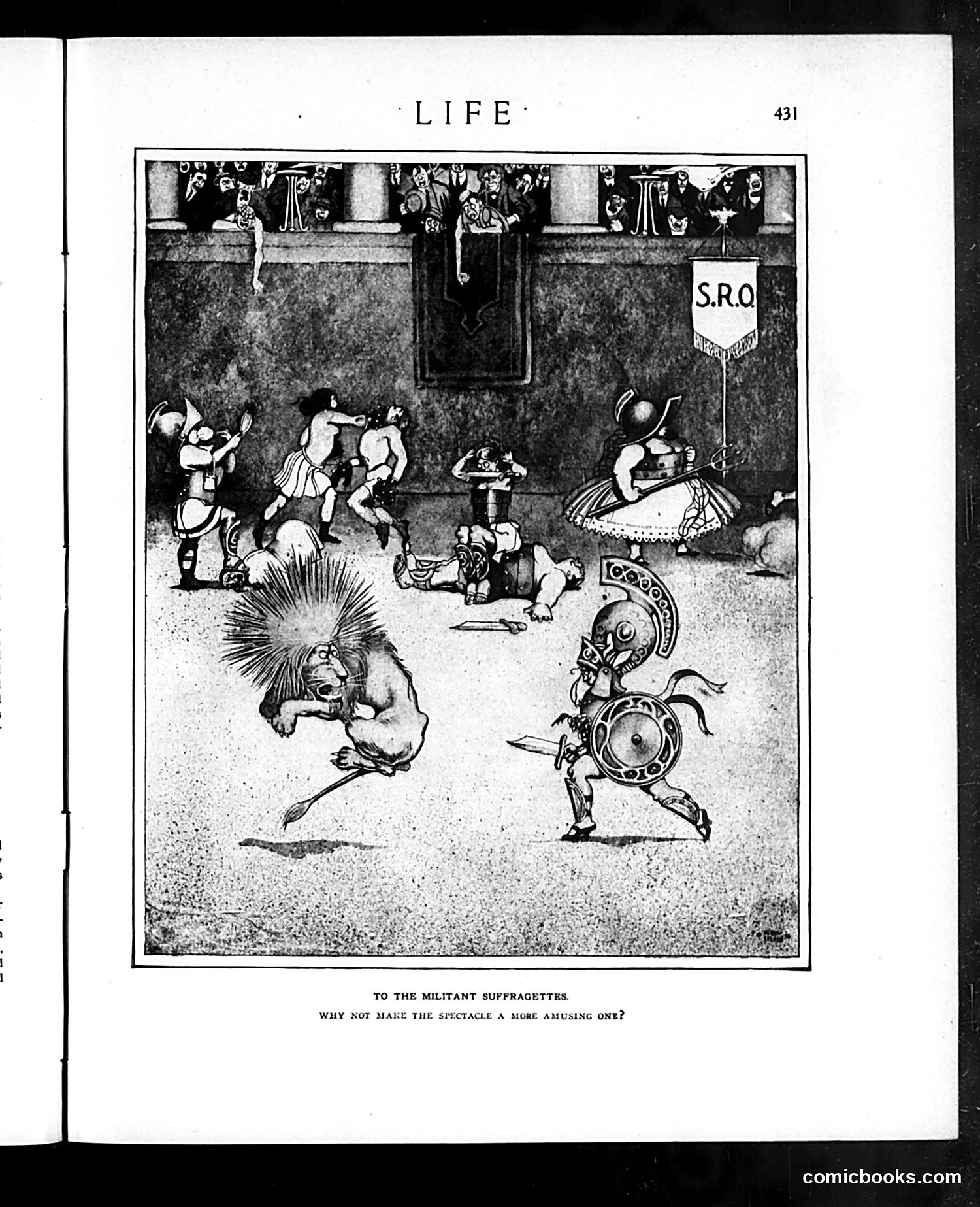
This Life magazine cartoon satirizes the British suffragette movement, specifically women fighting for voting rights. The image depicts a Roman gladiatorial arena scene where female suffragettes (shown in the stands above) watch armored female warriors battling below—one appearing lion-like, the other a gladiator with shield and spear. The caption's sarcastic suggestion—"Why not make the spectacle a more amusing one?"—mocks suffragettes by comparing their activism to violent combat. The cartoon implies their militant tactics (which included property destruction and public disruption) are barbaric entertainment rather than serious political activism. The "S.R.O." (Standing Room Only) banner suggests packed crowds, sarcastically treating suffragette protest as theatrical spectacle rather than legitimate political discourse. This represents contemporary anti-suffrage sentiment that dismissed women's voting rights advocacy as unseemly aggression.
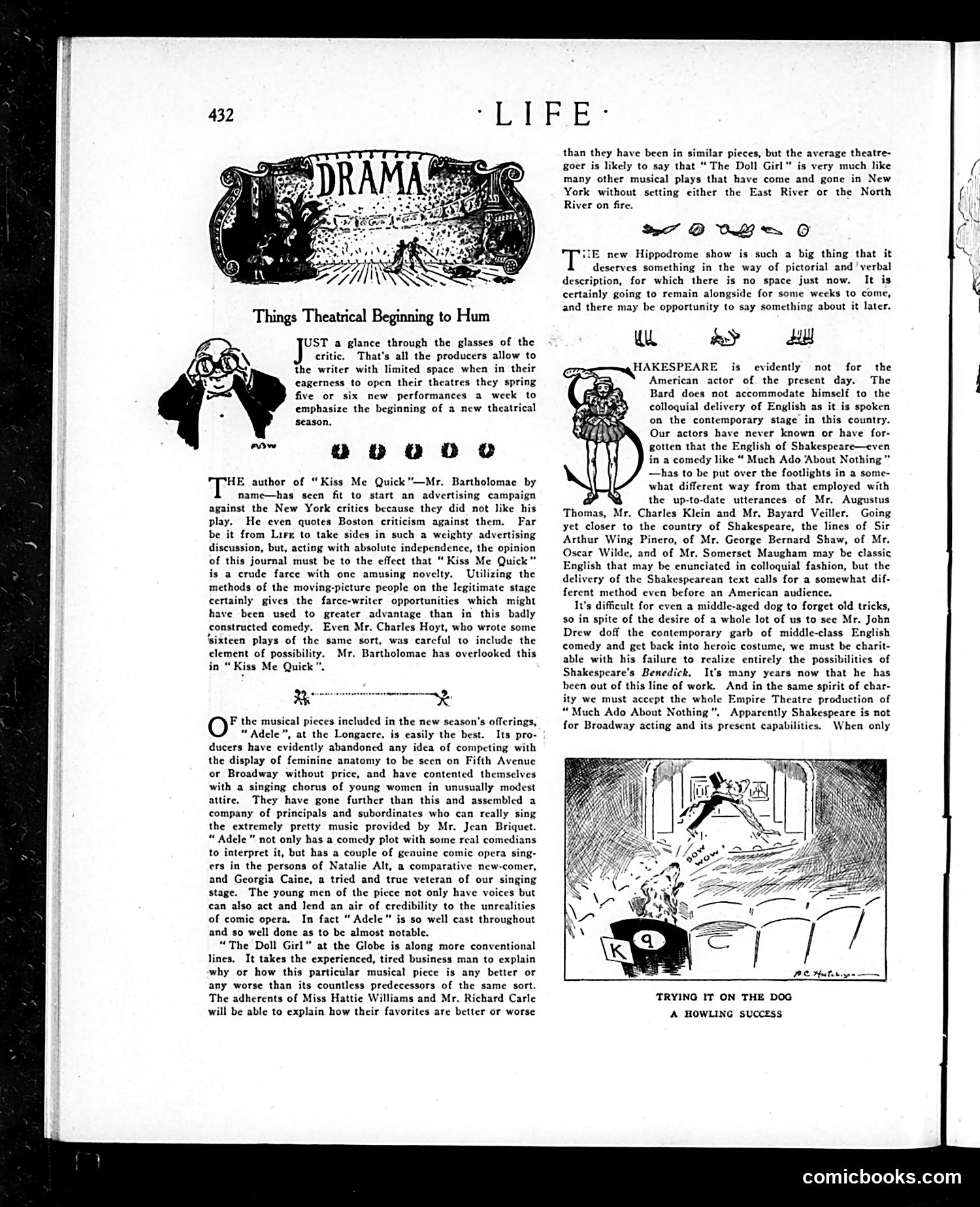
This page reviews the 1909 theatrical season's new productions. The main satire targets playwright Mr. Bartholomae, who publicly attacked New York critics for panning his play "Kiss Me Quick." Life mocks both the play (calling it a "crude farce") and Bartholomae's defensive advertising campaign, noting his attempt to invoke Boston critics as allies against New York's judgment. The reviews evaluate several musicals: "Adele" receives genuine praise for its modest chorus and actual singing talent (unusual for the era), while "The Doll Girl" is dismissed as indistinguishable from countless similar productions. The page's larger point criticizes American actors' inability to properly perform Shakespeare, arguing they've abandoned the formal vocal delivery the text requires, imposing instead contemporary colloquial speech patterns unsuited to the material. The cartoon "Trying It On the Dog" (bottom) illustrates theatrical rehearsal/tryout practices.
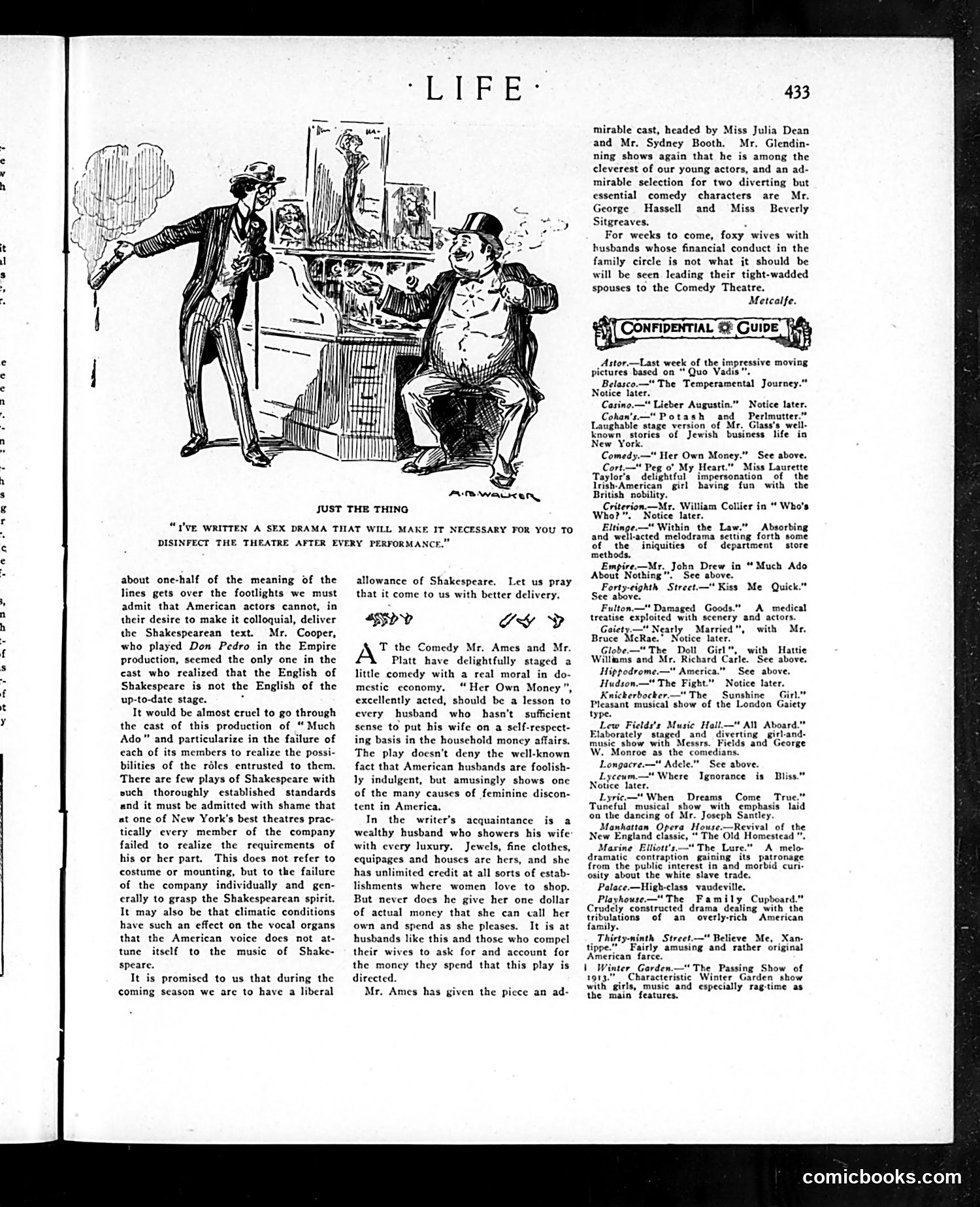
The cartoon titled "Just the Thing" satirizes a playwright's boastful claim that his sexually explicit "sex drama" is so scandalous it requires theater disinfection after each performance. The two figures appear to be a self-aggrandizing dramatist (left, gesturing theatrically) and a skeptical listener (right, seated). The joke mocks the pretension of writers who equate obscenity with artistic merit. The accompanying text critiques American actors' poor delivery of Shakespeare and reviews contemporary comedies, particularly "Her Own Money"—a domestic farce about a husband who denies his wife personal spending money, illustrating marital financial control as a source of feminine discontent. The page reflects early 20th-century theatrical culture and emerging debates about women's economic independence within marriage, treating both high art (Shakespeare) and popular comedy as worthy of serious critical discussion.
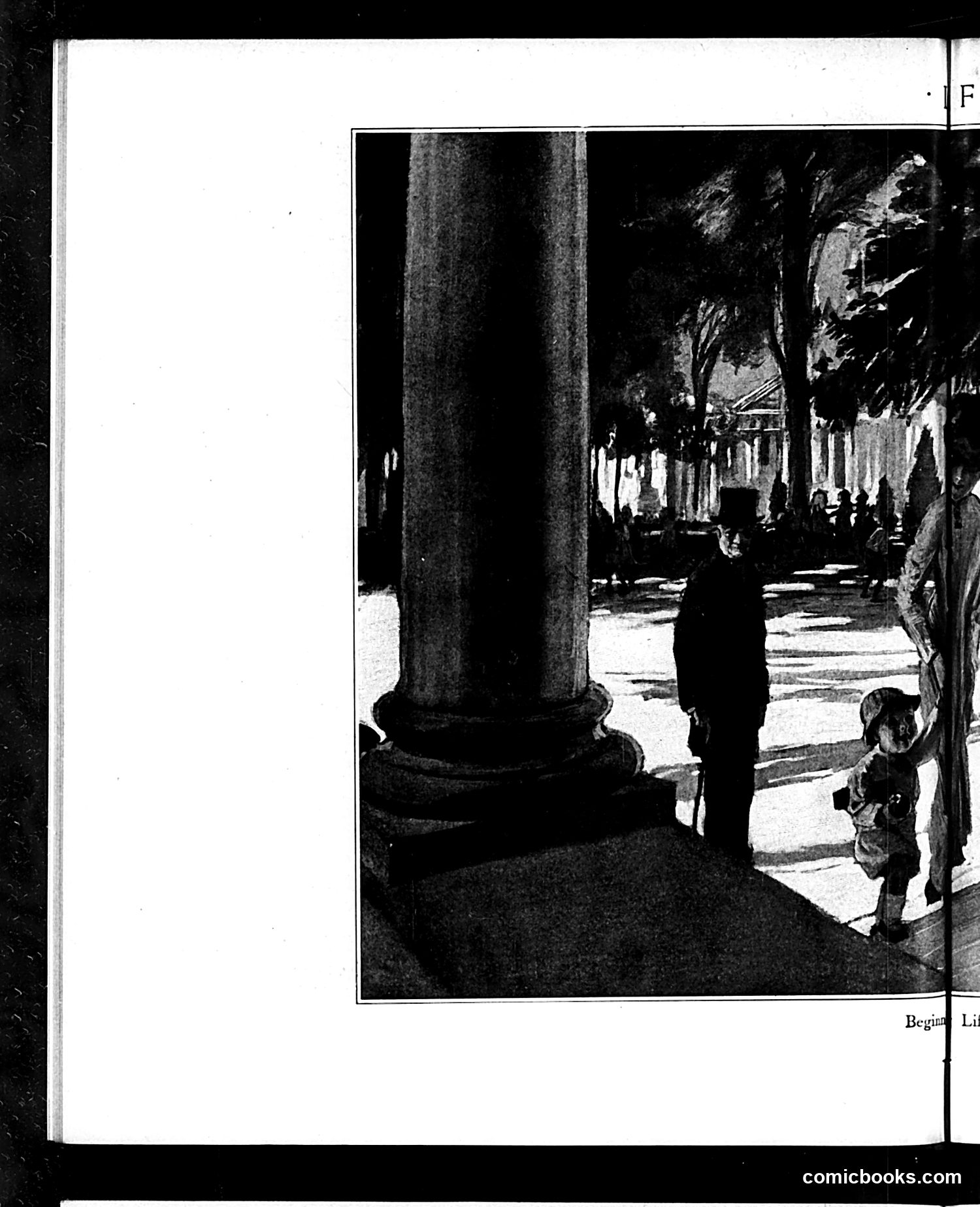
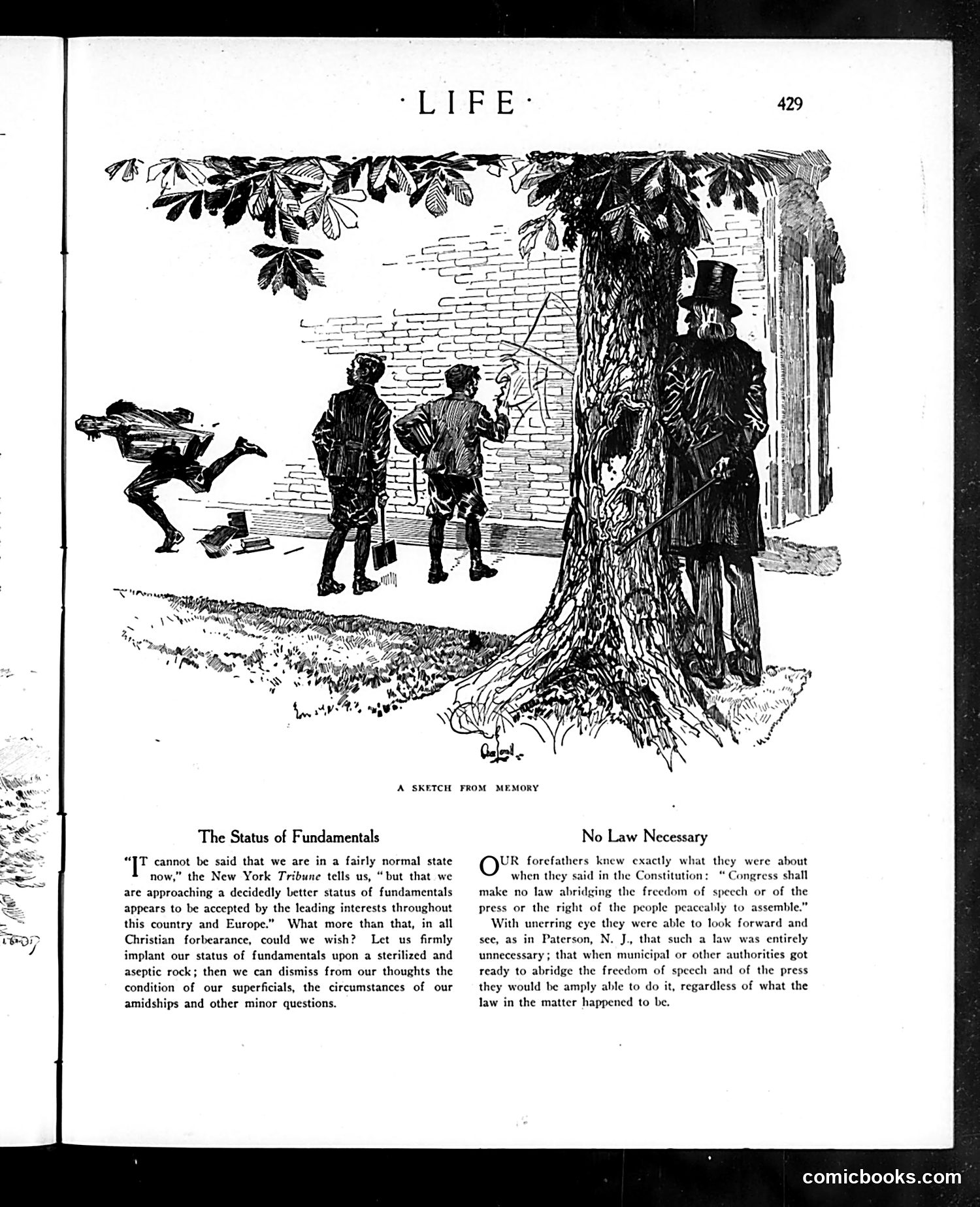
This appears to be a page from Life magazine featuring a black and white photograph rather than a cartoon. The image shows a colonial or classical-style covered walkway with large columns, where a few figures (including what appears to be a child) stand in shadow while sunlit areas and crowds are visible in the background. Without clearer text visible on the page beyond the "comicbooks.com" watermark at the bottom, I cannot definitively identify the specific satirical content, political references, or intended joke. The architectural setting and composition suggest it may be documenting a public space or event, but the satirical point—if one exists—is not evident from the image alone. Additional context would be needed for accurate interpretation.
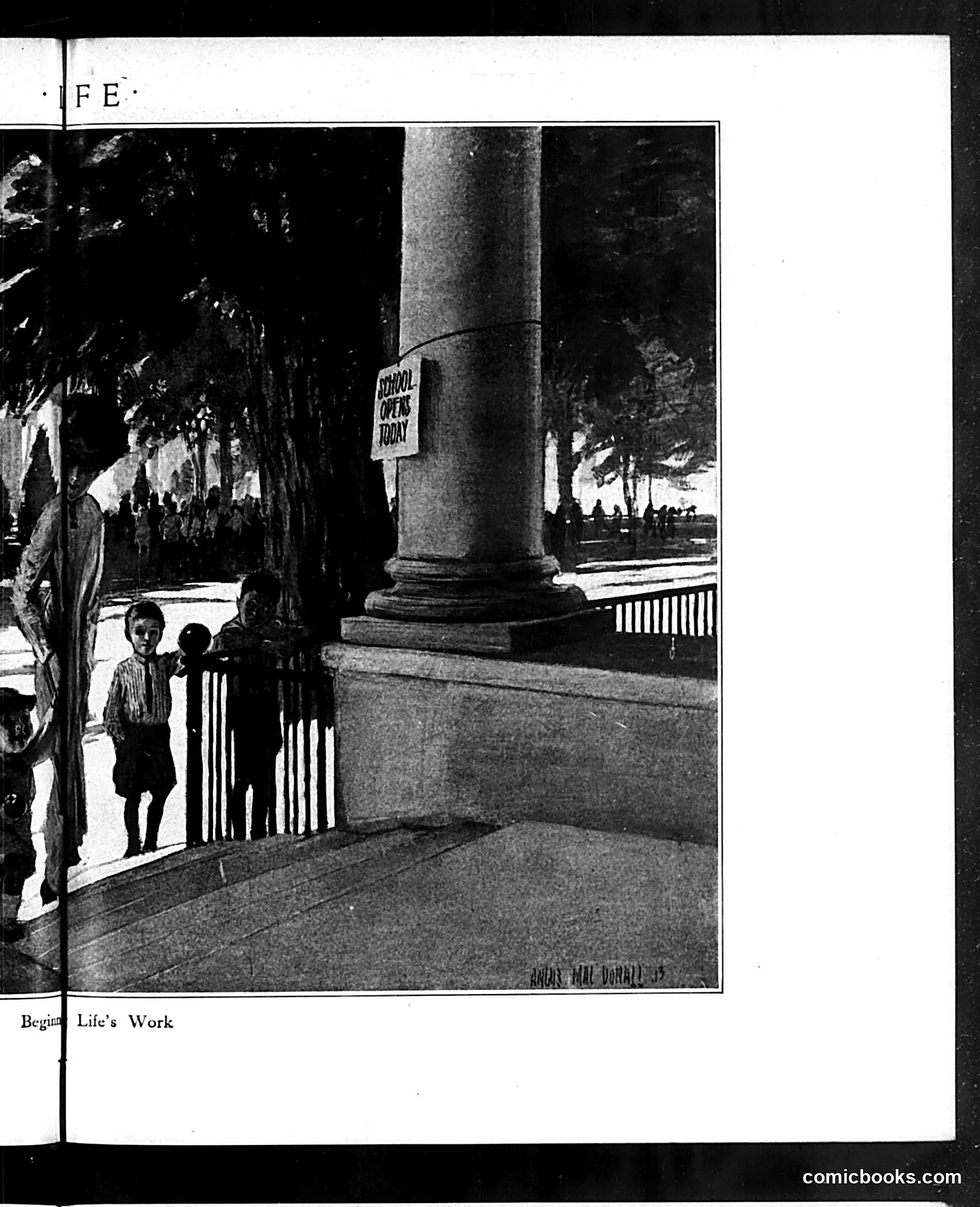
This appears to be a page caption titled "Begin Life's Work" from *Life* magazine. The black-and-white photograph shows a large classical column with a sign reading "SCHOOL OPENS TODAY" attached to it. In the foreground, a few children stand near a fence, looking toward the column and the school building visible in the distance. The satire likely comments on the scale of institutional education or bureaucratic authority—represented by the imposing architectural column—dwarfing individual students beginning their schooling. The composition emphasizes how young students appear small and almost insignificant against the monumental structure of the educational system they're entering. Without additional context or a visible date, the specific historical moment referenced remains unclear.
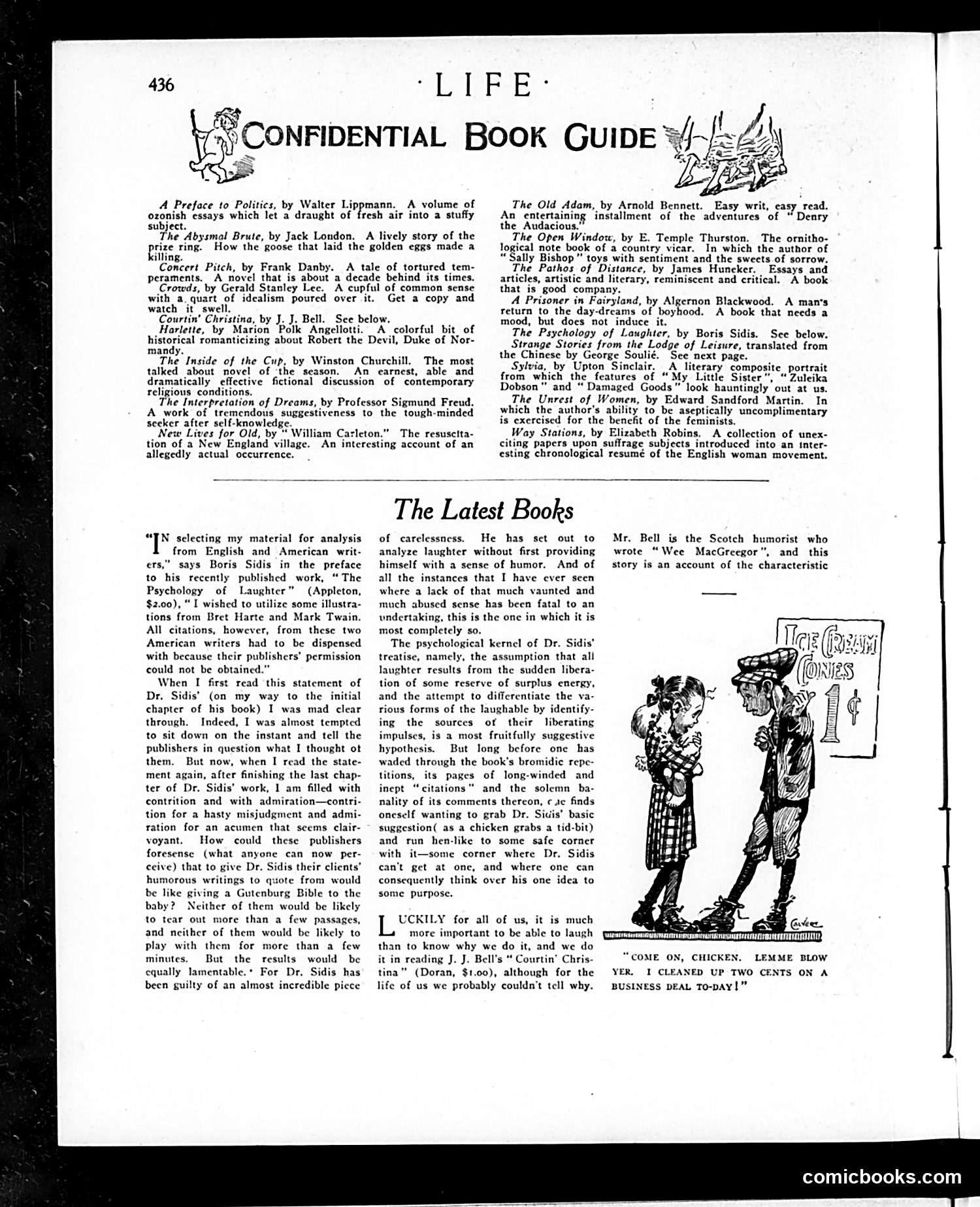
This page features book reviews and a cartoon satirizing publishers' gatekeeping. The main text critiques psychologist Boris Sidis's book *The Psychology of Laughter*, which he claims couldn't include Mark Twain and Bret Harte quotes because publishers refused permission. The reviewer sarcastically praises the publishers' "foresight," suggesting Sidis would have ruined these classic humorists' work—comparing giving him their material to "giving a Gutenberg Bible to the baby." The implication: Sidis's own attempts at humor are so pedestrian or clumsy that his analysis would embarrass superior writers. The accompanying cartoon (right) shows two figures in period dress with the caption "Come on, chicken. Lemme blow yer. I cleaned up two cents on a business deal to-day!" This appears to mock either materialism or crude social climbing. The page is primarily a **book guide** listing contemporary publications, functioning as advertising/literary criticism rather than political satire.
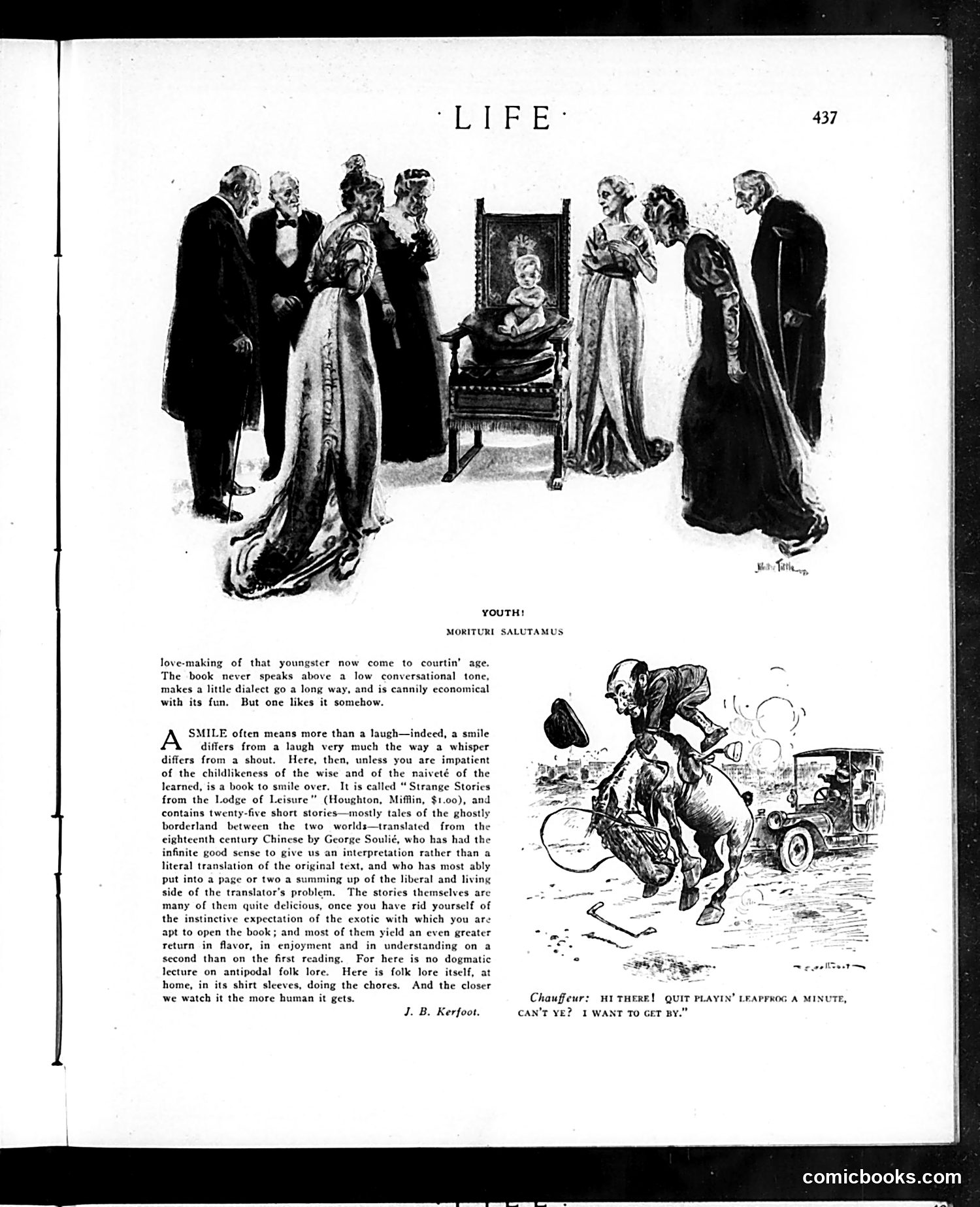
**Top Illustration ("Youth! Morituri Salutamus"):** A formal Victorian-era scene depicting a young woman being presented to society—likely a debutante ball or courtship ritual. The title's Latin phrase ("Those about to die salute you") ironically suggests the solemnity with which society treats young romance and marriage arrangements. **Bottom Cartoon ("Chauffeur"):** A slapstick humor piece showing a chauffeur frustrated with children playing leapfrog in front of his automobile, blocking his passage. The joke plays on the tension between modern motorized transportation and old-fashioned street play—a common early-20th-century satire theme as cars increasingly displaced traditional urban recreation. **Text:** A book review praising "Strange Stories from the Lodge of Leisure," translated Chinese ghost tales valued for their accessible folk wisdom rather than exotic mystique. Both items reflect *Life* magazine's characteristic blend of social observation, gentle satire about courtship/class conventions, and humor about modern inconveniences.
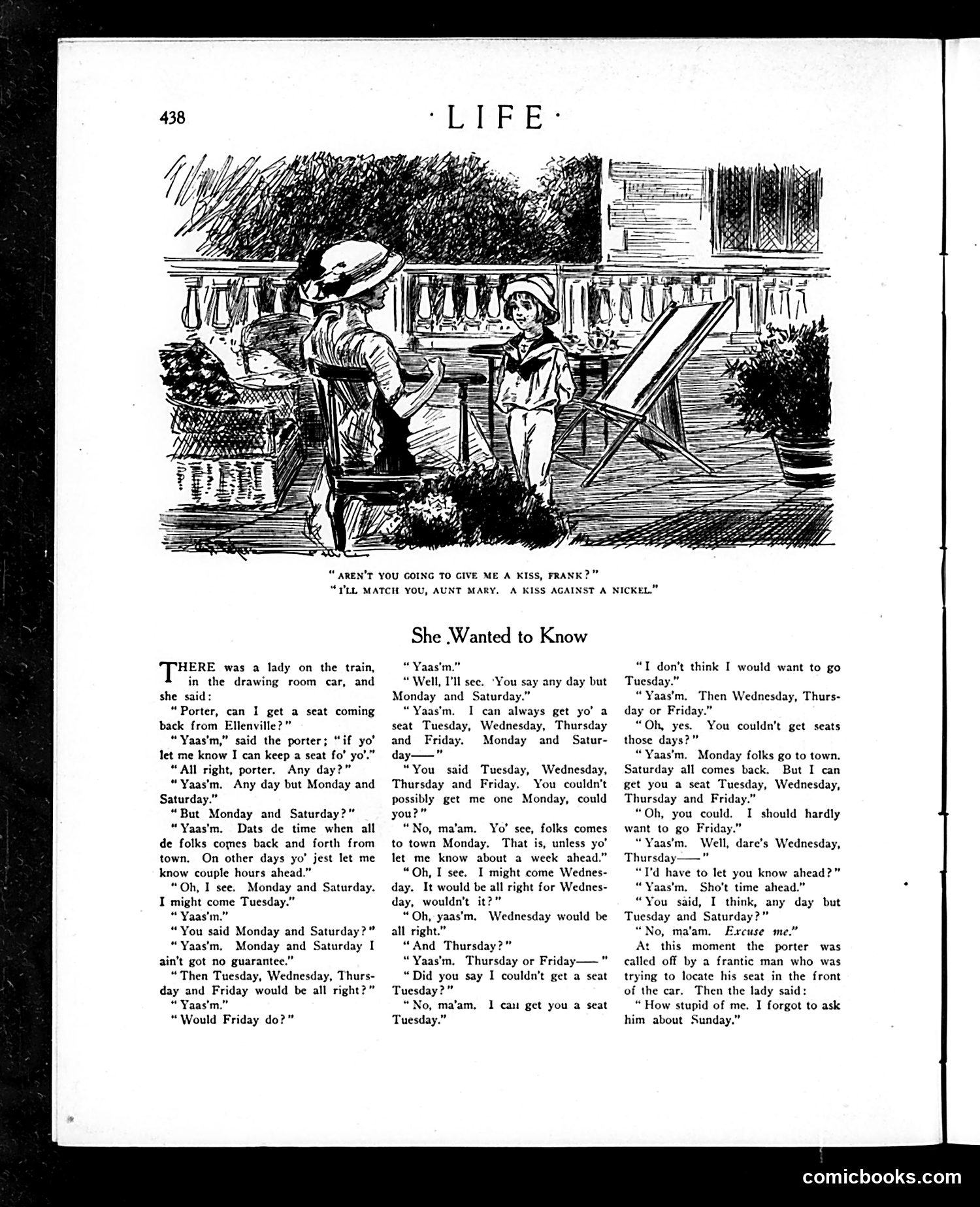
This humorous dialogue satirizes indecisive passengers and the absurdity of over-complication. A lady repeatedly questions a railroad porter about seat availability, asking about nearly every day of the week while the porter tries to explain a simple rule: seats are unavailable Monday and Saturday (when townspeople travel), but guaranteed other days. The joke lies in her circular, confused questioning—she keeps asking the same information in different ways, seemingly unable to grasp or commit to a simple answer. The porter's patient, repetitive explanations become increasingly circular as she second-guesses herself about which days she actually wants to travel. The caption cartoon above shows a flirtatious exchange ("a kiss against a nickel"), establishing the era's light-hearted, social humor typical of Life magazine's satirical content about everyday situations and human behavior.
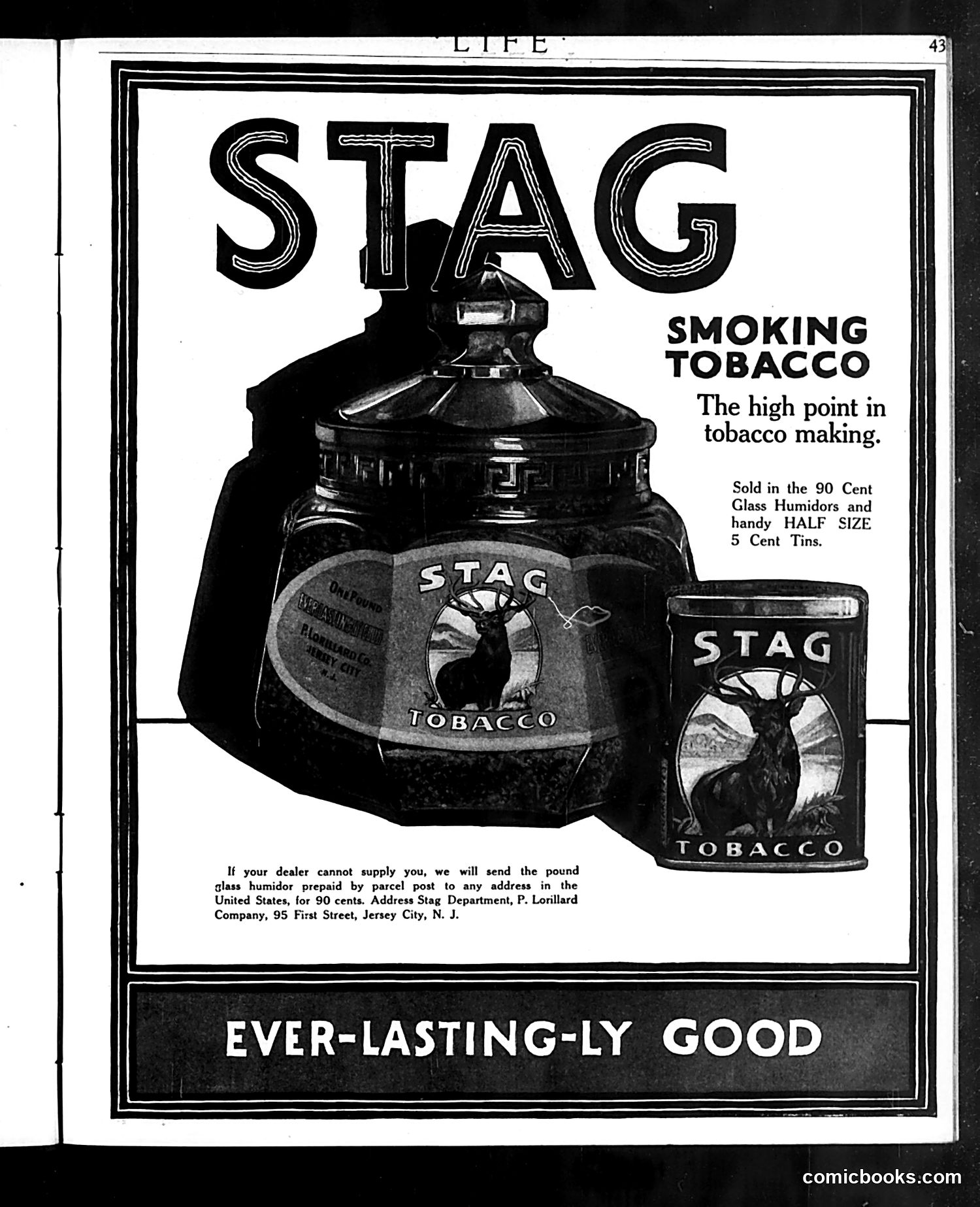
This is a **straightforward product advertisement**, not political satire. It promotes Stag brand smoking tobacco, manufactured by P. Lorillard Company of Jersey City, New Jersey. The ad emphasizes the product's quality ("The high point in tobacco making") and availability in two formats: 90-cent glass humidors and handy 5-cent tins. The imagery shows a decorative tobacco jar and tin package featuring a stag (male deer) as the brand mascot. The tagline "Ever-Lastingly Good" promises product longevity and consistent quality. The ad offers mail-order convenience: if local dealers lack stock, customers could purchase directly for 90 cents via parcel post. This represents typical early-20th-century tobacco marketing, when such products were openly advertised without health warnings in mainstream magazines.
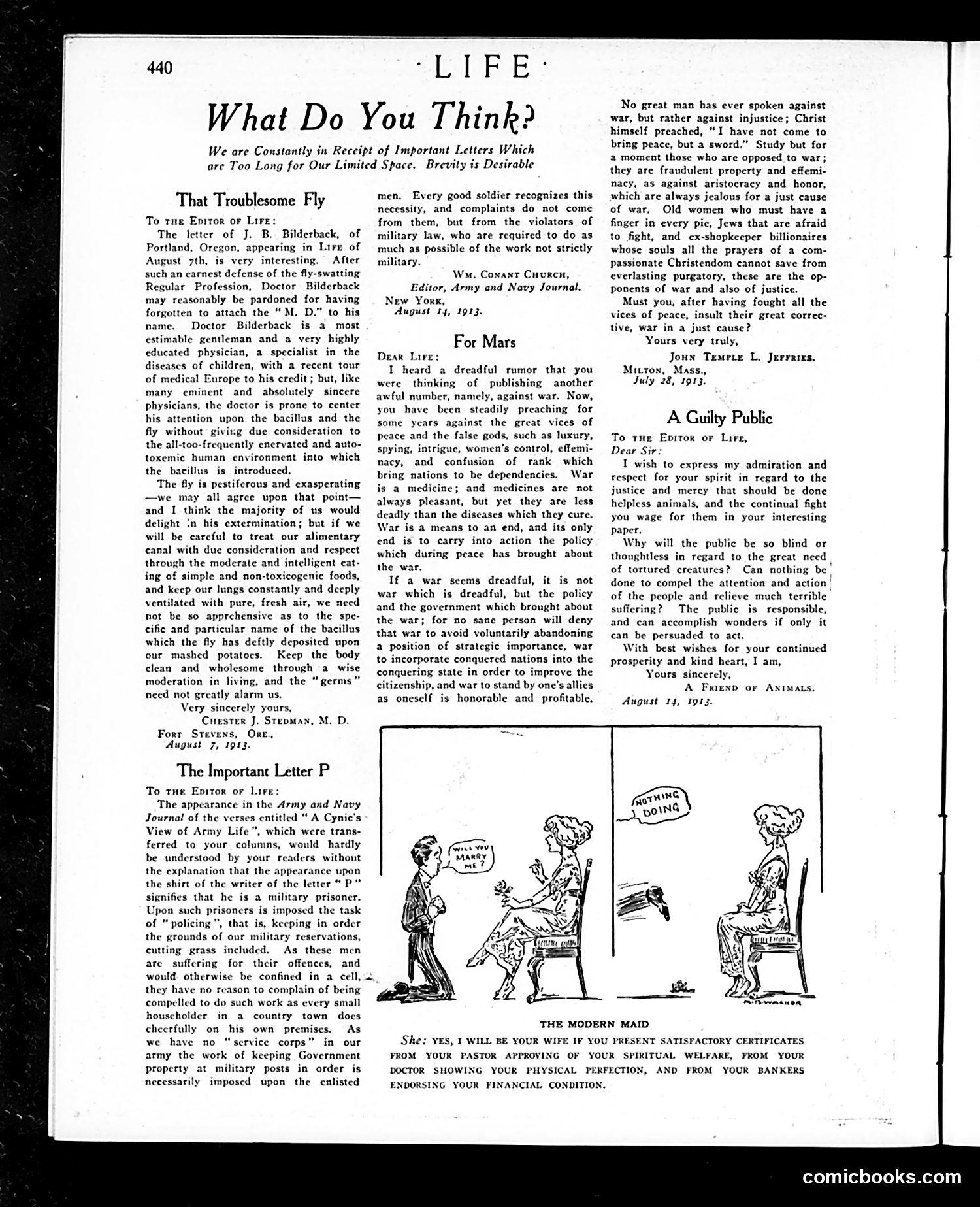
This single-panel cartoon satirizes marriage standards of 1913. It depicts a man proposing to a woman with an absurdly elaborate set of requirements—she must present certificates from her pastor approving her "spiritual welfare," a doctor verifying her "physical perfection," and her bankers endorsing her "financial condition." The joke mocks the bureaucratization and commodification of courtship: marriage has become less about love and more about verifying a woman's credentials like a business transaction. The woman's deadpan response ("NOTHING DOING") suggests the ridiculousness of treating matrimony as a transaction requiring official documentation. This reflects genuine anxieties of the era about marriage, gender roles, and modern efficiency—applying industrial-age systematization to intimate human relationships. The cartoon ridicules both excessive materialism and the absurd formalization of personal decisions.
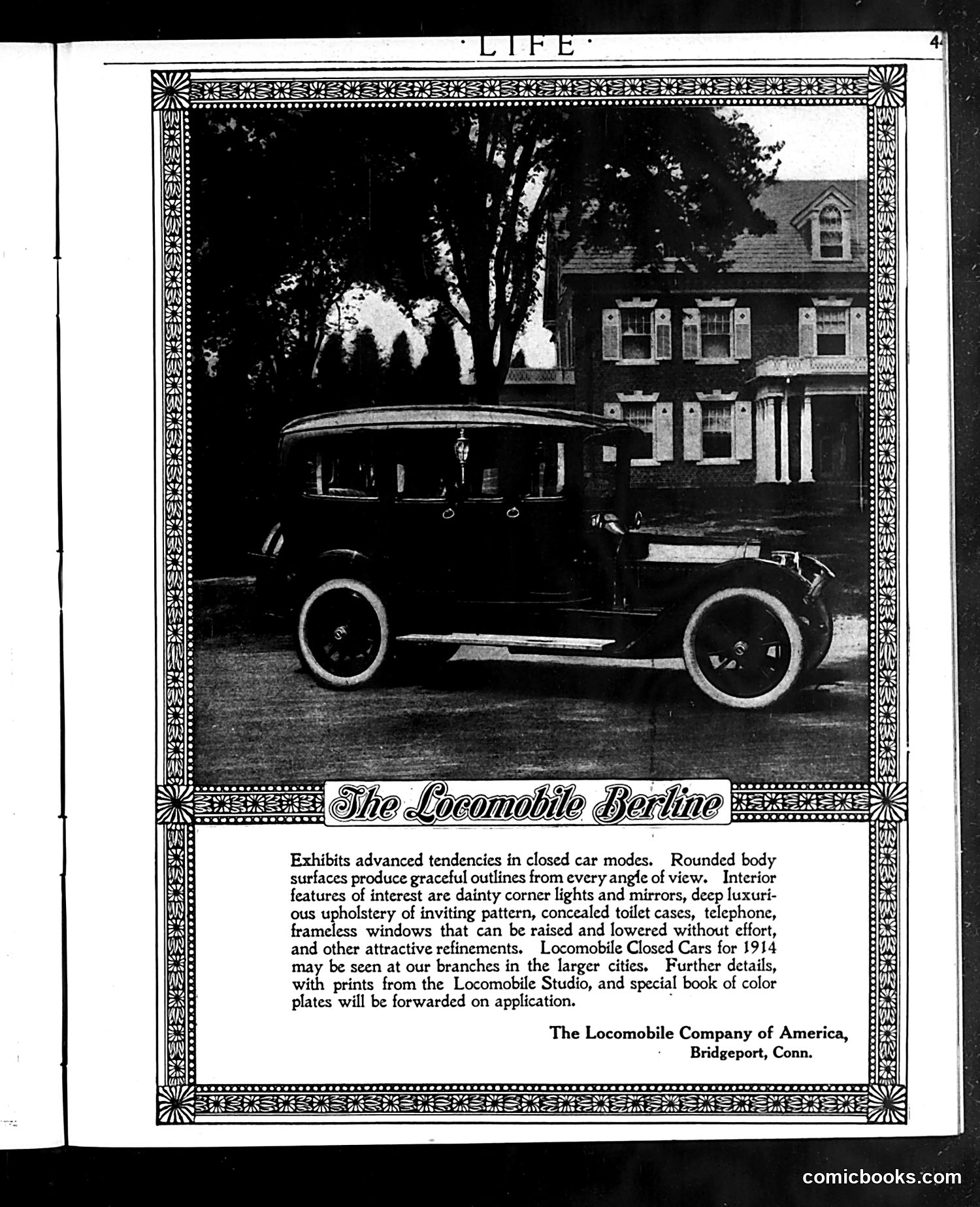
This is not satire or political commentary—it's a straightforward automobile advertisement from *Life* magazine's early 20th-century pages. The image showcases the "Locomobile Berlins," a luxury closed-car model. The text highlights features meant to appeal to wealthy buyers: rounded body design, interior refinements like corner lights, mirrors, concealed toilet cases, and telephones—luxuries that emphasized automobiles as mobile drawing rooms for the affluent. The advertisement reflects the era when closed cars (as opposed to open touring cars) were novel and prestigious. By mentioning "advanced tendencies in closed car modes," it positions the Locomobile as cutting-edge technology for the 1914 market. The inclusion of features like frameless windows and luxurious upholstery signals the vehicle targets upper-class consumers seeking comfort and status symbols during the early automobile boom.
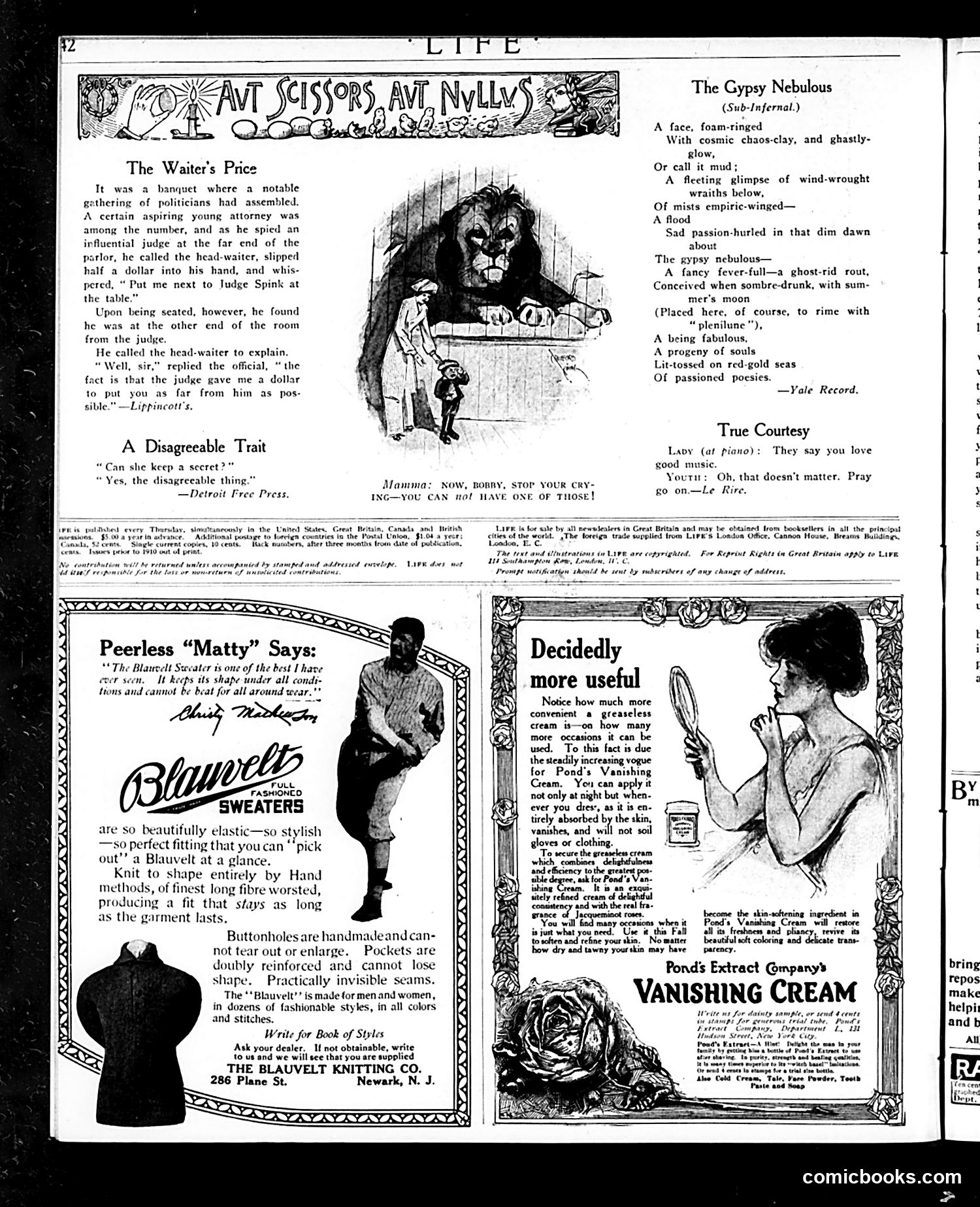
This page contains several humorous pieces mocking human nature and social pretense: **"The Waiter's Price"** satirizes political ambition and bribery. An aspiring lawyer attempts to bribe a waiter to seat him next to an influential judge, only to discover the judge paid double to keep him away. The joke exposes the transactional nature of political networking and the futility of social climbing. **"A Disagreeable Trait"** is a brief quip about women gossiping—suggesting that while a woman may keep secrets, her *disagreeable* nature means she'll spread them anyway. This reflects period gender stereotypes. The page also features period advertisements (Blauvelt Sweaters, Pond's Vanishing Cream) and lighter poetry ("The Gypsy Nebulous"), with a cartoon showing a mother denying her child candy. The overall tone is typical of Life's early-20th-century satirical approach: poking fun at social pretension, gender dynamics, and human weakness while maintaining genteel humor for educated readers.
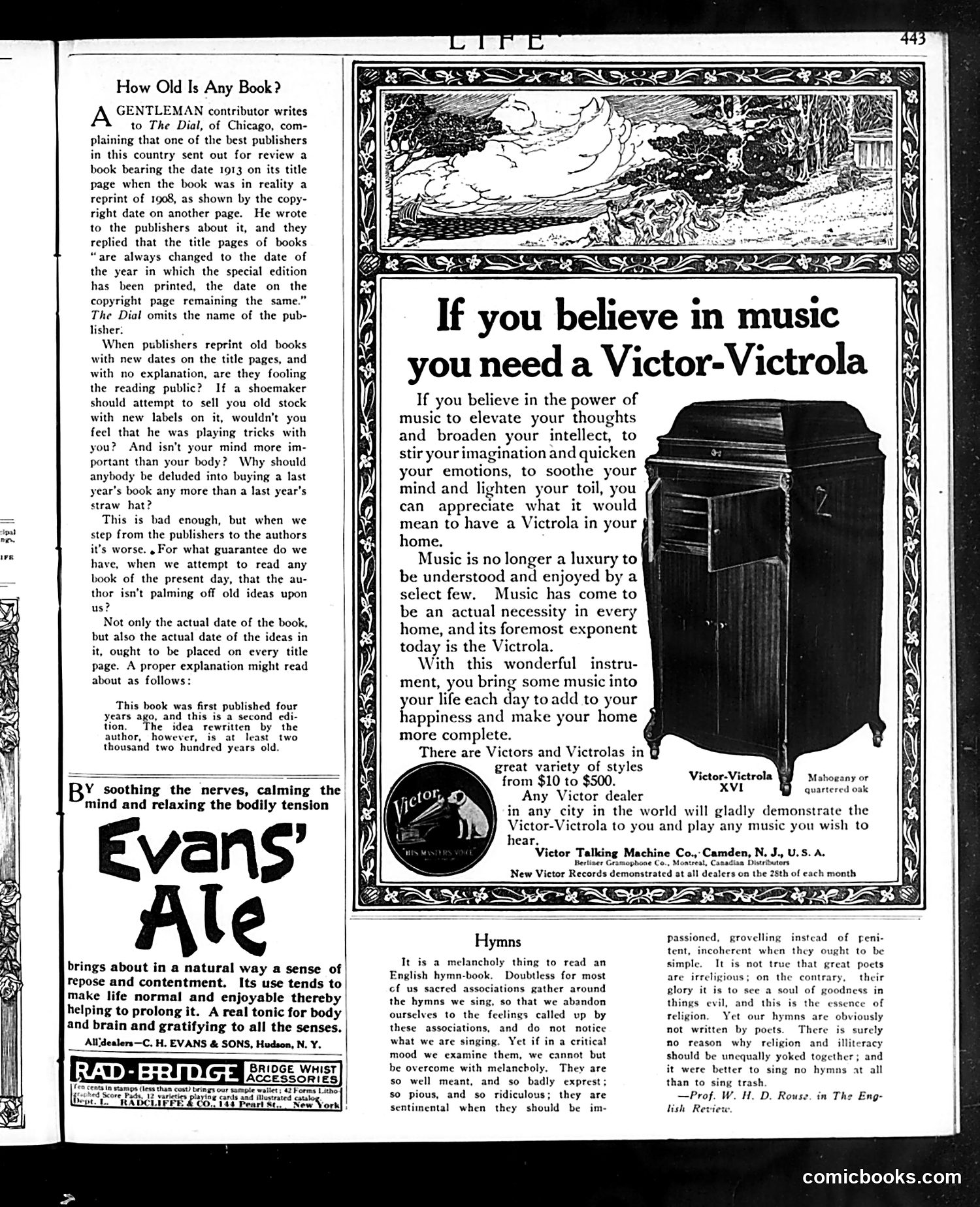
This page contains **editorial satire and period advertising**, not political cartoons. **"How Old Is Any Book?"** critiques deceptive publishing practices. A contributor complains that publishers reissue old books with new title-page dates while keeping original copyright dates hidden, misleading readers into thinking they're buying current work. The satire argues this is consumer fraud—comparable to a shoemaker selling old stock with new labels. It extends the critique to authors, suggesting they too recycle old ideas without disclosure. The piece advocates for honesty: books should reveal both publication and original composition dates. **The advertisements** (Evans' Ale, Victor-Victrola, Rad-Bridge) are period marketing with no satirical content. **"Hymns"** is a literary essay criticizing English hymnal poetry as poorly written despite good intentions—overly sentimental and clumsy rather than genuinely moving. The page reflects early 20th-century *Life* magazine's focus on social commentary and consumer criticism alongside advertising.
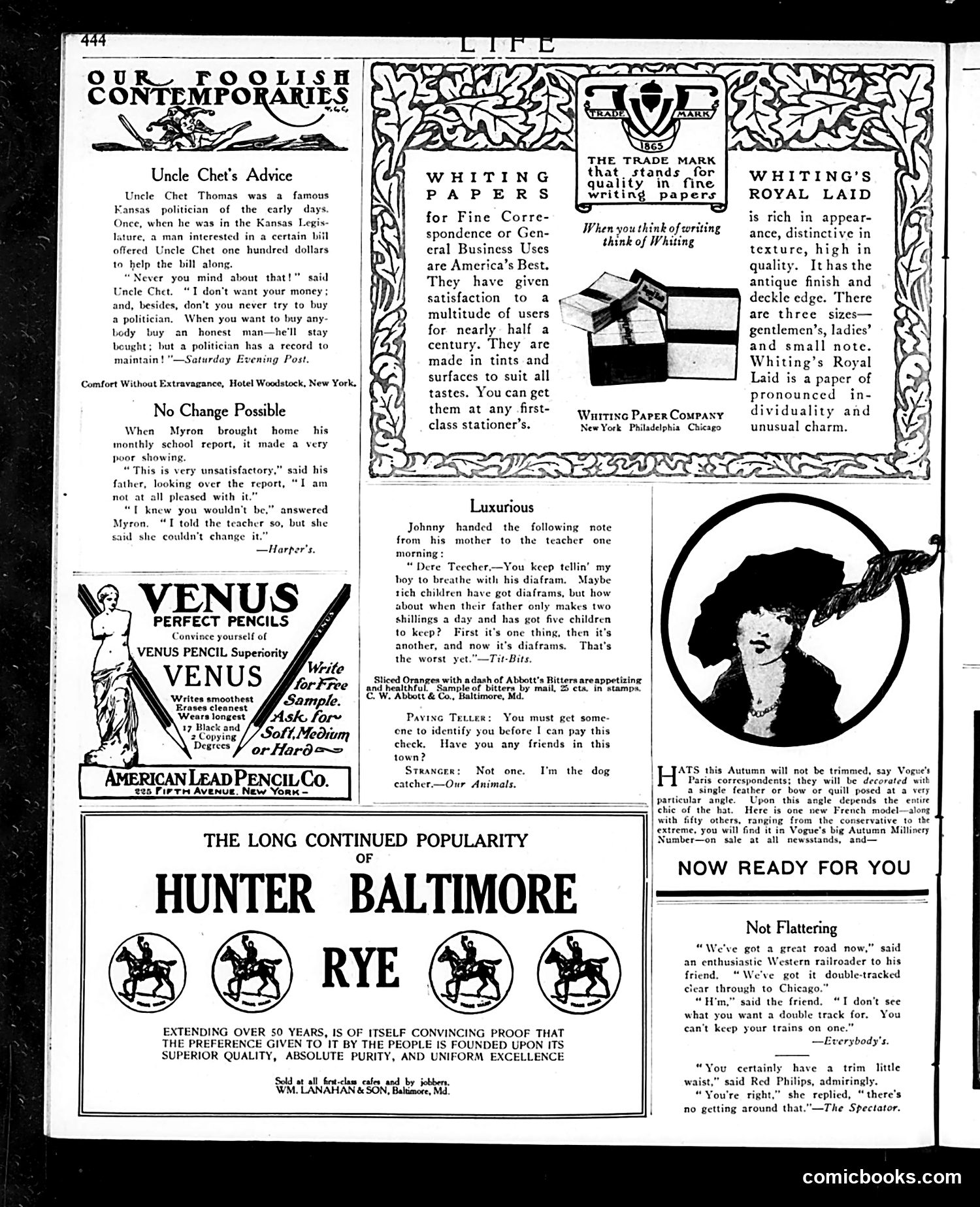
This page is primarily **advertisements and humor fillers**, typical of Life's satirical format circa early 1900s. The humor pieces mock everyday foolishness: - **"Uncle Chet's Advice"**: A politician's paradoxical claim that honest men stay "bought" while politicians maintain records—satirizing political corruption and hypocrisy. - **"No Change Possible"**: A boy uses circular logic with his teacher about poor grades, suggesting institutional inflexibility. - **"Luxurious"**: A working-class father complains about teachers demanding children practice breathing exercises ("diaframs") when he can barely feed five children on two shillings daily—mocking middle-class educational pretension amid poverty. - **"Paying Teller"** and **"Not Flattering"**: Brief joke exchanges about absurd logic. The advertisements (Venus Pencils, Whiting Paper, Hunter Baltimore Rye whiskey, Vogue hats) occupy significant space. There are **no political cartoons** here—just commercial and comic content reflecting early 20th-century American consumer culture and gentle social satire.
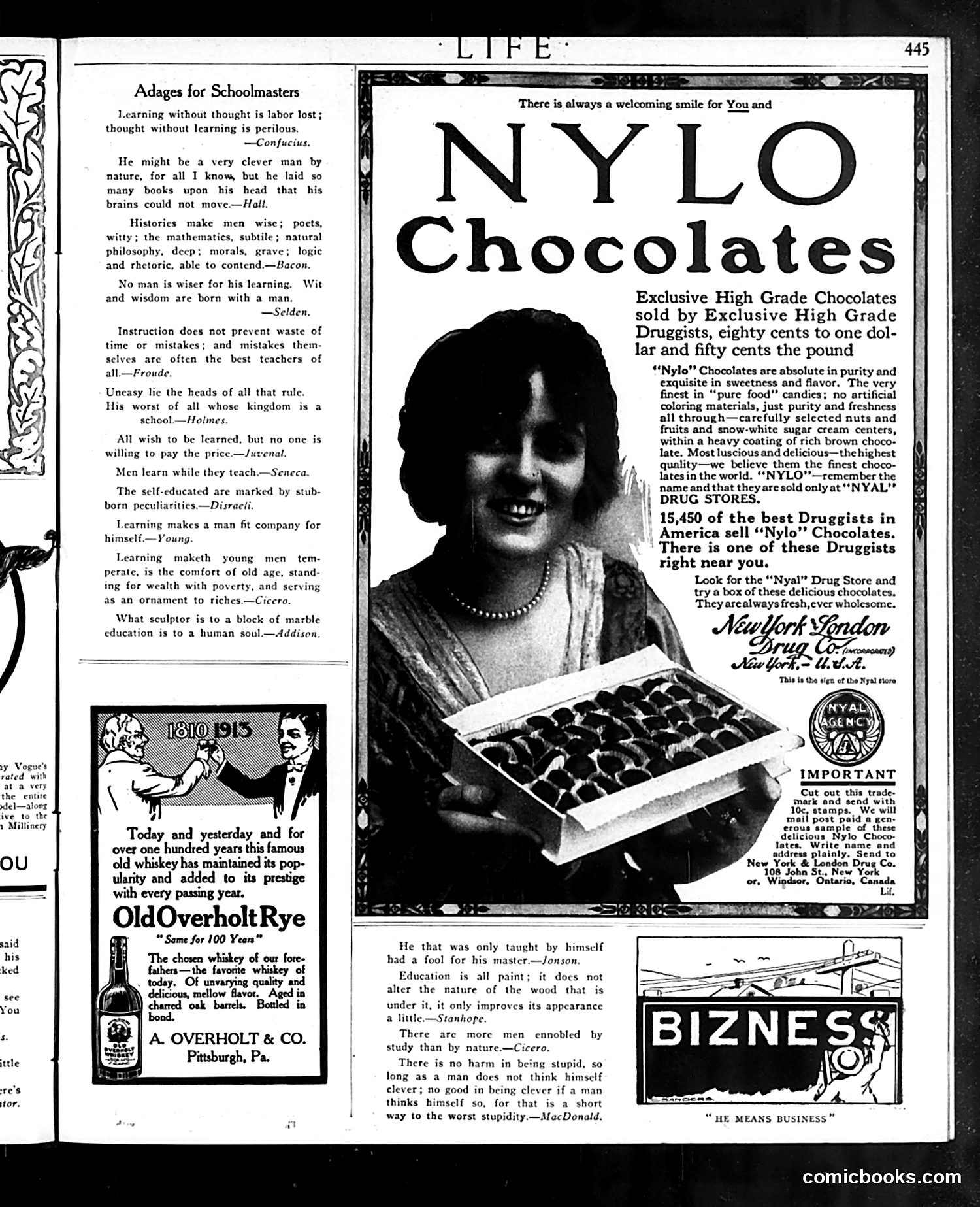
This page combines educational content with period advertising. The left side features classical quotations about education and learning—aphorisms from Confucius, Bacon, Holmes, and others—alongside an Old Overholt Rye whiskey advertisement emphasizing century-old tradition. The dominant right-side advertisement promotes "Nylo" chocolates sold exclusively through "Nyal" drug stores. The large photograph shows a smiling woman holding an open box of chocolates, capitalizing on appeals to purity, quality, and feminine consumption—common marketing strategies of the era. The lower section includes a small "Business" cartoon (caption: "He Means Business"), though its specific content is unclear from this image. The page reflects early 20th-century values: reverence for classical wisdom, brand loyalty tied to heritage, drug stores as distribution centers for non-pharmaceutical goods, and gendered marketing targeting women as candy consumers.
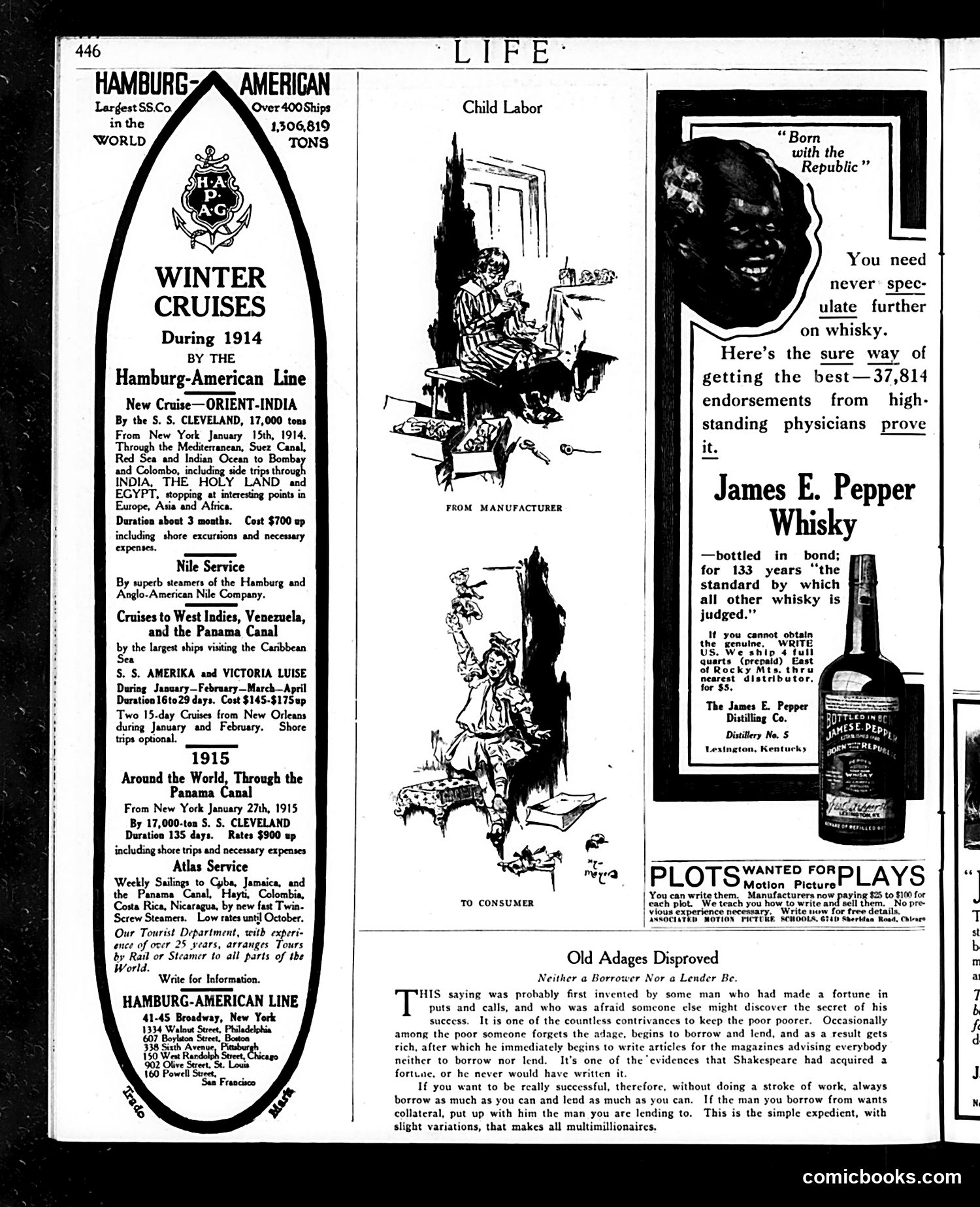
This page primarily contains **advertisements and satirical commentary** rather than political cartoons. The central "Child Labor" illustration depicts a young child working—a darkly ironic contrast to the surrounding luxury cruise and whisky advertisements. This juxtaposition criticizes American consumer culture and industrial exploitation of the early 1900s, when child labor was widespread and legal. The **James E. Pepper Whisky ad** boasts physician endorsements during the Prohibition era debate, representing corporate appeals to authority. Most notably, the final essay "Old Adages Disproved" **satirizes wealthy hypocrisy**. It mocks the claim "Neither a Borrower Nor a Lender Be" as invented by the rich to keep the poor subjugated. The author suggests the wealthy became rich *through* borrowing and lending, then hypocritically advised against it. This reflects early-1900s tensions over economic inequality and class mobility—the essay argues working-class people should ignore traditional morality and aggressively pursue wealth through credit and speculation. The overall page critiques both consumer excess and class-based moral manipulation.
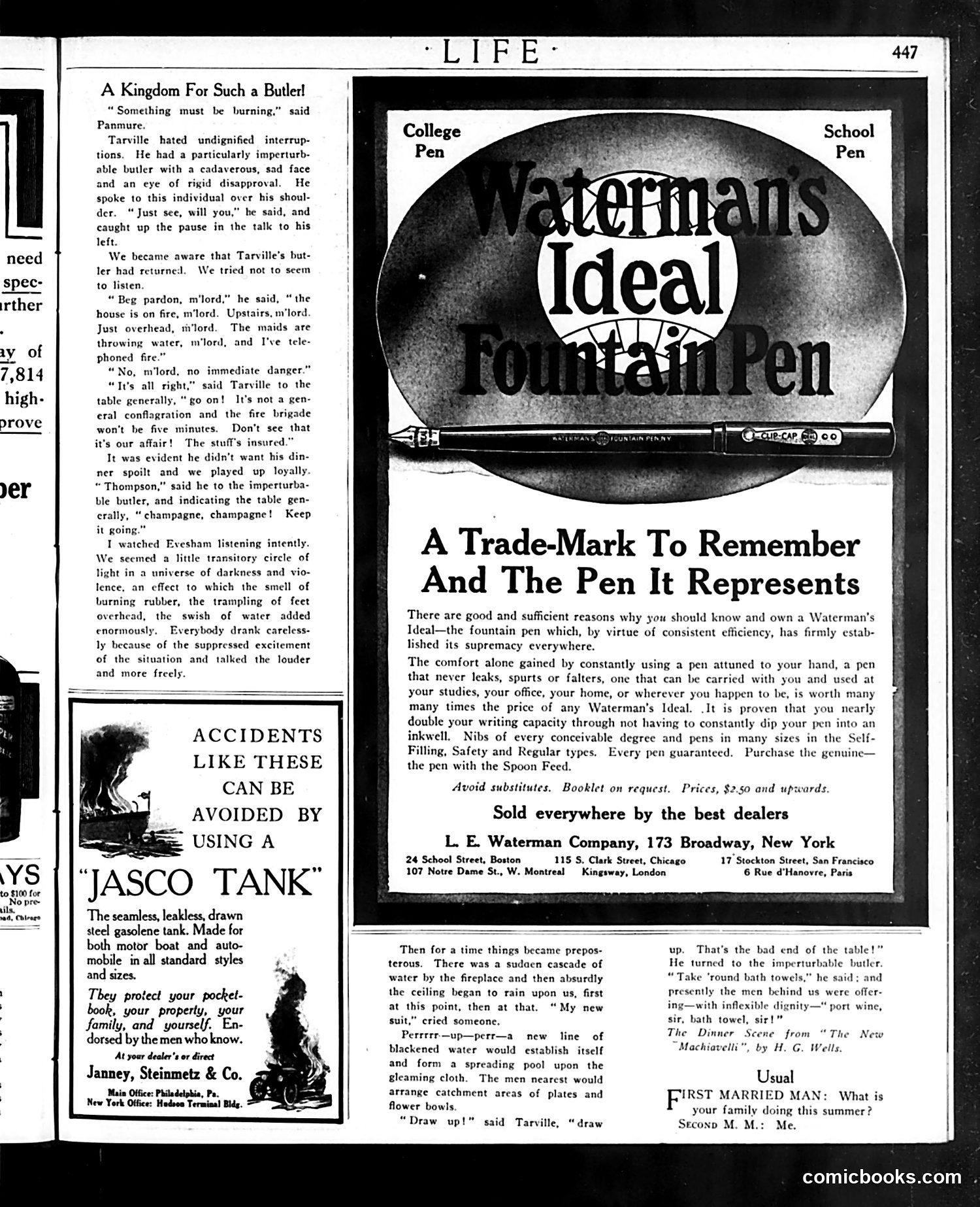
This page contains a humorous short story satirizing British upper-class social pretension. The narrative depicts a dinner party where the host, Tarville, receives news from his butler that the house is literally on fire. Rather than evacuate, Tarville dismisses the emergency as mere inconvenience and insists the dinner continue—the house is insured, after all, and the fire brigade will arrive soon enough. The satire mocks rigid class etiquette and emotional repression: maintaining composure and social decorum matters more than actual danger. The absurdist humor escalates as water and debris rain down on the guests, yet they persist in their meal, treating the catastrophe as a minor annoyance. The page also contains period advertisements for Waterman fountain pens and Jasco gasoline tanks—unrelated to the story's content.
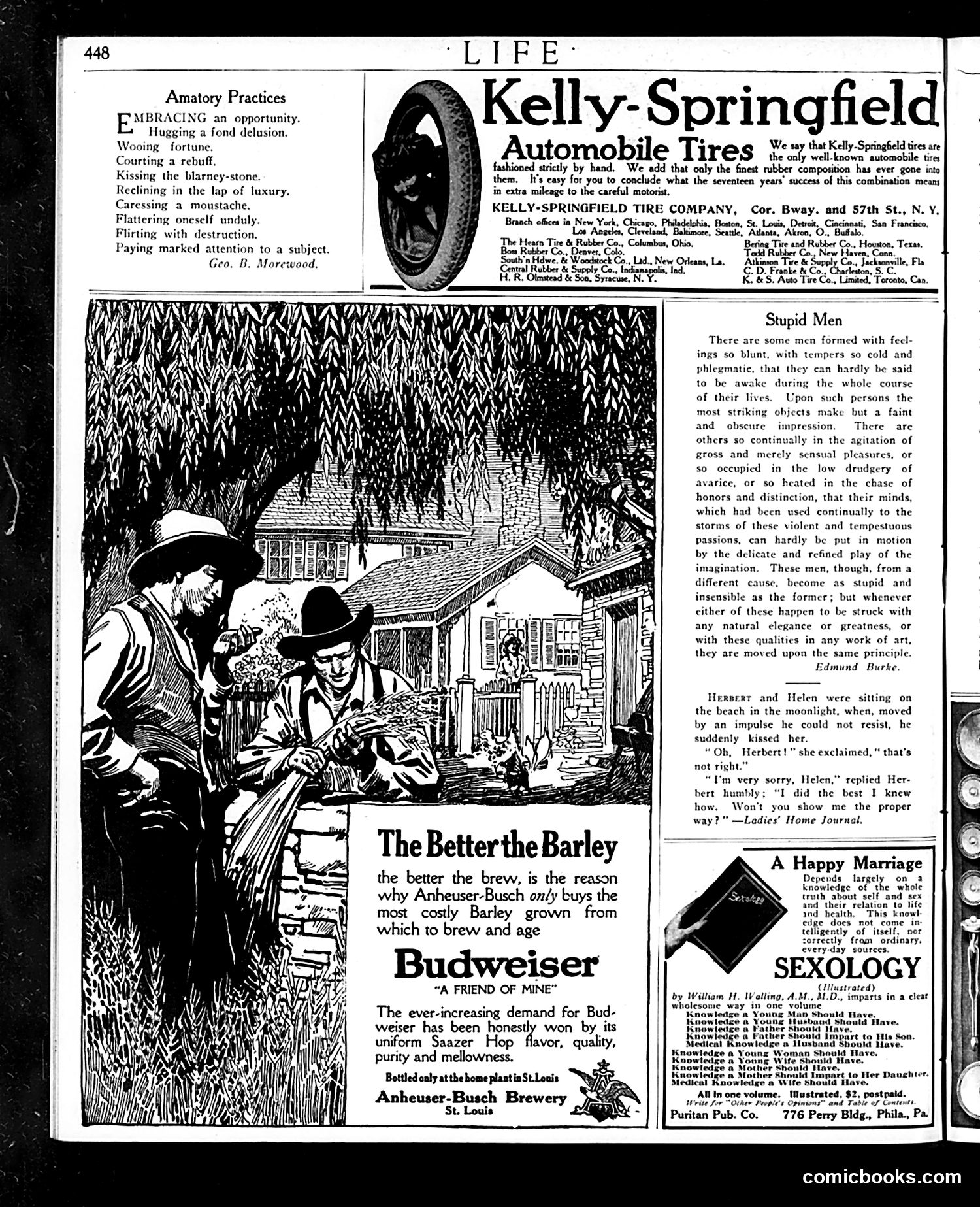
This page is primarily **advertising**, not satire or political commentary. It contains three main advertisements and one brief humorous anecdote. **Top section**: Kelly-Springfield Automobile Tires ad with a list of "Amatoty Practices" (embracing opportunities, wooing fortune, etc.) by Geo. B. Morewood—a lighthearted, non-political poem about human behavior used to promote tires. **Center**: A Budweiser beer advertisement emphasizing quality barley, with an illustration of workers in what appears to be a brewery or grain facility. **Right side**: Two smaller ads—one for a book on "Sexology" about marriage and sexual health, and a humorous anecdote about Herbert and Helen on a beach (a mild romantic joke about proper kissing technique). The page reflects early 20th-century advertising approaches: combining consumer products with poetry, health advice, and sentimental humor to appeal to readers.
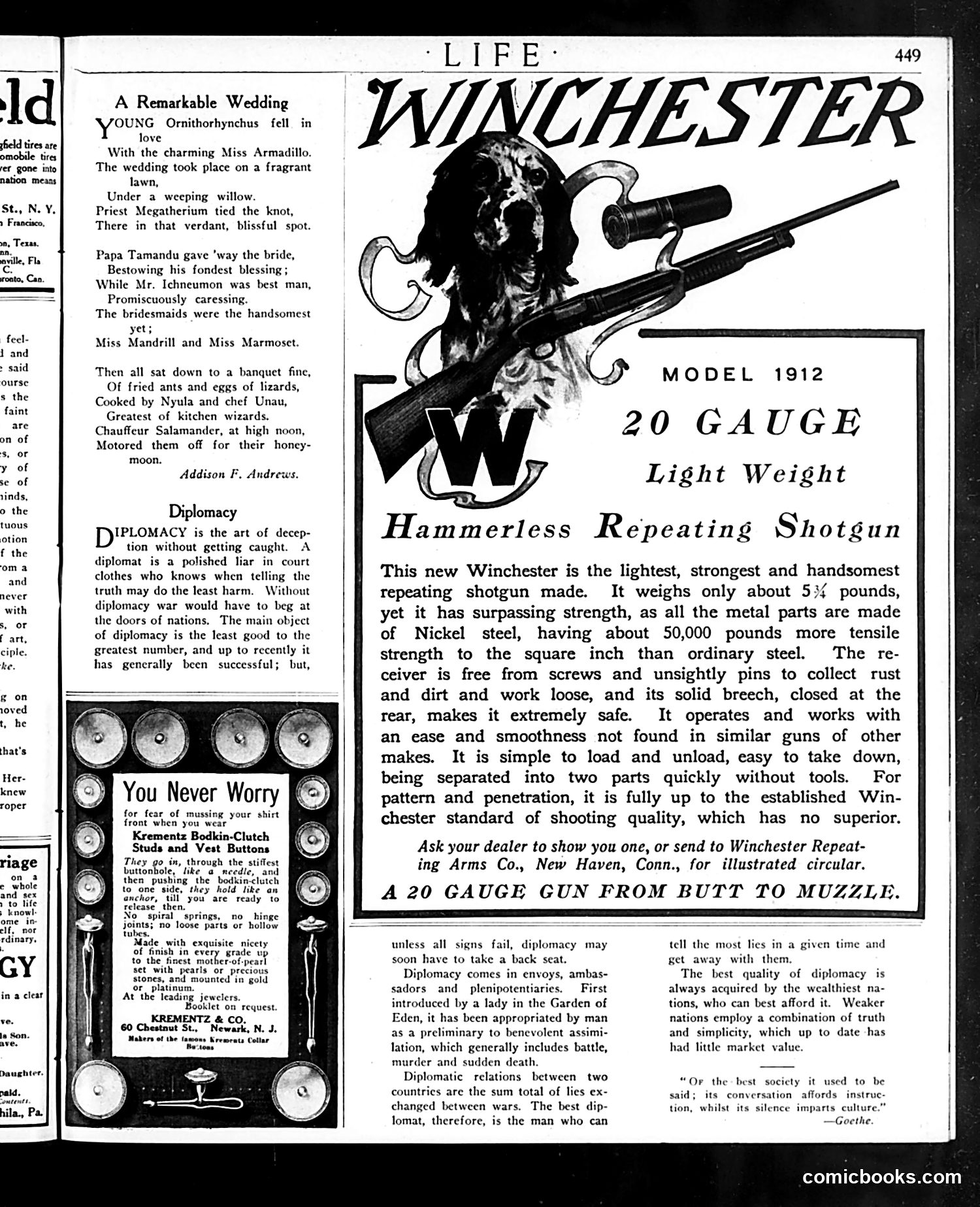
This page contains three distinct elements: **"A Remarkable Wedding"** (left): A humorous poem by Addison F. Andrews describing a wedding between animal species with scientific names—a young Ornithorhynchus (platypus) marrying Miss Armadillo. The joke relies on giving animals formal Victorian wedding treatment with made-up names for other creatures (Megatherium, Salamander as chauffeur). This is gentle satirical humor about pretentious social conventions. **"Diplomacy" (center-left)**: A cynical definition of diplomacy as "the art of deception without getting caught," claiming diplomats are "polished liars." It sarcastically traces diplomacy to Eden and defines diplomatic relations as "the sum total of lies exchanged between wars." This reflects early-20th-century skepticism about international relations and statecraft. **Winchester Shotgun Advertisement** (right): A commercial advertisement for the Model 1912 20-gauge repeating shotgun, emphasizing its light weight (5¾ pounds), strength, and ease of use. The page mixes satire, cynicism about politics, and period advertising—typical of Life magazine's format.
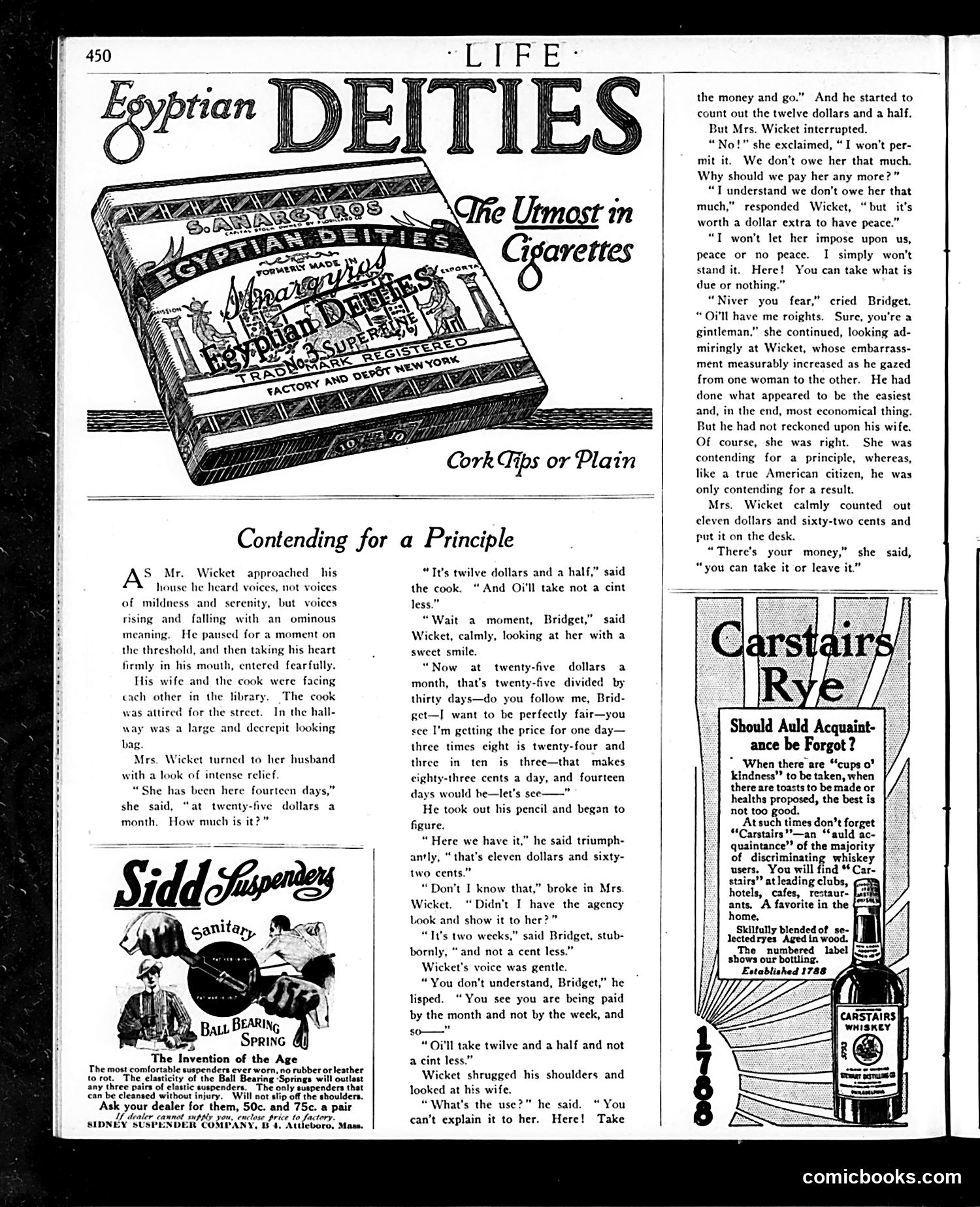
This domestic comedy depicts a dispute between Mr. and Mrs. Wicket over payment to their cook, Bridget, who is leaving after fourteen days. The cook demands two weeks' pay (twelve dollars and a half); Mr. Wicket calculates she's owed only eleven dollars sixty-two cents based on daily rates. The satire targets the difference between male and female approaches to principle: Mr. Wicket is willing to overpay a dollar for "peace"—a pragmatic, results-focused compromise. His wife refuses on principle, insisting on what they actually owe. The text explicitly notes she "was contending for a principle, whereas...he was only contending for a result." The joke suggests that American men prioritize practical outcomes over ethics, while this woman—unusually for the era—upholds moral rigor. It's a mild satire of male expedience, portrayed sympathetically through Mr. Wicket's embarrassment as the two women face off.
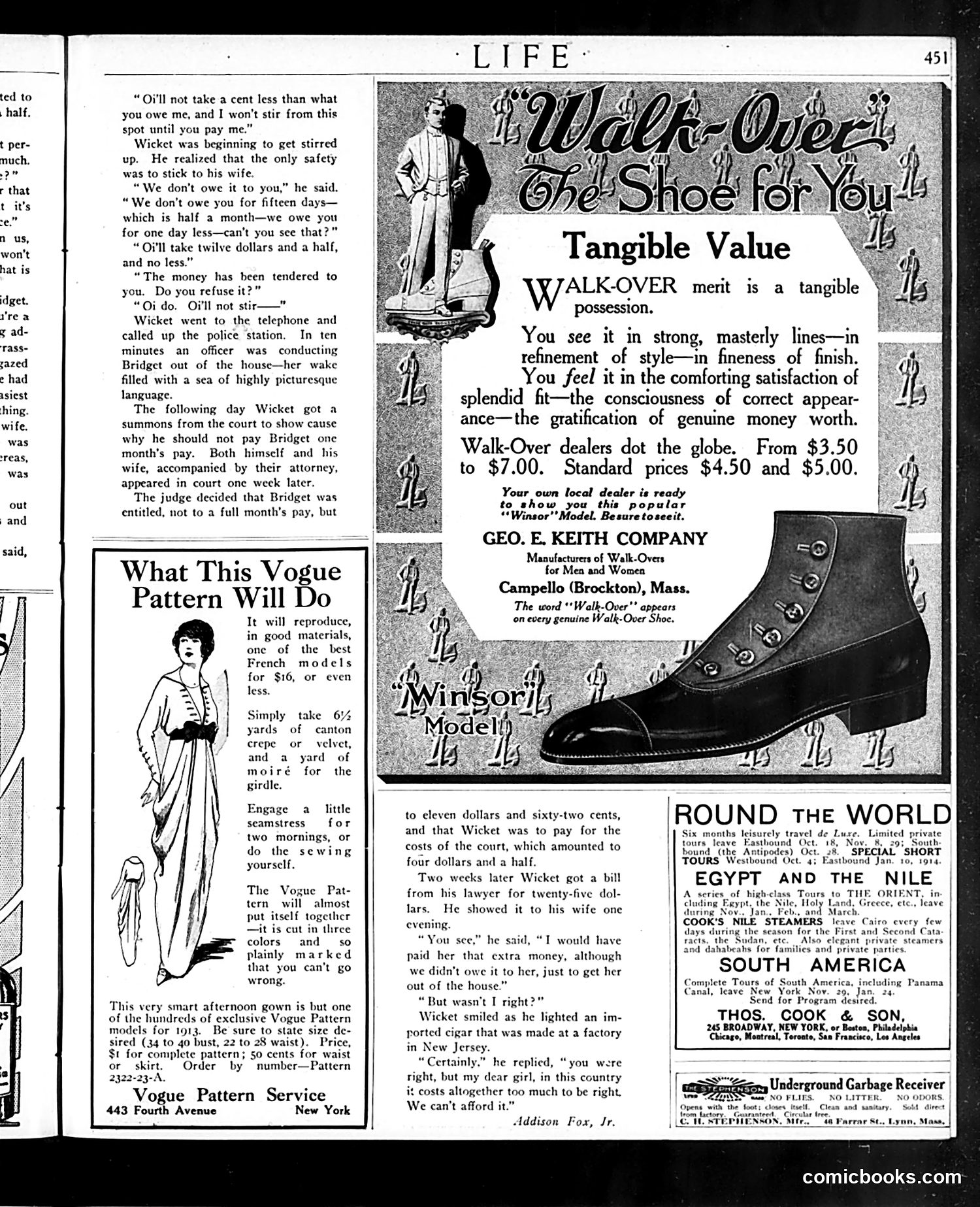
This page is primarily advertising with a brief story sidebar. The main narrative (left column) concerns a domestic dispute: Wicket refuses to pay his housemaid Bridget for a full month's work, claiming she only worked one day short of a month. Bridget insists on full payment and won't leave. Wicket calls police; Bridget is removed. A court sides partially with Bridget, awarding her less than demanded but making Wicket pay court costs and legal fees totaling more than the disputed wages. The satire: Wicket's "victory" proves pyrrhic—by being technically right, he spent far more money than simply paying the woman upfront. The wife notes this contradiction; Wicket's final reply critiques American legal expense: "in this country it costs altogether too much to be right."
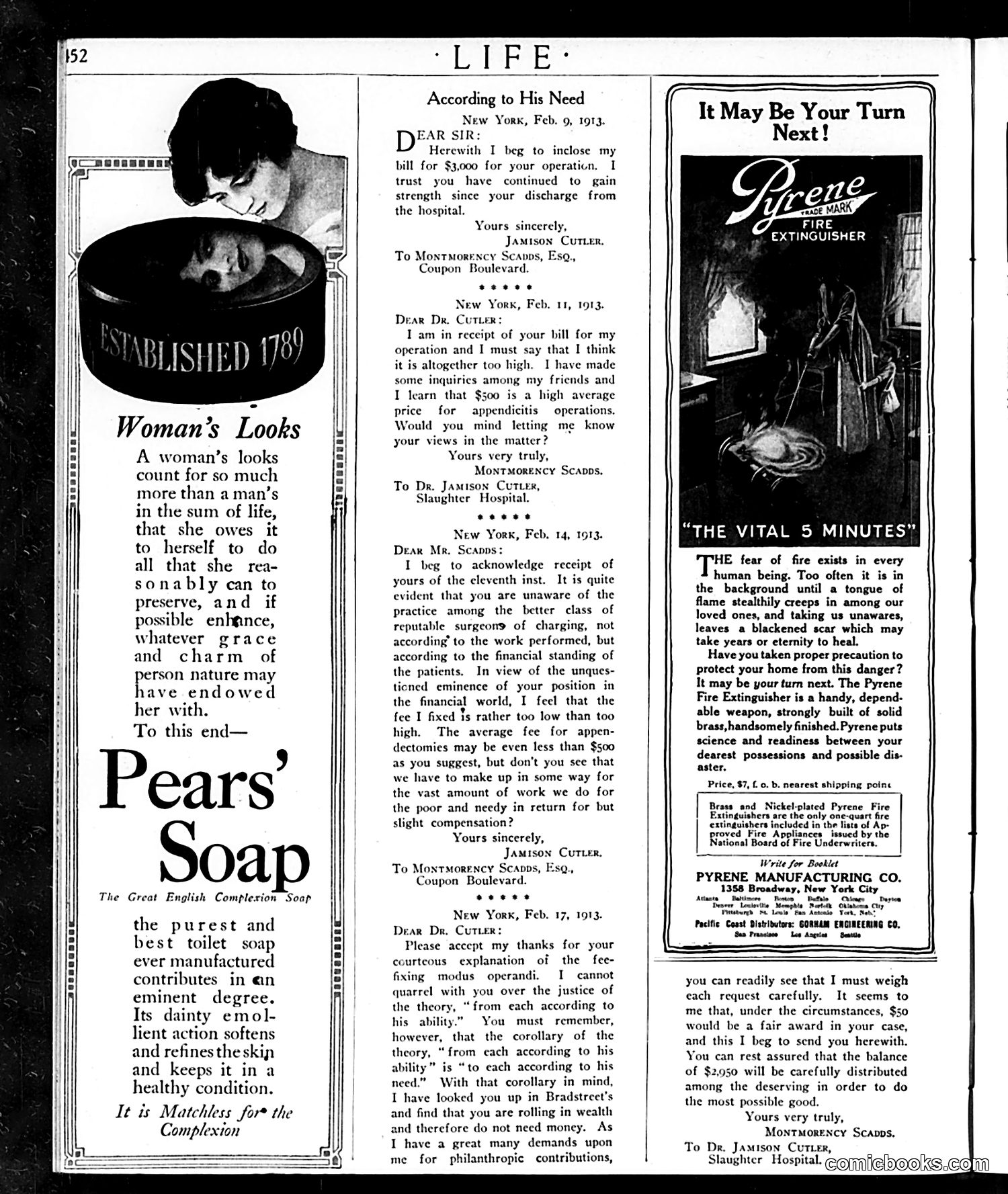
This satirical exchange of letters (Feb. 9-17, 1913) mocks both medical billing practices and socialist ideology. A wealthy patient, Montmorency Scapps, disputes surgeon Dr. Jamison Cutter's $3,000 appendectomy bill. Cutter defends the inflated fee by explaining that reputable surgeons charge "according to the financial standing of the patients"—not work performed. He justifies this by claiming surgeons do unpaid charity work for the poor. Scapps brilliantly counters by invoking Marx's communist principle "from each according to his ability, to each according to his need." Since Cutter is wealthy (per financial records), Scapps argues Cutter doesn't *need* the money. The joke: applying socialist redistribution logic to the surgeon himself exposes the hypocrisy of selective charity. The satire targets both medical profession greed and the absurdity of applying communist theory to capitalist America.
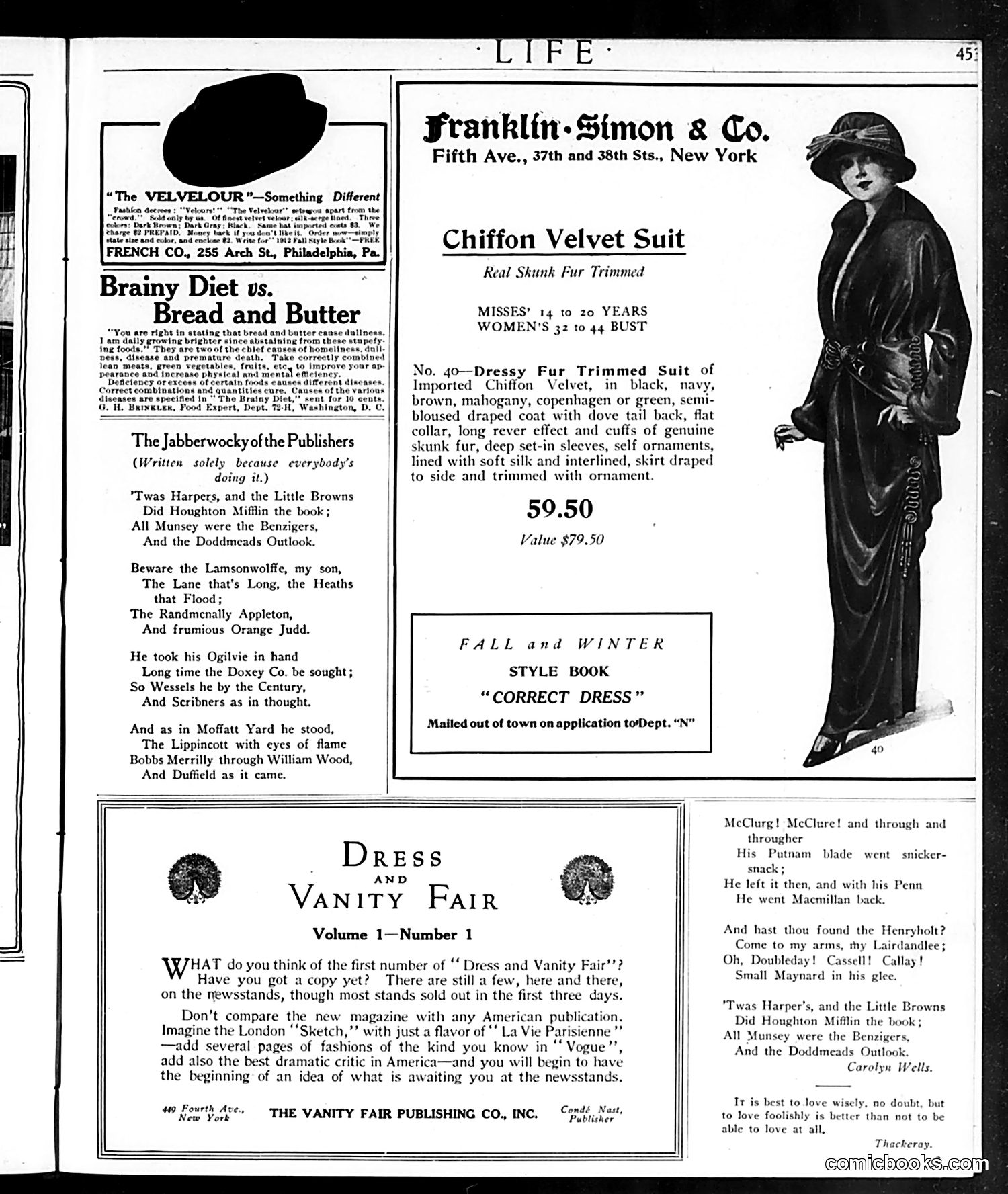
This page is primarily **advertising and promotional content** rather than political satire. The main items are: 1. **Fashion ads** (Franklin-Simon & Co., French Co.) promoting women's velvet suits with fur trim—typical 1920s luxury goods. 2. **"Jabberwocky of the Publishers"**—a satirical poem mocking American book publishers by playing on Lewis Carroll's "Jabberwocky." It ridicules publishers by treating their names as verbs and characters in a nonsense narrative: "Harper's," "Houghton Mifflin," "Munsey," "Doubleday," "Macmillan," etc. The joke is how absurdly these serious publishing houses sound when absurdly deployed as action-words and combatants. 3. **"Dress and Vanity Fair" promotion**—advertising the launch of a new fashion/lifestyle magazine, claiming it rivals the London *Sketch* and Paris's *La Vie Parisienne*. The satirical content is mild—lightweight mockery of publishing industry self-importance rather than serious political commentary. This appears to be a **society/lifestyle magazine page** focused on fashion and cultural messaging for upper-class readers.
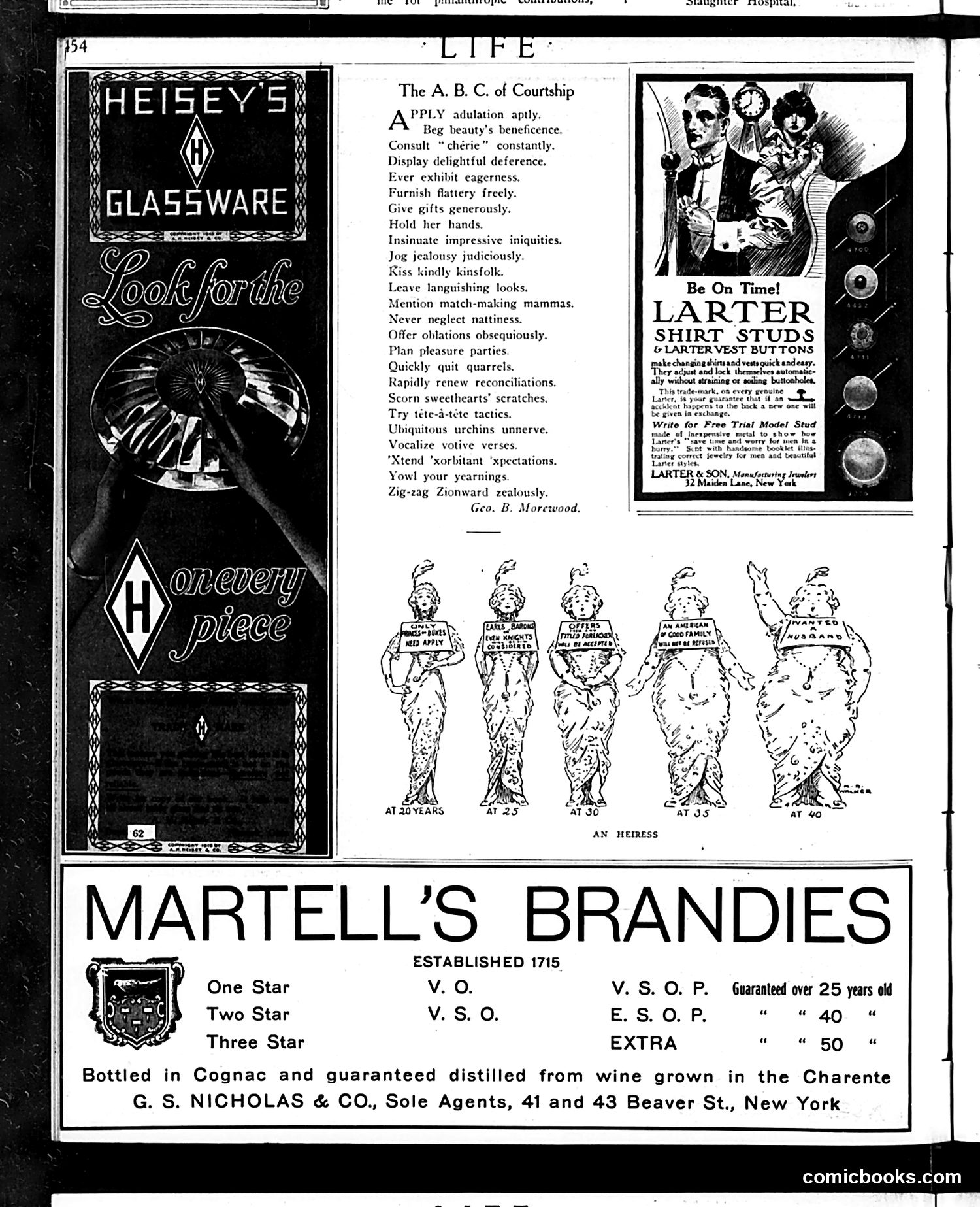
This page is primarily **advertising with one humorous article**. The main content is "The A.B.C. of Courtship" by Geo. B. Morewood—an alliterative satire on dating etiquette. Each letter offers tongue-in-cheek advice (e.g., "Jog jealousy judiciously," "Scorn sweethearts' scratches"). The humor lies in suggesting manipulative tactics wrapped in flowery language, mocking the overly formal courtship conventions of the era. The accompanying cartoon "An Heiress" shows a woman's body at five life stages (20-40 years), humorously depicting weight gain over time—a commentary on aging and appearance standards. The page also advertises Heisey's Glassware, Larter Shirt Studs, and Martell's Brandies (established 1715). This was typical Life magazine format: satirical content mixed with upscale product advertisements targeting wealthy readers.
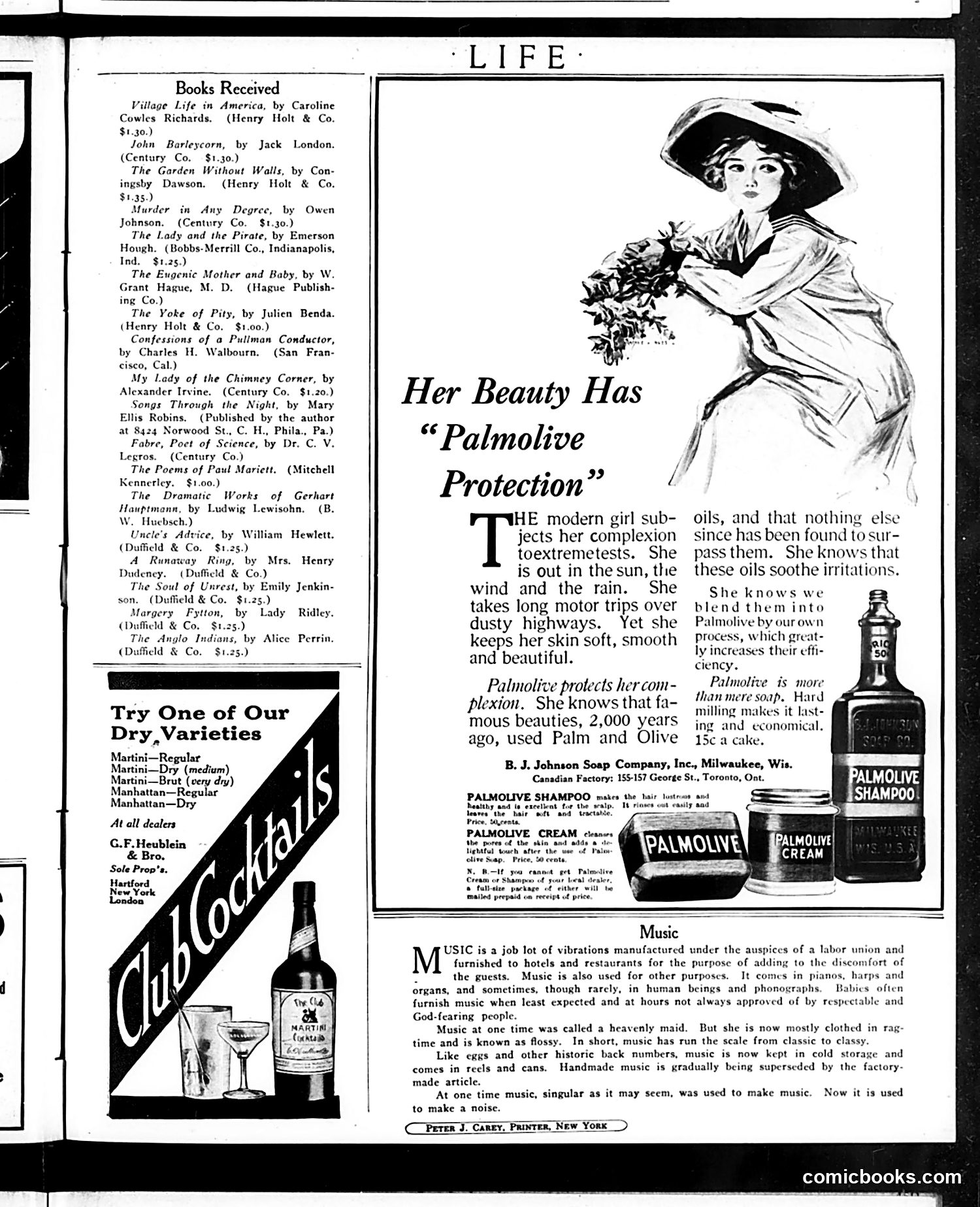
This page is primarily **advertising and book reviews**, not political satire. The main content includes: **Left side:** A book review section listing recent publications (Jack London's *John Barleycorn*, Owen Johnson's *Murder in Any Degree*, etc.) and an advertisement for Heublein cocktails ("Try One of Our Dry Varieties"). **Right side:** A full-page **Palmolive soap advertisement** featuring an illustrated woman with a large hat and flowers, claiming the product protects modern girls' complexions from sun, wind, and rain during motor trips. **Bottom section:** A **humorous definition of "Music"** that satirizes modern entertainment—describing it as manufactured "vibrations" provided by labor unions to hotels and restaurants, now mass-produced in "reels and cans" rather than handmade. The piece mocks how music has devolved from "classic to classy" and is now used "to make a noise" rather than music itself. The satire targets mechanization and commercialization of culture rather than politics.

This is **not a cartoon or satire**—it's a straightforward **advertisement** from Life magazine (September 11, 1913) for the J.B. Williams Company's shaving and grooming products. The ad promotes their "Holder-Top Shaving Stick" and offers sample "Suit Case Sets" for 24 cents in stamps. These were trial-size collections of toiletries marketed separately to men and women, containing products like shaving cream, talc powder, dental cream, and soaps. The layout uses decorative Art Nouveau-style borders and product illustrations typical of early 20th-century advertising. The messaging emphasizes luxury and convenience—appealing to consumers curious about new personal care products. For modern readers: this reflects an era when companies marketed grooming items through mail-order samples, and when gendered product lines were explicitly marketed and packaged differently for men versus women.