
Life, 1913-09-11 · page 24 of 44
Life — September 11, 1913 — page 24: what you’re looking at
What you’re looking at
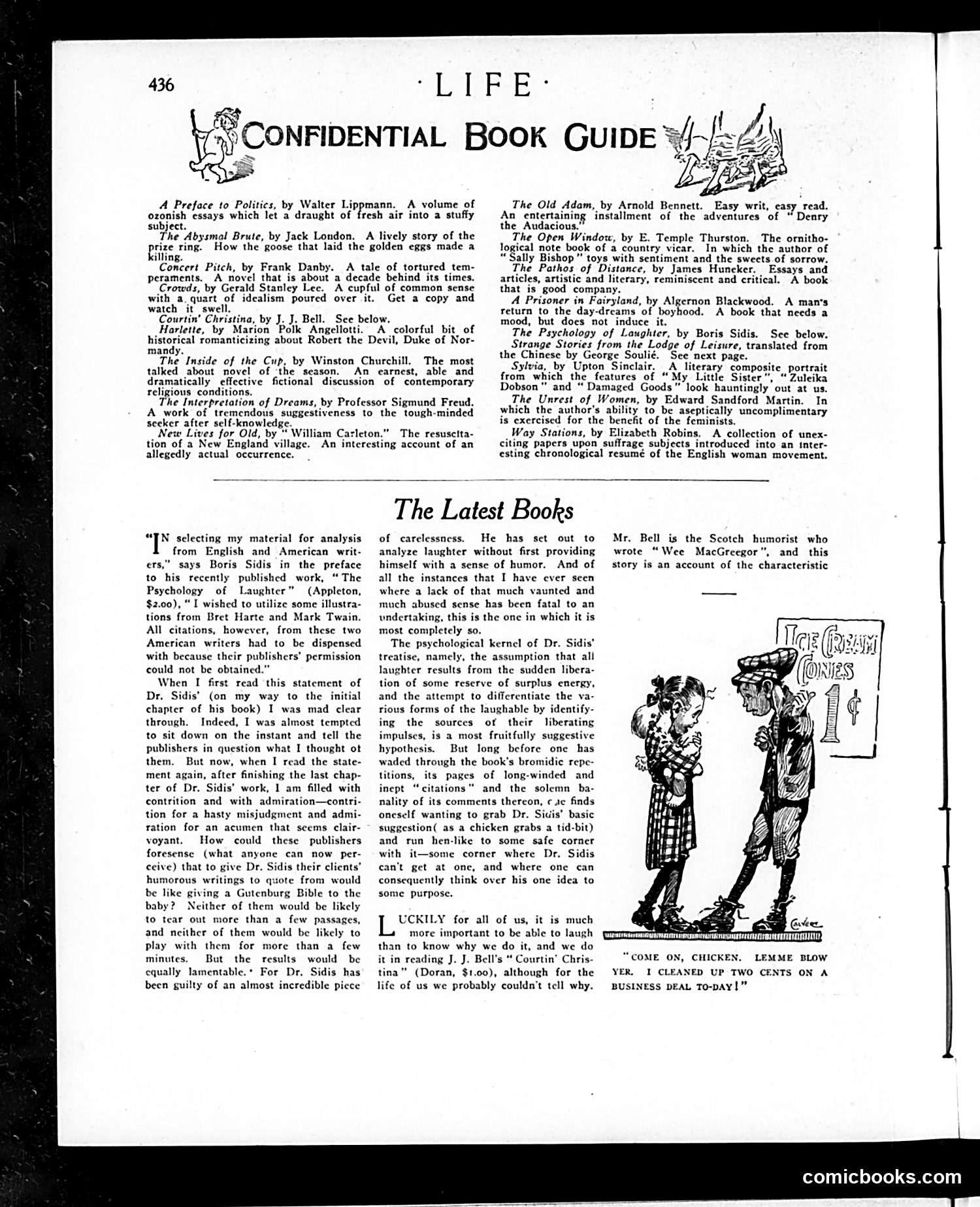
This page features book reviews and a cartoon satirizing publishers' gatekeeping. The main text critiques psychologist Boris Sidis's book *The Psychology of Laughter*, which he claims couldn't include Mark Twain and Bret Harte quotes because publishers refused permission. The reviewer sarcastically praises the publishers' "foresight," suggesting Sidis would have ruined these classic humorists' work—comparing giving him their material to "giving a Gutenberg Bible to the baby." The implication: Sidis's own attempts at humor are so pedestrian or clumsy that his analysis would embarrass superior writers. The accompanying cartoon (right) shows two figures in period dress with the caption "Come on, chicken. Lemme blow yer. I cleaned up two cents on a business deal to-day!" This appears to mock either materialism or crude social climbing. The page is primarily a **book guide** listing contemporary publications, functioning as advertising/literary criticism rather than political satire.
📄 Transcribed text from this page (OCR, searchable)
Machine-transcribed from the original scan — historical spelling and the odd misread are preserved.
A Preface to Politics, by Walter Lippmann. A volume of ozonish essays which let a draught of fresh air into a stuffy subject. s The Abysmal Brute, by Jack London. A lively story of the ne ring. How the goose that laid the golden eggs made a illing. Concert Pitch, by Frank Danby. A tale of tortured tem- peraments. A novel that is about a decade behind its times. Crowds, by Gerald Stanley Lee. A cupful of common sense with a. quart of idealism poured over it. Get a copy and watch it swell. Courtin’ Christina, by J. J. Bell. See below. Harlette, by Marion Polk Angellotti. A colorful bit of Bisto tical romanticizing about Robert the Devil, Duke of Nor- mandy. The Inside of the Cup, by Winston Churchill. The most talked about novel of ‘the season. An earnest, able and dramatically effective fictional discussion of contemporary religious conditions. The Interpretation of Dreams, by Professor Sigmund Freud, A work of tremendous suggestiveness to the tough-minded seeker after self-knowledg New Lives for Old, by “ William Carleton.” The resusctta- tion of a New England village. An interesting account of an allegedly actual occurrence. ny % The Old Adam, by Arnold Bennett. Easy writ, easy read. An entertaining installment of the adventures of “ Denry the Audacious.” The Open Window, by E. Temple Thurston. The ornitho- logical note book of a country vicar. In which the author of “Sally Bishop” toys with sentiment and the sweets of sorrow. The Pathos of Distance, by James Huneker, Essays and articles, artistic and literary, reminiscent and critical. A book that is’ good company. A Prisoner in Fairyland, by Algernon Blackwood. A man’s return to the day-dreams of boyhood. A book that needs a mood, but does not induce it, The Psychology of Laughter, by Boris Sidis. See below. Strange Stories from the Lodge of Leisure, translated from the Chinese by George Soulié. See next page. Sylvia, by Upton Sinclair, A literary composi from which the features of Little Sister Dobson" and “ Damaged Goods” look hauntingly out at us. The Unrest of Women, by Edward Sandford Martin. In which the author's ability to be aseptically uncomplimentary is exercised for the benefit of the feminists. Way Stations, by Elizabeth Robins. A collection of unex- citing papers upon suffrage subjects introduced into an inter- esting chronological resumé of the English woman movement. “ys selecting my material for analysis rom English and American writ- crs,” says Boris Sidis in the preface to his recently published work, “The Psychology of Laughter” (Appleton, $2.00), “I wished to utilize some illustra- tions from Bret Harte and Mark Twain. All citations, however, from these two American writers had to be dispensed with because their publishers’ permission could not be obtained.” When I first read this statement of Dr. Sidis’ (on my way to the initial chapter of his book) I was mad clear through. Indeed, I was almost tempted to sit down on the instant and tell the publishers in question what I thought ot them. But now, when I read the state- ment again, after finishing the last chap- ter of Dr. Sidis’ work, I am filled with contrition and with admiration—contri- tion for a hasty misjudgment and admi- ration for an acumen that scems clair- voyant. How could these publishers foresense (what anyone can now per- ceive) that to give Dr. Sidis their clients’ humorous writings to quote from would be like giving a Gutenburg Bible to the baby? Neither of them would be likely to tear out more than a few passages, and neither of them would be likely to play with them for more than a few minutes. But the results would be equally lamentable. For Dr. Sidis has been guilty of an almost incredible piece The Latest Books of carelessness. He has set out to analyze laughter without first providing himself with a sense of humor. And of all the instances that I have ever seen where a lack of that much vaunted and much abused sense has been fatal to an undertaking, this is the one in which it is most completely so. The psychological kernel of Dr. Sidis’ treatise, namely, the assumption that all laughter results from the sudden libera- tion of some reserve of surplus energy, and the attempt to differentiate the va- rious forms of the laughable by identify- ing the sources of their liberating impulses, is a most fruitfully suggestive hypothesis. But long before one has waded through the book’s bromidie repe- titions, its pages of long-winded and inept “citations” and the solemn ba- nality of its comments thereon, ¢ ac finds oneself wanting to grab Dr. Sidis’ basic suggestion( as a chicken grabs a tid-bit) and run hen-like to some safe corner with it—some corner where Dr, Sidis can't get at one, and where one can consequently think over his one idea to some purpose. UCKILY for all of us, it is much more important to be able to laugh than to know why we do it, and we do it in reading J. J. Bell's “ Courtin’ Chris- tina” (Doran, $1.00), although for the life of us we probably couldn't tell why. Mr. Bell is the Scotch humorist who wrote “Wee MacGreegor”, and this story is an account of the characteristic “COME ON, CHICKEN. YER. BUSINESS DEAL To-pay!” LEMME BLOW I CLEANED UP TWO CENTS ON A comicbooks.com