
Life, 1913-09-11 · page 18 of 44
Life — September 11, 1913 — page 18: what you’re looking at
What you’re looking at
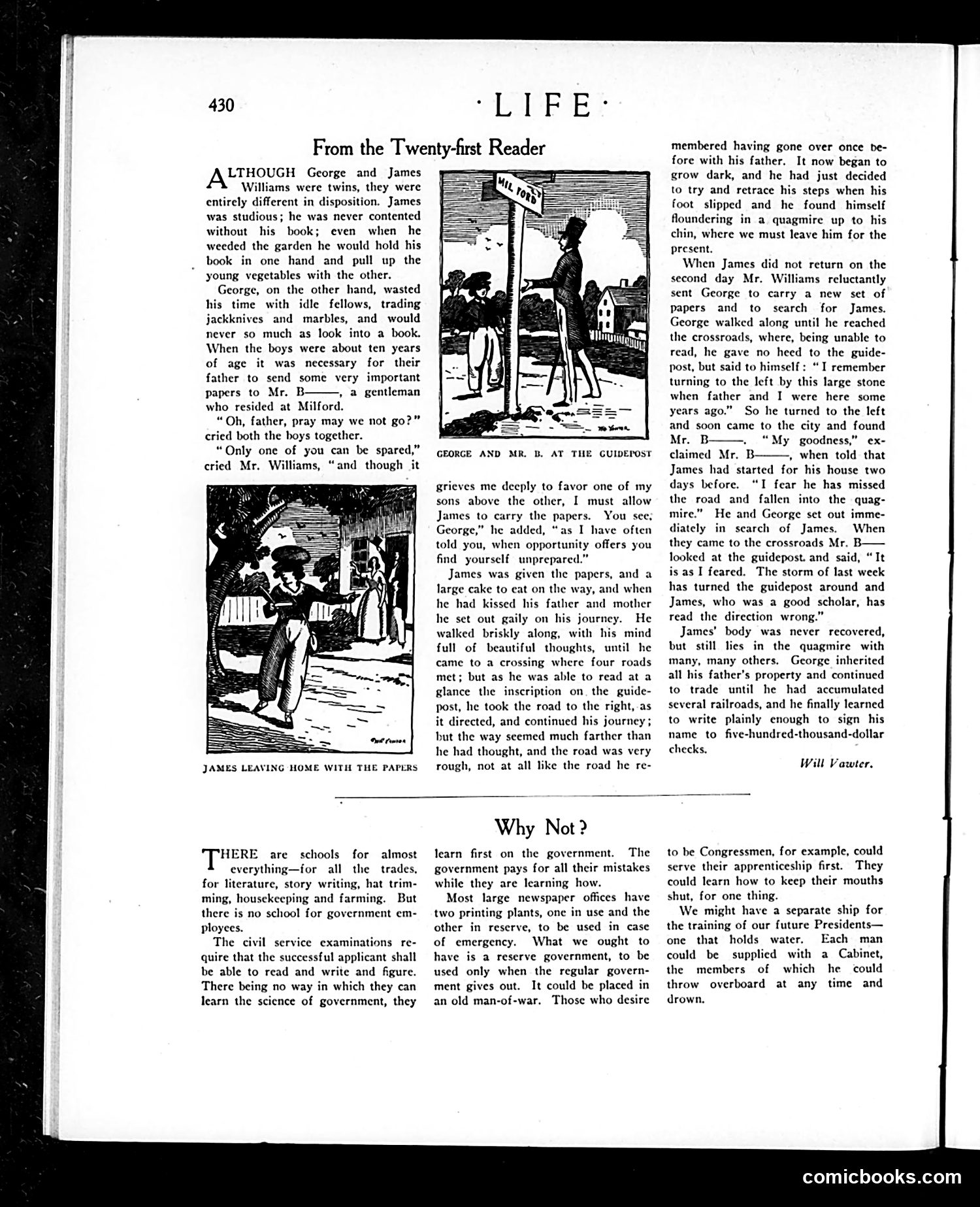
This page contains a moral fable from *Life* magazine's "Twenty-first Reader" section. The story contrasts two twin brothers: James (studious, literate) and George (idle, illiterate). **The Satire:** When James, the educated son, is sent on an important errand, he can read the guidepost at a crossroads and follows its directions—but the post has been turned around by a storm, and he falls into a quagmire and dies. George, unable to read, relies on memory instead and successfully reaches his destination. **The Point:** This is a critique of blind faith in education and reading without practical judgment. The story suggests that literacy alone doesn't guarantee success; common sense and experience matter equally. It's a Victorian-era satire mocking educational pretension—the irony being that the "studious" boy's reliance on reading kills him, while the "idle" boy survives through practical thinking. The accompanying "Why Not?" section advocates for a "reserve government" trained separately, extending this theme to institutional reform.
📄 Transcribed text from this page (OCR, searchable)
Machine-transcribed from the original scan — historical spelling and the odd misread are preserved.
GENE F From the Twenty-first Reader FA LTHOUGH George and James Williams were twins, they were entirely different in disposition. James was studious; he was never contented without his book; even when he weeded the garden he would hold his book in one hand and pull up the young vegetables with the other. George, on the other hand, wasted his time with idle fellows, trading jackknives and marbles, and would never so much as look into a book. When the boys were about ten years of age it was necessary for their father to send some very important papers to Mr. B. » a gentleman who resided at Milford. “Oh, father, pray may we not go?” cried both the boys together. “Only one of you can be spared,” cried Mr. Williams, “and though it schools for almost everything—for all the trades, for literature, story writing, hat trim- ming, housekeeping and farming. But there is no school for government em- ployees. The civil service examinations re- quire that the successful applicant shall be able to read and write and figure. There being no way in which they can learn the science of government, they GEORGE AND MR. B. AT THE GUIDEPOST grieves me deeply to favor one of my sons above the other, I must allow James to carry the papers. You see; George,” he added, “as I have often told you, when opportunity offers you find yourself unprepared.” James was given the papers, and a large cake to cat on the way, and when he had kissed his father and mother he set out gaily on his journey. He walked briskly along, with his mind full of beautiful thoughts, until he came to a crossing where four roads met; but as he was able to read at a glance the inscription on. the guide- post, he took the road to the right, as it directed, and continued his journey ; but the way seemed much farther than he had thought, and the road was very rough, not at all like the road he re- Why Not ? learn first on the government. government pays for all their mistakes while they are learning how. Most large newspaper offices have two printing plants, one in use and the other in reserve, to be used in case The of emergency. What we ought to have is a reserve government, to be used only when the regular govern- ment gives out. It could be placed in an old man-of-war. Those who desire membered having gone over once be- fore with his father. It now began to grow dark, and he had just decided to try and retrace his steps when his foot slipped and he found himself floundering in a quagmire up to his where we must leave him for the present. When James did not return on the second day Mr. Williams reluctantly sent George to carry a new set of papers and to search for James. George walked along until he reached the crossroads, where, being unable to read, he gave no heed to the guide- post, but said to himself: “I remember turning to the left by this large stone when father and I were here some years ago.” So he turned to the left and soon came to the city and found Mr. B. “My goodness,” ex- claimed Mr. B. , when told that James had started for his house two days before. “I fear he has missed the road and fallen into the quag- mire.” He and George set out imme- diately in search of James. When they came to the crossroads Mr. B— looked at the guidepost. and said, “It is as I feared. The storm of last week has turned the guidepost around and James, who was a good scholar, has read the direction wrong.” James’ body was never recovered, but still lies in the quagmire with many, many others. George inherited all his father’s property and continued to trade until he had accumulated several railroads, and he finally learned to write plainly enough to sign his name to five-hundred-thousand-dollar checks. Will Vawter. to be Congressmen, for example, could serve their apprenticeship first. They could learn how to keep their mouths shut, for one thing. We might have a separate ship for the training of our future Presidents— one that holds water. Each man could be supplied with a Cabinet, the members of which he could throw overboard at any time and drown. comicbooks.com