
Life, 1913-09-11 · page 38 of 44
Life — September 11, 1913 — page 38: what you’re looking at
What you’re looking at
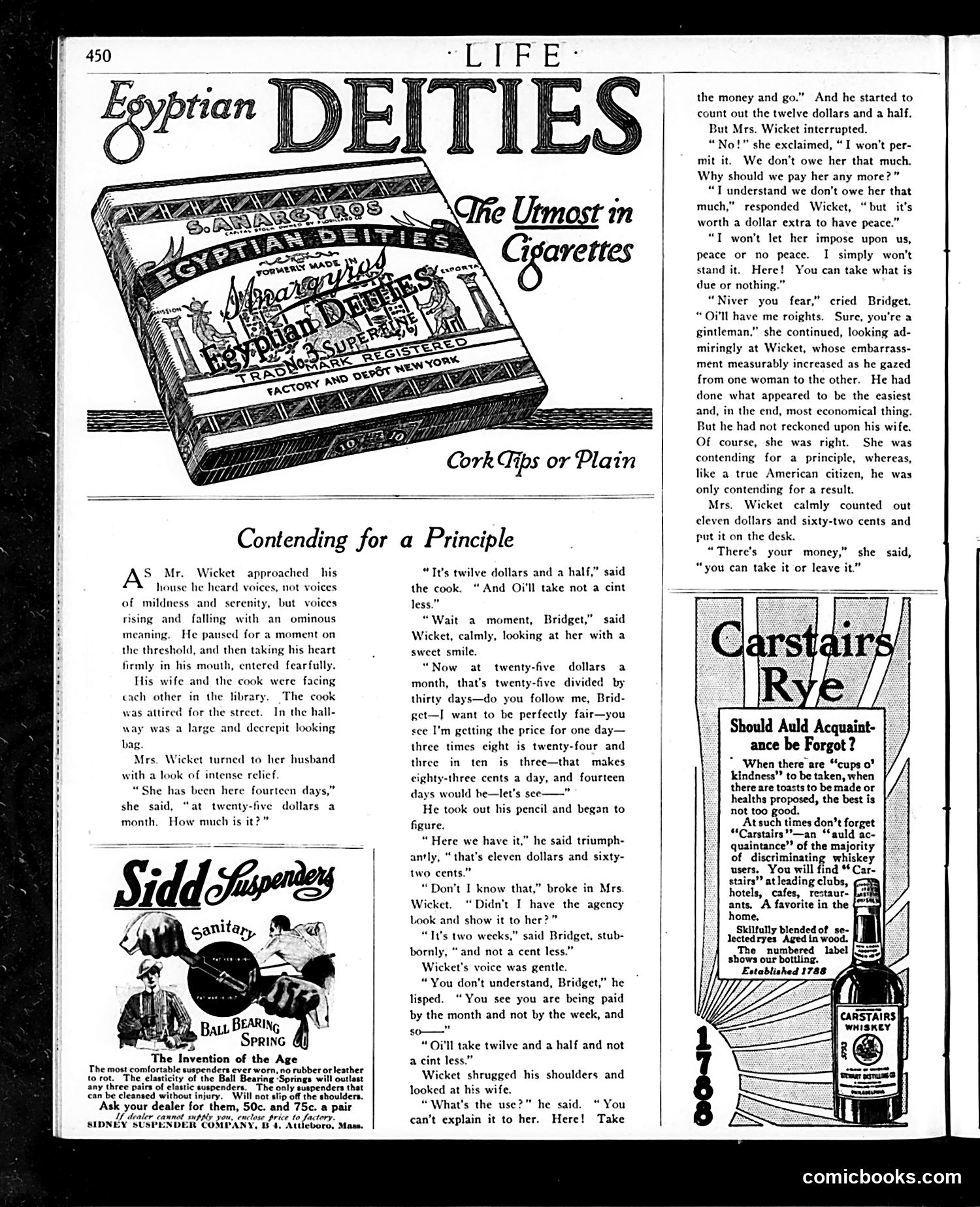
This domestic comedy depicts a dispute between Mr. and Mrs. Wicket over payment to their cook, Bridget, who is leaving after fourteen days. The cook demands two weeks' pay (twelve dollars and a half); Mr. Wicket calculates she's owed only eleven dollars sixty-two cents based on daily rates. The satire targets the difference between male and female approaches to principle: Mr. Wicket is willing to overpay a dollar for "peace"—a pragmatic, results-focused compromise. His wife refuses on principle, insisting on what they actually owe. The text explicitly notes she "was contending for a principle, whereas...he was only contending for a result." The joke suggests that American men prioritize practical outcomes over ethics, while this woman—unusually for the era—upholds moral rigor. It's a mild satire of male expedience, portrayed sympathetically through Mr. Wicket's embarrassment as the two women face off.
📄 Transcribed text from this page (OCR, searchable)
Machine-transcribed from the original scan — historical spelling and the odd misread are preserved.
Cork ips or Plain Contending for a Principle S Mr. Wicket approached his house he heard voices, not voices of mildness and serenity, but voices rising and falling with an ominous meaning. He paused for a moment on the threshold, and then taking his heart firmly in his mouth, entered fearfully, His wife and the cook were facing cach other in the library. The cook was attired for the street. In the hall- way was a large and decrepit looking bag. Mrs. Wicket turned to her husband with a look of intense relief. “She has been here fourteen days,” at twenty-five dollars a she said, month. How much is it?” L my The Invention of the Age “Tr’s twilve dollars and a half,” said the cook. “And Oi'll take not a cint less.” “Wait a moment, Bridget,” said Wicket, calmly, looking at her with a sweet smile. “Now at twenty-five dollars a month, that’s twenty-five divided by thirty days—do you follow me, Brid- get—I want to be perfectly fair—you sce I'm getting the price for one day— three times eight is twenty-four and three in ten is three—that makes cighty-three cents a day, and fourteen days would be—let’s see —” He took out his pencil and began to figure. “ Here we have it,” he said triumph- antly, “that’s eleven dollars and sixty- two cents.” “Don't I know that,” broke in Mrs. Wicket. “Didn't I have the agency Look and show it to her?” “Tt's two weeks,” said Bridget, stub- bornly, “and not a cent less.” Wicket's voice was gentle. “You don’t understand, Bridget,” he lisped. “You see you are being paid by the month and not by the week, and so—" “ Oi'll take twilve and a half and not a cint less.” the money and go.” And he started to count out the twelve dollars and a half. But Mrs. Wicket interrupted. “No!” she exclaimed, “I won't per- mit it. We don’t owe her that much. Why should we pay her any more?” “T understand we don’t owe her that much,” responded Wicket, “but it's worth a dollar extra to have peace.” “T won't let her impose upon us, peace or no peace. I simply won't stand it. Here! You can take what is due or nothing.” “Niver you fear,” cried Bridget. “Oj'll have me roights. Sure, you're a gintleman,” she continued, looking ad- miringly at Wicket, whose embarrass- ment measurably increased as he gazed from one woman to the other. He had done what appeared to be the casiest and, in the end, most economical thing. But he had not reckoned upon his wife. Of course, she was right. She was contending for a principle, whereas, like a true American citizen, he was only contending for a result. Mrs. Wicket calmly counted out eleven dollars and sixty-two cents and put it on the desk. “There’s your money,” she said, “you can take it or leave it.” Should Auld Acquaint- ance be Forgot? When there are “cups 0” kindness” to be taken, when there are toasts to be made or healths proposed, the best is not too good. Atsuch times don’t forget “Carstairs”—an ‘auld ac- quaintance’? of the majority of discriminating whiskey users. You will find ** Car- stairs’ at leading clubs, ga hotels, cafes, restaur- ants, A favorite in the home, Skilfally blended of se- lectedryes Aged in wood. The numbered label shows our bottling. Established 1788 The most comfortable suspenders ever worn, no rubber or leather torot. The elasticity of the Ball Bearing it any three pairs of elastic suspenders. The only suspe can be cleansed without injury. Will not slip off the shoulders. Ask your dealer for them, 50c. and 75c. a pair Uf dealer cannet supply you, enclose price to factory. SIDNEY SUSPENDER COMPANY, B 4, Attleboro, Mass, Wicket shrugged his shoulders and looked at his wife. “What's the use?” he said. “ You can’t explain it to her. Here! Take comicbooks.com