
Life, 1913-09-11 · page 21 of 44
Life — September 11, 1913 — page 21: what you’re looking at
What you’re looking at
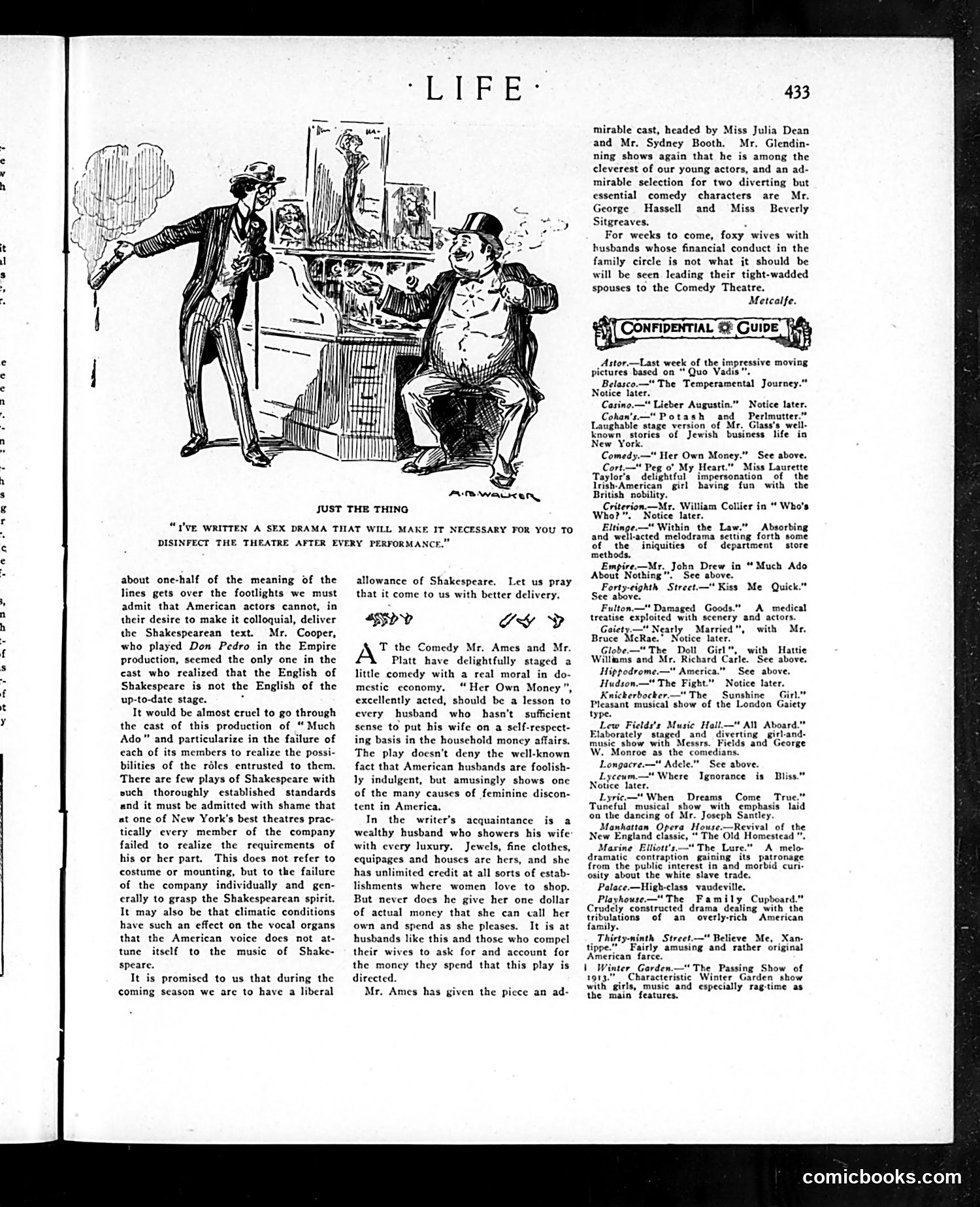
The cartoon titled "Just the Thing" satirizes a playwright's boastful claim that his sexually explicit "sex drama" is so scandalous it requires theater disinfection after each performance. The two figures appear to be a self-aggrandizing dramatist (left, gesturing theatrically) and a skeptical listener (right, seated). The joke mocks the pretension of writers who equate obscenity with artistic merit. The accompanying text critiques American actors' poor delivery of Shakespeare and reviews contemporary comedies, particularly "Her Own Money"—a domestic farce about a husband who denies his wife personal spending money, illustrating marital financial control as a source of feminine discontent. The page reflects early 20th-century theatrical culture and emerging debates about women's economic independence within marriage, treating both high art (Shakespeare) and popular comedy as worthy of serious critical discussion.
📄 Transcribed text from this page (OCR, searchable)
Machine-transcribed from the original scan — historical spelling and the odd misread are preserved.
JUST THE THING “VE WRITTEN A SEX DRAMA THAT WILL MAKE IT NECESSARY FOR YOU TO DISINFECT THE THEATRE AFTER EVERY PERFORMANCE.” about one-half of the meaning of the lines gets over the footlights we must admit that American actors cannot, in their desire to make it colloquial, deliver the Shakespearean text. Mr. Cooper, who played Don Pedro in the Empire production, seemed the only one in the cast who realized that the English of Shakespeare is not the English of the up-to-date stage. g It would be almost cruel to go through the cast of this production of “ Much Ado” and particularize in the failure of cach of its members to realize the possi- bilities of the réles entrusted to them, There are few plays of Shakespeare with uch thoroughly established standards and it must be admitted with shame that at one of New York's best theatres prac- tically every member of the company failed to realize the requirements of his or her part. This does not refer to costume or mounting, but to the failure of the company individually and gen- erally to grasp the Shakespearean spirit. It may also be that climatic conditions have such an effect on the vocal organs that the American voice does not at- tune itself to the music of Shake- speare. It is promised to us that during the coming season we are to have a liberal allowance of Shakespeare. Let us pray that it come to us with better delivery. “Sov Gs DY T the Comedy Mr. Ames and Mr. Platt have delightfully staged a little comedy with a real moral in do- mestic economy. “Her Own Money", excellently acted, should be a lesson to every husband who hasn't sufficient sense to put his wife on a self-respect- ing basis in the houschold money affairs. The play doesn't deny the well-known fact that American husbands are foolish- ly indulgent, but amusingly shows one of the many causes of feminine discon- tent in America, In the writer's acquaintance is a wealthy husband who showers his wife with every luxury. Jewels, fine clothes, equipages and houses are hers, and she has unlimited credit at all sorts of estab- lishments where women love to shop. But never docs he give her one dollar of actual moncy that she can call her own and spend as she pleases. It is at husbands like this and those who compel their wives to ask for and account for the money they spend that this play is directed. Mr. Ames has given the piece an ad- 433 mirable cast, headed by Miss Julia Dean and Mr, Sydney Booth. Mr. Glendin- ning shows again that he is among the cleverest of our young actors, and an ad- mirable selection for two diverting but essential comedy characters are Mr. George Hassell and Miss Beverly Sitgreaves, For weeks to come, foxy wives with husbands whose financial conduct in the family circle is not what it should be will be seen leading their tight-wadded spouses to the Comedy Theatre. Metcalfe. Astor.—Last week of the impressive mo pictures based on “Quo Vadis”. Belasco.—" The Temperamental Journey.” Notice lat Lieber Augustin.” Notice later. —“Potash and Perlmutter.” Laughable stage version of Mr. Glass’s, well- known stories of Jewish business life in New York. See above. Peg of My Heart s Laurette Taylor's delightful impersonation of the Irish-American girl having fun with the British nobility. Absorbing forth some store and well-acted melodrama setti of the iniquities of department methods. Empire-—Mr. John Drew in “Much Ado About Nothing”. "See above. Forty-eighth Street.—" Kiss, Me Quick.” See above. Fulton.—" Damaged Goods.” _A_ medical treatise exploited with scenery and actors. | Married", with Mr. with Hattie Richard Carle. See above. America." See above. Notice later. Knickerbocker.—" The Sunshine Girl."* Pleasant musical show of the London Gaiety type. Lew Fields's Music Hall.—" All Aboard Elaborately staged and diverting girl-and- music show with Messrs. Fields and George W. Monroe as the comedians. Longacre.—" Adele.” See above. Lyceum.—" Where Ignorance is Notice later. Lyric —"" When Dreams Come True. Tuneful musical show with emphasis laid on the dancing of Mr. Joseph Santley. Manhattan Opera House.—Revival of the New England classic, * The Old Homestead". Maxine Eltiott’s—" The Lure.” A. melo- dramatic contraption gaining its patronage from the public interest in and morbid curi- osity about the white slave trade. Palace-—High-class vaudeville, Playhouse—"The Family Cupboard.” Crudely constructed drama dealing with the tribulations of an overly-rich American i Willams and M Hippodrome. Hudson.—" The Fight. Bliss.” _Thirty-ninth Street—" Believe Me, Xan- tippe. Fairly amusing and rather original American farce. 3. Garden show with girls, music and especially ragtime as the main features. comicbooks.com