
Life, 1913-09-11 · page 20 of 44
Life — September 11, 1913 — page 20: what you’re looking at
What you’re looking at
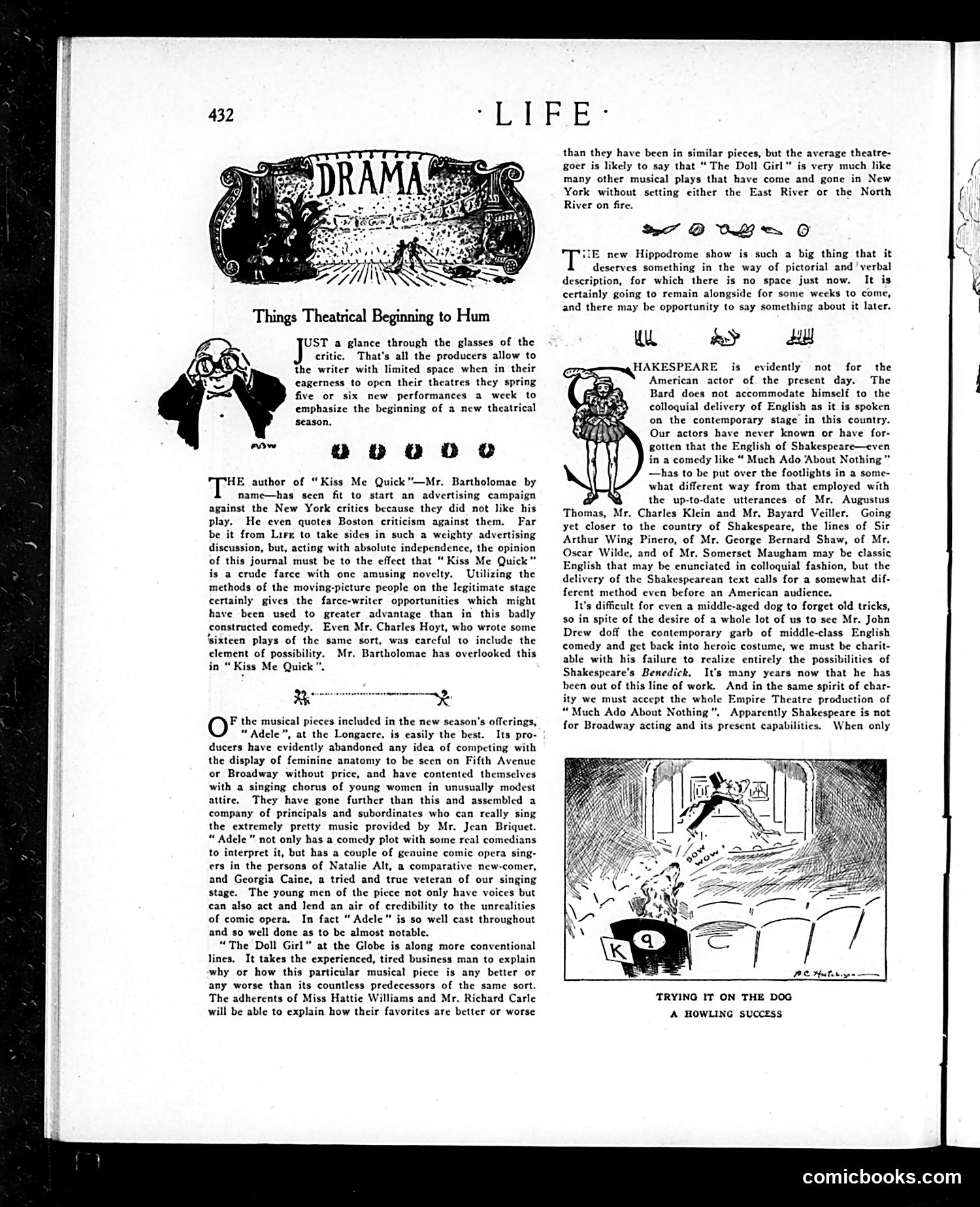
This page reviews the 1909 theatrical season's new productions. The main satire targets playwright Mr. Bartholomae, who publicly attacked New York critics for panning his play "Kiss Me Quick." Life mocks both the play (calling it a "crude farce") and Bartholomae's defensive advertising campaign, noting his attempt to invoke Boston critics as allies against New York's judgment. The reviews evaluate several musicals: "Adele" receives genuine praise for its modest chorus and actual singing talent (unusual for the era), while "The Doll Girl" is dismissed as indistinguishable from countless similar productions. The page's larger point criticizes American actors' inability to properly perform Shakespeare, arguing they've abandoned the formal vocal delivery the text requires, imposing instead contemporary colloquial speech patterns unsuited to the material. The cartoon "Trying It On the Dog" (bottom) illustrates theatrical rehearsal/tryout practices.
📄 Transcribed text from this page (OCR, searchable)
Machine-transcribed from the original scan — historical spelling and the odd misread are preserved.
Ease Things Theatrical Beginning to Hum UST a glance through the glasses of the critic, That's all the producers allow to the writer with limited space when in their eagerness to open their theatres they spring five or six new performances a week to emphasize the beginning of a new theatrical season, oo 00 0 'HE author of “Kiss Me Quick"—Mr. Bartholomae by name—has seen fit to start an advertising campaign against the New York critics because they did not like his play. He even quotes Boston criticism against them. Far be it from Lire to take sides in such a weighty advertising discussion, but, acting with absolute independence, the opinion of this journal must be to the effect that “Kiss Me Quick” is a crude farce with one amusing novelty. Utilizing the methods of the moving-picture people on the legitimate stage certainly gives the farce-writer opportunities which might have been used to greater advantage than in this badly constructed comedy. Even Mr. Charles Hoyt, who wrote some ‘sixteen plays of the same sort, was careful to include the element of possibility. Mr. Bartholomae has overlooked this in “ Kiss Me Quick”. Rom ee F the musical pieces included in the new season's offerings, “Adele”, at the Longacre. is easily the best. Its pro- ducers have evidently abandoned any idea of competing with the display of feminine anatomy to be scen on Fifth Avenue or Broadway without price, and have contented themselves with a singing chorus of young women in unusually modest attire. They have gone further than this and assembled a company of principals and subordinates who can really sing the extremely pretty music provided by Mr. Jean Briquet. “ Adele” not only has a comedy plot with some real comedians to interpret it, but has a couple of genuine comic opera sing- ers in the persons of Natalie Alt, a comparative new-comer, and Georgia Caine, a tried and true veteran of our singing stage. The young men of the piece not only have voices but can also act and Iend an air of credibility to the unrcalities of comic opera. In fact “Adele” is so well cast throughout and so well done as to be almost notable. The Doll Girl” at the Globe is along more conventional lines. It takes the experienced, tired business man to explain why or how this particular musical picce is any better or any worse than its countless predecessors of the same sort. The adherents of Miss Hattie Williams and Mr. Richard Carle will be able to explain how their favorites are better or worse than they have been in similar pieces, but the average theatre- goer is likely to say that “ The Doll Girl” is very much like many other musical plays that have come and gone in New York without setting either the East River or the North River on fire. eZ OB OL O IE new Hippodrome show is such a big thing that it deserves something in the way of pictorial and’ verbal description, for which there is no space just now. It is certainly going to remain alongside for some weeks to come, and there may be opportunity to say something about it later. cS ey A HAKESPEARE is evidently not for the American actor of the present day. The Bard does not accommodate himself to the colloquial delivery of English as it is spoken on the contemporary stage in this country. Our actors have never known or have for- gotten that the English of Shakespeare—even in a comedy like “ Much Ado About Nothing” —has to be put over the footlights in a some- what different way from that employed with the up-to-date utterances of Mr. Augustus Thomas, Mr. Charles Klein and Mr. Bayard Veiller. Going yet closer to the country of Shakespeare, the lines of Sir Arthur Wing Pinero, of Mr. George Bernard Shaw, of Mr. Oscar Wilde, and of Mr. Somerset Maugham may be classic English that may be enunciated in colloquial fashion, but the delivery of the Shakespearean text calls for a somewhat dif- ferent method even before an American audience. It’s difficult for even a middle-aged dog to forget old tricks, so in spite of the desire of a whole lot of us to see Mr. John Drew doff the contemporary garb of middle-class English comedy and get back into heroic costume, we must be charit- able with his failure to realize entirely the possibilities of Shakespeare's Benedick, It’s many years now that he has been out of this line of work. And in the same spirit of char- ity we must accept the whole Empire Theatre production of “Much Ado About Nothing”. Apparently Shakespeare is not for Broadway acting and its present capabilities. When only TRYING IT ON THE DOG A HOWLING SUCCESS comicbooks.com