
Life, 1913-09-11 · page 43 of 44
Life — September 11, 1913 — page 43: what you’re looking at
What you’re looking at
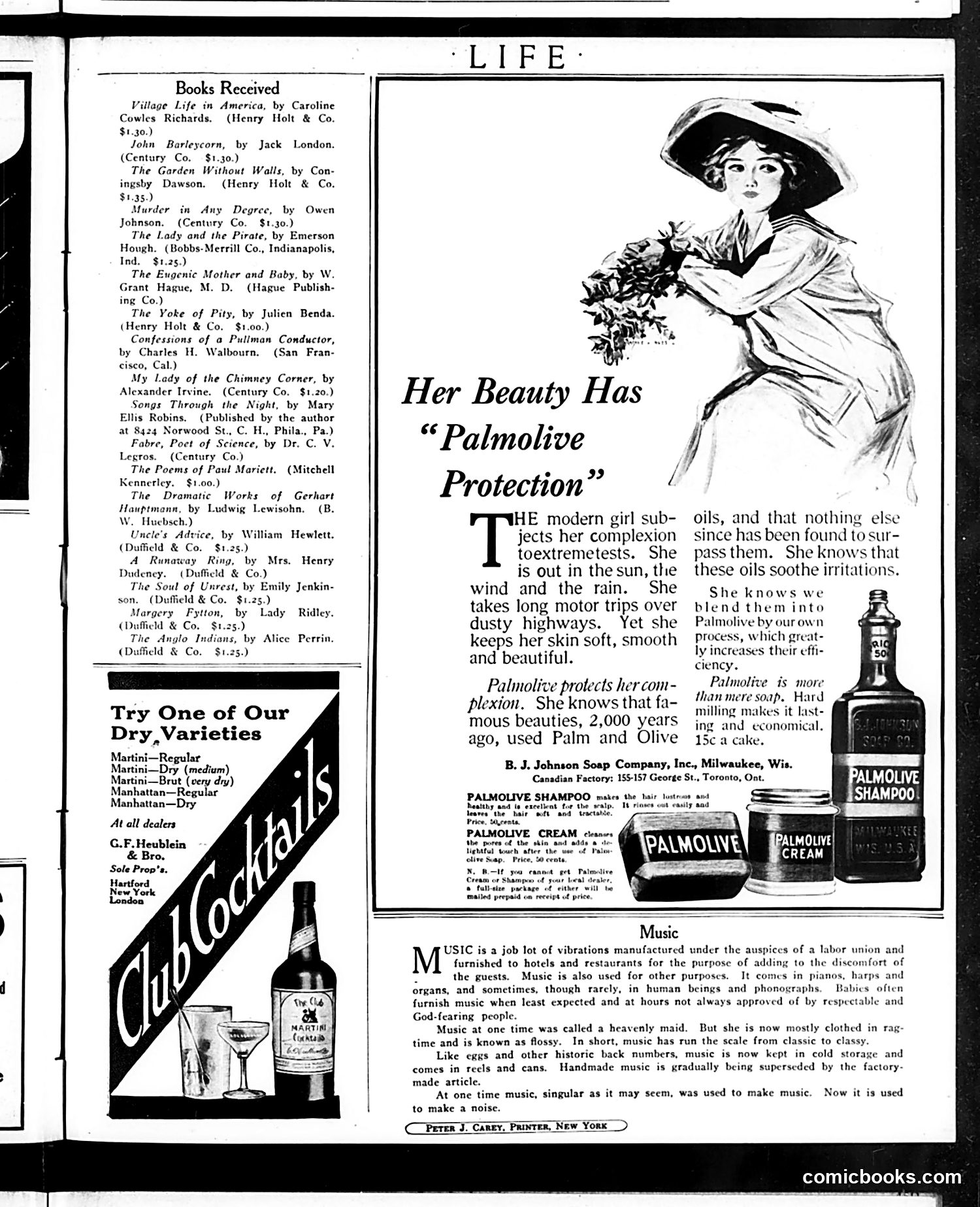
This page is primarily **advertising and book reviews**, not political satire. The main content includes: **Left side:** A book review section listing recent publications (Jack London's *John Barleycorn*, Owen Johnson's *Murder in Any Degree*, etc.) and an advertisement for Heublein cocktails ("Try One of Our Dry Varieties"). **Right side:** A full-page **Palmolive soap advertisement** featuring an illustrated woman with a large hat and flowers, claiming the product protects modern girls' complexions from sun, wind, and rain during motor trips. **Bottom section:** A **humorous definition of "Music"** that satirizes modern entertainment—describing it as manufactured "vibrations" provided by labor unions to hotels and restaurants, now mass-produced in "reels and cans" rather than handmade. The piece mocks how music has devolved from "classic to classy" and is now used "to make a noise" rather than music itself. The satire targets mechanization and commercialization of culture rather than politics.
📄 Transcribed text from this page (OCR, searchable)
Machine-transcribed from the original scan — historical spelling and the odd misread are preserved.
Books Received Village Life in America, by Caroline Cowles Richards, (Henry Holt & Co. $1.30.) John Barleycorn, by Jack London. (Century Co. $1.30.) The Garden Without Walls, by Con- ingsby Dawson. (Henry Holt & Co. ) Murder in Any Degree, by Owen Johnson. (Century Co. $1.30.) The Lady and the Pirate, by Emerson Hough. (Bobbs-Merrill Co., Indianapolis, Ind. $1.25.) The Eugenic Mother and Baby, by W. Grant Hague, M. D, (Hague Publish- ing Co.) The Yoke of Pity, by Julien Benda. (Henry Holt & Co. $1.00.) Confessions of a Pullman Conductor, by Charles H. Walbourn, (San Fran- cisco, Cal.) My Lady of the Chimney Corner, by Alexander Irvine. (Century Co. $1.20.) Songs Through the Night, by Mary Ellis Robins. (Published by the author at 8424 Norwood St. C. H., Phila. Pa.) Fabre, Poet of Science, by Dr. C. V. Legros. (Century Co.) The Poems of Paul Mariett, (Mitchell Kennerley. $1.00.) The Dramatic Works of Gerhart Hauptmann, by Ludwig Lewisohn, (B. W. Huebsch.) Unele’s Advice, by William Hewlett. (Duffield & Co. $1.25.) A Runaway Ring, by Mrs, Henry Dudeney. (Duffield & Co.) The Soul of Unrest, by Emily Jenkin- son. (Duffield & Co. $1.25.) Margery Fytton, by Lady Ridley. (Duffield & Co. $1.25.) The Anglo Indians, by Alice Perrin. (Duffield & Co. Try One of Our Dry, Varieties Martini—Regular Mart ‘Dry (medium) Martini—Brut (very dry) Manhattan—Regular Manhattan—| At all dealers G.F,Heublein & Bro. Sole Prop’s. Her Beauty Has Palmolive Protection” f HE modern girl sub- oils, and that nothing else jects her complexion _ since has been found to sur- toextremetests. She passthem. She knows that is out in the sun, the these oils soothe irritations. wind and the rain. She — she knows we takes long motor trips over blend them into dusty highways. Yet she Palmolive by our own keeps her skin soft, smooth — precess, which great- anit ly increases their effi- and beautiful. aeney, Palmolive protects her com- Rayisied is more plexion. She knows that fa- “anmere soap. Hard : milling makes it last- mous beauties, 2,000 years ing and economic: ago, used Palm and Olive 15¢ a cake. B. J. Johnson Soap Company, Inc., Milwaukee, Wis. Canadian Factory: 155-157 George St., Toronto, Ont. PALMOLIVE CREAM cesows the pores of the shin and adds Highttul touch after the wee of clive Susp. Price, cents X. Bit you cannot get Palmolive Cream of Shampoo uf $v © falleize parkage of either will te mailed peepaid on receipt uf price, USIC is a job lot of vibrations manufactured under the auspices of a labor union and furnished to hotels and restaurants for the purpose of adding to the discomfort of : the guests. Music is also used for other purposes. It comes in pianos, harps and organs, and sometimes, though rarely, in human beings and phonographs. Babics often furnish music when least expected and at hours not always approved of by respectable and God-fearing people. Music at one time was called a heavenly maid. But she is now mostly clothed in rag- time and is known as flossy. In short, music has run the scale from classic to classy. Like eggs and other historic back numbers, music is now kept in cold storage and comes in reels and cans. Handmade music is gradually being superseded by the factory- made article. At one time music, singular as it may seem, was used to make music. Now it is used to make a noise. (Peter REY, Painter, New YoRx comicbooks.com