
Life, 1913-09-11 · page 25 of 44
Life — September 11, 1913 — page 25: what you’re looking at
What you’re looking at
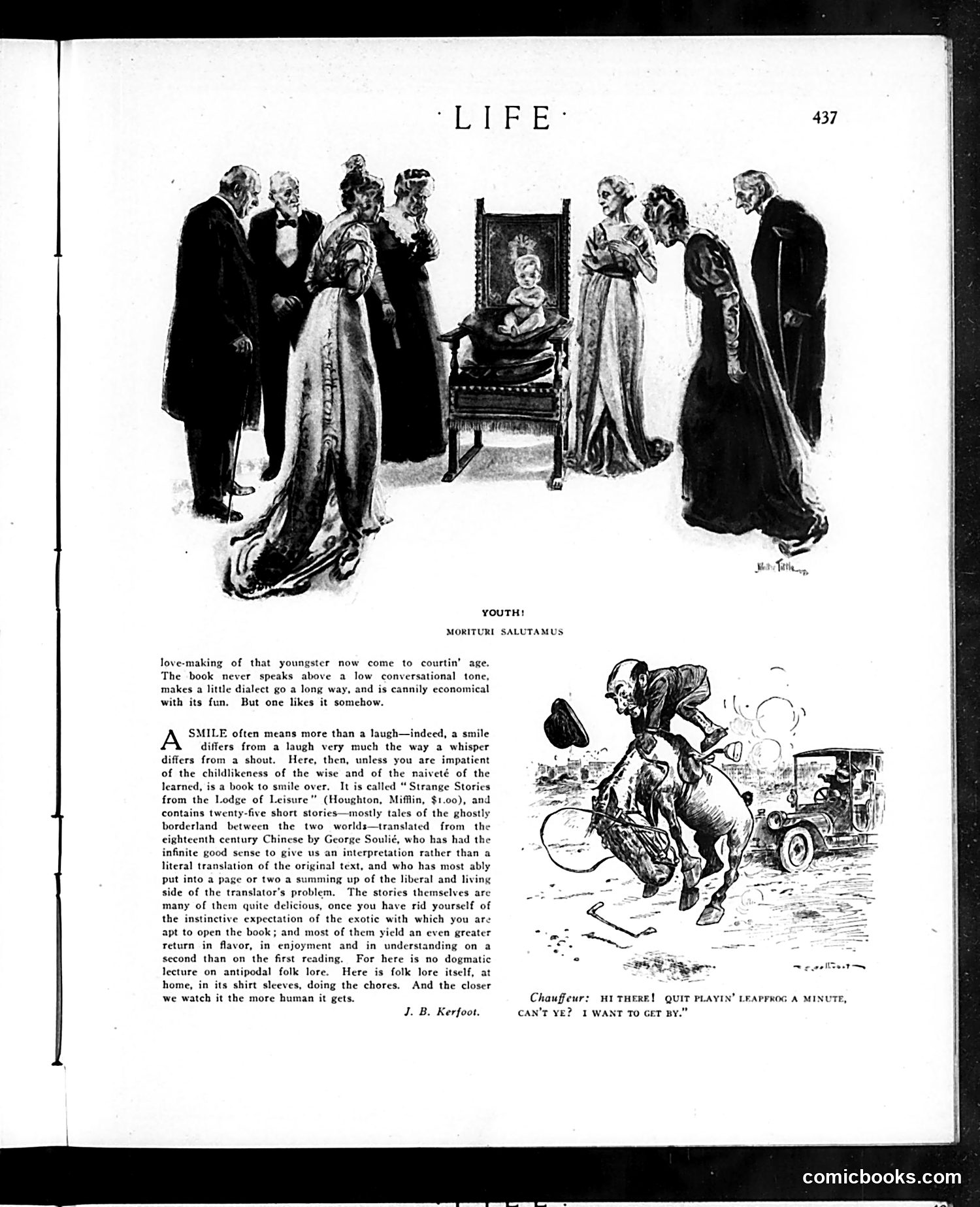
**Top Illustration ("Youth! Morituri Salutamus"):** A formal Victorian-era scene depicting a young woman being presented to society—likely a debutante ball or courtship ritual. The title's Latin phrase ("Those about to die salute you") ironically suggests the solemnity with which society treats young romance and marriage arrangements. **Bottom Cartoon ("Chauffeur"):** A slapstick humor piece showing a chauffeur frustrated with children playing leapfrog in front of his automobile, blocking his passage. The joke plays on the tension between modern motorized transportation and old-fashioned street play—a common early-20th-century satire theme as cars increasingly displaced traditional urban recreation. **Text:** A book review praising "Strange Stories from the Lodge of Leisure," translated Chinese ghost tales valued for their accessible folk wisdom rather than exotic mystique. Both items reflect *Life* magazine's characteristic blend of social observation, gentle satire about courtship/class conventions, and humor about modern inconveniences.
📄 Transcribed text from this page (OCR, searchable)
Machine-transcribed from the original scan — historical spelling and the odd misread are preserved.
ERI SRS Et 437 YOUTH! MORITURI SALUTAMUS love-making of that youngster now come to courtin’ age. The book never speaks above a low conversational tone, makes a little dialect go a long way, and is cannily economical with its fun. But one likes it somehow. A SMILE often means more than a laugh—indeed, a smile differs from a laugh very much the way a whisper differs from a shout. Here, then, unless you are impatient of the childlikeness of the wise and of the naiveté of the learned, is a book to smile over, It is called “ Strange Stories from the Lodge of Leisure" (Houghton, Mifflin, $1.00), and contains twenty-five short stories—mostly tales of the ghostly borderland between the two worlds—translated from the eighteenth century Chinese by George Soulié, who has had the infinite good sense to give us an interpretation rather than a literal translation of the original text, and who has most ably put into a page or two a summing up of the liberal and living side of the translator's problem. The stories themselves are many of them quite delicious, once you have rid yourself of the instinctive expectation of the exotic with which you are apt to open the book; and most of them yield an even greater return in flavor, in enjoyment and in understanding on a second than on the first reading. For here is no dogmatic lecture on antipodal folk lore. Here is folk lore itself, at home, in its shirt sleeves, doing the chores. And the closer we watch it the more human it gets. Chauffeur: 11 THERE! QUIT PLAYIN’ LEAPFROG A MINUTE, J. B. Kerfoot. CAN'T YE? I WANT TO GET BY.” comicbooks.com