
A complete issue · 52 pages · 1913
Life — June 19, 1913
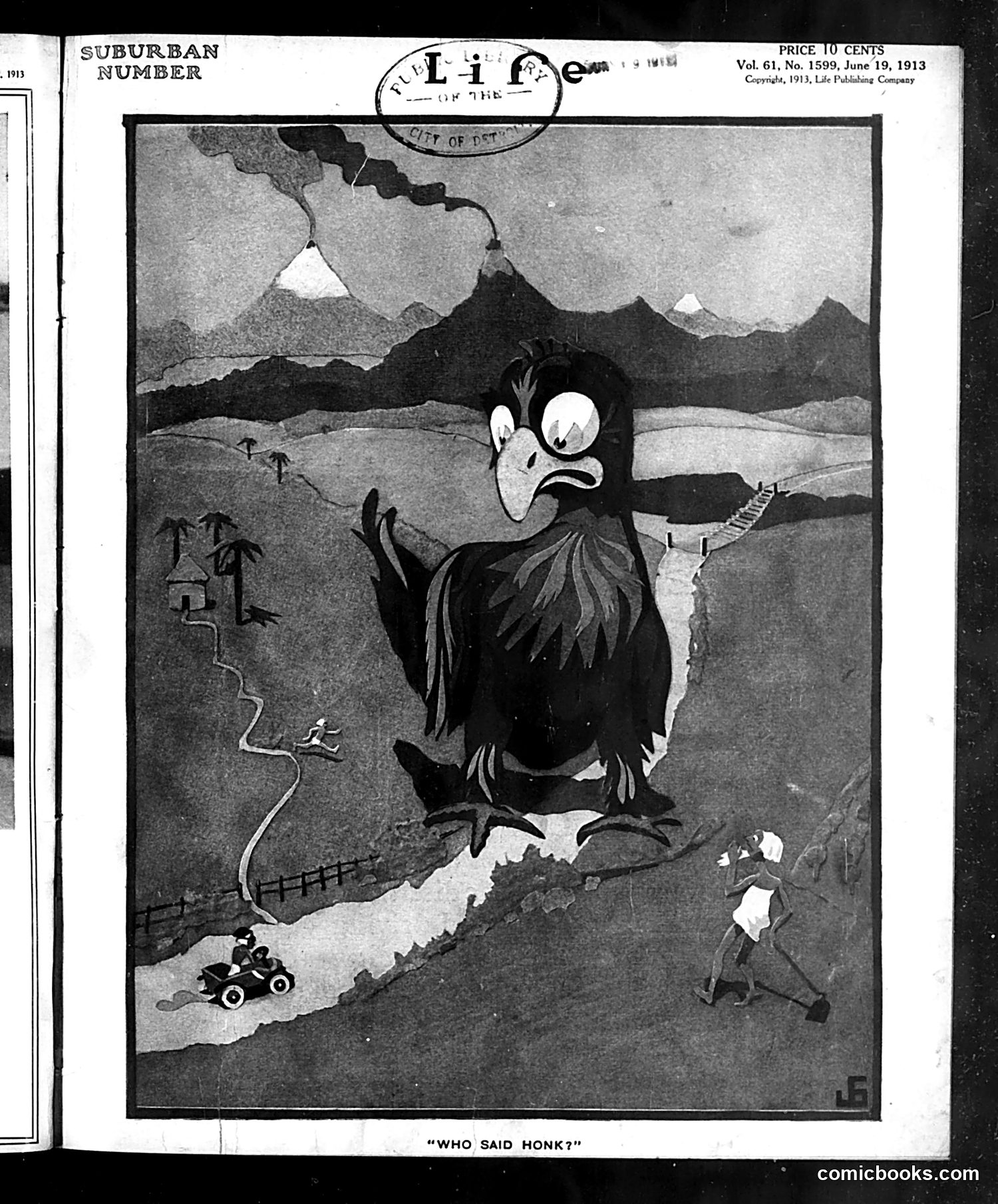
This cartoon from *Life* magazine (June 19, 1913) depicts a large, aggressive bird—likely representing a goose—confronting smaller human figures in a rural landscape. The bird appears cartoonishly menacing, with exaggerated features and an angry expression. The title "Who Said Honk?" suggests the cartoon plays on the goose's characteristic sound. The smaller figures—one appears to be driving an early automobile, another wielding a tool—seem to represent ordinary people or farmers reacting to this oversized creature. Without additional context from the issue, the specific political or social reference remains unclear. It may represent anxieties about rural disruption, agricultural concerns, or could be purely humorous satire typical of *Life*'s entertainment content. The exact meaning would benefit from accompanying article text.
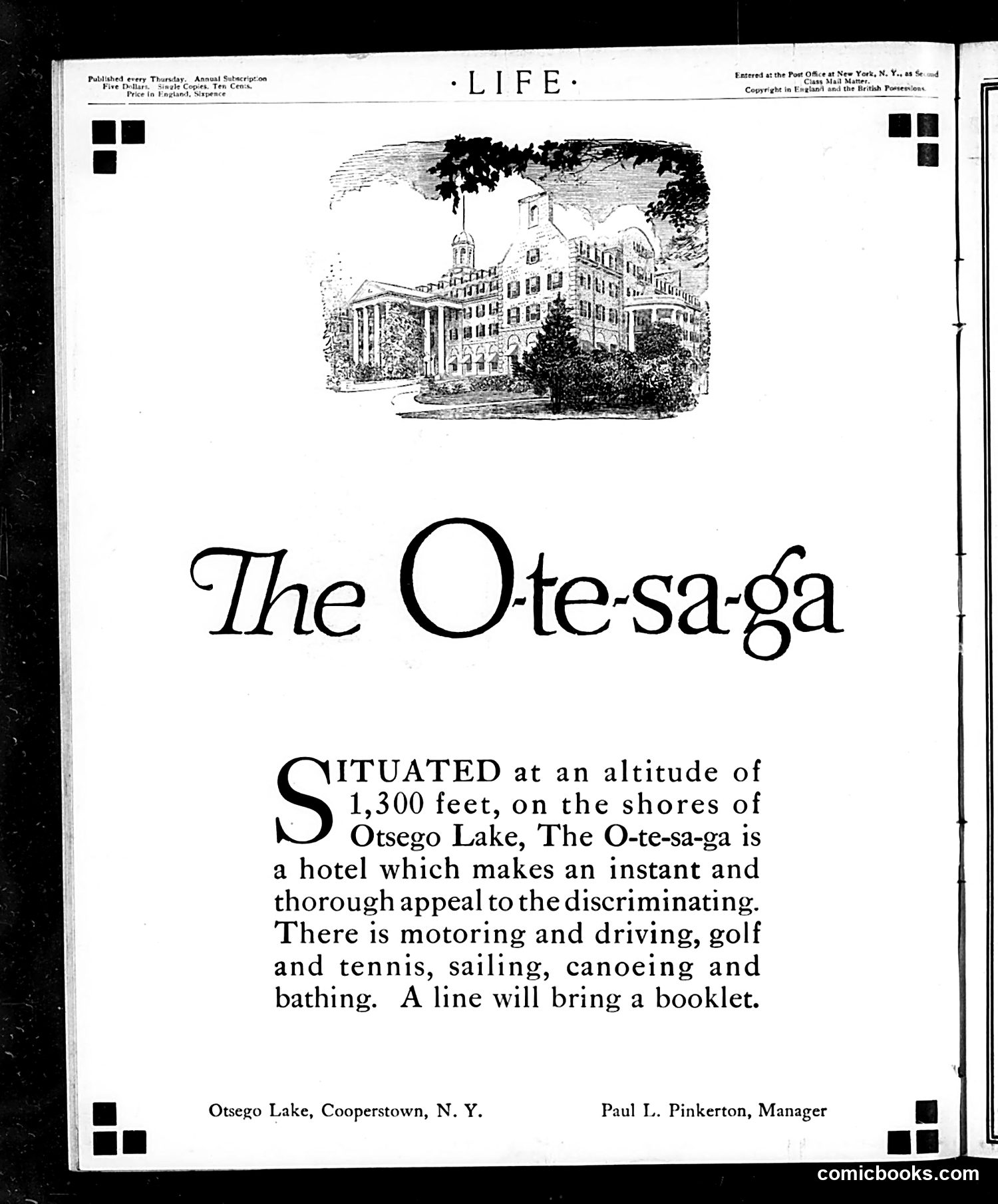
This page is primarily an advertisement for The O-te-sa-ga hotel, located on Otsego Lake in Cooperstown, New York, managed by Paul L. Pinkerton. The ad features an architectural sketch of the hotel building at the top and describes leisure amenities: motoring, driving, golf, tennis, sailing, canoeing, and bathing. The hotel is situated at 1,300 feet altitude. This is not a political cartoon or satirical content—it's a straightforward hospitality advertisement from Life magazine's advertising section. The page demonstrates how early 20th-century Life magazine, known for satire and humor, also carried commercial advertisements to support publication costs. No political or social commentary is present.
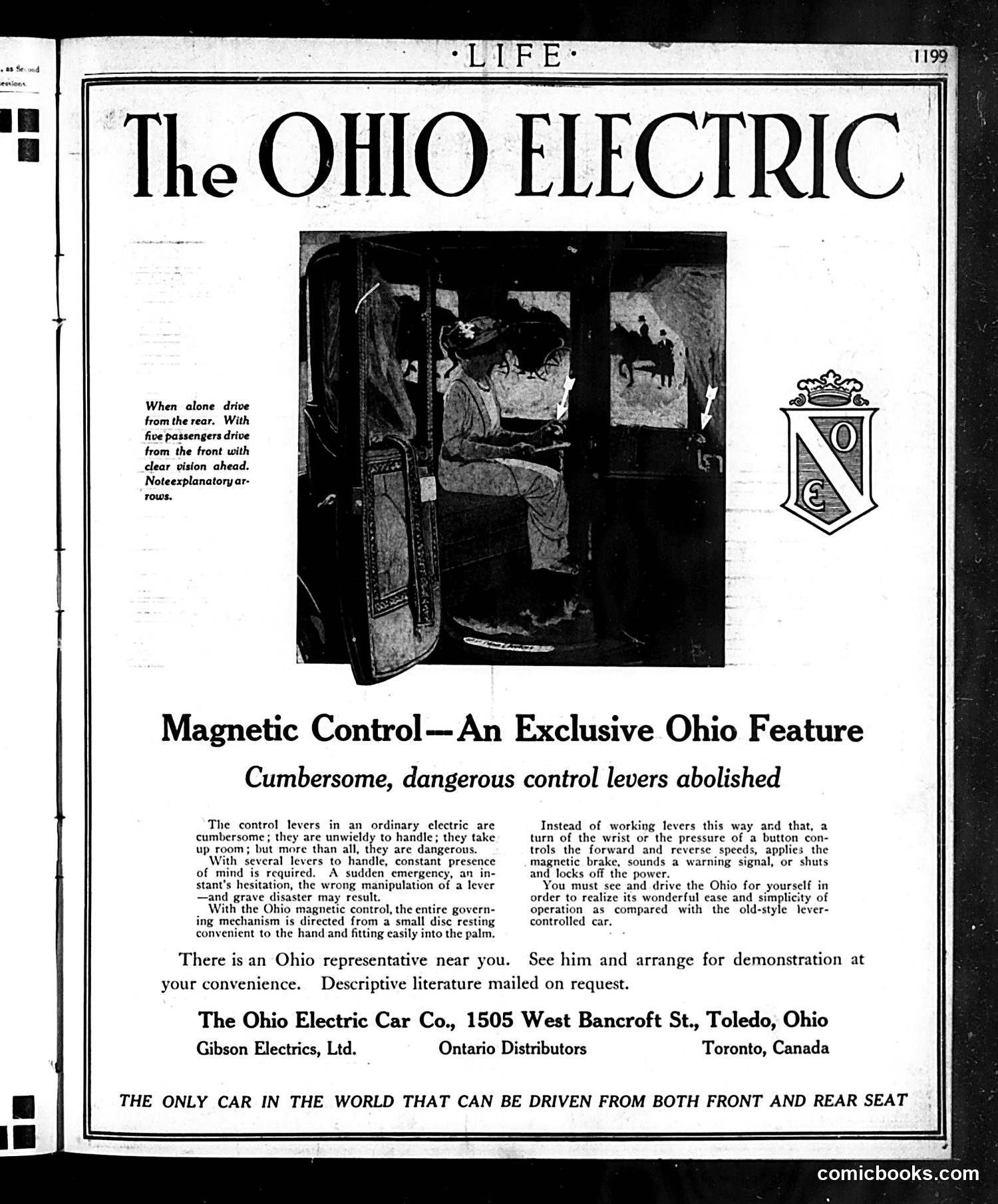
This page is primarily **advertising, not satire or political commentary**. It's a full-page advertisement for the Ohio Electric Car, published in Life magazine (page 1199). The ad promotes the car's "Magnetic Control" system as an exclusive feature, emphasizing safety by eliminating "cumbersome, dangerous control levers" found in ordinary electric vehicles. Instead of multiple levers requiring constant attention, the Ohio Electric uses a magnetic disc system operable from the palm—safer for emergency situations. The central photograph shows the car's interior with passengers. The headline boasts that this is "THE ONLY CAR IN THE WORLD THAT CAN BE DRIVEN FROM BOTH FRONT AND REAR SEAT." This reflects early 1900s electric vehicle technology and marketing, when such innovations were genuinely novel selling points.
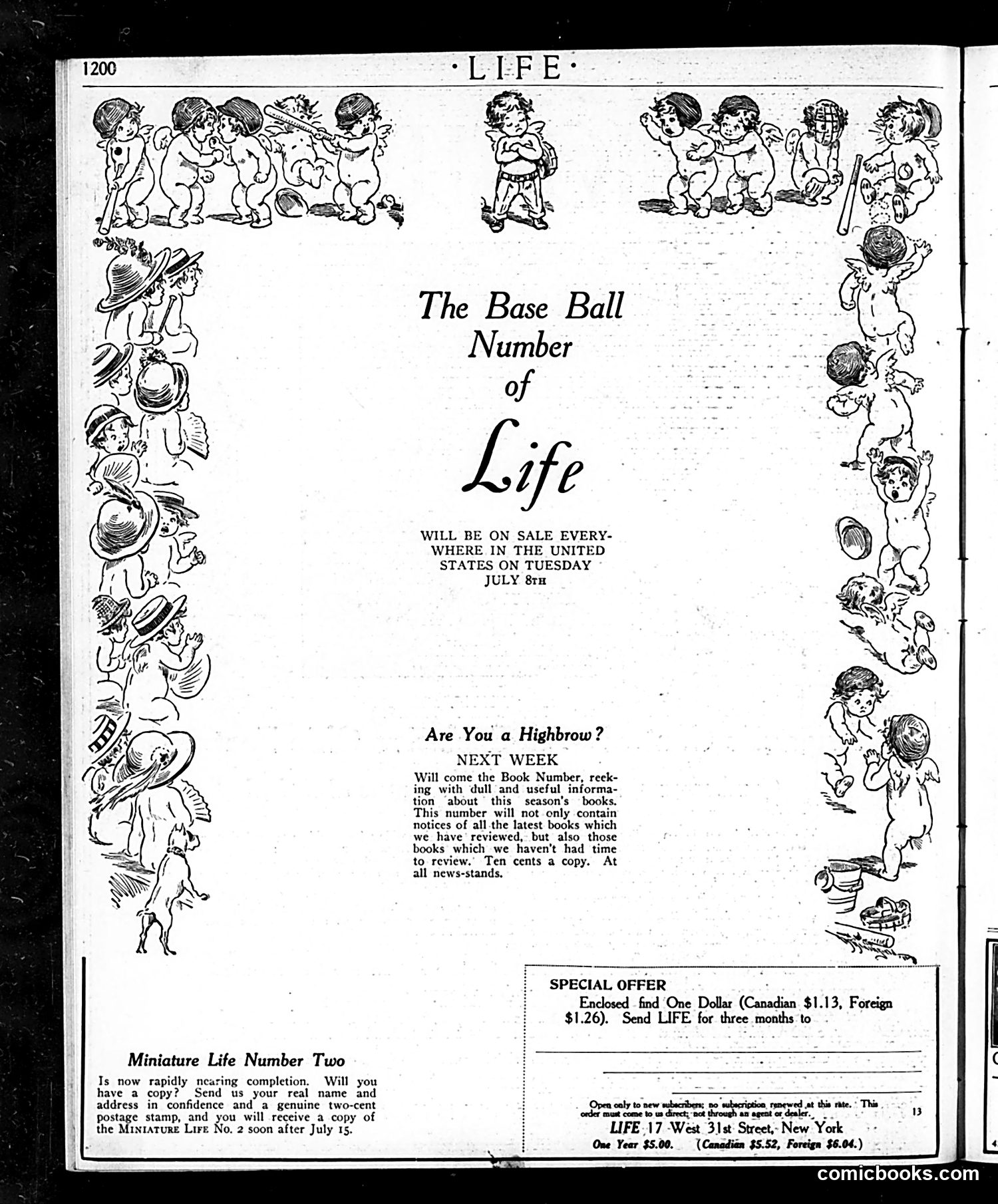
This page is primarily **advertising and promotional content** rather than political satire. The main feature announces "The Base Ball Number of Life" available for sale Tuesday, July 8th, with decorative borders of cherubs playing baseball and wearing various hats. The page includes promotional material for upcoming issues (notably "Are You a Highbrow?" for the next week's Book Number) and a subscription offer. The "Miniature Life Number Two" section requests readers send their real names and addresses to receive a two-cent postage stamp and a copy of an earlier issue. The baseball imagery reflects the sport's popularity during this era, but the page itself functions as a commercial advertisement rather than editorial satire or commentary.
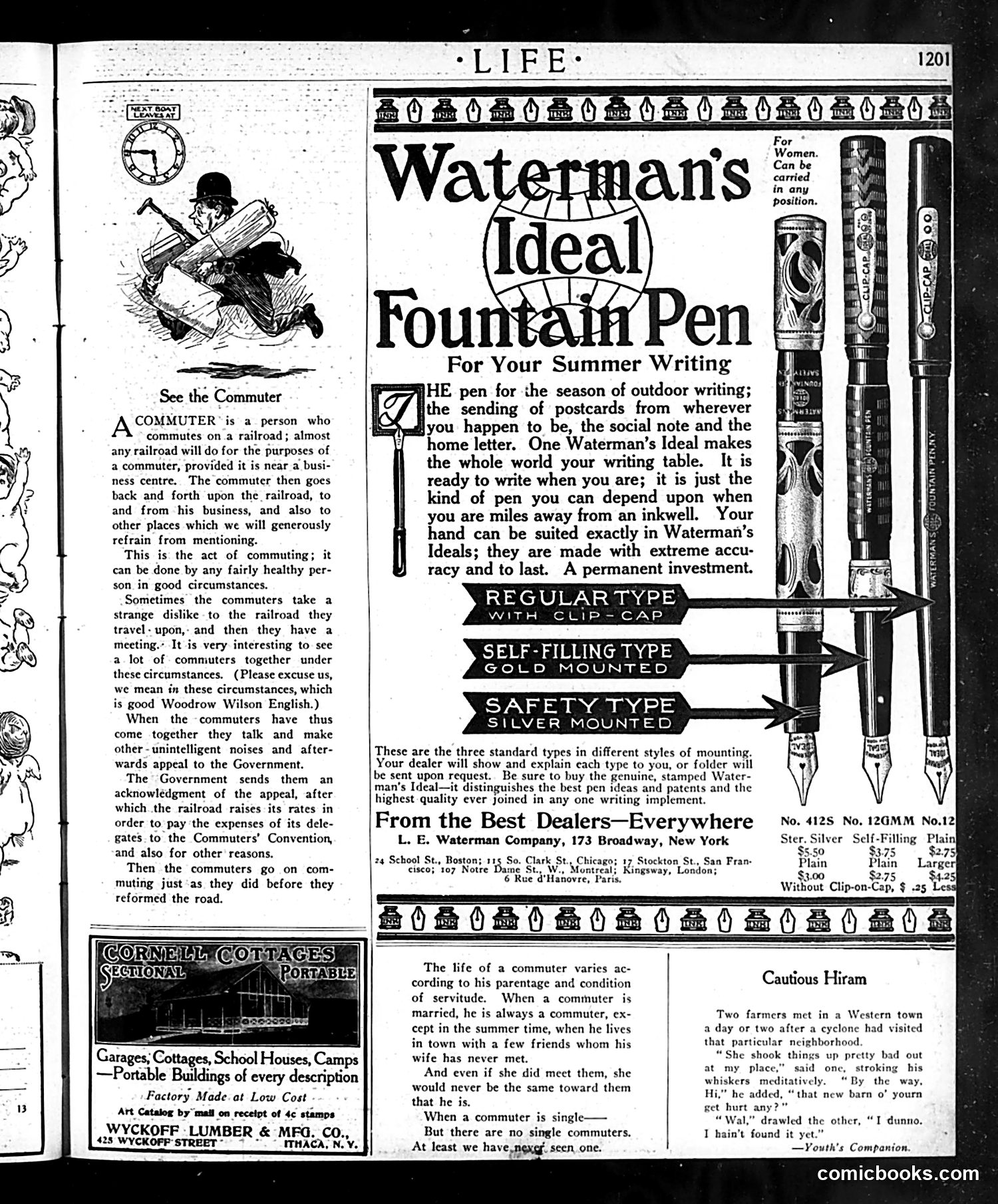
This page is primarily **advertising for Waterman's Ideal Fountain Pen**, occupying the right two-thirds of the layout. The ad emphasizes the pen's reliability for summer travel and outdoor writing, targeting professionals and travelers who need dependable writing instruments away from home. The left side contains a **satirical piece titled "See the Commuter,"** defining and gently mocking the figure of the railroad commuter—a person who travels daily between home and business. The satire humorously notes that commuters form conventions and collectively petition the government, suggesting they've become an organized social class with political influence. The tone is lighthearted social commentary on emerging urban commuting culture and its unexpected civic power. The page is primarily commercial rather than overtly political.
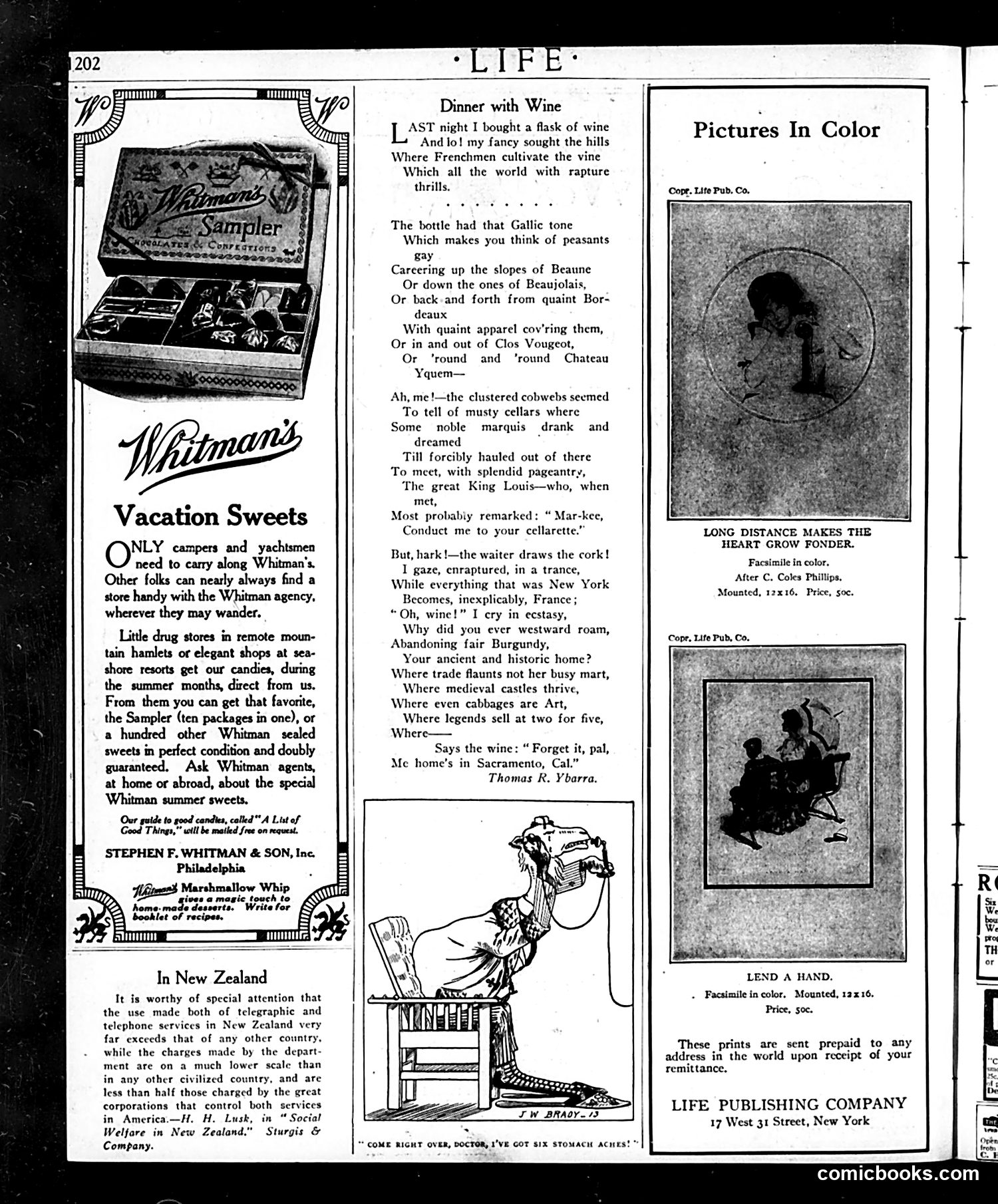
This page is primarily **advertising and literary content** rather than political satire. The left side features a **Whitman's candy advertisement** promoting their "Vacation Sweets" sampler boxes for travelers. The text emphasizes these candies' convenience for campers and yacht travelers. The center contains **"Dinner with Wine,"** a romantic poem by Thomas R. Ybarra romanticizing French wine regions and expressing homesickness for California. The right side shows two **color photographs** available for purchase from Life Publishing Company—one depicting a long-distance couple and another showing two people in an intimate moment. The bottom cartoon depicts a man at what appears to be a lunch counter, claiming stomach troubles as an excuse, likely a mild social humor about digestive complaints. This is primarily a **commercial page with light entertainment**, not political commentary.
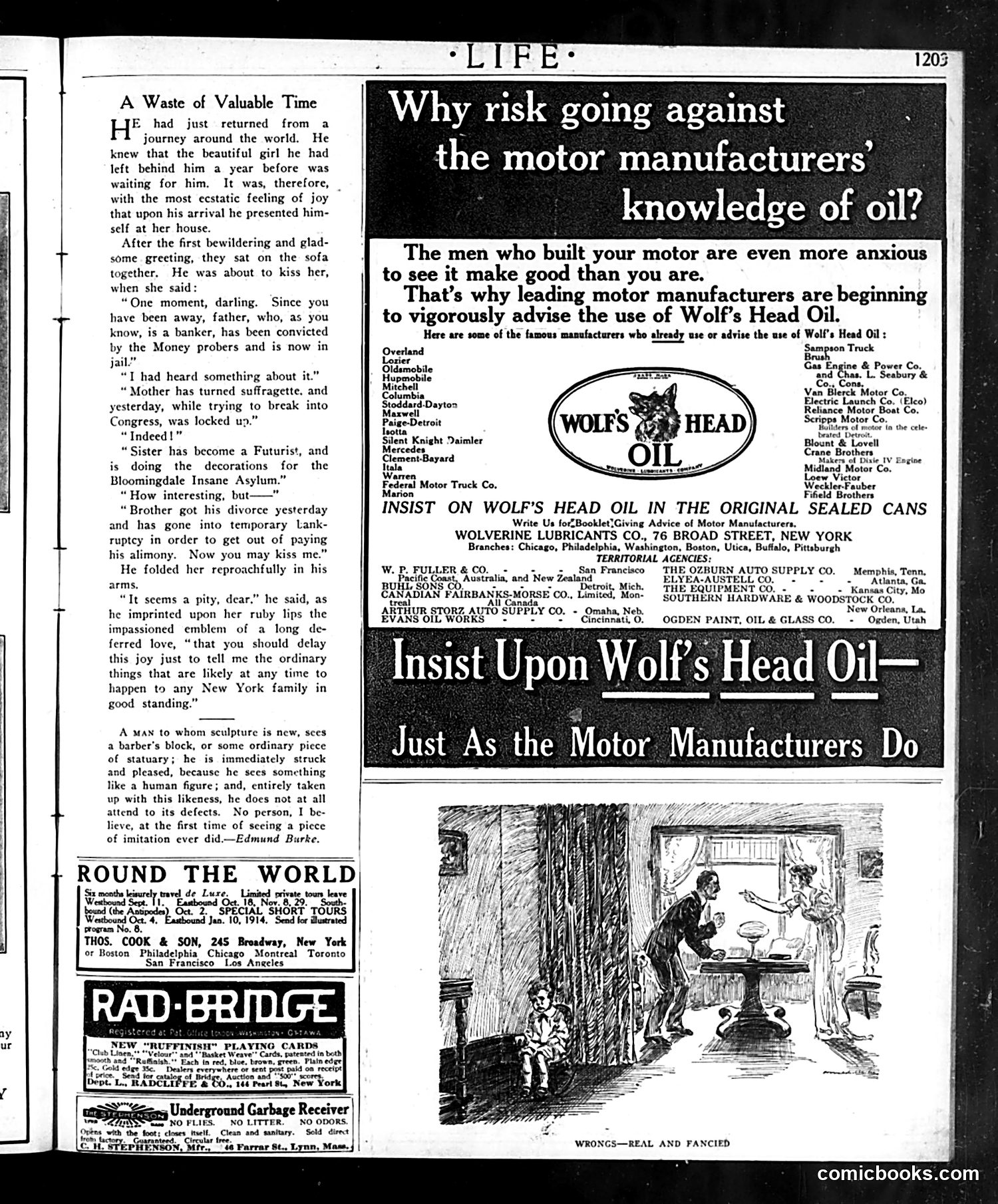
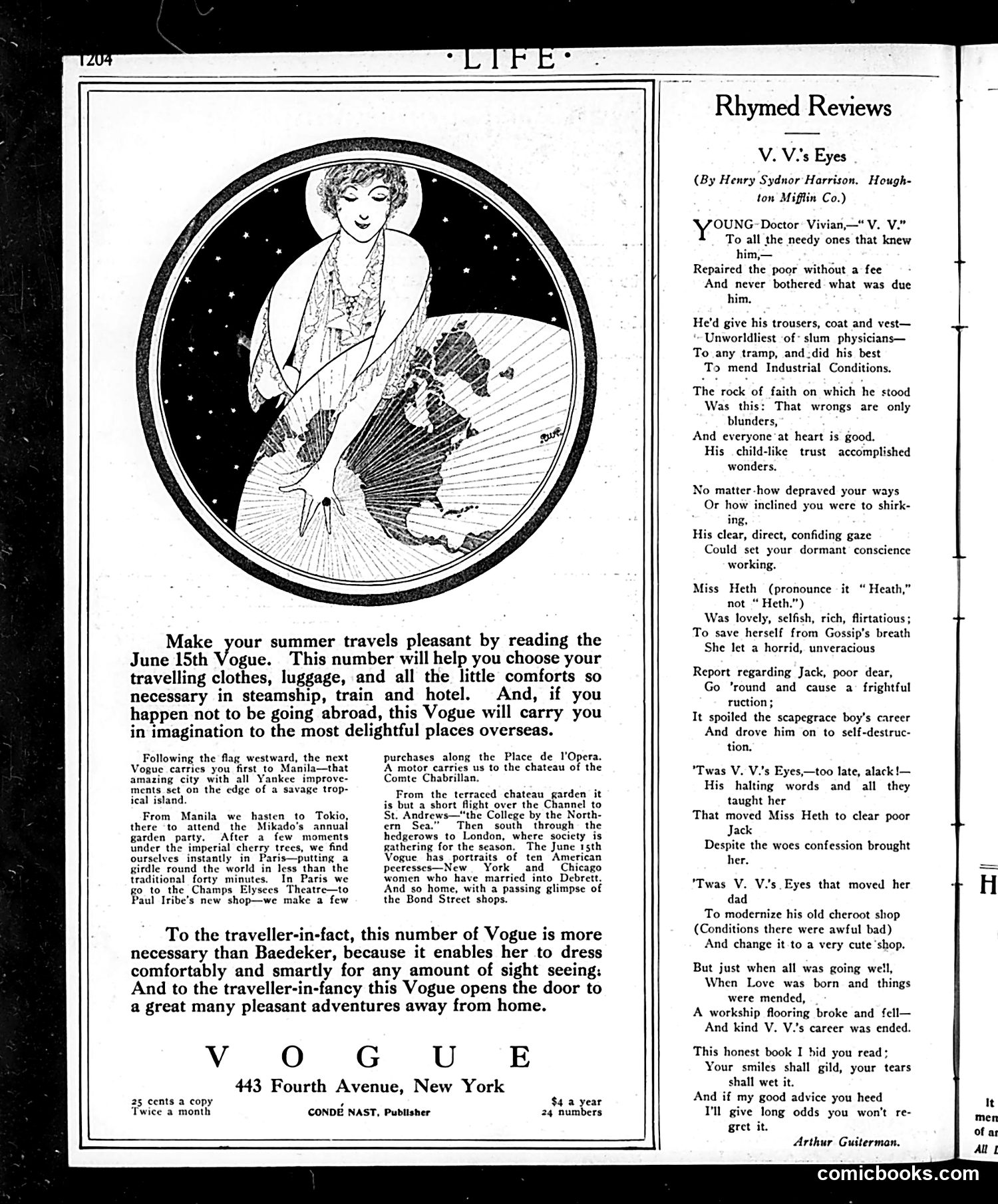
This page is primarily a **Vogue magazine advertisement** (left side) promoting summer travel reading, with a separate section of **rhymed book reviews** (right side). The advertisement features an Art Deco illustration of a stylish woman with a fan, encouraging readers to use Vogue to plan overseas travel and select appropriate clothing for steamship and hotel travel. The "Rhymed Reviews" section critiques a book titled "V.V.'s Eyes" by Henry Sydnor Harrison. The poem reviews the novel's protagonist—a virtuous young doctor named Vivian who helps the poor without fee, eventually winning over a selfish woman named Miss Heth through his moral character. The review, signed by Arthur Guiterman, summarizes the plot's romantic redemption arc in satirical verse form, poking gentle fun at the book's melodramatic morality tale.
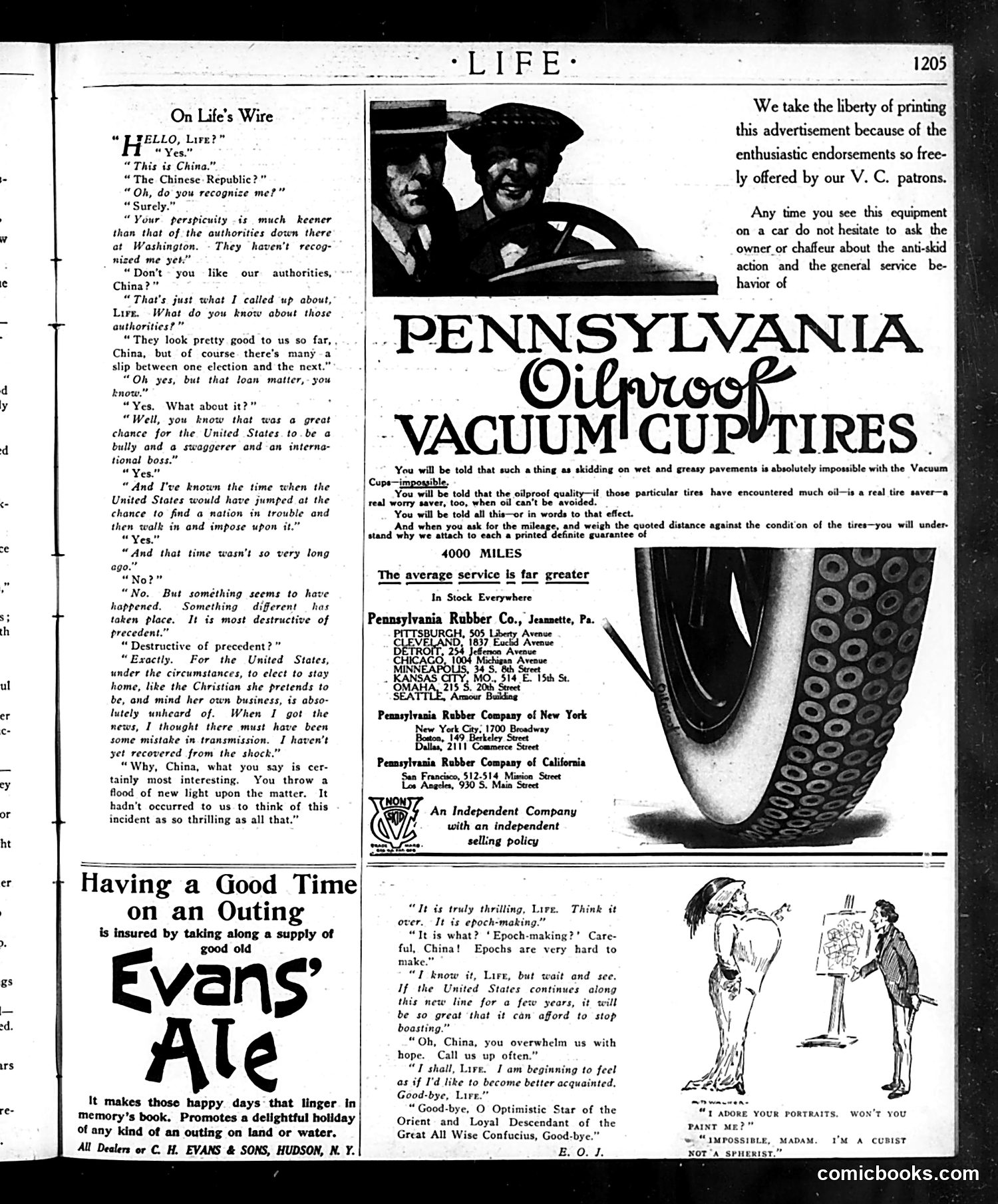
This page is primarily **advertising and light humor** rather than political satire. The left column contains "On Life's Wire," a dialogue between "Life" (the magazine) and "China" discussing American governance and international relations. The conversation touches on recent political upheaval, with China asking about American "authorities" and expressing concern about instability—likely referencing early 20th-century Chinese political turmoil. The bulk of the page comprises **advertisements**: Pennsylvania Oilproof Vacuum Cup Tires (with product photo), Evans' Ale, and portrait-style cartoons about social etiquette at bottom right. The overall tone is conversational rather than cutting satire. The China dialogue appears more earnest—exploring themes of political legitimacy and national stability—than the magazine's typical sharp social commentary.
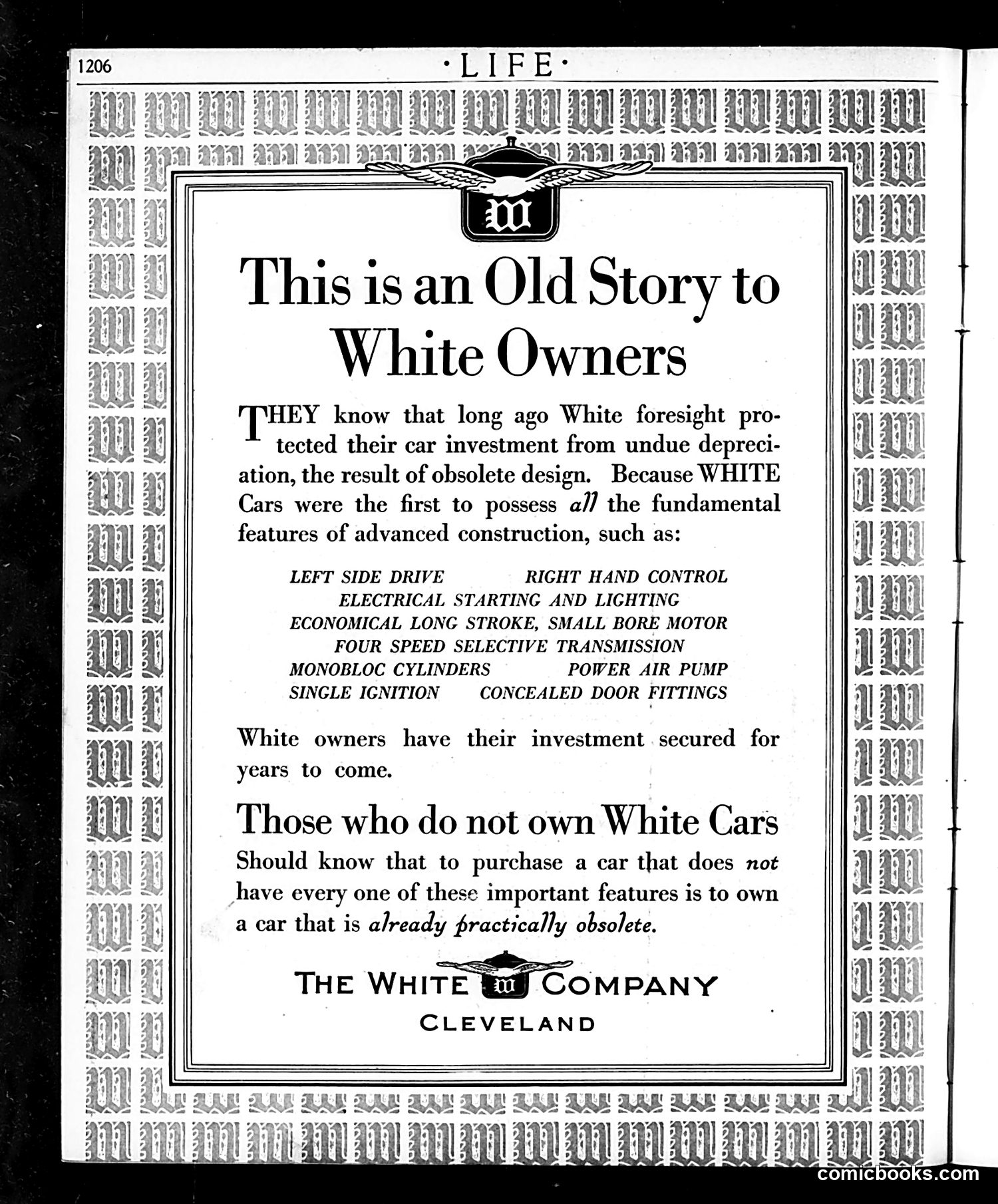
This is a vintage advertisement for White automobiles, published in Life magazine (page 1206). The ad addresses two audiences: existing White car owners and potential buyers of other brands. The copy claims White Cars pioneered advanced automotive features—left-side drive, electrical systems, selective transmission, and others—making them superior investments that retain value better than competitors' obsolete designs. The satire is implicit rather than explicit: the ad's tone is competitive boasting typical of early automotive advertising when these features were genuinely novel. For modern readers, the irony is that White automobiles are now completely obsolete and forgotten, making the confident claims about long-term investment value darkly humorous in retrospect. The White Company was based in Cleveland, Ohio.
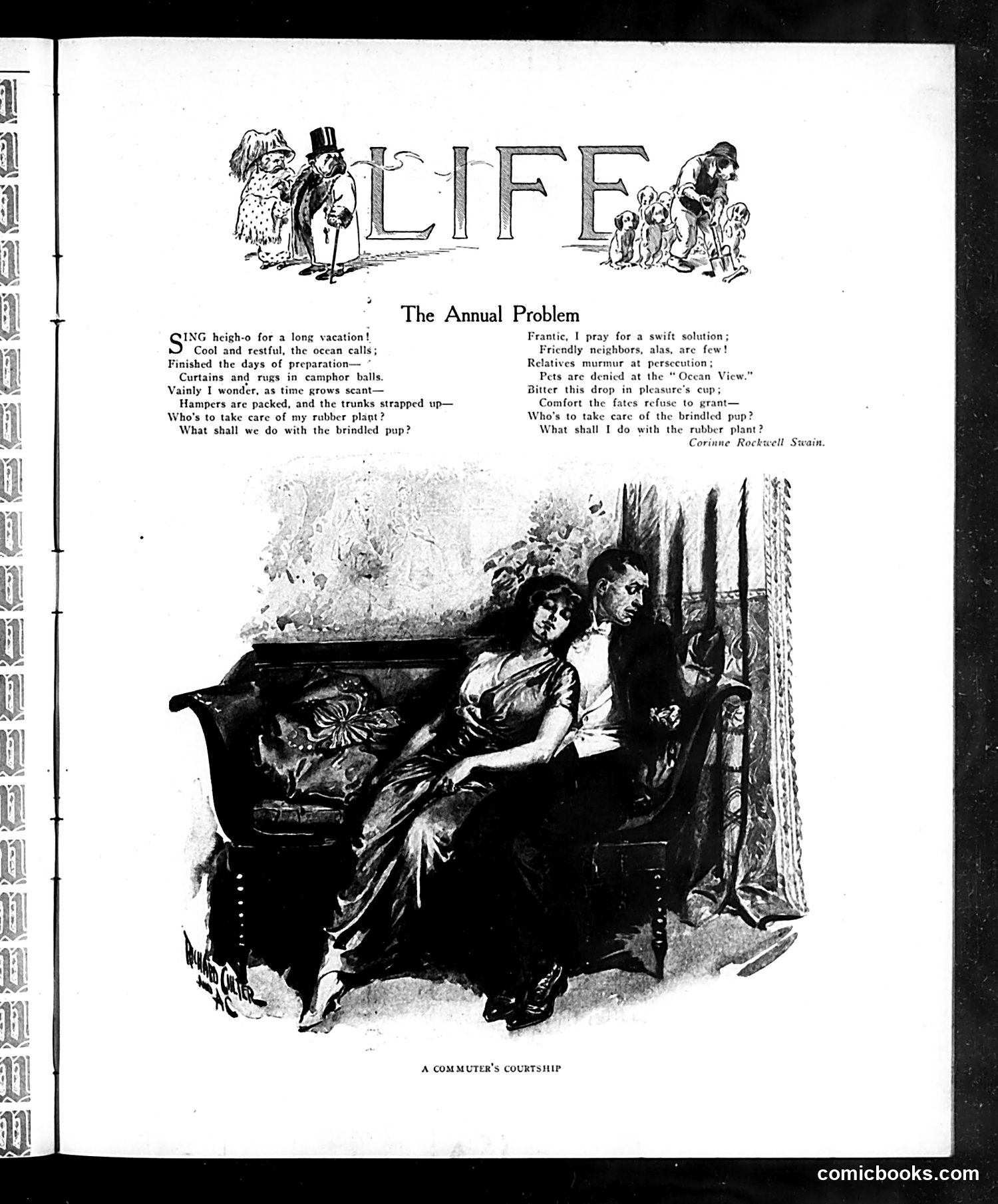
This page satirizes the common domestic dilemma of leaving a houseplant unattended during vacation. The poem humorously catalogs a departing person's anxieties: securing the home, packing, and crucially, who will water "the rubber plant"—a popular Victorian-era houseplant. The accompanying illustration shows "A Commuter's Courtship," depicting a man and woman on a couch, likely representing the solution: entrusting plant care to a romantic interest or neighbor during absence. The satire targets upper-middle-class concerns about maintaining domestic appearances and the awkwardness of asking favors from acquaintances. The rubber plant specifically symbolizes respectable home life during this era. The joke suggests that romantic complications—or at least social awkwardness—accompany even simple requests for help.
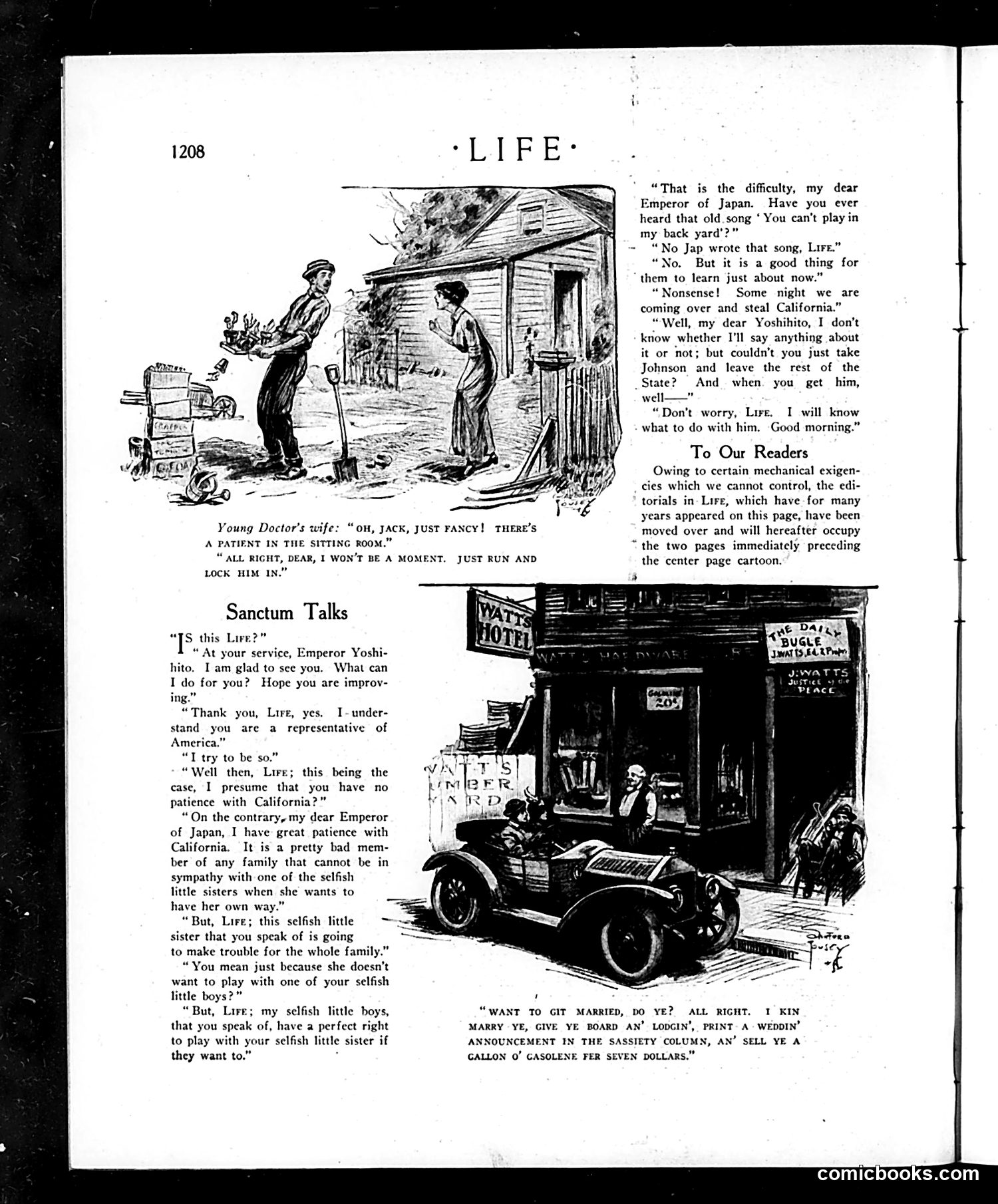
This page contains satirical dialogue between "Life" (a personified character representing the magazine) and the Emperor of Japan, likely referencing early 20th-century U.S.-Japan relations. The "Sanctum Talks" section satirizes American attitudes toward California and Japanese immigration. Life defends patience with California's "selfish" attitudes while the Emperor accuses Americans of hypocrisy—criticizing Japan's territorial ambitions while refusing Japanese settlement rights. The illustrations depict domestic American scenes: a doctor's visit and a vintage automobile outside a hotel. The marriage announcement at bottom appears to be humorous filler content, offering to print wedding announcements cheaply ("seven dollars"). The overall satire critiques American foreign policy inconsistency regarding Japan during a period of significant immigration and trade tensions.
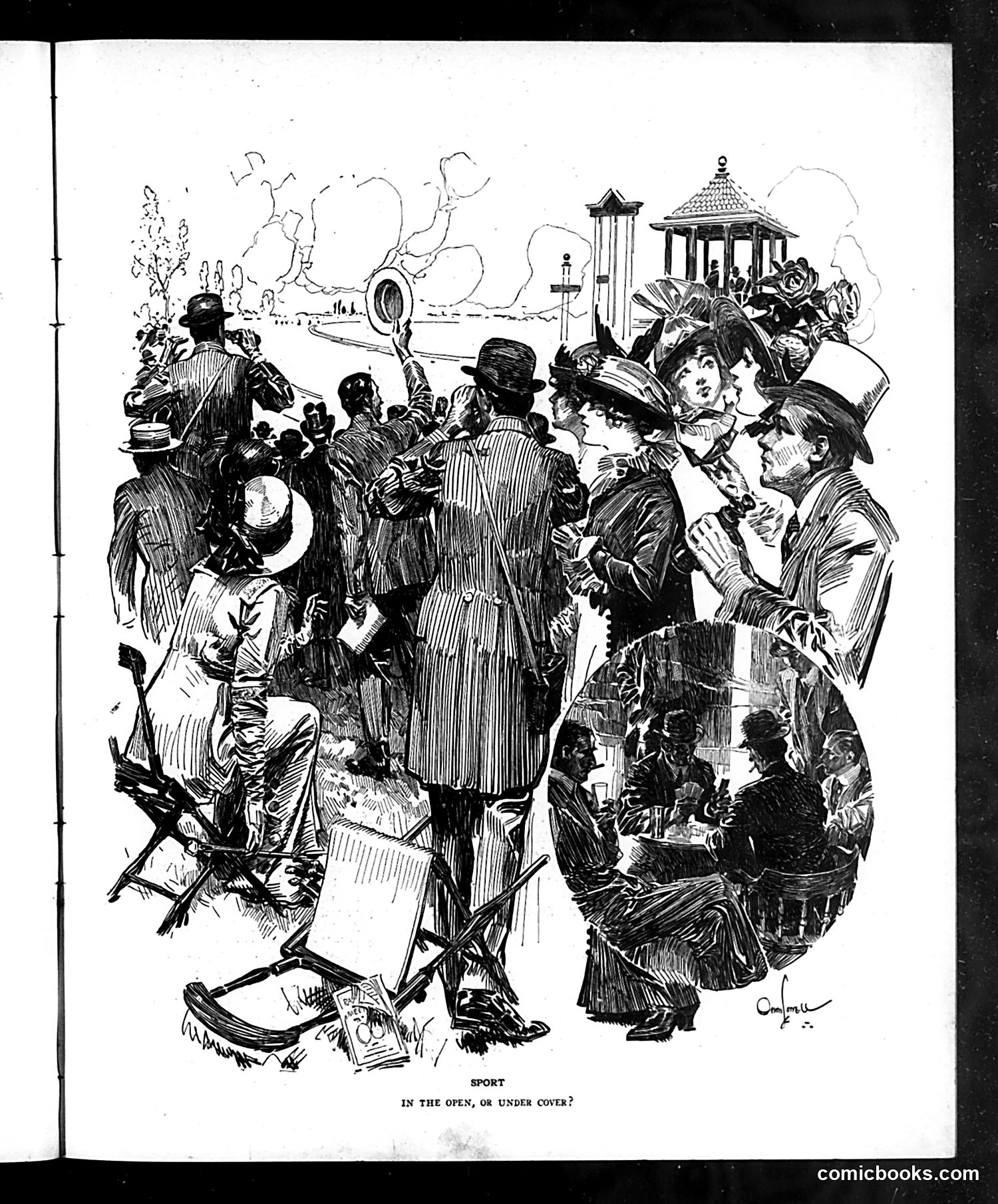
This cartoon satirizes the social hypocrisy surrounding public recreation and leisure activities. The crowded scene depicts well-dressed Victorians engaged in various pastimes—some standing, some seated—in what appears to be a public garden or park setting, with a gazebo visible in the background. The title's question suggests the cartoon critiques whether leisure activities are genuinely public and wholesome ("in the open") or involve hidden motives and private arrangements ("under cover"). The densely packed composition and the mix of social interaction implies commentary on class pretense, courtship rituals, or the gap between public propriety and private behavior during this era. The signature appears to read "Cesare" or similar.
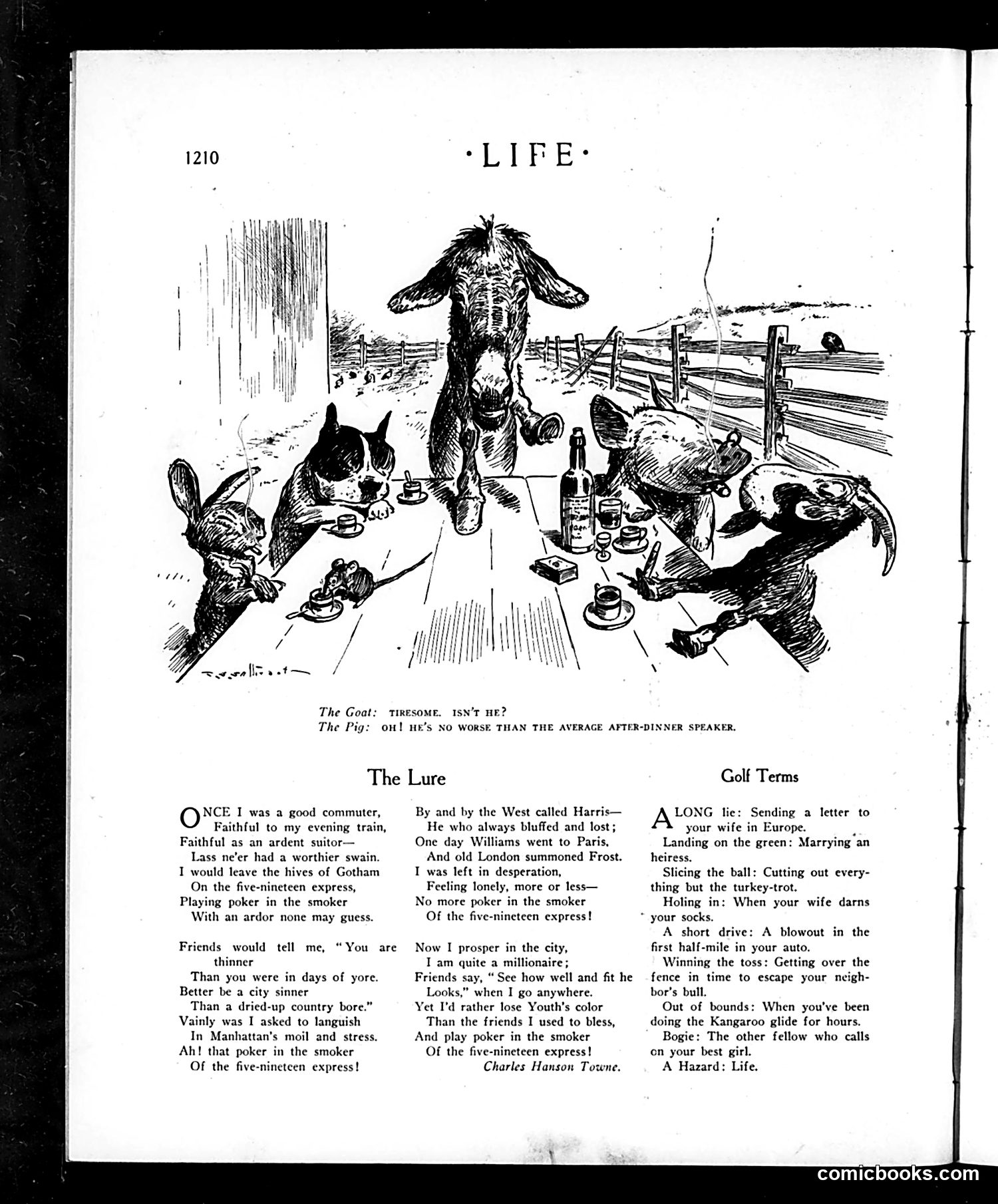
The main illustration depicts anthropomorphic farm animals (a goat, pig, and what appears to be other creatures) seated around a table with bottles and glasses, apparently dining or drinking together in a farm setting with fences visible behind them. The caption provides the joke: The Goat finds the gathering "tiresome," while the Pig responds that the goat is "no worse than the average after-dinner speaker"—a swipe at tedious public speakers of the era. Below are two text pieces: "The Lure" (a poem about leaving country life for city comforts) and "Golf Terms" (humorous golf definitions). The overall page satirizes the contrast between rural and urban life, and pokes fun at social conventions and leisure activities of early 20th-century American society.
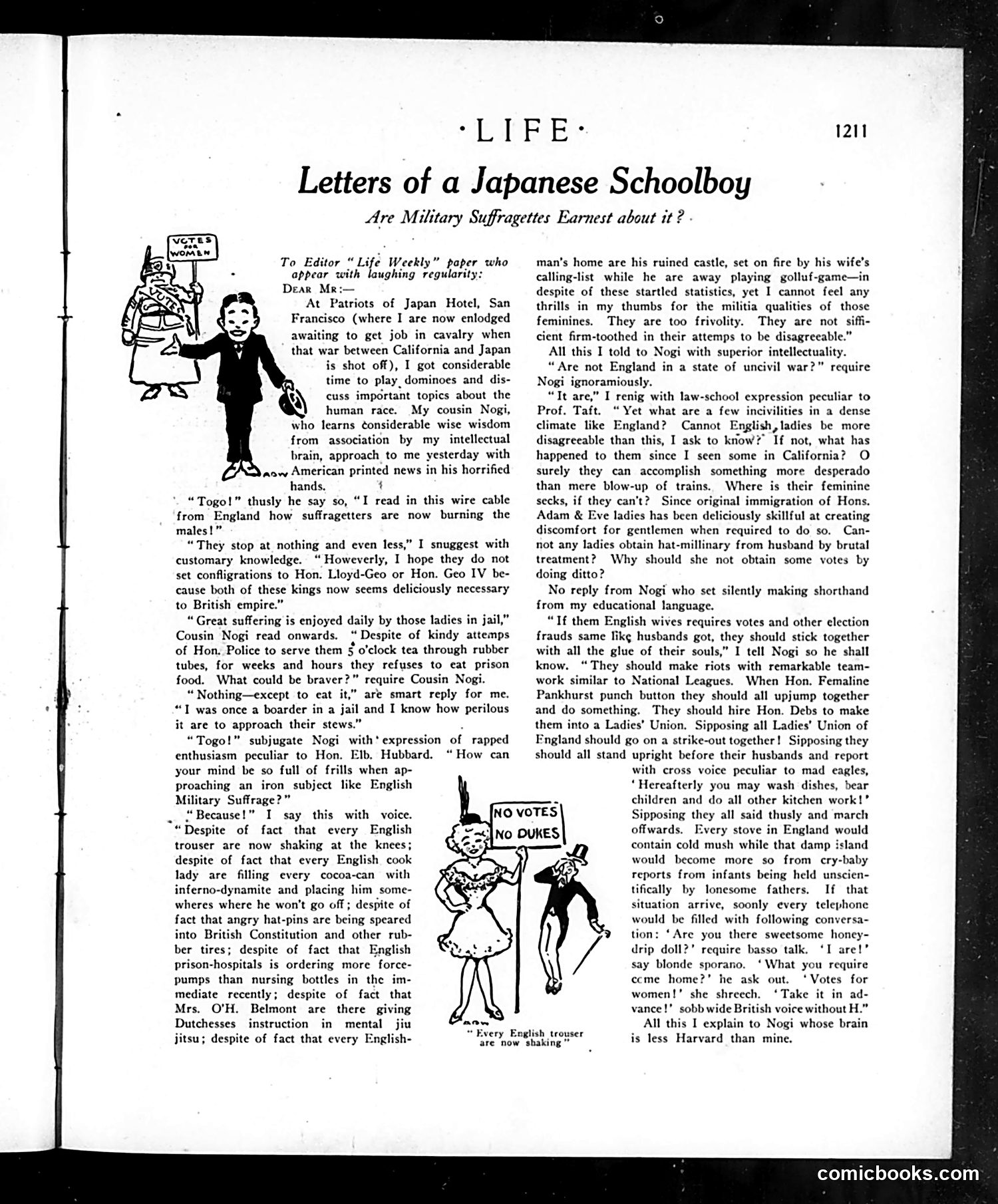
This satirical piece mocks both British suffragettes and Japanese people through an intentionally absurd "letter" from a Japanese schoolboy named Nogi staying in San Francisco. The humor operates on multiple levels: **The Suffragette Critique:** The piece ridicules militant British suffragettes (women fighting for voting rights, circa 1910s) by exaggerating their tactics—arson, hunger strikes, hat-pin violence—as simultaneously dangerous and ineffectual. The schoolboy narrator finds their efforts paradoxically both threatening and insufficiently "disagreeable." **The Comic Device:** By filtering suffragette news through deliberately broken English and a Japanese perspective, Life distances American readers from the real political debate, treating both the suffragettes and the foreigner as objects of mockery. **The Cartoons:** Illustrations show a suffragette holding a "Votes for Women" sign and another depicting "Every English trouser are now shaking"—visualizing the satirist's dismissal of male fear as overwrought. The piece ultimately trivializes women's suffrage as frivolous complaint rather than legitimate political grievance.
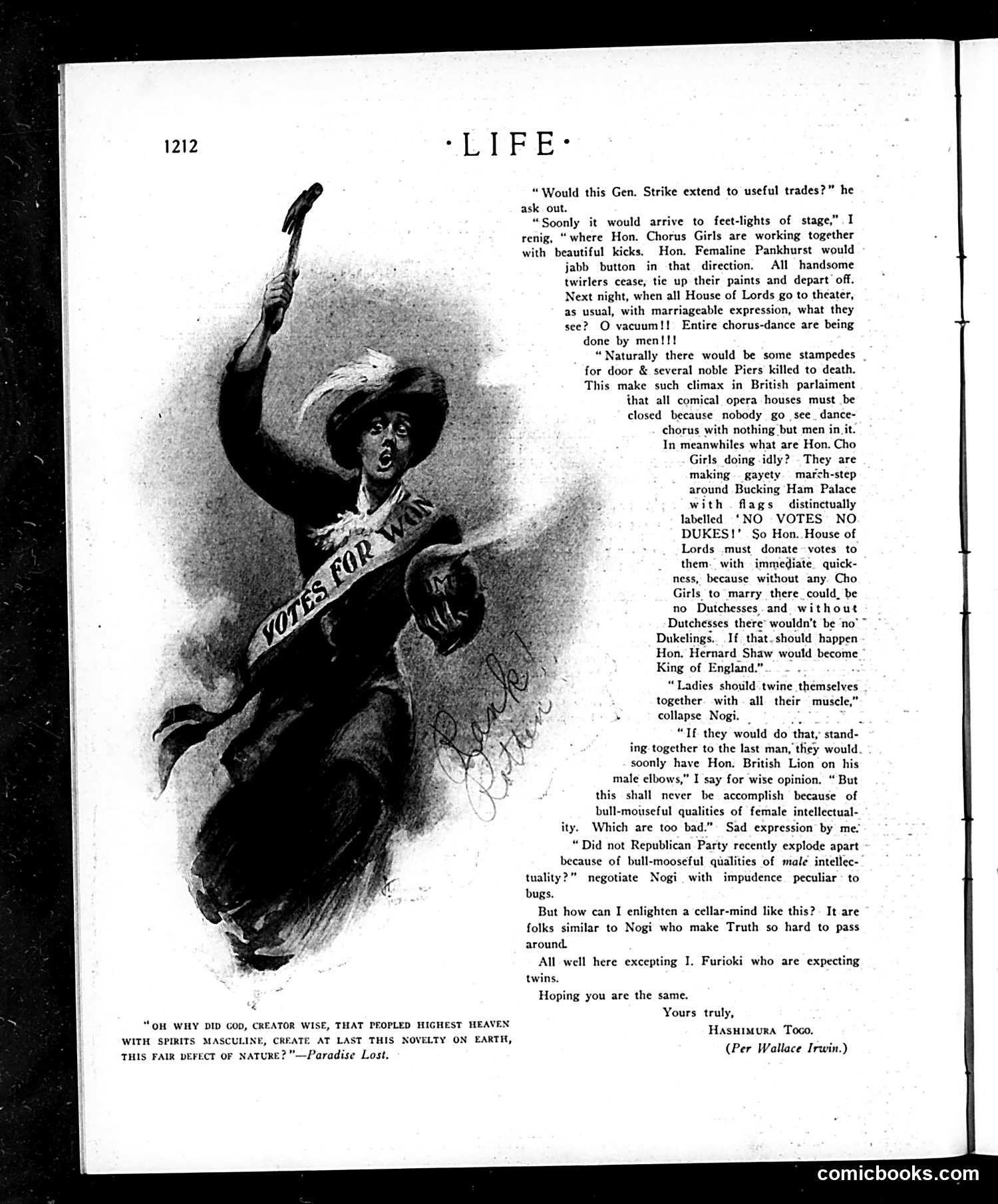
This page satirizes the British suffragette movement through a letter purporting to be from "Hashimura Toco," a Japanese observer. The cartoon depicts a suffragette with a "VOTES FOR WOMEN" banner, shown in exaggerated, comedic pose. The satire mocks female suffragists by imagining absurd consequences: if chorus girls strike to support women's voting rights, the House of Lords would be forced to grant votes to secure eligible wives for their sons and heirs. The piece ridicules women's political activism as fundamentally driven by marriage prospects rather than justice. The Japanese voice functions as a "naive outsider" device common to period satire, allowing the author (Wallace Irwin) to present misogynistic arguments as comic observations. References to "Femaline Pankhurst" (likely Emmeline Pankhurst, a prominent suffragette leader) and "Hon. Bernard Shaw" anchor the critique in real contemporary figures and debates. The overall message dismisses female intellectual capacity and political legitimacy—characteristic of anti-suffrage rhetoric of the era.
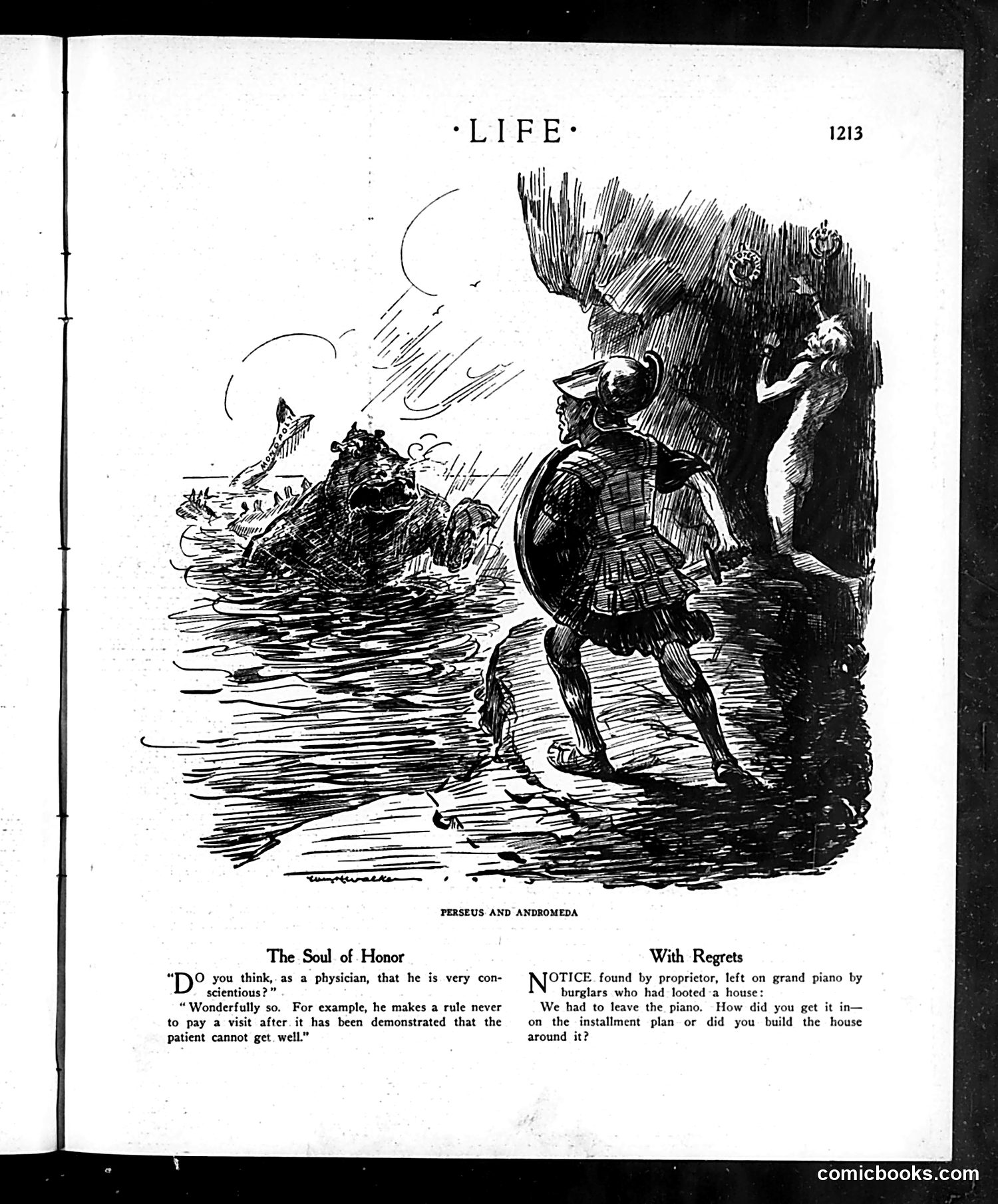
This page contains two separate satirical jokes, not political cartoons. **"The Soul of Honor"** mocks a supposedly ethical physician whose "conscientiousness" is actually self-serving cowardice—he avoids visiting patients he cannot cure to protect his reputation, abandoning them when help is impossible. **"With Regrets"** is a humorous anecdote about burglars leaving a note on a grand piano they couldn't steal from a looted house. The joke plays on the absurdity of the thieves' question: they're incredulous the homeowner acquired such a large, expensive instrument, sarcastically asking whether it was purchased on installment (implying the owner couldn't afford it outright) or if the house was literally built around it. The Perseus and Andromeda illustration is classical mythological decoration, unrelated to the text below it—a common design practice in period magazines.
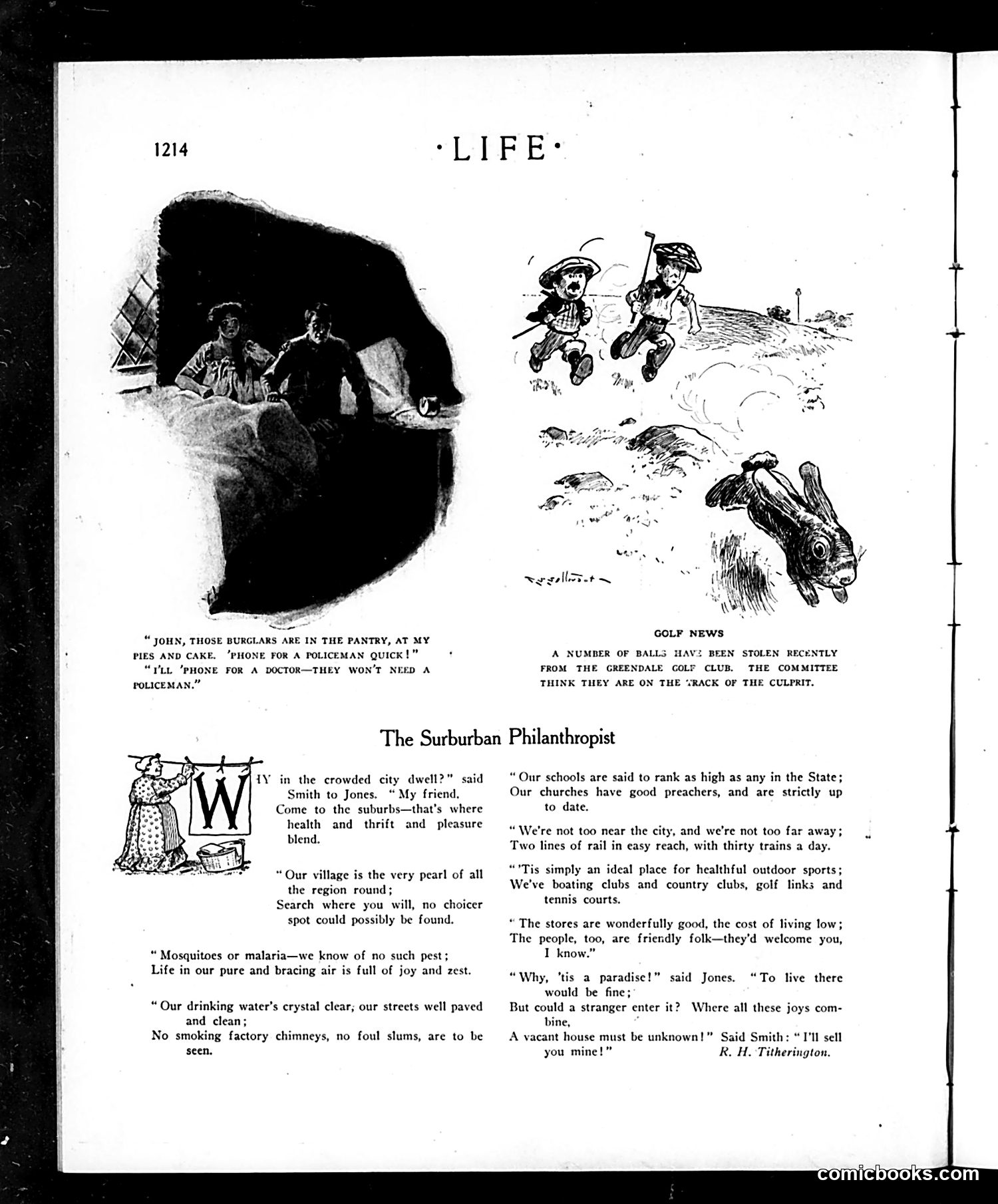
This page contains multiple satirical pieces mocking suburban life and middle-class pretensions. **Top cartoons:** Two brief comic strips joke about practical consequences—burglars eating poisoned pies don't need police (implying they'll die from food poisoning), and stolen golf balls suggest the thief is a glutton. **"The Suburban Philanthropist":** The main piece satirizes a booster promoting suburbs as paradise. Smith enthusiastically lists suburban virtues (clean air, good schools, rail access, outdoor clubs, low costs, friendly people) to persuade Jones to move. Jones eagerly agrees—until Smith reveals the punchline: he wants to *sell Jones his own house*, implying the paradise is only desirable as an investment opportunity or escape route. The satire targets the contradiction between genuine suburban idealism and self-interested real estate marketing. Smith's glowing description masks that even suburban enthusiasts view their own homes as commodities to unload on newcomers rather than permanent havens worth keeping.
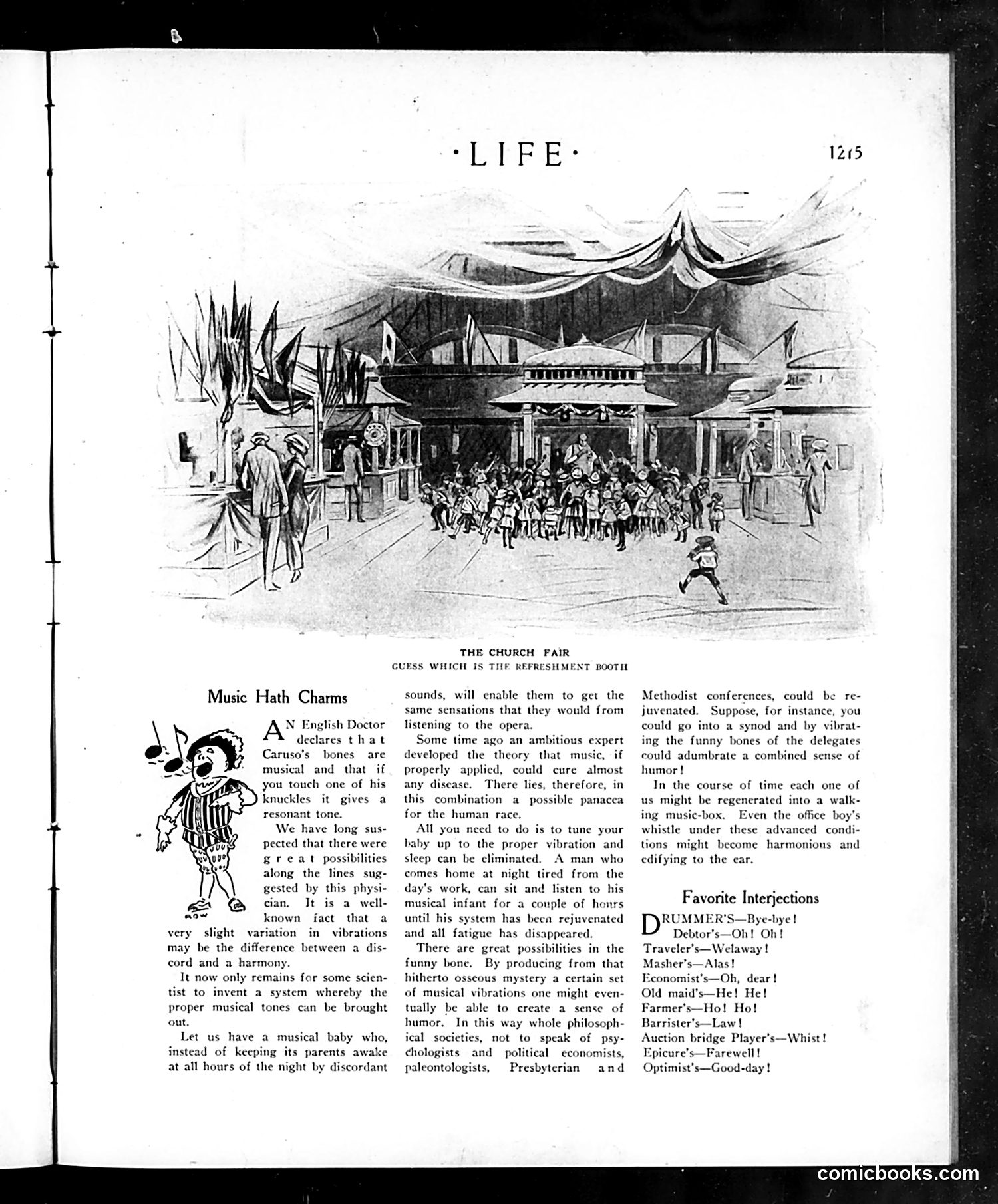
This page contains two distinct pieces of humor: **"Music Hath Charms"** satirizes pseudoscientific health fads of the era. It mocks the claim that the opera singer Caruso's bones possess musical properties, then absurdly extrapolates: imagine "musical babies" that never cry, or vibrating people's "funny bones" to cure humorlessness in "Presbyterian and Methodist conferences." The satire targets both credulous belief in music's curative powers and the era's tendency toward overconfident scientific theorizing about human improvement. **"The Church Fair"** appears to be a visual cartoon (top illustration) depicting a fair with the caption asking readers to identify the refreshment booth—likely a gentle joke about church social conventions. **"Favorite Interjections"** is a brief comedic list pairing social types (Debtor, Farmer, Auctioneer, Optimist) with their characteristic exclamations, poking gentle fun at class and professional stereotypes. The overall tone is light, satirizing both scientific pretension and social conventions of the early 20th century.
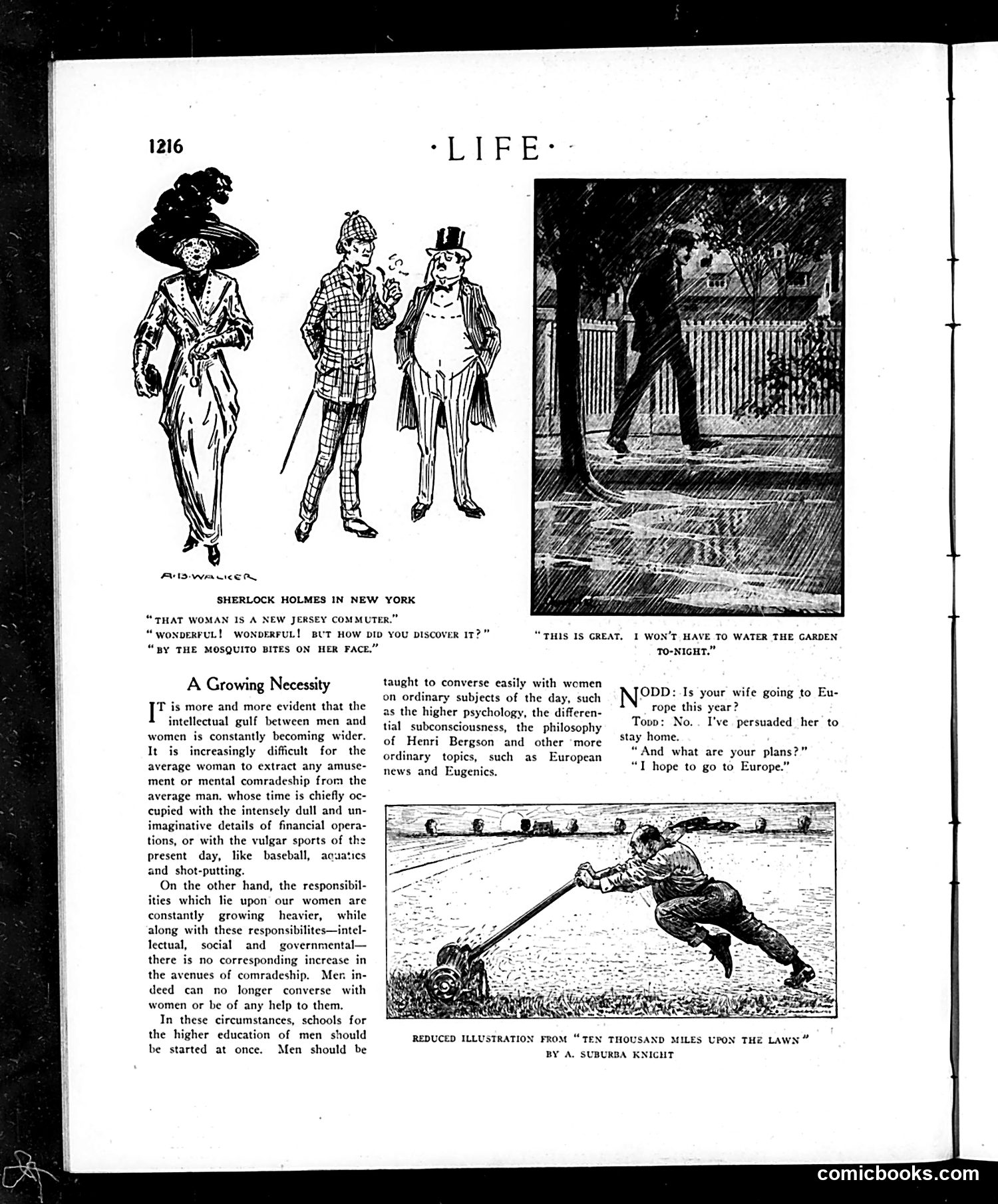
This page satirizes early 20th-century gender dynamics and the widening intellectual gulf between men and women. **"Sherlock Holmes in New York"** (top left): A playful sketch mocking male detectives' limited observational skills. Holmes deduces a woman is a "New Jersey commuter" from mosquito bites—a ridiculous non-sequitur that jokes about men's inability to understand women's lives or perspectives. **"A Growing Necessity"** (main essay): Argues that women's education and responsibilities are expanding while men remain intellectually stagnant, occupied only with "dull" financial details and sports. The piece satirically proposes "schools for higher education of men"—suggesting men, not women, need intellectual improvement to keep pace with their female counterparts. **The conversation** (right): Ironic domestic humor: a wife wants to visit Europe; the husband persuades her to stay home so he can go to Europe alone, showing marital disconnection and selfish male priorities. **Bottom illustration**: Appears to depict lawn irrigation, possibly reinforcing the essay's point about men's preoccupation with mundane, domestic details. The overall message critiques male intellectual complacency amid women's advancement.
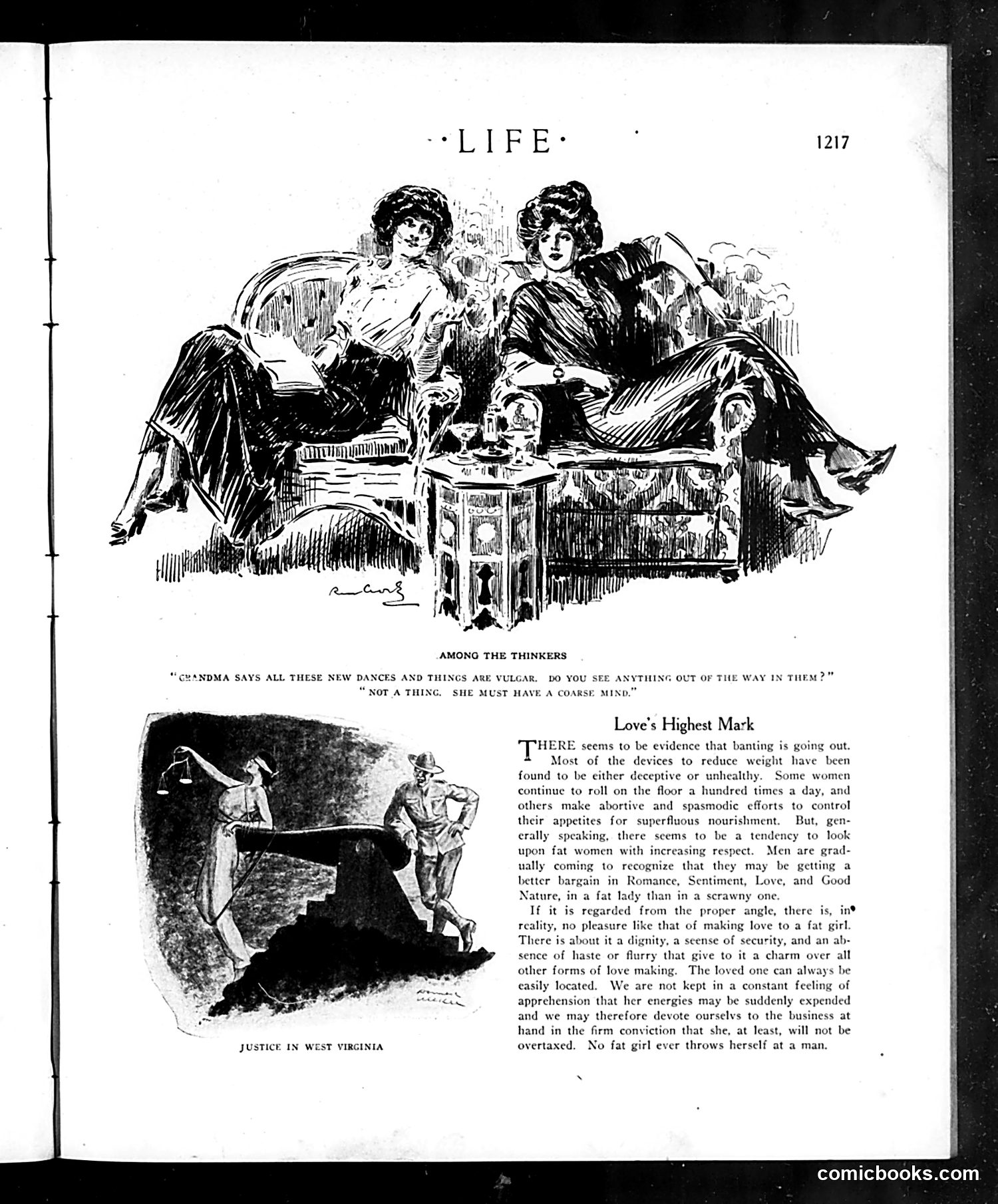
**"Among the Thinkers"** (top cartoon): Two women dismiss their grandmother's complaints about modern dances as vulgar, claiming to see nothing improper. The joke satirizes younger generations' casual acceptance of new social behaviors—particularly the increasingly risqué dances of the 1910s-1920s (likely the Turkey Trot, Bunny Hug, or similar)—while mocking their dismissal of elders' moral concerns as evidence of prudishness rather than wisdom. **"Love's Highest Mark"** (article): This piece sarcastically praises larger women as romantic partners, arguing that "banting" (dieting) is going out of fashion. It humorously claims fat women offer better "Romance, Sentiment, Love, and Good Nature" than thin ones, joking that they're easier to locate, won't exhaust themselves, and possess dignified restraint. The satire likely mocks both 1910s diet culture obsession and romanticized notions of femininity.
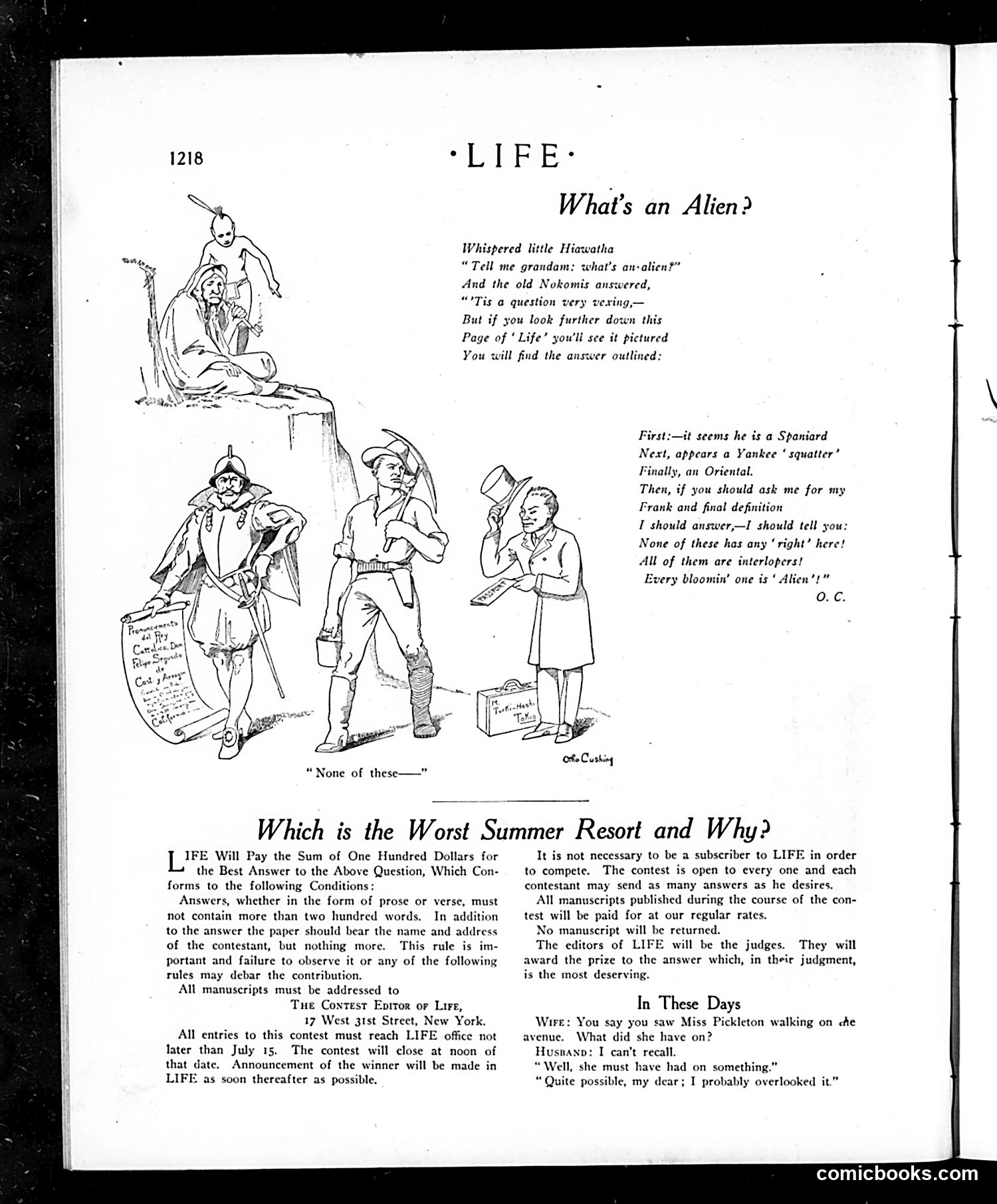
This page satirizes American attitudes toward immigration and citizenship. The main cartoon uses a Native American framework (referencing Hiawatha and Nokomis) to argue that *everyone* is technically an "alien"—Spanish colonizers, American settlers ("Yankee squatters"), and Asian immigrants are all portrayed as interlopers with no inherent "right" to be in America. The satire's irony is sharp: by showing that all groups are equally foreign, it critiques nativist xenophobia and the arbitrary nature of deciding who "belongs." The joke suggests that Americans cannot logically exclude any group as aliens without acknowledging their own status as invaders. The page also includes a contest asking readers to identify the worst summer resort, and a brief joke about a woman's appearance that relies on period-specific social humor about feminine modesty.
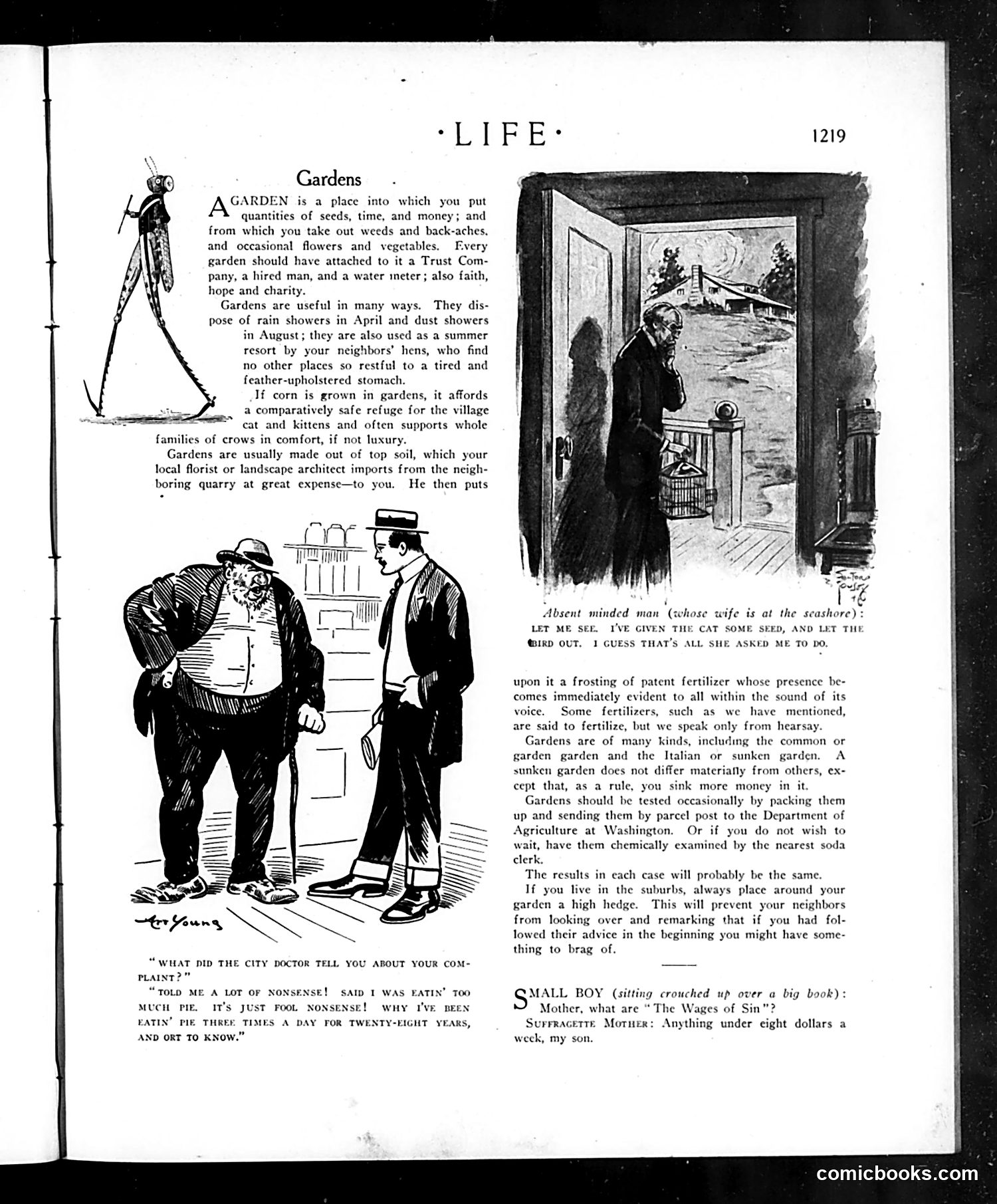
This page from *Life* magazine offers humorous social satire about suburban gardening culture, a fashionable pursuit among middle-class Americans of the era. **The Main Cartoon:** An absentminded husband, left alone while his wife vacations at the seashore, catastrophically confuses her instructions—feeding the cat bird seed and releasing the bird, believing he's completed his domestic duties. **The Satirical Essay:** The text mocks gardening as an expensive, labor-intensive hobby that yields weeds and backaches rather than actual vegetables. It ridicules the common practice of hiring landscapers to import costly topsoil and fertilizer, and suggests gardens serve primarily as gathering spots for neighbors' chickens and village crows. **Social Commentary:** The satire targets suburban pretension—the insistence on high hedges to hide gardening failures from neighbors, and the absurd suggestion of mailing soil samples to the Department of Agriculture for analysis, as if gardening were a scientific endeavor rather than simple yard work. **The Bottom Joke:** A suffragette mother tells her son that "wages of sin" means "anything under eight dollars a week"—a reference to women's labor rights and wage inequality.
This editorial page commemorates the recent death of **Henry Flagler**, the Standard Oil magnate who developed Florida's infrastructure—hotels, railroads, and Palm Beach as a winter resort. The author uses Flagler's passing to debate capitalism's value. The piece argues that while imaginative capitalists like Flagler created tangible developments, their achievements depend on wealth concentration. It sarcastically notes that after capitalism is "abolished," such developments may disappear—though nobody will be rich enough to enjoy them anyway. The editorial also compares Flagler to recently deceased **Bishop Doane**, suggesting both served similar social roles: the capitalist provided physical comfort (hotels, railroads); the bishop provided spiritual comfort. The underlying satire critiques both socialist aspirations and the hypocrisy of criticizing wealth-accumulation while benefiting from capitalist infrastructure. The tone is skeptical toward revolutionary rhetoric while acknowledging capitalism's contradictions.
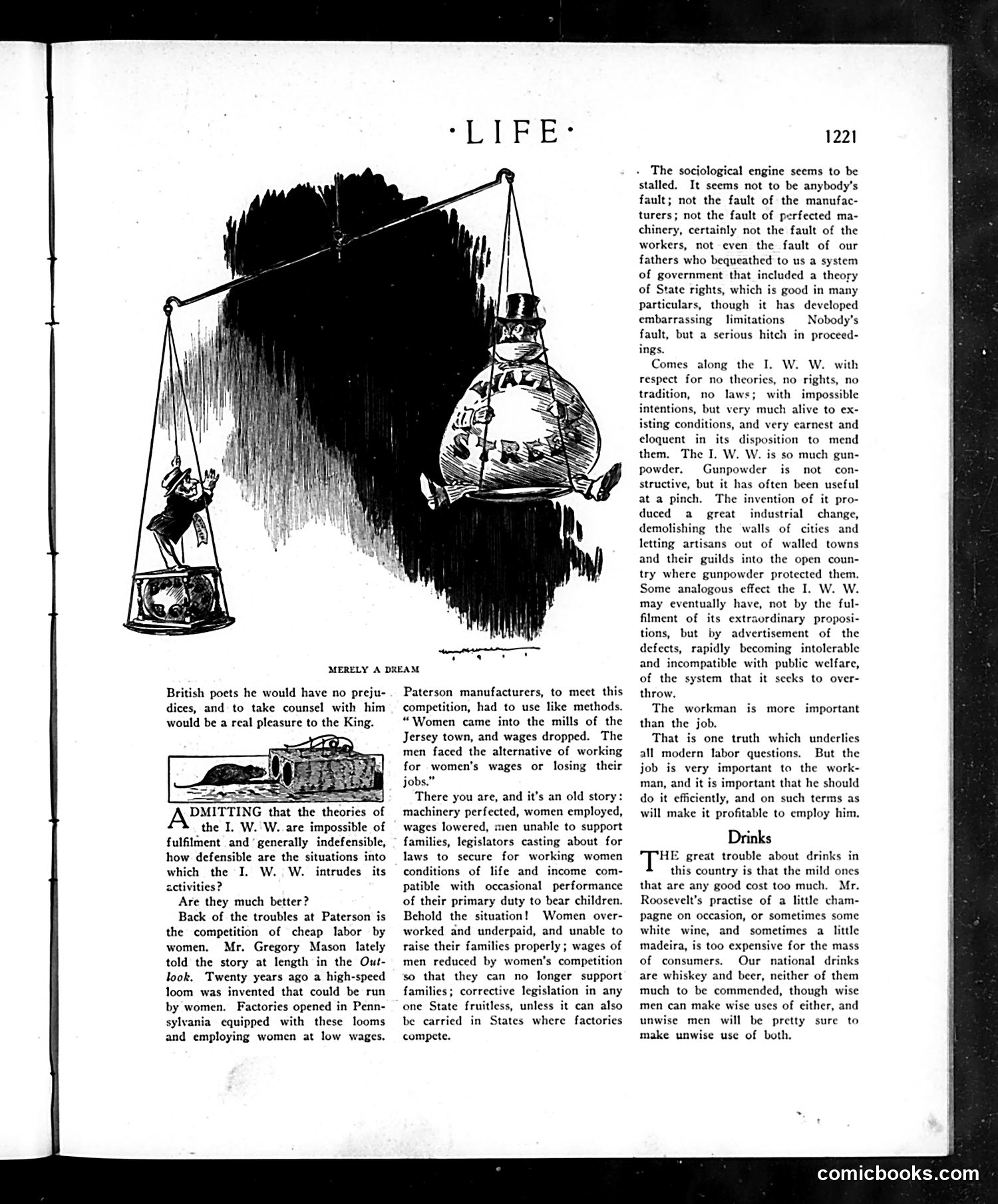
The cartoon depicts a **scale of justice in imbalance**, illustrating the Paterson textile strike's core problem: women workers (lighter side) versus male workers' wages and job security (heavier side). The text critiques the I.W.W. (Industrial Workers of the World), a radical labor union active in early 1900s labor disputes. The article acknowledges the I.W.W.'s radical methods are "impossible" and "indefensible," yet sympathizes with the *conditions* they protest—a genuine structural problem nobody can fix. The core issue: new machinery allowed factories to employ cheap female labor, forcing down all wages. Men couldn't support families; women were overworked and underpaid. State-by-state labor reform failed because factories simply relocated to unregulated states. The article suggests the I.W.W., though destructive like "gunpowder," may inadvertently expose systemic flaws too serious to ignore. The secondary section on "Drinks" appears unrelated editorial content.
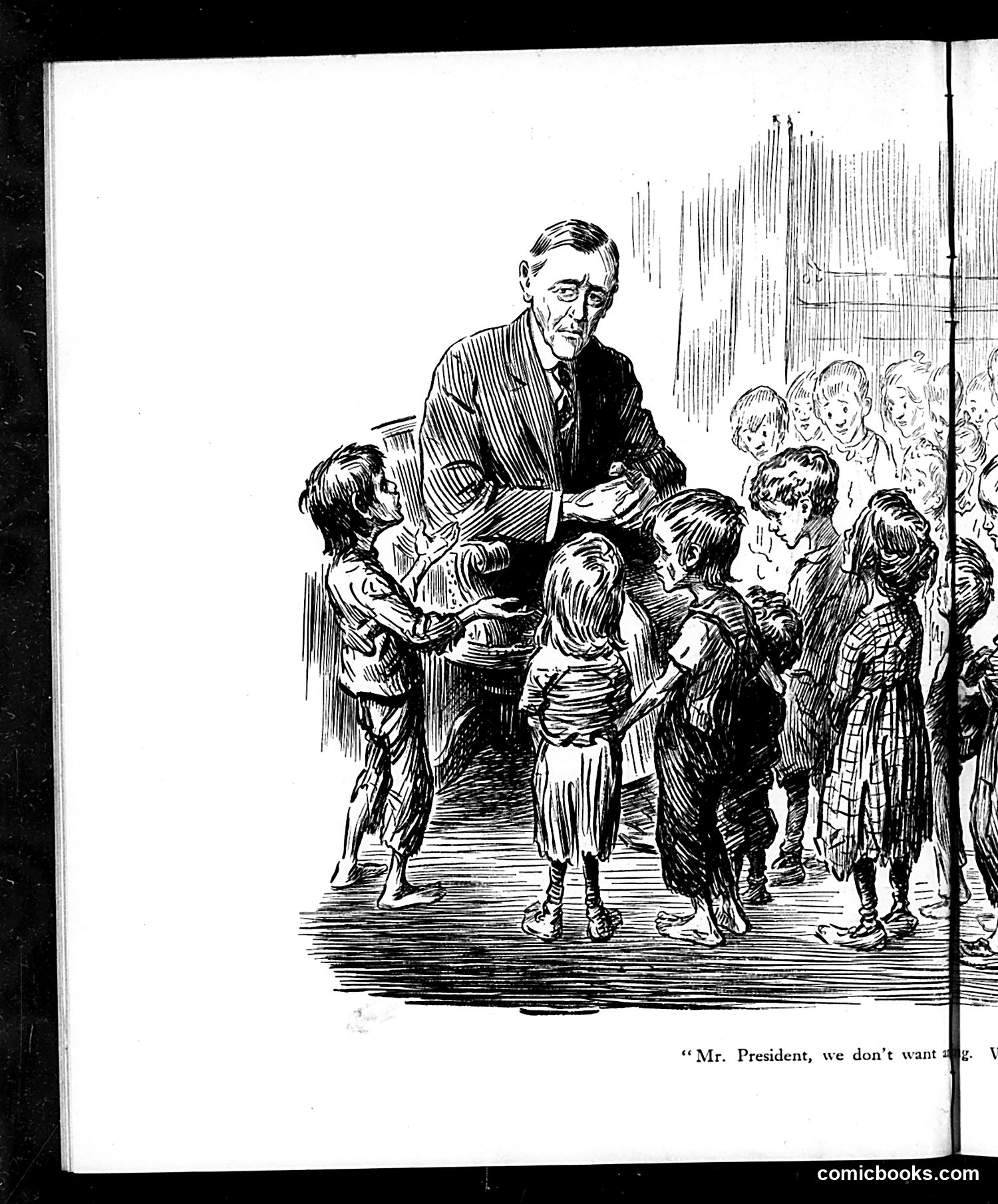
This illustration depicts a well-dressed man in a pinstriped suit (labeled "Mr. President") surrounded by a group of children who appear to be making a request. The caption reads: "Mr. President, we don't want..." The incomplete dialogue suggests this is satirizing a political appeal or petition to a U.S. President from children about something they oppose. Without the full caption, the specific issue cannot be definitively identified, but the cartoon's structure—children approaching authority to protest something—indicates social or political criticism of presidential policies affecting youth, likely from the early-to-mid 20th century based on the artistic style and clothing depicted. The satire appears to mock either the President's responsiveness to constituents or the specific policy being criticized.
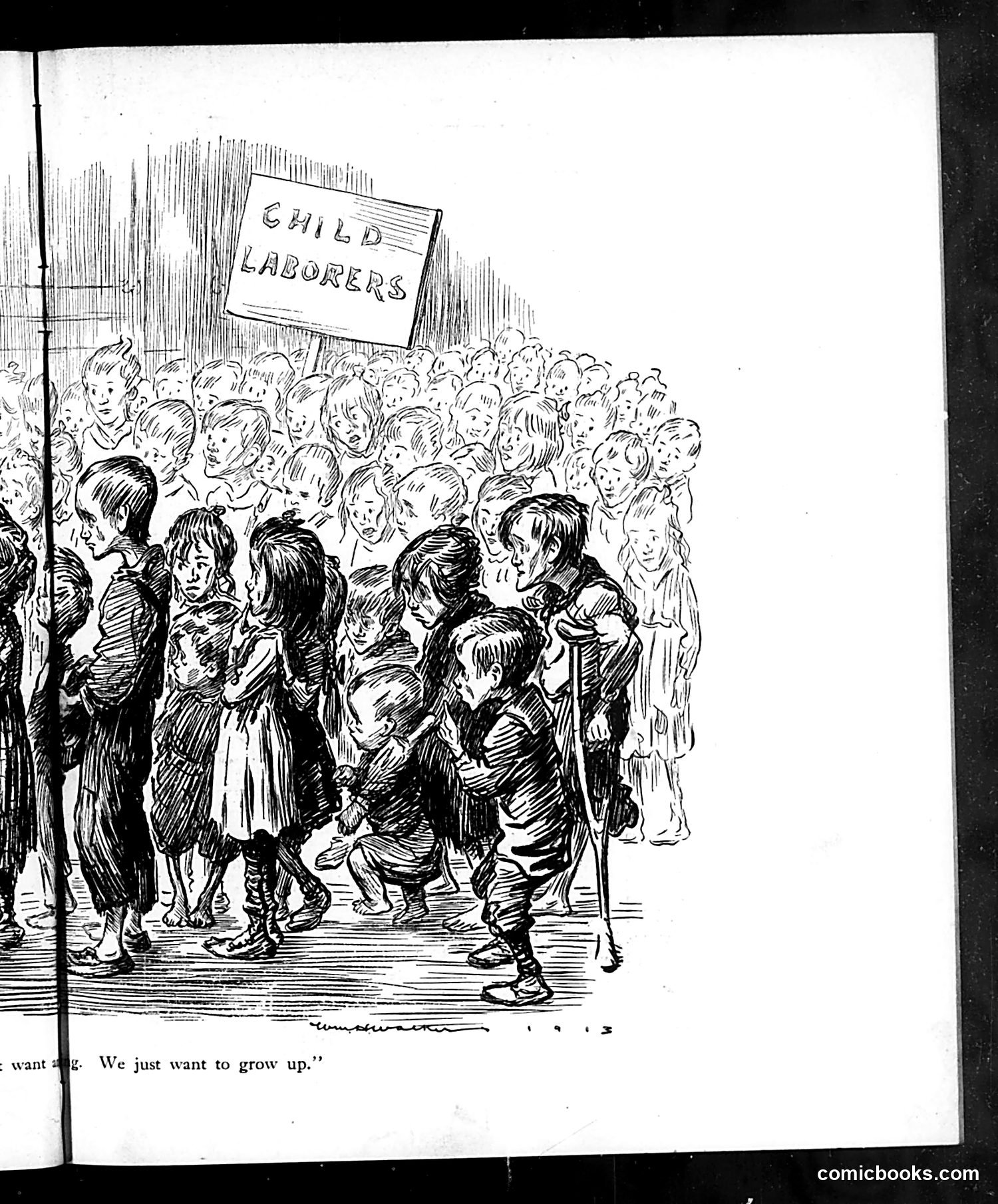
This political cartoon depicts a large crowd of children holding a sign reading "CHILD LABORERS." The caption reads: "We just want to grow up." The satire criticizes child labor practices, likely from the early-to-mid 20th century when such exploitation was common. The children's simple statement—merely wanting to mature normally—contrasts sharply with their circumstances as laborers. The artist uses the crowd's size and youth to evoke sympathy and highlight how systemic child labor prevented normal childhood development. The cartoon advocates for child labor reform by presenting children as victims who deserve basic rights to grow up without exploitation. This reflects Progressive Era concerns about protecting children from industrial work conditions.
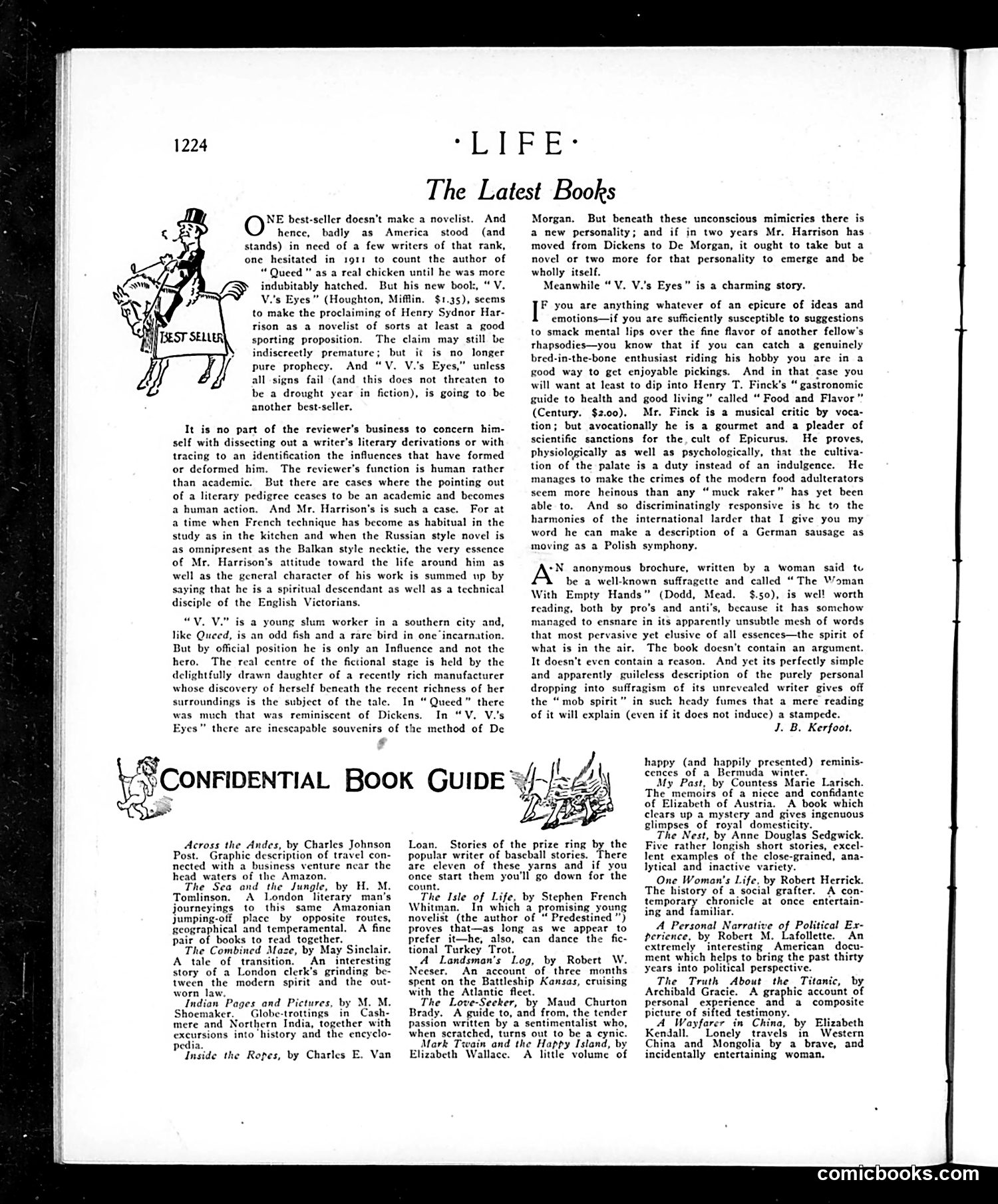
This page from Life magazine's "The Latest Books" section reviews Henry Sydnor Harrison's novel "V.V.'s Eyes" (1913). The critic evaluates Harrison as an emerging novelist, noting he previously wrote "Queed" but remained uncertain of his talent until this new work. The key satirical point concerns **literary influences**: the reviewer observes that while French and Russian literary techniques dominate contemporary writing, Harrison distinctively derives from **English Victorian novelists**—particularly Dickens and De Morgan. This was notable because by 1913, Victorian methods were considered somewhat old-fashioned compared to modernist European influences. The cartoon's Uncle Sam figure (left margin) represents American letters, symbolizing the magazine's commentary on American literary culture. The review treats this Victorian lineage positively, suggesting Harrison's work offers refreshing traditionalism amid fashionable continental experimentalism—a subtle critique of literary pretension and foreign influence.
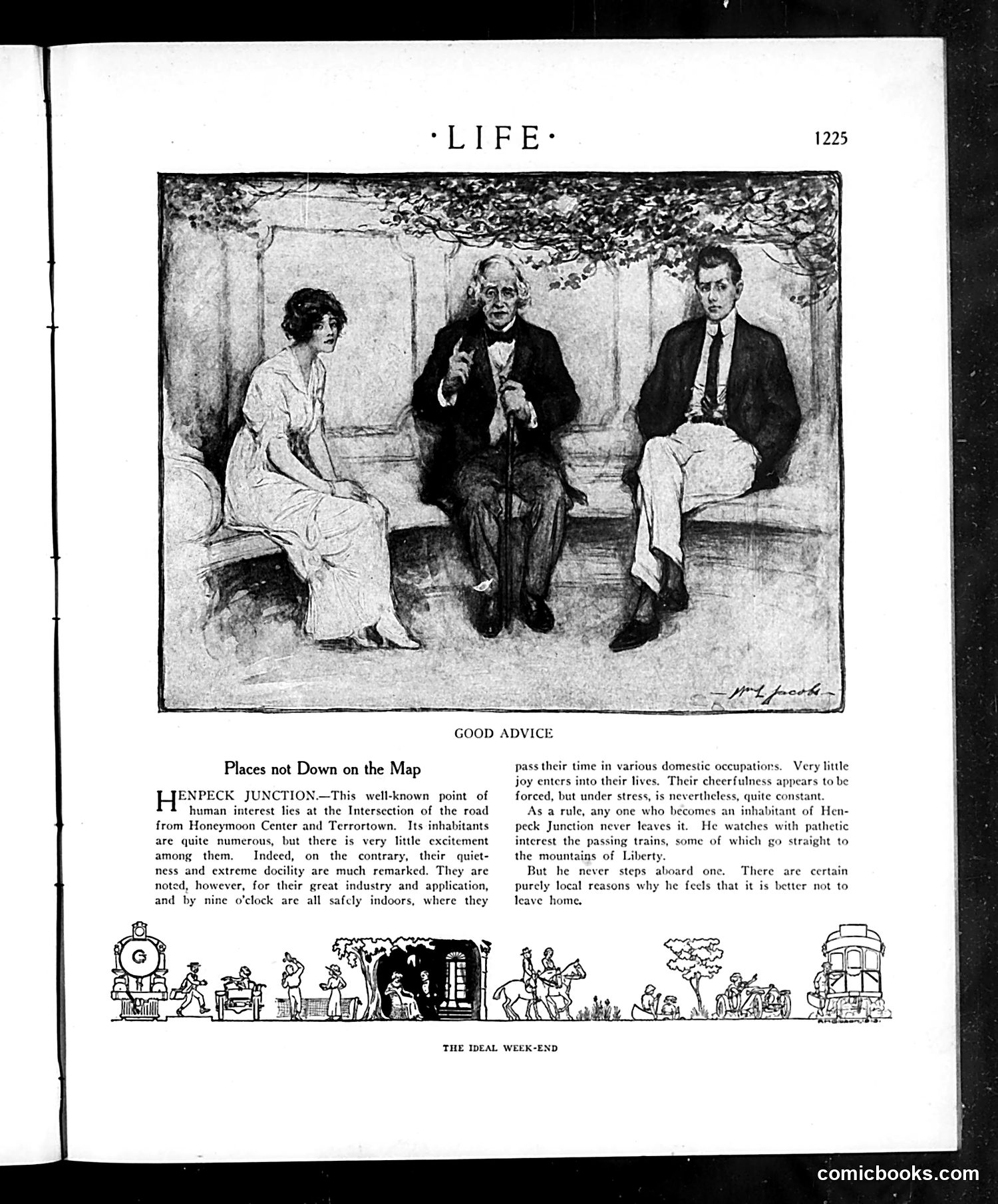
This satirical piece mocks **henpecked husbands**—men dominated by their wives. The cartoon depicts three figures: a woman in a light dress, an older man in dark clothes (the titular "Henpeck"), and a younger man. The text describes "Henpeck Junction" as a metaphorical place where men live passively indented lives, confined indoors by nine o'clock, performing domestic duties without joy or autonomy. The satire's point: these men see opportunities for freedom and adventure (trains heading to "mountains of Liberty"), but lack the will to escape their domestic servitude. They remain trapped by "purely local reasons"—their wives' control—choosing safety over liberty. This reflects early-20th-century gender anxieties, where cartoonists frequently portrayed marriage as emasculating and wives as domineering. The piece uses whimsical place-names to mock both the trapped husbands and the social convention that kept them bound.
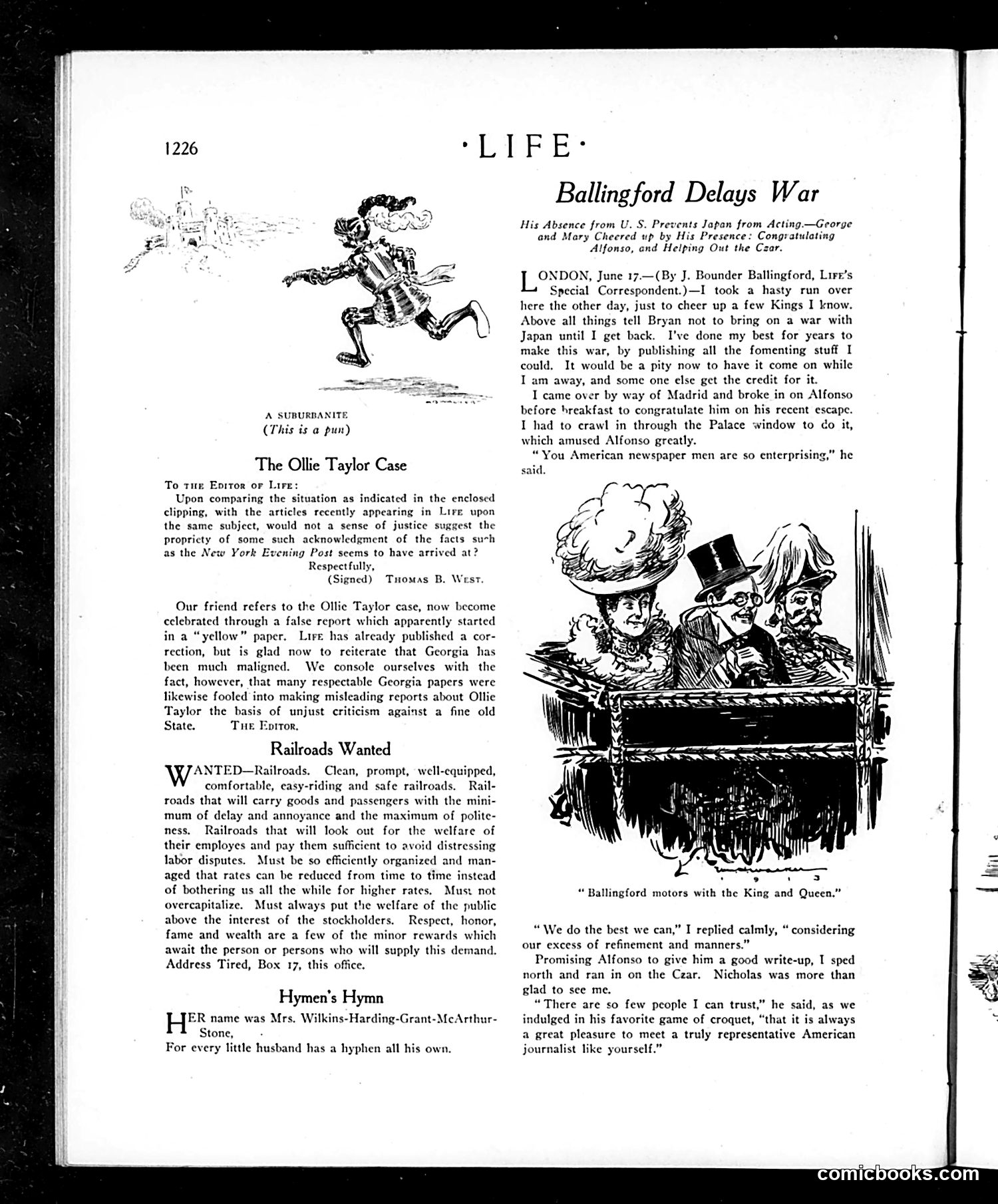
## Main Cartoon: "Ballingford Motors with the King and Queen" This satirical piece mocks a fictional American journalist named "J. Bounder Ballingford" who claims credit for international diplomacy. The cartoon depicts him with European royalty (likely King George V and Queen Mary of Britain, based on the caption), shown in exaggerated caricature with top hats. ## The Satire's Point The text parodies American newspaper boosterism and self-importance. Ballingford brags about inciting war with Japan for publication purposes, then personally visits European monarchs (Spain's Alfonso, Russia's Czar) to "cheer them up." His absurd claims—crawling through palace windows, playing croquet with the Czar—mock American journalists' inflated sense of their geopolitical influence. The humor targets: American press sensationalism, the pretension that newspaper coverage shapes international affairs, and the stereotype of enterprising but tactless American reporters. ## Supporting Content Other items address the "Ollie Taylor case" (a news story Georgia was falsely blamed for) and satirize railroads' poor service—typical Life fare critiquing American institutions and media.
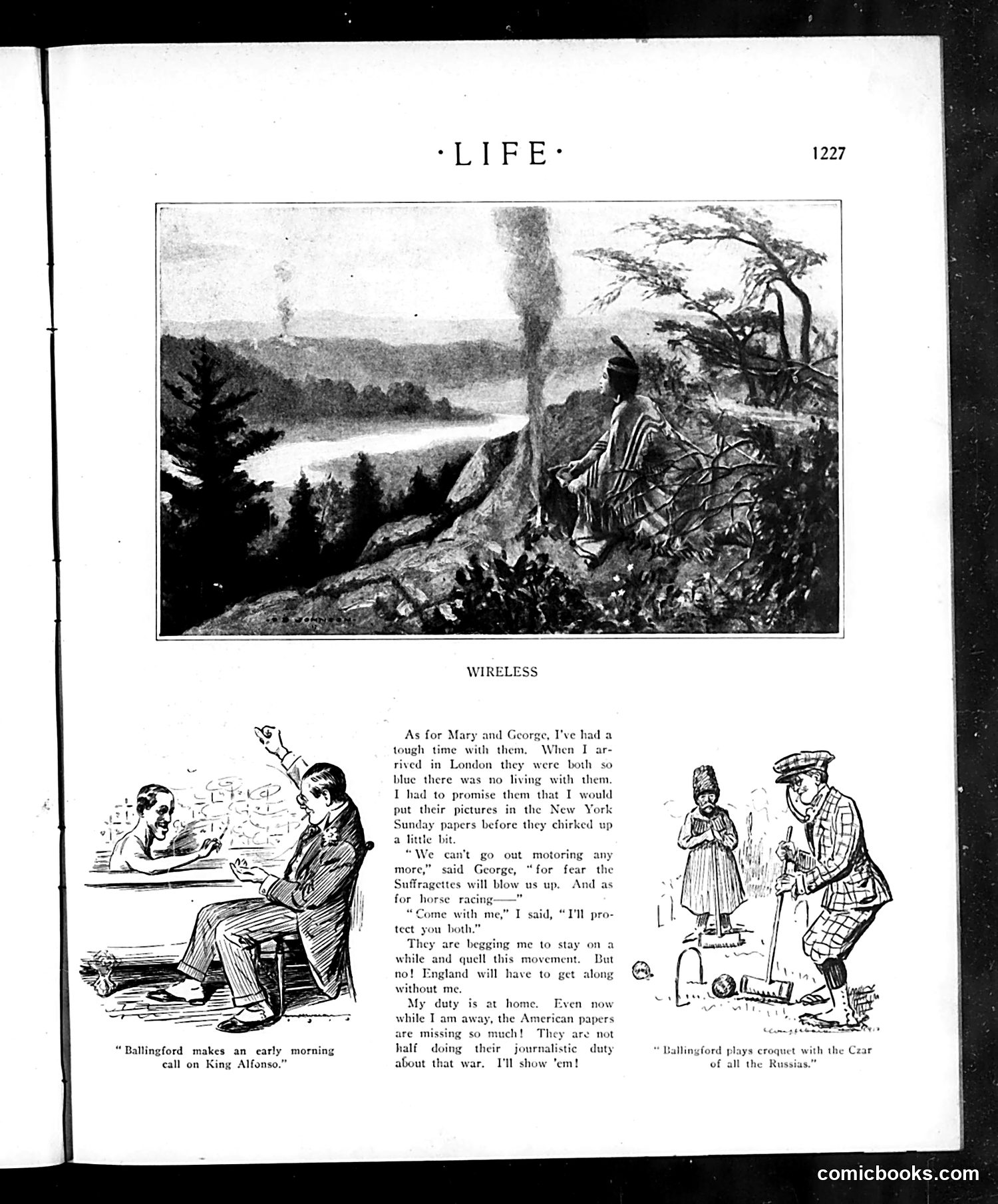
This page satirizes an American journalist named Ballingford who is visiting Europe. The main joke concerns his self-importance: while in London, he claims Mary and George are depressed until he promises to publish their pictures in New York papers, instantly cheering them up. Ballingford refuses to stay longer to help "quell" the Suffragette movement (women's voting rights activists whom the text jokes are violent enough to threaten motoring and horse racing). Instead, he insists he must return home because American newspapers are "missing so much" without his coverage of "that war"—likely referring to the Russo-Japanese War or Balkan conflicts of the early 1900s. The cartoons mock his vanity: the left shows him reporting to King Alfonso of Spain; the right depicts him playing croquet with the Russian Czar. The satire targets American journalistic arrogance and Ballingford's delusional belief that his presence alone drives international news coverage.
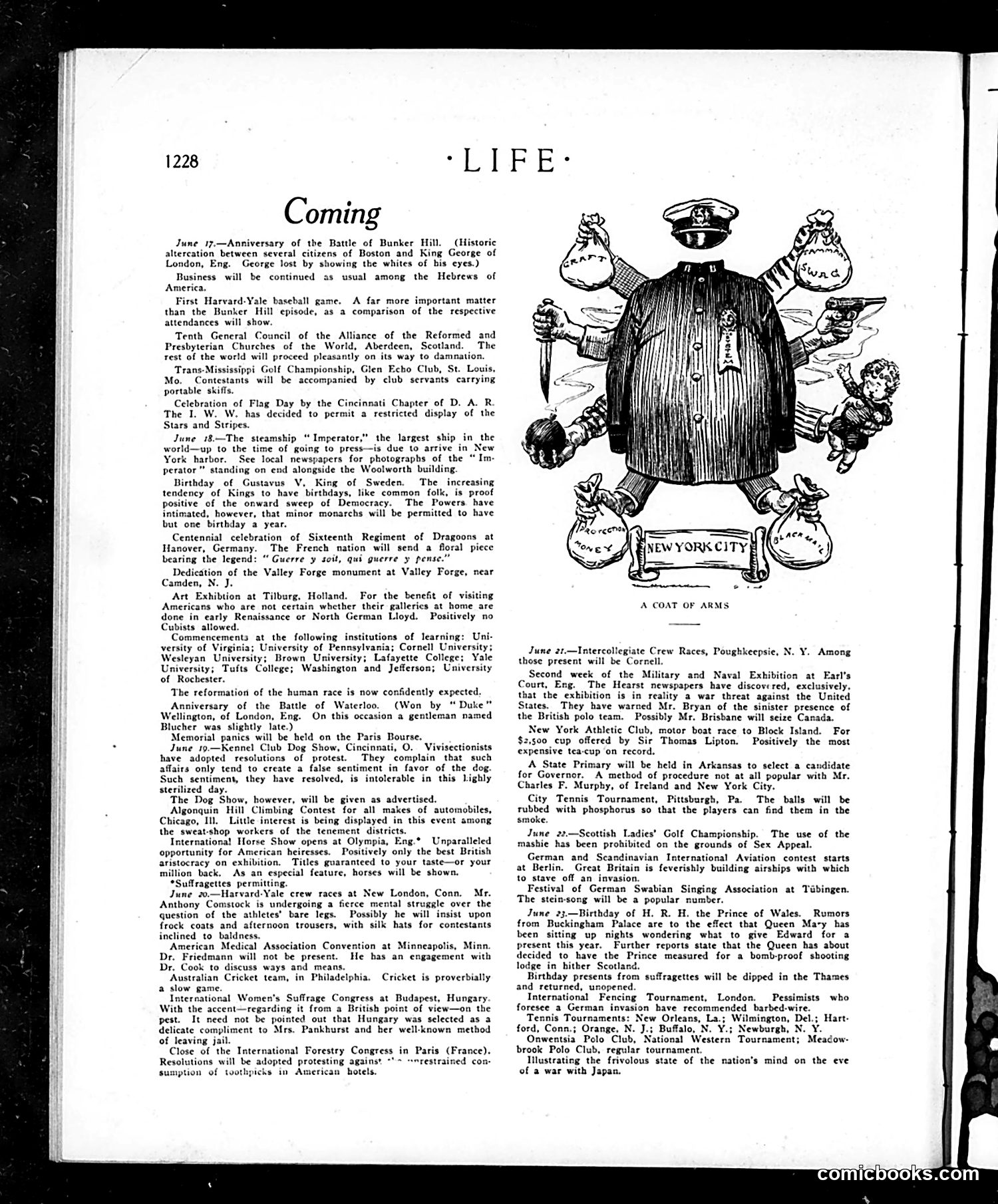
This satirical column announces upcoming events with irreverent commentary. The cartoon shows Uncle Sam as a juggler, symbolizing America managing multiple concerns simultaneously. Key satirical targets: **Political/Social Commentary:** - Bunker Hill anniversary dismissed as less important than Harvard-Yale baseball - Business continuing "as usual among the Hebrews of America" (antisemitic stereotyping, suggesting Jewish merchants ignore patriotic observance) - Reformed Presbyterian churches proceeding "on its way to damnation" - Democracy's "onward sweep" mocked via kings having birthdays like commoners - French monument inscription sarcastically quotes Napoleon **Cultural Jabs:** - Steamship "Imperator" photographed "standing on end" alongside Woolworth Building (hyperbolic boasting) - Art exhibition disclaiming "Positively no Cubists allowed" (modernism dismissal) - Dog show criticized by vivisectionists for creating "false sentiment" toward animals - Comstock (anti-vice activist) imagined agonizing over Harvard-Yale rowers' bare legs The humor relies on exaggeration, class prejudice, and contemporary reference points unfamiliar today.
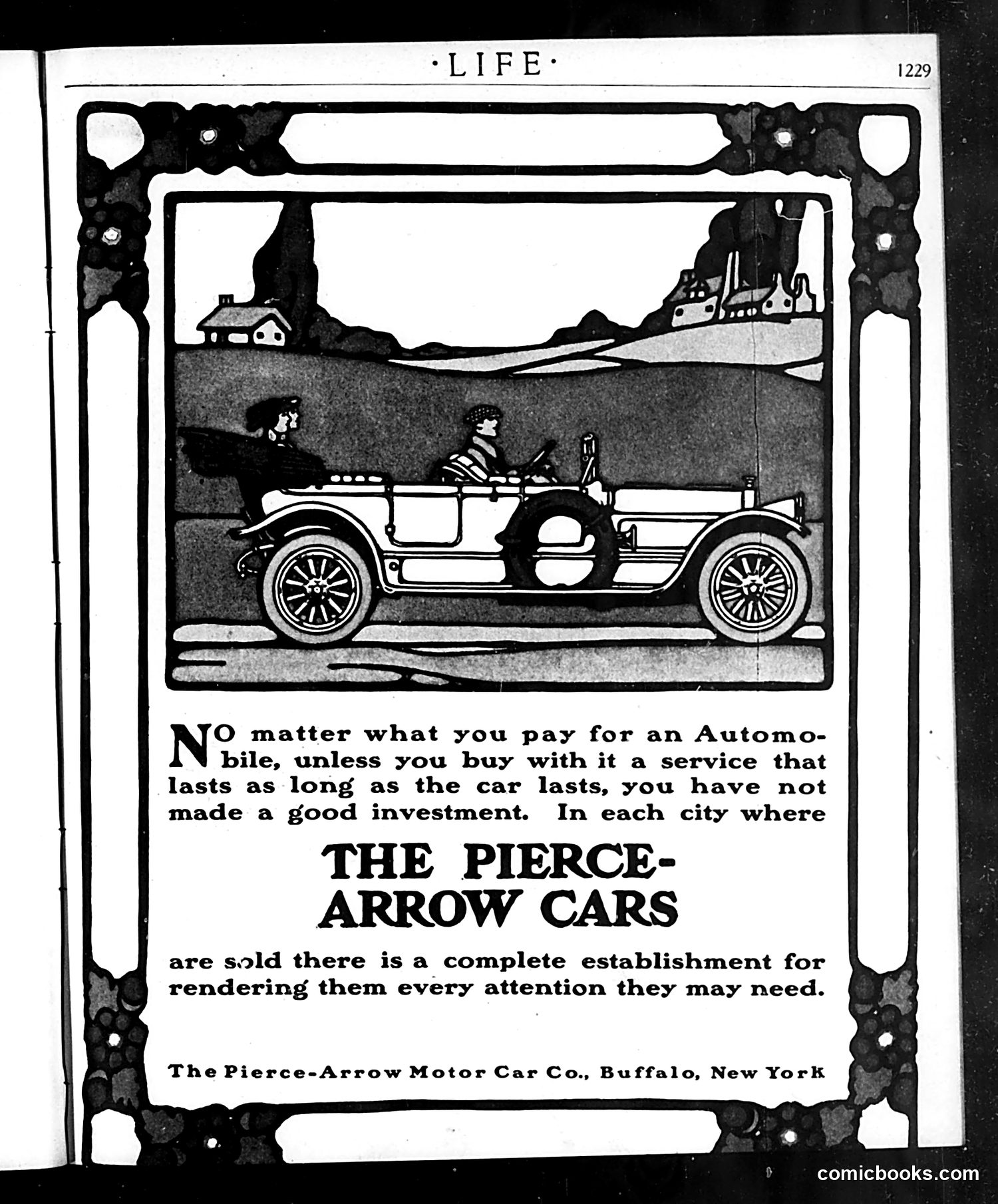
This is a full-page advertisement, not satire or political commentary. It promotes Pierce-Arrow automobiles from Buffalo, New York, emphasizing the importance of long-term service support when purchasing a car. The illustration shows an early 1910s motorcar with two well-dressed passengers traveling past rural landscape with a factory or industrial complex in the background—imagery suggesting progress and modernity. The advertisement's argument is straightforward: buying a car is only a worthwhile investment if the manufacturer provides ongoing maintenance and service throughout the vehicle's lifetime. Pierce-Arrow positions itself as offering this complete support infrastructure in every city where their cars are sold, distinguishing their brand through customer service reliability rather than price alone.
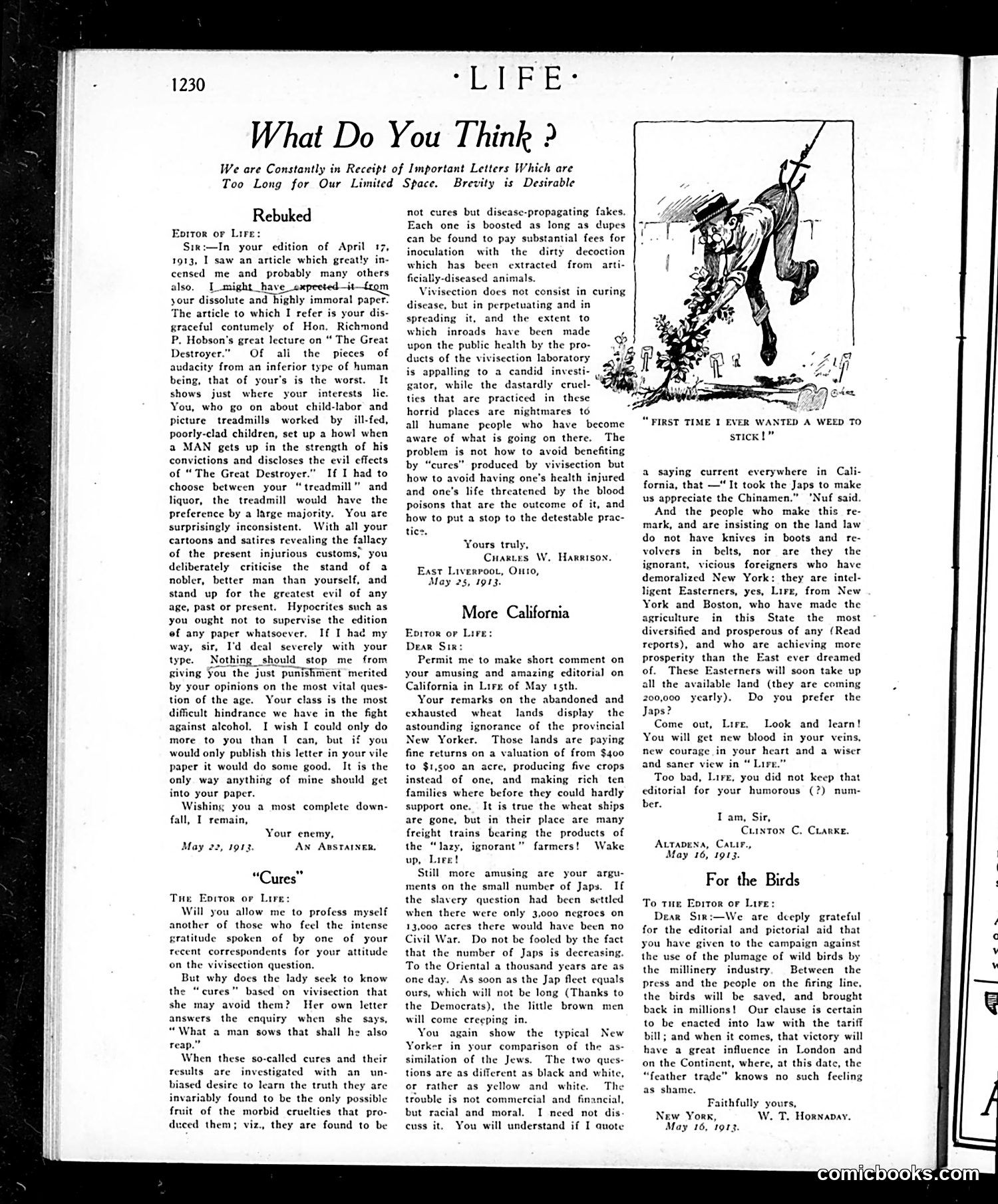
This page features a "Letters to the Editor" section and one political cartoon. The cartoon depicts a figure riding what appears to be a donkey or mule, illustrating the caption "FIRST TIME I EVER WANTED A WEED TO STICK!" The letters address three contemporary issues: 1. **Alcohol/Temperance**: A reader attacks *Life* for criticizing Richmond P. Hobson's anti-alcohol lecture while simultaneously mocking child labor—seeing this as hypocritical. The writer demands stricter censorship of the magazine. 2. **Vivisection**: A correspondent praises *Life*'s stance against animal testing, arguing that medical "cures" derived from vivisection are actually disease-propagating frauds and cause public health harm. 3. **California Agriculture**: A brief letter comments on *Life*'s editorial about California farming practices. The cartoon likely satirizes agricultural conditions or farming difficulties, though without clearer context the specific reference remains unclear. The page reflects *Life*'s characteristic role as a satirical arbiter of social causes (temperance, animal welfare, labor rights) during the Progressive Era.
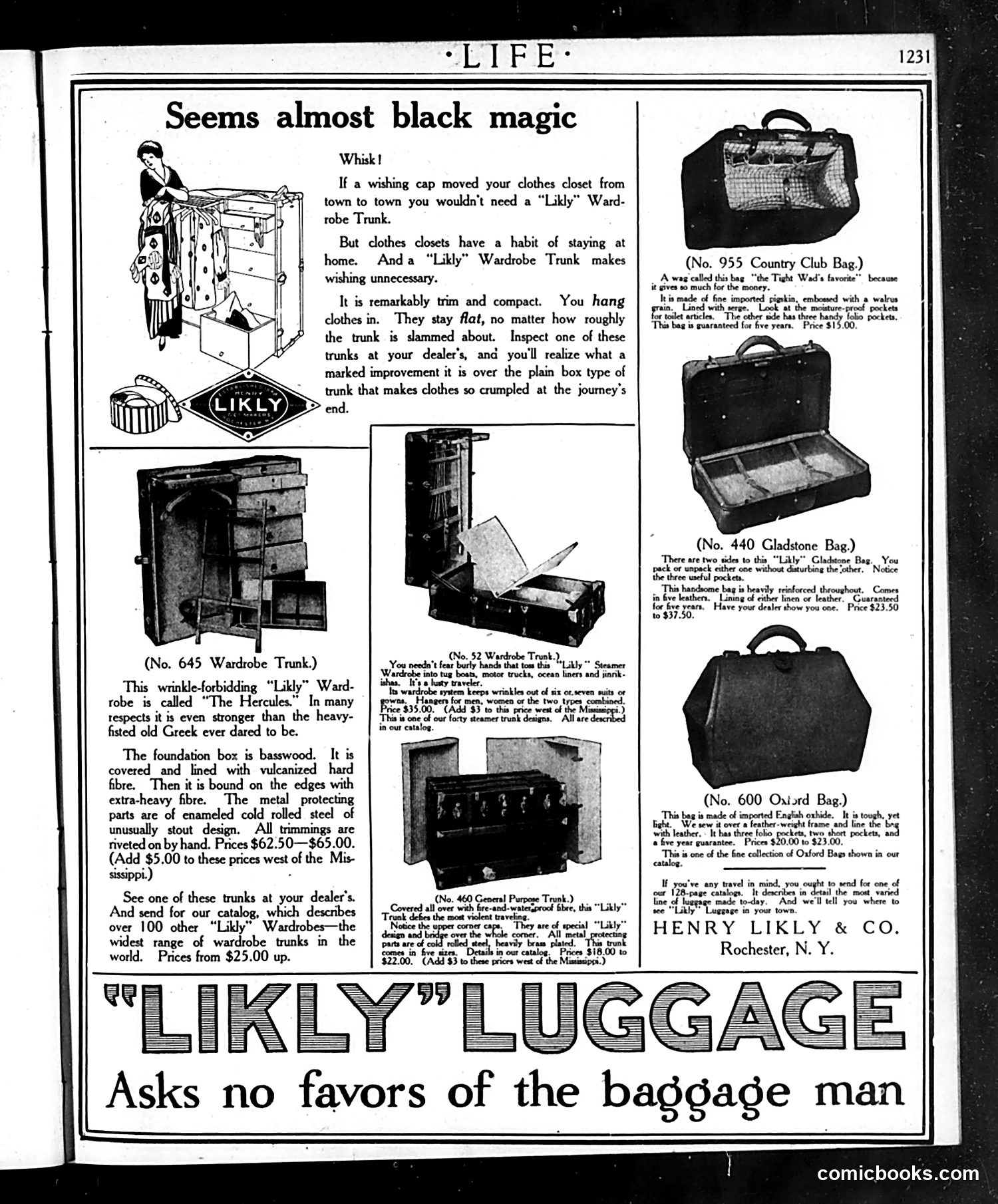
This is primarily **advertising, not satire**. It's a product page for Henry Likly & Co.'s luggage line, published in *Life* magazine. The headline "Seems almost black magic" uses playful language to promote wardrobe trunks that keep clothes unwrinkled during travel—presented as a miraculous solution to a genuine problem of the era. The opening joke about a "wishing cap" moving your closet is lighthearted product marketing, not political commentary. The page showcases multiple luggage styles (wardrobe trunks, gladstone bags, country club bags, oxford bags) with technical specifications and prices ranging from $18-$65. The tagline "Asks no favors of the baggage man" suggests these trunks withstand rough handling during transportation—a practical concern when traveling by train, ship, or motor vehicle. This reflects early-20th-century concerns about travel logistics and luggage durability, targeting affluent consumers who traveled frequently between towns.
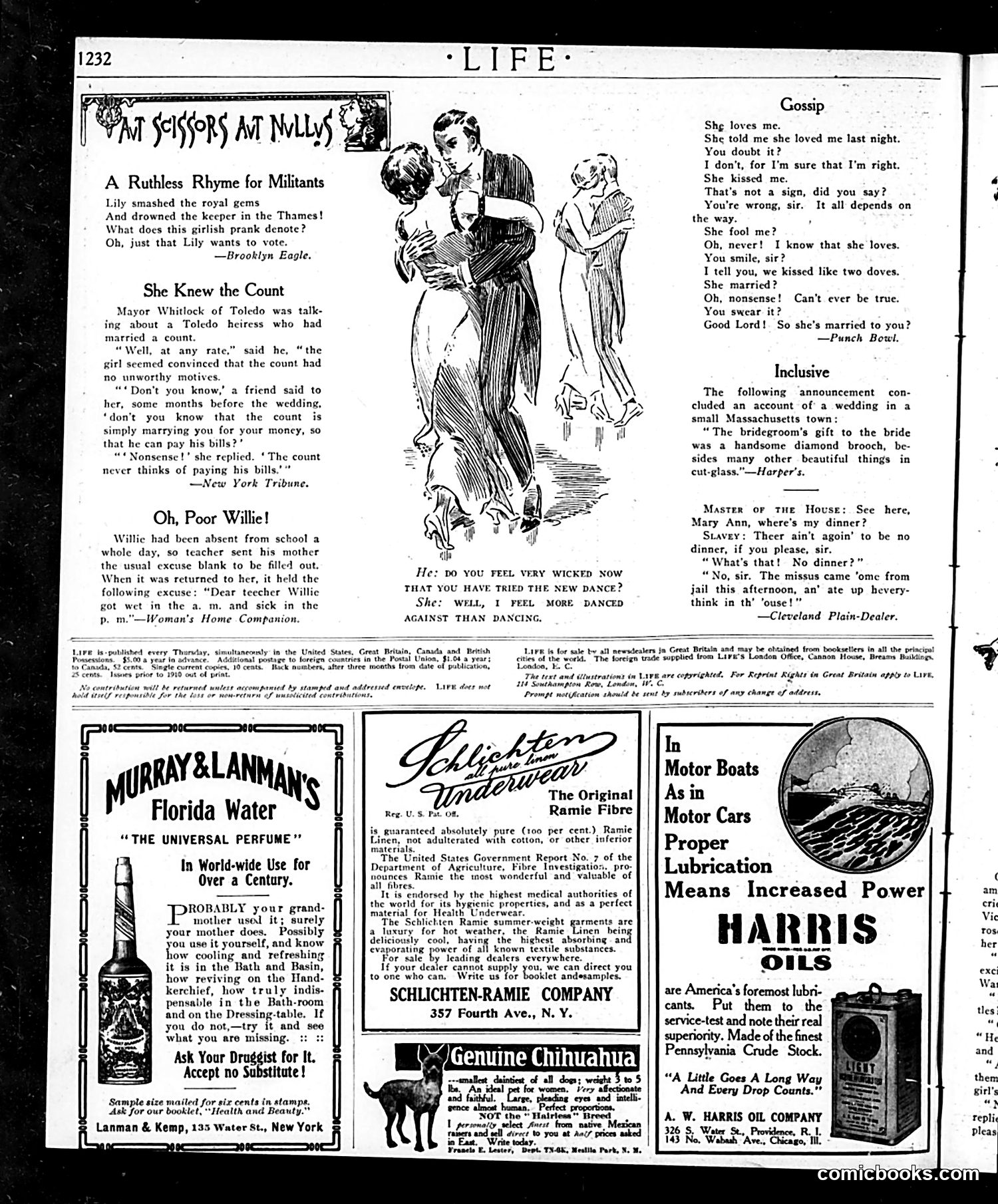
This page contains three brief satirical pieces typical of early 20th-century American humor magazines: **"A Ruthless Rhyme for Militants"** references the British suffragette movement, where activists (like Lily Constance Lenton, known as "Tiger Lil") committed property destruction—smashing royal jewels, drowning a keeper—to demand voting rights. The satire mocks suffragettes by suggesting their radical tactics are merely childish pranks motivated by wanting to vote. **"She Knew the Count"** satirizes naive heiresses marrying foreign nobility. The joke: a Toledo girl married a count despite warnings he was merely after her money. The punchline's dark humor lies in her reply that the count never pays his bills anyway—implying even his deception is incompetent. **"Oh, Poor Willie!"** is gentler humor about a mother's garbled excuse note for her son's absence from school, conflating "a.m." (morning) with "a. m." (presumably her abbreviation). The page is primarily advertisements for perfume, ramie fiber, and motor oils, which dominated Life's revenue.
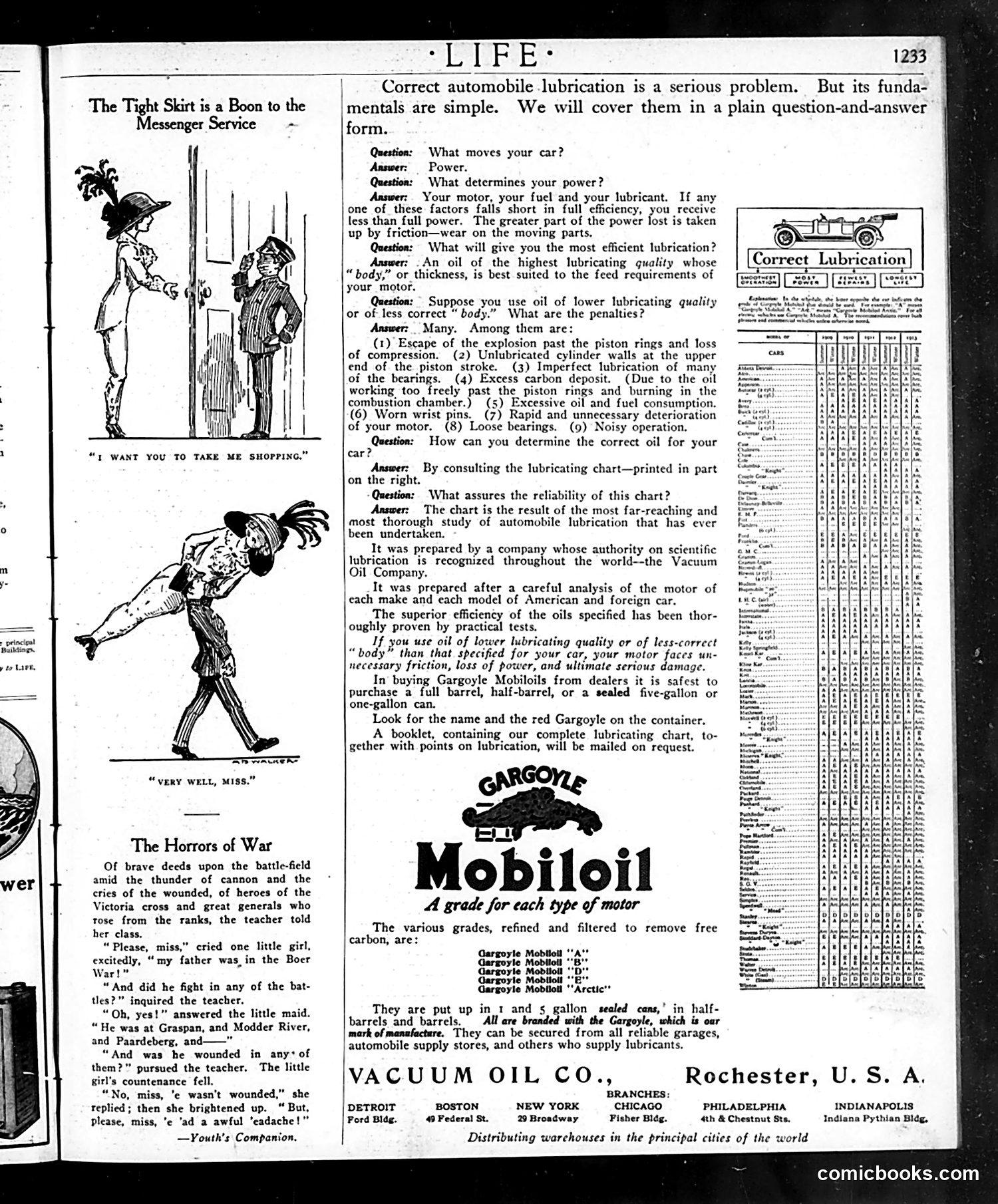
This page contains two distinct elements: **Left side:** Two brief cartoon jokes about messenger service and wartime experiences. The first shows a woman in a tight skirt requesting shopping assistance—the joke being that tight skirts (fashionable at the time) are inconvenient for messengers. The second is a humorous anecdote where a schoolteacher asks about a girl's father's war service; the child lists three battles from the Boer War but ends with "he wasn't wounded"—the joke implying the father was present but avoided action. **Right side:** A substantial advertisement for Gargoyle Mobiloil (an automobile lubricant by Vacuum Oil Company). It uses a question-and-answer format to educate readers about proper motor oil selection, includes a detailed lubrication chart, and promotes their product line across different vehicle types. This reflects early-20th-century advertising's educational approach to establishing consumer trust in a technical product.
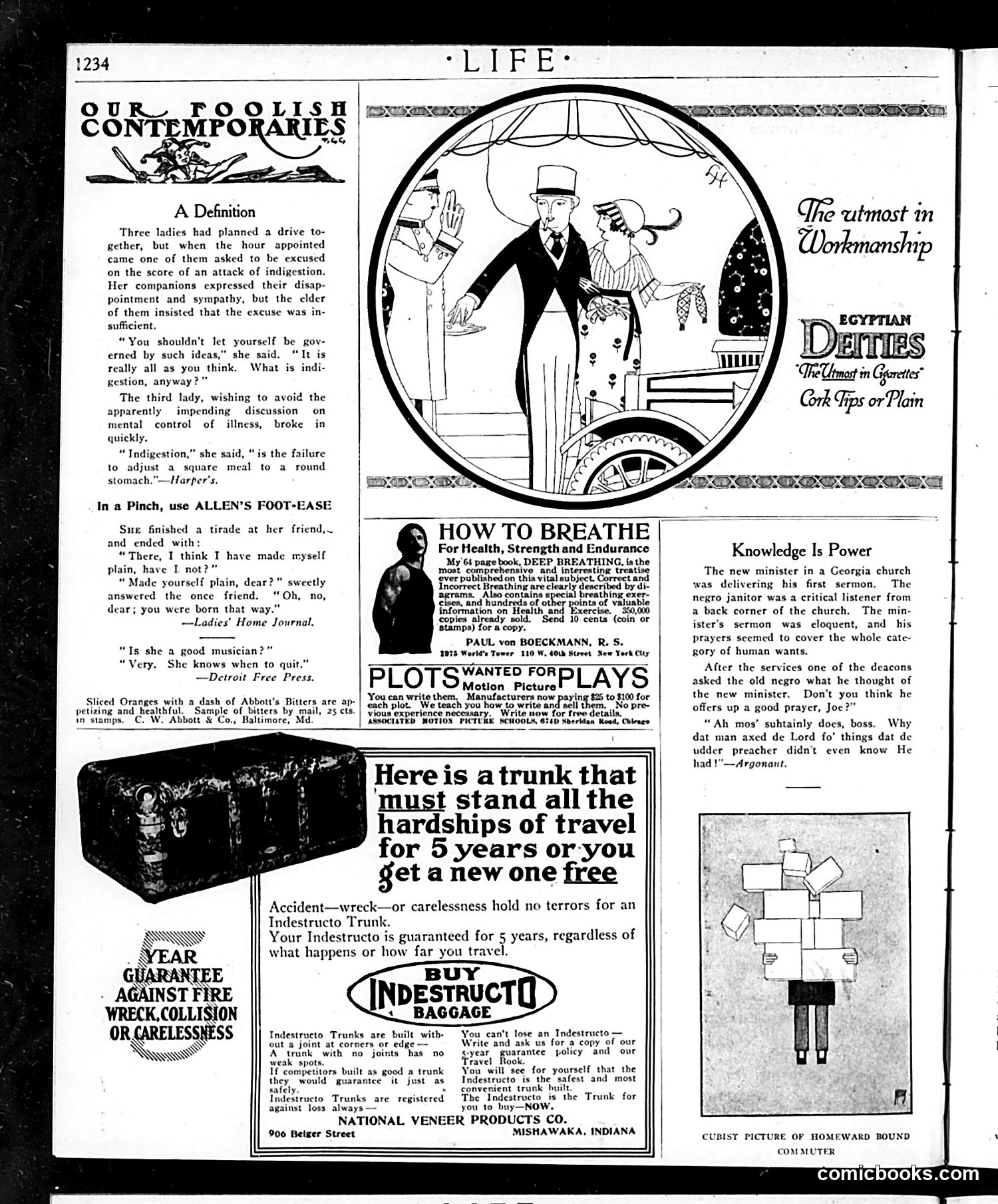
This page is primarily **advertising** with brief humor columns interspersed. The main content includes: **"Our Foolish Contemporaries"** — A satirical column mocking three ladies whose friend cancels a planned drive. One excuses herself for indigestion; her companions dismiss this as insufficient. The humor targets women's perceived hypochondria and weak constitutions—a period stereotype. **Other brief jokes** mock women's chattiness ("Made yourself plain?"), musicianship, and domestic dynamics—typical early 20th-century gender humor. **"Knowledge Is Power"** — A brief anecdote about a Black church janitor impressed that a new minister prayed for things the previous preacher "didn't even know He had." The humor relies on a racial stereotype of Black servants as simple-minded observers. **Advertisements** dominate: Allen's Foot-Ease, Abbott's Bitters, Indestructo Trunks (with 5-year guarantee), and correspondence courses for writing movie plots. The cartoonish illustration shows a fashionable man in a car with women, likely supporting the contemporary advertising/lifestyle content rather than conveying specific satire.
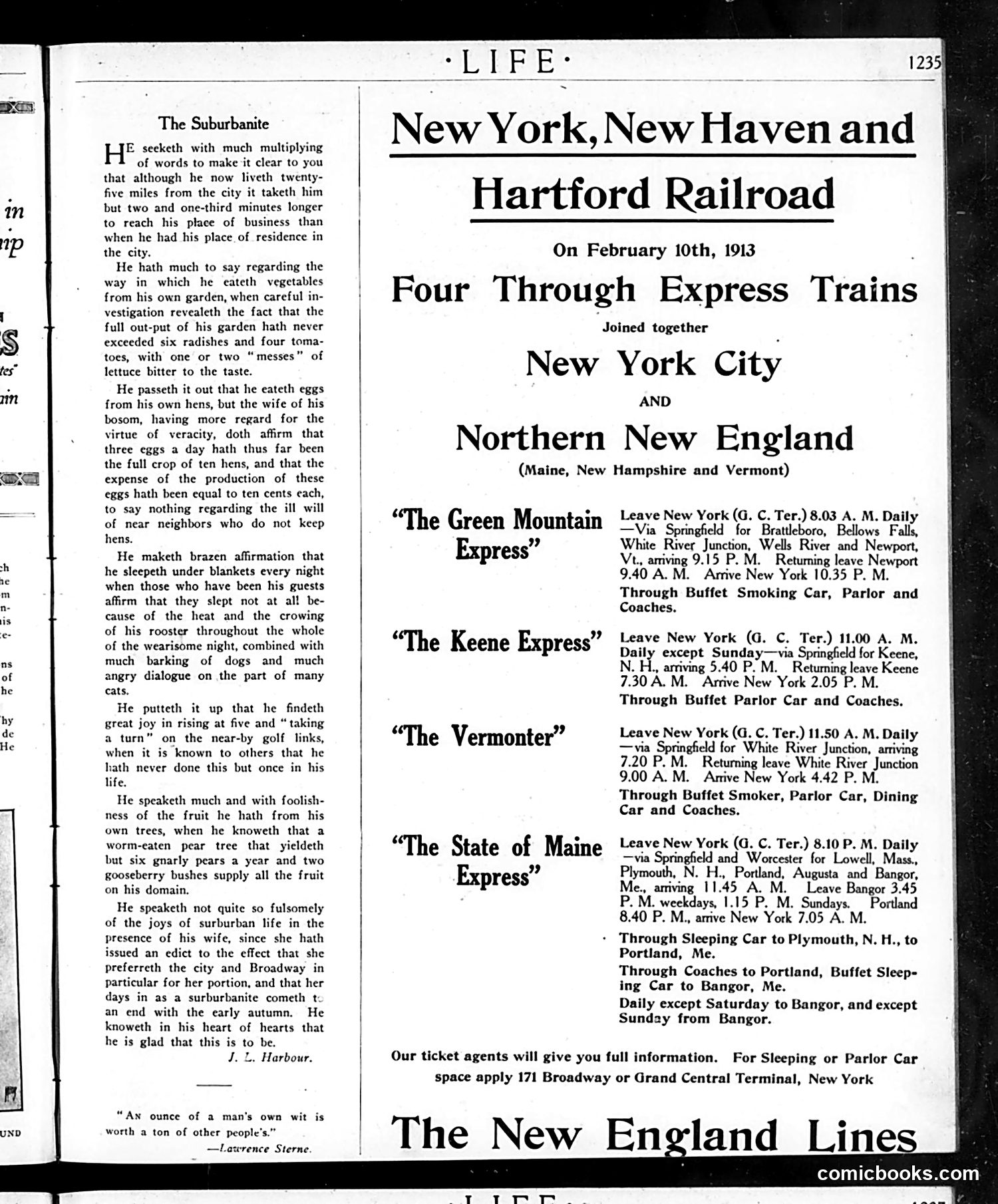
This page is primarily a **railroad advertisement** for the New York, New Haven and Hartford Railroad (announcing four new express trains on February 10, 1913), but the left column contains satirical commentary titled "The Suburbanite." The satire mocks the early suburban commuter—a figure newly common in 1913 as people moved to outlying areas while maintaining city jobs. The piece exposes his exaggerations and pretensions: he claims his commute is barely longer than before, yet boasts endlessly about homegrown vegetables, eggs, and fruit that investigations reveal are minimal or nonexistent. He claims to rise at five for golf but has done so only once. He sleeps peacefully while guests confirm he keeps them awake with noise and heat. The satire's point: the suburbanite is a poseur and braggart, trying to convince others (and himself) that suburban life is superior when his wife has already decided to abandon it in autumn. The humor targets the gap between his claims and reality—a recognizable social type emerging with suburban expansion.
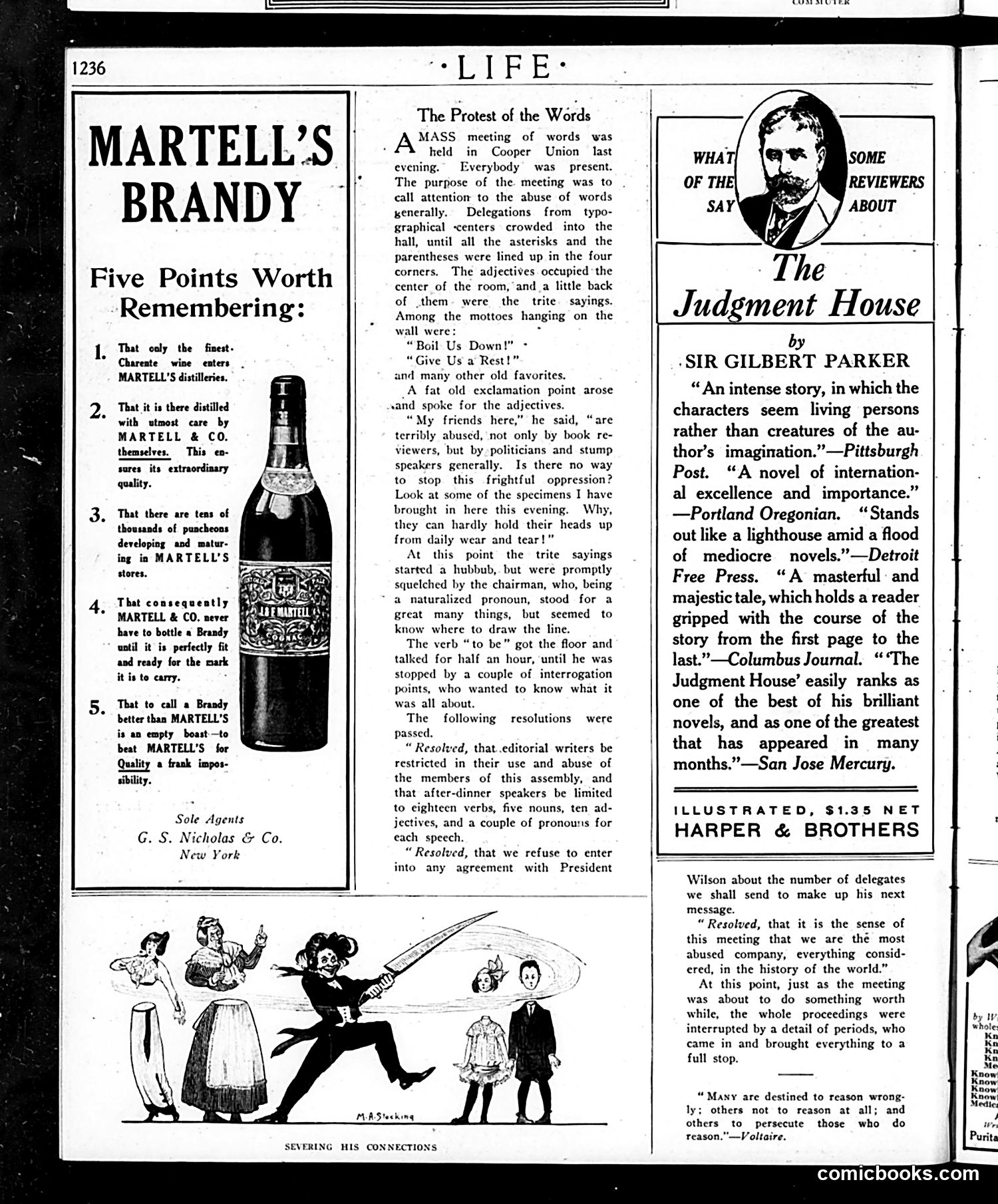
This satirical piece personifies parts of speech—adjectives, verbs, nouns, pronouns—staging a mock assembly at Cooper Union to protest their abuse by writers, politicians, and public speakers. The cartoon depicts words as characters literally "holding their heads up" from exhaustion. Adjectives complain they're overused by book reviewers and politicians; verbs demand fair treatment; punctuation marks (periods, interrogation points) interrupt proceedings. The satire targets the careless, excessive use of language in American public discourse—particularly by editorial writers and politicians making speeches. The resolutions mock formal meetings by proposing absurd restrictions: limiting speakers to "eighteen verbs, five nouns, ten adjectives." The bottom cartoon illustration shows this "assembly" devolving into slapstick chaos, ending when periods literally "brought everything to a full stop." The joke: Language itself is being victimized by overuse and misuse in contemporary American rhetoric, especially political speech circa World War I era.
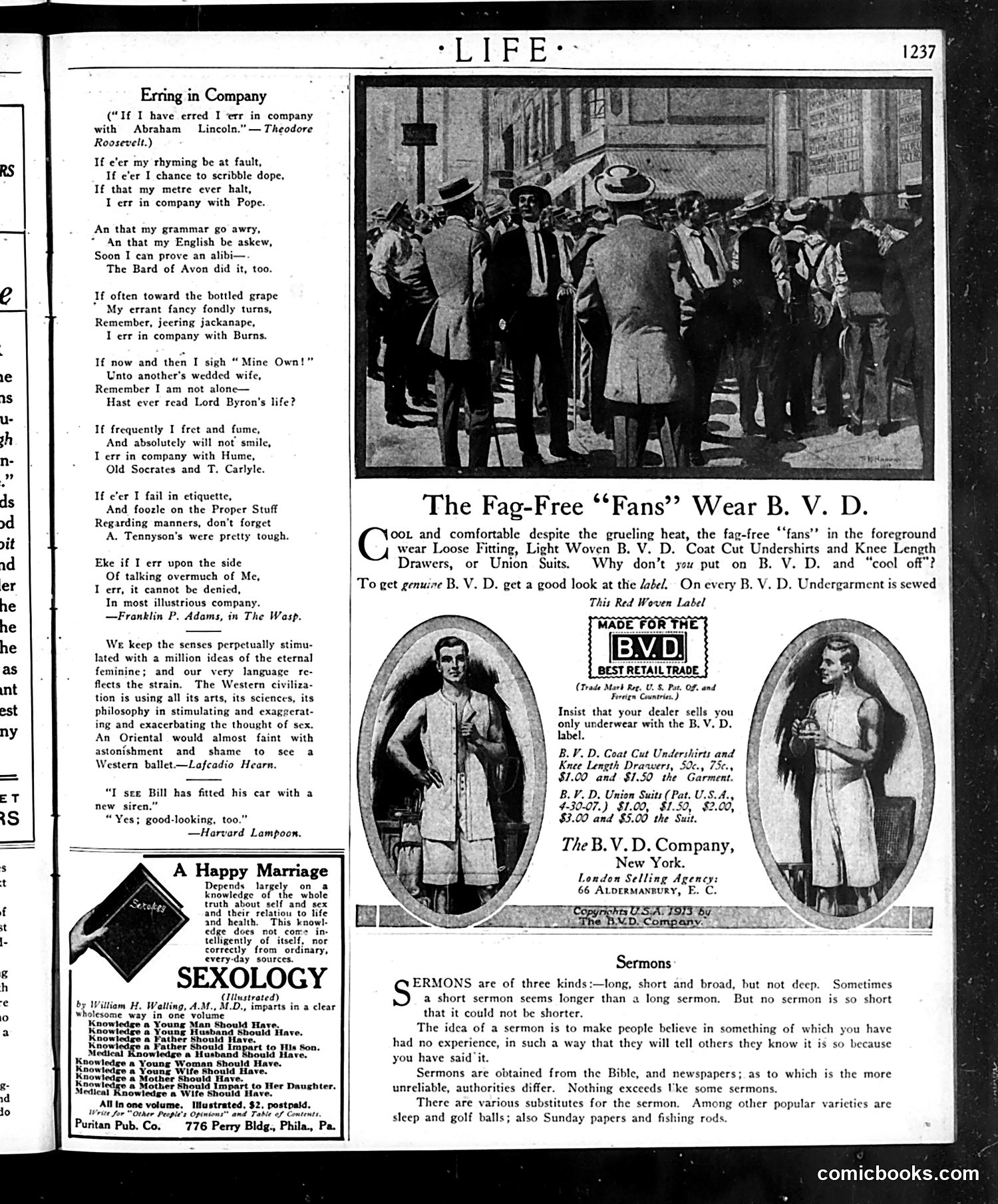
This page contains multiple unrelated items typical of early 20th-century satirical magazines: **"Erring in Company"** is a humorous poem by Franklin P. Adams (credited as from *The Wasp*) that justifies various personal failings by claiming famous historical figures—Shakespeare, Pope, Byron, Burns—committed the same errors. It's lighthearted self-deprecation. **"A Happy Marriage"** and **"Sexology"** are advertisements for an instructional book about sexual education, reflecting early-1900s attitudes toward marriage education. **"The Fag-Free 'Fans'"** is a B.V.D. underwear advertisement showing men in the street during hot weather. "Fag-free" here means "free from fatigue," not a slur; the ad promotes comfortable undergarments for heat. The photograph shows actual street crowds, likely staged. **"Sermons"** is a brief satirical commentary defining sermons cynically—as attempts to make people believe things the preacher hasn't experienced, obtained from unreliable sources like the Bible and newspapers. It's gentle mockery of religious hypocrisy. The page is primarily advertising and light humor, not political satire.
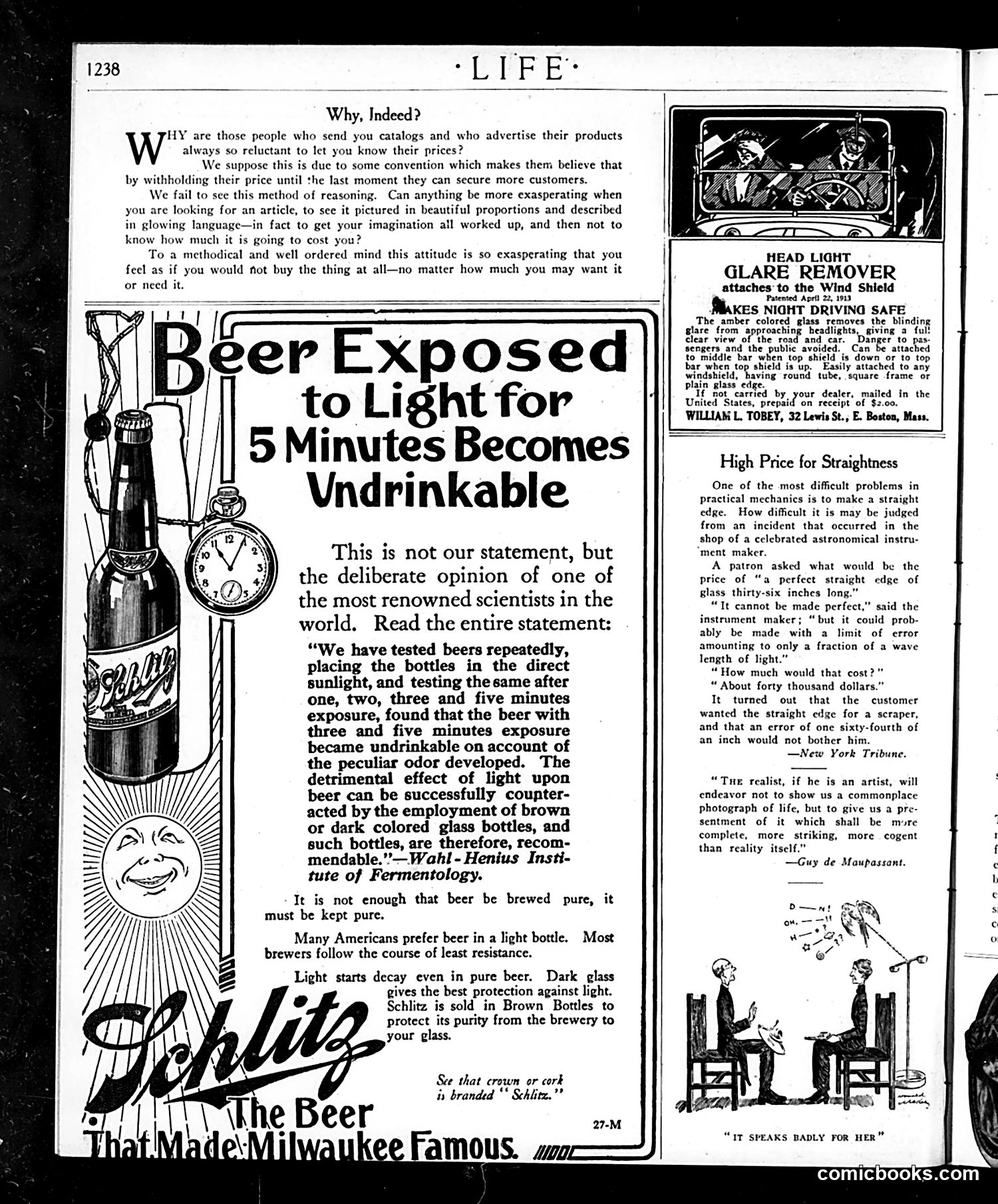
This page contains advertisements and editorial commentary typical of early 20th-century Life magazine. The **main advertisement** promotes Schlitz beer, citing a scientific statement claiming beer exposed to sunlight for 3-5 minutes becomes undrinkable due to odor development. Schlitz argues that brown bottles—not light ones—protect beer quality from brewery to consumer. This addresses a real brewing concern: light exposure causes chemical degradation (now called "skunky" flavor). The **opening editorial** satirizes merchants who advertise products beautifully but hide prices until the last moment, frustrating customers who've already imagined owning the item. **Secondary advertisements** include a "Head Light Glare Remover" (amber windshield attachment) and an anecdote about astronomical instrument makers pricing a "perfect straight edge." The **cartoon at bottom** is captioned "It Speaks Badly for Her," though the specific context is unclear from this page fragment. The magazine critiques both deceptive advertising practices and product quality standards of the era.
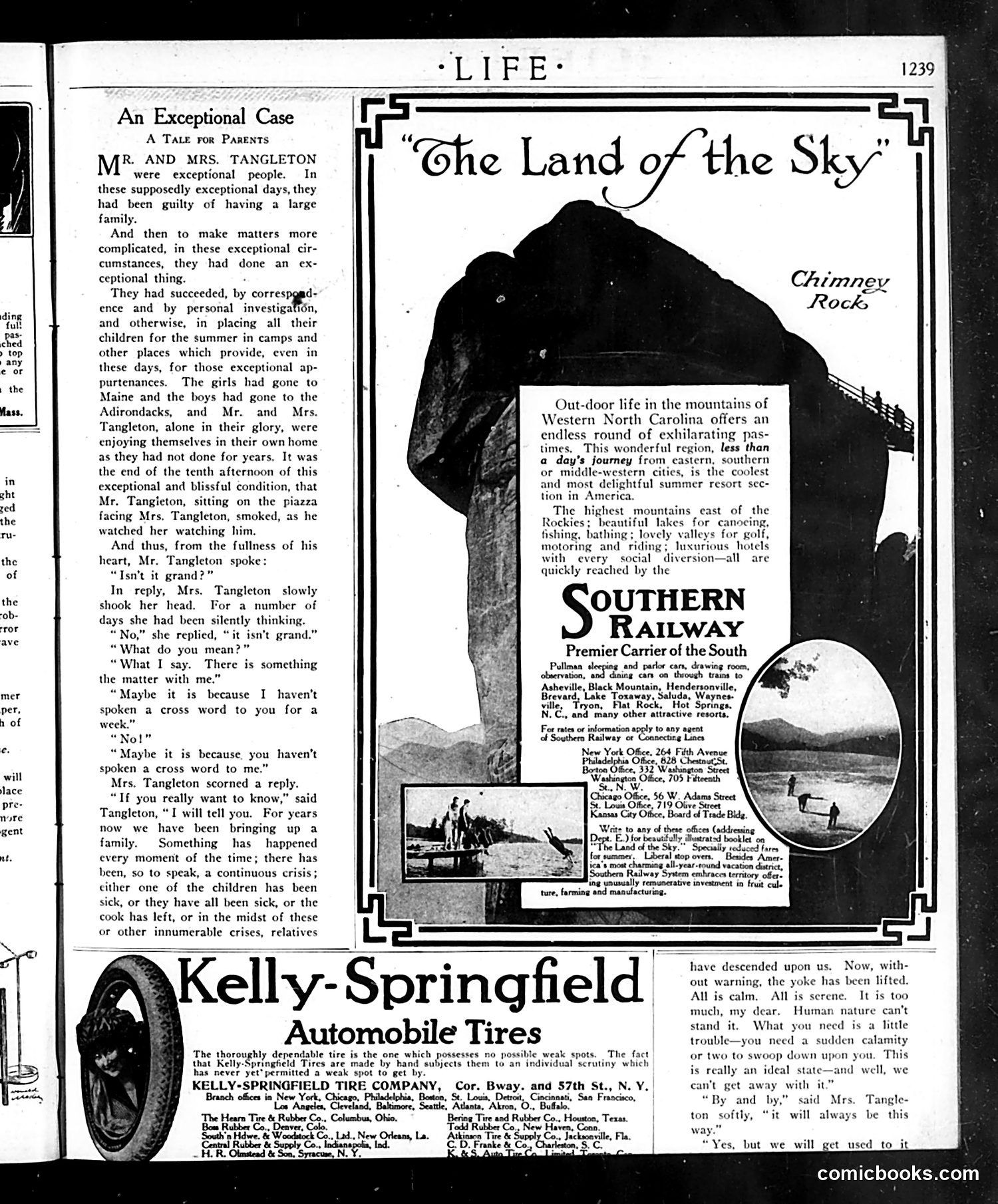
This page presents a domestic humor story about the Tangletons, an affluent couple who have temporarily achieved their dream: sending all their children to summer camps and finally enjoying uninterrupted peace at home. The satire targets upper-middle-class anxieties. After years of constant family chaos—sick children, servant crises, visiting relatives—Mr. Tangleton expects bliss. Instead, Mrs. Tangleton reveals the psychological trap: humans *need* problems to feel alive. Without crisis and conflict, their marriage feels hollow; they've forgotten how to connect without domestic turbulence. The joke exposes how some couples unconsciously depend on family chaos as the foundation of their relationship. The twist—that peace feels worse than crisis—reflects early 20th-century assumptions about gender dynamics and marriage as inherently contentious rather than companionable. The page also features advertising (Southern Railway, Kelly-Springfield Tires), typical of Life's format mixing satirical content with commercial material.
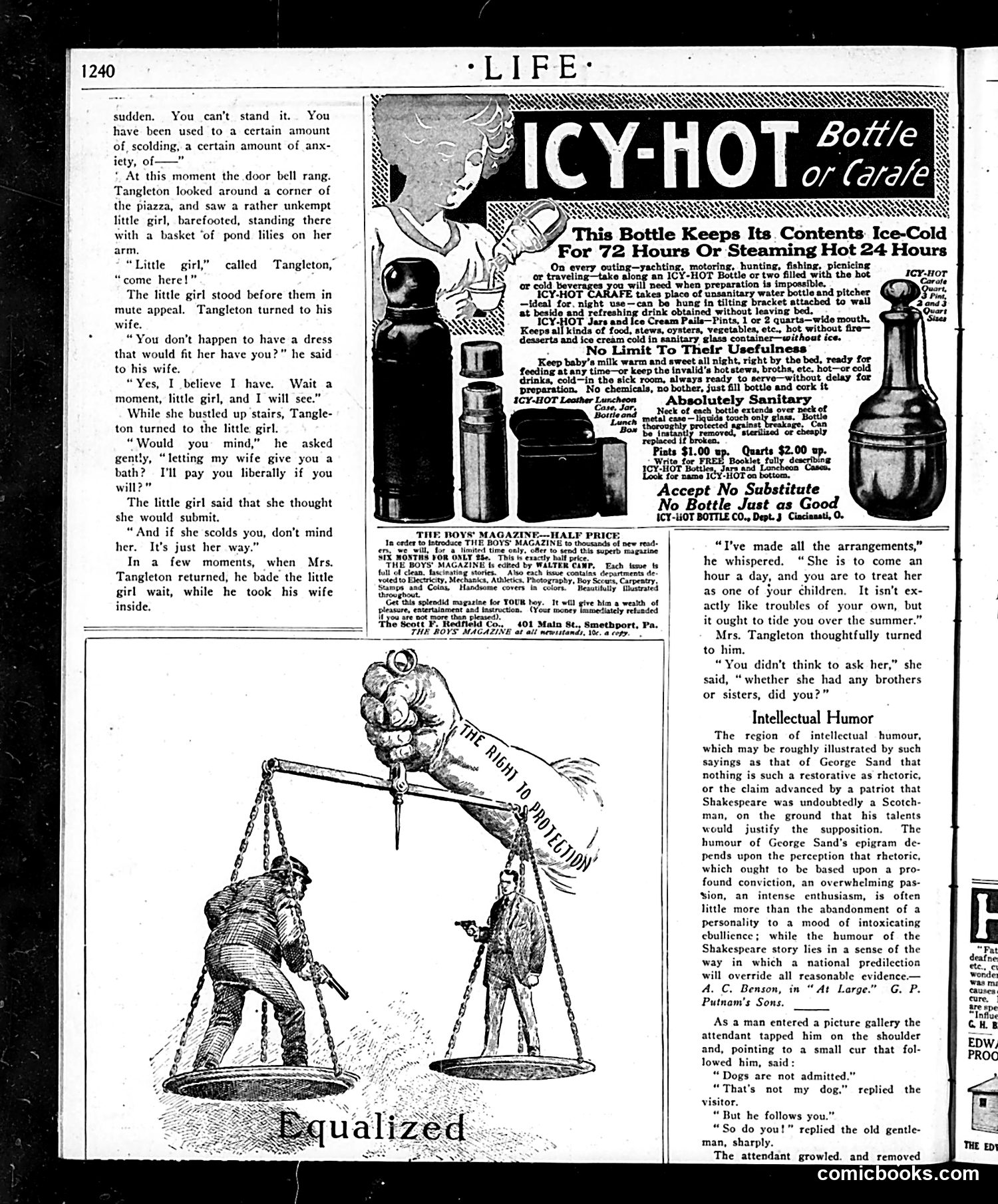
This page contains a serialized short story about a man named Tangleton who impulsively offers a barefoot, impoverished girl a bath and new dress—revealing anxieties about class and charity. When his wife questions whether he asked about the girl's family, the story suggests unspoken social complications beneath this seemingly kind gesture. The cartoon titled "Equalized" (bottom left) depicts Lady Justice holding a scale with an elephant on one side and a small man on the other—likely satirizing wealth inequality or imbalanced power dynamics in society. The "Intellectual Humor" essay discusses how humor relies on shared cultural understanding. The dominant advertising space promotes the "Icy-Hot Bottle," a thermos product claiming to keep beverages hot or cold for extended periods—typical early 20th-century consumer marketing emphasizing convenience and hygiene for middle-class households.
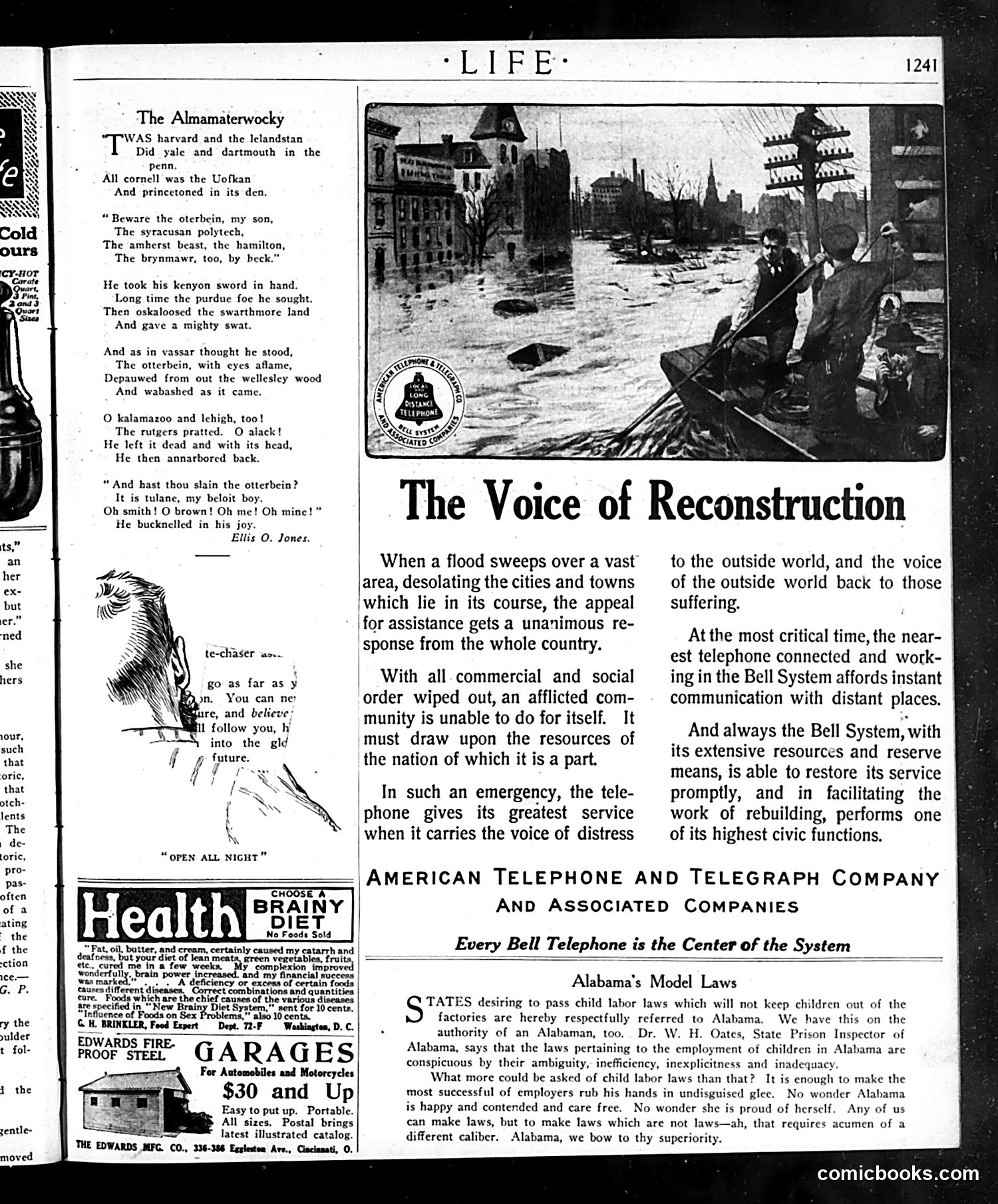
This page contains two satirical pieces. The top poem is a parody of Lewis Carroll's "Jabberwocky," replacing nonsense words with American college names (Harvard, Yale, Dartmouth, Cornell, etc.) fighting each other in mock-heroic battle. It's gentle satire of collegiate rivalry and pretension. The lower piece, "Alabama's Model Laws," is sharper political satire. It mocks Alabama's deliberately weak child labor laws by praising them with heavy irony—calling them a model despite their "ambiguity, inefficiency, inexplicitness and inadequacy." The piece sarcastically suggests these inadequate laws are actually *perfect* because they allow employers to exploit child workers without legal restriction. It's exposing how Alabama crafted loopholes into legislation specifically to permit child labor in factories, framing regulatory failure as achievement.
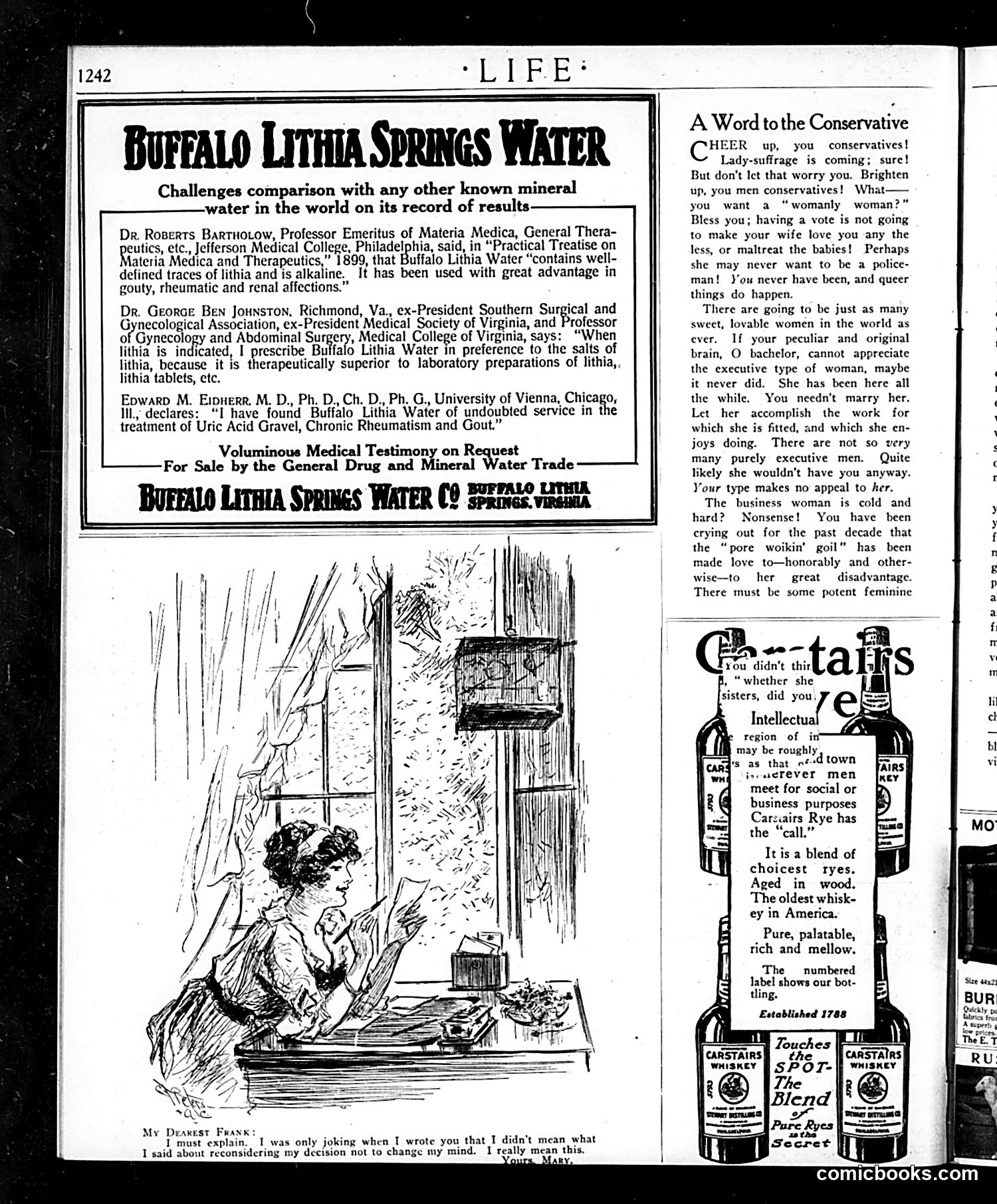
This page contains **primarily advertisements** rather than editorial cartoons, though one small illustration appears. **Buffalo Lithia Springs Water ad** (top): A medical testimonial advertisement citing three doctors endorsing the mineral water's therapeutic benefits for gout, rheumatism, and kidney ailments—standard early-20th-century patent medicine marketing using credentialed physicians. **Small illustration** (center-left): Shows a woman at a desk writing a letter. The caption reveals a humorous domestic scene where she's clarifying that her previous letter—saying she'd *changed her mind about not changing her mind*—was sincere. This illustrates marital miscommunication through intentionally confusing double-negatives. **"A Word to the Conservative"** (right): An essay addressing men skeptical of women's suffrage, arguing that voting won't make wives less loving or transform "sweet, lovable women" into harsh businesswomen. It defends working women against stereotypes. **Carstairs Whiskey ad** (bottom-right): Standard liquor advertisement emphasizing the brand's age and quality. The page reflects early-suffrage-era debates and period attitudes toward women and work.
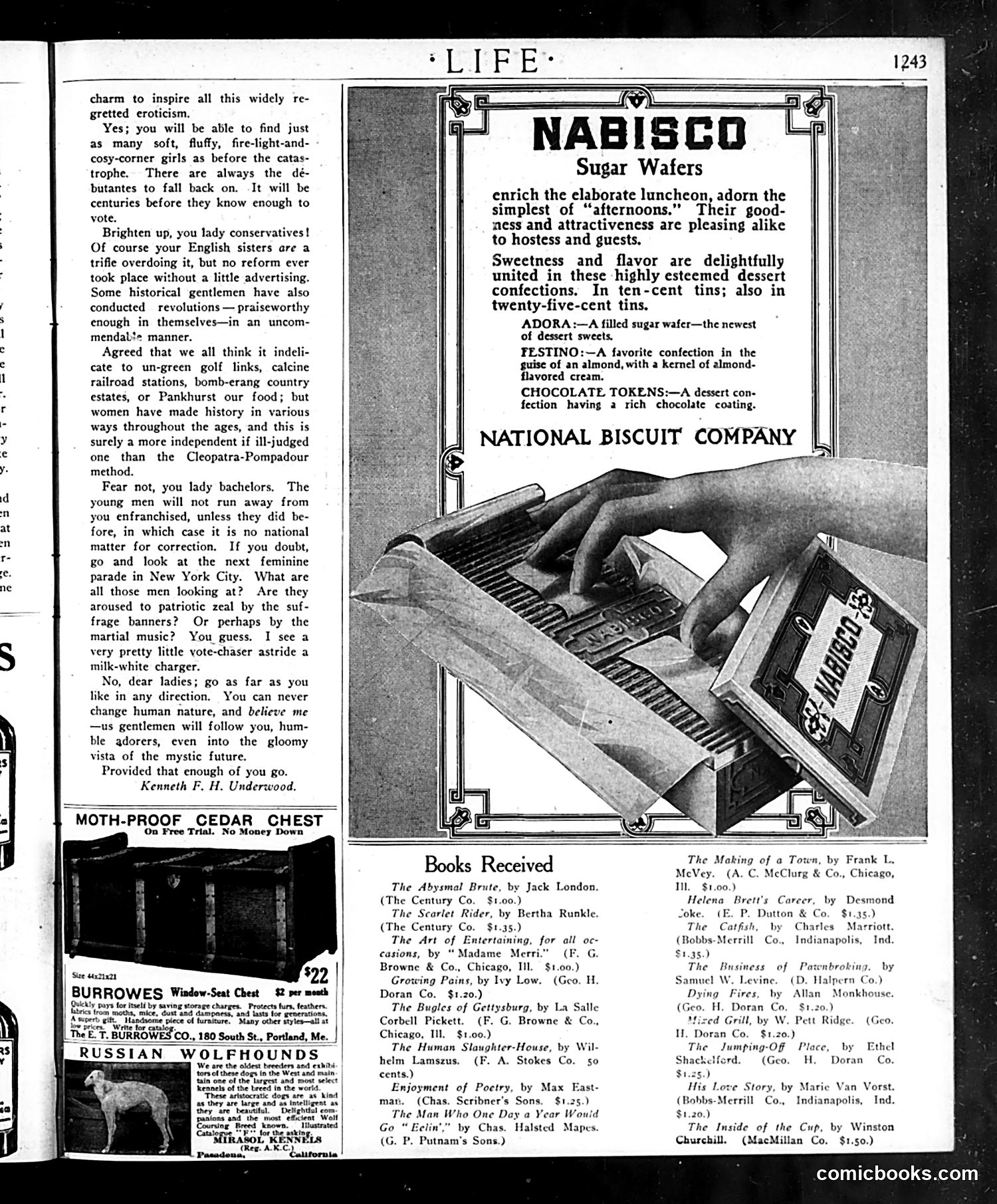
This page contains a satirical essay by Kenneth F. H. Underwood addressing concerns about women's suffrage and social reform. The piece mockingly reassures conservative women that granting women voting rights won't undermine femininity or marriage prospects—men will remain attracted regardless. The satire targets both conservative anxieties about women's liberation and the suffrage movement itself. References to "Pankhurst" invoke Emmeline Pankhurst, leader of the British suffragette movement known for disruptive tactics ("bomb-erang country estates"). The author dismisses such methods while arguing women's independence is historically inevitable. The condescending tone—calling women "lady conservatives" and "lady bachelors," suggesting men will "follow" enfranchised women—undercuts the progressive message, suggesting the author sees women's liberation as inevitable despite male resistance rather than justified reform. The remaining page content comprises product advertisements (Nabisco wafers, cedar chests, Russian wolfhounds) and a book review section typical of *Life* magazine's format.
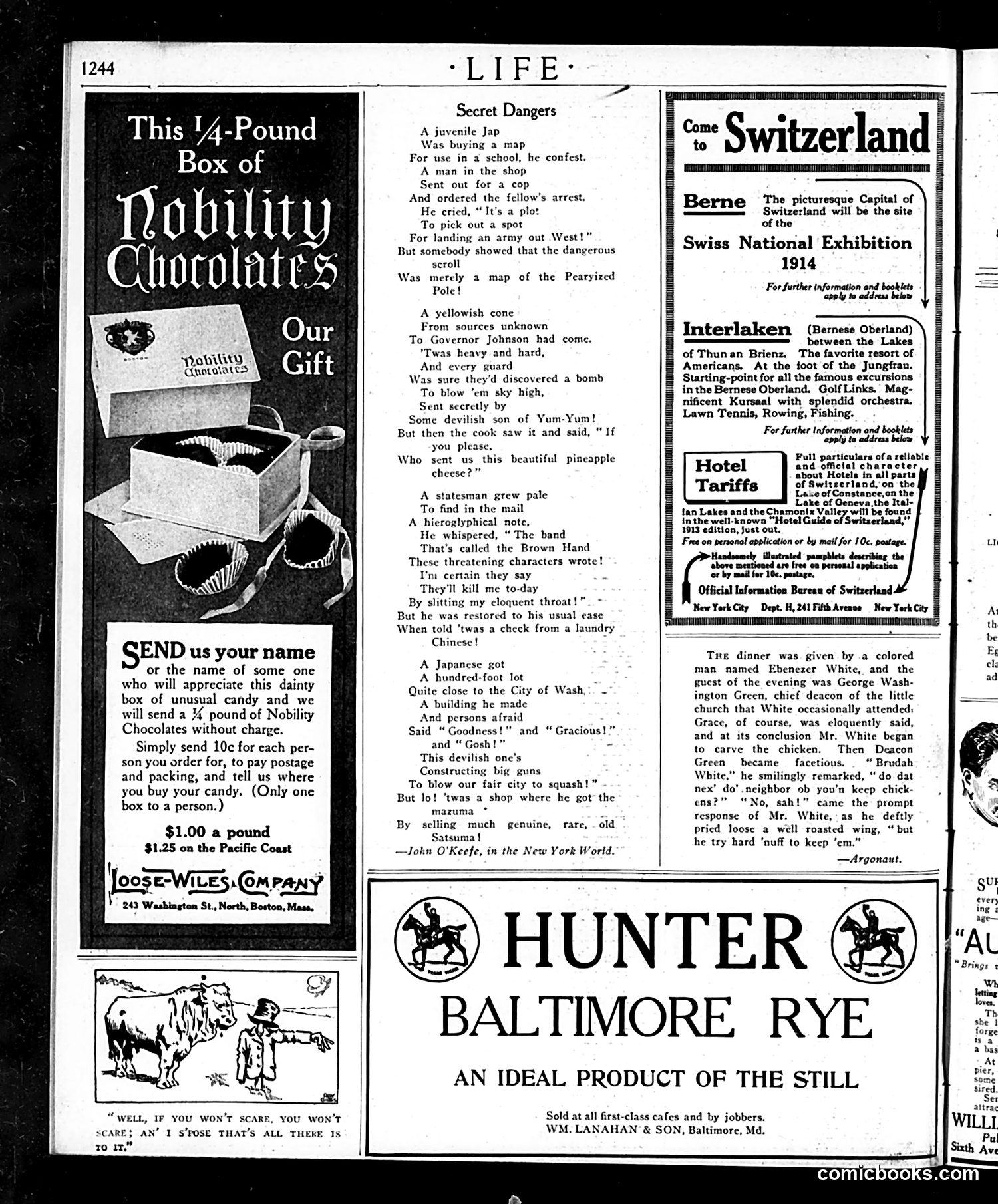
This page combines advertisements with satirical poetry mocking anti-Japanese hysteria in early 20th-century America. The central poem, "Secret Dangers," ridicules xenophobic panic about Japanese people through escalating absurd scenarios: a schoolboy buying a map is arrested for espionage; a mysterious package is feared as a bomb but proves to be pineapple cheese; a Japanese businessman constructing a building near Washington is suspected of building guns for sabotage, when he's actually just opening a shop selling Satsuma pottery. The satire critiques overblown fears of Japanese infiltration and sabotage that characterized American attitudes during this period of rising Japan-U.S. tensions. The joke lies in the gap between paranoid suspicions and innocent reality—each "dangerous" plot dissolves into mundane commerce. The page also includes a racist humor piece featuring stereotyped dialect and an advertisement for Baltimore Rye whiskey, reflecting the casual prejudices normalized in 1914 American publications.
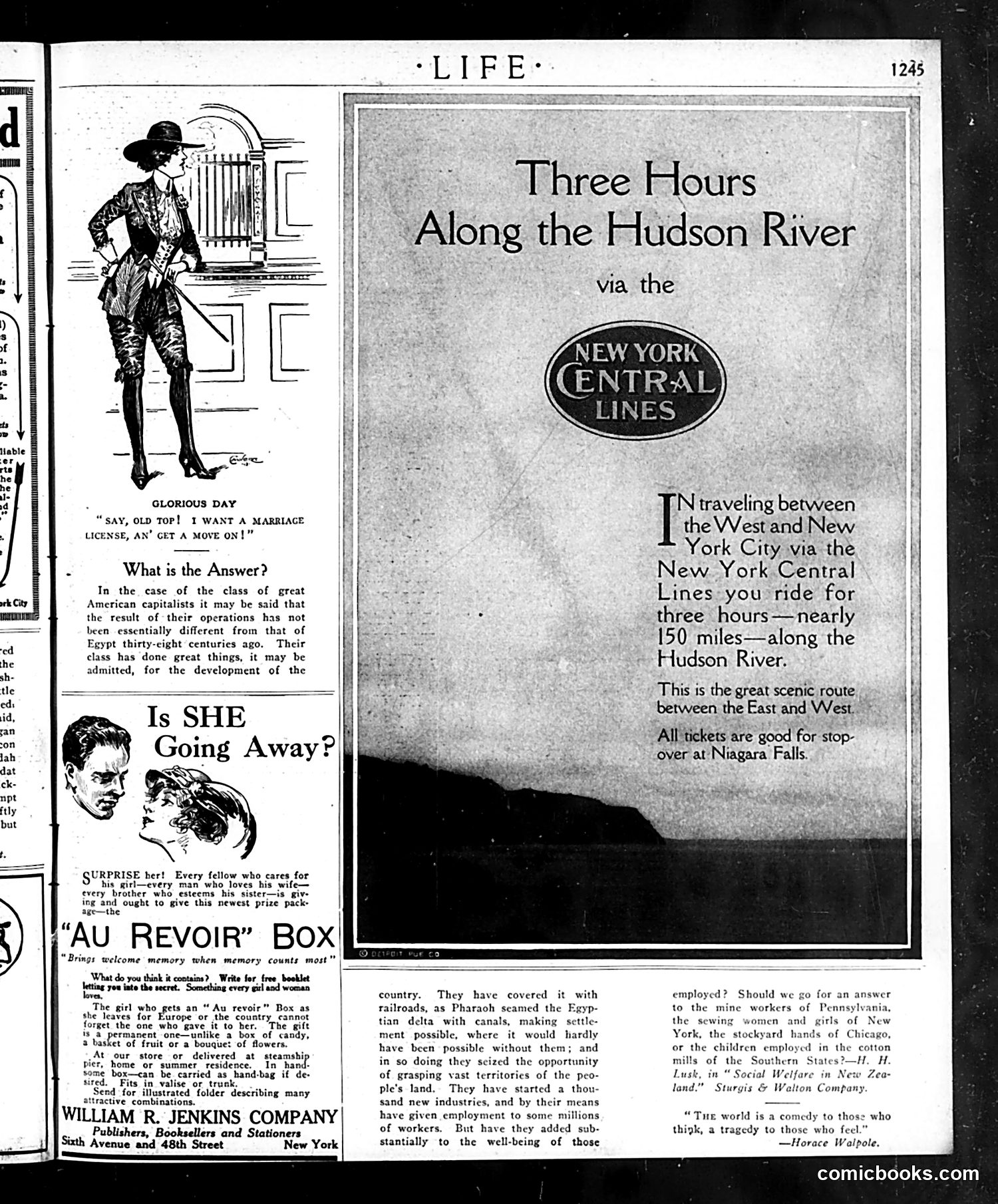
This page contains **three separate pieces**: 1. **"Glorious Day" cartoon** (top left): A woman in fashionable dress demands a marriage license, telling the clerk to "get a move on." The satire mocks the casual, transactional attitude toward marriage among the wealthy—treating it as just another quick business deal. 2. **"Is She Going Away?" advertisement** (middle left): Promotes an "Au Revoir Box" gift for women traveling. The satire is subtle but present in the copy's emphasis on impressing girls/wives/sisters with an expensive, permanent keepsake—poking fun at consumerism and gender relations. 3. **Main feature** (right): A New York Central Lines railroad advertisement for Hudson River travel, framed with a scenic landscape photograph. The page's editorial content (bottom text) critiques American capitalists, comparing them to Pharaoh—building infrastructure (railroads) while exploiting workers (miners, seamstresses, stockyard workers, child laborers). The point: industrial progress hasn't genuinely improved workers' lives, only enriched capitalists.
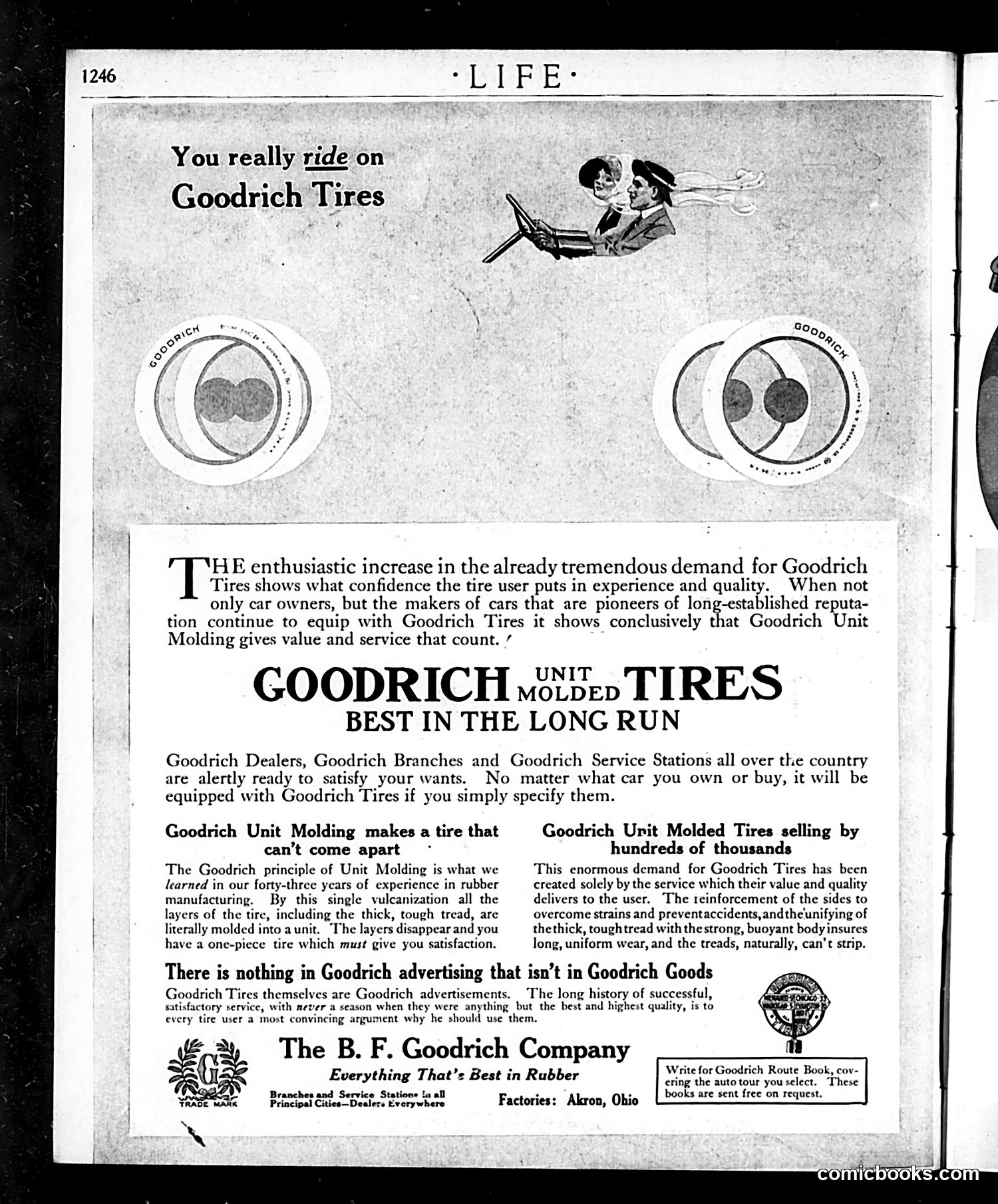
This is a **full-page advertisement** for B.F. Goodrich Tires from Life magazine, not satirical content. The page features two cross-section diagrams of tires showing their internal construction, and an illustration at top of two men in a car (likely representing satisfied customers or manufacturers). The advertisement's central claim is that Goodrich's "Unit Molding" manufacturing process—vulcanizing all tire layers together into one piece—creates superior durability and safety. The text emphasizes that major automobile manufacturers ("pioneers of long-established reputation") choose Goodrich tires, which supposedly proves their quality. The final tagline, "There is nothing in Goodrich advertising that isn't in Goodrich Goods," attempts to build consumer confidence by claiming the company's claims match actual product quality. This represents early 20th-century automotive advertising using technical specifications and appeals to established manufacturers' endorsements rather than modern emotional marketing.
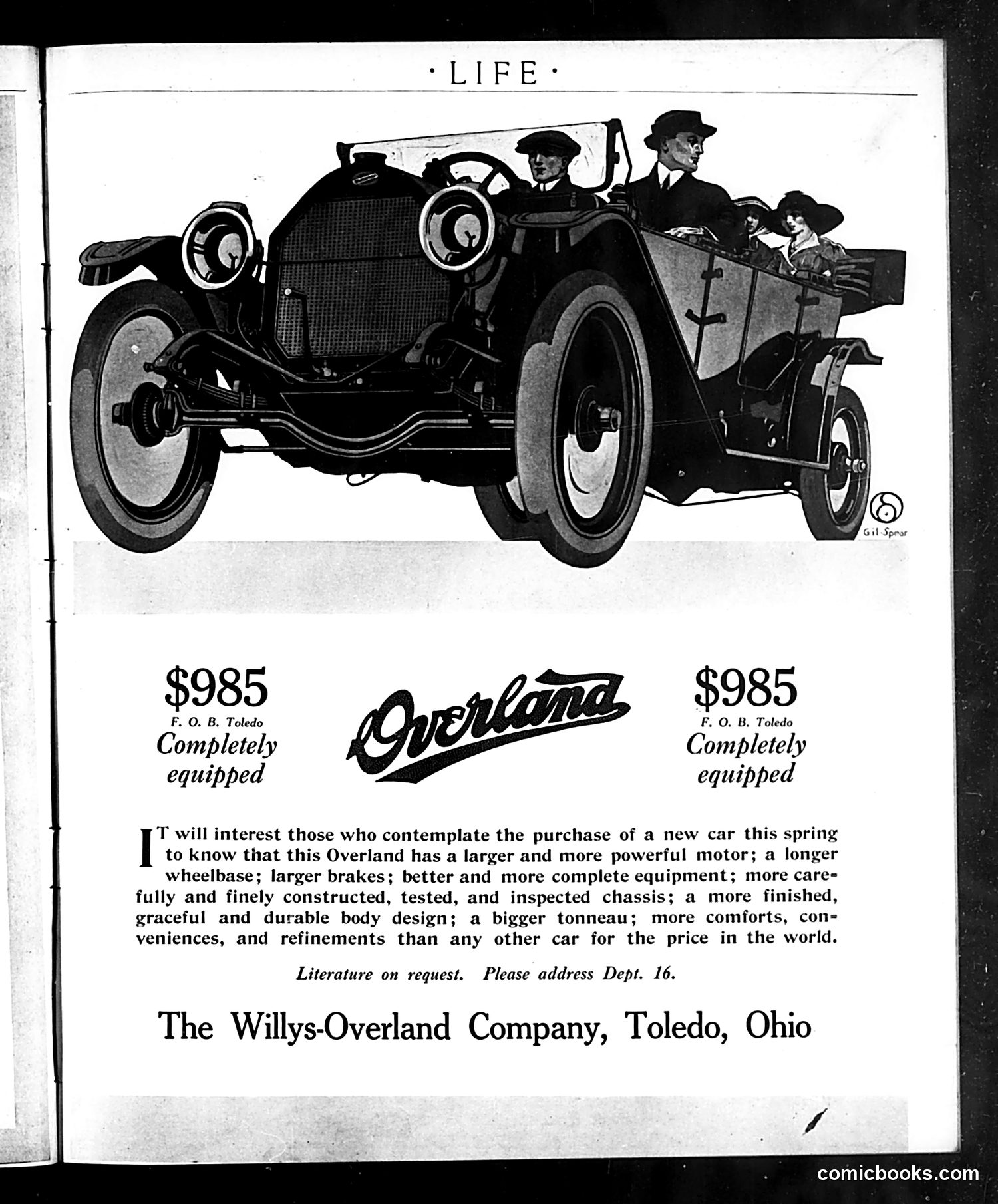
This is primarily a **car advertisement**, not a political cartoon. It appears in *Life* magazine, which published both satirical content and paid advertising. The page advertises the **Overland automobile** by the Willys-Overland Company (Toledo, Ohio) at $985, completely equipped. The illustration shows a detailed drawing of an early 1900s touring car with well-dressed passengers and a driver. The text makes competitive claims typical of auto advertising of this era: the Overland supposedly offers superior features (larger motor, longer wheelbase, better brakes, more refinements) compared to competitors, all at a competitive price point. There is **no satirical commentary visible** — this is straightforward product marketing positioned in a magazine read by relatively affluent consumers who could afford automobiles. The price ($985 in the early 1910s) represented a significant purchase.
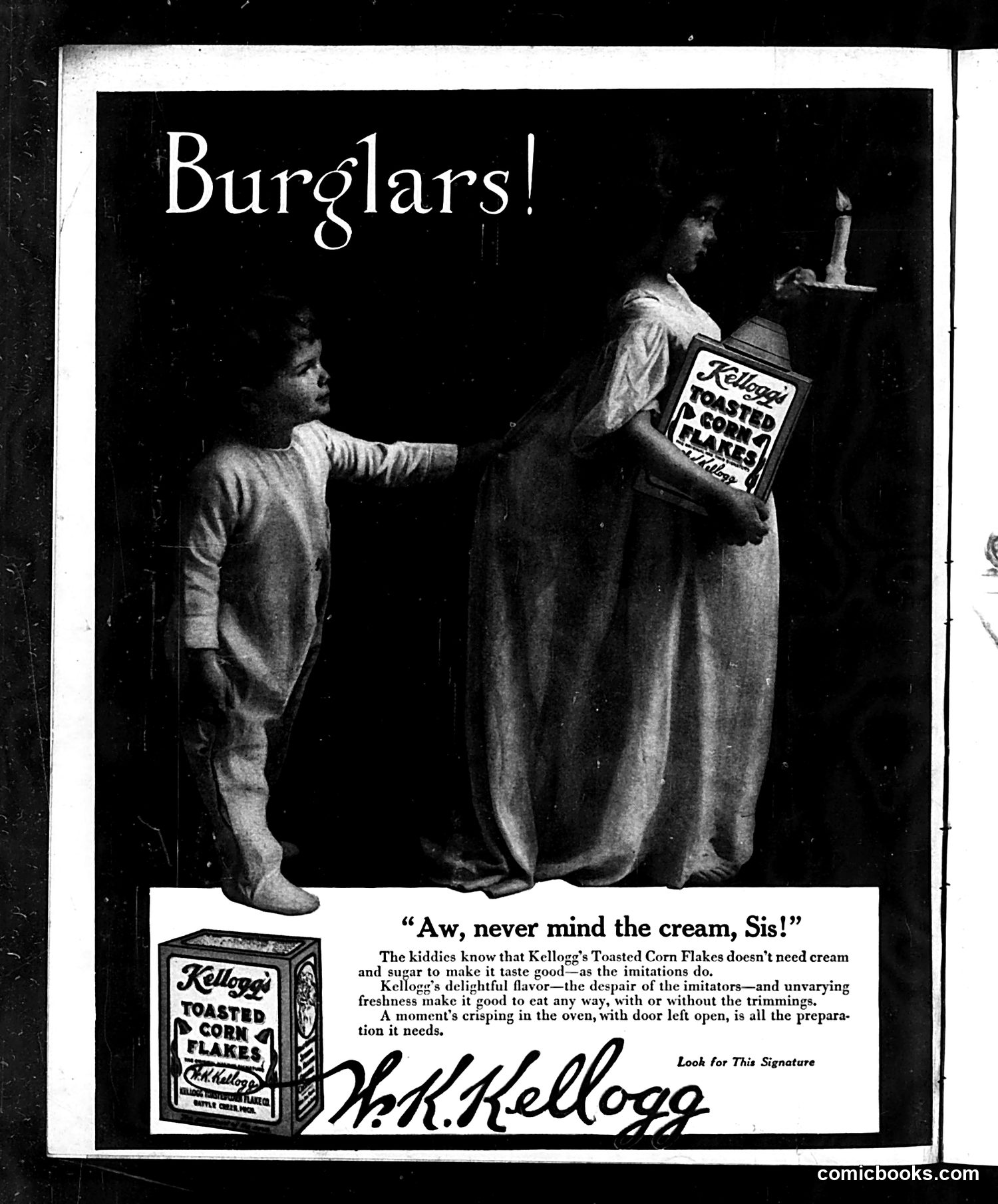
This is primarily a **Kellogg's Toasted Corn Flakes advertisement**, not political satire. The image depicts a domestic scene where one child attempts to serve another child cereal with cream and sugar, but the second child refuses, saying "never mind the cream, Sis!" The ad's pitch is that Kellogg's cereal is so naturally flavorful and crispy it requires no additions—unlike competitor brands (the unnamed "imitations") that supposedly need cream and sugar to taste good. The tagline emphasizes the product's "delightful flavor" and "unvarying freshness." This reflects early 20th-century advertising strategy: positioning one's product as superior by claiming competitors are inferior or require enhancement. The casual domestic scene was typical marketing imagery of the era, appealing to families and mothers as purchasers.