
Life, 1913-06-19 · page 34 of 52
Life — June 19, 1913 — page 34: what you’re looking at
What you’re looking at
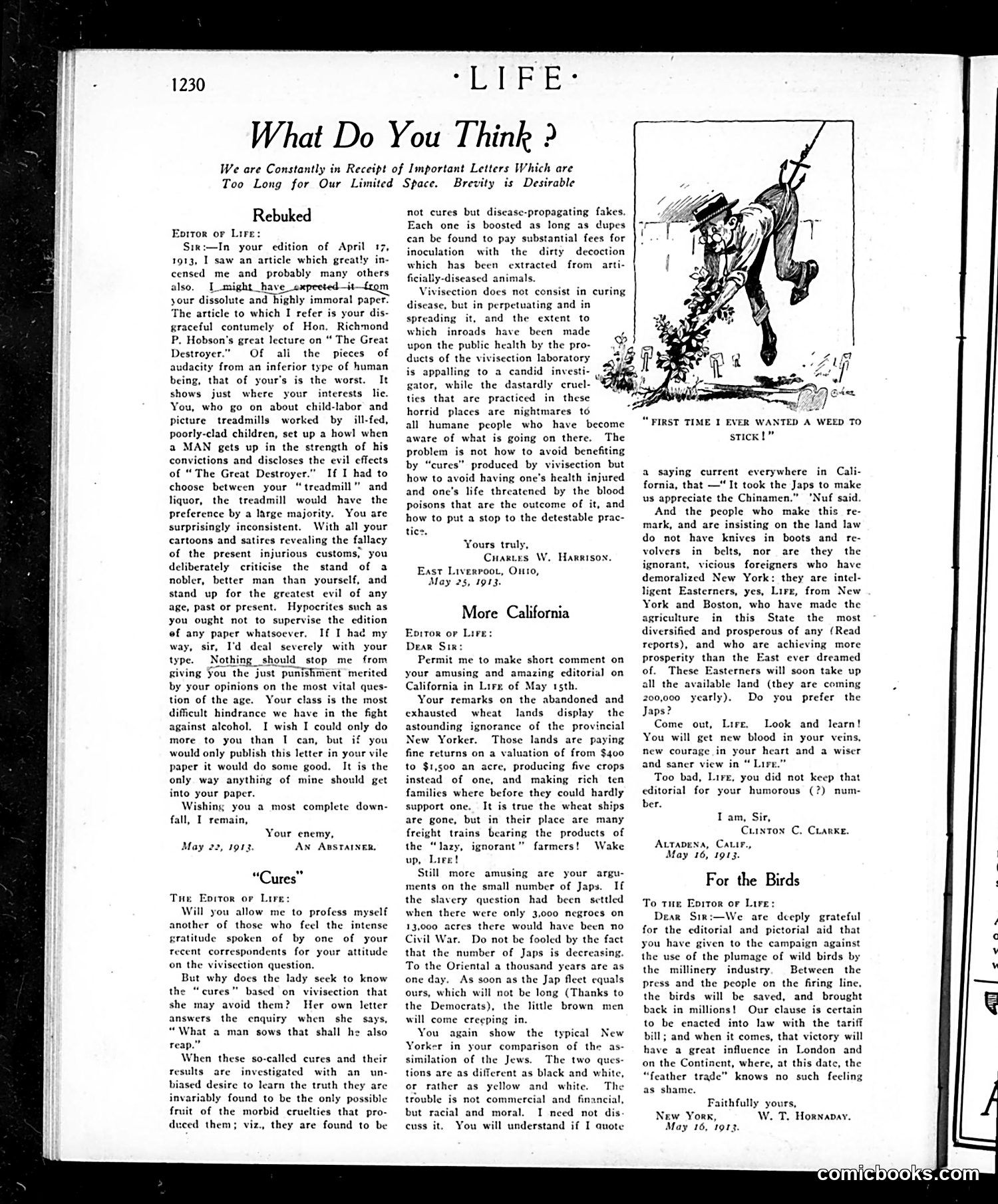
This page features a "Letters to the Editor" section and one political cartoon. The cartoon depicts a figure riding what appears to be a donkey or mule, illustrating the caption "FIRST TIME I EVER WANTED A WEED TO STICK!" The letters address three contemporary issues: 1. **Alcohol/Temperance**: A reader attacks *Life* for criticizing Richmond P. Hobson's anti-alcohol lecture while simultaneously mocking child labor—seeing this as hypocritical. The writer demands stricter censorship of the magazine. 2. **Vivisection**: A correspondent praises *Life*'s stance against animal testing, arguing that medical "cures" derived from vivisection are actually disease-propagating frauds and cause public health harm. 3. **California Agriculture**: A brief letter comments on *Life*'s editorial about California farming practices. The cartoon likely satirizes agricultural conditions or farming difficulties, though without clearer context the specific reference remains unclear. The page reflects *Life*'s characteristic role as a satirical arbiter of social causes (temperance, animal welfare, labor rights) during the Progressive Era.
📄 Transcribed text from this page (OCR, searchable)
Machine-transcribed from the original scan — historical spelling and the odd misread are preserved.
What Do You Think ? We are Constantly in Receipt of Important Letters Which are Too Long for Our Limited Space. Rebuked Eprror oF Lire: Six:—In your edition of April 1913, I saw an article which greatly in- censed me and probably many others also. [_might_have_cxpeeted—it your dissolute and highly immoral paper: The article to which I refer is your dis- graceful contumely of Hon, Richmond P, Hobson's great lecture on “ The Great Destroye Of ali the pieces of audacity from an inferior type of human being, that of your's is the worst. It shows just where your interests lie. You, who go on about child-labor and picture treadmills worked by ill-fed, poorly-clad children, set up a howl when a MAN gets up in the strength of his convictions and discloses the evil effects of “The Great Destroyer.” If I had to choose between your “treadmill” and liquor, the treadmill would have the preference by a large majority. You are surprisingly inconsistent. With all your cartoons and satires revealing the fallacy of the present injurious customs, you deliberately criticise the stand of a nobler, better man than yourself, and stand up for the greatest evil of any age, past or present. Hypocrites such as you ought not to supervise the edition ef any paper whatsoever. If I had my way, sir, I'd deal severely with your type. Nothing should stop me from giving You the just punishment merited by your opinions on the most vital ques- tion of the age. Your class is the most difficult hindrance we have in the fight against alcohol. I wish I could only do more to you than I can, but if you would only publish this letter in your vile paper it would do some good. It is the only way anything of mine should get into your paper. Wishing you a most complete down- fall, I remain, Your enemy, May 22, 1913. AN Anstatnee. “Cures” Epitor ov Lir Il you allow me to profess myself another of those who feel the intense gratitude spoken of by one of your recent correspondents for your attitude on the vivisection question. But why does the lady seck to know the “cures” based on vivisection that she may avoid them? Her own letter answers the enquiry when she says, “What a man sows that shall he also reap.” When these so-called cures and their results are investigated with an un- biased desire to learn the truth they are invariably found to be the only possible fruit of the morbid cruelties that pro- duced them; they are found to be LIS asl Brevity is Desirable not cures but disease-propagating fakes. Each one is boosted as long as dupes can be found to pay substantial fees for inoculation with the dirty decoction which has been extracted from arti- ficially-diseased animals. Vivisection does not consist in curing disease, but in perpetuating and in spreading it, and the extent to which inroads have been made upon the public health by the pro- P ducts of the vivisection laboratory is appalling to a candid investi gator, while the dastardly cruel- ties that are practiced in these horrid places are nightmares t6 all humane people who have become aware of what is going on there. The problem is not how to avoid benefiting by “cures” produced by vivisection but how to avoid having one’s health injured and one’s life threatened by the blood poisons that are the outcome of it, and how to put a stop to the detestable prac- tics. Yours truly Cuartes W. East Liverroot, Outo, May 25, 1913. More California Eprror or Lire Dear Sir: Permit me to make short comment on your amusing and amazing editorial on California in Lirx of May 15th. Your remarks on the abandoned and exhausted wheat lands display the astounding ignorance of the provincial New Yorker. Those lands are paying fine returns on a valuation of from $400 to $1,500 an acre, producing five crops instead of one, and making rich ten families where before they could hardly support one. It is true the wheat ships are gone, but in their place are many freight trains bearing the products of the “lazy, ignorant” farmers! Wake up, Lie ill more amusing are your argu- ments on the small number of Japs. If the slavery question had been settled when there were only 3,000 negroes on 13,000 acres there would have been no Civil War. Do not be fooled by the fact that the number of Japs is decreasing. To the Oriental a thousand years are as one day, As soon as the Jap fleet equals ours, which will not be long (Thanks to the Democrats), the little brown men will come creeping in. You again show the typical N Yorker in your comparison of the as- similation of the Jews. The two ques- tions are as different as black and white, or rather as yellow and white. The trouble is not commercial and financial, but racial and moral. I need not dis cuss it. You will understand if I quote Harrison. “ FIRST TIME I EVER WANTED A WEED TO stick!” a saying current everywhere in Cali- fornia, that —‘It took the Japs to make us appreciate the Chinamen.” 'Nuf said. And the people who make this re- mark, and are insisting on the land law do not have knives in boots and re- volvers in belts, nor are they the ignorant, vicious foreigners who have demoralized New York: they are intel- ligent Easterners, yes, Lirz, from New York and Boston, who have made the agriculture in this State the most diversified and prosperous of any (Read reports), and who are achieving more prosperity than the East ever dreamed of. These Easterners will soon take up all the available land (they are coming 200,000 yearly). Do you prefer the Japs? Come out, Lire. Look and learn! You will get new blood in your veins, new courage in your heart and a wiser and saner view in “ Lin Too bad, Lire, you did not keep that editorial for your humorous ber. I am, Sir, Cuintox C, CLarke. Attapena, Catir., May 16, 1913. For the Birds To tHe Eprtor oF Lire: Dear Sin:—We are deeply grateful for the editorial and pictorial aid that you have given to the campaign against the use of the plumage of wild birds by the millinery industry. Between the press and the people on the firing line, the birds will be saved, and brought back in millions! Our clause is certain to be enacted into law with the tariff ; and when it comes, that victory will have a great influence in London and on the Continent, where, at this date, the “feather trade” knows no such feeling as shame. Faithfully yours, New York, W. T. Horwapay. May 16, 1913.