
Life, 1913-06-19 · page 25 of 52
Life — June 19, 1913 — page 25: what you’re looking at
What you’re looking at
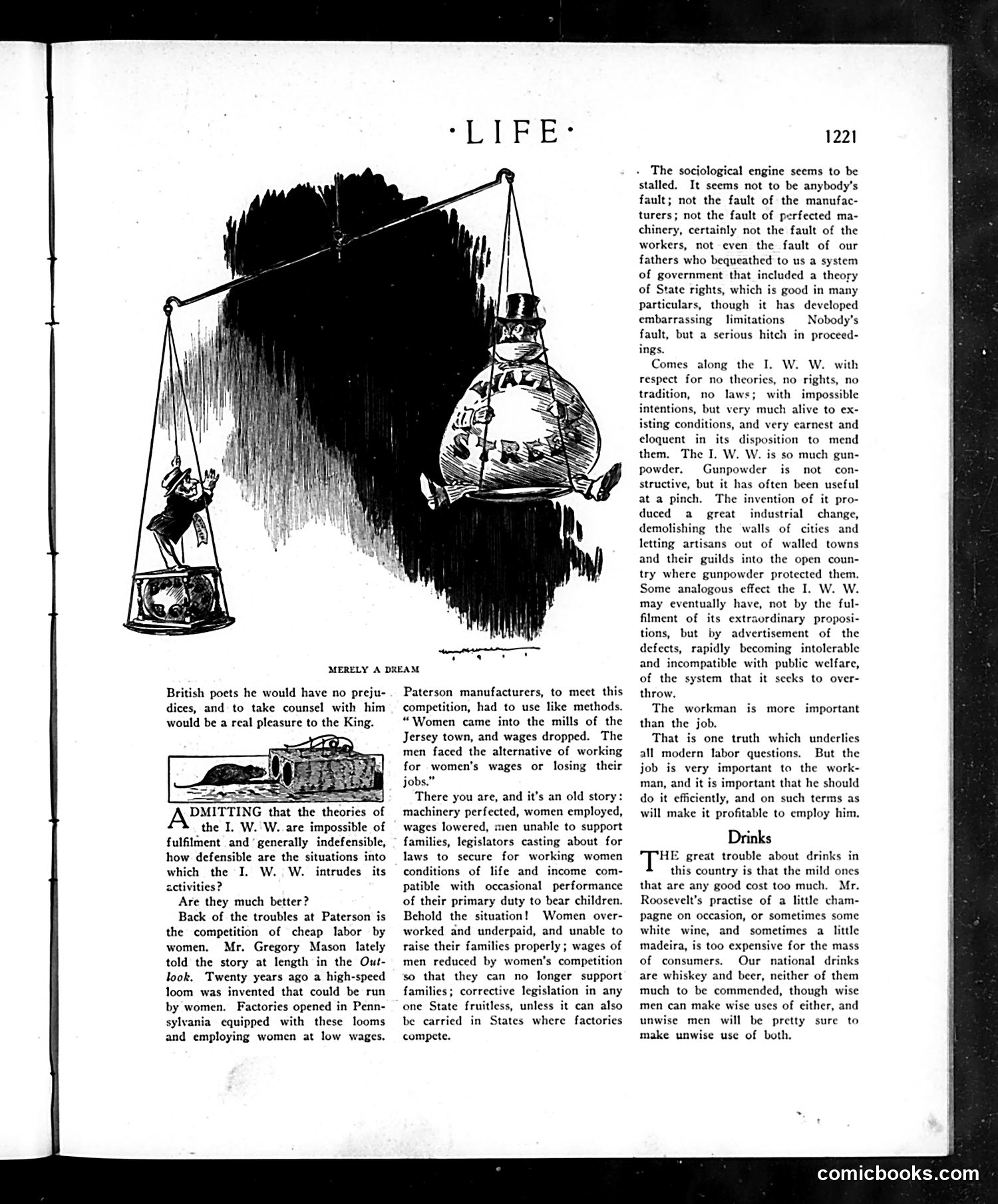
The cartoon depicts a **scale of justice in imbalance**, illustrating the Paterson textile strike's core problem: women workers (lighter side) versus male workers' wages and job security (heavier side). The text critiques the I.W.W. (Industrial Workers of the World), a radical labor union active in early 1900s labor disputes. The article acknowledges the I.W.W.'s radical methods are "impossible" and "indefensible," yet sympathizes with the *conditions* they protest—a genuine structural problem nobody can fix. The core issue: new machinery allowed factories to employ cheap female labor, forcing down all wages. Men couldn't support families; women were overworked and underpaid. State-by-state labor reform failed because factories simply relocated to unregulated states. The article suggests the I.W.W., though destructive like "gunpowder," may inadvertently expose systemic flaws too serious to ignore. The secondary section on "Drinks" appears unrelated editorial content.
📄 Transcribed text from this page (OCR, searchable)
Machine-transcribed from the original scan — historical spelling and the odd misread are preserved.
MERELY A DREAM British poets he would have no preju- dices, and to take counsel with him would be a real pleasure to the King. SS ss DMITTING that the theories of the I, W. W. are impossible of fulfilment and ‘generally indefensible, how defensible are the situations into which the I. W. W. intrudes its activities? Are they much better? Back of the troubles at Paterson is the competition of cheap labor by women. Mr. Gregory Mason lately told the story at length in the Out- look. Twenty years ago a high-speed loom was invented that could be run by women. Factories opened in Penn- sylvania equipped with these looms and employing women at low wages. Paterson manufacturers, to meet this competition, had to use like methods. “Women came into the mills of the Jersey town, and wages dropped. The men faced the alternative of working for women’s wages or losing their jobs.” There you are, and it’s an old story: machinery perfected, women employed, wages lowered, men unable to support families, legislators casting about for laws to secure for working women conditions of life and income com- patible with occasional performance of their primary duty to bear children. Behold the situation! Women over- worked and underpaid, and unable to raise their families properly; wages of men reduced by women's competition so that they can no longer support families; corrective legislation in any one State fruitless, unless it can also be carried in States where factories compete. 1221 The sociological engine seems to be stalled. It seems not to be anybody's fault; not the fault of the manufac- turers; not the fault of perfected ma- chinery, certainly not the fault of the workers, not even the fault of our fathers who bequeathed to us a system of government that included a theory of State rights, which is good in many particulars, though it has developed embarrassing limitations | Nobody's fault, but a serious hitch in proceed- ings. Comes along the I. W. W. with respect for no theories, no rights, no tradition, no laws; with impossible intentions, but very much alive to ex- isting conditions, and very earnest and eloquent in its disposition to mend them. The I. W. W. is so much gun- powder. Gunpowder is not con- structive, but it has often been useful ata pinch. The invention of it pro- duced a great industrial change, demolishing the walls of cities and letting artisans out of walled towns and their guilds into the open coun- try where gunpowder protected them. Some analogous effect the I. W. W. may eventually have, not by the ful- filment of its extraordinary proposi- tions, but by advertisement of the defects, rapidly becoming intolerable and incompatible with public welfare, of the system that it secks to over- throw. The workman than the job. That is one truth which underlies all modern labor questions. But the job is very important to the work- man, and it is important that he should do it efficiently, and on such terms as will make it profitable to employ him. Drinks T8 is more important great trouble about drinks in this country is that the mild ones. that are any good cost too much. Mr. Roosevelt's practise of a little cham- pagne on occasion, or sometimes some white wine, and sometimes a little madeira, is too expensive for the mass of consumers. Our national drinks are whiskey and beer, neither of them much to be commended, though wise men can make wise uses of either, and unwise men will be pretty sure to make unwise use of both. comicbooks.com