
Life, 1913-06-19 · page 24 of 52
Life — June 19, 1913 — page 24: what you’re looking at
What you’re looking at
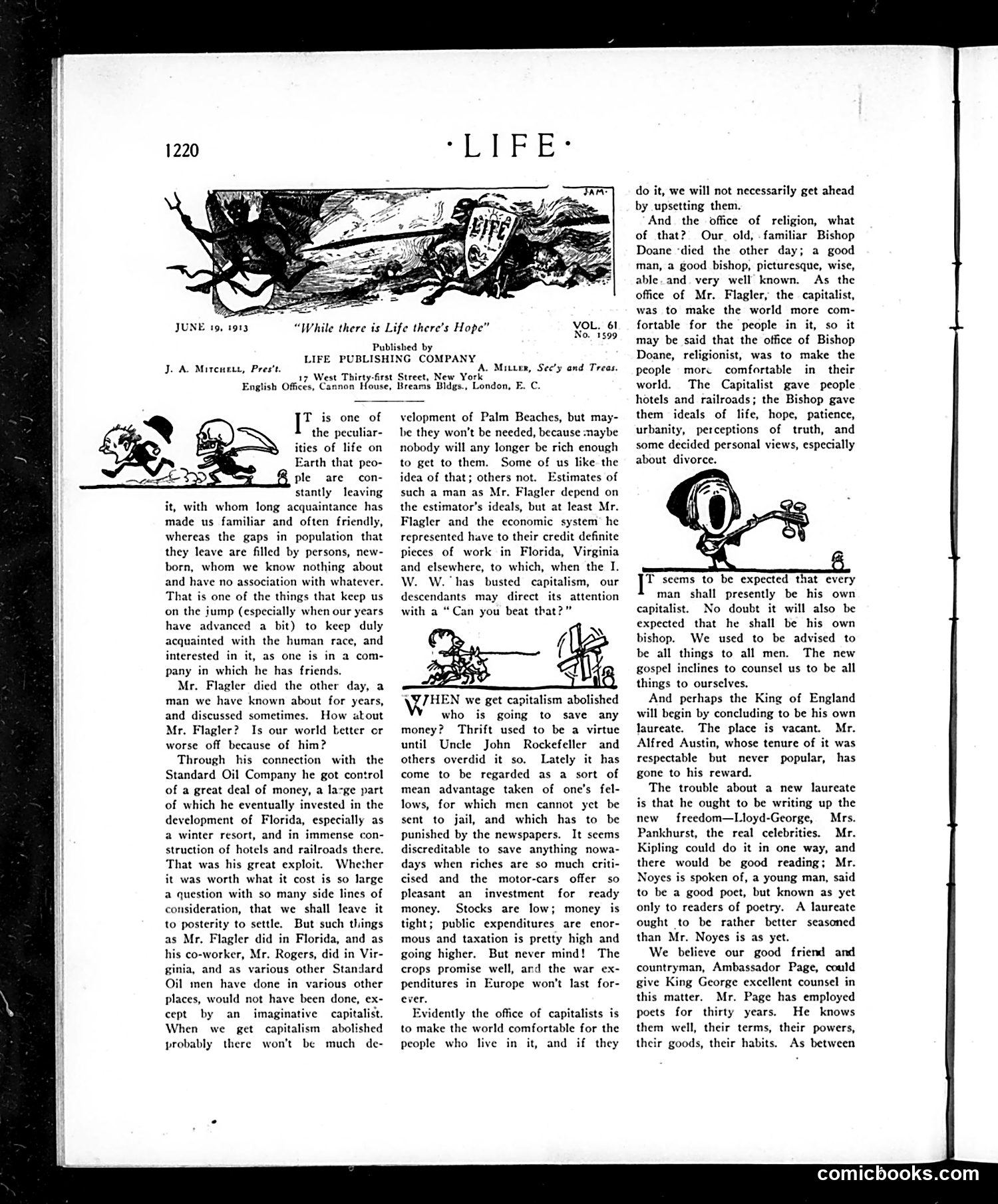
This editorial page commemorates the recent death of **Henry Flagler**, the Standard Oil magnate who developed Florida's infrastructure—hotels, railroads, and Palm Beach as a winter resort. The author uses Flagler's passing to debate capitalism's value. The piece argues that while imaginative capitalists like Flagler created tangible developments, their achievements depend on wealth concentration. It sarcastically notes that after capitalism is "abolished," such developments may disappear—though nobody will be rich enough to enjoy them anyway. The editorial also compares Flagler to recently deceased **Bishop Doane**, suggesting both served similar social roles: the capitalist provided physical comfort (hotels, railroads); the bishop provided spiritual comfort. The underlying satire critiques both socialist aspirations and the hypocrisy of criticizing wealth-accumulation while benefiting from capitalist infrastructure. The tone is skeptical toward revolutionary rhetoric while acknowledging capitalism's contradictions.
📄 Transcribed text from this page (OCR, searchable)
Machine-transcribed from the original scan — historical spelling and the odd misread are preserved.
JUNE 19, 1913 “While there is Life there’s Hope” Published by PUBLISHING COMPANY 17 West Thirty-first Street, New York English Offices, Cannon House, Breams Bldgs., London, E. C. J. A. Mitcuent, Pres't. T is one of the peculiar- ities of life on Earth that peo- ple are con- stantly leaving it, with whom long acquaintance has made us familiar and often friendly, whereas the gaps in population that they leave are filled by persons, new- born, whom we know nothing about and have no association with whatever. That is one of the things that keep us on the jump (especially when our years have advanced a bit) to keep duly acquainted with the human race, and interested in it, as one is in a com- pany in which he has friends. Mr. Flagler died the other day, a man we have known about for years, and discussed sometimes. How atout Mr. Flagler? Is our world better or worse off because of him? Through his connection with the Standard Oil Company he got control of a great deal of money, a la-ge part of which he eventually invested in the development of Florida, especially as a winter resort, and in immense con- struction of hotels and railroads there. That was his great exploit. Whether it was worth what it cost is so large a question with so many side lines of consideration, that we shall leave it to posterity to settle. But such things as Mr, Flagler did in Florida, and as his co-worker, Mr. Rogers, did in Vir- ginia, and as various other Standard Oil men have done in various other places, would not have been done, ex- cept by an imaginative capitalist. When we get capitalism abolished probably there won't be much de- A. Miter, Sec’y and Treas. velopment of Palm Beaches, but may- be they won't be needed, because maybe nobody will any longer be rich enough to get to them. Some of us like the idea of that; others not. Estimates of such a man as Mr. Flagler depend on the estimator’s ideals, but at least Mr. Flagler and the economic system’ he represented have to their credit definite pieces of work in Florida, Virginia and elsewhere, to which, when the I. W. W. has busted capitalism, our descendants may direct its attention with a “Can you beat that?” Wh we get capitalism abolished who is going to save any money? Thrift used to be a virtue until Uncle John Rockefeller and others overdid it so, Lately it has come to be regarded as a sort of mean advantage taken of one’s fel- lows, for which men cannot yet be sent to jail, and which has to be punished by the newspapers. It seems discreditable to save anything nowa- days when riches are so much criti: cised and the motor-cars offer so pleasant an investment for ready money. Stocks are low; money is tight; public expenditures are enor- mous and taxation is pretty high and going higher. But never mind! The crops promise well, ard the war ex- penditures in Europe won't last for- ever. Evidently the office of capitalists is to make the world comfortable for the people who live in it, and if they do it, we will not necessarily get ahead by upsetting them. And the office of religion, what of that? Our. old, .familiar Bishop Doane ‘died the other day; a good man, a good bishop, picturesque, wise, able. and. very well’ known. As the office of Mr. Flagler, the capitalist, was to make the world more com- fortable for the people in it, so it may be said that the office of Bishop Doane, religionist, was to make the people more comfortable in their world. The Capitalist gave people hotels and railroads; the Bishop gave them ideals of life, hope, patience, urbanity, perceptions of truth, and some decided personal views, especially about divorce. seems to be expected that every man shall presently be his own capitalist. No doubt it will also be expected that he shall be his own bishop. We used to be advised to be all things to all men. The new gospel inclines to counsel us to be all things to ourselves. And perhaps the King of England will begin by concluding to be his own laureate. The place is vacant. Mr. Alfred Austin, whose tenure of it was respectable but never popular, has gone to his reward. The trouble about a new laureate is that he ought to be writing up the new freedom—Lloyd-George, Mrs. Pankhurst, the real celebrities. Mr. Kipling could do it in one way, and there would be good reading; Mr. Noyes is spoken of, a young man, said to be a good poet, but known as yet only to readers of poetry. A laureate ought to be rather better seasoned than Mr. Noyes is as yet. We believe our good friend and countryman, Ambassador Page, could give King George excellent counsel in this matter. Mr. Page has employed poets for thirty years. He knows them well, their terms, their powers, their goods, their habits. As between comicbooks.com