
Life, 1913-06-19 · page 28 of 52
Life — June 19, 1913 — page 28: what you’re looking at
What you’re looking at
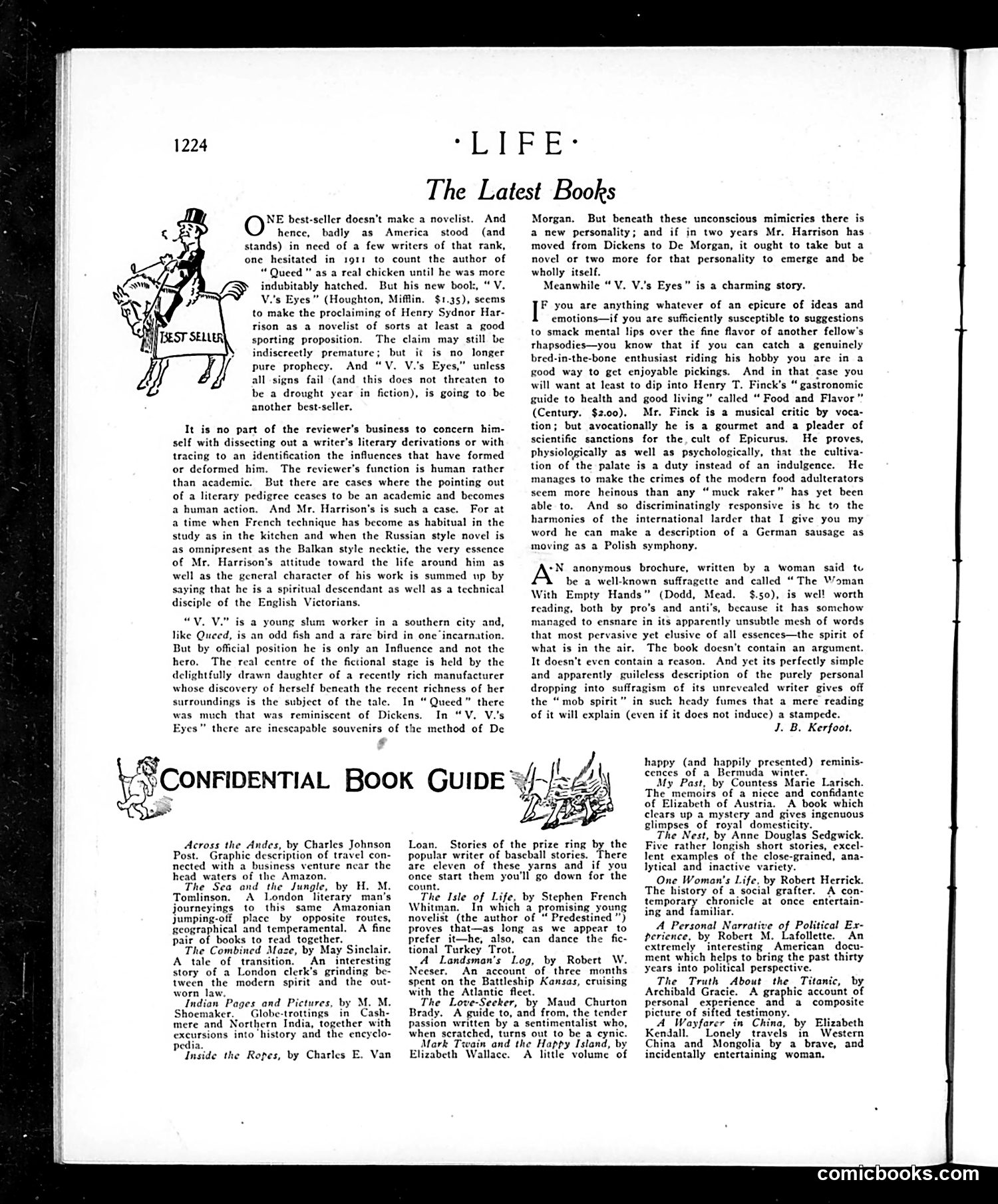
This page from Life magazine's "The Latest Books" section reviews Henry Sydnor Harrison's novel "V.V.'s Eyes" (1913). The critic evaluates Harrison as an emerging novelist, noting he previously wrote "Queed" but remained uncertain of his talent until this new work. The key satirical point concerns **literary influences**: the reviewer observes that while French and Russian literary techniques dominate contemporary writing, Harrison distinctively derives from **English Victorian novelists**—particularly Dickens and De Morgan. This was notable because by 1913, Victorian methods were considered somewhat old-fashioned compared to modernist European influences. The cartoon's Uncle Sam figure (left margin) represents American letters, symbolizing the magazine's commentary on American literary culture. The review treats this Victorian lineage positively, suggesting Harrison's work offers refreshing traditionalism amid fashionable continental experimentalism—a subtle critique of literary pretension and foreign influence.
📄 Transcribed text from this page (OCR, searchable)
Machine-transcribed from the original scan — historical spelling and the odd misread are preserved.
“LIFE: The Latest Books NE best-seller doesn't make a novelist. And hence, badly as America stood (and stands) in need of a few writers of that rank, one hesitated in 1911 to count the author of “ Queed " as a real chicken until he was more indubitably hatched. But his new book, “ V. V's Eyes” (Houghton, Mifflin. $1.35), seems to make the proclaiming of Henry Sydnor Har- rison as a novelist of sorts at least a good sporting proposition. The claim may still be indiscreetly premature; but it is no longer pure prophecy. And “V. V.’s Eyes,” unless all signs fail (and this docs not threaten to be a drought year in fiction), is going to be another best-seller. It is no part of the reviewer's business to concern him- self with dissecting out a writer's literary derivations or with tracing to an identification the influences that have formed or deformed him. The reviewer's function is human rather than academic. But there are cases where the pointing out of a literary pedigree ceases to be an academic and becomes a human action. And Mr. Harrison's is such a case. For at a time when French technique has become as habitual in the study as in the kitchen and when the Russian style novel is as omnipresent as the Balkan style necktie, the very essence of Mr. Harrison's attitude toward the life around him as well as the general character of his work is summed up by saying that he is a spiritual descendant as well as a technical disciple of the English Victorians. “V. V." is a young slum worker in a southern city and, like Queed, is an odd fish and a rare bird in one incarnation. But by official position he is only an Influence and not the hero, The real centre of the fictional stage is held by the ghtfully drawn daughter of a recently rich manufacturer whose discovery of herself beneath the recent richness of her surroundings is the subject of the tale. In “ Queed” there was much that was reminiscent of Dickens. In “V. V.’s Eyes" there are inescapable souvenirs of the method of De »y CONFIDENTIAL Book GUIDE* Across the Andes, by Charles Johnson Loan. Stories of the prize ring by the Morgan. But beneath these unconscious mimicries there is a new personality; and if in two years Mr. Harrison has moved from Dickens to De Morgan, it ought to take but a novel or two more for that personality to emerge and be wholly itself. Meanwhile “ V, V.’s Eyes” is a charming story. F you are anything whatever of an epicure of ideas and emotions—if you are sufficiently susceptible to suggestions to smack mental lips over the fine flavor of another fellow's thapsodies—you know that if you can catch a genuinely bred-in-the-bone enthusiast riding his hobby you are in a good way to get enjoyable pickings. And in that case you will want at least to dip into Henry T. Finck’s “ gastronomic guide to health and good living” called “ Food and Flavor" (Century. $2.00). Mr. Finck is a musical critic by voca- tion; but avocationally he is a gourmet and a pleader of scientific sanctions for the cult of Epicurus. He proves, physiologically as well as psychologically, that the cultiva- tion of the palate is a duty instead of an indulgence. He manages to make the crimes of the modern food adulterators seem more heinous than any “muck raker” has yet been able to. And so discriminatingly responsive is he to the harmonies of the international larder that I give you my word he can make a description of a German sausage as moving as a Polish symphony. A’ anonymous brochure, written by a woman said tu be a well-known suffragette and called “The Woman With Empty Hands” (Dodd, Mead. $50), is wel! worth reading, both by pro's and anti’s, because it has somchow managed to ensnare in its apparently unsubtle mesh of words that most pervasive yet elusive of all essences—the spirit of what is in the air, The book docsn’t contain an argument. It doesn’t even contain a reason. And yet its perfectly simple and apparently guileless description of the purely personal dropping into suffragism of its unrevealed writer gives off the “mob spirit” in suck heady fumes that a mere reading of it will explain (even if it does not induce) a stampede. J. B. Kerfoot. happy (and happily presented) reminis- cences of a Bermuda winter. My Past, by Countess Marie Larisch. The memoirs of a nicce and confidante of Elizabeth of Austria. A book which clears up a mystery and gives ingenuous glimpses of royal domesticity. The Nest, by Anne Douglas Sedgwick. Five rather longish short stories, excel- Post. Graphic description of travel con- nected with a business venture near the head waters of the Amazon. he Sea and the Jungle, by H. M. Tomlinson. A london literary man’s journeyings to this same Amazonian jumping-off place by opposite routes, geographical and temperamental. A fine pair of books to read together. The Combined Maze, by May Sinclair. A tale of transition. An interesting story of a London clerk's grinding be- tween the modern spirit and the out- worn law. Indian Pages and Pictures, by M. M. Shoemaker. Globe-trottings in Cash- mere and Northern India, together with excursions into history and the encyclo- pedia. Inside the Ropes, by Charles E. Van popular writer of bascball stories. There are cleven of these yarns and if you once start them you'll go down for the count. Isle of Life, by Stephen French Whitman. In which a promising young novelist (the author of “ Predestined ”) Proves that—as long as we appear to prefer it—he, also, can dance the fic- tional Turkey Trot, ‘A Landsman's Log, by Robert W. Neeser. An account of three months spent on the Battleship Kansas, cruising with the Atlantic fleet. The Love-Seeker, by Maud Churton Brady. A guide to, and from, the tender passion written by a sentimentalist who, when scratched, turns out to be a cynic. Mark Twain and the Happy Island, by Elizabeth Wallace. A little volume of lent examples of the close-grained, ana- lytical and inactive variety. One Woman's Life, by Robert Herrick. The history of a social grafter. A con- temporary chronicle at once entertain- ing and familiar. A Personal Narrative of Political Ex- perience, by Robert M. Lafollette. An extremely intevcation American docu- ment which helps to bring the past thirty years into political perspective. The Truth About the Titanic, by Archibald Gracie. A graphic account of personal experience. and a composite picture of sifted testimony. A Wayfarer in China, by Elizabeth Kendall. Lonely travels in Western China and Mongolia by a brave, and incidentally entertaining woman. comicbooks.com