
Life, 1913-06-19 · page 23 of 52
Life — June 19, 1913 — page 23: what you’re looking at
What you’re looking at
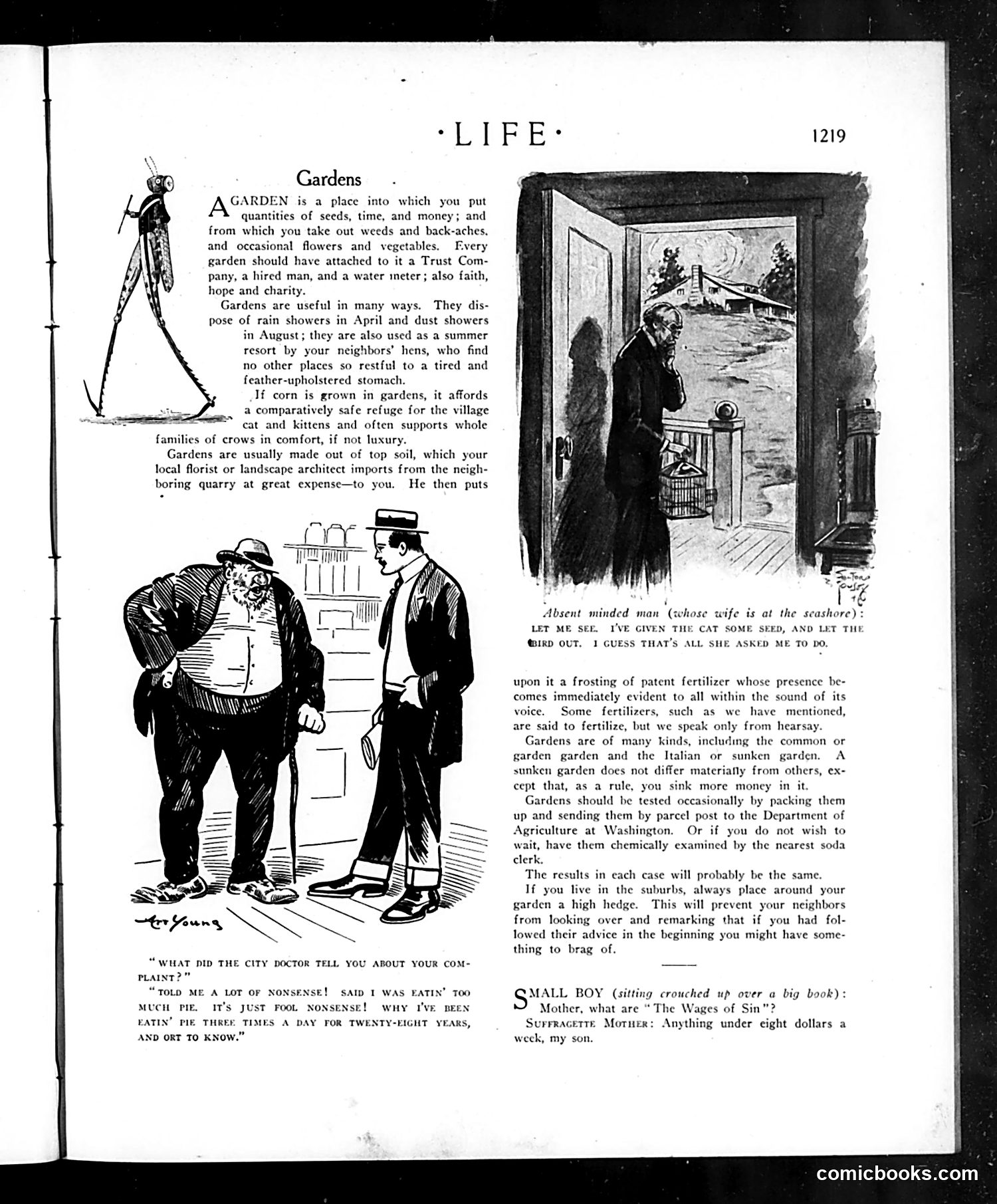
This page from *Life* magazine offers humorous social satire about suburban gardening culture, a fashionable pursuit among middle-class Americans of the era. **The Main Cartoon:** An absentminded husband, left alone while his wife vacations at the seashore, catastrophically confuses her instructions—feeding the cat bird seed and releasing the bird, believing he's completed his domestic duties. **The Satirical Essay:** The text mocks gardening as an expensive, labor-intensive hobby that yields weeds and backaches rather than actual vegetables. It ridicules the common practice of hiring landscapers to import costly topsoil and fertilizer, and suggests gardens serve primarily as gathering spots for neighbors' chickens and village crows. **Social Commentary:** The satire targets suburban pretension—the insistence on high hedges to hide gardening failures from neighbors, and the absurd suggestion of mailing soil samples to the Department of Agriculture for analysis, as if gardening were a scientific endeavor rather than simple yard work. **The Bottom Joke:** A suffragette mother tells her son that "wages of sin" means "anything under eight dollars a week"—a reference to women's labor rights and wage inequality.
📄 Transcribed text from this page (OCR, searchable)
Machine-transcribed from the original scan — historical spelling and the odd misread are preserved.
Ga rdens GARDEN is a place into which you put quantities of seeds, time, and money; and from which you take out weeds and back-aches, and occasional flowers and vegetables. Every garden should have attached to it a Trust Com- pany, a hired man, and a water meter; also faith, hope and charity. Gardens are useful in many ways. They dis- pose of rain showers in April and dust showers in August; they are also used as a summer resort by your neighbors’ hens, who find no other places so restful to a tired and feather-upholstered stomach. If corn is grown in gardens, it affords a comparatively safe refuge for the village cat and kittens and often supports whole families of crows in comfort, if not luxury. Gardens are usually made out of top soil, which your local florist or landscape architect imports from the neigh- boring quarry at great expense—to you. He then puts Absent minded man (whose wife is at the seashore): LET ME SEE. I'VE GIVEN THE CAT SOME SEED, AND LET THE @iRD OUT. 1 GUESS THAT'S ALL SHE ASKED ME TO Do, upon it a frosting of patent fertilizer whose presence be- comes immediately evident to all within the sound of its voice. Some fertilizers, such as we have mentioned, are said to fertilize, but we sp only from hearsay. Gardens are of many kinds, including the common or garden garden and the Italian or sunken garden. A sunken garden does not differ materianly from others, ex- cept that, as a rule, you sink more money in it. Gardens should be tested occasionally by packing them up and sending them by parcel post to the Department of Agriculture at Washington. Or if you do not wish to wait, have them chemically examined by the nearest soda clerk, The results in each case will probably be the same. If you live in the suburbs, always place around your garden a high hedge. This will prevent your neighbors from looking over and remarking that if you had fol- lowed their advice in the beginning you might have some- thing to brag of. “WHAT DID THE CITY DOCTOR TELL YOU ABOUT YOUR COM- PLAINT? “ToLD ME A LOT OF 3 ! VAS EATIN’ TOO GMALL BOY (sitting crouched up over a big book): MUCH PIE, IT'S JUST FOOL NONSENSE! WHY I've BEEN Mother, what are “The Wages of Sin"? EATIN’ PIE THREE TIMES A DAY FOR TWENTY-EIGHT YEARS, Surrracette Motrner: Anything under eight dollars a AND ORT TO KNOW.” week, my son. comicbooks.com