
A complete issue · 48 pages · 1913
Life — April 24, 1913
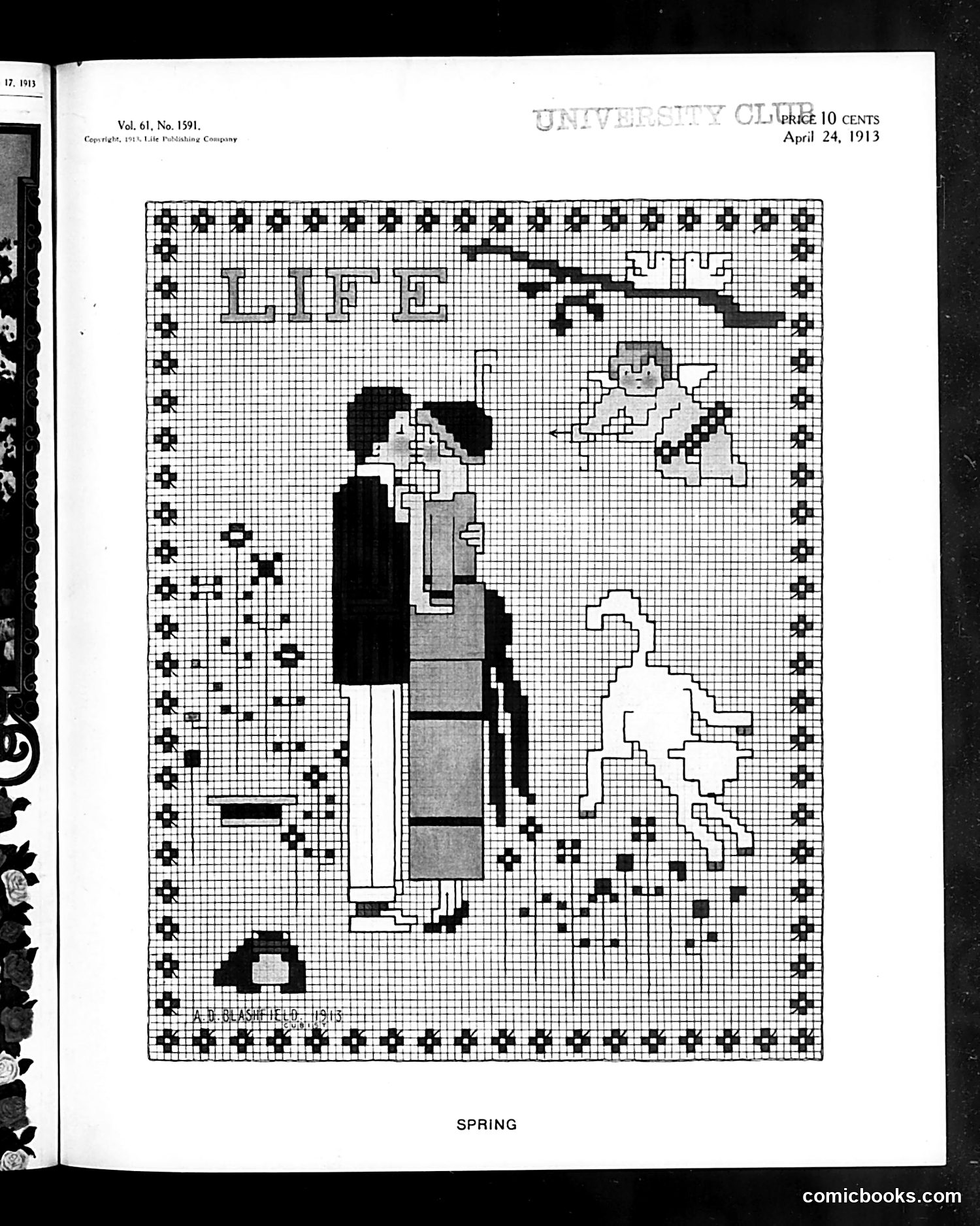
This pixelated cross-stitch pattern depicts a woman in a long black coat and hat standing among stylized floral and natural elements, labeled "SPRING" at the bottom. The cartoon appears to be a gentle seasonal satire common to Life magazine's era. The figure's formal Victorian or Edwardian dress—heavy coat and hat—contrasts humorously with spring's arrival and the flowering plants surrounding her. The joke likely mocks how society women remained overdressed and constrained by fashion conventions even as nature bloomed and warmer weather arrived, or perhaps satirizes the gap between spring's promise and urban/civilized reality. The elaborate decorative border with repeating motifs was typical of Life's design aesthetic from this period.
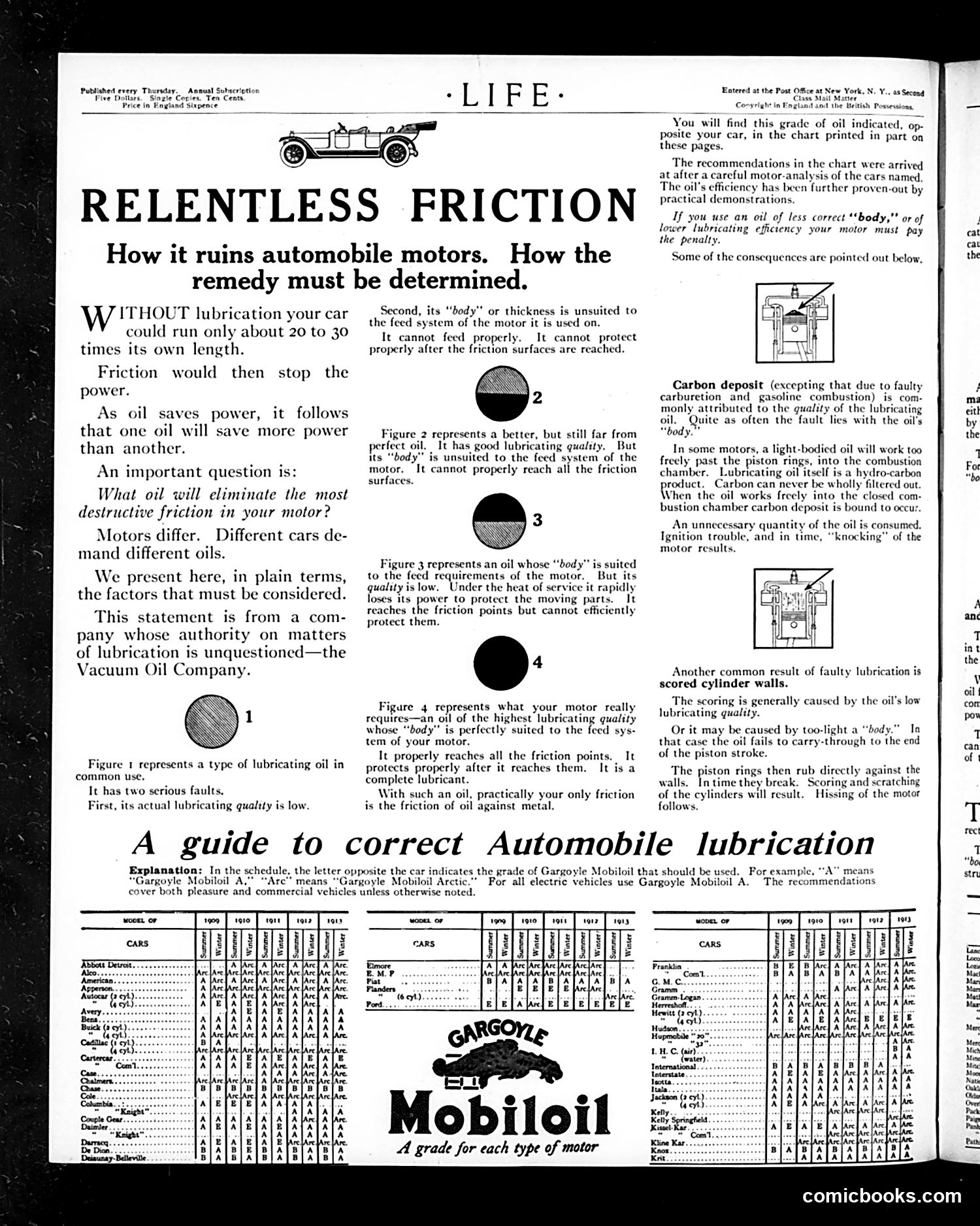
This page is **not a political cartoon or satire** — it's primarily **automobile advertising content** from Life magazine. The page features an educational article titled "Relentless Friction" explaining motor lubrication, illustrated with four circular diagrams (labeled 1-4) showing oil conditions ranging from poor to ideal quality. The text, attributed to the Vacuum Oil Company, discusses how different oils protect engine parts. Below this is a large **Gargoyle Mobiloil advertisement** with a comprehensive chart recommending specific oil grades for various car models and years. The ad's tagline reads "A grade for each type of motor." There is no political satire present. This is straightforward early automotive industry marketing and consumer education presented as editorial content.
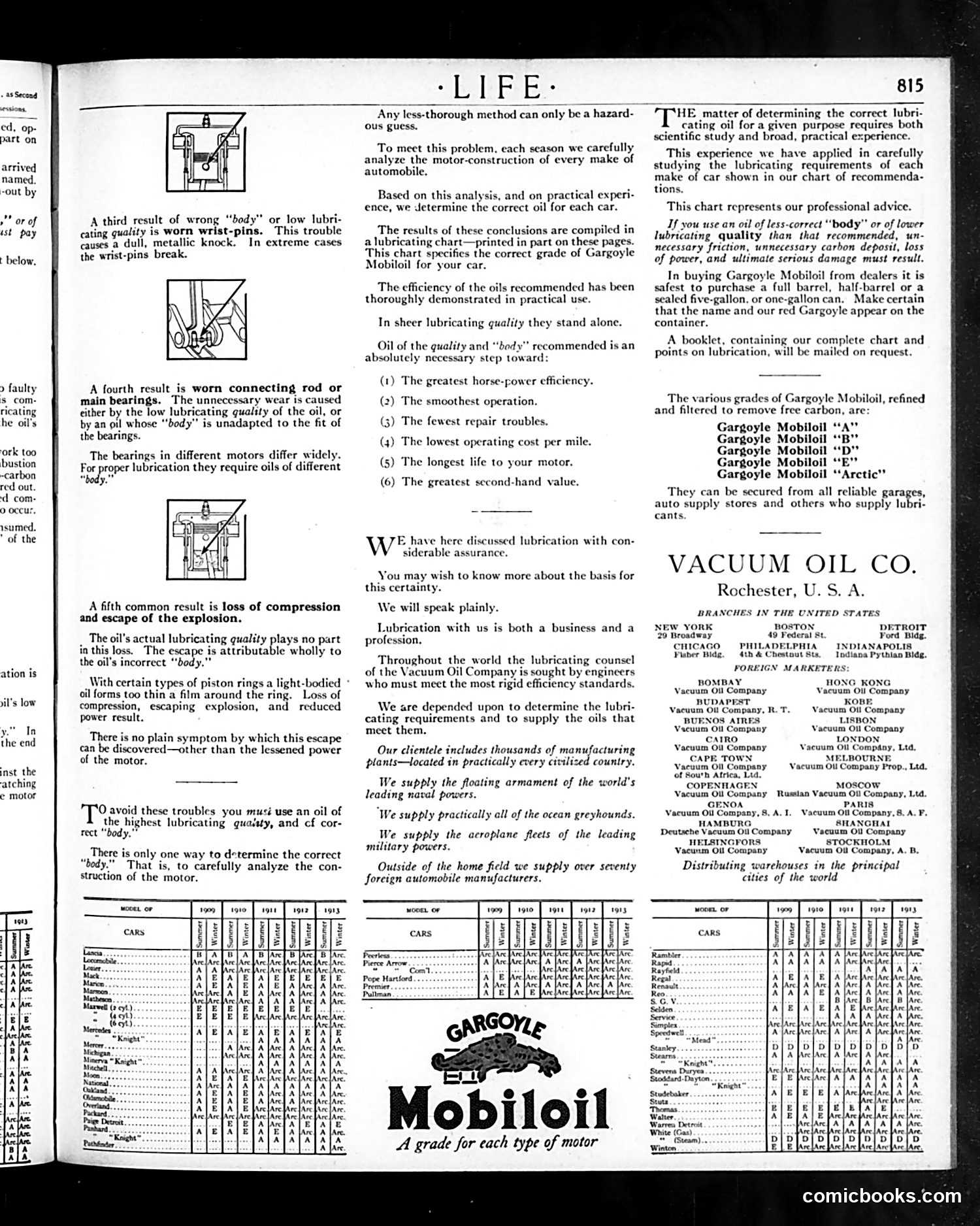
This page is **primarily advertising for Gargoyle Mobiloil**, a motor lubricant product from the Vacuum Oil Company (Rochester, U.S.A.). The small technical diagrams on the left illustrate common engine problems caused by inadequate lubrication—worn wrist-pins, connecting rod bearings, compression loss, and piston ring damage. These serve as fear-based marketing, showing consumers what happens without proper oil. The bulk of the page features product charts showing which Gargoyle Mobiloil grades ("A," "B," "D," "E," "Arctic") were recommended for specific car models from 1909-1913, plus a company directory listing international offices and distributors. There are **no political cartoons or satire** on this page—it's a straightforward commercial advertisement using technical education as a sales strategy.
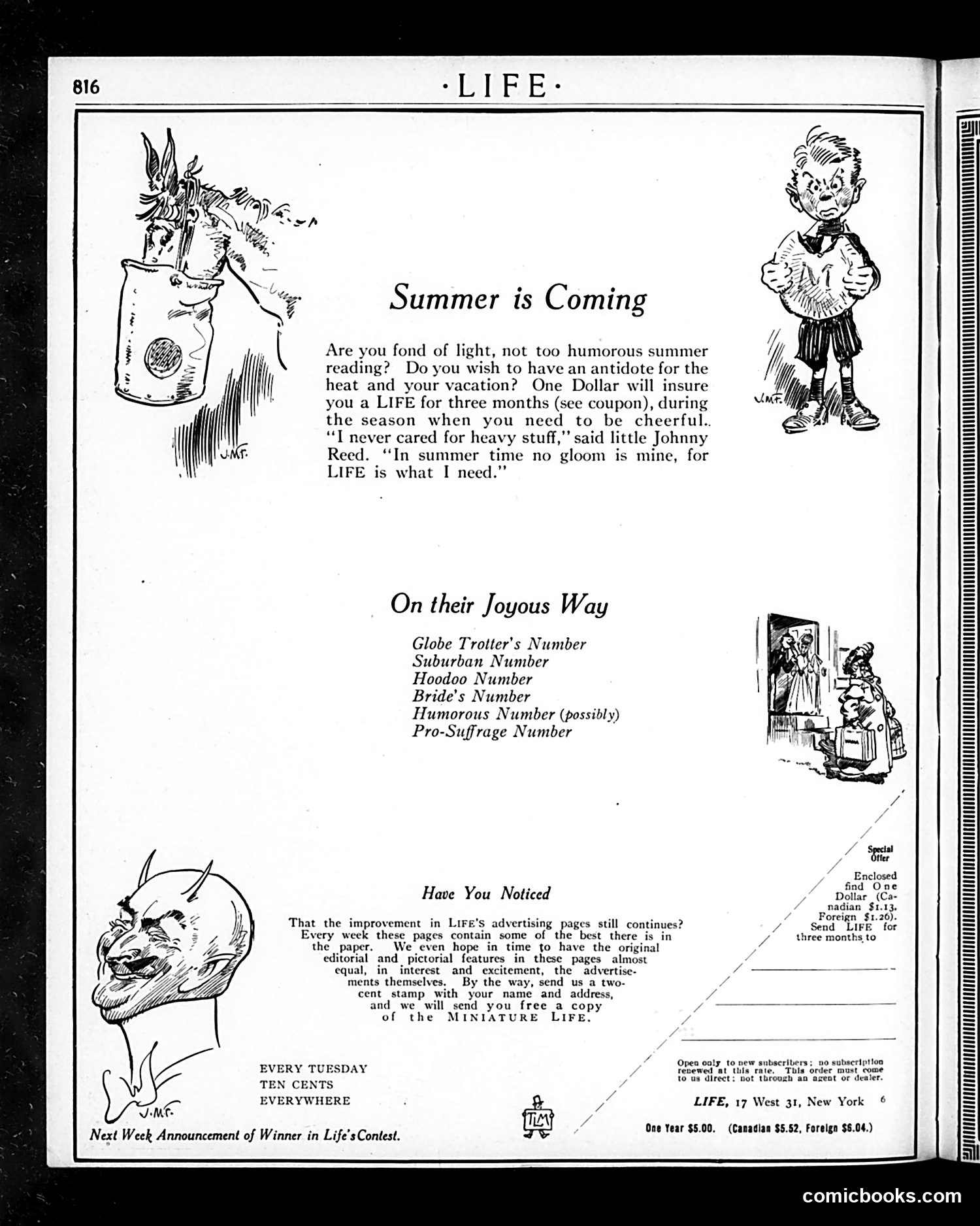
This page is primarily **advertising and promotional content** for LIFE magazine itself, rather than political satire or commentary. The "Summer is Coming" section pitches a three-month subscription using a cheerful boy character (Johnny Reed) who claims LIFE provides needed light reading for hot weather. The "On their Joyous Way" section lists humorous fictional magazine titles (Globe Trotter's Number, Hoodoo Number, Bride's Number, Pro-Suffrage Number), likely satirizing the era's proliferation of specialized publications. The cartoon illustrations—a plant in a pot, a boy, a face, and a domestic scene—are decorative rather than politically pointed. The "Have You Noticed" section promotes LIFE's editorial quality and invites reader participation via a two-cent stamp submission for a free miniature edition. This is primarily **magazine self-promotion** rather than political or social satire.
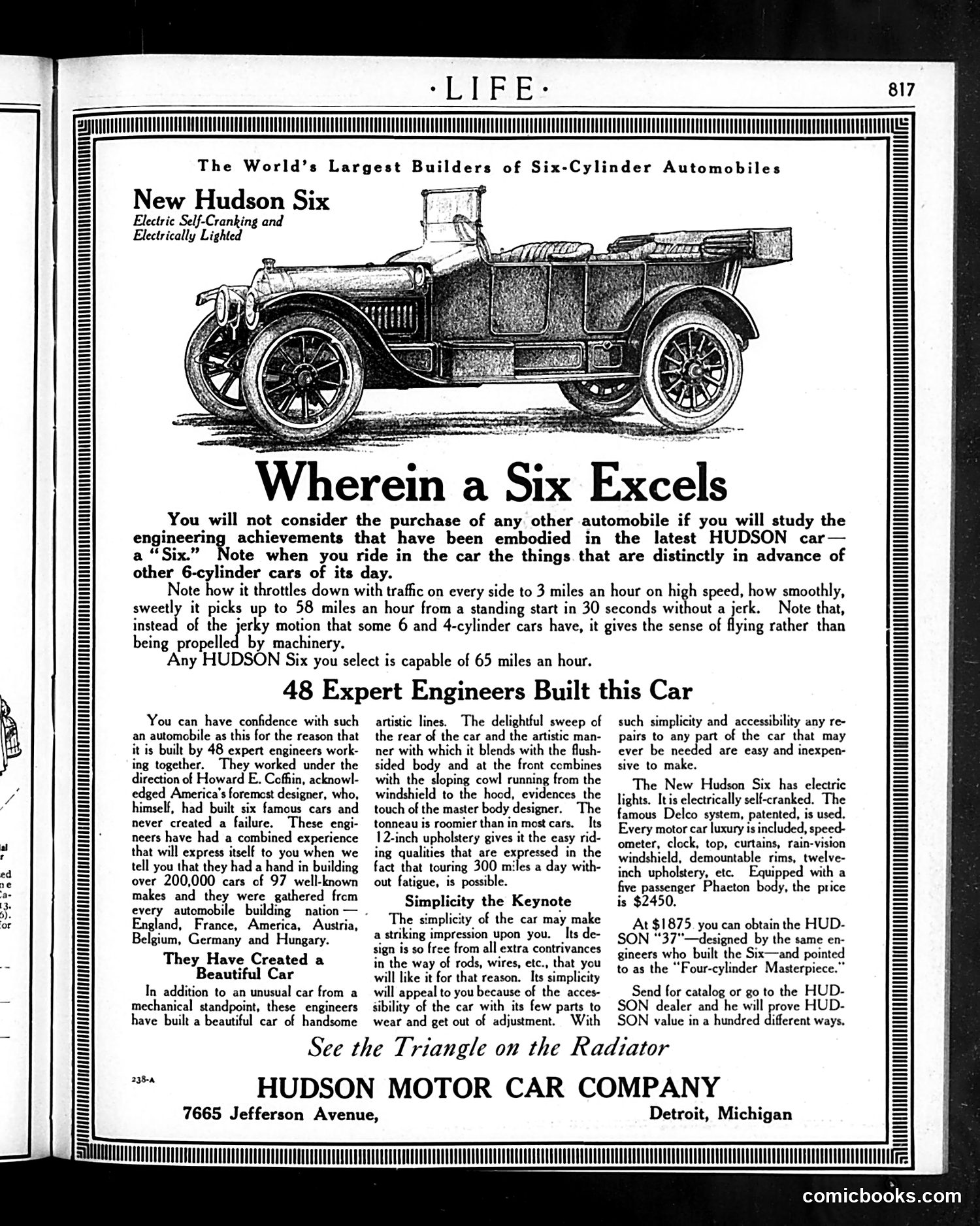
This page is **not a cartoon or satire**—it's a straightforward automobile advertisement for the Hudson Motor Car Company's new six-cylinder car, published in Life magazine (page 817). The ad emphasizes engineering superiority: 48 expert engineers designed the vehicle, which features electric self-cranking, smooth acceleration, and a top speed of 65 mph. Key selling points include simplicity of design, accessibility for repairs, and the patented Delco electrical system. Pricing is listed at $2,450 (or $1,875 for a four-cylinder model). The ad targets affluent readers by highlighting craftsmanship and reliability over competitors' offerings. This represents typical early 20th-century automotive advertising strategy—emphasizing technical innovation and engineer expertise as status markers.
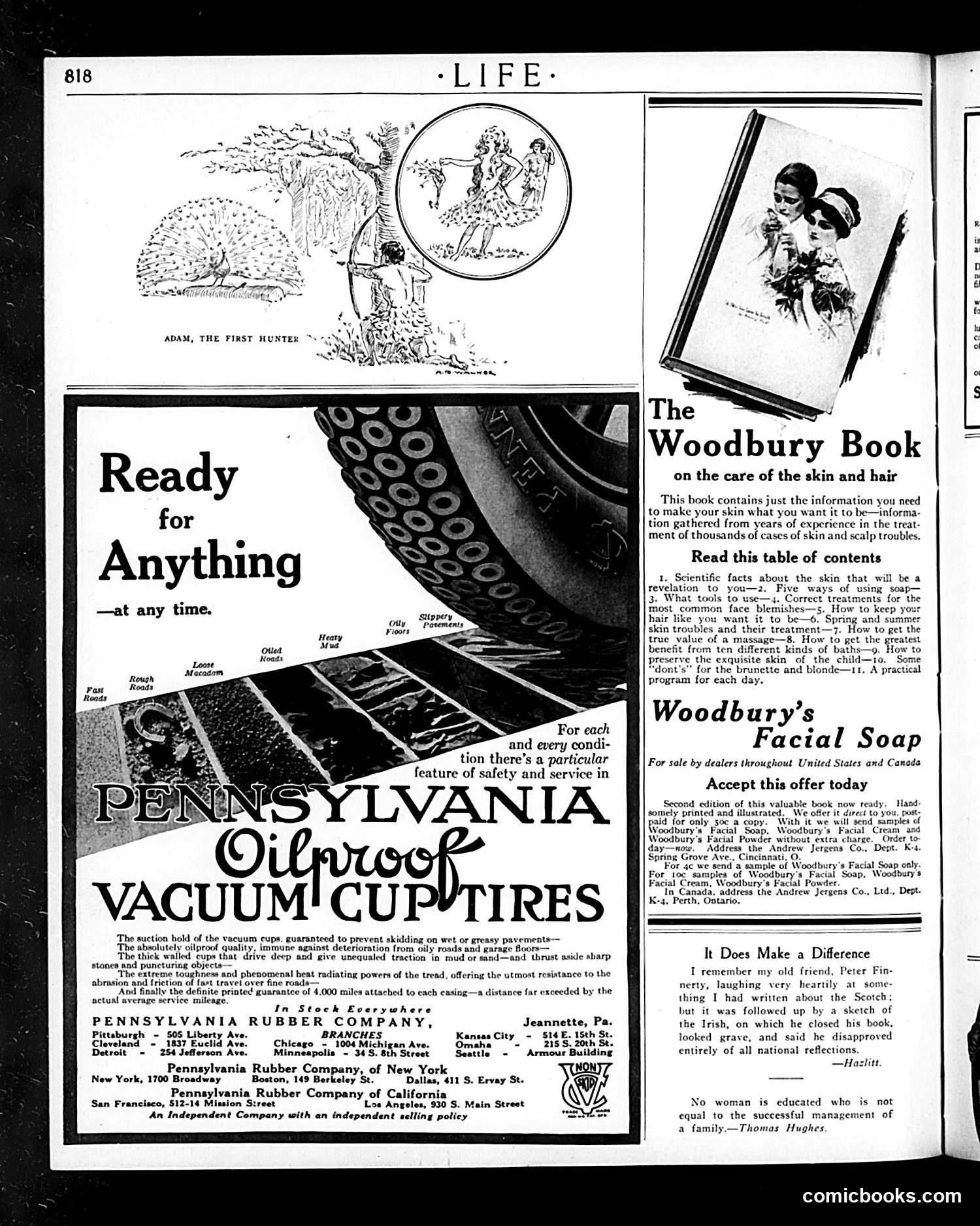
This page is predominantly **advertising**, not satire or political commentary. The top cartoon titled "Adam, the First Hunter" is a humorous natural history illustration showing early man discovering hunting, with a hedgehog and classical figures—a lighthearted joke about humanity's origins rather than contemporary satire. The main advertisements feature Pennsylvania vacuum-cup tires and Woodbury's Facial Soap, both common early 20th-century products. A small sidebar quote from Hazlitt about Scottish references appears unrelated to the ads. The page lacks the sharp political or social satire typically associated with Life magazine's editorial content. Instead, it demonstrates how vintage magazines mixed editorial material with substantial advertising throughout their pages.
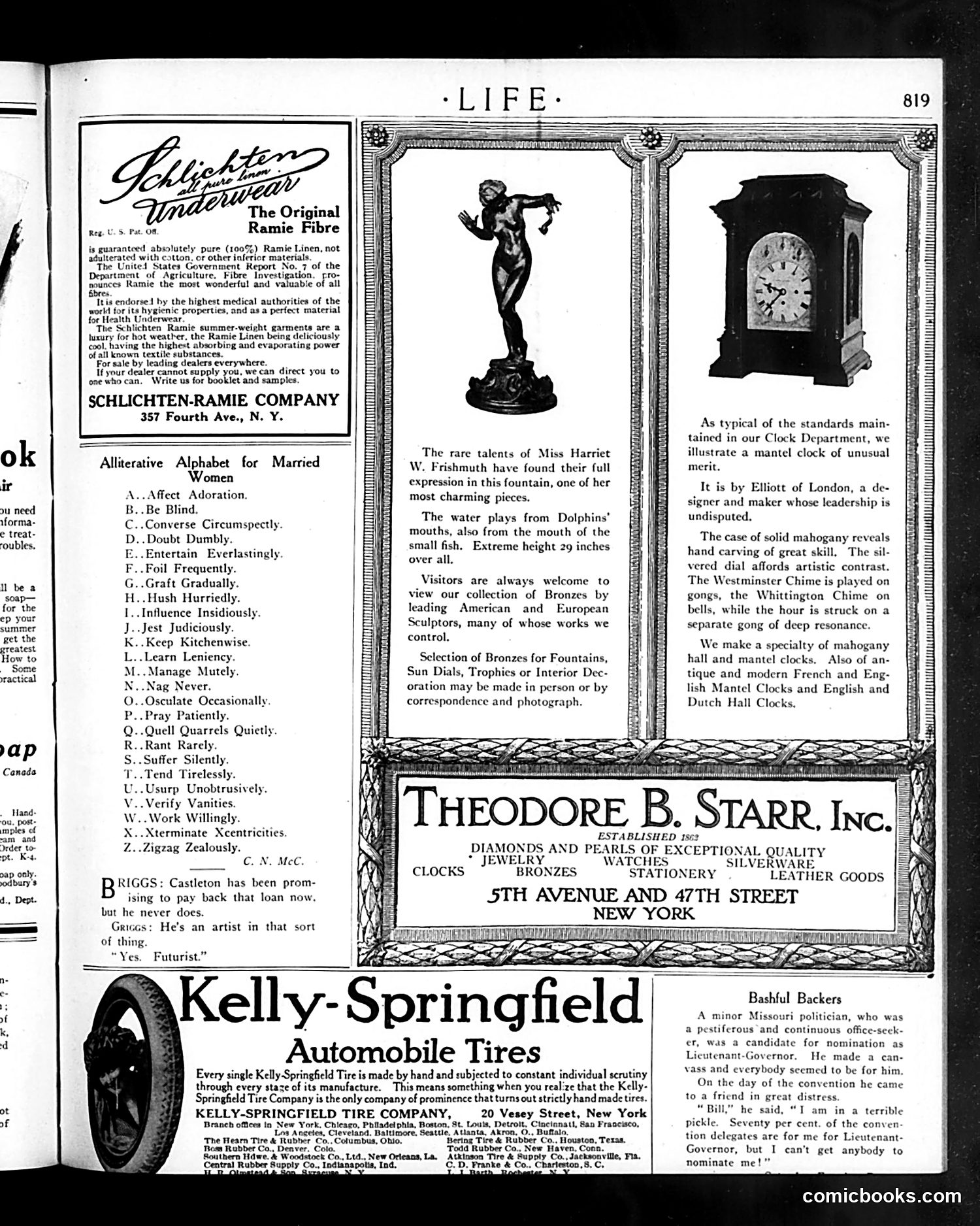
This page is primarily **advertising**, not satire or political commentary. It contains: 1. **Schlichten-Ramie Company ad** (upper left): promoting "Ramie Fibre" underwear as pure and hygienic 2. **"Alliterative Alphabet for Married Women"** (left side): a humorous list using alliteration to describe wives' traits (e.g., "Affect Adoration," "Be Blind," "Doubt Dumbly"). This is light domestic humor mocking wives' expected behavior in marriage—typical early 20th-century comedy about gender roles. 3. **Two product showcases** (center): a decorative fountain and mantel clock by Theodore B. Starr, Inc. 4. **Kelly-Springfield Automobile Tires ad** (bottom): emphasizing hand-made quality 5. **A brief joke** about an artist named Castleton and a "Futurist" reference. The page reflects period attitudes toward marriage and consumer goods rather than addressing specific political events.
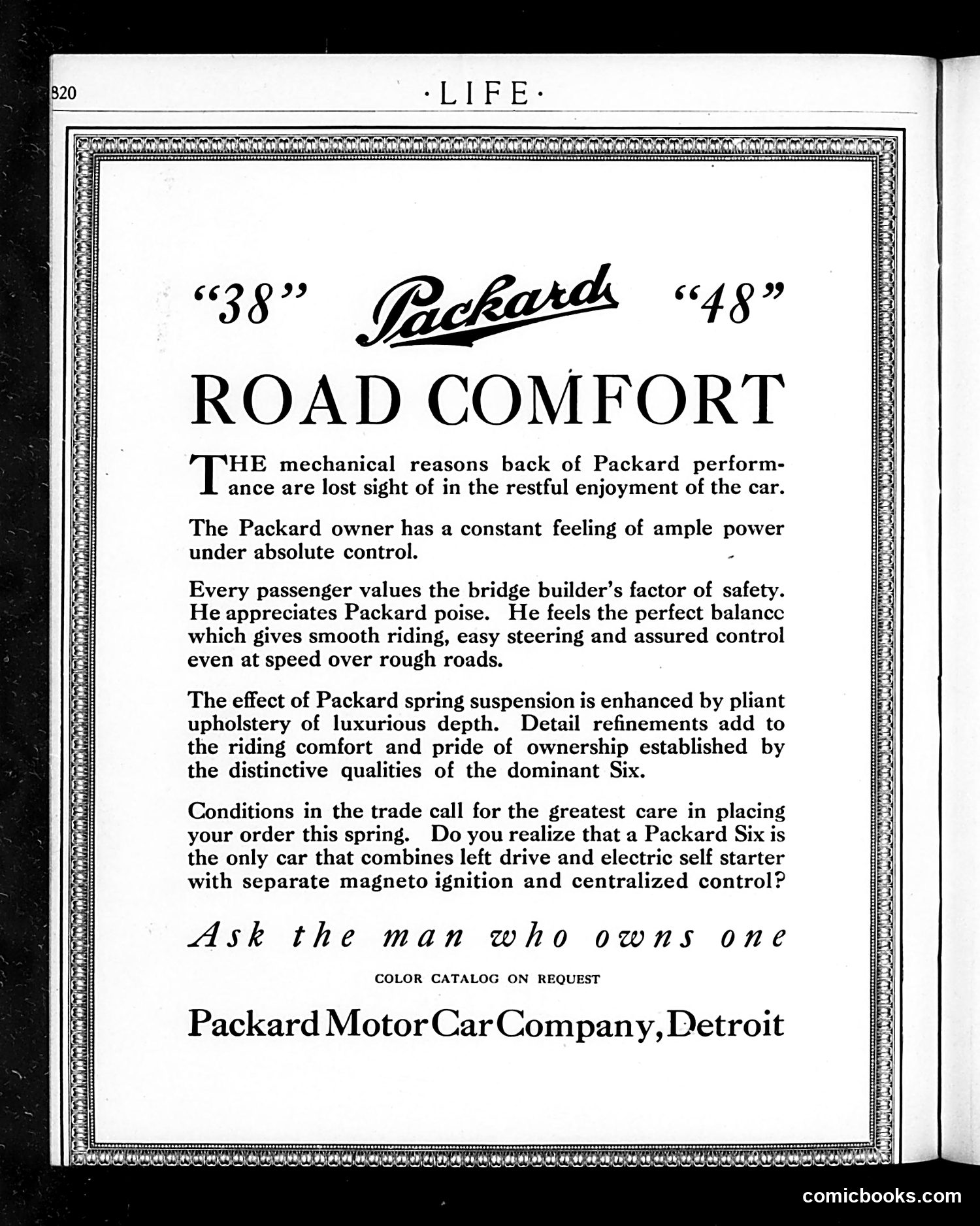
This is a **full-page advertisement**, not satirical content. It promotes the Packard automobile (models "38" and "48") from the Packard Motor Car Company in Detroit. The ad emphasizes luxury features: mechanical reliability, suspension comfort, spring suspension with plush upholstery, and control on rough roads. A notable technical claim is that the Packard Six is "the only car that combines left drive and electric self starter with separate magneto ignition and centralized control." The closing line—"Ask the man who owns one"—became Packard's famous advertising slogan, implying that satisfied owners would endorse the vehicle. For modern readers: this represents early automotive marketing targeting affluent buyers by emphasizing engineering sophistication and comfort rather than speed or style.
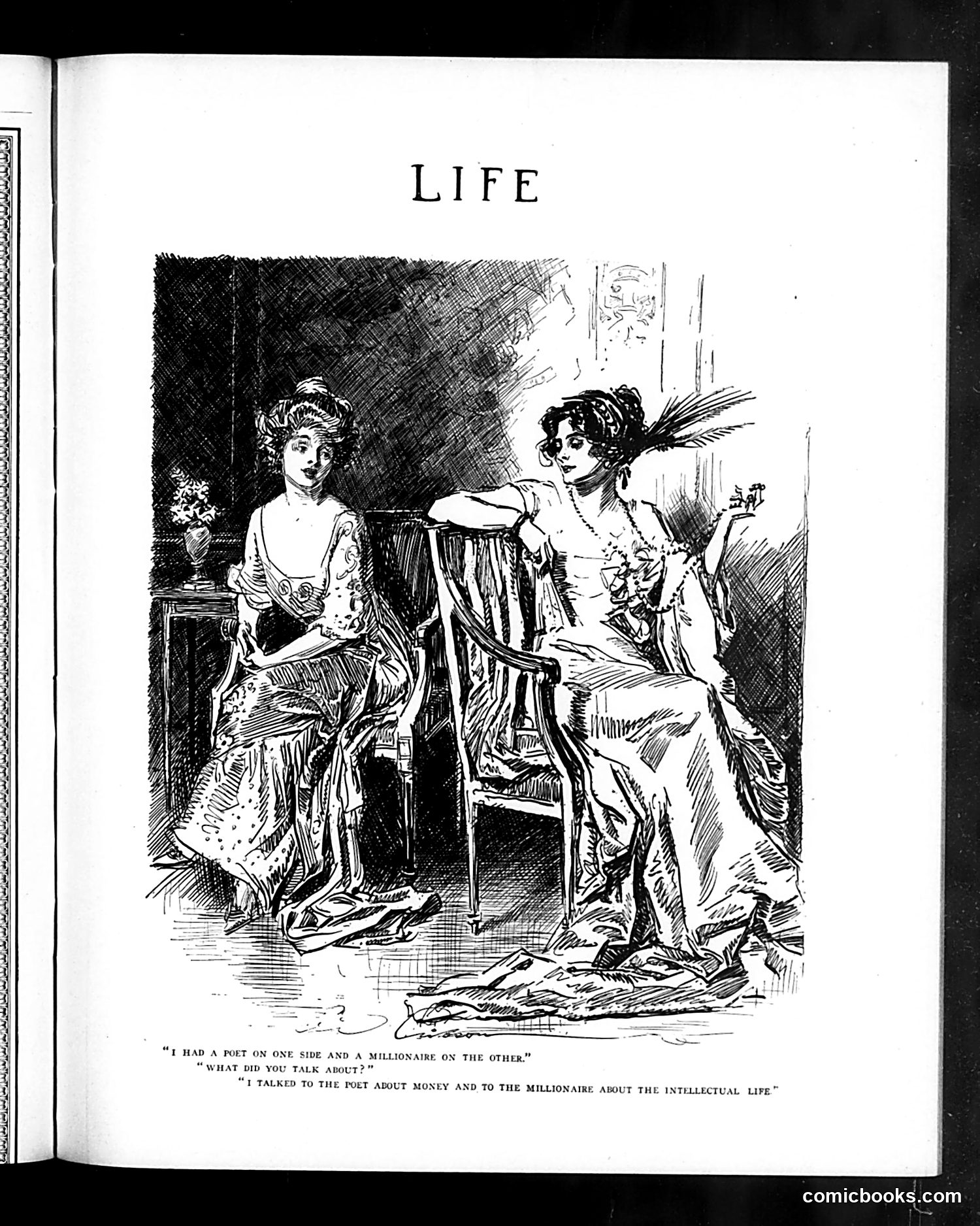
This satirical cartoon depicts two elegant women in conversation, illustrating a class-based social commentary. The caption reveals the joke: one woman had "a poet on one side and a millionaire on the other," and when asked what she discussed with them, she replies: "I talked to the poet about money and to the millionaire about the intellectual life." The satire mocks the superficiality of high society and inverts expectations about class and culture. It suggests that wealthy people lack intellectual depth while poets obsess over financial security—a commentary on early 20th-century American society's misplaced values. The elegant illustration style contrasts with the biting critique of aristocratic pretension and the disconnect between artistic and economic worlds.
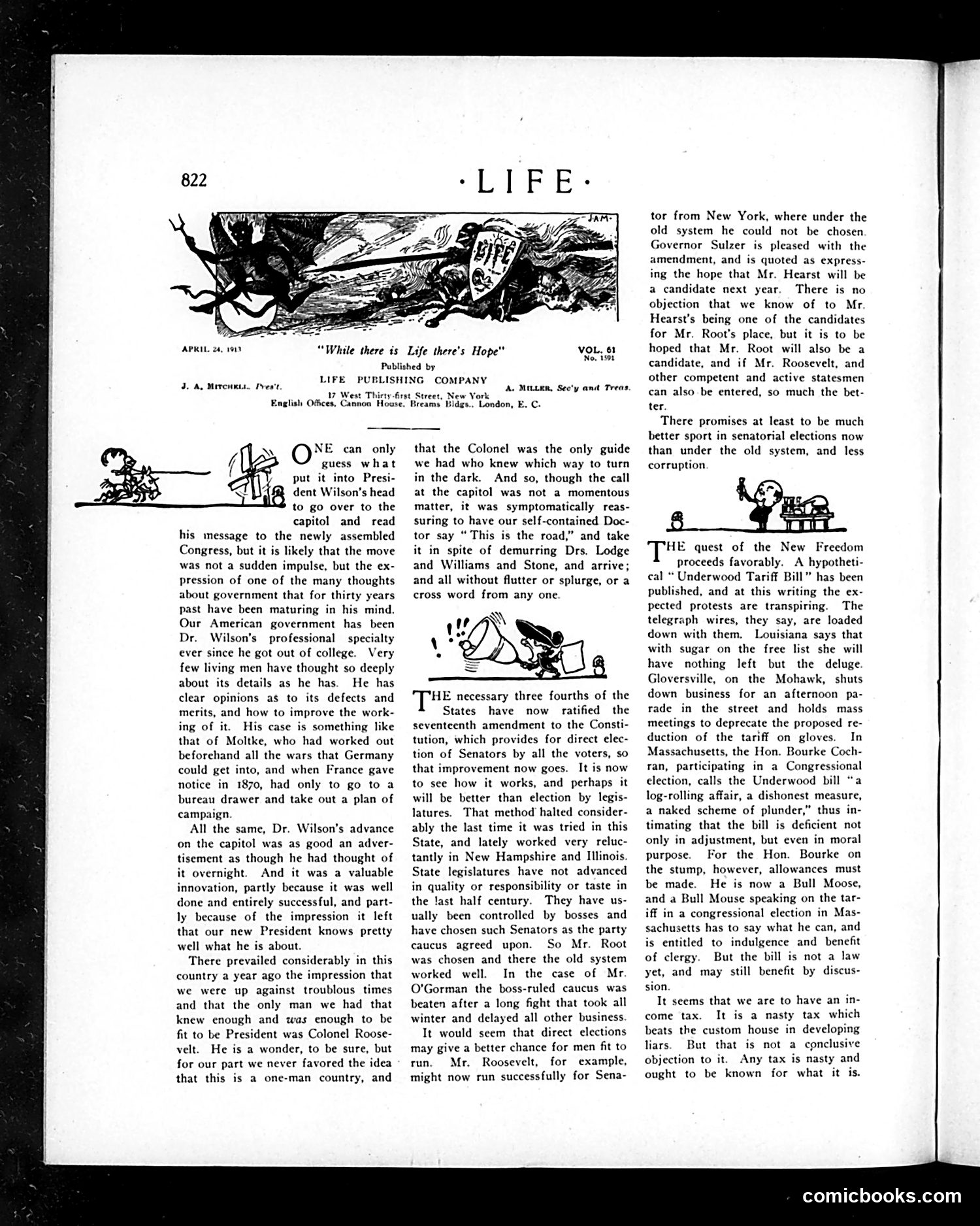
This page discusses President Wilson's approach to governance, comparing him favorably to Colonel Roosevelt. The text argues Wilson demonstrated wisdom by consulting Congress rather than acting unilaterally—contrasting with Roosevelt's more independent executive style. The main cartoon (top) depicts a figure in bed labeled "While there is Life here's Hope," referencing the ongoing political debate about leadership styles and succession planning. The page discusses senatorial elections and the recent ratification of the 17th Amendment, which allowed direct election of senators (replacing legislative selection). The text suggests this reform may improve governance quality compared to the old "boss-ruled" system. Additional cartoons address the proposed tariff on gloves and an income tax, critiquing these as poorly conceived legislation.
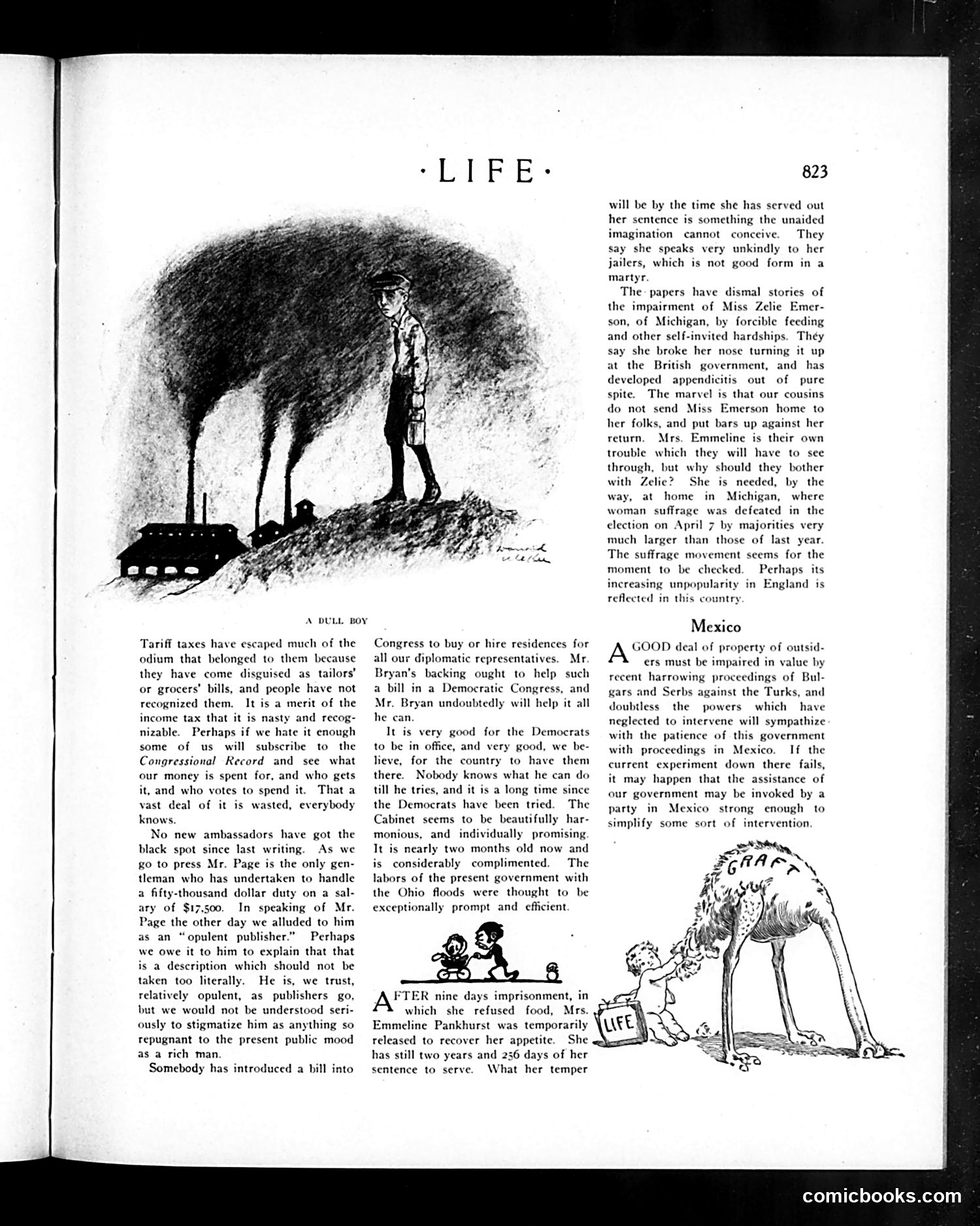
The page contains two distinct editorial cartoons with accompanying commentary on early 20th-century politics. **"A Bull Boy"** (left): Shows a figure standing on a hill beside what appears to be a bull. The text discusses tariff taxes, Congressional matters, and mentions Mr. Bryan and Democratic policy. The cartoon likely satirizes political debate over economic policy, though the specific allegorical meaning of the bull requires more context. **"Mexico"** (right): The lower cartoon depicts a figure in distress beneath a large eagle. This clearly references American intervention in Mexican affairs, satirizing U.S. involvement in Mexico's instability. The text discusses property disputes and suggests the U.S. government may need to intervene diplomatically. Both cartoons reflect turn-of-the-century American political anxieties about trade policy and foreign relations.
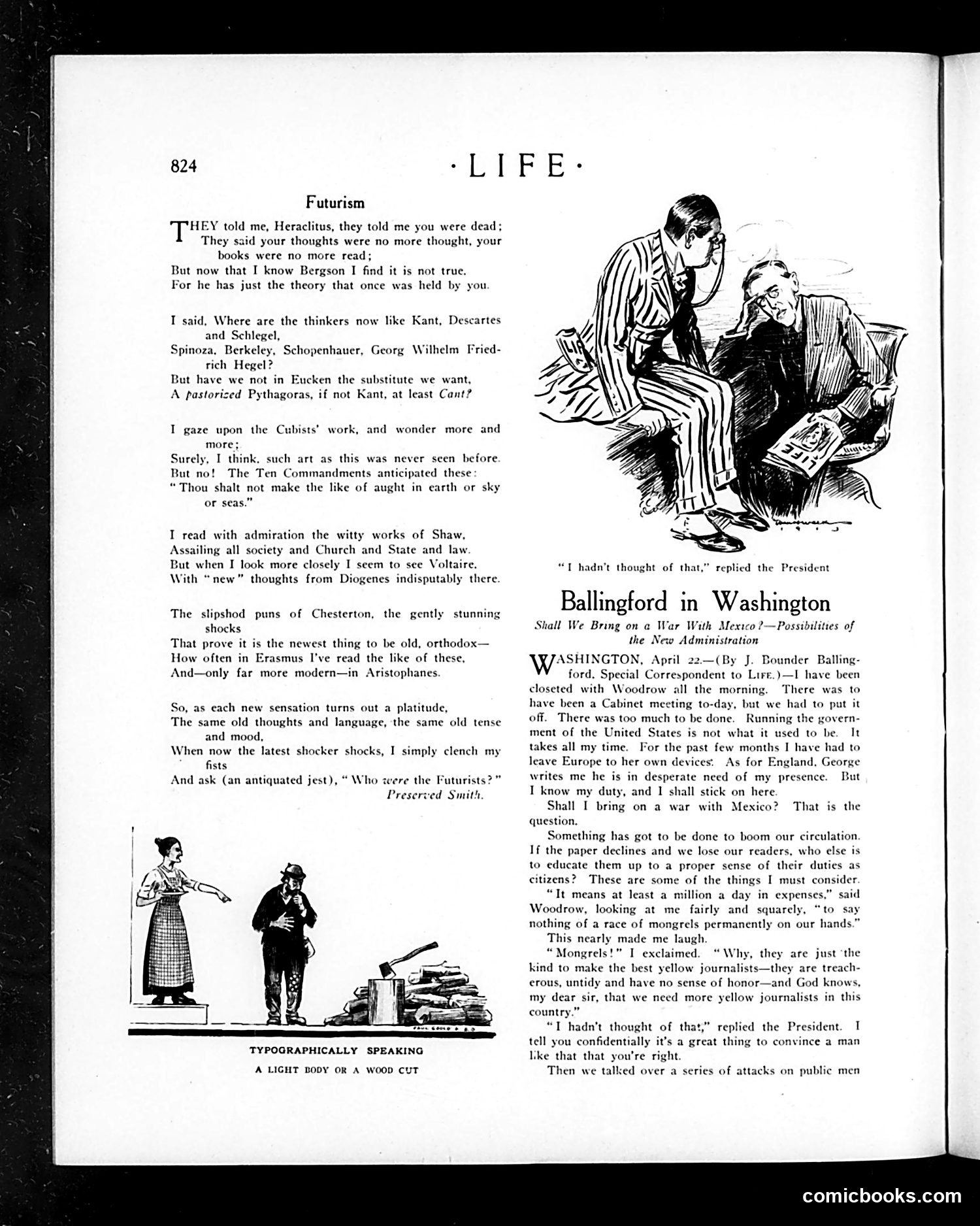
This page satirizes intellectual and artistic trends of the early 20th century. The top poem "Futurism" mocks the Futurist art movement and modernist philosophy, suggesting contemporary thinkers merely recycle old ideas from figures like Kant and Descartes. References to Cubism, Shaw, and Voltaire indicate critique of avant-garde movements claimed as revolutionary but derivative. The main article features "J. Bounder Ballingford," a fictional correspondent discussing potential U.S.-Mexico conflict with President Woodrow Wilson. Ballingford advocates war propaganda to boost newspaper circulation, while Wilson resists, calling yellow journalists "mongrels" lacking honor. The satire targets both jingoistic press and diplomatic tensions of the era (likely pre-WWI).
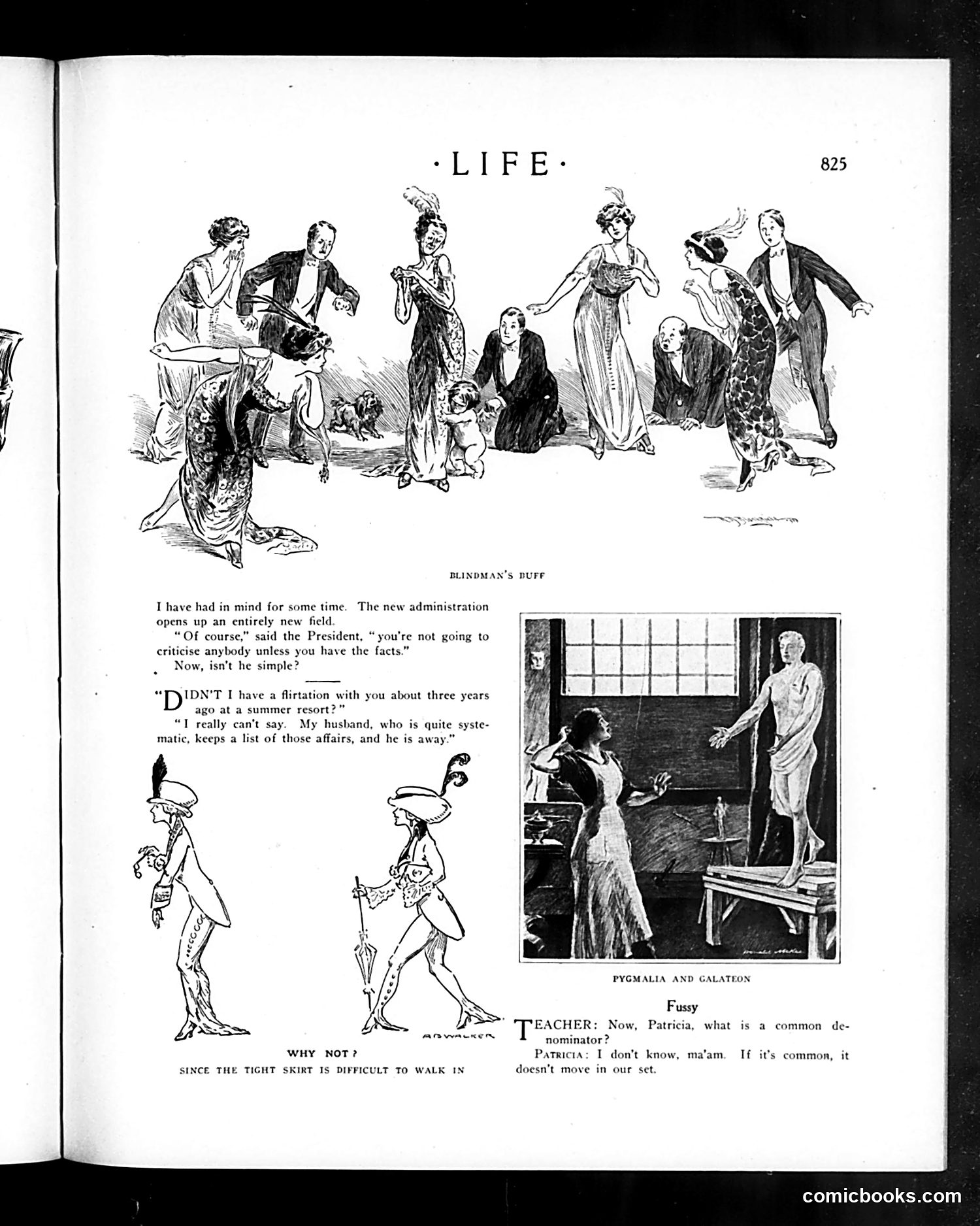
This page contains two satirical pieces: **"Blindman's Buff"** (top illustration) depicts a social gathering where blindfolded figures attempt to navigate among standing onlookers—a visual metaphor for political or social confusion, likely referencing the "new administration" mentioned in the accompanying text about not criticizing without facts. **"Why Not?"** (bottom left) shows two caricatured male figures in discussion about tight skirts, sarcastically questioning why women don't wear them—social commentary on women's fashion and mobility. **"Pygmalia and Galaton"** (right) presents a domestic scene where a woman gestures toward a male statue or figure, referencing the classical Pygmalion myth to comment on relationships or romantic idealization. The overall page satirizes social conventions, government administration, and gender dynamics of the era.
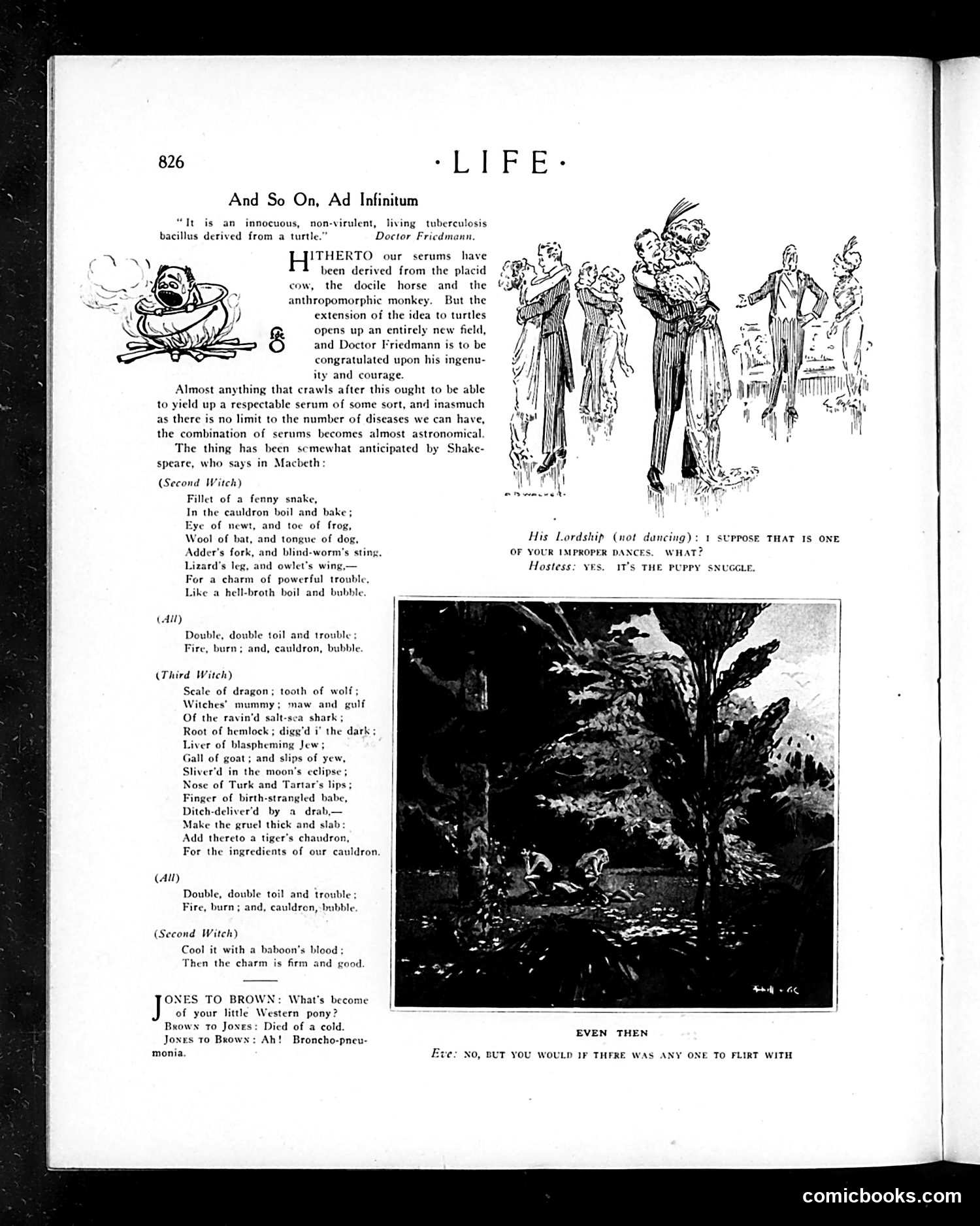
This page satirizes medical/scientific overreach. The top section quotes Doctor Friedmann's tuberculosis serum claims, mocking the notion that treatments derived from animals (cow, horse, monkey, turtle) could cure virtually any disease. The witches' brew recipe from *Macbeth* appears as satire—suggesting Friedmann's approach is as absurd and superstitious as witchcraft. The dialogue at bottom shows a social scene where someone's pony died of bronchopneumonia, likely referencing Friedmann's dubious animal-derived treatments. The satire suggests that extending such remedies to all animals and diseases is laughably illogical. The dark illustration appears to depict witches, reinforcing the "magical thinking" critique of unproven medical claims presented as scientific breakthroughs.
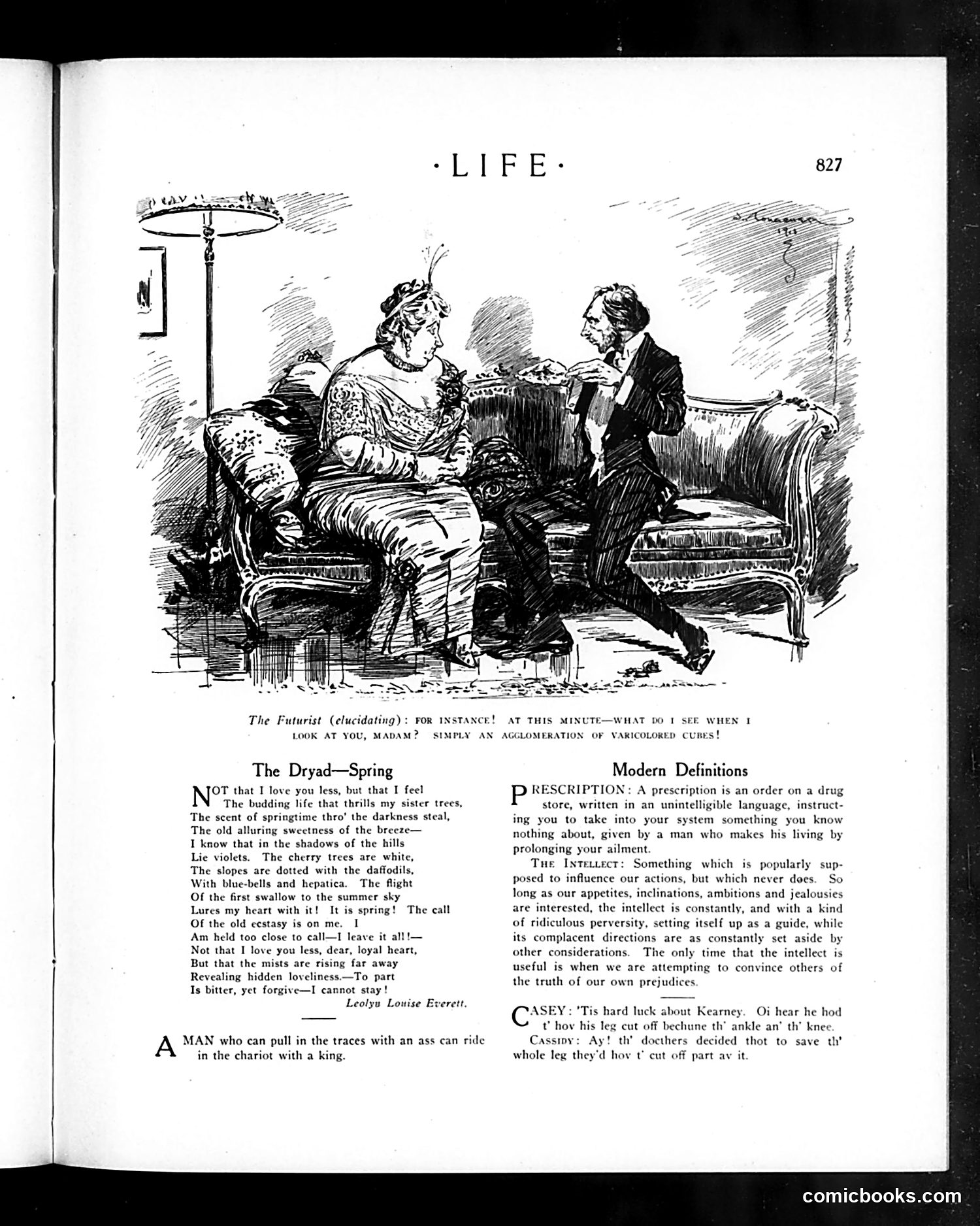
**The Main Cartoon:** "The Futurist (elucidating)" mocks early 20th-century Futurism and modernist art criticism. A pretentious man lectures a well-dressed woman, claiming that when he looks at her, he sees only "an agglomeration of varicolored curves"—reducing a person to abstract geometric forms. This satirizes how avant-garde artists and critics used obscure, pseudo-intellectual language to describe art in ways disconnected from reality or human experience. **The Satire:** Life ridicules Futurist doctrine by showing how absurdly this analytical framework fails to actually *see* or describe anything meaningful about a person. **Supporting Content:** The page includes poetry ("The Dryad—Spring"), humorous definitions mocking prescriptions and false intellectualism, and an Irish-dialect joke about amputation. These reinforce Life's theme of exposing pretension and linguistic nonsense in modern discourse.
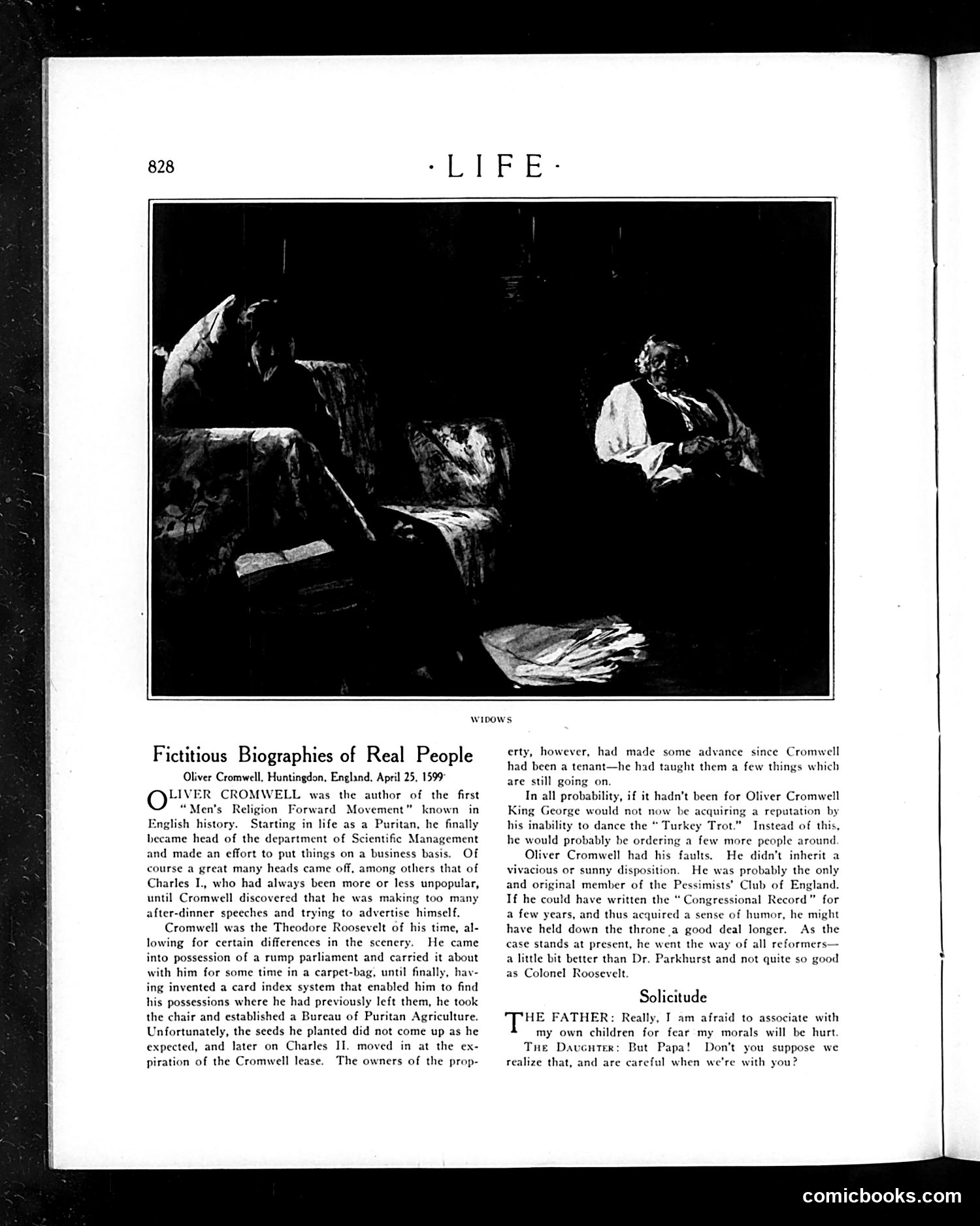
This page contains a satirical "biography" of Oliver Cromwell (1599-1658), the English Puritan revolutionary who executed King Charles I and ruled as Lord Protector. **The Satire's Point:** Life magazine presents Cromwell as a modern American businessman-reformer, comparing him to Theodore Roosevelt. The joke mocks both Cromwell's rigid Puritanism and contemporary "efficiency" movements: he treated government like a business (inventing a "card index system," establishing a "Bureau of Puritan Agriculture"), yet his reforms ultimately failed—the monarchy returned under Charles II. **The Modernization:** Phrases like "Men's Religion Forward Movement," "Scientific Management," and "Turkey Trot" (a contemporary dance) translate 17th-century religious upheaval into early 1900s American corporate and social language, creating anachronistic humor. **The Lower Cartoon ("Solicitude"):** A brief dialogue joke about a father's hypocrisy—he fears corrupting his morals by associating with his children, who dryly note they're already careful *around him*. The page satirizes both historical figures and contemporary American reform movements.
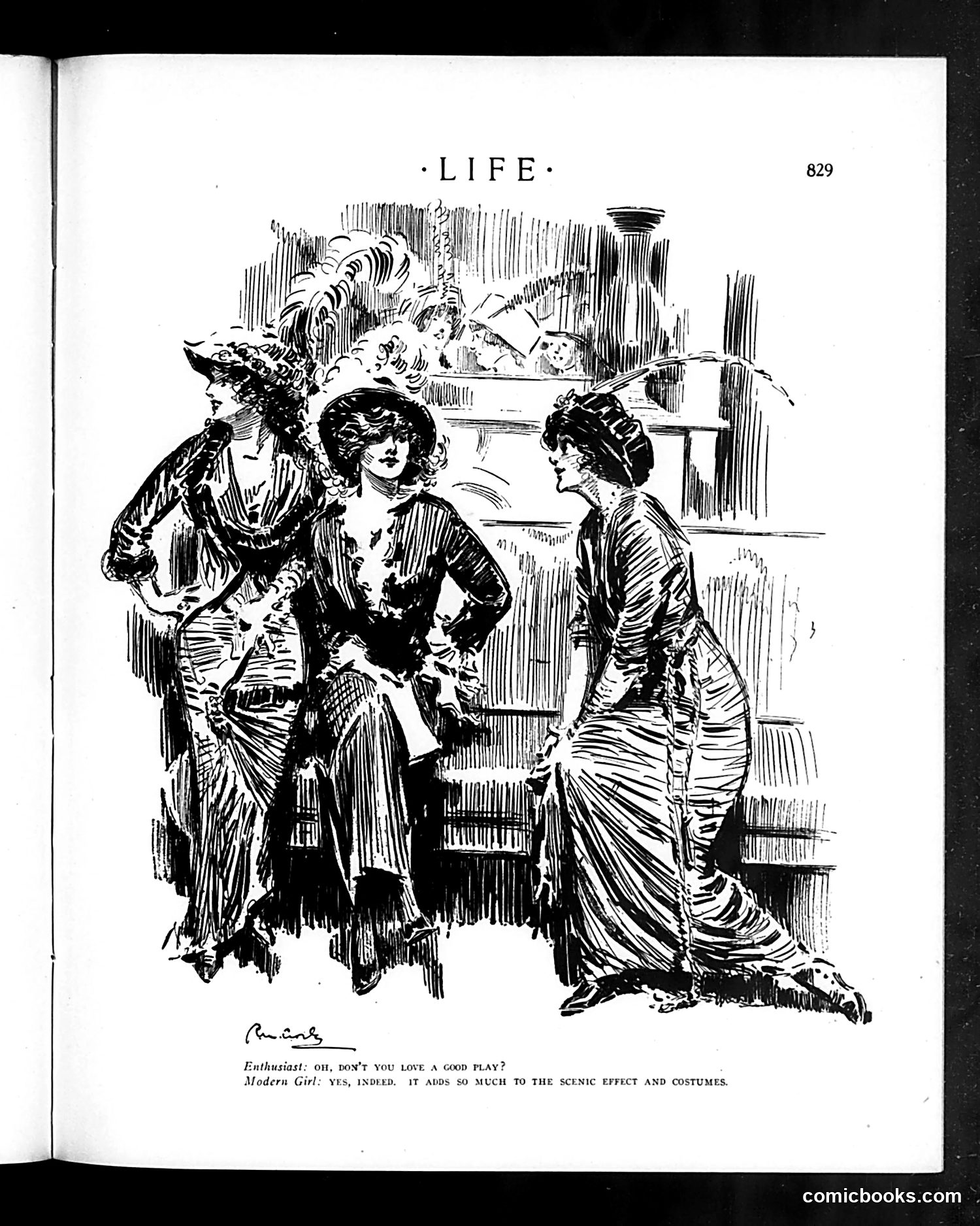
This page features a single satirical cartoon by an artist (signature illegible) depicting three elegantly dressed women in early 1900s fashion discussing theater. **The Joke:** An "Enthusiast" asks a "Modern Girl" if she loves good plays. She responds that she does—"indeed, it adds so much to the scenic effect and costumes." **The Satire:** The cartoon mocks shallow theatergoing among fashionable women. Rather than appreciating dramatic quality or storytelling, the "Modern Girl" values plays primarily as backdrops to display costumes and staging—suggesting she attends theater mainly to be seen in fine clothes rather than for artistic merit. This reflects early 20th-century social commentary about vanity and the superficiality of fashionable society, particularly targeting women's consumer culture and appearance-focused values.
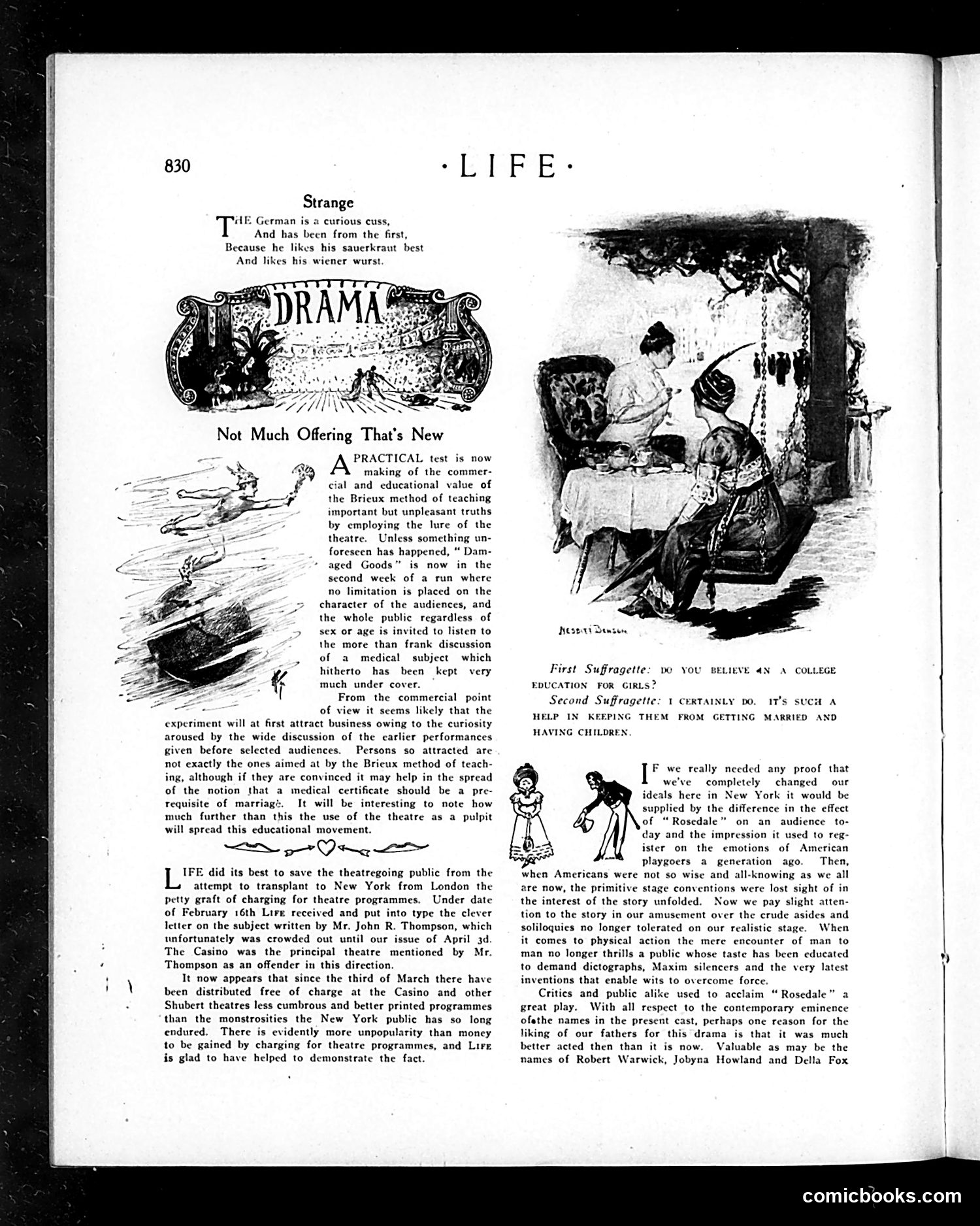
This page contains theater criticism and social satire typical of early 20th-century Life magazine. **The cartoons:** - A crude German stereotype with sauerkraut and wiener references—reflective of the casual ethnic humor common in the era - A suffragette joke where two women advocate college education as a way to prevent marriage and childbearing—mocking feminist arguments by suggesting educated women reject motherhood **The articles:** The main content discusses the "Brieux method"—using theater to educate audiences about serious social issues, particularly a play called "Damaged Goods" addressing venereal disease. Life questions whether this actually spreads understanding or merely attracts curiosity-seekers. A second piece celebrates Life's campaign against theater programs being sold, claiming victory when theaters began distributing them free. A third criticizes a revival of "Rosedale," arguing modern audiences have become too sophisticated and jaded—they sneer at old theatrical conventions rather than engaging emotionally with the story. The satire assumes readers' familiarity with current theater productions and debates about theatrical realism versus melodramatic convention.
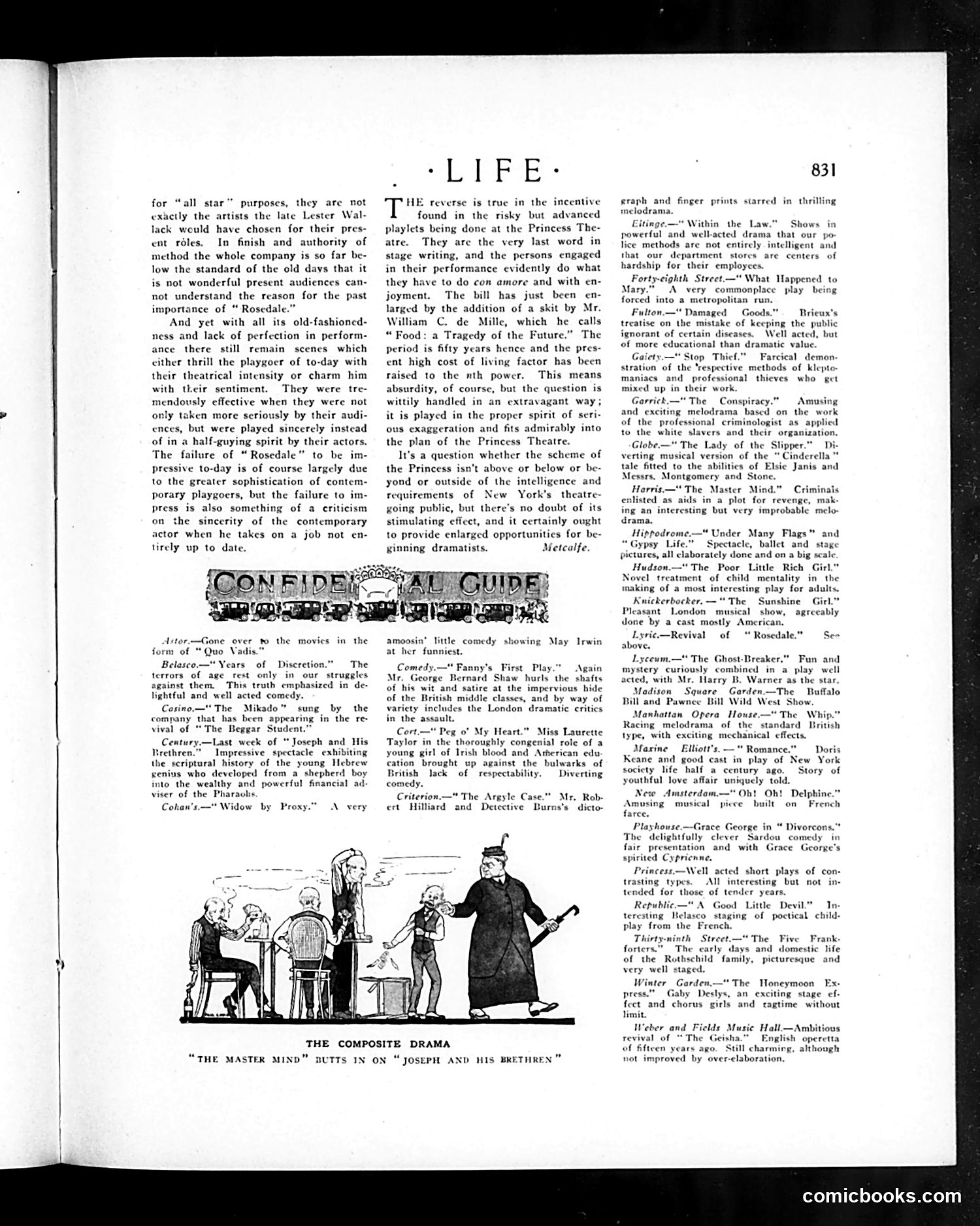
The cartoon titled "The Master Mind Butts In on Joseph and His Brethren" depicts a domestic scene where a stern-looking man in formal dress interrupts a family tableau. The image appears to satirize theatrical direction or domestic authority—likely mocking how authority figures intrude upon or disrupt staged family scenes or sentimental moments. The surrounding text reviews various theater productions, suggesting this cartoon critiques contemporary theater's loss of sincerity. The reviews repeatedly lament that modern actors perform with insufficient earnestness compared to earlier generations. The cartoon likely illustrates this point: the "master mind" figure represents overbearing direction or modern cynicism that undermines genuine emotional performance, much like how reviewers claim contemporary actors "half-gu[y]" serious scenes rather than playing them sincerely. The reference to "Joseph and His Brethren" (a biblical spectacle mentioned in the reviews) anchors the satire in theater criticism specifically.
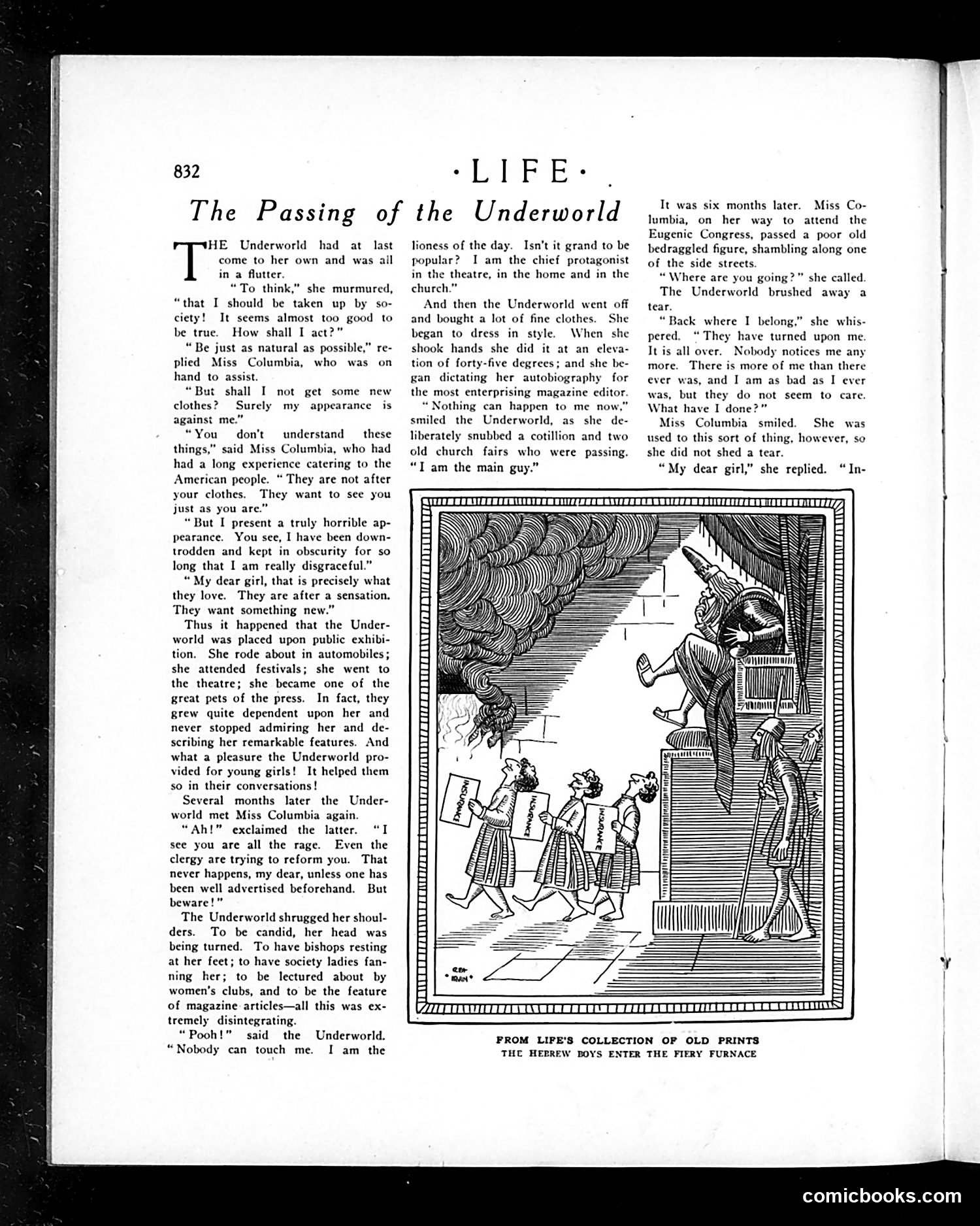
This satirical story uses allegory to critique American society's treatment of social problems. "The Underworld"—personified as a disreputable woman—represents crime, vice, and urban poverty. Miss Columbia (America itself) initially advises her to remain authentic, but the public becomes fascinated by her "as a sensation." The Underworld becomes a celebrity: newspapers cover her, society ladies attend her, clergy attempt reform. But her newfound fame goes to her head—she buys fine clothes, adopts airs, and snubs her old associates. Within months, public interest evaporates, and she's abandoned and forgotten, returning to obscurity. The satire targets American society's superficial interest in social reform. The public treats serious problems as entertainment rather than issues requiring genuine solutions. Once the novelty fades, they abandon their concern entirely. The cartoon's caption reference to "Hebrew Boys" suggests moral/spiritual judgment on this cycle of exploitation and discard.
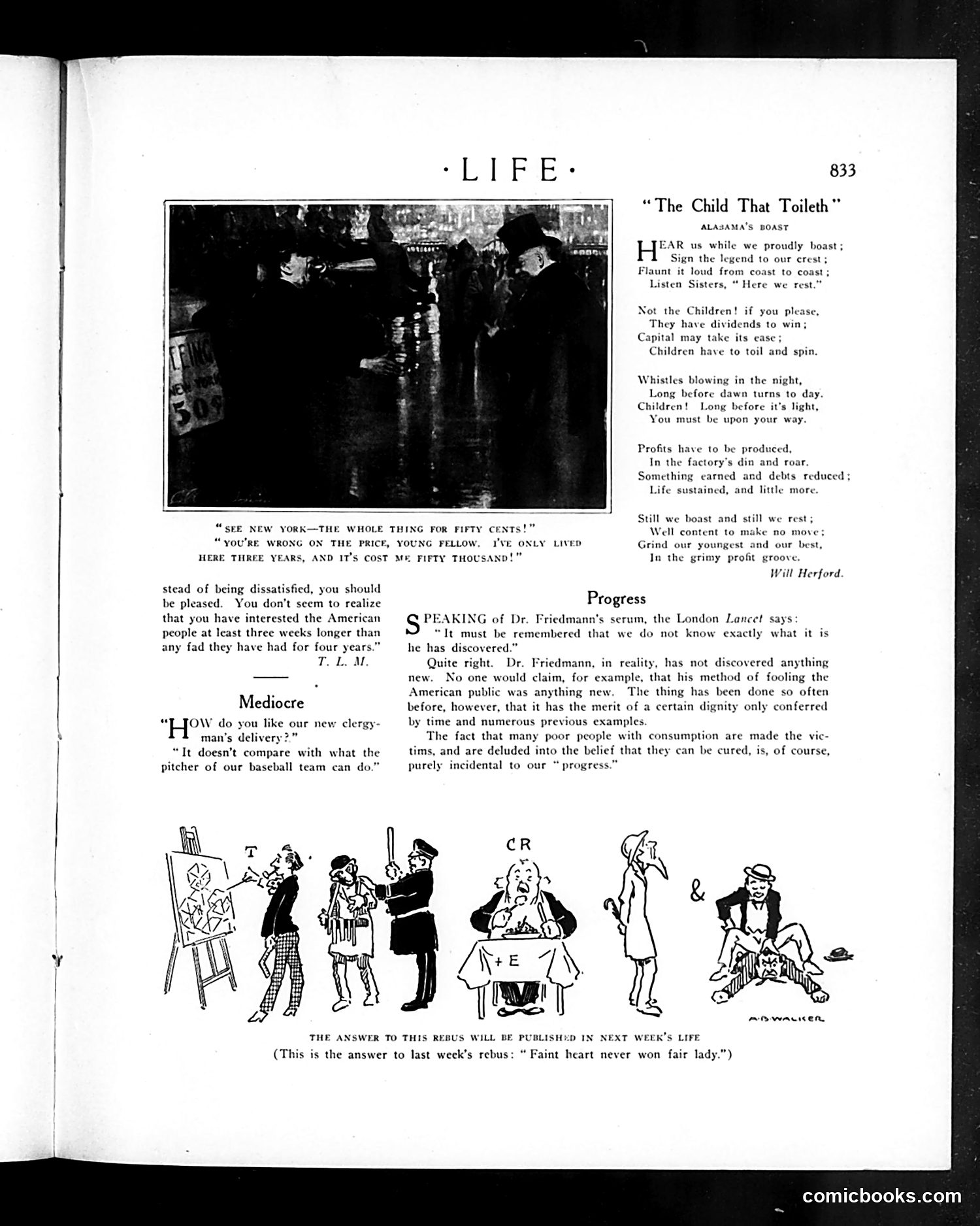
This page satirizes Alabama's exploitation of child labor in factories. The poem mocks Alabama's self-congratulatory "boast" about progress while children work night shifts before dawn in mills and factories, grinding away in "the grimy profit groove" to produce capital and reduce debt. The accompanying photograph (caption unclear but showing industrial workers) illustrates this grim reality. The satire's point: while Alabama celebrates itself, it sacrifices its children's welfare to industrial profit. Below, a separate item mocks "Dr. Friedmann's serum"—likely a fraudulent tuberculosis cure being marketed to desperate poor people. The satire exposes how "progress" often means exploiting the vulnerable through false medical claims, treating their suffering as incidental to commercial gain. Both pieces critique how industrial society and medical charlatanism harm the powerless while society celebrates "advancement."
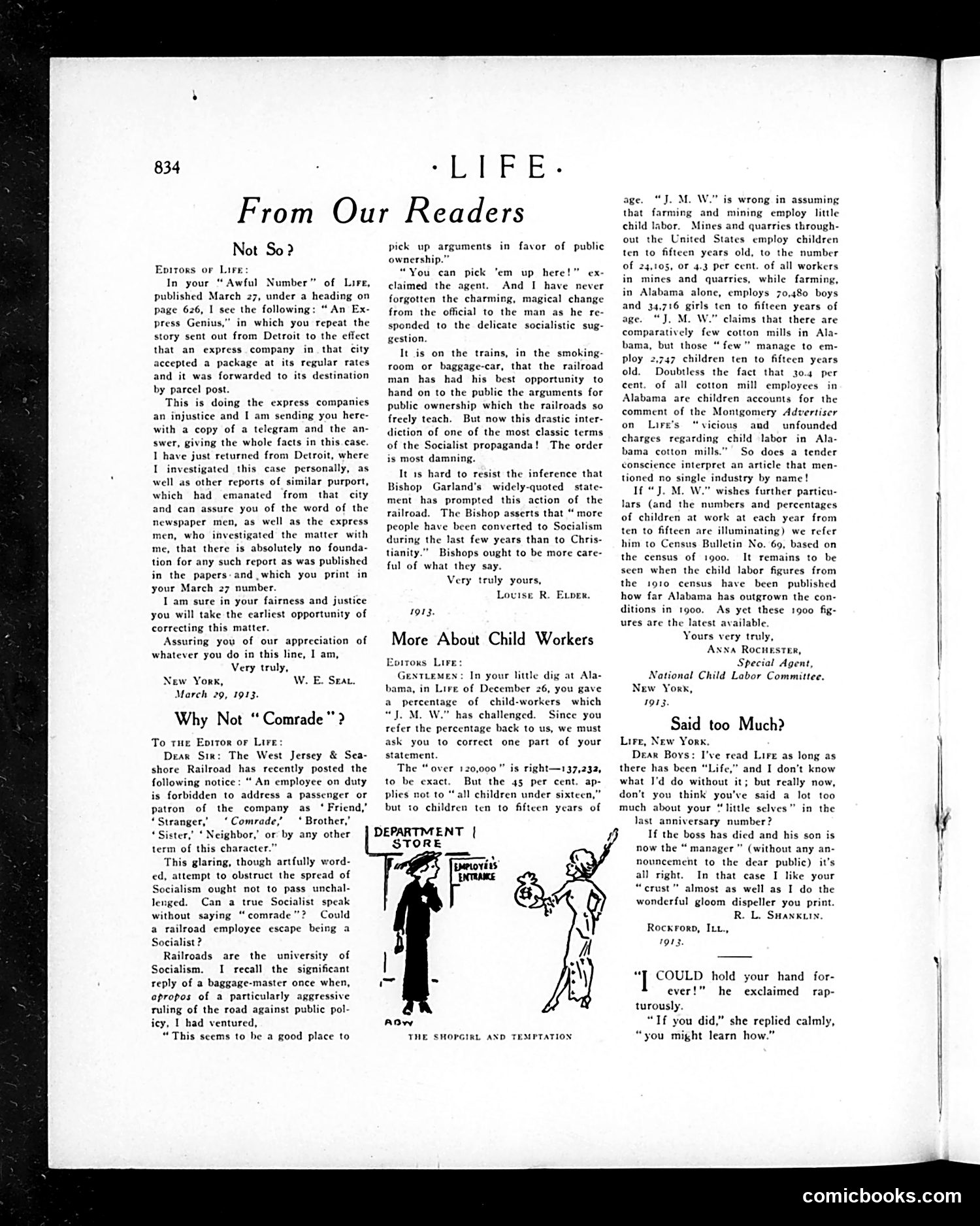
This is a **letters-to-the-editor page** featuring three reader complaints about prior LIFE articles. The content is primarily textual rather than cartographic satire. The key controversies: 1. **Express Company Defense** — A reader disputes LIFE's reporting on parcel post efficiency, defending railroad express companies' reputation. 2. **"Comrade" Controversy** — A reader mocks a railroad's ban on employees calling patrons "Comrade," interpreting it as anti-Socialist propaganda. References Bishop Garland's claim that Socialism converts more people than Christianity — suggesting railroads feared Socialist agitation among their workers. 3. **Child Labor in Alabama** — Readers dispute statistical accuracy regarding child workers (ages 10-15), with one correspondent defending Alabama's agricultural practices. The small **illustration** ("The Shopgirl and Temptation") appears unrelated editorial art. The page demonstrates early 20th-century concerns about labor rights, Socialist organizing, and industrial regulation—particularly worker classification and child employment practices.
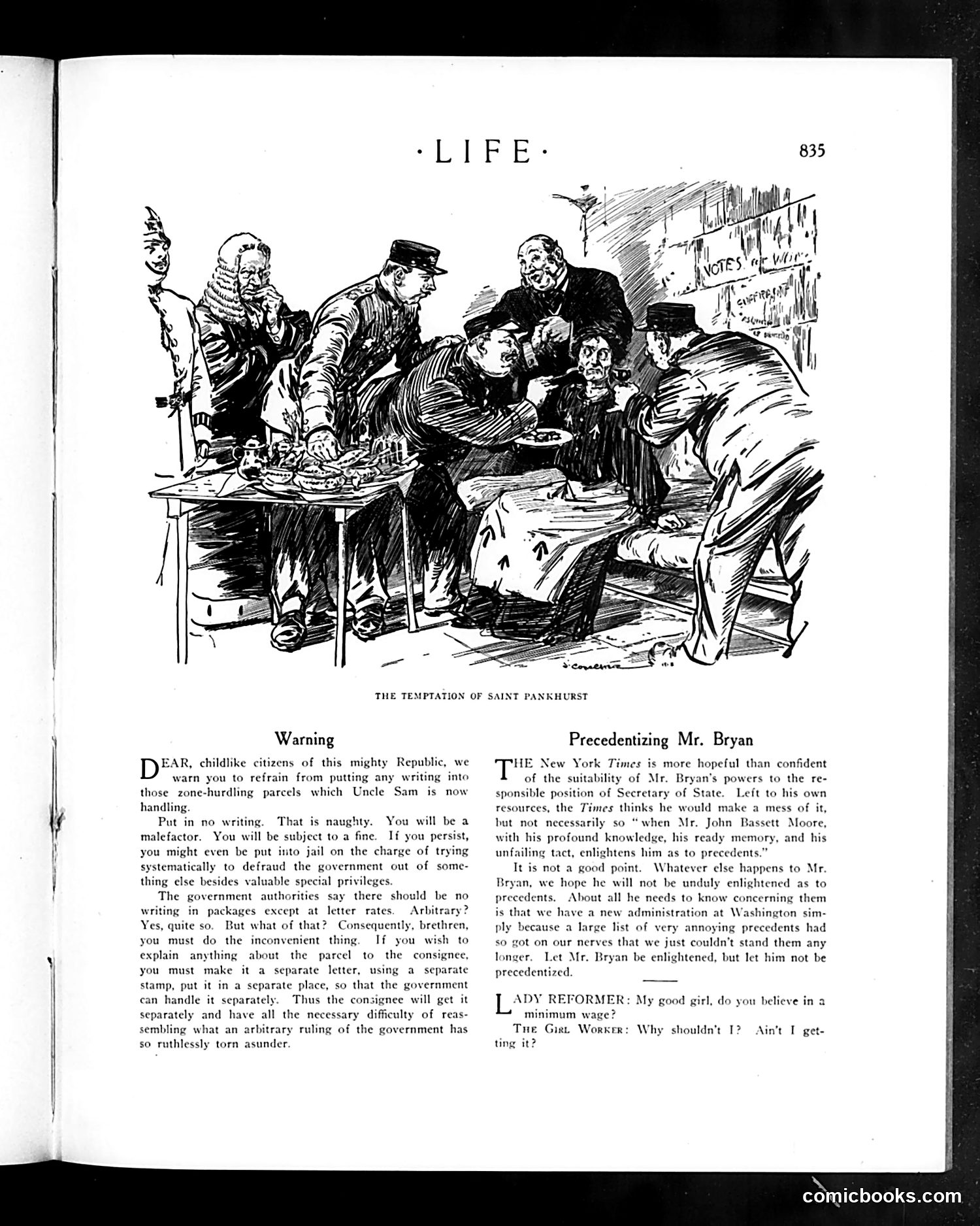
**The main cartoon** ("The Temptation of Saint Pankhurst") depicts what appears to be political figures dining together, likely referencing William Jennings Bryan's appointment as Secretary of State under President Wilson. The title invokes Emmeline Pankhurst, the British suffragist, suggesting a parallel to resisting temptation. **"Warning"** satirizes new postal regulations prohibiting written messages in parcels—only letters could contain writing. Life mocks this arbitrary government rule as absurd bureaucracy, forcing citizens to send separate letters with separate postage. **"Precedentizing Mr. Bryan"** criticizes The New York Times's suggestion that Bryan needs guidance from legal expert John Bassett Moore regarding diplomatic precedents. Life argues Bryan shouldn't be bound by old precedents—the new administration exists *because* people rejected those annoying established practices. **The brief dialogue** about minimum wage presents working-class irony: a girl worker sarcastically agrees with minimum wage advocacy, noting she's already receiving it (implying it's inadequate). All pieces mock authority, bureaucracy, and establishment thinking.
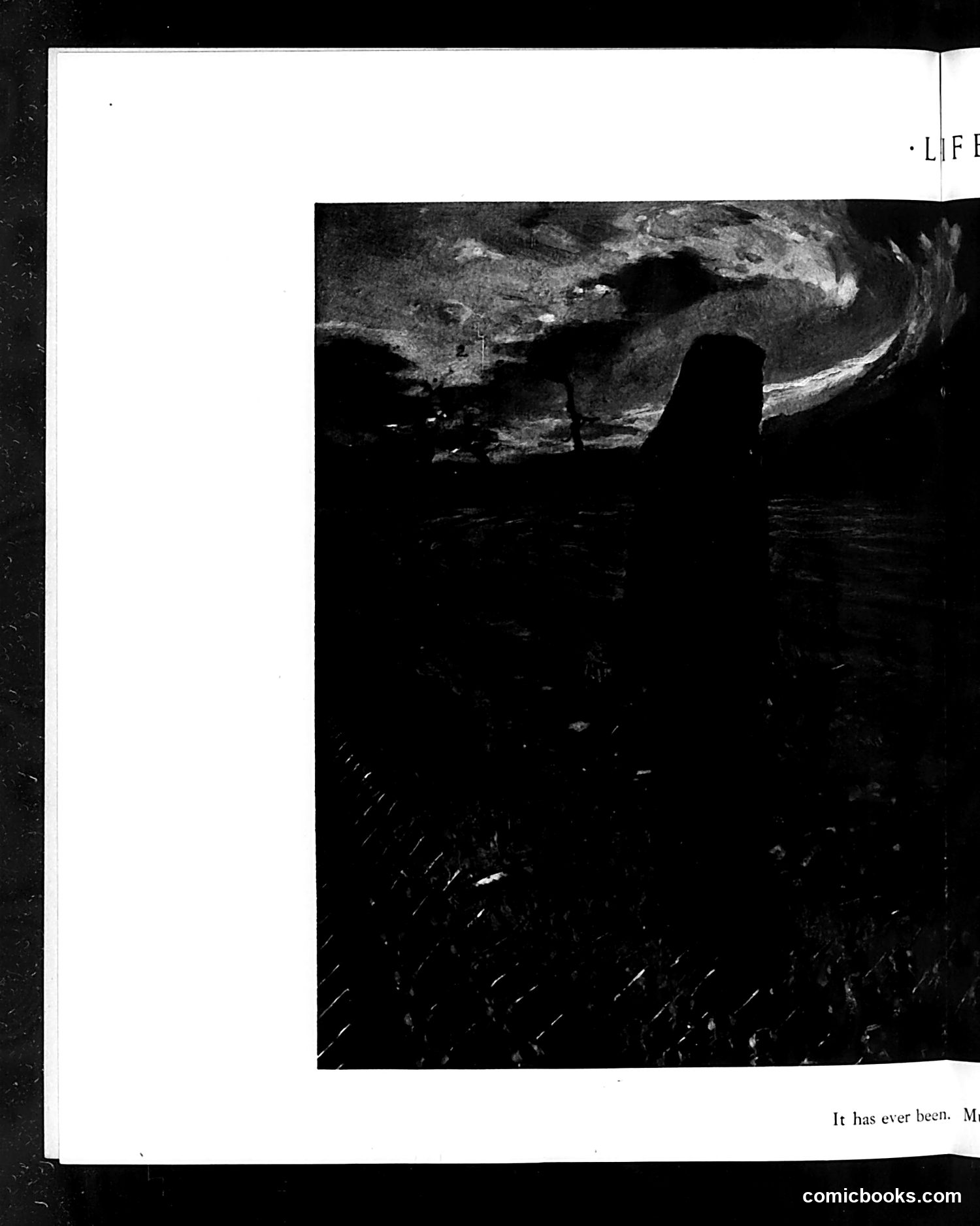
The image quality and contrast make detailed interpretation difficult. The page appears to be from *Life* magazine and contains a dark, dramatic black and white illustration showing silhouetted figures against a stormy or turbulent background with clouds. The partial text at bottom reads "It has ever been. M[...]" but is incomplete. Without clearer visibility of the illustration's details, character features, captions, or complete text, I cannot reliably identify the specific figures, political references, or satirical point with confidence. To provide accurate historical context, I would need either a higher-resolution image or the complete OCR text from the page.
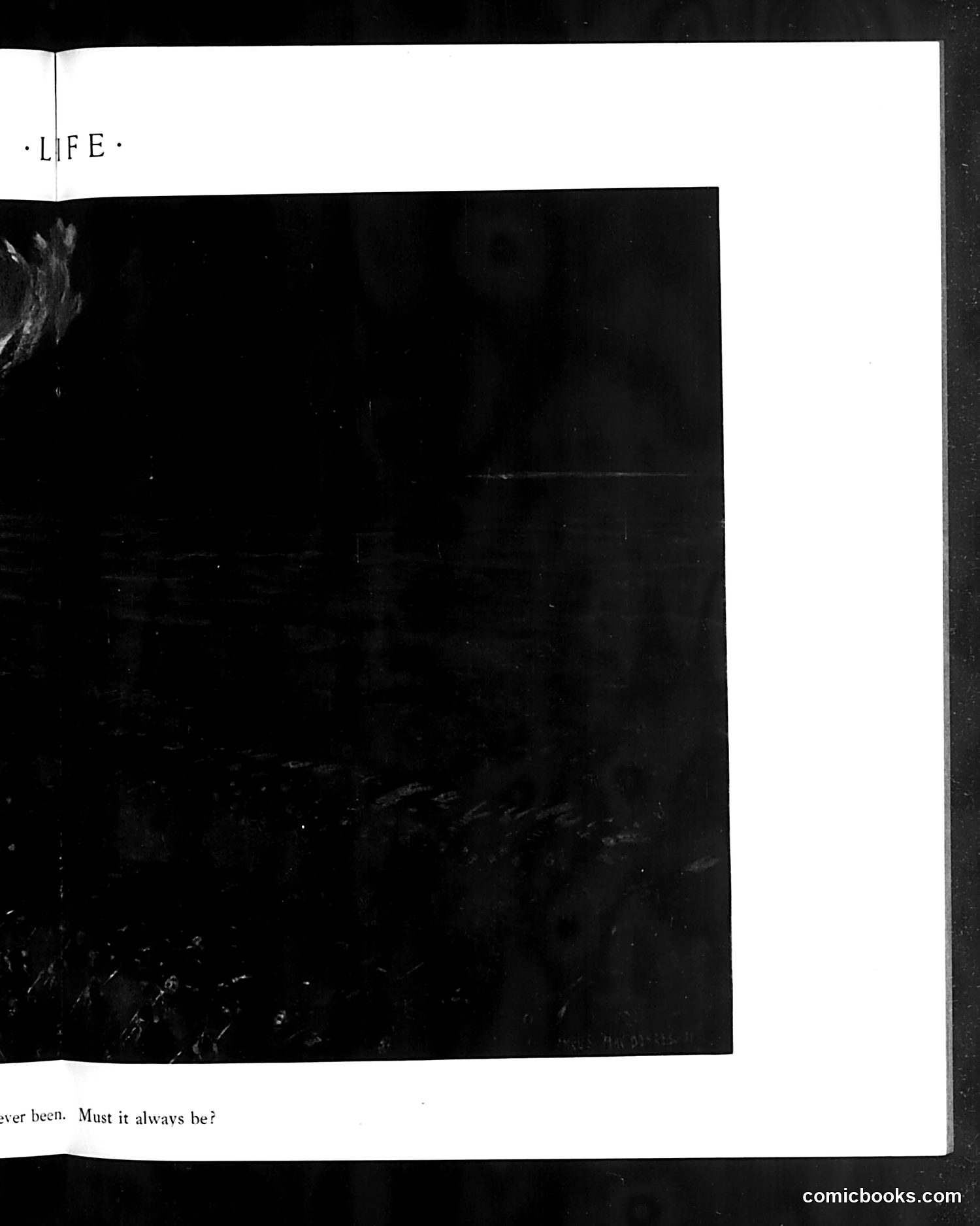
This page appears to be from a section titled "LIFE" and contains mostly a large black photograph or illustration that is too dark to discern clear details. The visible OCR text—"ver been. Must it always be?"—appears to be a fragment from a longer caption or dialogue, likely the end of a sentence asking whether something unfortunate or undesirable must continue indefinitely. Without being able to see the image clearly or read the complete text, I cannot identify specific figures, political references, or the satire's target with confidence. The page seems designed to accompany commentary on a social or political condition presented as inevitable, but the actual subject matter remains unclear from what's visible here.
This is a book review essay, not a political cartoon. The author uses an extended metaphor comparing Socialism's arrival in practical politics to Black Flies emerging from tree-tops in early summer Ontario. The conceit: just as an Indian guide warned that Black Flies would descend from high branches, Socialists have warned that their ideology would eventually move from abstract theory ("the tree tops") into everyday life ("face-high in the underbrush"). The author admits intellectually believing this warning while emotionally disbelieving it—until now, when Socialism apparently is "coming down to brass tacks." The reviews cover socialist texts by Morris Hillquit and John Spargo. The author praises their practical, non-utopian approach but criticizes their limited emotional power. The satire targets readers like himself—comfortable people who intellectually acknowledge Socialism's inevitability while hoping to avoid its actual implementation.
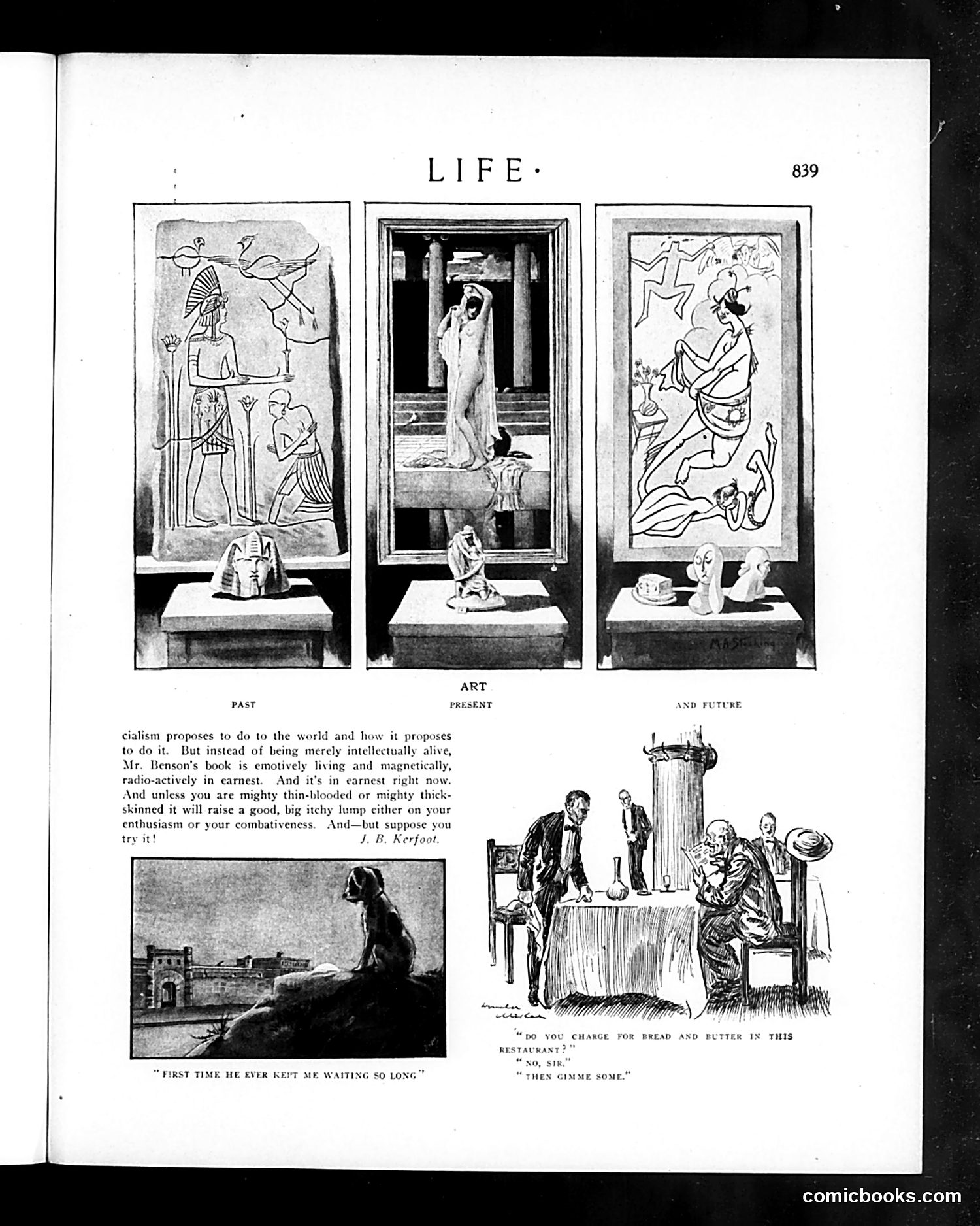
This Life magazine page contains a book review and two separate cartoons. **The Review:** J.B. Kerfoot reviews a book by "Mr. Benson" (likely socialist author Allan L. Benson) about socialism. Kerfoot praises it as emotionally engaging and urgent, warning readers it will provoke strong reactions—either enthusiasm or anger—depending on their disposition. **The Cartoons:** 1. **"First Time He Ever Kept Me Waiting So Long"**: A silhouetted figure (likely a dog or loyal companion) waits by a fortress or castle, suggesting abandonment or betrayal by someone expected to return. 2. **The Restaurant Joke**: A man asks a restaurant if they charge for bread and butter. Told "no, sir," he replies "Then gimme some"—a joke mocking cheap customers or those trying to get free meals. The page juxtaposes serious political commentary with light humor, typical of Life's satirical approach.
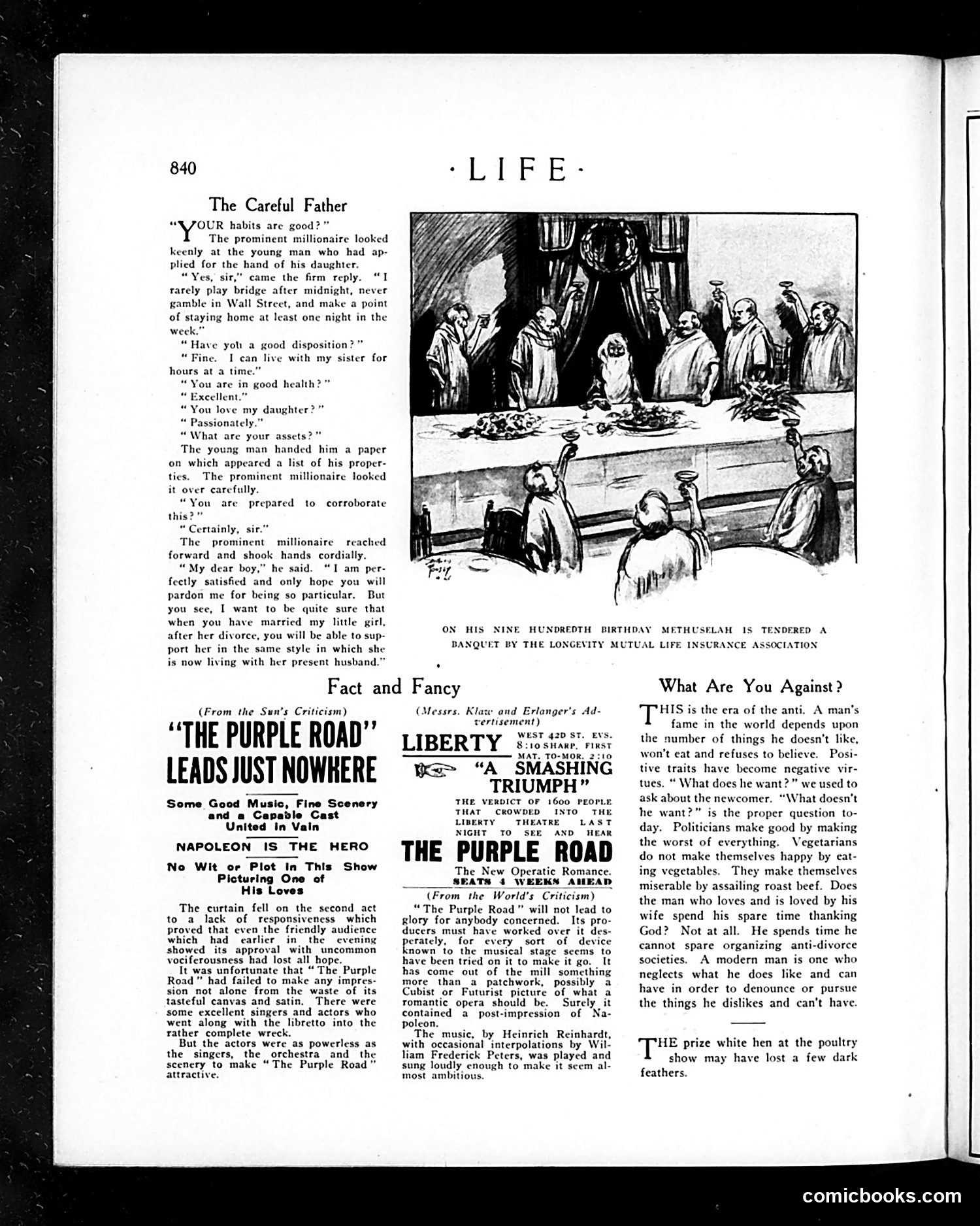
This short comic story satirizes the mercenary nature of 1920s marriage among the wealthy. A young suitor impresses a millionaire father-in-law by demonstrating good habits and financial assets. However, the punchline reveals the father's true concern: he wants assurance the suitor can support his daughter *after her inevitable divorce* in the same luxury she currently enjoys with her *present husband*. The satire targets: - The expectation that wealthy marriages will end in divorce - The reduction of courtship to financial negotiation - Society's casual acceptance of serial marriage among the rich - The father's indifference to his daughter's fidelity or happiness—only her continued comfort matters This reflects real concerns in the 1920s about rising divorce rates among the wealthy, where alimony and lifestyle maintenance were genuine legal and financial issues.
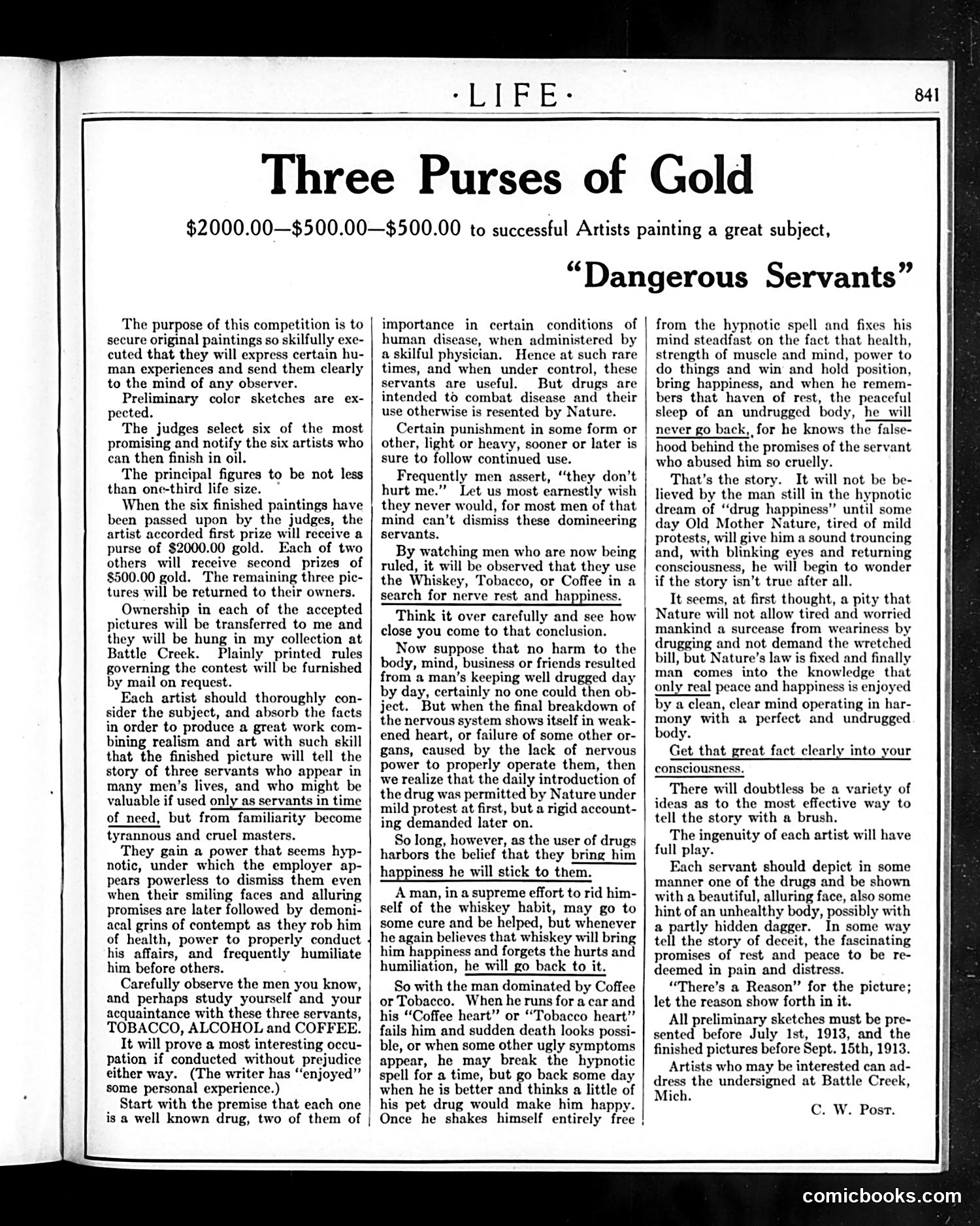
This page announces a painting competition offering cash prizes ($2,000 and $500) to artists depicting "Dangerous Servants"—an allegorical treatment of **tobacco, alcohol, and coffee** as enslaving habits. The competition, sponsored by someone with a collection at Battle Creek (likely J.H. Kellogg, the cereal magnate and prominent temperance advocate), seeks realistic paintings showing how these substances appear initially helpful but become tyrannical masters controlling men's lives. The text uses dramatic language: these "servants" gain "hypnotic power," rob men of "health" and "power," and cause "humiliation." The author frames drug use as causing inevitable physical breakdown—weakened hearts, nervous system failure—despite users' belief in their benefits. This reflects early-1900s **Progressive Era health reformism**, when temperance movements portrayed addiction as a moral and medical crisis requiring artistic and social intervention. The competition itself functioned as propaganda for anti-drug messaging.
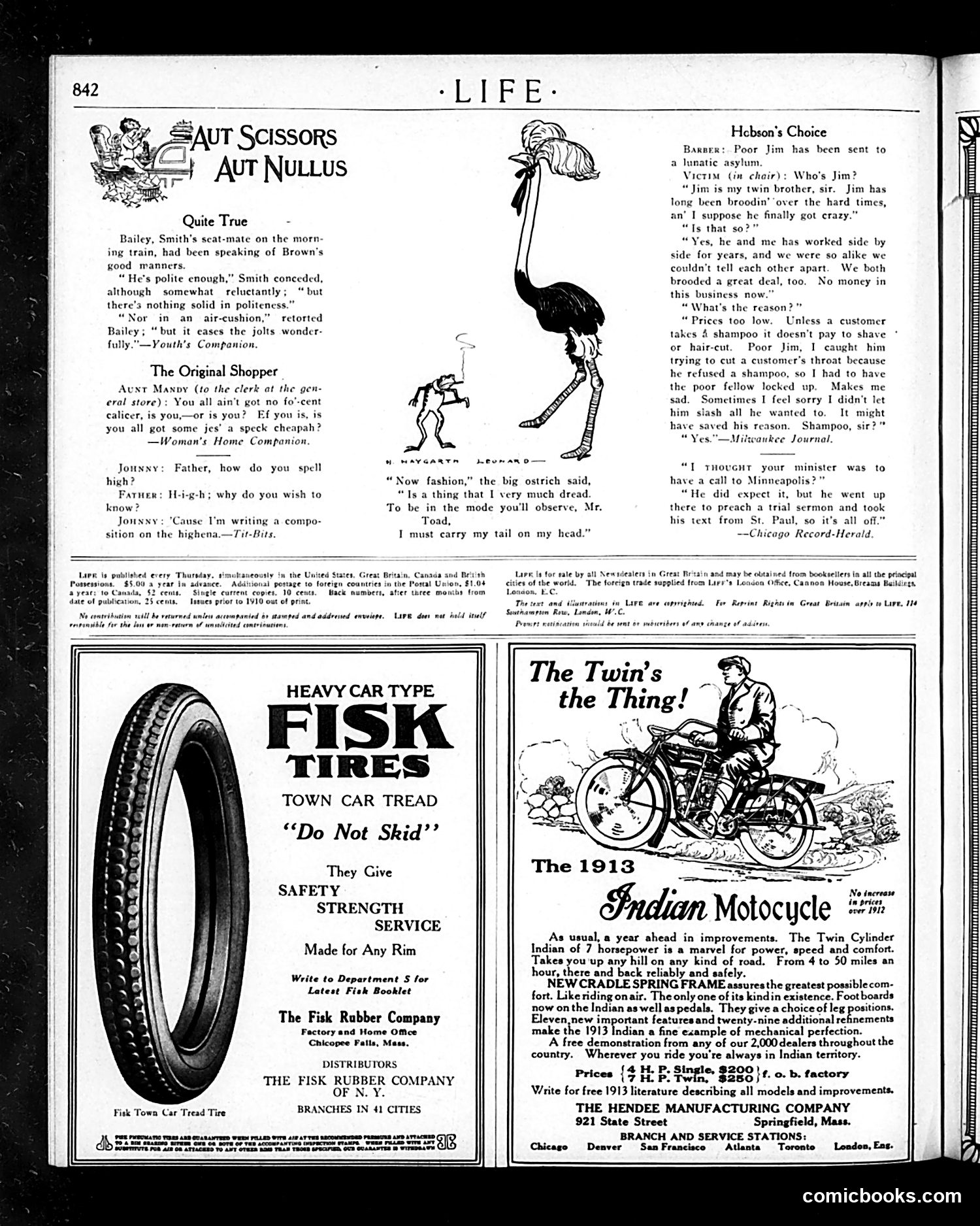
This page from *Life* magazine contains several short humorous anecdotes and advertisements typical of early 1910s American humor. **The cartoons/jokes** mock everyday social situations: a man defending politeness as having "nothing solid" in it; a frugal rural customer haggling over calico prices; a child misspelling "hyena" as "highena"; and an ostrich forced by fashion to carry its tail on its head rather than naturally. **"Hobson's Choice"** presents a darkly comic scenario where a barber's twin brother has gone insane from poverty and desperation—nearly attacking a customer who refused a shampoo. The barber's bitter joke suggests their economic hardship was so severe that madness seemed almost logical. **The remaining jokes** play on religious and regional humor: a minister's trial sermon text from St. Paul inadvertently ends his job opportunity. **The advertisements** promote Fisk Tires and Indian Motorcycles, representing early automotive/motorcycle marketing emphasizing safety and mechanical advancement—products for a modernizing America. Overall, the page reflects pre-WWI American humor: class-conscious, occasionally dark, and celebrating the new consumer economy.
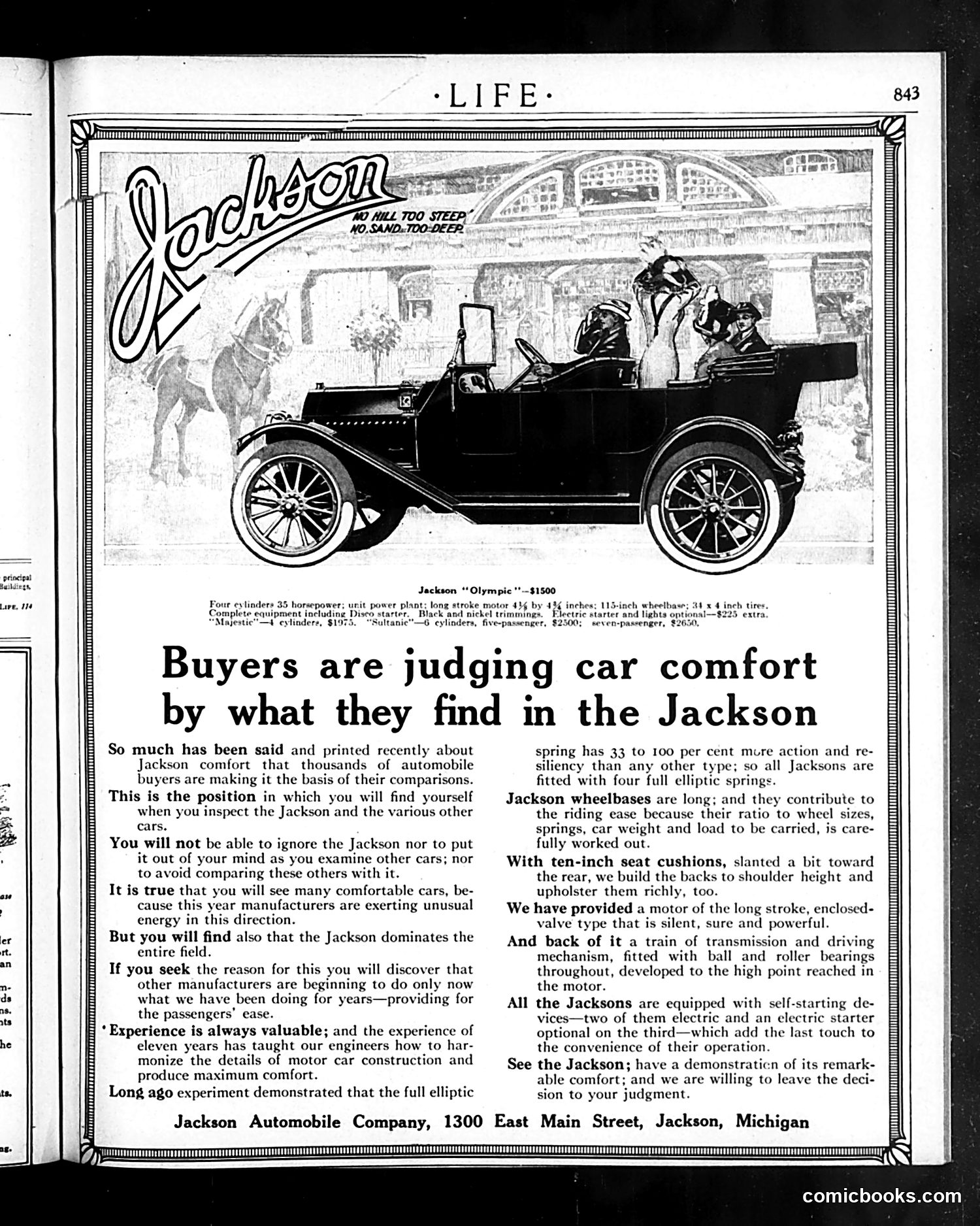
This page is **primarily automobile advertising**, not satire or political commentary. It's a Jackson Automobile Company advertisement from *Life* magazine (page 843). The image shows a Jackson "Olympic" touring car with well-dressed passengers. The ad's headline—"Buyers are judging car comfort by what they find in the Jackson"—makes a comparative sales claim: Jackson automobiles dominate the comfort market because competitors are only now adopting features Jackson has used for eleven years. The "cartoon" element is minimal; the illustration is a straightforward product image. The satirical tone, if present, is subtle marketing language positioning Jackson as the established comfort standard against newer competitors catching up. The technical details (elliptic springs, long wheelbase, motor specifications, electric starter) reflect early 1910s automobile features marketed as luxury innovations. The address (Jackson, Michigan) and pricing ($1500) date this advertisement to the pre-WWI automobile boom era. No political figures or references are apparent.
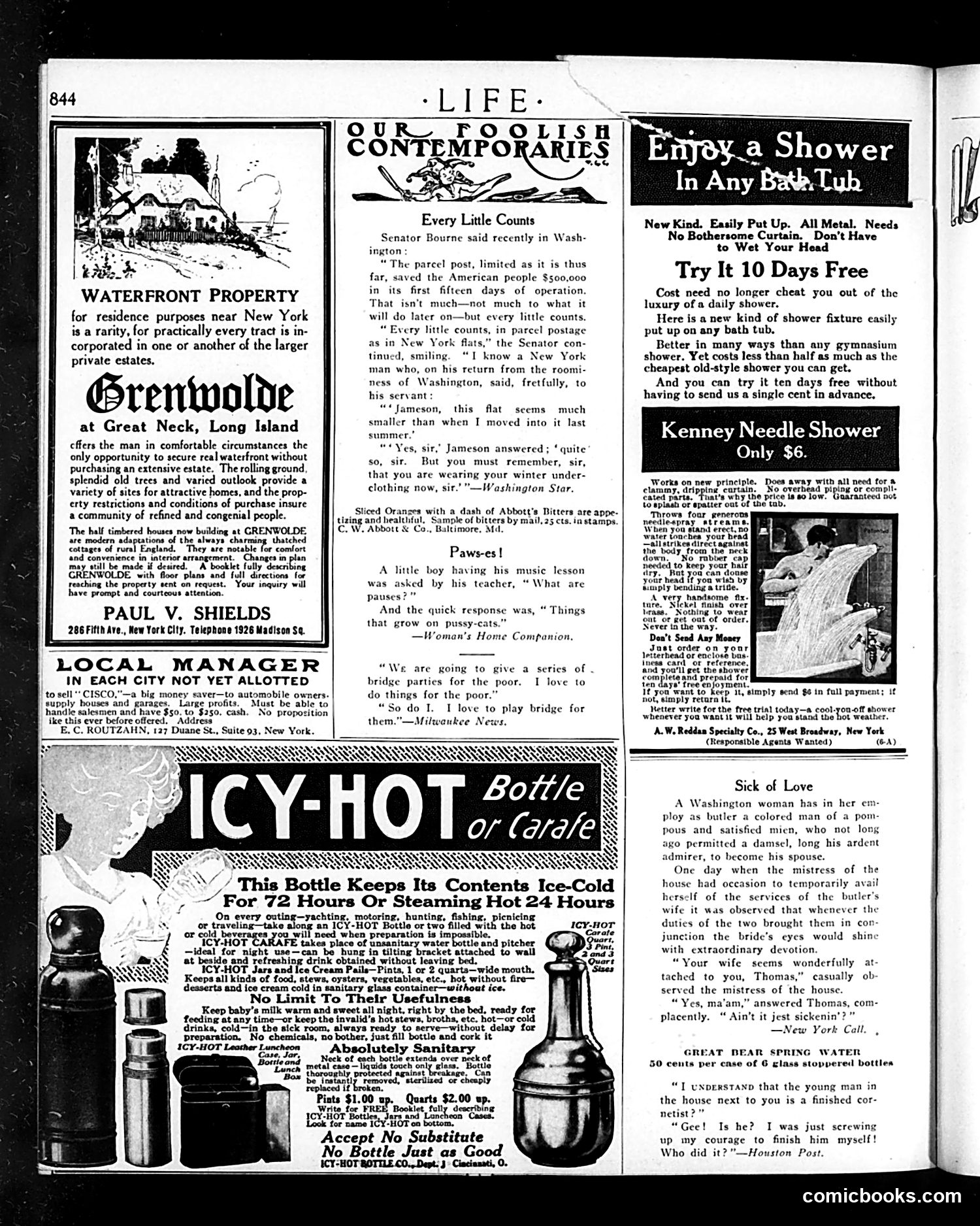
This page is primarily **advertisements and humor fillers** typical of *Life* magazine's satirical format. The main satirical content appears in the **"Our Foolish Contemporaries"** section, featuring three brief anecdotes mocking social pretension: 1. **Senator Bourne's parcel post comment**: Satirizes politicians' self-congratulation over minor achievements ("every little counts"). 2. **The apartment anecdote**: Mocks wealthy New Yorkers' complaints about modest living spaces—a servant notes the flat seems smaller because the owner now wears winter clothes year-round, exposing the absurdity of their complaint. 3. **The music lesson joke**: A child innocently defines "pauses" as "things that grow on pussy-cats," creating wordplay humor. 4. **Bridge party irony**: Two wealthy women claim to "love doing things for the poor" while discussing exclusive bridge parties, satirizing performative charity. The remainder consists of real product advertisements (shower fixtures, real estate, bottles), which were standard *Life* revenue sources. The "Sick of Love" anecdote below similarly mocks social hypocrisy regarding racial boundaries and servant relationships.
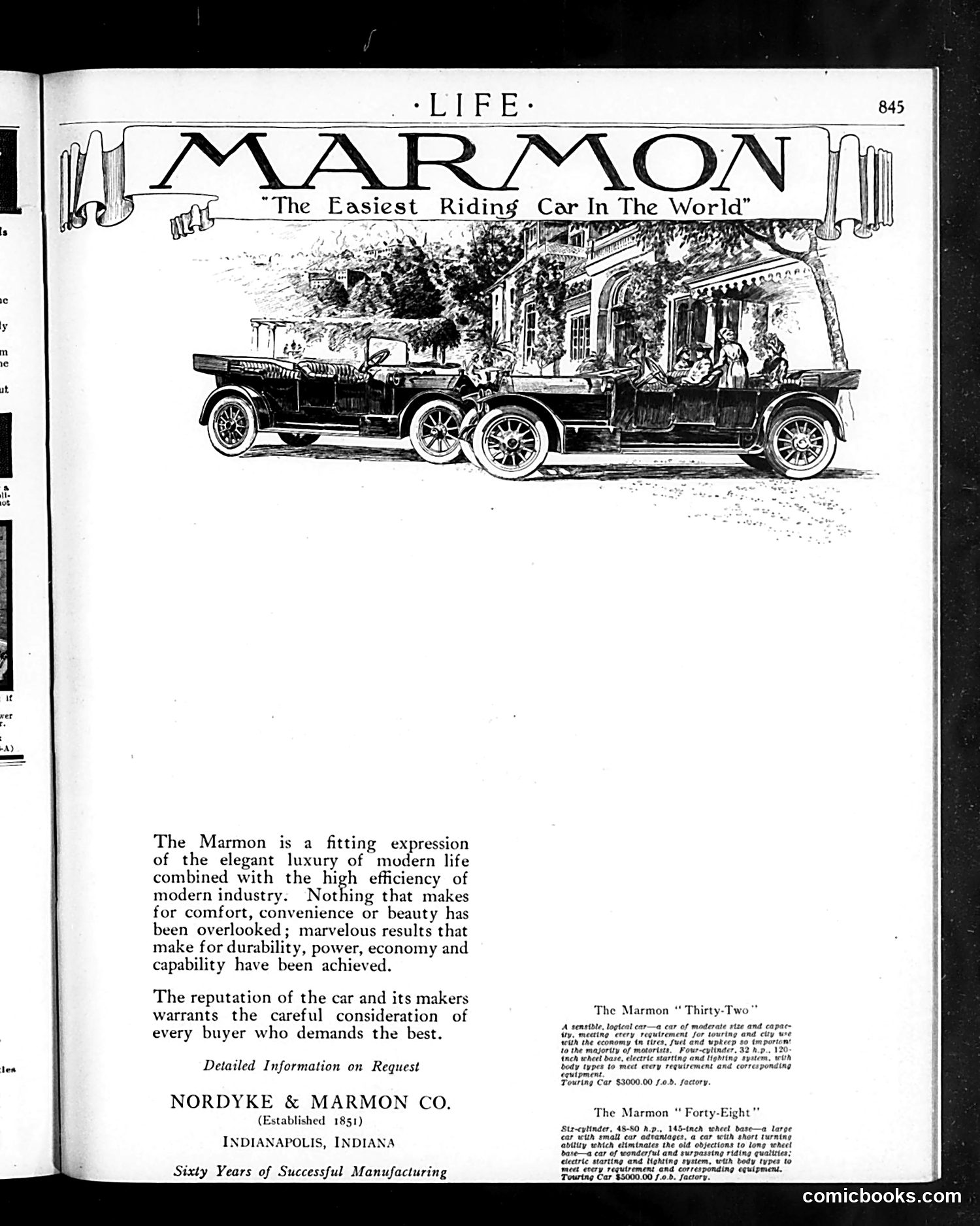
This is **not a cartoon or satire**—it's a straightforward automobile advertisement for the Marmon car, appearing in Life magazine (page 845). The page features an illustration of an elegant early-automobile with well-dressed passengers in front of a mansion, depicting luxury motoring. Below are two product descriptions for Marmon models: the "Thirty-Two" (moderate-priced touring car) and the "Forty-Eight" (larger luxury vehicle). The ad is from Nordyke & Marmon Co., an Indianapolis manufacturer established 1851. The marketing emphasizes comfort, efficiency, durability, and economy—standard early-20th-century automobile advertising appeals. The phrase "The Easiest Riding Car in The World" is the brand's slogan. **Context for modern readers:** This represents the era when automobiles transitioned from luxury novelties to aspirational consumer goods, and when Life magazine (founded 1883) contained substantial advertising alongside its satirical editorial content.
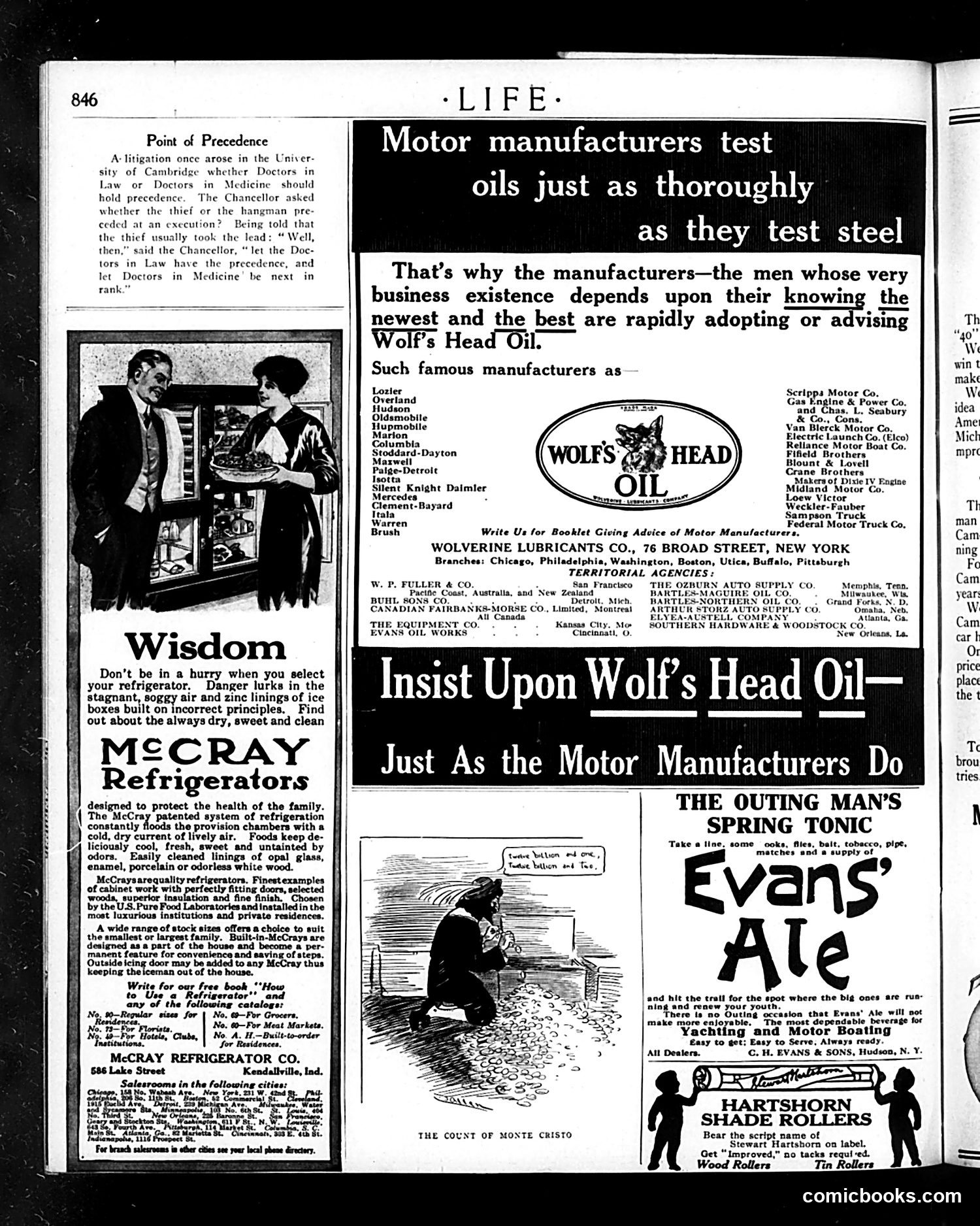
This page is primarily **advertising**, not satire or political commentary. The main content promotes **Wolf's Head Oil** motor lubricant, claiming manufacturers test it as rigorously as they test steel. A list of famous automobile companies (Overland, Hudson, Oldsmobile, etc.) endorses the product—a common early advertising tactic using brand testimonials. The small cartoon at top left titled "Point of Precedence" is a historical anecdote: a Cambridge University debate about whether doctors of law or medicine should precede at executions. The Chancellor joked that since thieves (executed criminals) came before hangmen, lawyers should rank above doctors. This is humor based on wordplay and academic hierarchy—not contemporary satire. The page also advertises **McCray Refrigerators** (emphasizing food safety through quality design) and **Evans' Ale** (marketed as an "outing" tonic for sportsmen). These represent typical early 20th-century product advertising emphasizing health, quality, and lifestyle appeal to middle-class readers.
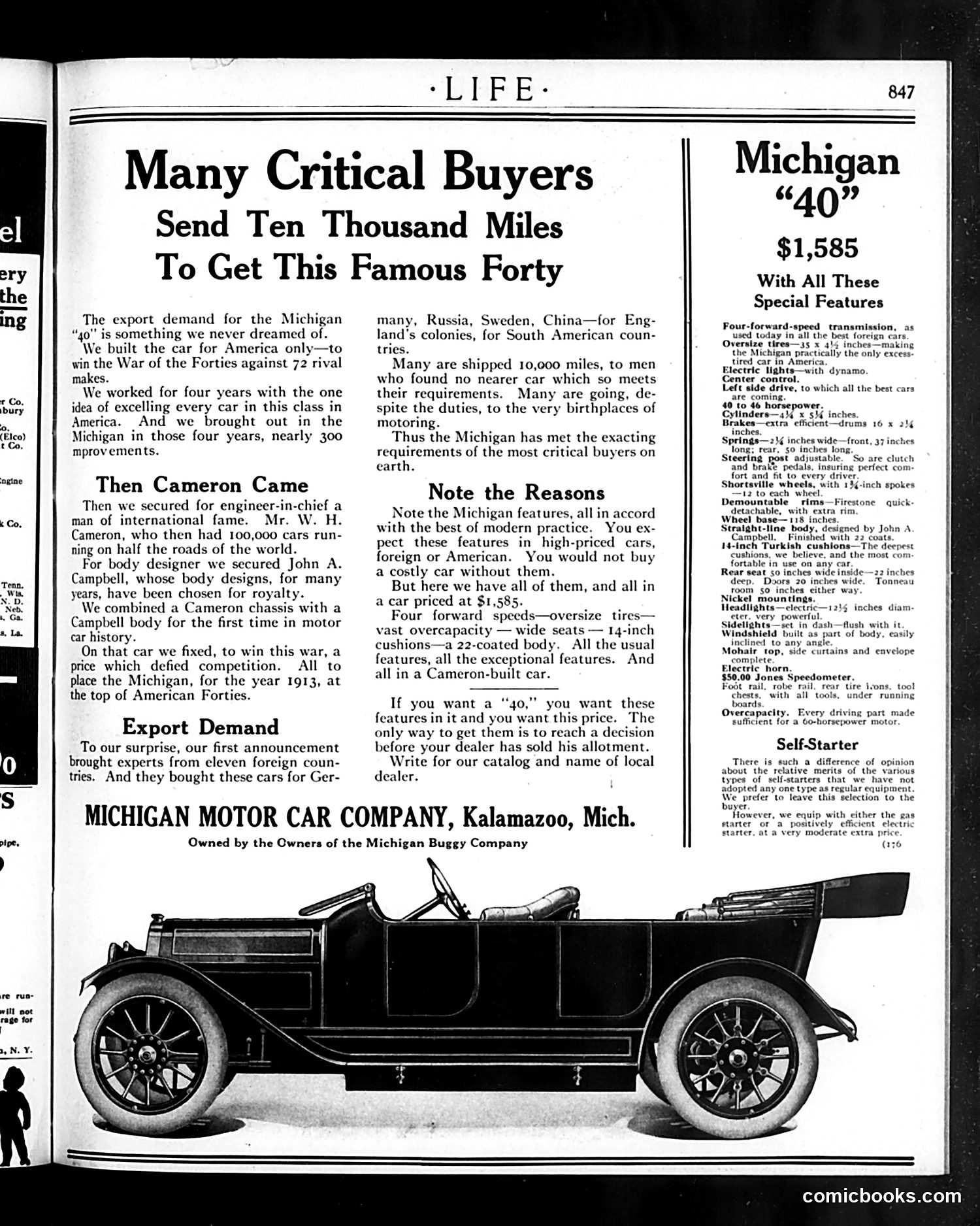
This is **not a cartoon but a full-page advertisement** for the Michigan "40" automobile, priced at $1,585 (circa 1913). The ad uses narrative marketing: it claims engineers secured famous designer W.H. Cameron and body designer John A. Campbell to create a car combining luxury features ("high-priced cars, foreign or American") at an affordable price. The pitch emphasizes unexpected export demand—buyers from Germany, Russia, Sweden, and China allegedly travel 10,000 miles to purchase it, validating the car's quality. The "War of the Forties" references competition among forty-horsepower automobiles; the Michigan claims superiority through innovations like electric lights, demountable rims, and a self-starter. The side-panel lists exhaustive technical specifications to convey engineering sophistication and value-for-money. The image shows a simple line drawing of the open-air vehicle. This reflects pre-WWI American optimism about manufacturing and the emerging automobile industry's prestige.
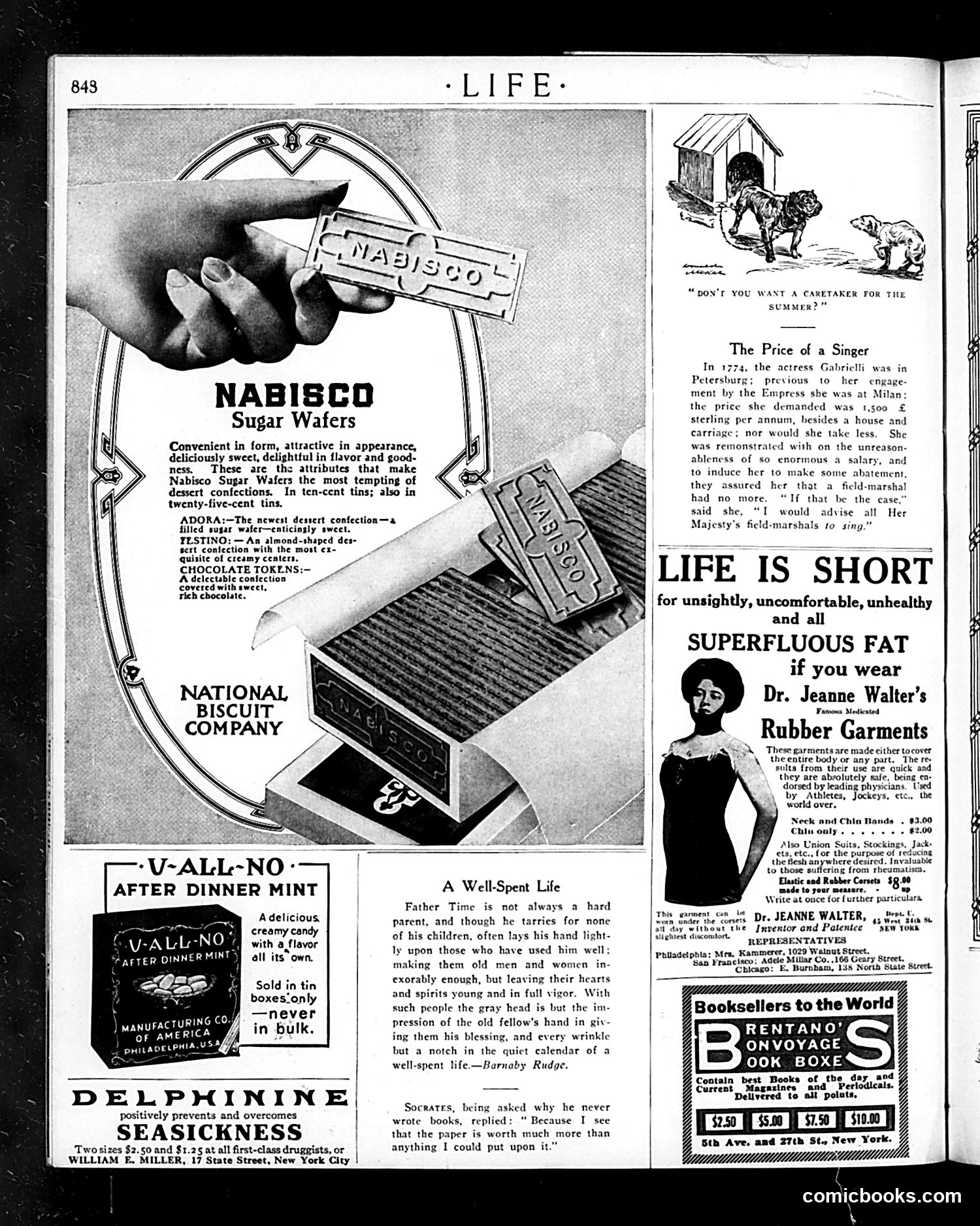
This page is primarily **advertising**, not political satire. It contains six product advertisements typical of early 20th-century magazines: **Notable ads include:** - **Nabisco Sugar Wafers** (prominent left): emphasizes convenience and variety of flavors - **Dr. Jeanne Walter's Rubber Garments** (right): medicated corsets and full-body garments marketed to reduce "superfluous fat"—reflecting period obsessions with figure control and pseudoscientific health remedies - **U-All-No After Dinner Mints** and **Delphinine** (seasickness remedy) - **Brentano's Book Boxes** (travel books) The only non-advertisement content is a small cartoon ("Don't You Want a Caretaker for the Summer?") showing a dog house, and two literary excerpts about life's value—one historical anecdote about actress Gabrielli's salary demands, another from Dickens. **For modern readers:** The rubber garment ad particularly stands out as absurd—it promises quick fat reduction through compression, endorsed by a "famous" doctor, representing an era of unregulated medical claims.
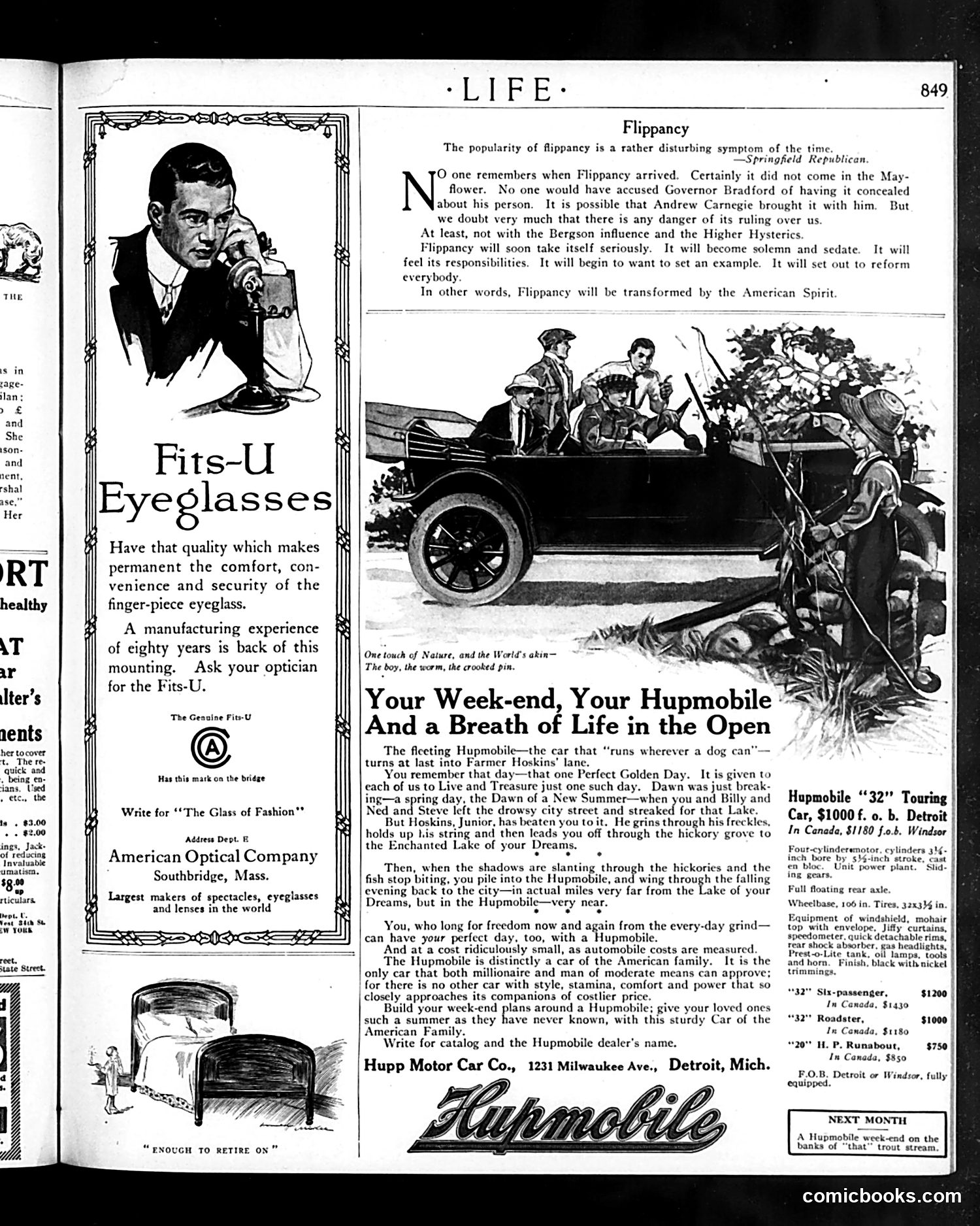
This page contains two distinct elements: **"Flippancy" Essay:** A brief satirical commentary on the trendy social behavior of flippancy (frivolous irreverence). The author argues that this recent American phenomenon—possibly imported by Andrew Carnegie—will eventually reform itself through American seriousness and responsibility. The piece gently mocks contemporary anxieties about youth culture and moral decline, suggesting that earnestness will naturally prevail. **Hupmobile Advertisement:** The dominant content is a lengthy car advertisement disguised as lifestyle journalism. It romanticizes weekend leisure, depicting the Hupmobile as the vehicle enabling escape to nature and authentic experience. The ad explicitly targets middle-class families by positioning the car as affordable yet stylish—accessible to both "millionaire and man of moderate means." **Supporting Ads:** A Fits-U eyeglasses advertisement appears on the left, using similar aspirational messaging about quality and comfort. The page reflects early 20th-century consumer culture, where advertising increasingly merged with editorial content to create persuasive lifestyle narratives rather than straightforward product promotion.
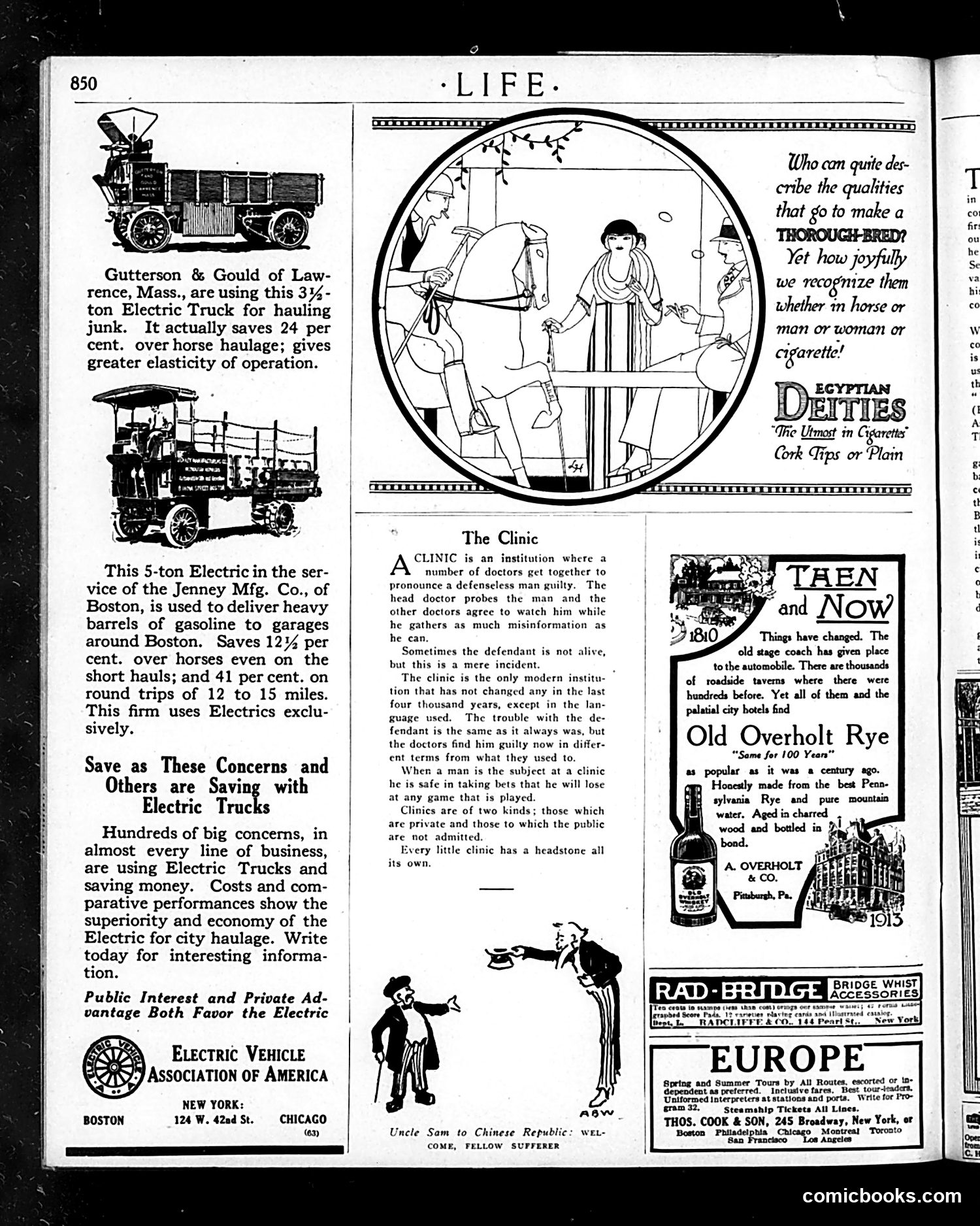
This page mixes advocacy advertising with satirical content typical of Life magazine's editorial voice. **The "Clinic" Satire:** A biting critique of medical diagnostic clinics, where multiple doctors collectively declare a patient guilty of illness. The satire suggests clinics produce "misinformation" rather than genuine diagnosis—doctors use modern terminology to pronounce the same verdicts they always have. The darkly comic final line ("Every little clinic has a headstone all its own") implies clinics are death sentences. This reflects early 20th-century skepticism toward medical bureaucracy. **The Advertisements:** The bulk of the page promotes electric trucks (Electric Vehicle Association of America), cigarettes (Egyptian Deities brand), whiskey (Old Overholt Rye), and travel services. These ads assume a prosperous readership. **"Uncle Sam to Chinese Republic":** The small cartoon at bottom appears to reference U.S.-China relations, though context is unclear without fuller caption visibility. The page exemplifies Life's mix of sharp social commentary alongside commercial sponsorship.
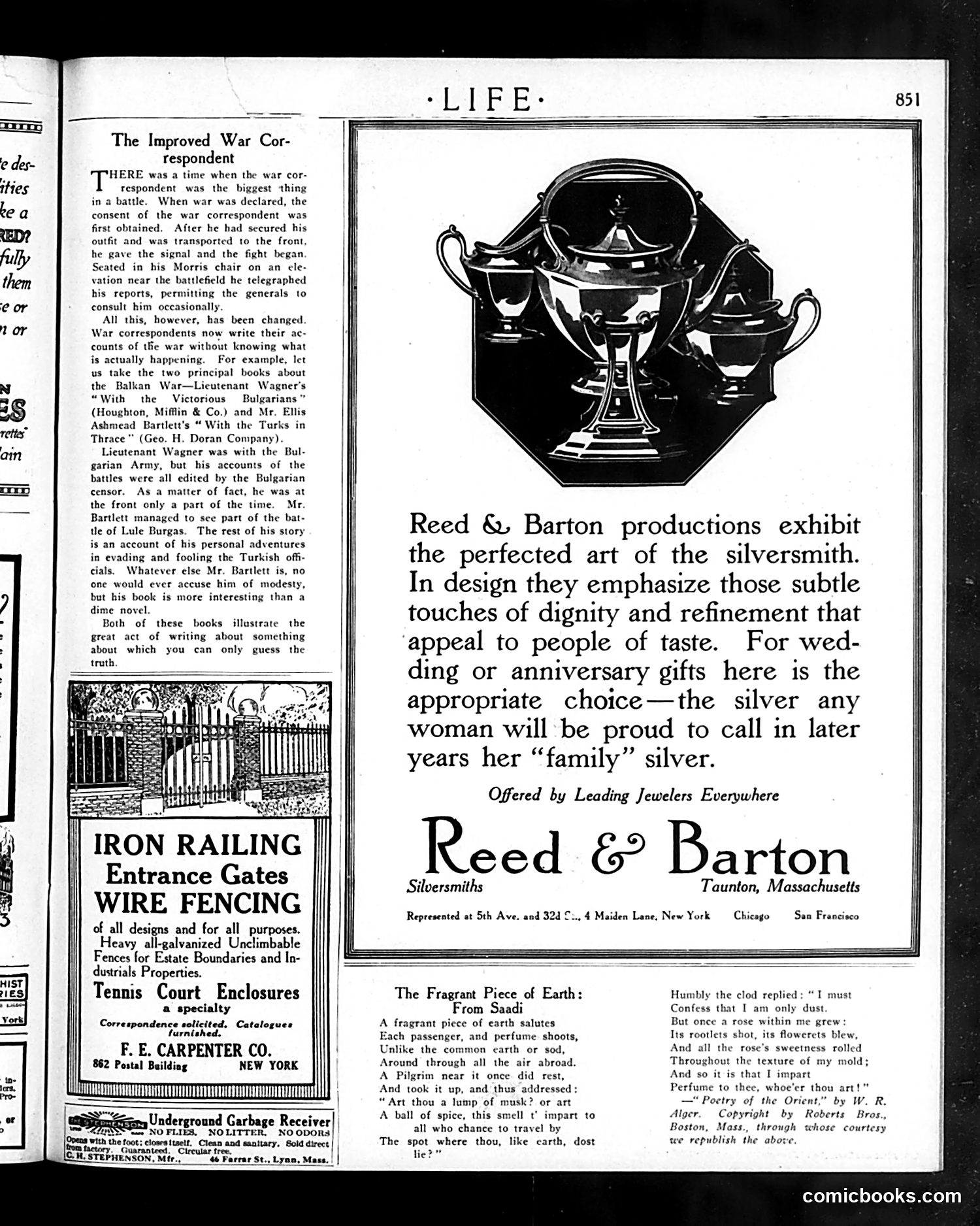
This satirical article mocks how World War I correspondents report battles they don't actually witness. The piece contrasts the romantic notion of war correspondents as battlefield observers with the reality: they now write accounts while censored, absent from fighting, or relying on personal anecdotes rather than facts. The examples given—Lieutenant Wagner (whose Bulgarian Army accounts were edited by censors and he was rarely present) and Ashmead Bartlett (who saw only one battle but padded his book with self-aggrandizing adventure stories)—illustrate how these writers fabricate narratives about wars they barely understand. The satire's point: modern war correspondents are unreliable storytellers inventing dramatic tales from ignorance, yet their books still sell better than reality would. The final line cynically notes readers can "only guess the truth"—because the correspondents certainly aren't providing it.
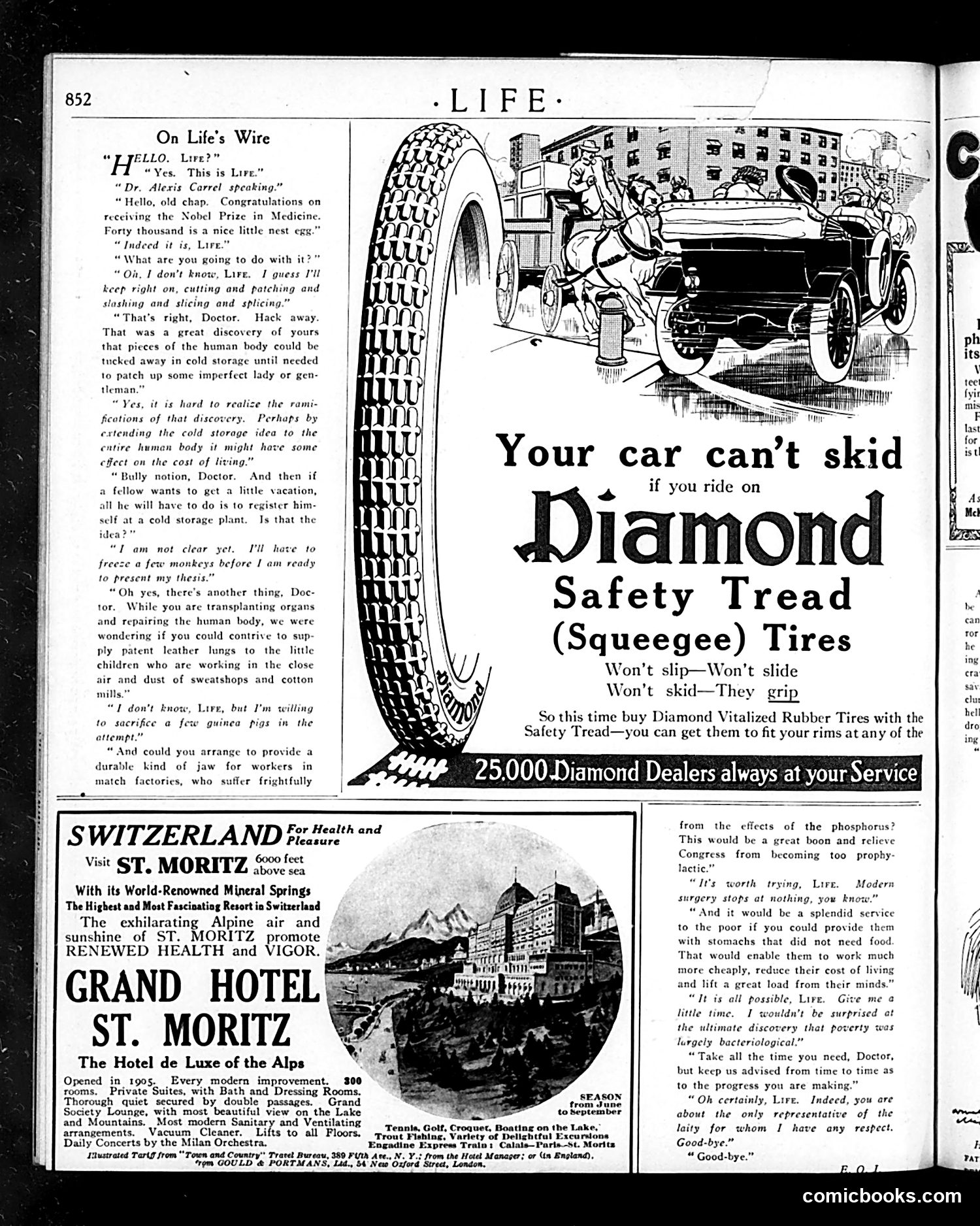
This comic dialogue mocks Dr. Alexis Carrel, a real French surgeon who won the Nobel Prize in Medicine for his work on organ transplantation and tissue preservation. The satire imagines a phone conversation between "Lire" (Life magazine's persona) and Carrel. The joke targets the implications of Carrel's discoveries: the cartoon exaggerates them absurdly—freezing workers for "vacations," creating artificial organs for sweatshop children, and eliminating poverty through biological engineering. By having "Lire" propose increasingly outlandish applications (synthetic lungs for child laborers, stomachless workers), the cartoon critiques both scientific utopianism and capitalist exploitation. The punchline—that poverty might be "largely bacteriological"—exposes how easily scientific rhetoric masks unwillingness to address actual social injustice. The page also contains period advertisements (Diamond tires, Swiss hotels), typical of Life magazine's format.
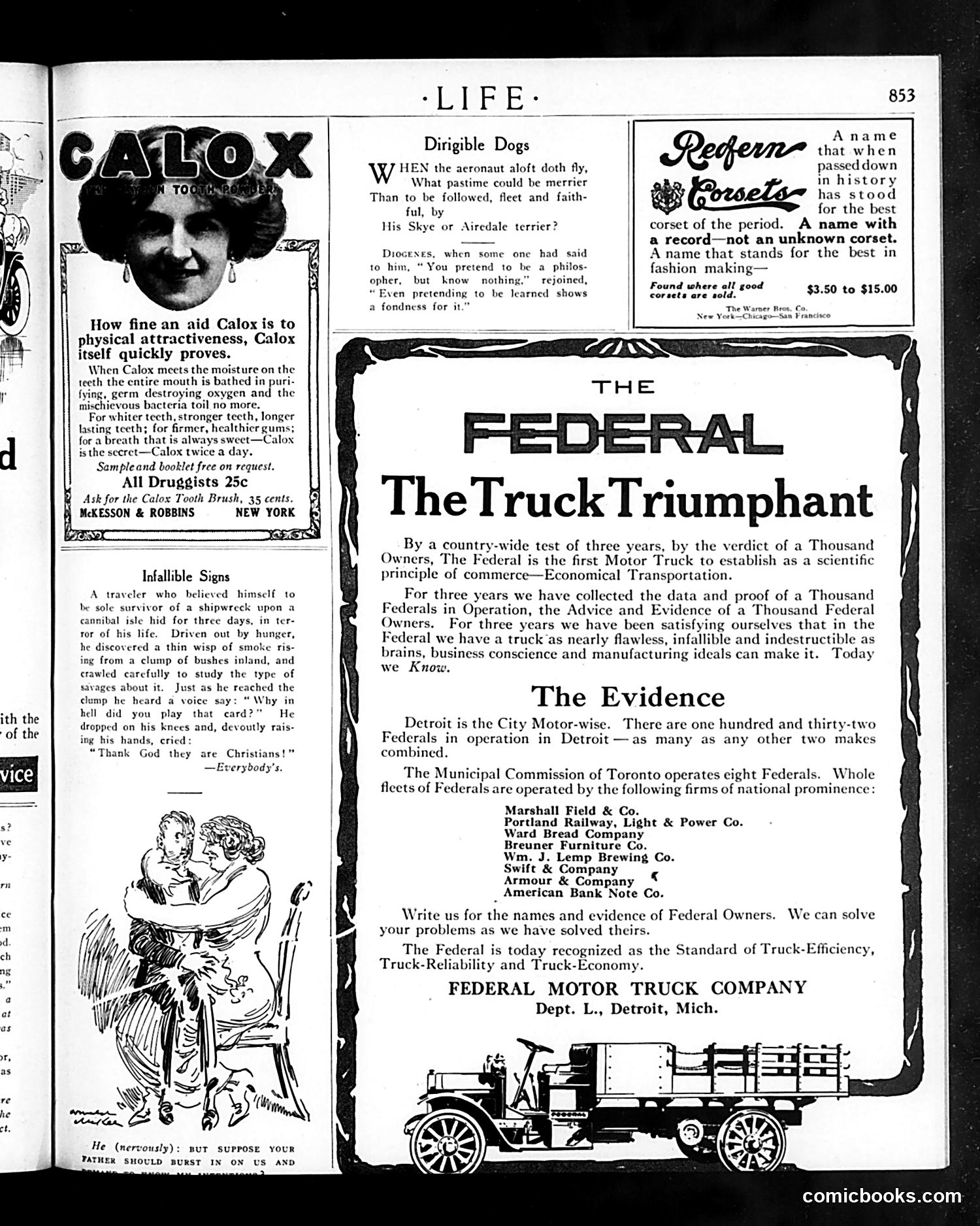
This page is primarily **advertising**, not political satire. It contains: 1. **Calox toothpaste ad** (left): Standard product advertisement emphasizing hygiene benefits. 2. **"Infallible Signs" anecdote** (left): A humorous short story about a shipwreck survivor who fears cannibals until hearing people arguing about card games—the joke being that this mundane quarreling "proves" they're civilized Christians. It's gentle social satire mocking human nature rather than political commentary. 3. **"Dirigible Dogs" poem** (center): Whimsical verse about terriers following aircraft—likely referencing the novelty of early aviation. 4. **Federal Motor Truck advertisement** (right, large): B2B marketing emphasizing the Federal truck's reliability through testimonials from major companies (Armour, Swift, Marshall Field). This represents early automotive industry competition and corporate advertising. The page reflects 1920s commercial culture: consumer product marketing, light humor, and industrial advertising demonstrating American manufacturing confidence.
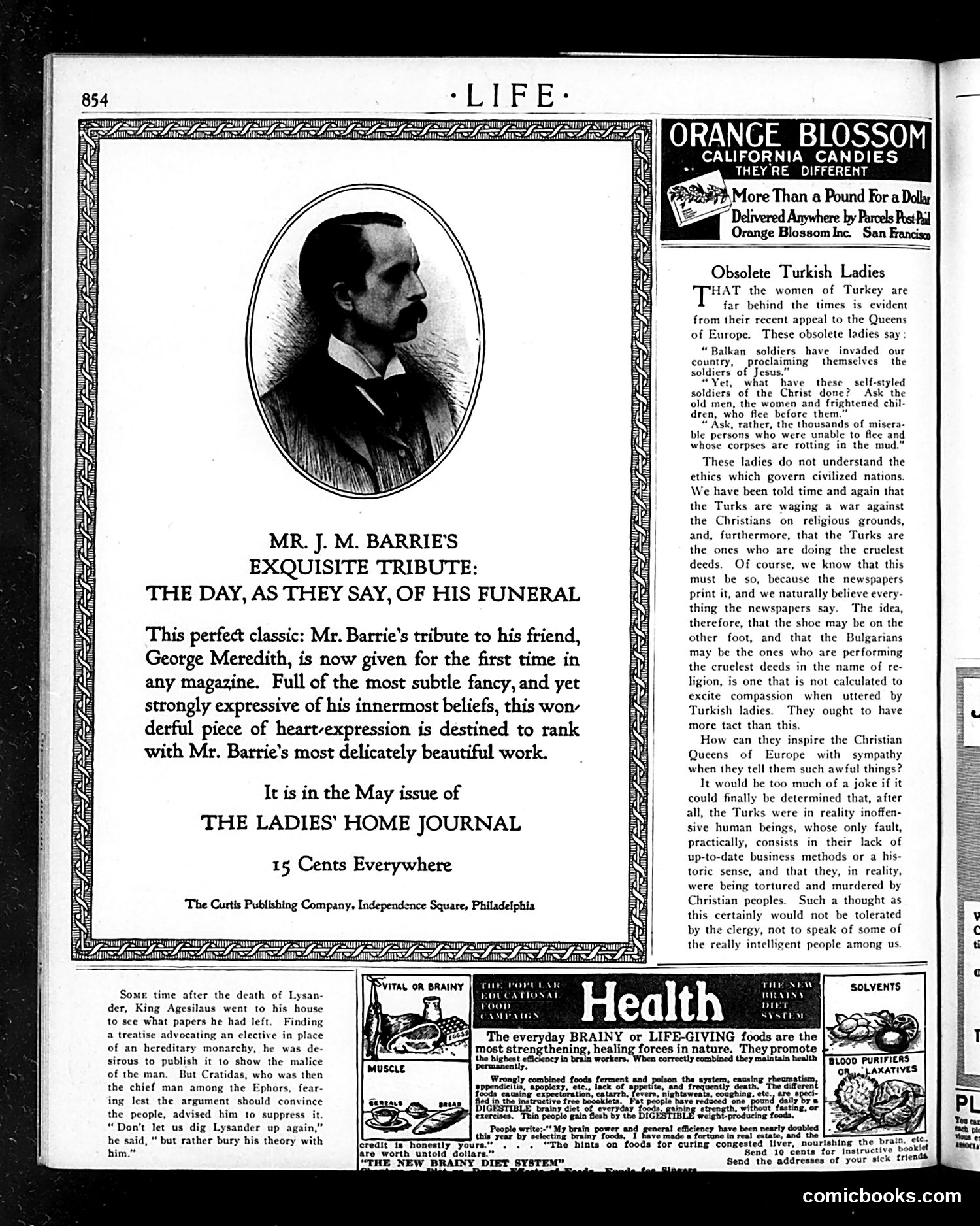
This page primarily contains **advertisements and editorial content** rather than political satire. The main feature announces J.M. Barrie's tribute to deceased writer George Meredith, published in *The Ladies' Home Journal*. The satirical content appears in the **"Obsolete Turkish Ladies"** article (right column). This piece mocks Turkish women who appealed to European queens regarding Balkan soldiers' violence, claiming those soldiers act "in the name of Jesus." Life's editors sarcastically defend the newspapers' anti-Turkish stance while suggesting—through heavy irony—that perhaps Turkish accounts of Christian atrocities might actually be true. The satire attacks Western bias: readers automatically believe anti-Turkish propaganda while finding it absurd that Turkish women would dare suggest Christian peoples committed equal cruelties. The piece appears to reference the **Balkan Wars** (early 1910s), when European media heavily favored Christian Balkan nations over Ottoman Turkey. The page also includes typical period advertisements (Orange Blossom candies, health products) and an unrelated anecdote about ancient Sparta.
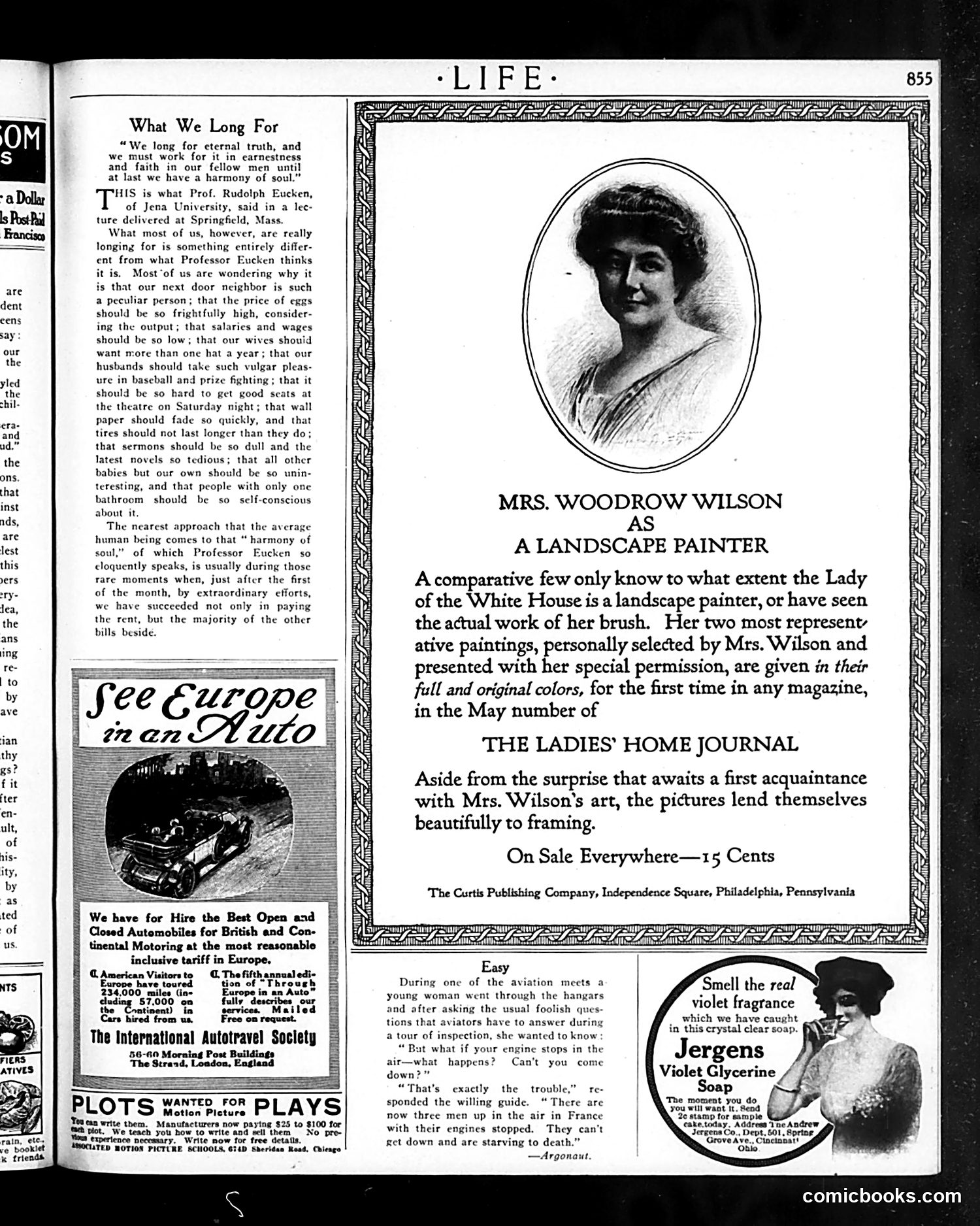
This page combines satirical commentary with advertisements and society content. **"What We Long For"** is satirical social commentary contrasting philosopher Rudolph Eucken's idealistic talk of "harmony of soul" with ordinary Americans' mundane complaints: expensive eggs, low wages, wives wanting multiple hats, dull sermons, and the struggle to pay rent. The joke critiques the gap between high-minded philosophy and working-class reality—most people aren't seeking spiritual truth but relief from everyday frustrations. **Mrs. Woodrow Wilson as Landscape Painter** is a society feature promoting her artwork in *The Ladies' Home Journal*, highlighting the First Lady's artistic pursuits. **"Easy"** is a brief humorous anecdote about a woman touring an aviation meet who asks a pilot what happens if engines stop mid-flight. The guide jokes that three French pilots currently aloft have stopped engines and are "starving to death"—dark humor about aviation's dangers. The page is primarily advertising and lifestyle content typical of this era's *Life* magazine, mixed with gentle social satire.
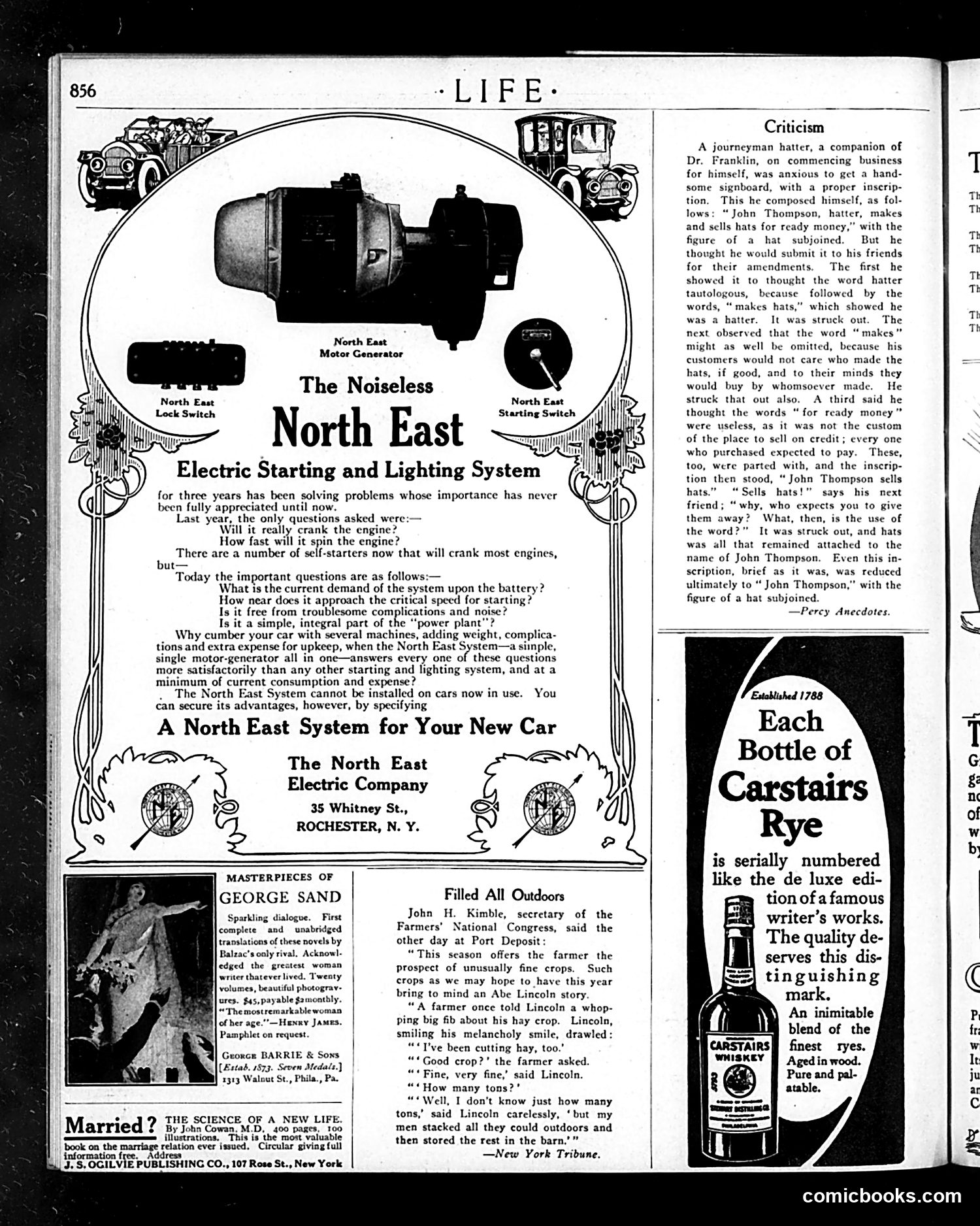
This page is primarily **advertising and filler content**, not political satire. The main feature is a North East Electric Company advertisement for automobile electric starting and lighting systems—a new automotive technology. The ad emphasizes practical advantages: battery demand, starting speed, noise reduction, and simplicity compared to competing multi-part systems. The "Criticism" section is an **anecdote** (attributed to "Percy Anecdotes," a popular 19th-century collection) about a hatmaker named John Thompson who repeatedly edits his signboard based on friends' feedback, removing words until only his name and a hat image remain. The joke illustrates how excessive criticism and nitpicking can reduce something to absurdity—a light moral tale about the dangers of over-editing. The page also includes advertisements for Carstairs Rye whiskey and a book on marriage by Dr. John Cowan. No political figures or contemporary satire appear on this page.
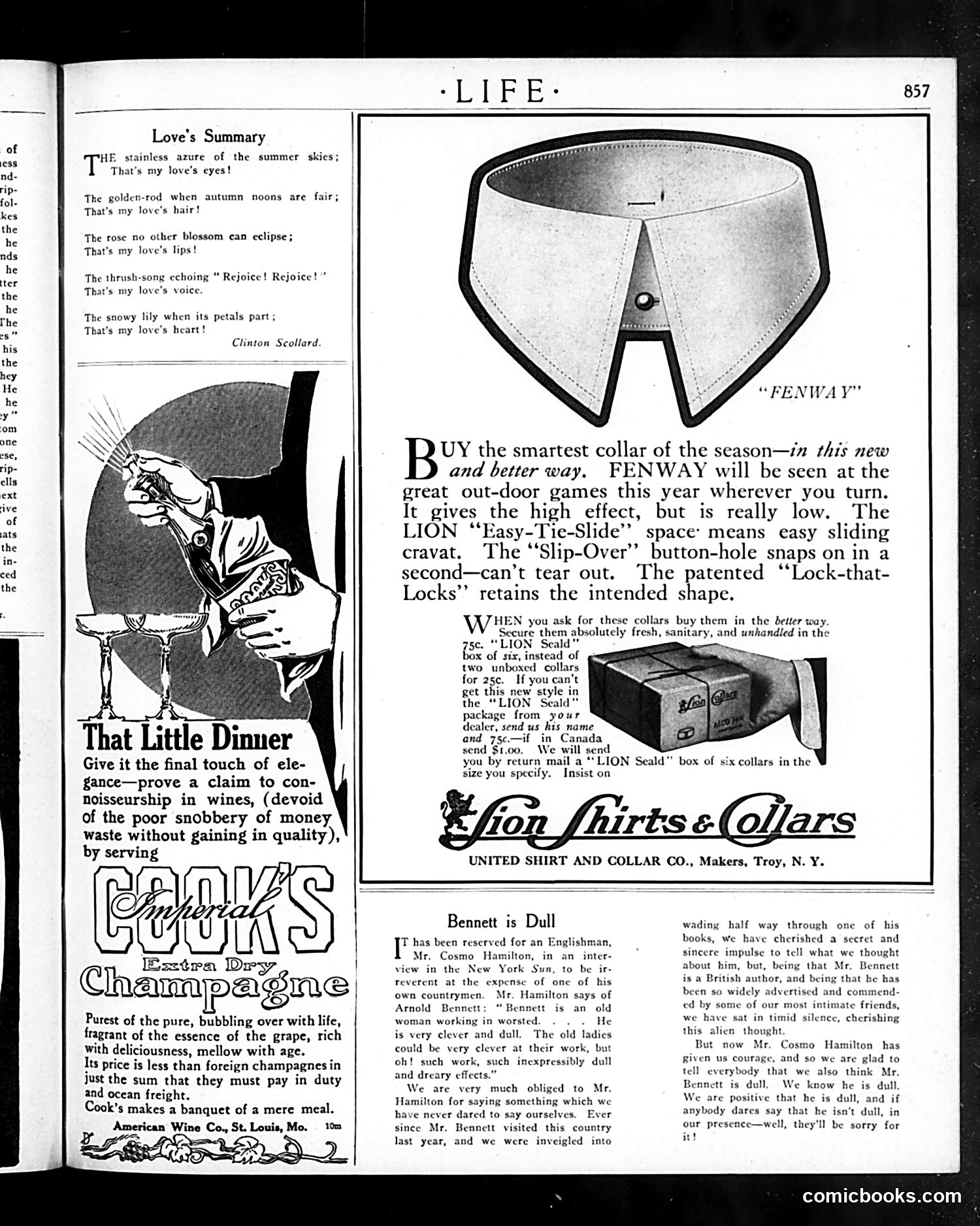
This page contains three distinct pieces of content: **"Love's Summary"** is a romantic poem by Clinton Scollard using nature imagery to describe a beloved—eyes like summer skies, hair like autumn goldenrod, etc. It's straightforward sentimental verse typical of the era. **The Fenway Collar Advertisement** promotes the "Lion Shirts & Collars" brand, emphasizing a new detachable collar design with an "Easy-Tie-Slide" feature and snap buttons. The ad targets men attending outdoor sporting events, positioning the collar as fashionable and practical. **"Bennett is Dull"** is a satirical piece mocking British author Arnold Bennett. Using British critic Cosmo Hamilton's dismissive remarks as cover, the editors gleefully join in criticizing Bennett as tedious and uninspired, despite his being widely promoted by American friends. The satire lies in the magazine finally feeling "permitted" to voice its own negative opinion once a respected British voice validated it first—poking fun at both Bennett's reputation and American deference to British cultural authority.
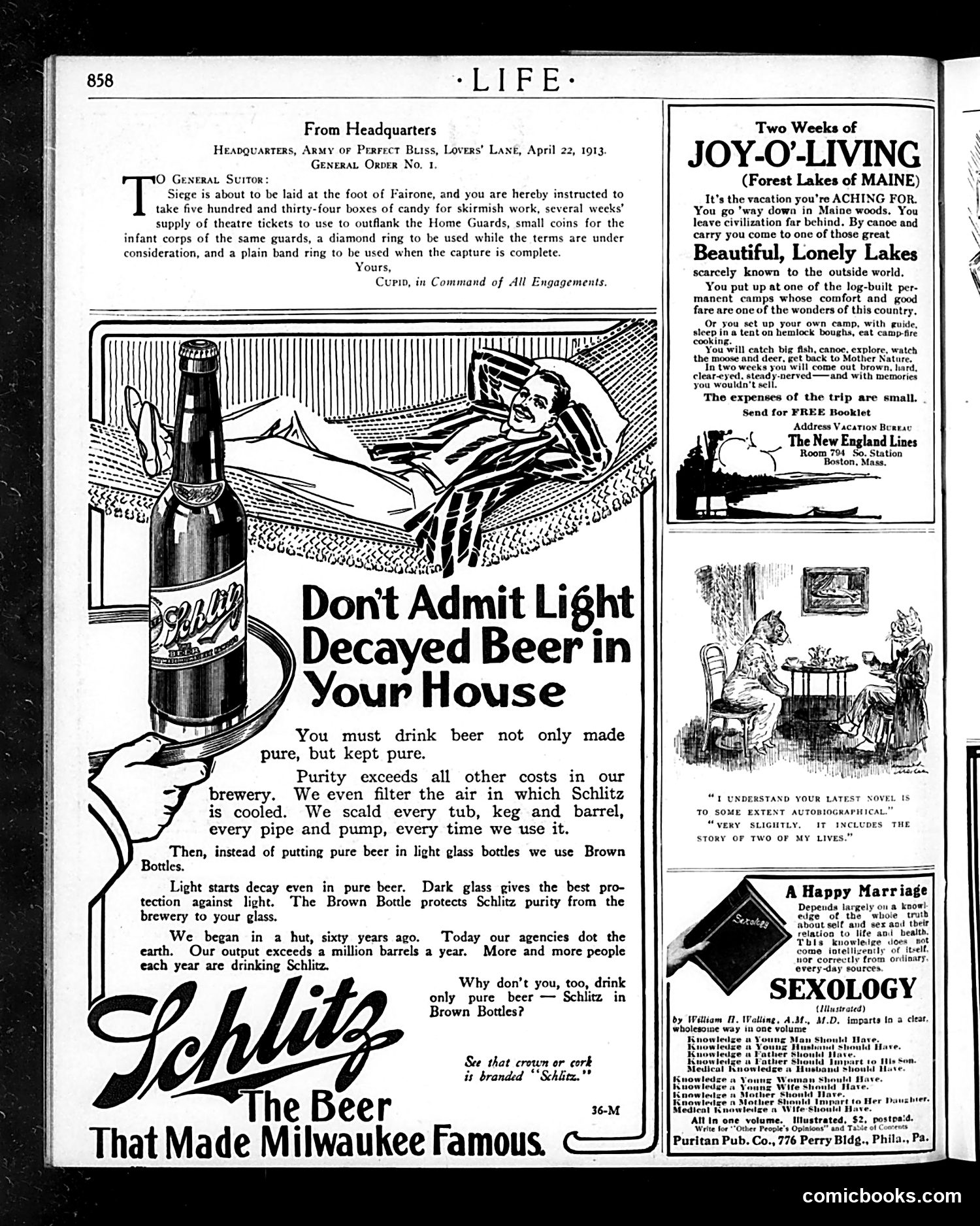
This page contains **two distinct satirical pieces**: **The "General Order" cartoon** (top left) mocks courtship rituals as military siege. Using mock-military language, it humorously presents romance as strategic conquest—the suitor must deploy "five hundred and thirty-four boxes of candy," theater tickets, and coins to overcome parental "Home Guards," culminating in engagement and wedding rings. This satirizes the formal, transactional nature of early 20th-century courtship and marriage negotiations. **The Schlitz beer advertisement** (center/bottom) represents typical contemporary advertising, emphasizing purity and protection from "light decay" through brown bottles—a legitimate technical concern for beer preservation, presented as a mark of quality and care. The remaining content consists of **straightforward advertisements**: a Maine vacation promotion and a marriage/sexuality advice book ("Sexology"), neither satirical. The page exemplifies how *Life* magazine mixed genuine satire with commercial advertising, using humor to comment on social conventions while monetizing the space.
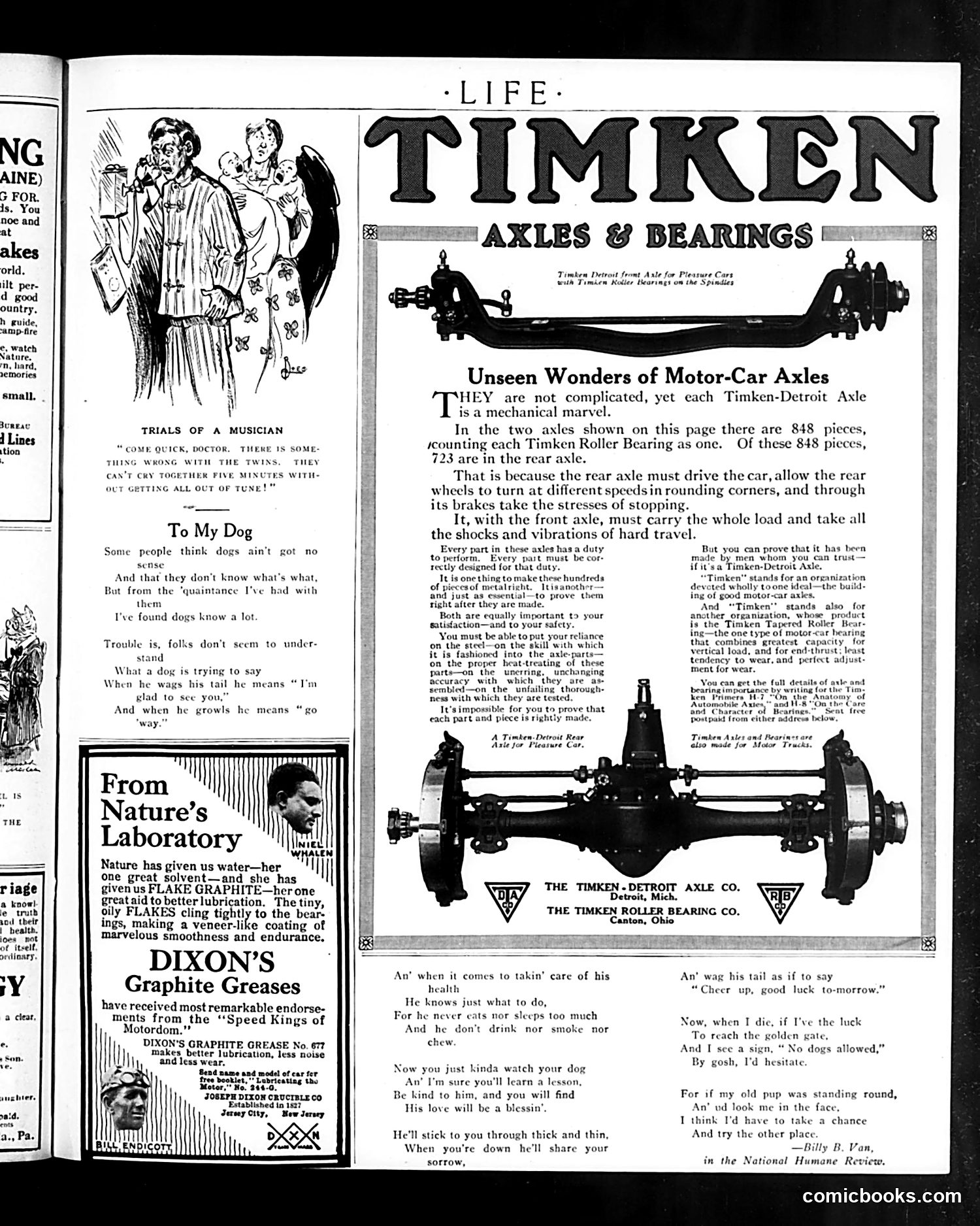
This page contains three distinct elements: **Left side:** Two pieces of light verse—"Trials of a Musician" (a joke about twins who cry out of tune) and "To My Dog" (sentimental poetry praising dogs' loyalty and wisdom). These are typical of Life's humorous filler content. **Center-right:** A large Timken axle advertisement disguised as educational content, explaining motor-car mechanics to readers. The piece uses technical detail and engineering credibility to market axle bearings. **Bottom left:** A Dixon's Graphite Grease advertisement claiming endorsements from "Speed Kings of Motordom." **Context for modern readers:** This represents early 20th-century Life magazine's mixed model—humor and light literature subsidized by prominent advertising. The Timken ad's earnest mechanical explanation reflects how manufacturers then positioned industrial products as marvels of modern engineering to appeal to readers fascinated by automotive technology.
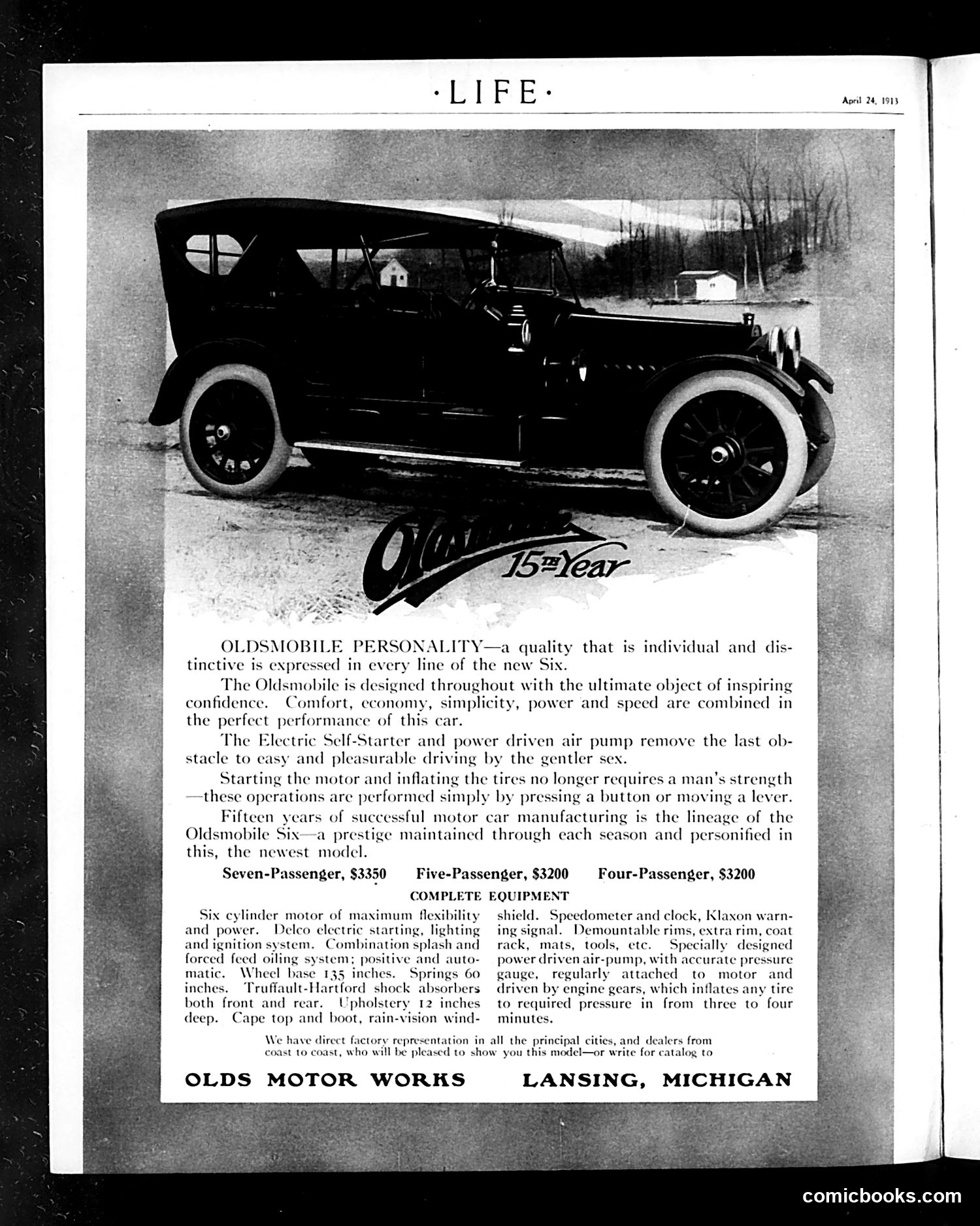
This is primarily a **car advertisement**, not satire or political commentary. However, it reveals period attitudes worth noting for modern readers. The ad explicitly markets the Oldsmobile Six to **women**, highlighting that the electric self-starter and power air pump eliminate tasks "no longer require[ing] a man's strength"—operations performed by "simply pressing a button or moving a lever." This targets "the gentler sex" as potential drivers. By 1913 standards, this was progressive marketing: automobiles were becoming accessible to women, challenging the notion that driving required masculine physical strength. The ad positions mechanical innovation as liberating, though the paternalistic language ("gentler sex") reflects prevailing gender attitudes. The pricing ($3,200–$3,350) indicates this was a luxury vehicle for affluent households, not mass-market transportation.