
Life, 1913-04-24 · page 18 of 48
Life — April 24, 1913 — page 18: what you’re looking at
What you’re looking at
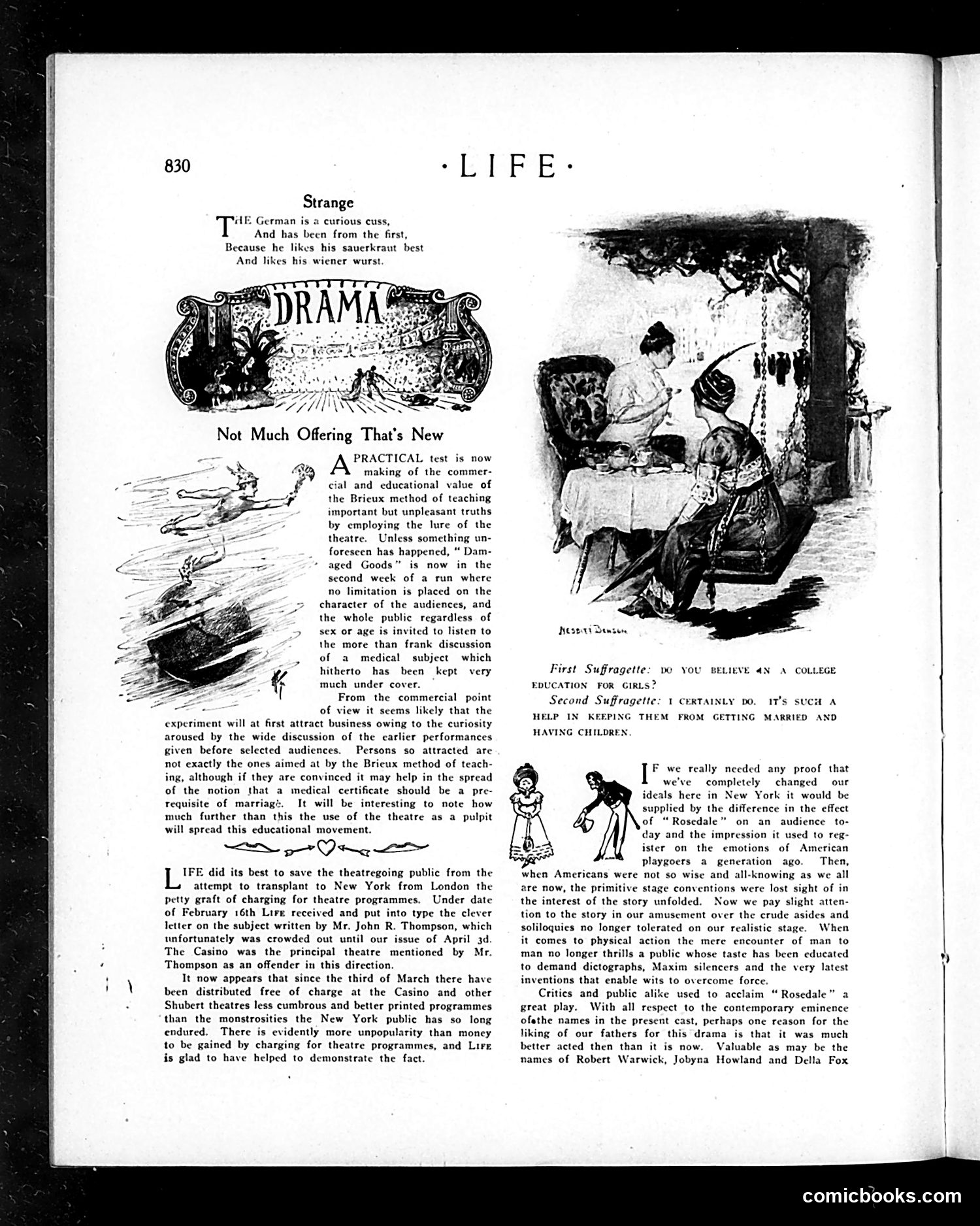
This page contains theater criticism and social satire typical of early 20th-century Life magazine. **The cartoons:** - A crude German stereotype with sauerkraut and wiener references—reflective of the casual ethnic humor common in the era - A suffragette joke where two women advocate college education as a way to prevent marriage and childbearing—mocking feminist arguments by suggesting educated women reject motherhood **The articles:** The main content discusses the "Brieux method"—using theater to educate audiences about serious social issues, particularly a play called "Damaged Goods" addressing venereal disease. Life questions whether this actually spreads understanding or merely attracts curiosity-seekers. A second piece celebrates Life's campaign against theater programs being sold, claiming victory when theaters began distributing them free. A third criticizes a revival of "Rosedale," arguing modern audiences have become too sophisticated and jaded—they sneer at old theatrical conventions rather than engaging emotionally with the story. The satire assumes readers' familiarity with current theater productions and debates about theatrical realism versus melodramatic convention.
📄 Transcribed text from this page (OCR, searchable)
Machine-transcribed from the original scan — historical spelling and the odd misread are preserved.
Strange ) Die German is a curious cuss, And has been from the first, Because he likes his sauerkraut best And likes his wiener wurst Fl SSeS Not Much Offering That's New PRACTICAL test is now making of the commer- cial and educational value of the Brieux method of teaching important but unpleasant truths by employing the lure of the theatre. Unless something un- forescen has happened, “ Dam- aged Goods” is now in the second week of a run where no limitation is placed on the character of the audiences, and the whole public regardless of sex or age is invited to listen to the more than frank discussion of a medical subject’ which hitherto has been kept very much under cover. From the commercial point of view it seems likely that the experiment will at first attract business owing to the curiosity aroused by the wide discussion of the carlier performances given before selected audiences. Persons so attracted are not exactly the ones aimed at by the Bricux method of teach- ing, although if they are convinced it may help in the spread of the notion that a medical certificate should be a pre- requisite of marriag:. It will be interesting to note how much further than this the use of the theatre as a pulpit will spread this educational movement. om. o—6 OH > IFE did its best to save the theatregoing public from the attempt to transplant to New York from London the petty graft of charging for theatre programmes, Under date of February 16th Lire received and put into type the clever letter on the subject written by Mr. John R. Thompson, which unfortunately was crowded out until our issue of April 3d. The Casino was the principal theatre mentioned by Mr. Thompson as an offender in this direction. It now appears that since the third of March there have been distributed free of charge at the Casino and other Shubert theatres less cumbrous and better printed programmes than the monstrosities the New York public has so long endured. There is evidently more unpopularity than money to be gained by charging for theatre programmes, and Lire is glad to have helped to demonstrate the fact. hese Dense First Suffragette: vo You BELIEVE 4N A COL! EDUCATION FOR GIRLS? Second Suffragette: 1 CERTAINLY po. 11's suUCH A HELP IN KEEPING THEM FROM GETTING MARRIED AND HAVING CHILDREN e really needed any proof that we've completely changed our ideals here in New York it would be supplied by the difference in the effect of “Rosedale” on an audience to- day and the impression it used to reg- ister on the emotions of American playgoers a generation ago. Then, when Americans were not so wise and all-knowing as we all are now, the primitive stage conventions were lost sight of in the interest of the story unfolded. Now we pay slight atten- tion to the story in our amusement over the crude asides and soliloquics no longer tolerated on our realistic stage. When it comes to physical action the mere encounter of man to man no longer thrills a public whose taste has been educated to demand dictographs, Maxim silencers and the very latest inventions that enable wits to overcome force. Critics and public alike used to acclaim “ Rosedale” a great play. With all respect to the contemporary eminence ofethe names in the present cast, perhaps one reason for the liking of our fathers for this drama is that it was much better acted then than it is now. Valuable as may be the names of Robert Warwick, Jobyna Howland and Della Fox comicbooks.com