
Life, 1913-04-24 · page 10 of 48
Life — April 24, 1913 — page 10: what you’re looking at
What you’re looking at
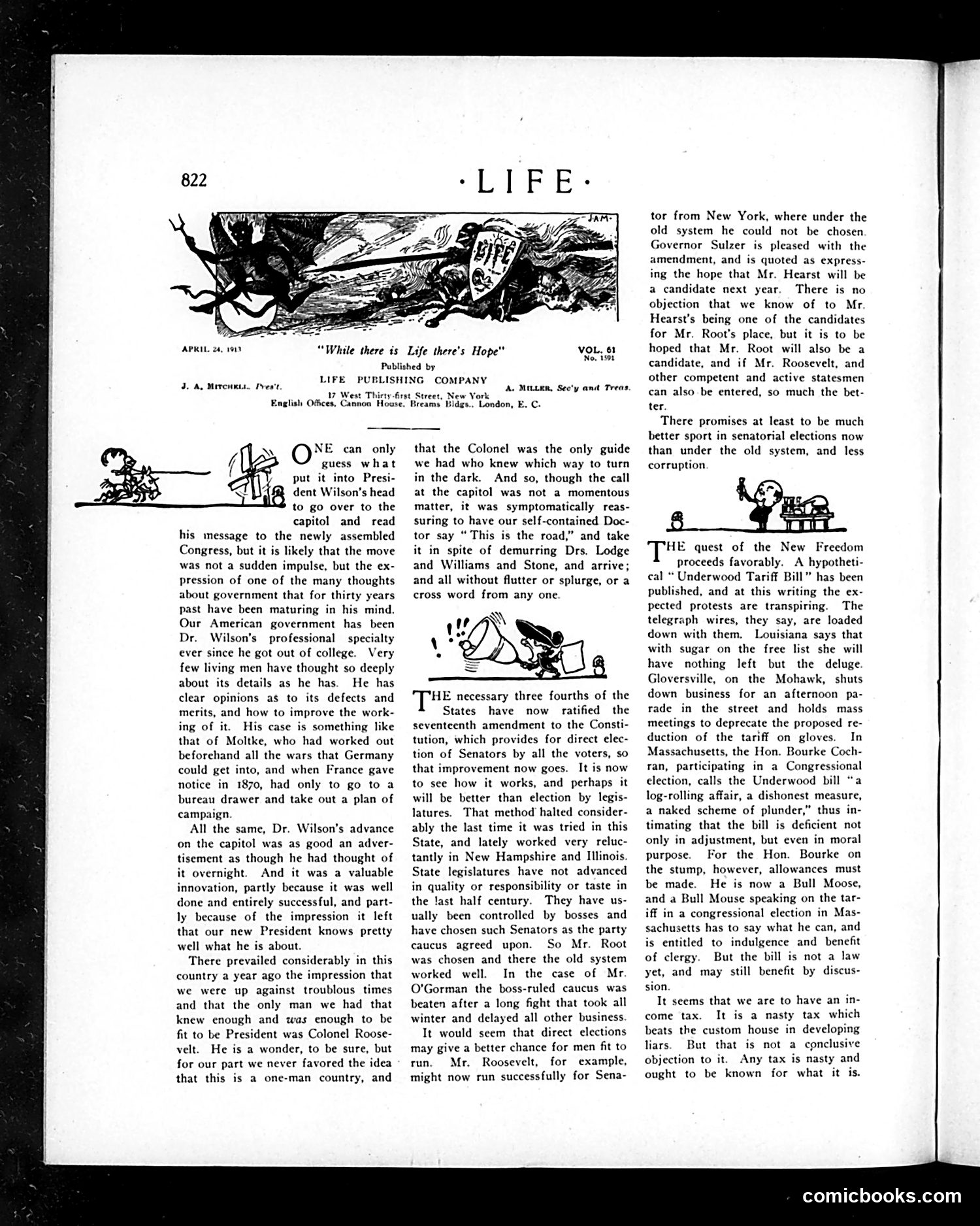
This page discusses President Wilson's approach to governance, comparing him favorably to Colonel Roosevelt. The text argues Wilson demonstrated wisdom by consulting Congress rather than acting unilaterally—contrasting with Roosevelt's more independent executive style. The main cartoon (top) depicts a figure in bed labeled "While there is Life here's Hope," referencing the ongoing political debate about leadership styles and succession planning. The page discusses senatorial elections and the recent ratification of the 17th Amendment, which allowed direct election of senators (replacing legislative selection). The text suggests this reform may improve governance quality compared to the old "boss-ruled" system. Additional cartoons address the proposed tariff on gloves and an income tax, critiquing these as poorly conceived legislation.
📄 Transcribed text from this page (OCR, searchable)
Machine-transcribed from the original scan — historical spelling and the odd misread are preserved.
APRIL 24, 1919 “While there is Life there's Hope" Published by J. A, Mrronmis. Pes't, TIPS EUE 17 West Thirty-frst Street, ISHING COMPANY sew Vor: MILLER, Secty and Treas English Offices, Cannon House, Breams' Iildgs.. London, E. C. NE can only guess what put it into Presi- dent Wilson’s head to go over to the capitol and read his message to the newly assembled Congress, but it is likely that the move was not a sudden impulse, but the ex- pression of one of the many thoughts about government that for thirty years past have been maturing in his mind. Our American government has been Dr. Wilson's professional specialty ever since he got out of college. Very few living men have thought so deeply about its details as he has. He has clear opinions as to its defects and merits, and how to improve the work- ing of it. His case is something like that of Moltke, who had worked out beforehand all the wars that Germany could get into, and when France gave notice in 1870, had only to go to a bureau drawer and take out a plan of campaign. All the same, Dr. Wilson's advance on the capitol was as good an adver- tisement as though he had thought of it overnight. And it was a valuable innovation, partly because it was well done and entirely successful, and part- ly because of the impression it left that our new President knows pretty well what he is about. There prevailed considerably in this country a year ago the impression that we were up against troublous times and that the only man we had that knew enough and was enough to be fit to be President was Colonel Roose- velt. He is a wonder, to be sure, but for our part we never favored the idea that this is a one-man country, and that the Colonel was the only guide we had who knew which way to turn in the dark. And so, though the call at the capitol was not a momentous matter, it was symptomatically reas- suring to have our self-contained Doc- tor say “This is the road,” and take it in spite of demurring Drs. Lodge and Williams and Stone, and arrive; and all without flutter or splurge, or a cross word from any one. HE necessary three fourths of the States have now ratified the seventeenth amendment to the Cons tution, which provides for direct elec- tion of Senators by all the voters, so that improvement now goes. It is now to see how it works, and perhaps it will be better than election by legis- latures. That method halted consider- ably the last time it was tried in this State, and lately worked very reluc- tantly in New Hampshire and Illinois. State legislatures have not advanced in quality or responsibility or taste in the last half century. They have us- ually been controlled by bosses and have chosen such Senators as the party caucus agreed upon. So Mr. Root was chosen and there the old system worked well. In the case of Mr. O'Gorman the boss-ruled caucus was beaten after a long fight that took all winter and delayed all other business. It would seem that direct elections may give a better chance for men fit to run. Mr. Roosevelt, for example, might now run successfully for Sena- tor from New York, where under the old system he could not be chosen. Governor Sulzer is pleased with the amendment, and is quoted as express- ing the hope that Mr. Hearst will be a candidate next year. There is no objection that we know of to Mr Hearst’s being one of the candidates for Mr. Root’s place, but it is to be hoped that Mr. Root will also be a candidate, and if Mr. Roosevelt, and other competent and active statesmen can also be entered, so much the bet- ter. There promises at least to be much better sport in senatorial elections now than under the old system, and less corruption HE quest of the New Freedom proceeds favorably. A hypotheti- cal “ Underwood Tariff Bill” has been published, and at this writing the ex- pected protests are transpiring. The telegraph wires, they say, are loaded down with them. Louisiana says that with sugar on the free list she will have nothing left but the deluge. Gloversville, on the Mohawk, shuts down business for an afternoon pa- rade in the street and holds mass meetings to deprecate the proposed re- duction of the tariff on gloves. In Massachusetts, the Hon. Bourke Coch- ran, participating in a Congressional election, calls the Underwood bill “a log-rolling affair, a dishonest measure, a naked scheme of plunder,” thus in- timating that the bill is deficient not only in adjustment, but even in moral purpose. For the Hon. Bourke on the stump, however, allowances must be made. He is now a Bull Moose, and a Bull Mouse speaking on the tar- iff in a congressional election in Ma’ sachusetts has to say what he can, and is entitled to indulgence and benefit of clergy. But the bill is not a law yet, and may still benefit by discus- sion. It seems that we are to have an in- come tax. It is a nasty tax which beats the custom house in developing liars. But that is not a conclusive objection to it. Any tax is nasty and ought to be known for what it is. comicbooks.com