
Life, 1913-04-24 · page 28 of 48
Life — April 24, 1913 — page 28: what you’re looking at
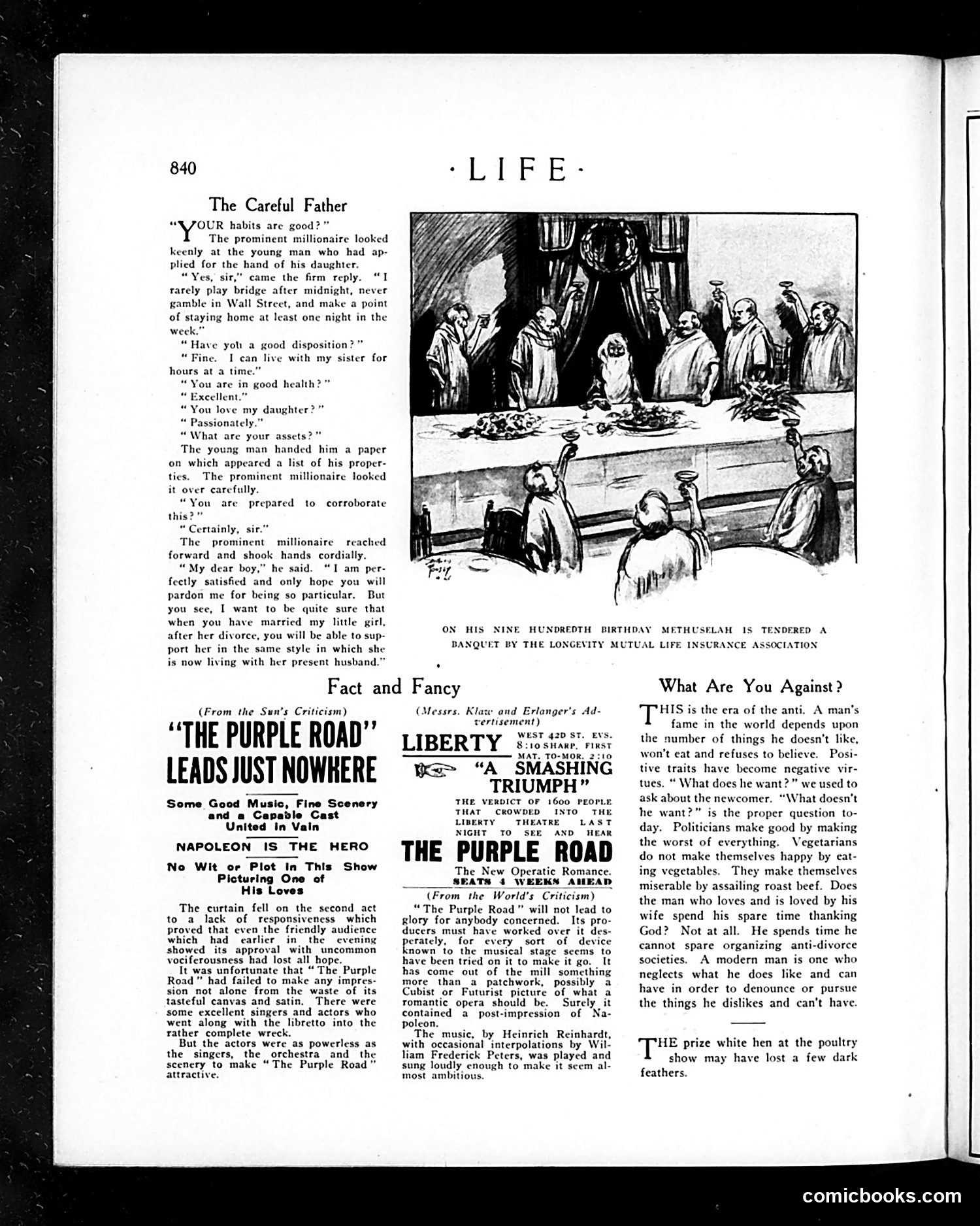
What you’re looking at
This short comic story satirizes the mercenary nature of 1920s marriage among the wealthy. A young suitor impresses a millionaire father-in-law by demonstrating good habits and financial assets. However, the punchline reveals the father's true concern: he wants assurance the suitor can support his daughter *after her inevitable divorce* in the same luxury she currently enjoys with her *present husband*. The satire targets: - The expectation that wealthy marriages will end in divorce - The reduction of courtship to financial negotiation - Society's casual acceptance of serial marriage among the rich - The father's indifference to his daughter's fidelity or happiness—only her continued comfort matters This reflects real concerns in the 1920s about rising divorce rates among the wealthy, where alimony and lifestyle maintenance were genuine legal and financial issues.
📄 Transcribed text from this page (OCR, searchable)
Machine-transcribed from the original scan — historical spelling and the odd misread are preserved.
840 The Careful Father OUR habits are good?” The prominent millionaire looked keenly at the young man who had ap- plied for the hand of his daughter. “Yes, sir,” came the firm reply. “1 rarely play bridge after midnight, never gamble in Wall Street, and make a point of staying home at least one night in the wee “Have yott a good dispositioi “Fine. I can live with my sister for hours at a time.” “You are in good health?” “ Excellent.” You love my daughter?” Passionately.” “What are your assets? The young man handed him a paper on which appeared a list of his proper- ties. The prominent millionaire looked it over carefully. “You are prepared to this “ Certainly, sir.” The prominent millionaire reached forward and shook hands cordially. “My dear boy,” he said. “1 am per- feetly satisfied and only hope you will pardon me for being so particular. But you sce, I want to be quite sure that when you have married my little girl, after her divorce, you will be able to sup- port her in the same style in which she is now living with her present husband.” corroborate ON HIS NINE Fact and Fancy (From the Sun’s Criticism) “THE PURPLE ROAD” LEADS JUST NOWHERE Some Good Music, | Fine Scenery and a Capable Cast United in Vain NAPOLEON IS THE HERO No Wit or Plot In This Show Picturing One of His Loves The curtain fell on the second act to a lack of responsiveness which proved that even the friendly audience which had earlier in the evening showed its approval with uncommon vociferousness had lost all hope. It was unfortunate that “ The Purple Road” had failed to make any impres- sion not alone from the waste of its tasteful canvas and satin. There were some excellent singers and actors who went along with the libretto into the rather complete wreck. But the actors were as powerless as the singers, the orchestra and the scenery to make “The Purple Road” attractive. langer's Ad- tisement) west “A _ SMASHING TRIUMPH” THE VERDICT OF 1600 PEOPLE THAT CROWDED INTO E LIBERTY —- THEATRE GHT TO SEE AND PURPLE ROAD The New Operatic Romance. SEATS 4 WEEKS A (From the World’s Criticism) “The Purple Road” will not lead to glory for anybody concerned. Its pro- ducers must have worked over it des- porate: for every sort of device known to the musical stage seems to have been tried on it to make it go. It has come out of the mill something more than a patchwork, possibly a Cubist or Futurist picture of what a romantic opera should be. Surely it contained a post-impression of Na- poleon. The music, by Heinrich Reinhardt, with occasional interpolations by Wil- liam Frederick Peters, was played and sung loudly enough to make it seem al- most ambitious. HUNDREDTH BIRTHDAY What Are You Against? HIS is the era of the anti. A man's fame in the world depends upon the number of things he doesn’t like, won't eat and refuses to believe. Posi- tive traits have become negative vir- tues. “ What does he want?” we used to ask about the newcomer. “What doesn’t he want?” is the proper question to- day. Politicians make good by making the worst of everything. Vegetarians do not make themselves happy by eat- ing vegetables, They make themselves miserable by assailing roast beef. Does the man who loves and is loved by his wife spend his spare time thanking God? Not at all. He spends time he cannot spare organizing anti-divorce societies. A modern man is one who neglects what he does like and can have in order to denounce or pursue the things he dislikes and can’t have. I Faas prize white hen at the poultry show may have lost a few dark feathers. comicbooks.com