
Life, 1913-04-24 · page 22 of 48
Life — April 24, 1913 — page 22: what you’re looking at
What you’re looking at
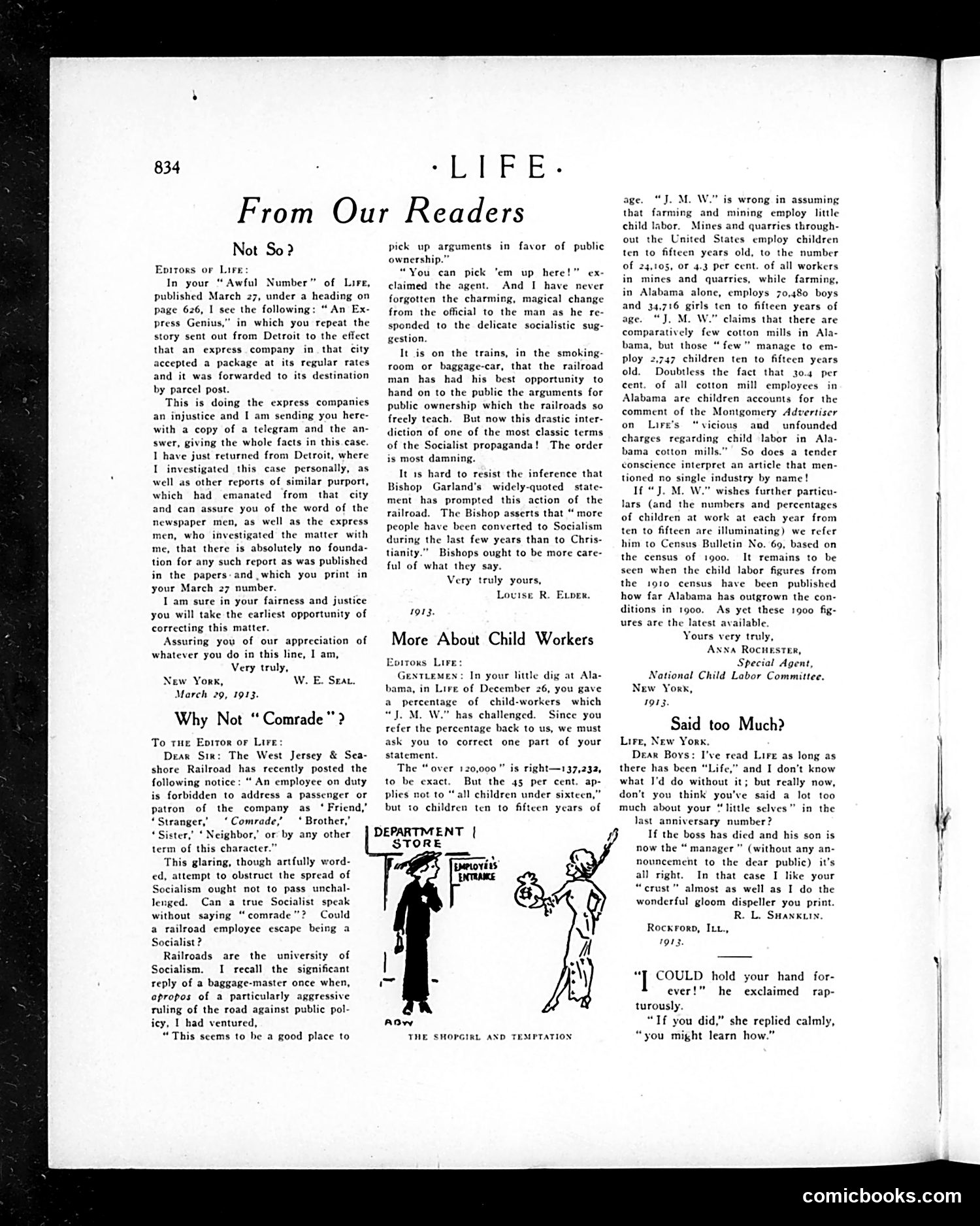
This is a **letters-to-the-editor page** featuring three reader complaints about prior LIFE articles. The content is primarily textual rather than cartographic satire. The key controversies: 1. **Express Company Defense** — A reader disputes LIFE's reporting on parcel post efficiency, defending railroad express companies' reputation. 2. **"Comrade" Controversy** — A reader mocks a railroad's ban on employees calling patrons "Comrade," interpreting it as anti-Socialist propaganda. References Bishop Garland's claim that Socialism converts more people than Christianity — suggesting railroads feared Socialist agitation among their workers. 3. **Child Labor in Alabama** — Readers dispute statistical accuracy regarding child workers (ages 10-15), with one correspondent defending Alabama's agricultural practices. The small **illustration** ("The Shopgirl and Temptation") appears unrelated editorial art. The page demonstrates early 20th-century concerns about labor rights, Socialist organizing, and industrial regulation—particularly worker classification and child employment practices.
📄 Transcribed text from this page (OCR, searchable)
Machine-transcribed from the original scan — historical spelling and the odd misread are preserved.
oa Fa bal mal From Our Readers Not So? Epitoxs or Lire: In your “Awful Number” of Lire, published March 27, under a heading on page 626, I see the following: “An Ex- press Genius,” in which you repeat the story sent out from Detroit to the effect that an express company in that city accepted a package at its regular rates and it was forwarded to its destination by parcel post. This is doing the express companies an injustice and I am sending you here- with a copy of a telegram and the an- swer, giving the whole facts in this case. I have just returned from Detroit, where I investigated this case personally, as well as other reports of similar purport, which had emanated from that city and can assure you of the word of the newspaper men, as well as the express men, who investigated the matter with me, that there is absolutely no founda- tion for any such report as was published in the papers-and,which you print in your March 27 number. I am sure in your fairness and justice you will take the earliest opportunity of correcting this matter. Assuring you of our appreciation of whatever you do in this line, | am, Very truly, New York, W. E. Sra. March 29, 1913. Why Not “ Comrade”? To tite Epitor oF Live: Dear Six: The West Jersey & Sea- shore Railroad has recently posted the following notice: “ An employee on duty is forbidden to address a passenger or patron of the company as ‘Friend,’ ‘Stranger,’ ‘Comrade,’ * Brother,’ ‘Sister,’ ‘Neighbor,’ or by any other term of this character.” This glaring, though artfully word- ed, attempt to obstruct the spread of Socialism ought not to pass unchal- lenged. Can a true Socialist speak without saying “comrade”? Could a railroad employee escape being a Socialist? Railroads are the university of Socialism. I recall the significant reply of a baggage-master once when, apropos of a particularly aggressive ruling of the road against public pol- icy, I had ventured, “This seems to he a good place to pick up arguments in favor of public ownership.” “You can pick ‘em up here!” ex- claimed the agent. And I have never forgotten the charming, magical change from the official to the man as he re- sponded to the delicate socialistic sug- gestion. It is on the trains, in the smoking- room or baggage-car, that the railroad man has had his best opportunity to hand on to the public the arguments for public ownership which the railroads so freely teach. But now this drastic inter- diction of one of the most classic terms of the Socialist propaganda! The order is most damning. It 1s hard to resist the inference that Bishop Garland’s widely-quoted stat ment has prompted this action of the railroad. The Bishop asserts that “ more people have been converted to Socialism during the last few years than to Chris- tianity.” Bishops ought to be more care- ful of what they say. Very truly yours, Lovise R. Exper. 1913. More About Child Workers Eorroxs Lire: Gexttemen: In your little dig at Ala- bama, in Lire of December 26, you gave a percentage of child-workers which M. W.” has challenged. Since you refer the percentage back to us, we must ask you to correct one part of your statement. The “over 120,000" is right—137,233, to be exact. But the 45 per cent. ap- plies not to “‘all children under sixteen,” but to children ten to fifteen years of DEPARTMENT [ STORE peetovits ENTIRE AOw THE SHOPGIRL AND TEMPTATION age. “J. M. W." is wrong in assuming that farming and mining employ little child labor. Mines and quarries through- out the United States employ children ten to fifteen years old, to the number of 24,105, or 4.3 per cent. of all workers in mines and quarries, while farming, in Alabama alone, employs 70,480 boys and 34,716 girls ten to fifteen years of age. “J, M. W." claims that there are comparatively few cotton mills in Ala- bama, but those “few” manage to em- ploy 2.747 children ten to fifteen years old. Doubtless the fact that 30.4 per cent. of all cotton mill employees in Alabama are children accounts for the comment of the Montgomery Advertiser on Lirs’s “vicious and unfounded charges regarding child labor in Ala- bama cotton mills.” So does a tender conscience interpret an article that men- tioned no single industry by name! If “J. M. W." wishes further particu- lars (and the numbers and percentages of children at work at each year from ten to fifteen are illuminating) we refer him to Census Bulletin No. 69, based on the census of 1900. It remains to be seen when the child labor figures from the 1910 census have been published how far Alabama has outgrown the con- ditions in 1900. As yet these 1900 fig- ures are the latest available, Yours very truly, Axwa Rocuester, Special Agent, ‘ational Child Labor Committee. New York, 1913. Said too Much? Lire, New York. Dear Boys: I've read Lire as long as there has been “Life,” and I don’t know what I'd do without it; but really now, don't you think you've said a lot too much about your “little selves” in the last anniversary number? If the boss has died and his son is now the “ manager” (without any an- nouncement to the dear public) it’s all right. In that case I like your “crust” almost as well as I do the wonderful gloom dispeller you print. R. L. Swanky. Rockrorp, Int, 1913. ‘l COULD hold your hand for- ever!" he exclaimed rap- turously. “If you did,” she replied calmly, “you might learn how.” comicbooks.com