
Life, 1913-04-24 · page 23 of 48
Life — April 24, 1913 — page 23: what you’re looking at
What you’re looking at
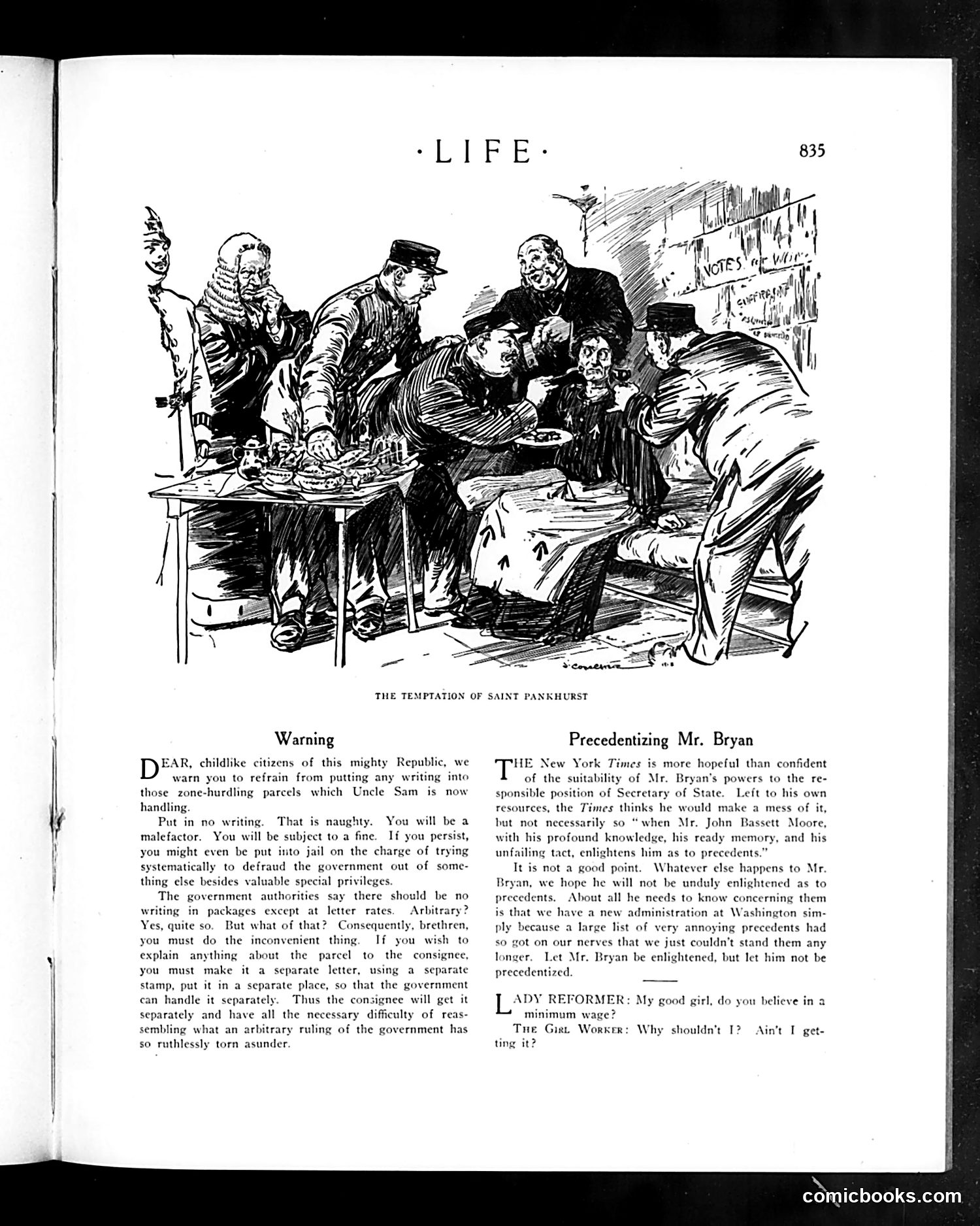
**The main cartoon** ("The Temptation of Saint Pankhurst") depicts what appears to be political figures dining together, likely referencing William Jennings Bryan's appointment as Secretary of State under President Wilson. The title invokes Emmeline Pankhurst, the British suffragist, suggesting a parallel to resisting temptation. **"Warning"** satirizes new postal regulations prohibiting written messages in parcels—only letters could contain writing. Life mocks this arbitrary government rule as absurd bureaucracy, forcing citizens to send separate letters with separate postage. **"Precedentizing Mr. Bryan"** criticizes The New York Times's suggestion that Bryan needs guidance from legal expert John Bassett Moore regarding diplomatic precedents. Life argues Bryan shouldn't be bound by old precedents—the new administration exists *because* people rejected those annoying established practices. **The brief dialogue** about minimum wage presents working-class irony: a girl worker sarcastically agrees with minimum wage advocacy, noting she's already receiving it (implying it's inadequate). All pieces mock authority, bureaucracy, and establishment thinking.
📄 Transcribed text from this page (OCR, searchable)
Machine-transcribed from the original scan — historical spelling and the odd misread are preserved.
Warning D R, childlike citizens of this mighty Republic, we warn you to refrain from putting any those zone-hurdling parcels which Uncle Sam is now handling. Put in no writing. That is naughty. You will be a malefactor. You will be subject to a fine. If you pe you might even be put into jail on the charge of trying systematically to defraud the government out of some- thing else besides valuable special privileges. The government authorit ay there should be no writing in packages except at letter rates. Arbitrary? Yes, quite so, But what of that? Consequently, brethren, you must do the inconvenient thing. If you wish to explain anything about the parcel to the consignee, you must make it a separate letter, using a separate stamp, put it in a separate place, so that the government can handle it separ. Thus the consignee will get it separately and have all the necessary difficulty of reas sembling what an arbitrary ruling of the government has so ruthlessly torn asunder. THE TEMPTATION OF SAINT PANKHURST Precedentizing Mr. Bryan HE New York Times is more hopeful than confident of the suitability of Mr. Bryan's powers to the re- sponsible position of Secretary of State. Left to his own resources, the Times thinks he would make a mess of it, but not necessarily so “when Mr. John Bassett Moore, ry, and his with his profound knowledge, his ready mem unfailing tact, enlightens him as to precedents. It is not a good point. Whatever else happens to Mr. Bryan, we hope he will not be unduly enlightened as to precedents. About all he needs to know concerning them is that we have a new administration at Washington sim- ply because a large list of very annoying precedents had so got on our nerves that we just couldn't stand them any longer. Let Mr. Bryan be enlightened, but let him not be precedentized. L** REFORMER: My good girl, do you believe in a minimum wage Tue Girt Worker: Why shouldn't 1? Ain't I get- ting it? Nan comicbooks.com