
Life, 1913-04-24 · page 26 of 48
Life — April 24, 1913 — page 26: what you’re looking at
What you’re looking at
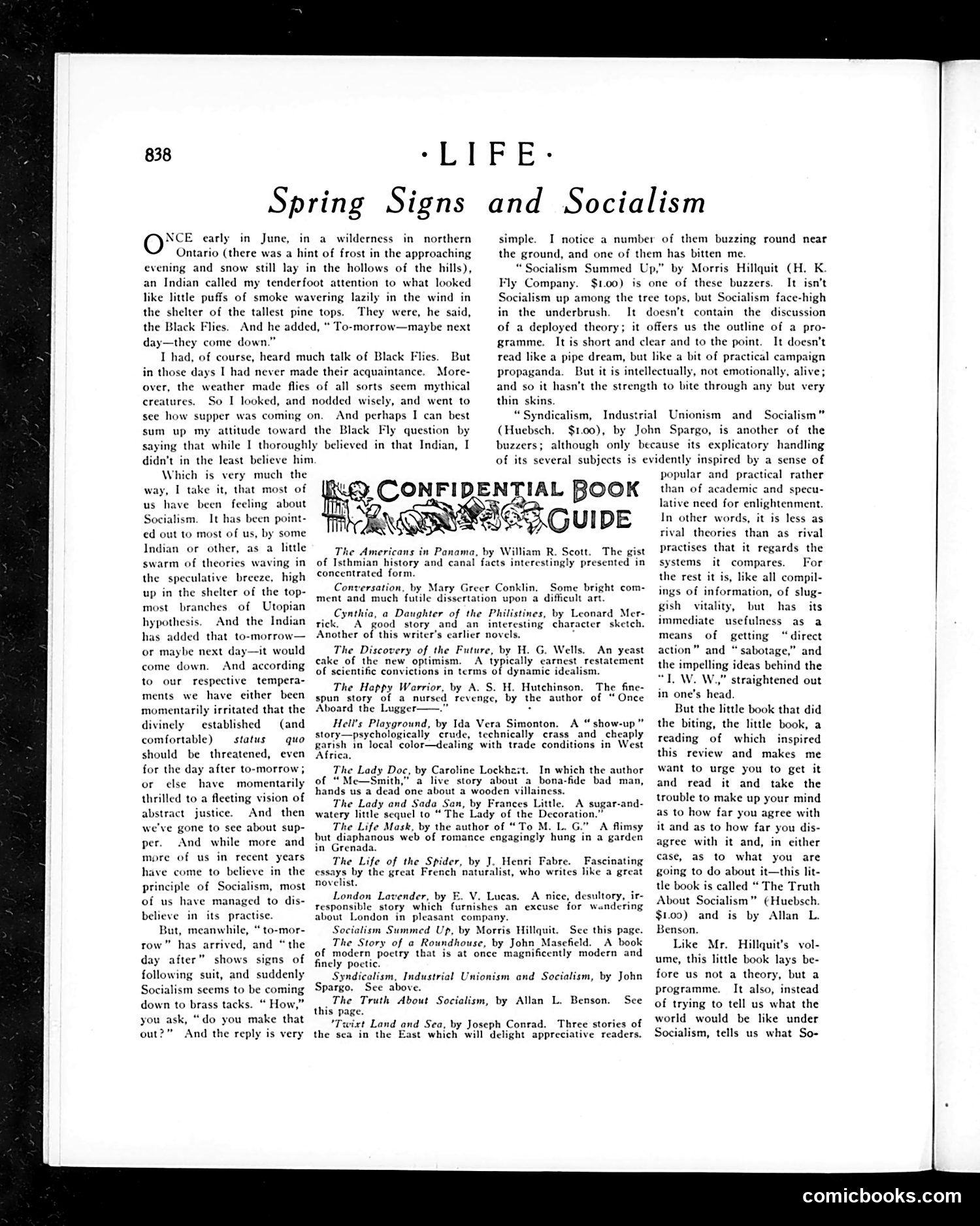
This is a book review essay, not a political cartoon. The author uses an extended metaphor comparing Socialism's arrival in practical politics to Black Flies emerging from tree-tops in early summer Ontario. The conceit: just as an Indian guide warned that Black Flies would descend from high branches, Socialists have warned that their ideology would eventually move from abstract theory ("the tree tops") into everyday life ("face-high in the underbrush"). The author admits intellectually believing this warning while emotionally disbelieving it—until now, when Socialism apparently is "coming down to brass tacks." The reviews cover socialist texts by Morris Hillquit and John Spargo. The author praises their practical, non-utopian approach but criticizes their limited emotional power. The satire targets readers like himself—comfortable people who intellectually acknowledge Socialism's inevitability while hoping to avoid its actual implementation.
📄 Transcribed text from this page (OCR, searchable)
Machine-transcribed from the original scan — historical spelling and the odd misread are preserved.
‘LIF E- Spring Signs and Socialism Ome early in June, in a wilderness in northern Ontario (there was a hint of frost in the approaching evening and snow still lay in the hollows of the hills), an Indian called my tenderfoot attention to what looked like little puffs of smoke wavering lazily in the wind in the shelter of the tallest pine tops. They were, he said, the Black Flies. And he added, “ To-morrow—maybe next day—they come down.” I had, of course, heard much talk of Black Flies. But in those days I had never made their acquaintance. More- over, the weather made flies of all sorts seem mythical creatures. So I looked, and nodded wisely, and went to see how supper was coming on. And perhaps I can best sum up my attitude toward the Black Fly question by saying that while I thoroughly believed in that Indian, I didn’t in the least believe him. simple. I notice a number of them buzzing round near the ground, and one of them has bitten me. Socialism Summed Up,” by Morris Hillquit (H. K. Fly Company. $1.00) is one of these buzzers. It isn’t Socialism up among the tree tops, but Socialism face-high in the underbrush. It contain the discussion of a deployed theory; it offers us the outline of a pro- gramme. It is short and clear and to the point. It doesn’t read like a pipe dream, but like a bit of practical campaign propaganda. But it is intellectually, not emotionally, aliv and so it hasn't the strength to bite through any but very thin skins. “Syndicalism, Industrial Unionism and Socialism” (Huebsch. $1.00), by John Spargo, is another of the buzzers; although only because its explicatory handling of its several subjects is evidently inspired by a sense of doesn’t Which is very much the , L take it, that most of us have been feeling about Socialism. It has been point- ed out to most of us, by some Indian or other, as a little swarm of theories waving in the speculative breeze, high up in the shelter of the top- most branches of Utopian hypothesis. And the Indian has added that to-morrow— or maybe next day—it would come down. And according to our respective tempera- ments we have either been momentarily irritated that the divinely established (and comfortable) status quo should be threatened, even for the day after to-morrow; or else have momentarily thrilled to a fleeting vision of abstract justice. And then we've gone to see about sup- per. And while more and more of us in recent years have come to believe in the principle of Socialism, most of us have managed to dis- believe in its practise. But, meanwhile, “ to-mor- row” has arrived, and “the day after” shows signs of following suit, and suddenly Socialism seems to be coming down to brass tacks. “ How,” you ask, “do you make that 12” And the reply is very v ou Te aaa IAL BOOK ENGR OS. GUIDE The Americans in Panama, by William R. Scott. The gist of Isthmian history and canal facts interestingly presented in concentrated form. Conversation, by Mary Greer Conklin. Some bright com- ment and much futile dissertation upon a difficult art. Cynthia, a Daughter of the Philistines, by Leonard Mer- and an character sketch. tick. A good story interesting Another of this writer’s earlier novels. The Discovery of the Future, by H. G. Wells. An yeast cake of the new optimism. A typically carnest restatement of scientific convictions in terms of dynamic idealism. The Happy Warrior, by A. S. H. Hutchinson. The fine- spun story of a nursed revenge, by the author of “Once Aboard the Lugger. : Hell's Playground, by Ida Vera Simonton. A “ show-up” story—psychologically crude, technically crass and cheaply garish in local color—dealing with trade conditions in West Africa. The Lady Doc, by Caroline Lock In which the author of “Mc—Smith,” a live story about a bona-fide bad man, hands us a dead’ one about a wooden villaines: The Lady and Sada San, by Frances Little. watery little sequel to “ The Lady of the Decorat The Life Mask, by the author of “To M. L. G.” A flimsy but diaphanous web of romance engagingly hung in a garden in Grenada. The Life of the Spider, by J. Henri Fabre. Fascinating essays by the great French natufalist, who writes like a great novelist. London Lavender, by E. V. Lucas. A nice, desultory, ir- responsible story which furnishes an excuse for wandering about London in pleasant company. Socialism Summed Up, by Morris Hillquit. See this page. The Story of a Roundhouse, by John Mascfield. A book of modern poctry that is at once magnificently modern and finely poetic. Syndicalism, Industrial Unionism and Socialism, by John Spargo. Sce above. The Truth About Socialism, by Allan L. Benson. this page. ‘Twixt Land and Sea, by Joseph Conrad. Three stories of the sca in the East which will delight appreciative readers. A sugar-and- See popular and practical rather than of academic and specu- lative need for enlightenment In other words, it is less as rival theories than as_ rival practises that it regards the systems it compares. For the rest it is, like all compil- ings of information, of slug- gish vitality, but has its immediate usefulness as a means of getting direct action” and “ sabota; and the impelling ideas behind the “IW. W,,” straightened out in one’s head. But the little book that did the biting, the little book, a reading of which inspired this review and makes me want to urge you to get it and read it and take the trouble to make up your mind as to how far you agree with it and as to how far you dis- agree with it and, in either case, as to what you are going to do about it—this lit- tle book is called “ The Truth About Socialism” (Huebsch. $1.00) and is by Allan L. Benson. Like Mr. Hillquit’s vol- ume, this little book lays be- fore us not a theory, but a programme. It also, instead of trying to tell us what the world would be like under Socialism, tells us what So- comicbooks.com