
Life, 1913-04-24 · page 16 of 48
Life — April 24, 1913 — page 16: what you’re looking at
What you’re looking at
This page contains a satirical "biography" of Oliver Cromwell (1599-1658), the English Puritan revolutionary who executed King Charles I and ruled as Lord Protector. **The Satire's Point:** Life magazine presents Cromwell as a modern American businessman-reformer, comparing him to Theodore Roosevelt. The joke mocks both Cromwell's rigid Puritanism and contemporary "efficiency" movements: he treated government like a business (inventing a "card index system," establishing a "Bureau of Puritan Agriculture"), yet his reforms ultimately failed—the monarchy returned under Charles II. **The Modernization:** Phrases like "Men's Religion Forward Movement," "Scientific Management," and "Turkey Trot" (a contemporary dance) translate 17th-century religious upheaval into early 1900s American corporate and social language, creating anachronistic humor. **The Lower Cartoon ("Solicitude"):** A brief dialogue joke about a father's hypocrisy—he fears corrupting his morals by associating with his children, who dryly note they're already careful *around him*. The page satirizes both historical figures and contemporary American reform movements.
📄 Transcribed text from this page (OCR, searchable)
Machine-transcribed from the original scan — historical spelling and the odd misread are preserved.
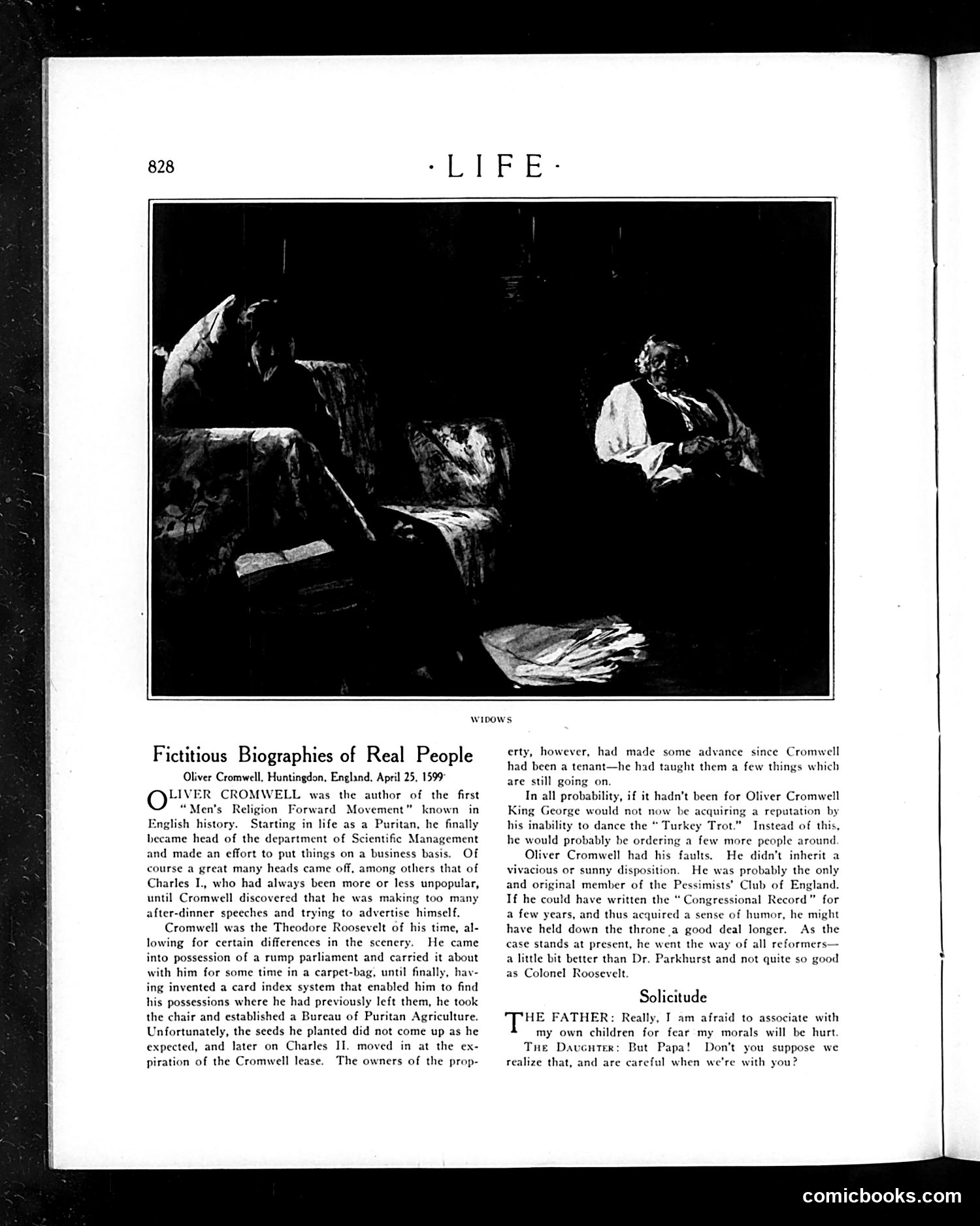
wipows Fictitious Biographies of Real People Oliver Cromwell, Huntingdon, England, April 25, 1599 LIVER CROMWELL was the author of the first “Men's Religion Forward Movement” known in English history. Starting in life as a Puritan, he finally became head of the department of Scientific Management and made an effort to put things on a business basis. Of course a great many heads came off, among others that of Charles I, who had always been more or less unpopular, until Cromwell discovered that he was making too many after-dinner speeches and trying to advertise himself. Cromwell was the Theodore Roosevelt of his time, al- lowing for certain differences in the scenery. He came into possession of a rump parliament and carried it about with him for some time in a carpet-bag, until finally, hav- ing invented a card index system that enabled him to find his possessions where he had previously left them, he took the chair and established a Bureau of Puritan Agriculture. Unfortunately, the seeds he planted did not come up as he expected, and later on Charles II. moved in at the ex- piration of the Cromwell lease. The owners of the prop- erty, however, had made some advance since Cromwell had been a tenant—he had taught them a few things which are still going on. In all probability, if it hadn't been for Oliver Cromwell King George would not now be acquiring a reputation by his inability to dance the “ Turkey Trot.” Instead of this, he would probably be ordering a few more people around Oliver Cromwell had his faults, He didn’t inherit a vivacious or sunny disposition. He was probably the only and original member of the Pessimists’ Club of England. If he could have written the “ Congressional Record” for a few years, and thus acquired a sense of humor, he might have held down the throne a good deal longer. As the case stands at present, he went the way of all reformers— a little bit better than Dr. Parkhurst and not quite so good as Colonel Roosevelt Solicitude HE FATHER: Really, I am afraid to associate with my own children for fear my morals will be hurt Tue Davcnter: But Papa! Don't you suppose we realize that, and are careful when we're with you? comicbooks.com