
A complete issue · 46 pages · 1912
Life — April 11, 1912
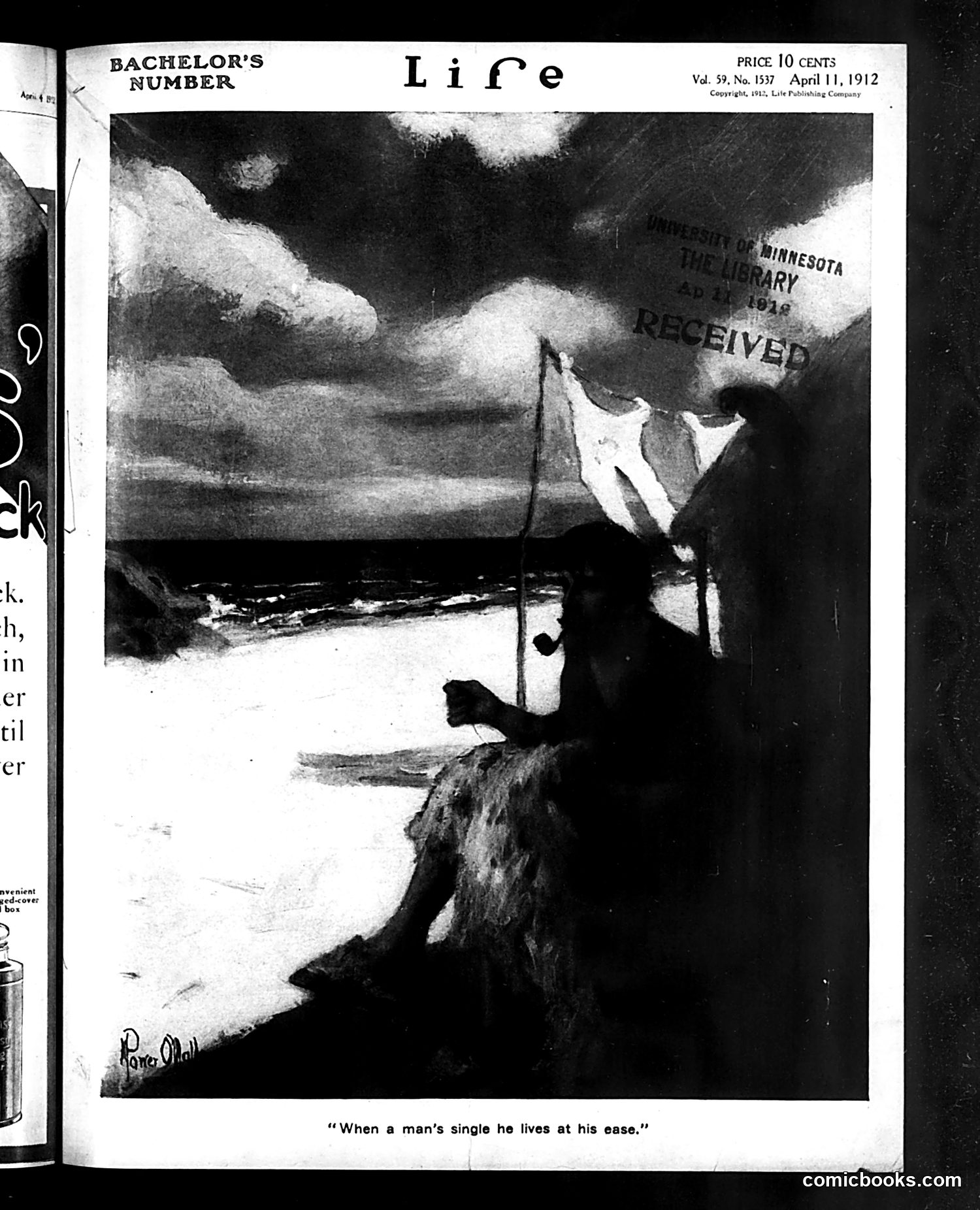
This is the cover of Life's "Bachelor's Number" issue. The illustration depicts a man in formal attire relaxing contentedly at seaside, with the caption: "When a man's single he lives at his ease." The image is a straightforward satirical commentary on bachelor life versus marriage. The well-dressed man appears peaceful and unburdened, sailing or enjoying leisure activities by the ocean—contrasting with the implied complications of married life. This represents typical early-20th-century humor about marriage, domesticity, and male independence. The "Bachelor's Number" was likely a special themed issue playing on contemporary social attitudes about unmarried men's freedom and the sacrifices marriage supposedly demanded.
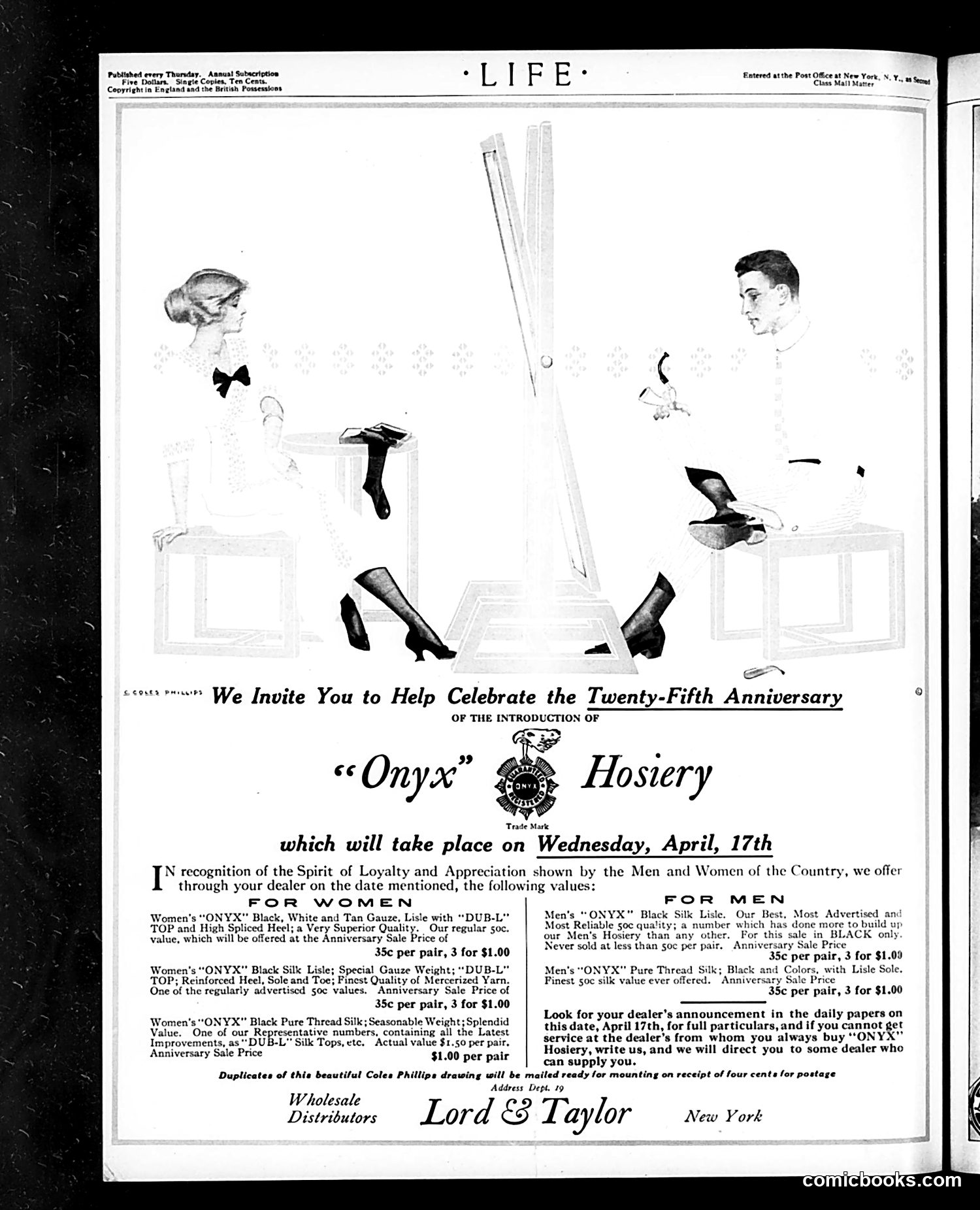
This page is primarily **advertising**, not satire or political commentary. It announces a twenty-fifth anniversary celebration for "Onyx" brand hosiery by Lord & Taylor, scheduled for Wednesday, April 17th. The illustration shows a man and woman in a room separated by a mirror or divider, with stockings and shoes scattered on the floor between them. This appears to be **humorous domestic imagery** rather than political satire—the visual joke likely plays on the idea of hosiery being a desirable product that appeals to both genders, or perhaps suggesting romantic/flirtatious undertones. The page then lists product offerings and special anniversary prices for both men's and women's hosiery. No political figures or references are evident. This is straightforward commercial advertising from Life magazine.
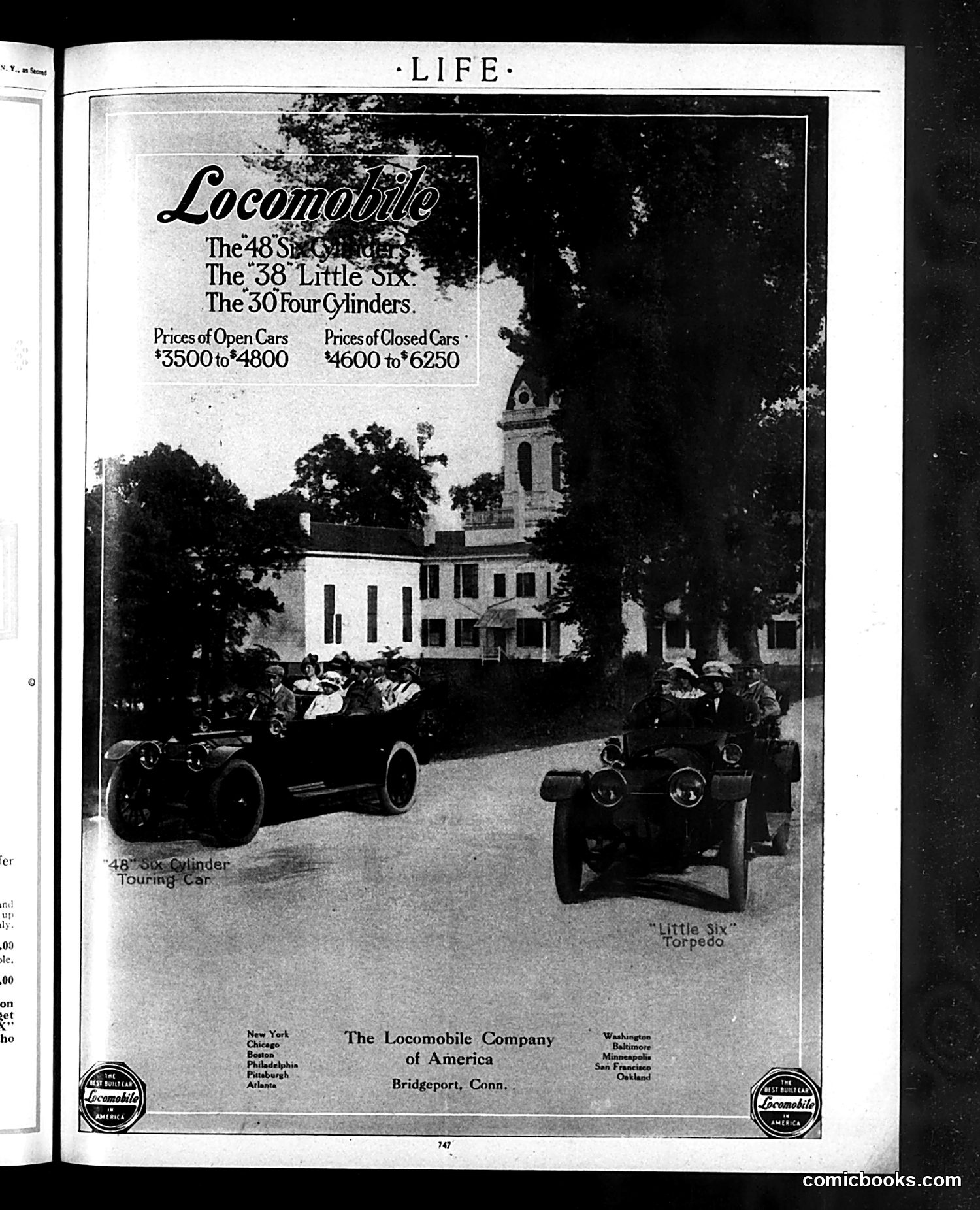
This page is **primarily an advertisement**, not satire or political commentary. It promotes the Locomobile automobile brand, manufactured in Bridgeport, Connecticut. The ad showcases three vehicle models: the "48" Special, the "38" Little Six, and the "30" Four Cylinders, with pricing for open and closed versions (ranging from $3,500-$6,250). The image depicts early-1900s racing or touring cars positioned in front of a classical mansion, emphasizing luxury and prestige. The "48-Cylinder Touring Car" and "Little Six" Torpedo are labeled examples. The advertisement lists Locomobile's regional offices nationwide, targeting wealthy consumers. This represents the era when automobiles were high-end luxury goods, not mass-market products—quite different from today's automotive market.
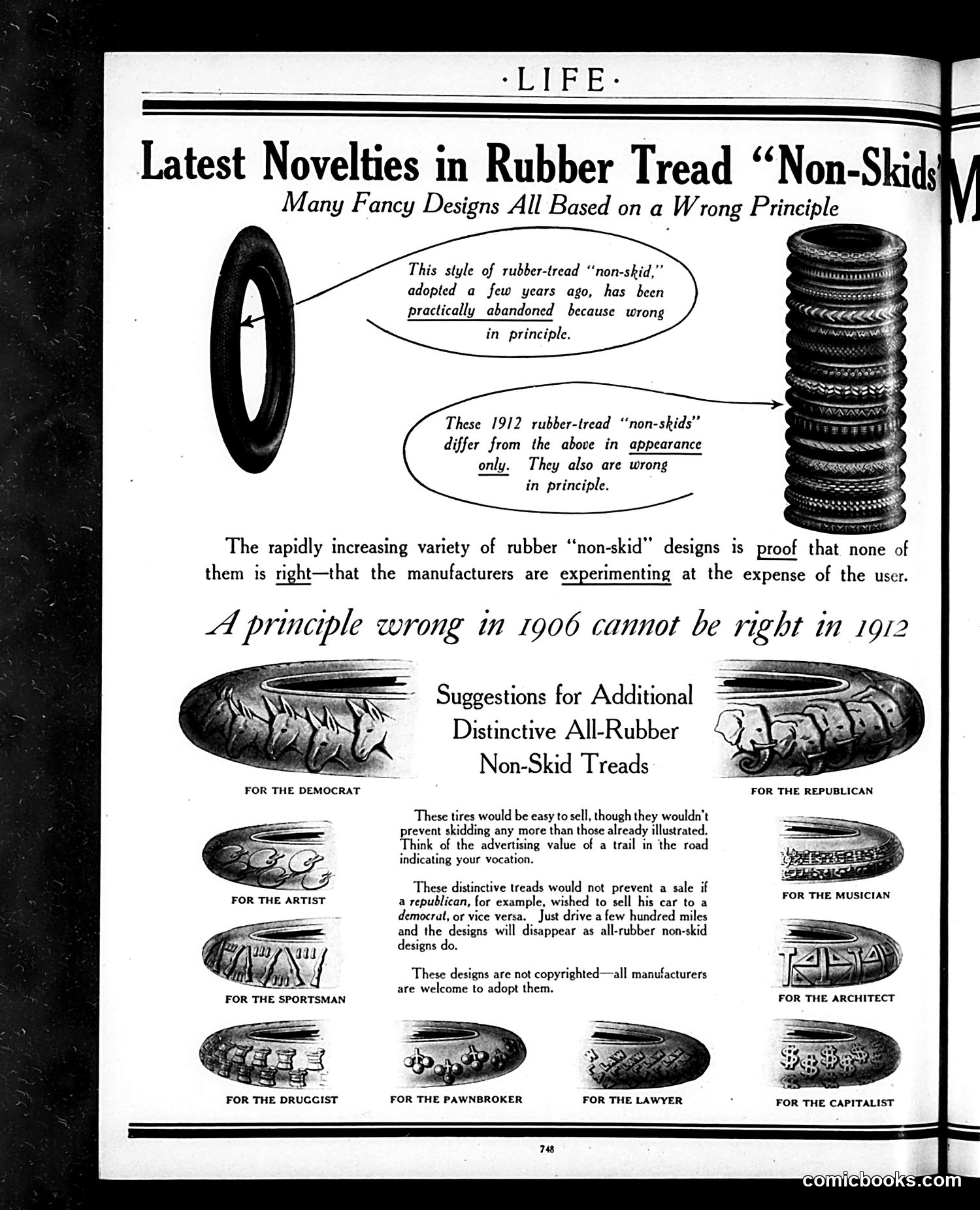
This is a satirical advertisement critiquing rubber tire manufacturers' "non-skid" tread designs. The piece argues that manufacturers are experimenting with countless decorative tread patterns—claiming each prevents skidding—without scientific basis, merely to differentiate products and boost sales. The humor lies in the invented tire designs for specific professions: "For the Democrat," "For the Republican," "For the Artist," etc. Each tread pattern supposedly reflects that profession's values or interests—musical notes for musicians, dollar signs for capitalists. The satire suggests that these distinctions are meaningless marketing gimmicks rather than functional improvements. The core argument: manufacturers adopt wrong principles from 1906 and perpetuate them in 1912, experimenting at consumers' expense. The tread patterns offer no actual safety advantage, only novelty.
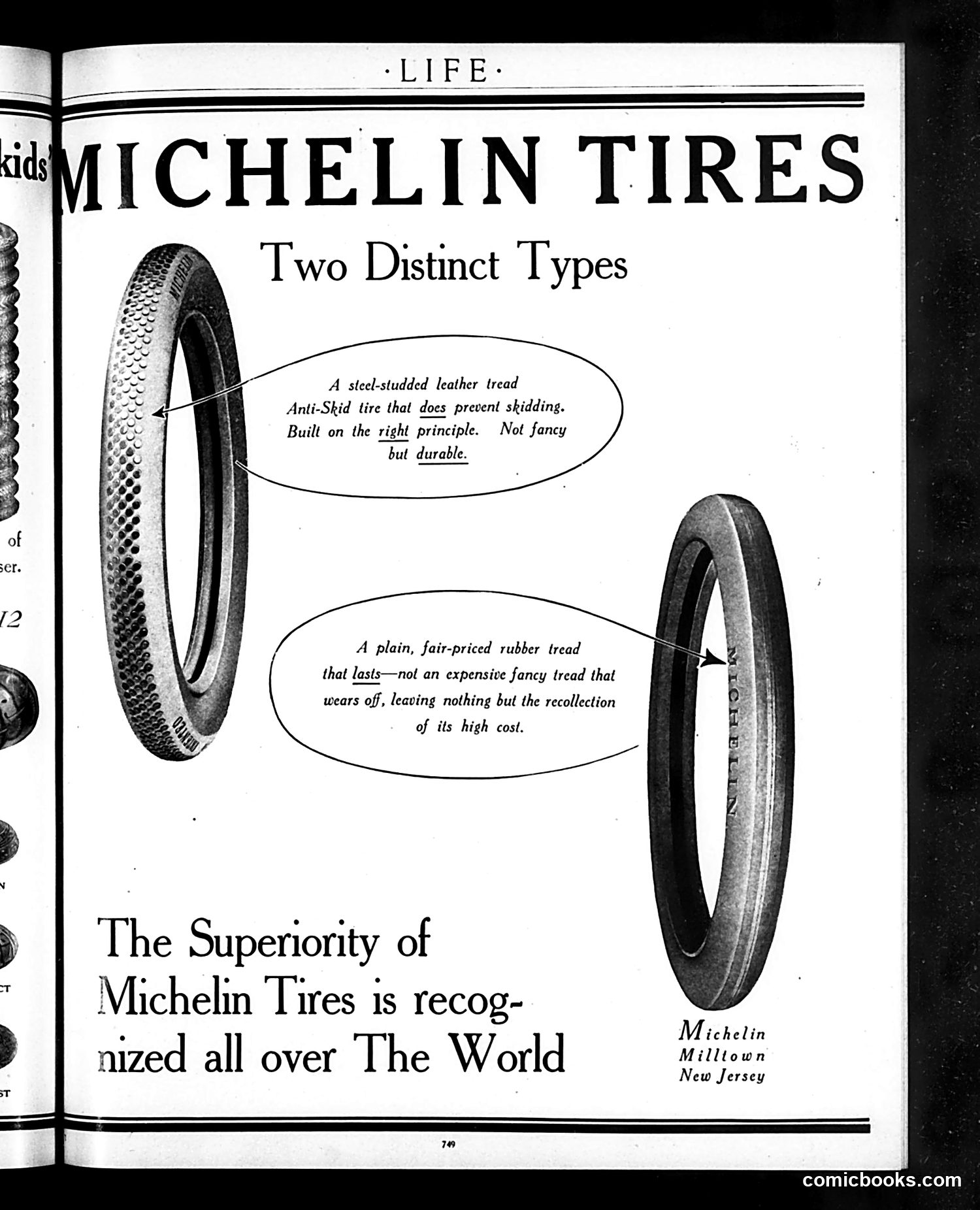
This page is a **Michelin Tires advertisement**, not a political cartoon. It appears in *Life* magazine's "LIFE" section and promotes two distinct tire models: 1. A steel-studded leather tread (left) marketed as an "Anti-Skid" tire emphasizing durability over aesthetics 2. A plain rubber tread (right) positioned as affordable and long-lasting, contrasting with expensive "fancy" alternatives The ad's appeal to early 20th-century readers likely centered on **practicality and value**—assuring consumers that Michelin offered reliable options without premium pricing. The copy emphasizes "built on the right principle" and durability, addressing buyer concerns about tire performance and cost. The Michelin location (Milltown, New Jersey) grounds the product as American-made.
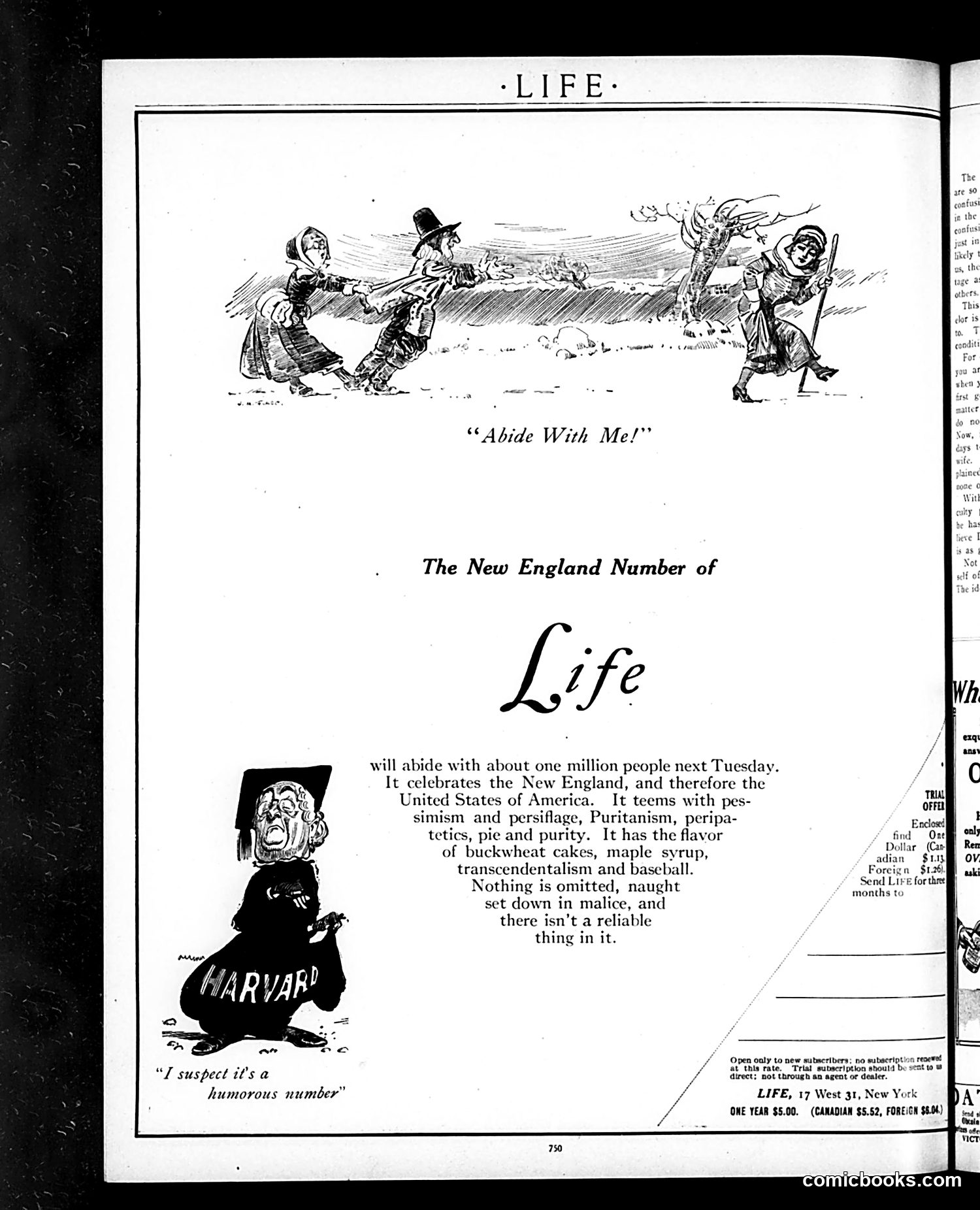
This is primarily an **advertisement for Life magazine's "New England Number,"** not political satire. The top illustration ("Abide With Me!") shows four figures in period dress dancing or celebrating in a New England landscape—likely referencing Puritan settlers or colonial America. The Harvard caricature below (labeled "I suspect it's a humorous number") depicts a stereotypical Harvard student or intellectual as an exaggerated, somewhat pompous figure, playing on Harvard's reputation. The advertisement copy humorously catalogs New England stereotypes: "pessimism and persiflage, Puritanism, peripatetics, ole and purity," plus "buckwheat cakes, maple syrup, transcendentalism and baseball," concluding that "nothing is omitted, naught set down in malice, and there isn't a reliable thing in it." This self-aware humor promotes the special issue by satirizing New England identity itself rather than targeting specific political figures or events.
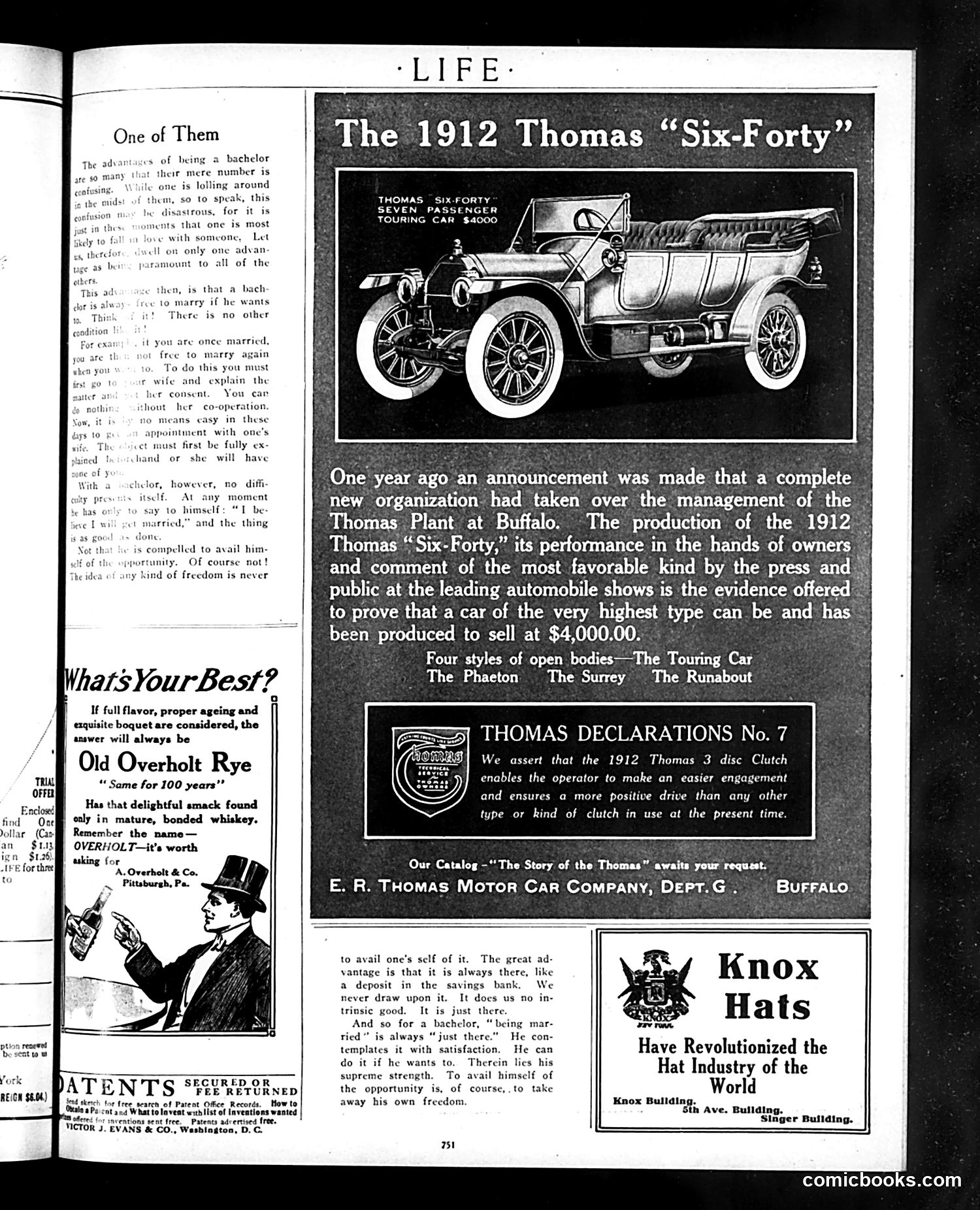
This page is primarily **advertising and product promotion** rather than political satire. The main content features the 1912 Thomas "Six-Forty" automobile—a seven-passenger luxury car priced at $4,000 (substantial for the era). The ad emphasizes the car's prestige, reliability, and the company's new management at the Buffalo plant. The left sidebar contains an unrelated essay titled "One of Them," discussing bachelor versus married life philosophies, alongside advertisements for Old Overholt Rye whiskey and patent services. The bottom right promotes Knox Hats, claiming to have "revolutionized the hat industry." There is no political cartoon or satire visible on this page—it's a commercial publication showcasing early automotive and consumer goods marketing.
This page is **entirely an advertisement**, not satirical content. It's a Packard Motor Car Company advertisement for the "Six" model, appearing in *Life* magazine. The ad makes performance and safety claims typical of early automotive marketing: "absolutely positive steering," effective brakes, smooth high-speed operation (70 mph), and rapid acceleration (60 mph in 30 seconds). It emphasizes luxury and durability. There is no political cartoon, caricature, or satire present. The decorative border and formal typography reflect the design conventions of early 20th-century print advertising. The appeal is straightforward—positioning the Packard Six as the premier choice for wealthy, performance-conscious drivers seeking both speed and safety.
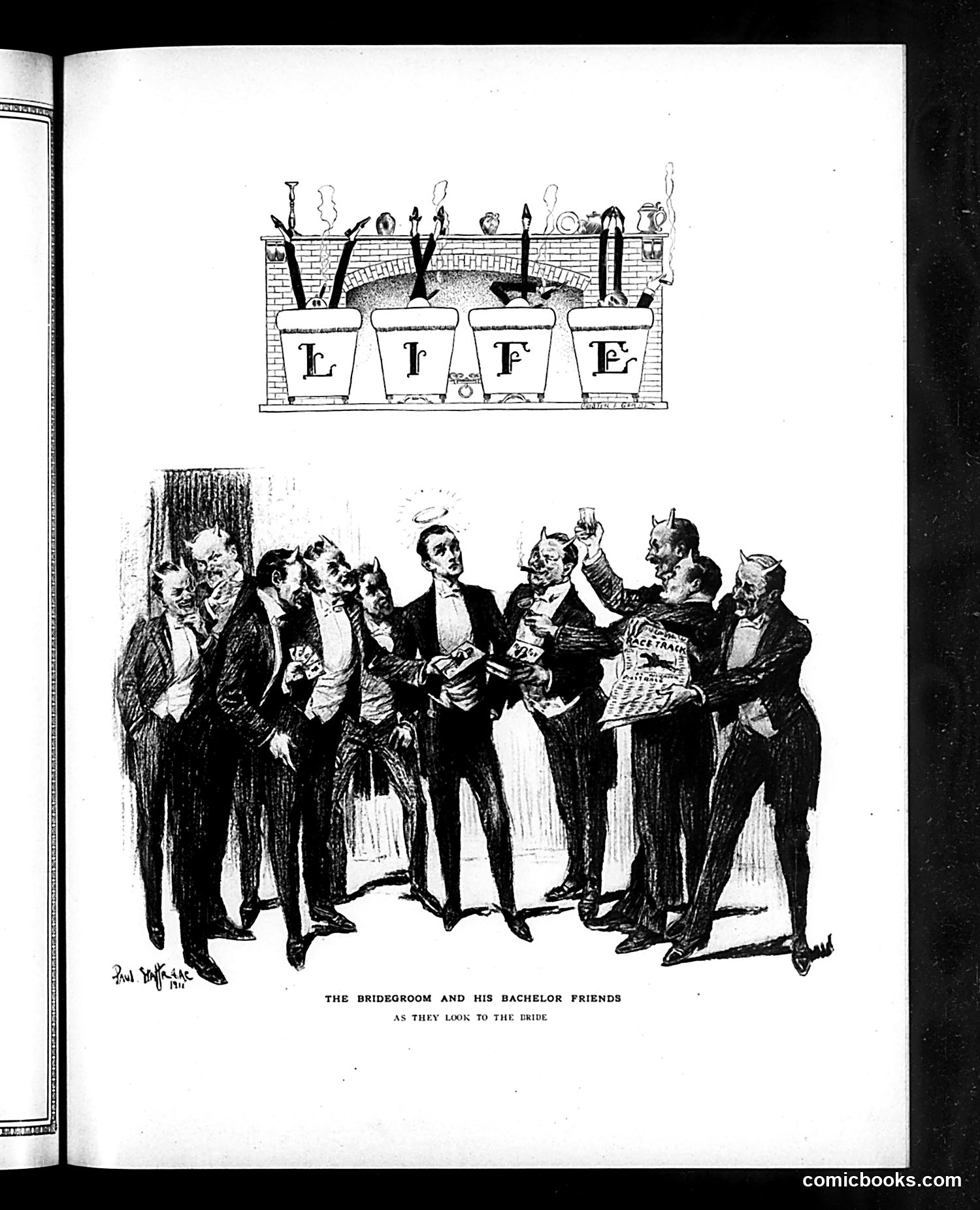
This satirical cartoon depicts "The Bridegroom and His Bachelor Friends as They Look to the Bride" — a commentary on male behavior at weddings, likely from the late 19th or early 20th century. The upper illustration shows a theatrical stage labeled "LIFE," suggesting marriage as performative spectacle. The lower cartoon shows the groom (center, with halo) surrounded by grotesque "bachelor friends" with exaggerated demonic or devilish features — some with horns and malicious expressions. They're toasting and carousing while looking toward the bride (unseen). The satire mocks how bachelor friends corrupt or negatively influence the groom before/during marriage, portraying them as morally questionable influences. The juxtaposition of the "pure" theatrical life above with the "corrupted" bachelors below emphasizes the satirical point about marriage transforming men away from dissolute behavior.
The page features **Dr. Morton Prince's psychological essay** titled "Life's Psychological Problems: How the Colonel Came to Do It." The accompanying illustration shows a man's head in profile with visible brain imagery, depicting Prince's analysis of Colonel Roosevelt's subconscious mind. The text discusses **Theodore Roosevelt's third-term candidacy**, examining his psychological motivations. Prince argues Roosevelt's actions stem from subconscious drives rather than conscious reasoning—suggesting the Colonel's supporters are unaware of deeper psychological forces influencing his decision to run. The piece satirizes both Roosevelt's ambitions and the era's newfound fascination with Freudian psychology, using pseudo-scientific analysis to mock political motivation while simultaneously poking fun at psychological determinism itself.
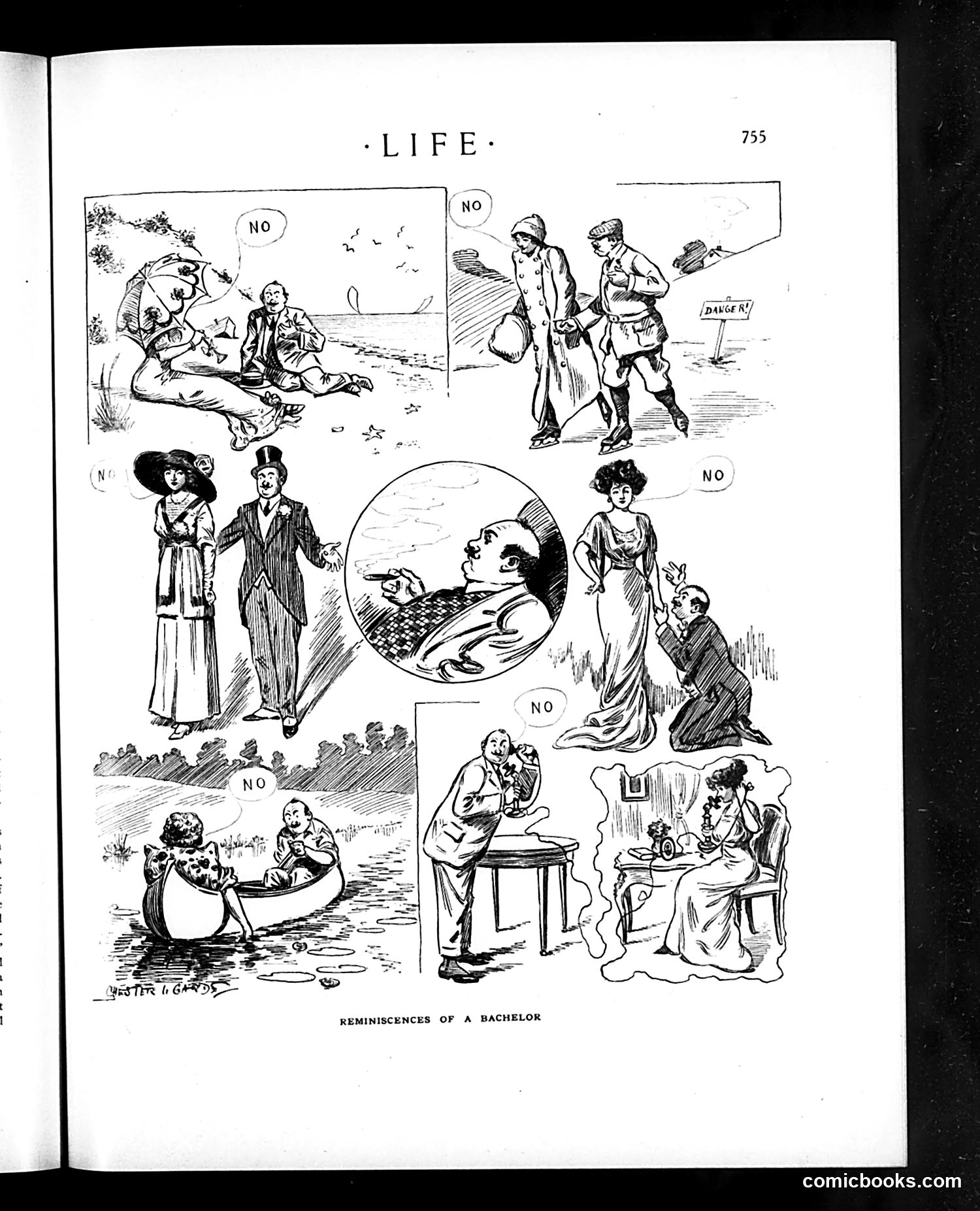
This comic strip satirizes a bachelor's romantic rejections and misadventures. Each panel shows the man being turned down by women in different scenarios—labeled "NO" repeatedly—suggesting his consistent failure at courtship and relationships. The scenes depict various settings: outdoor encounters, formal social situations, domestic scenes, and intimate moments. The visual joke centers on the bachelor's perpetual rejection despite his apparent efforts to pursue romantic interests. The title "Reminiscences" implies he's looking back on these failures with ironic nostalgia. The satire mocks the bachelor lifestyle and male romantic incompetence—a common theme in early 20th-century humor magazines. The repetitive "NO" responses emphasize the comedy of romantic futility.
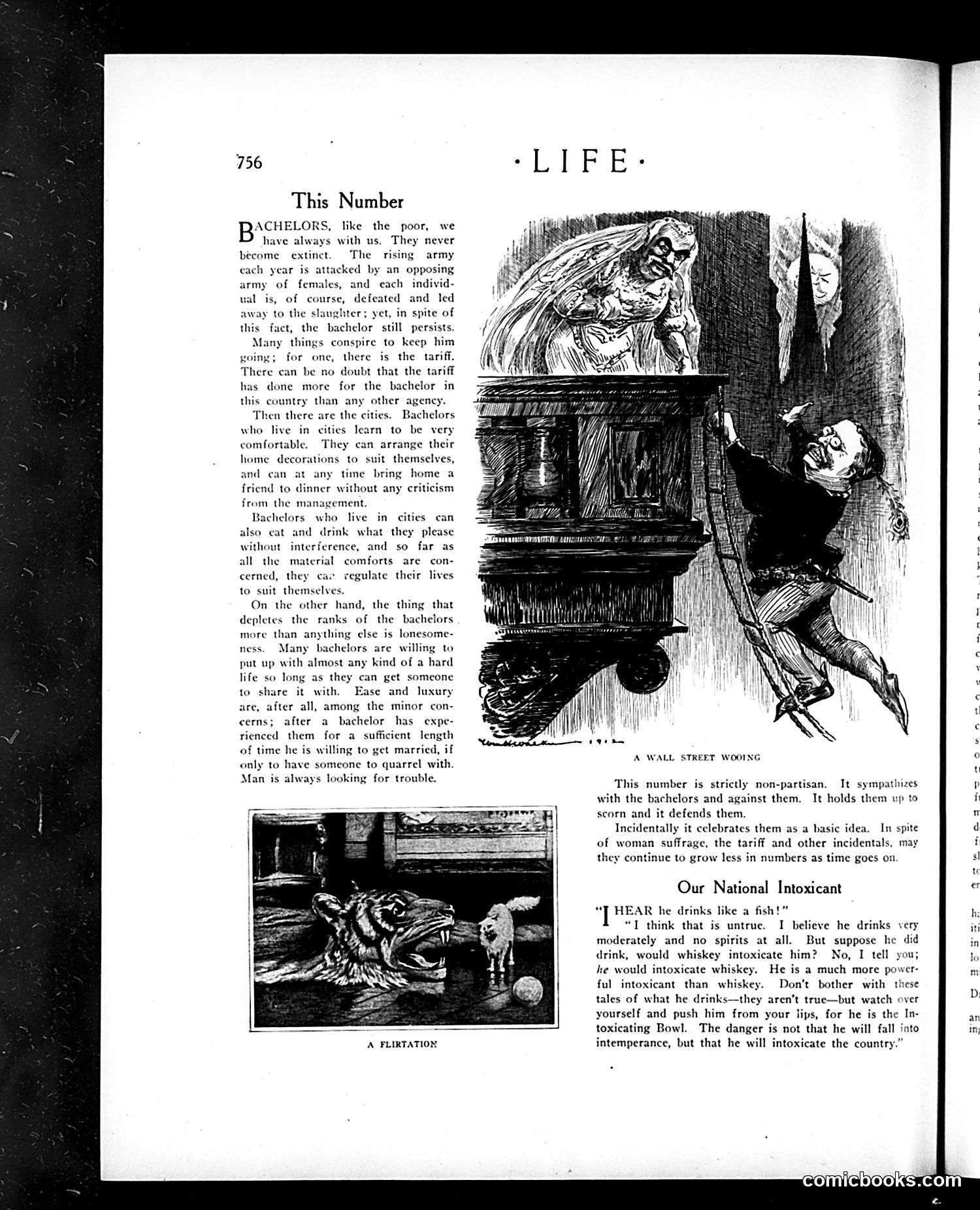
This page satirizes bachelor life through two illustrated scenes and accompanying commentary. "A Wall Street Wooing" (top) depicts a man courting a woman, while "A Flirtation" (bottom) shows a more casual domestic scene. The text argues bachelors persist despite financial and social pressures to marry. It notes city bachelors enjoy material comforts and freedom, yet "homesickness" drives some toward marriage—often reluctantly, seeking companionship despite quarrels. The section "Our National Intoxicant" debates whether bachelors drink excessively. The author defends moderate drinking, warning that whiskey itself isn't the danger; rather, the "Intoxicating Bowl" threatens national welfare—likely referencing temperance concerns and Prohibition-era anxieties about alcohol's social impact. The satire critiques both bachelor independence and period anxieties about masculinity, domesticity, and substance abuse.
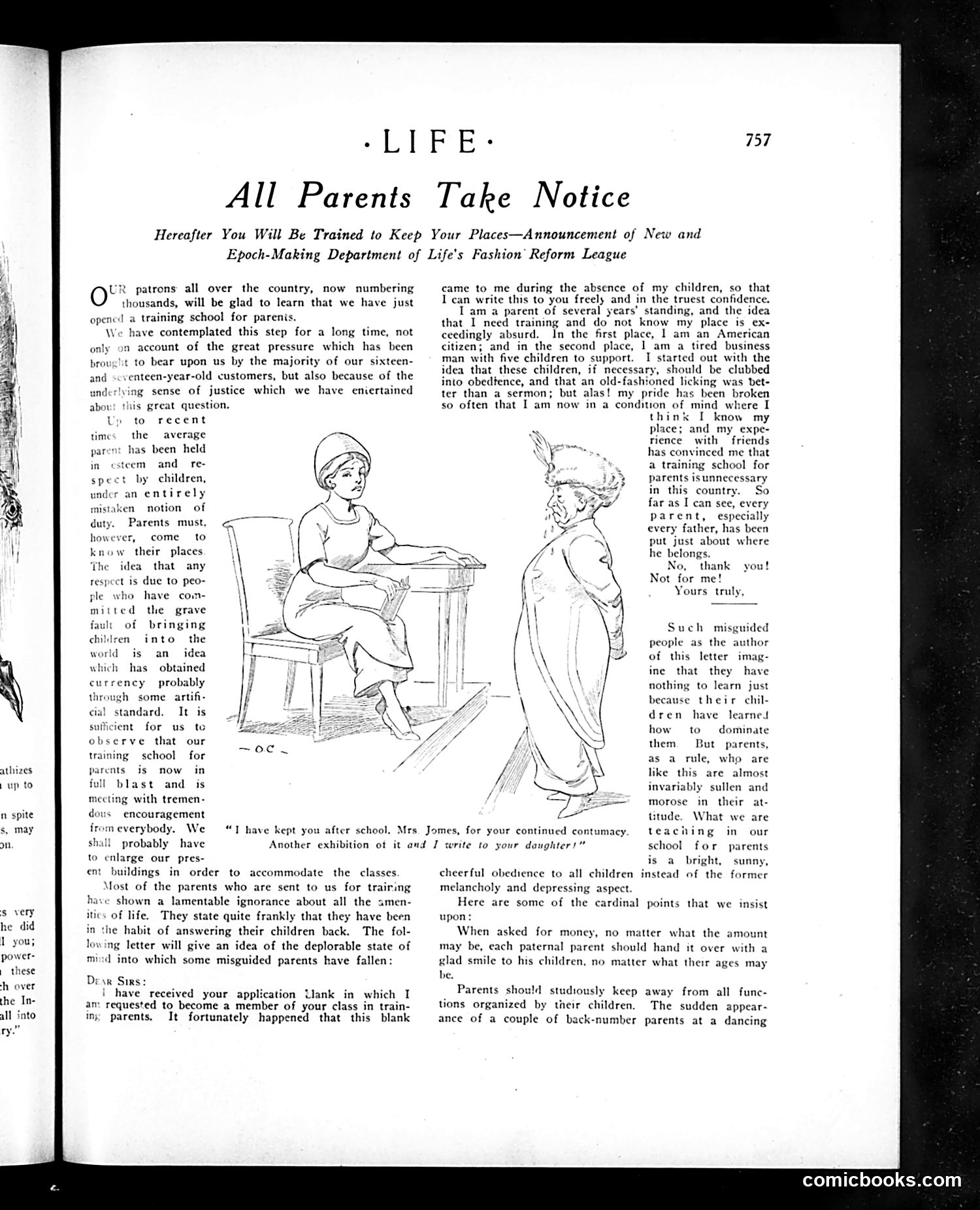
This page satirizes a proposed "training school for parents" announced by Life's "Fashion Reform League." The cartoon depicts a woman instructor teaching proper child discipline to a presumably inadequate parent. The satire targets two main points: 1. **Parental incompetence**: The text mocks parents who've failed to properly train their children into obedience, suggesting they need formal instruction themselves. 2. **Overreach of reform movements**: The piece ridicules the era's proliferation of reform leagues and improvement schemes—here suggesting that even parent-training had become necessary. The accompanying rejection letter parodies condescending reform rhetoric, with the school dismissing an applicant parent as hopeless. The humor lies in inverting normal authority: children supposedly need training *less* than their parents do, and even reformers find some parents beyond salvation.
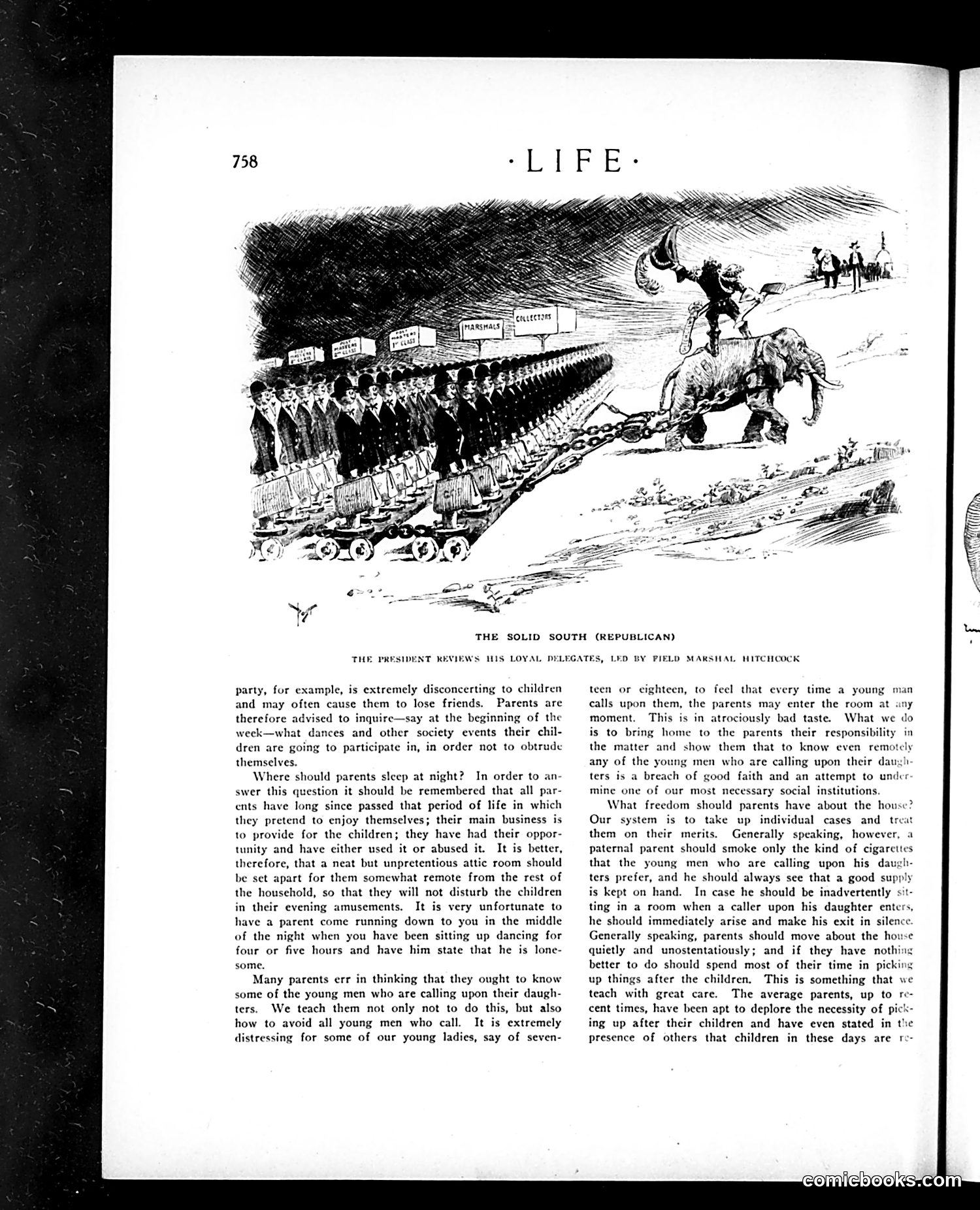
This satirical cartoon depicts the Republican Party's attempt to court Southern Democrats during the Reconstruction era. The image shows a massive elephant (Republican symbol) pulling an enormous train filled with uniformed figures—representing Republican delegates or voters. A figure identified as "Field Marshal Hitchcock" leads them, while various obstacles and figures on the right appear to resist or obstruct their progress. The caption "THE SOLID SOUTH (REPUBLICAN)" mocks Republican hopes of breaking the Democratic stranglehold on Southern politics. The train's struggle against resistance symbolizes the futility of Republican efforts to win over the "Solid South," a voting bloc that remained consistently Democratic. The cartoon satirizes Republican overconfidence in achieving Southern political realignment.
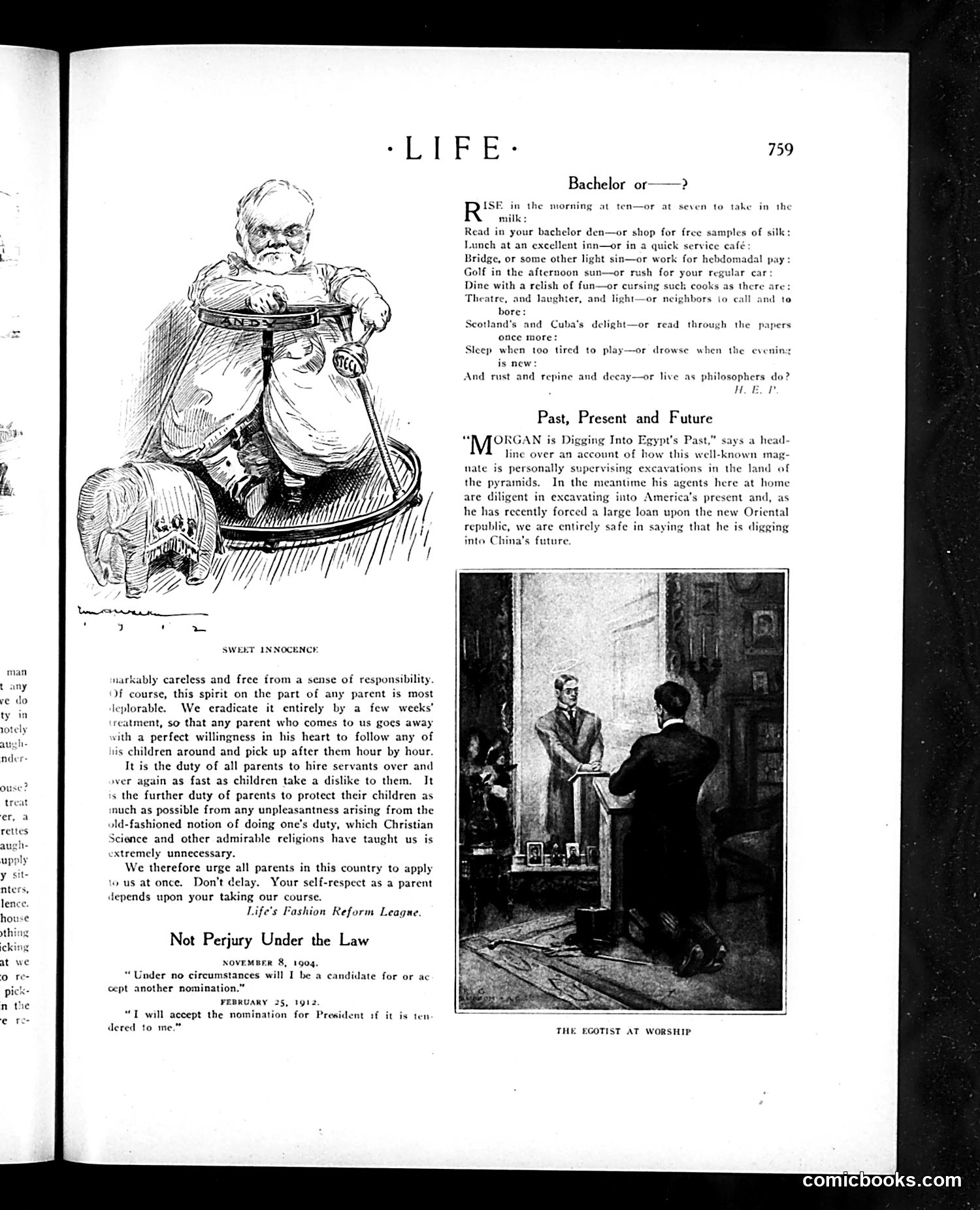
The page contains two distinct satirical pieces: **"Sweet Innocence"** (left): A cartoon mocking overly permissive parenting. The illustrated cherub represents the spoiled child the text describes—one raised without responsibility or discipline. Life's "Fashion Reform League" sarcastically urges parents to hire endless servants to shield children from consequences, satirizing both wealthy indulgence and the era's rejection of Victorian discipline in favor of newer parenting philosophies. **"Not Perjury Under the Law"** (bottom): This attacks Theodore Roosevelt's contradictory statements about presidential ambition. His November 1904 pledge not to seek another term directly contradicts his February 1912 acceptance of the nomination, which Life presents as perjury unpunished by law—mocking his political flip-flopping. **"Past, Present and Future"** (right): Likely references J.P. Morgan's archaeological expeditions in Egypt while satirizing his financial domination of America's present and imperial control of China's future, positioning him as metaphorically "excavating" into global resources.
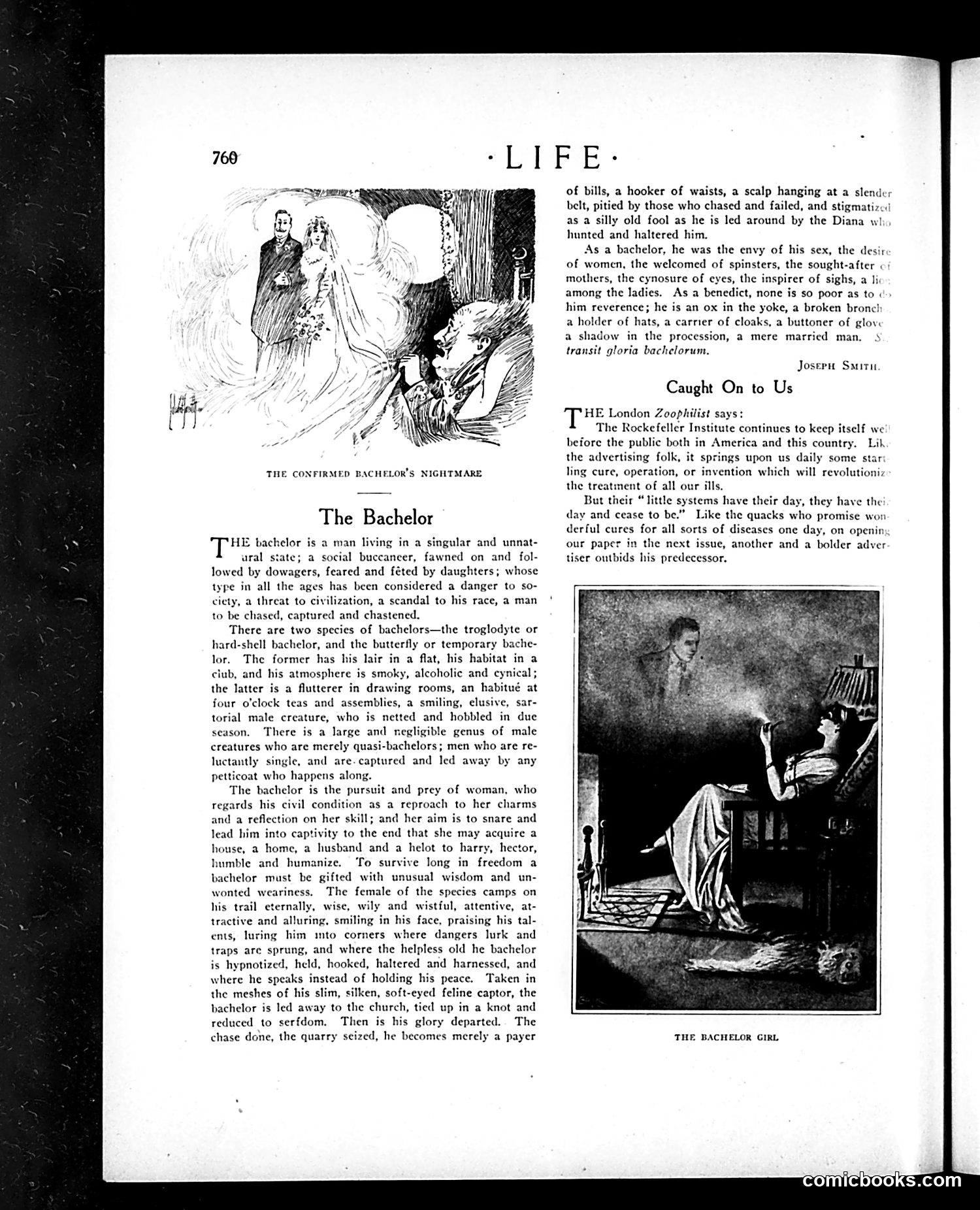
This page satirizes bachelors as social threats, using exaggerated gender warfare rhetoric. The text describes unmarried men as "dangers to society" hunted by women seeking marriage, property, and domesticity. It distinguishes between "hard-shell" bachelors (clubmen living in smoky flats) and "butterfly" bachelors (drawing-room socialites), treating bachelorhood as a temporary, doomed state. The accompanying illustration titled "THE CONFIRMED BACHELOR'S NIGHTMARE" depicts a specter or ghostly vision—likely representing marriage or domesticity—materializing before a horrified man, literalizing the text's predatory framing of women's marital pursuit. The satire mocks both bachelors' self-importance and women's supposed schemes, presenting marriage as the bachelor's downfall: from "envy of his sex" to mere "payer of bills" and "ox in the yoke." The Latin epigraph *transit gloria bachelorum* ("the glory of bachelors passes away") emphasizes this mock-tragic tone.
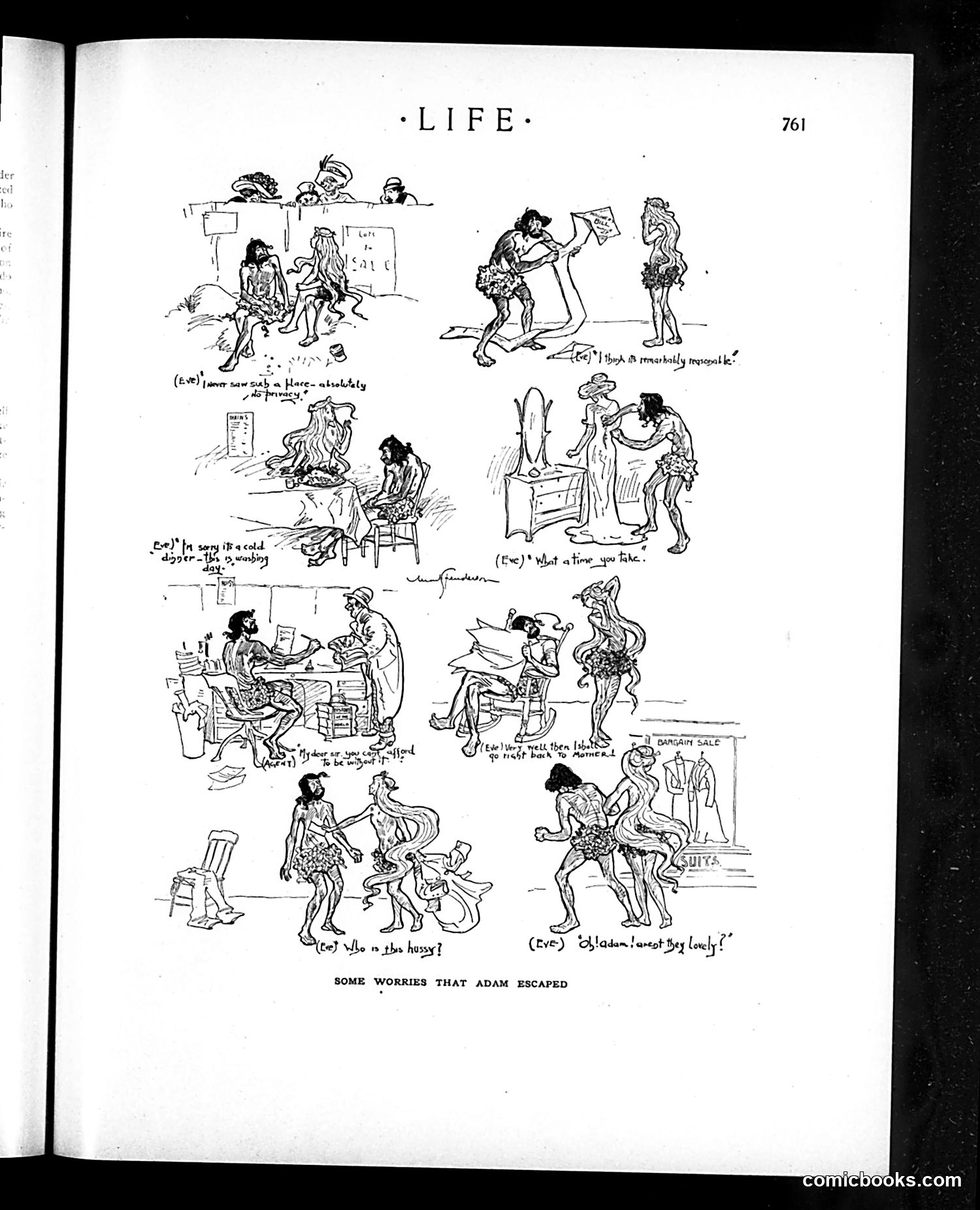
This satirical cartoon series depicts various domestic and social problems presented as situations the biblical Adam avoided by living alone in Eden before Eve's creation. Each panel shows a different "worry": The sequence appears to reference common marital and household frustrations: domestic disputes, financial troubles (a "bargain sale"), childcare challenges, and romantic complications. The cartoons humorously suggest that Adam's solitary existence spared him from the complications of married life and family responsibilities. This reflects early 20th-century satirical humor about gender relations and domesticity, where wives and female companions were portrayed as sources of male anxiety and expense. The biblical framing makes the social commentary tongue-in-cheek—blaming women (and by extension, Eve) for introducing worldly complications into male existence.
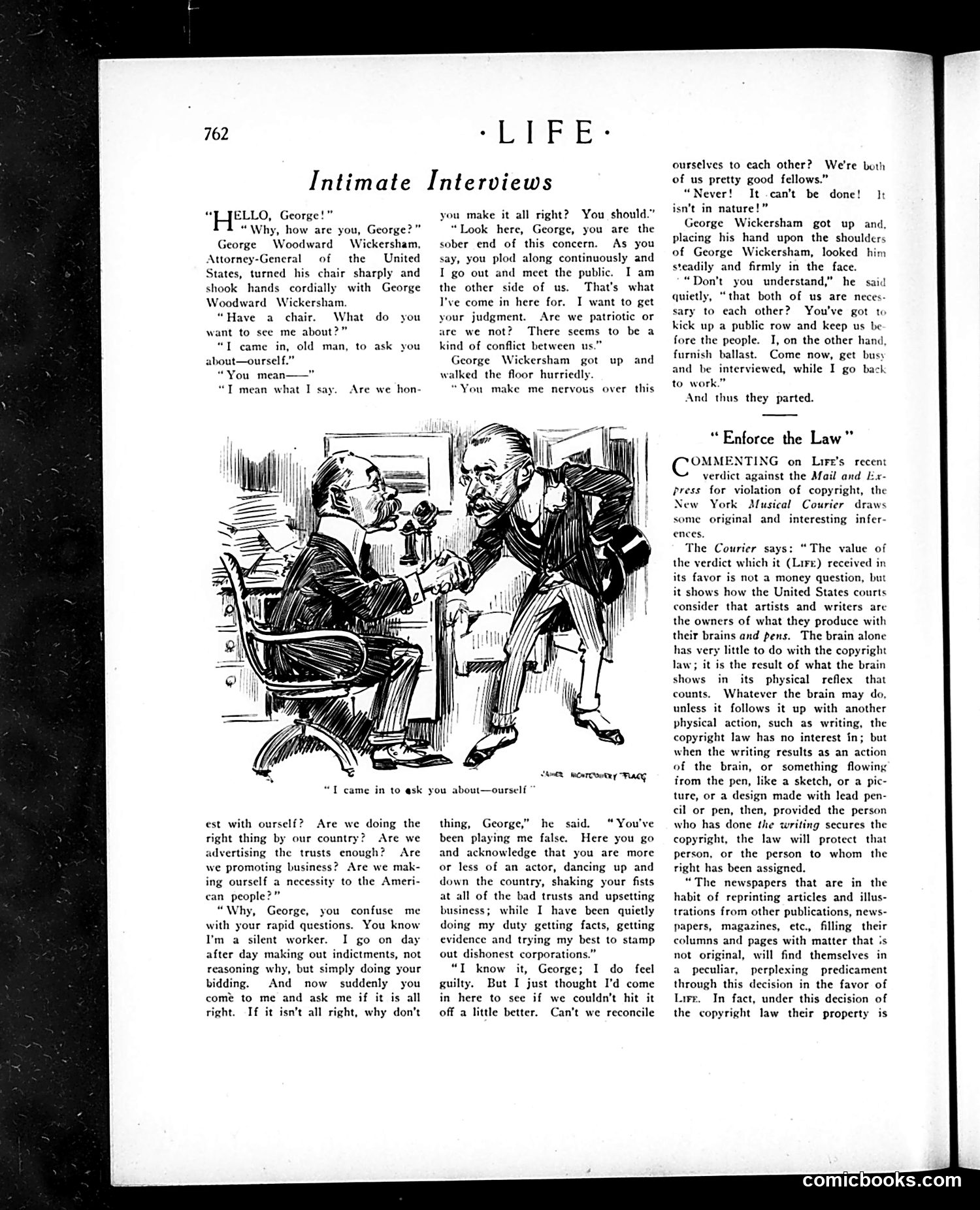
## The Cartoon: "Intimate Interviews" This cartoon depicts Attorney-General **George Wickersham** interviewing himself—a visual pun on his full name appearing twice. The satire critiques the apparent contradiction in his public role: one "Wickersham" aggressively prosecutes trusts and performs theatrical denunciations before the public, while the other quietly handles legal indictments behind the scenes. The cartoon mocks their inability to "reconcile" these two personas, suggesting Wickersham presents a populist anti-trust crusade while potentially enabling corporate interests. The dialogue implies his public trust-busting theater masks less aggressive actual enforcement. This reflects early 20th-century Progressive Era skepticism about whether government trust prosecution was genuine reform or political performance. ## "Enforce the Law" Section This brief commentary on a recent court verdict (Lire v. Mail and Express) regarding copyright protection argues that intellectual property laws only protect work when ideas manifest in physical form—writing, sketching, or design. It advocates stronger legal protection for creators and criticizes newspapers reprinting others' content without compensation.
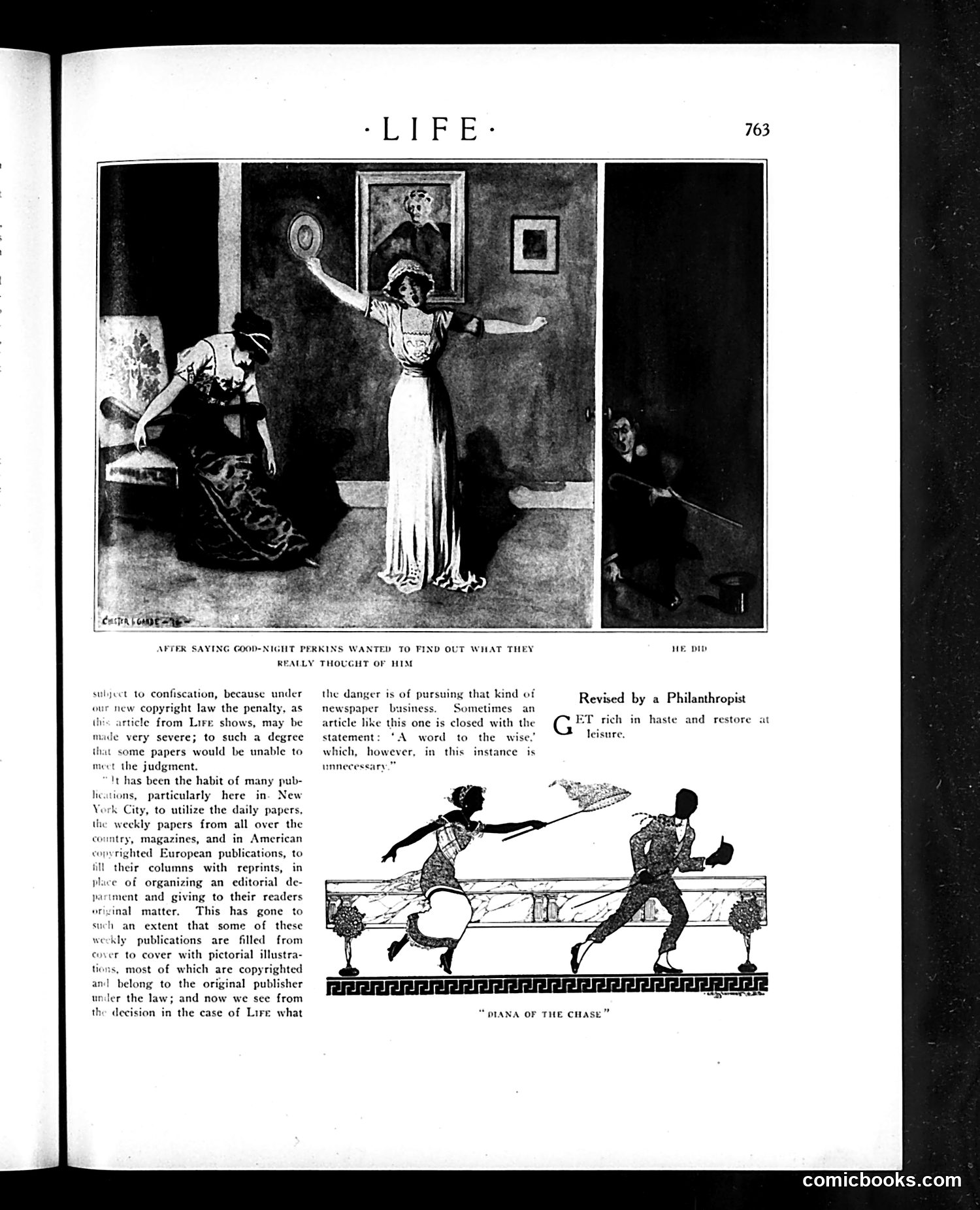
The top cartoon satirizes social hypocrisy. After Perkins says goodnight to hosts, he apparently eavesdrops or somehow discovers their true unflattering opinions of him—contrasting polite facade with private judgment. The joke concerns the gap between public courtesy and private gossip. The lower illustration, "Diana of the Chase," appears decorative rather than satirical—a classical-style scene of figures in pursuit. The surrounding text discusses copyright law violations by publications reprinting material without permission. Life uses this space to editorialize about publishers filling pages with copyrighted illustrations from other sources rather than creating original content. The heading "Revised by a Philanthropist" appears ironic, suggesting someone correcting or "improving" content. The overall page addresses publishing ethics and legal consequences rather than specific political figures or events.
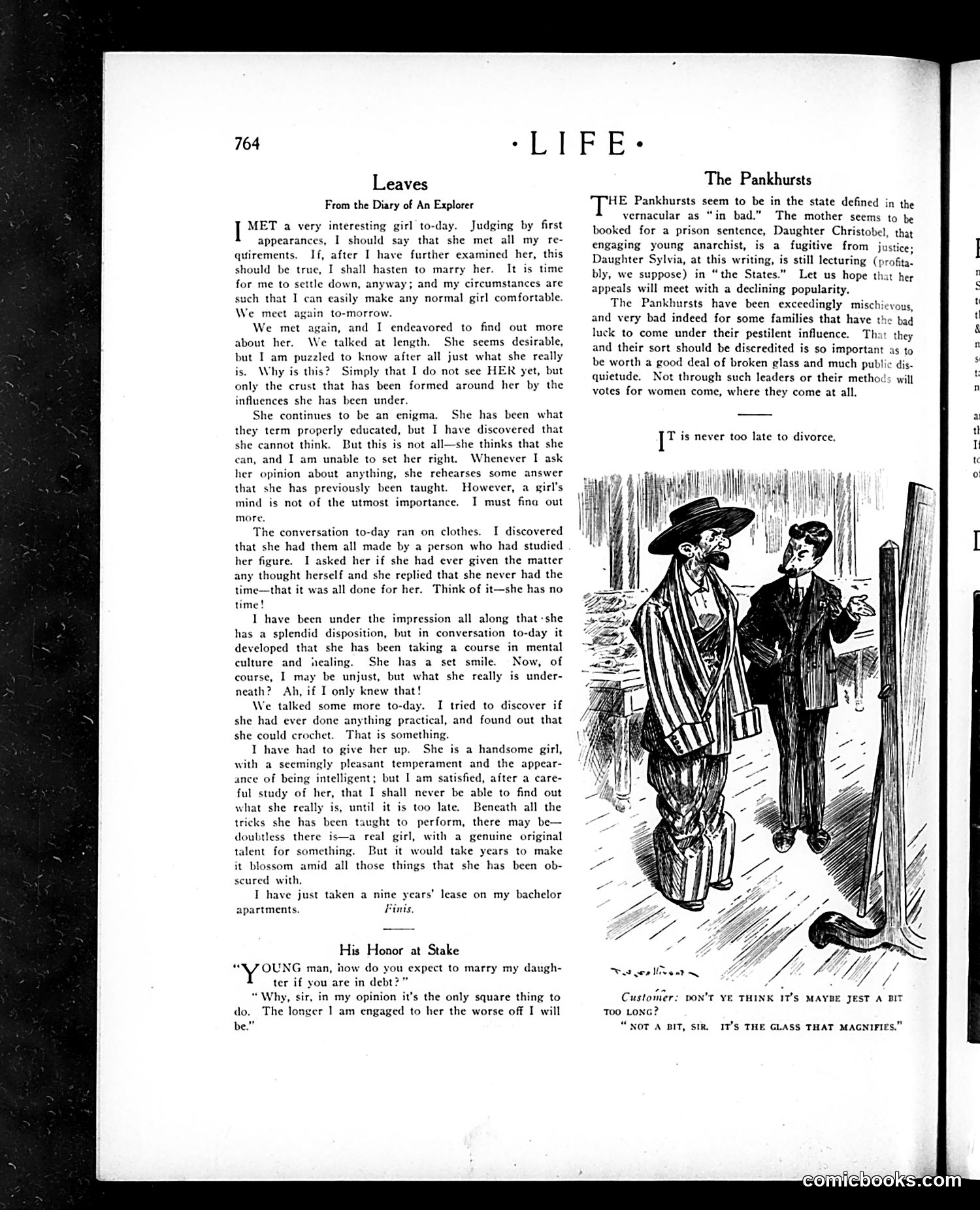
This page contains three distinct pieces of satire from *Life* magazine (likely early 1900s): **"Leaves from the Diary of an Explorer"**: A man seeking a wife examines a young woman as if she's a scientific specimen. The joke is that despite her education and pleasant appearance, she lacks original thought—she merely recites lessons, has a forced smile from "mental culture" courses, and has outsourced all decisions (clothing, thinking) to others. The satire criticizes how women of that era were trained to be decorative rather than intellectually independent. He ultimately gives up, unable to find her authentic self beneath the "tricks she has been taught." **"His Honor at Stake"**: A young man in debt argues it's logical to marry quickly—staying engaged longer only worsens his finances. Dark humor about courtship and debt. **"The Pankhursts"**: A criticism of the famous suffragist family (Emmeline and daughters Christabel and Sylvia), describing them as "mischievous" and "bad," opposing their militant tactics (vandalism: "broken glass") while grudgingly acknowledging women deserve voting rights—but "not through such leaders."
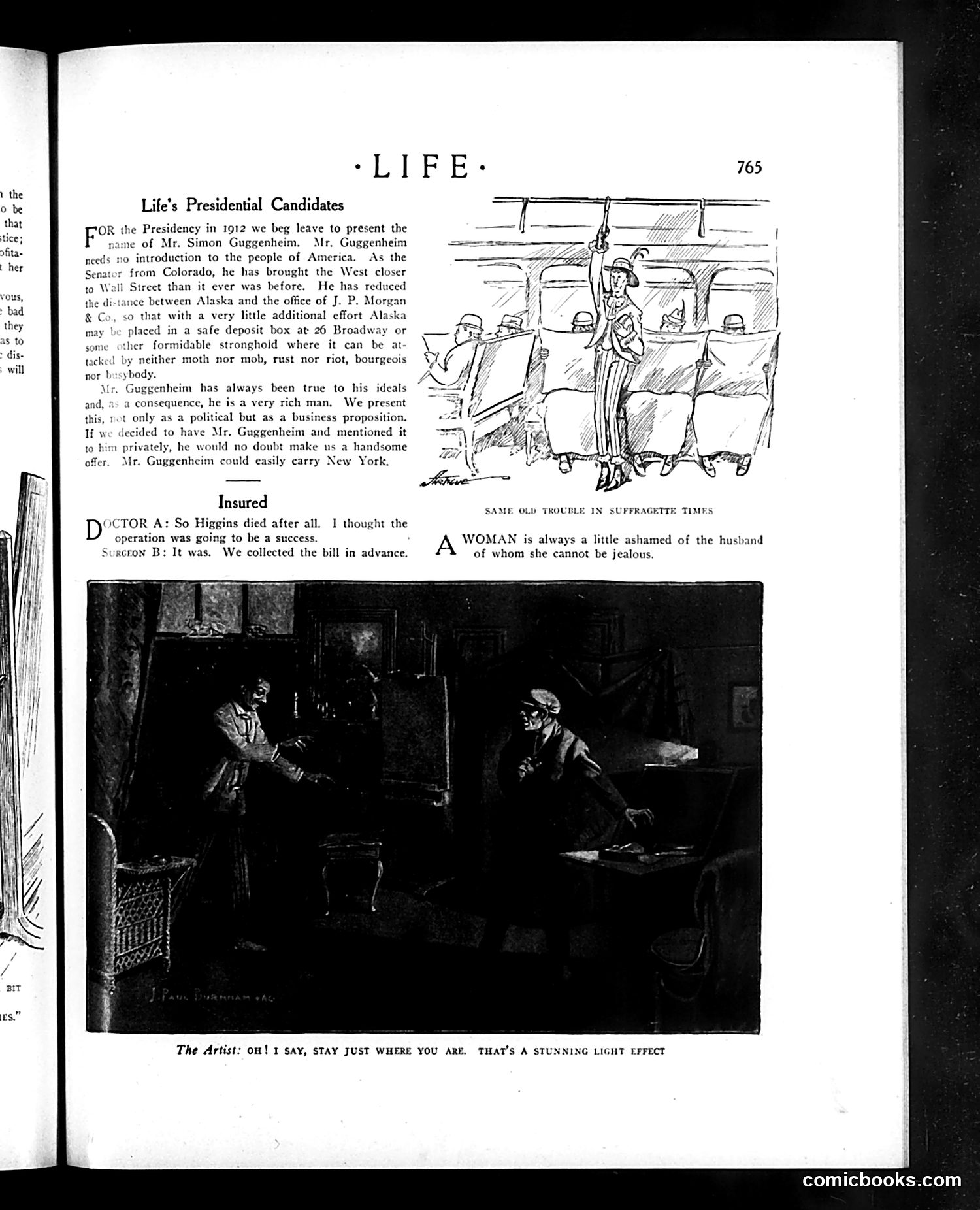
**"Life's Presidential Candidates" section:** This mocks Simon Guggenheim, a wealthy Colorado senator and mining magnate, as a 1912 presidential prospect. Life's satire argues Guggenheim represents the dangerous influence of Wall Street finance over Western resources—he's brought Alaska and the West under the control of J.P. Morgan & Co.'s financial empire. The cruel joke: Life suggests they could bribe Guggenheim into candidacy privately, treating high office as a business transaction. This reflects Progressive Era criticism of oligarchs and corporate capture of politics. **Lower cartoons:** "Insured" jokes darkly about a surgeon billing patients before confirming successful outcomes. "Same Old Trouble in Suffragette Times" shows a woman interrupting an artist's work, with accompanying text about female jealousy—a misogynistic reference to contemporary women's suffrage activism, implying women's participation in public life creates domestic disruption.
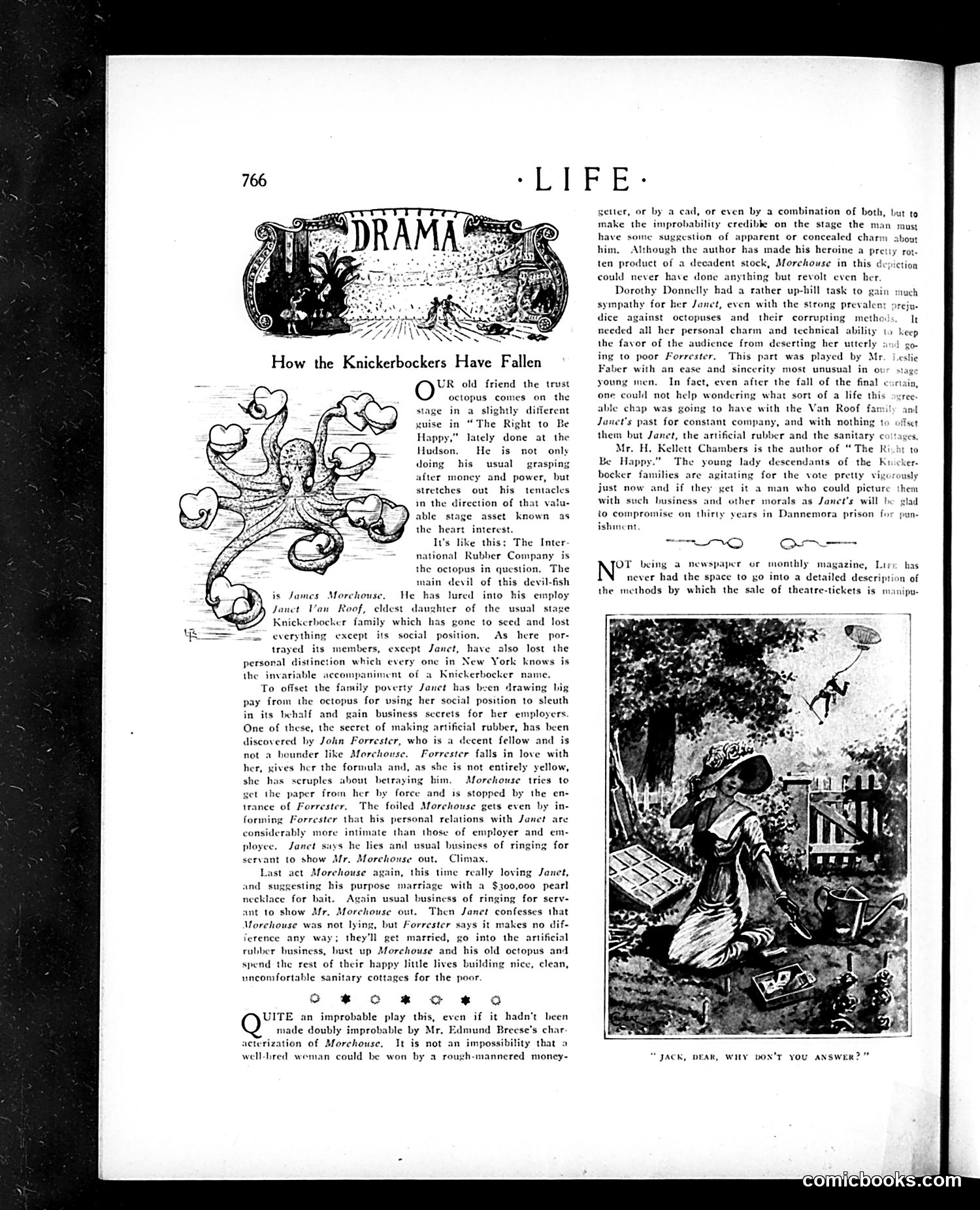
This page reviews a Broadway play featuring a familiar Progressive-era villain: the **trust octopus**—a corporate monopoly (here, the International Rubber Company) personified as a predatory creature. The octopus's human agent, **James Morehouse**, exploits a desperate socialite, **Janet Van Roof**, from an impoverished Knickerbocker family. She uses her aristocratic name to spy for the company. The plot involves a love triangle: honest inventor John Forrester offers her redemption through marriage, but Morehouse blackmails her with false intimacy claims. The reviewer critiques the production's implausibility—arguing that actor Edmund Breese fails to make the villainous Morehouse charming enough to believably seduce anyone. The satire targets both **corporate corruption** and **old money decay**: the Knickerbocker family's social pretension masks financial ruin, making them vulnerable to exploitation. The happy ending—marriage and fighting the monopoly—reflects Progressive idealism about defeating big business through virtue and honest enterprise.
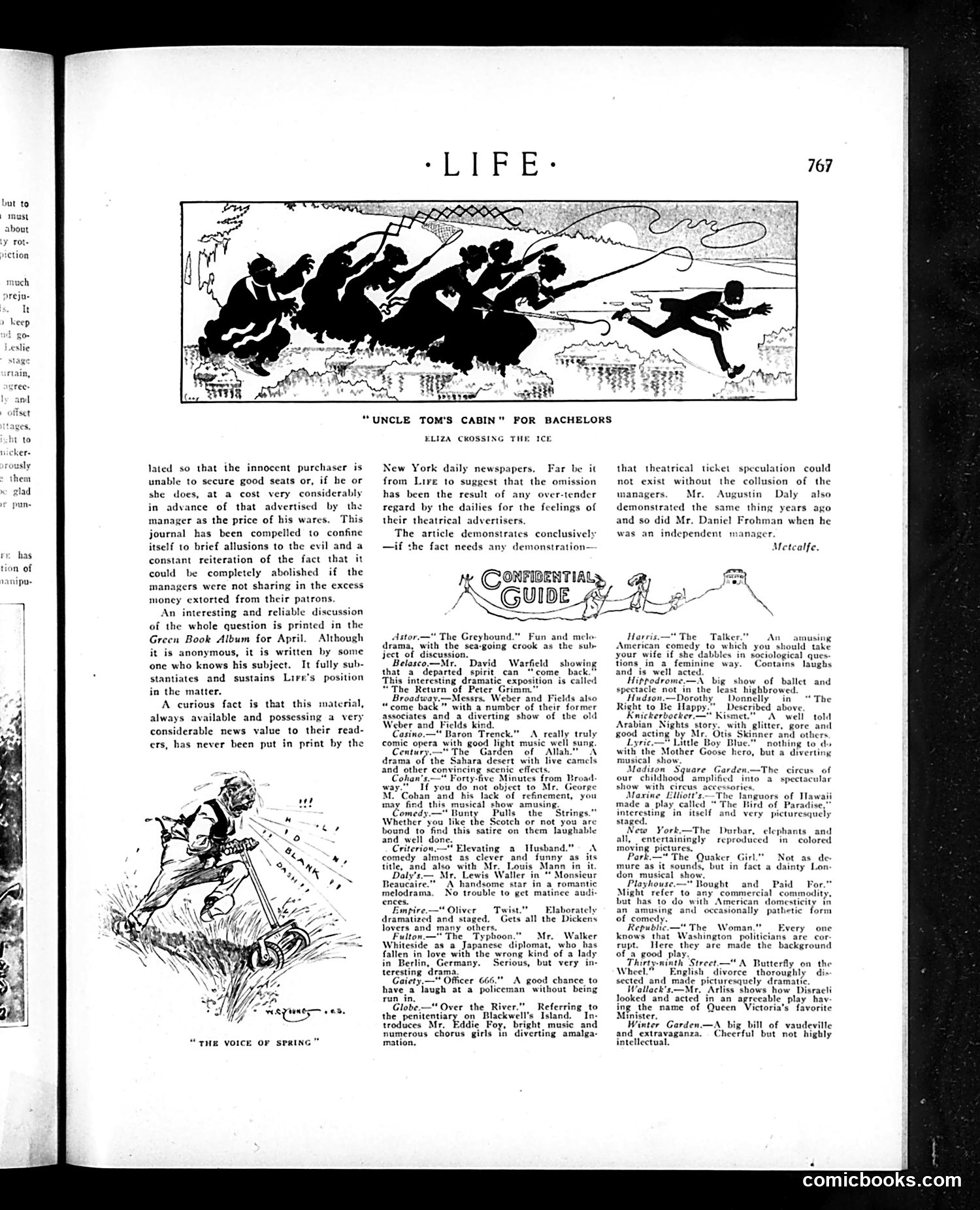
The top illustration, titled "Uncle Tom's Cabin for Bachelors—Eliza Crossing the Ice," is a silhouette cartoon satirizing theatrical ticket speculation. It depicts a woman (Eliza, the famous character fleeing slavery) pursued across ice by men in top hats—likely representing theater managers and speculators profiting from ticket sales. The page's main text criticizes how theater managers collude with ticket speculators to artificially inflate prices beyond advertised rates, making seats unaffordable for ordinary patrons. Life magazine argues this corrupt practice could not exist without managerial complicity, citing past managers like Augustin Daly and Daniel Frohman who exposed the scheme. The bottom section is a theater guide ("Confidential Guide") reviewing current Broadway productions, a regular Life feature. **The satire's point**: Theater managers—depicted as pursuing hunters—prey on innocent patrons just as Eliza was hunted, but through financial exploitation rather than slavery.
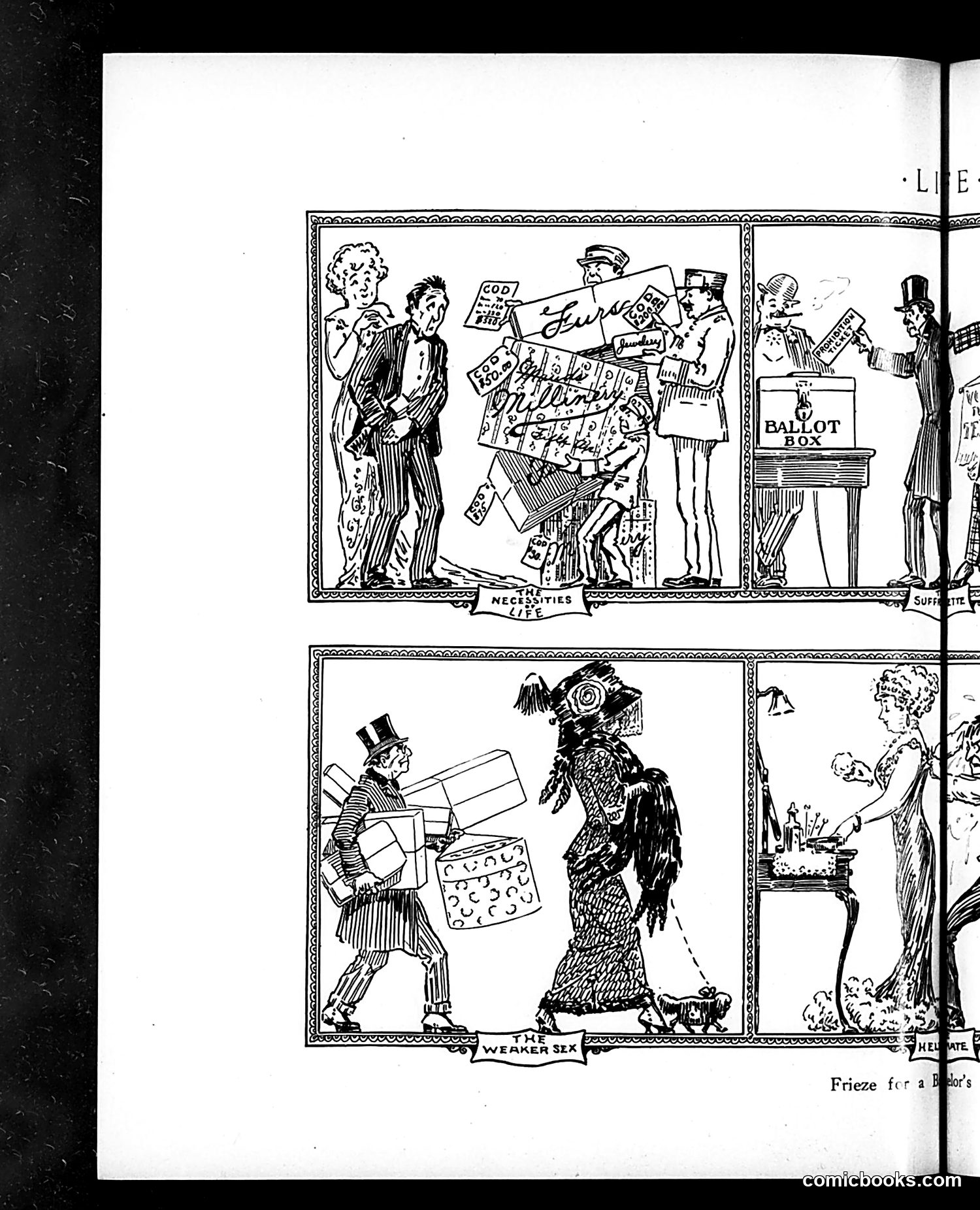
This page presents two satirical comic panels titled "Frieze for a Bishop's" (likely referring to a bishop's residence or church). **Top panel** ("Necessities of Life"): Shows various figures distributing or promoting items—politicians, salesmen, and citizens exchanging goods and documents, with a ballot box visible. This satirizes how "necessities" are actually commercial products and political promises being pushed on the public. **Bottom panel** ("Weaker Sex"): Depicts a man in formal dress presenting elaborate goods/supplies to a fashionably-dressed woman, mocking gender stereotypes about women's supposed material frivolousness and dependence on male providers. Both panels use exaggerated caricature to critique early 20th-century consumer culture, gender roles, and political manipulation—suggesting that both commerce and gender relations were being satirized as performative and absurd.
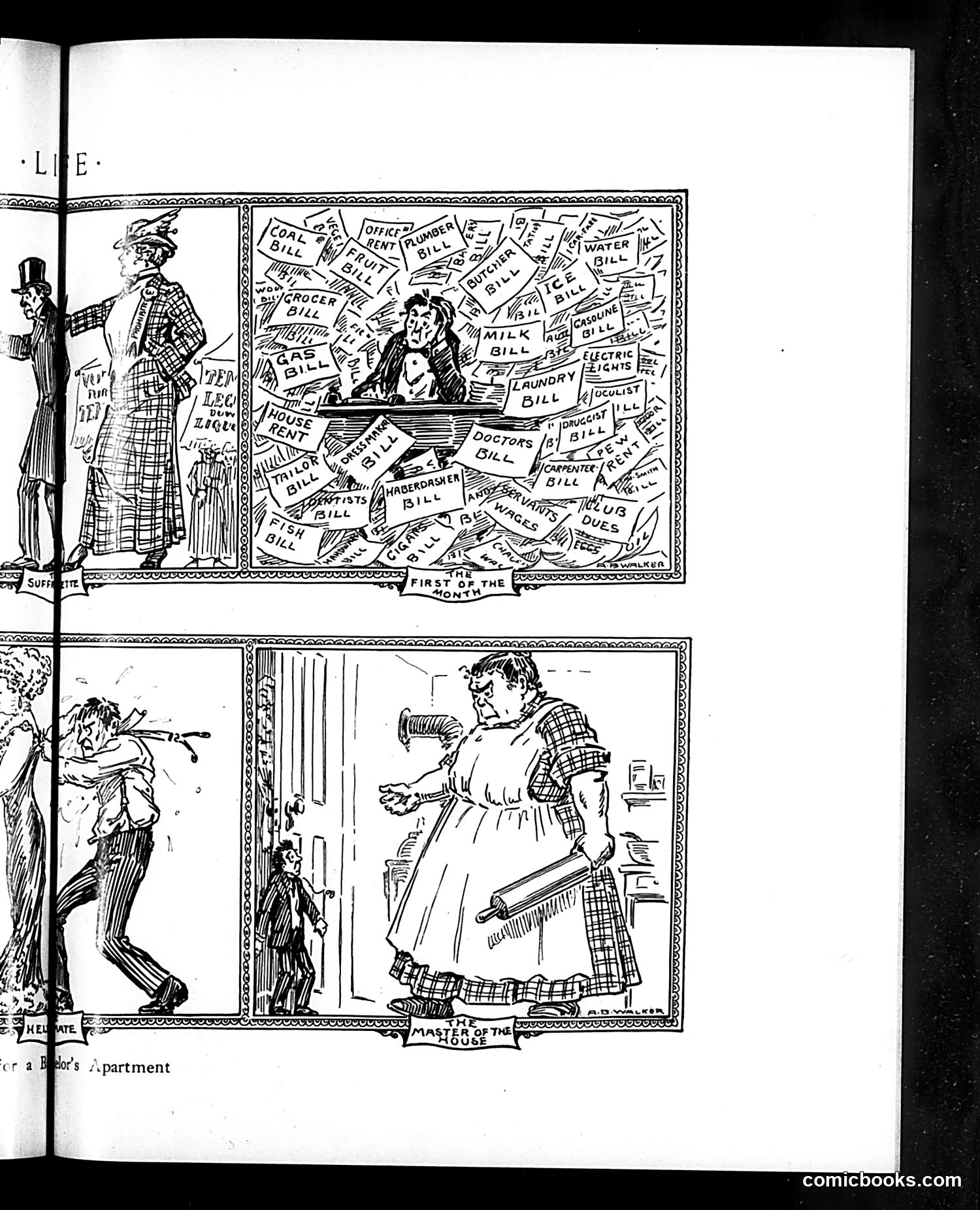
This two-panel comic satirizes household financial strain. The top panel shows a overwhelmed man surrounded by bills (coal, rent, grocer, milk, doctor, etc.)—a visual chaos representing mounting domestic expenses. The caption "First of the Month" references payday and bill-paying day. The bottom panel, titled "Master of the House," depicts an assertive woman wielding what appears to be a rolling pin or broom, literally dominating the domestic space while a smaller man cowers. The ironic caption suggests that despite being called "master," the husband has no actual authority—the wife controls household finances and decisions. This reflects early 20th-century anxieties about gender roles and economic pressure on working-class families, using humor to address the gap between traditional patriarchal ideology and actual household power dynamics.
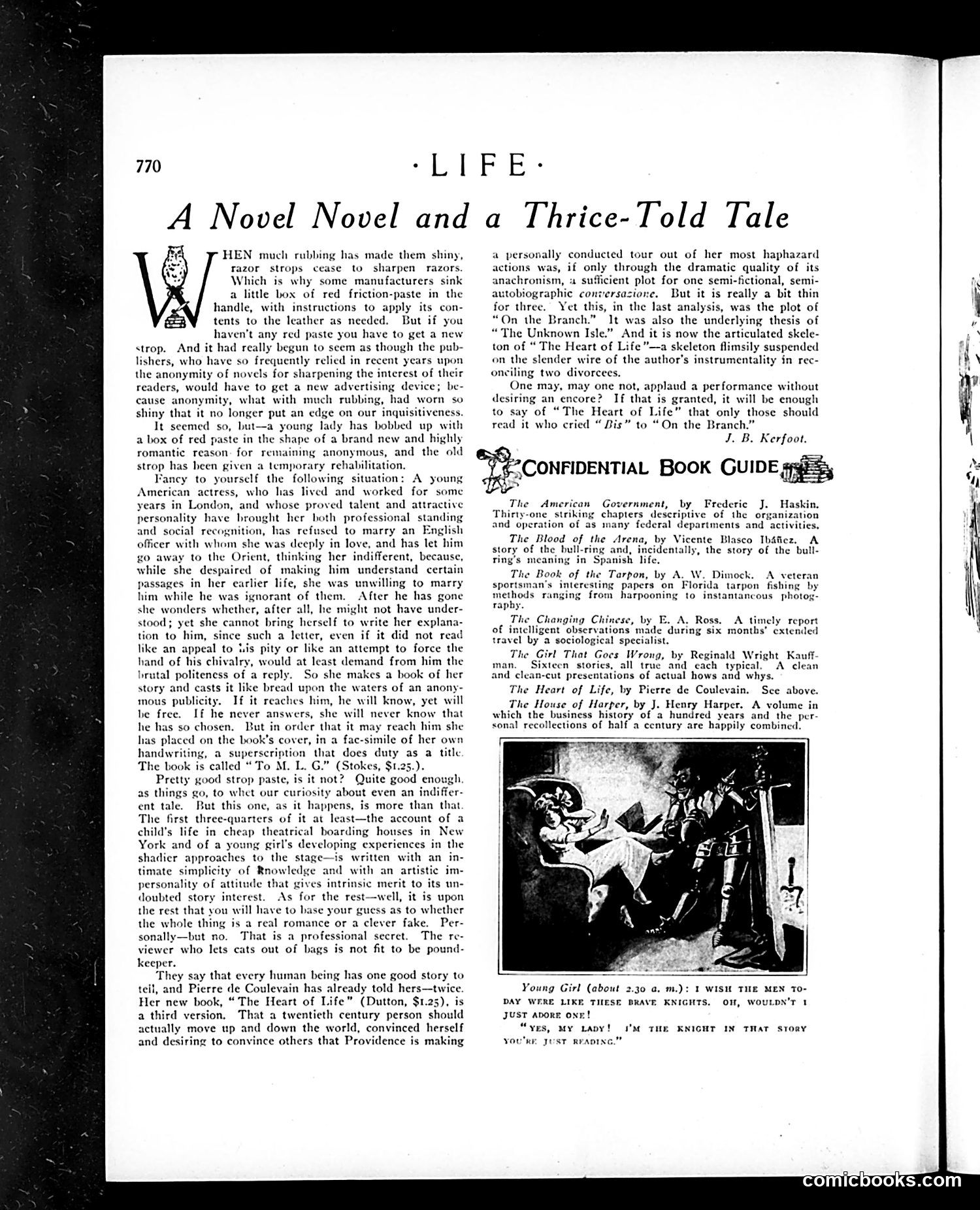
This page reviews three books while satirizing publishing trends. The main article critiques the overuse of **anonymous publication as a marketing gimmick**—comparing it to a worn-out razor strop that's lost its edge through excessive use. The featured book, "To M. L. G." (anonymous), uses a romantic premise to justify anonymity: an American actress publishes her story unsigned, hoping her English lover will recognize himself and understand her past without her directly explaining it. The reviewer finds this ploy clever enough to generate interest, though somewhat manipulative. The page also mocks **Pierre de Coulevain**, an author rehashing her own story for the third time in "The Heart of Life," criticizing her for pretending divine providence orchestrates her mundane life—an absurdly self-important conceit for a modern person. The cartoon caption (partially visible) appears to reference theatrical melodrama, supporting the page's broader theme: publishing relies heavily on manufactured intrigue rather than genuine literary merit.
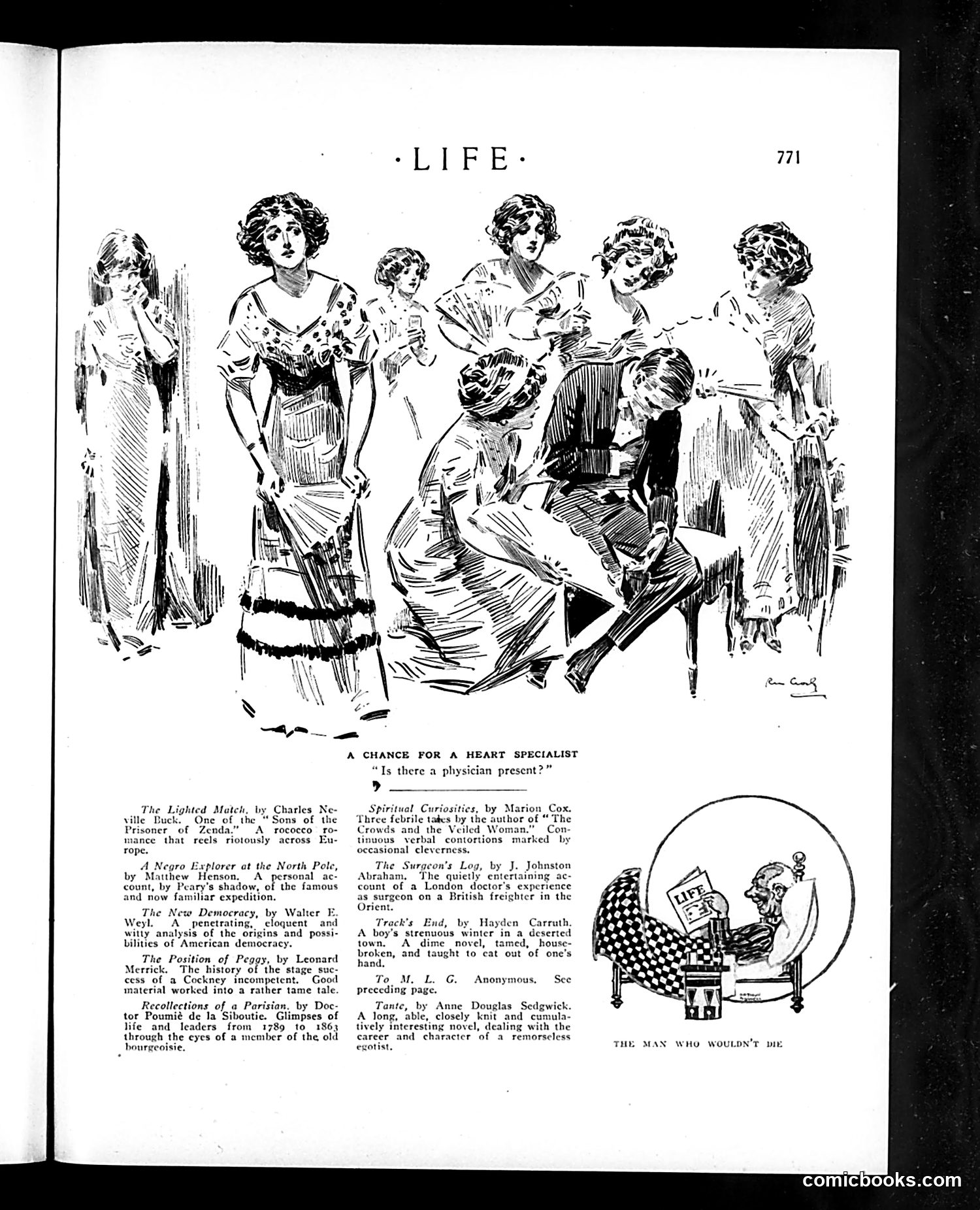
The main cartoon depicts a social gathering of well-dressed women, with one asking "Is there a physician present?" The satire targets the emotional drama and romantic entanglements typical of early 1900s high-society gatherings—the implication being that someone's heart (literally or figuratively) requires medical attention, likely due to romantic distress or scandal. The page functions primarily as a book review section from *Life* magazine, listing contemporary publications with brief critical commentary. The cartoon's caption plays on the magazine's sophisticated, witty style: it suggests that among such emotionally volatile social circles, a heart doctor would find plenty of business. The illustration on the right, "The Man Who Wouldn't Die," appears unrelated to the main content—likely advertising or editorial filler common to period magazines.
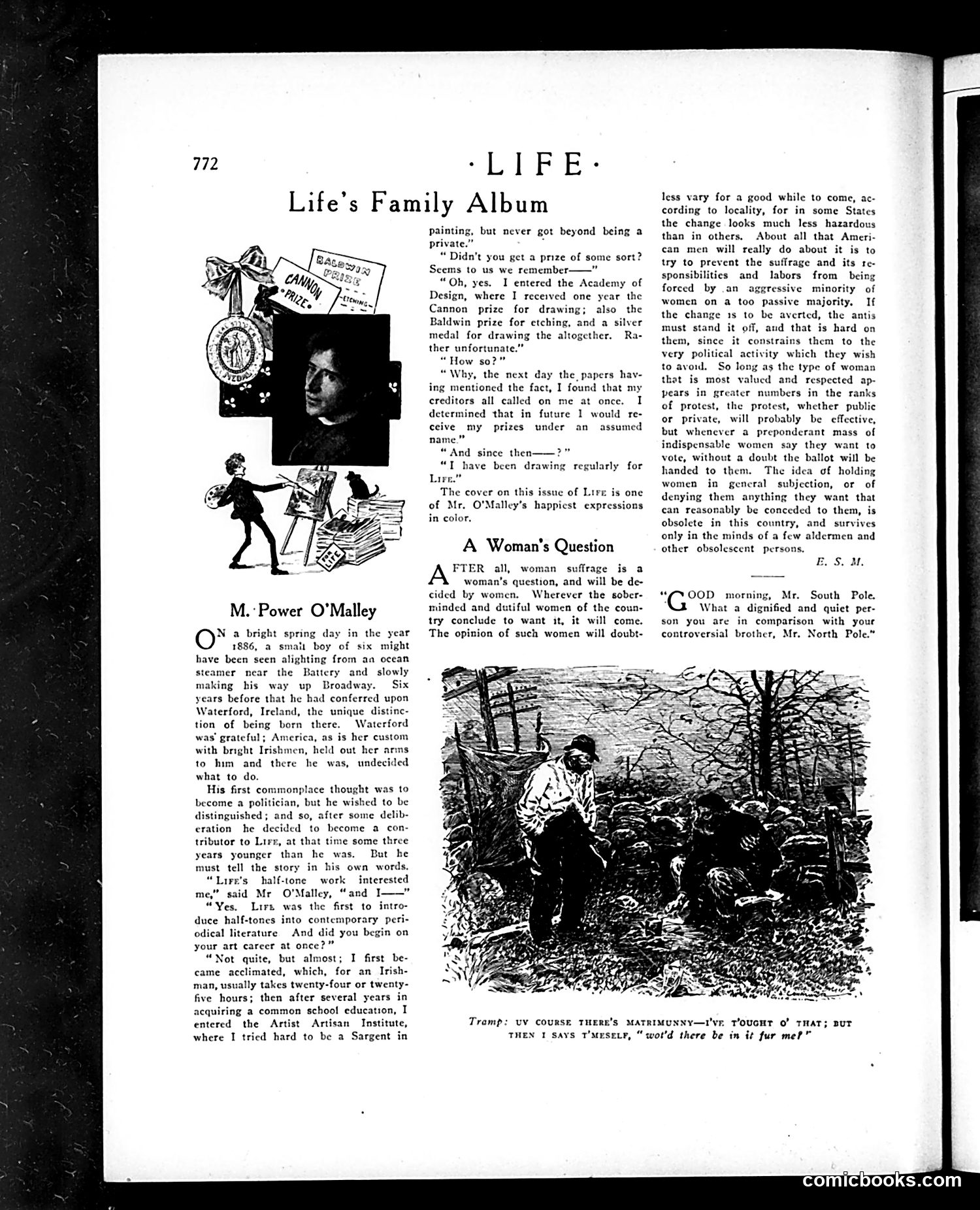
This page profiles **M. Power O'Malley**, an Irish-born artist and contributor to *Life* magazine. The biographical interview humorously describes O'Malley's journey from arriving in America in 1886, through art training, to becoming a cartoonist for *Life*. The satire lies in his deadpan anecdotes—particularly how winning prizes immediately summoned creditors, forcing him to accept future awards under assumed names. The second section, "A Woman's Question," addresses **women's suffrage**, then a contemporary political debate. The editorial argues that women themselves will decide the issue; male opposition cannot permanently prevent it. The argument is pragmatic rather than ideological: women's participation in protest movements suggests inevitable enfranchisement. The bottom illustration shows two personified **polar regions** debating matrimony, a visual pun unrelated to suffrage. These pieces reflect *Life*'s early editorial stance: supporting women's voting rights while depicting the suffrage debate as socially inevitable rather than radical.
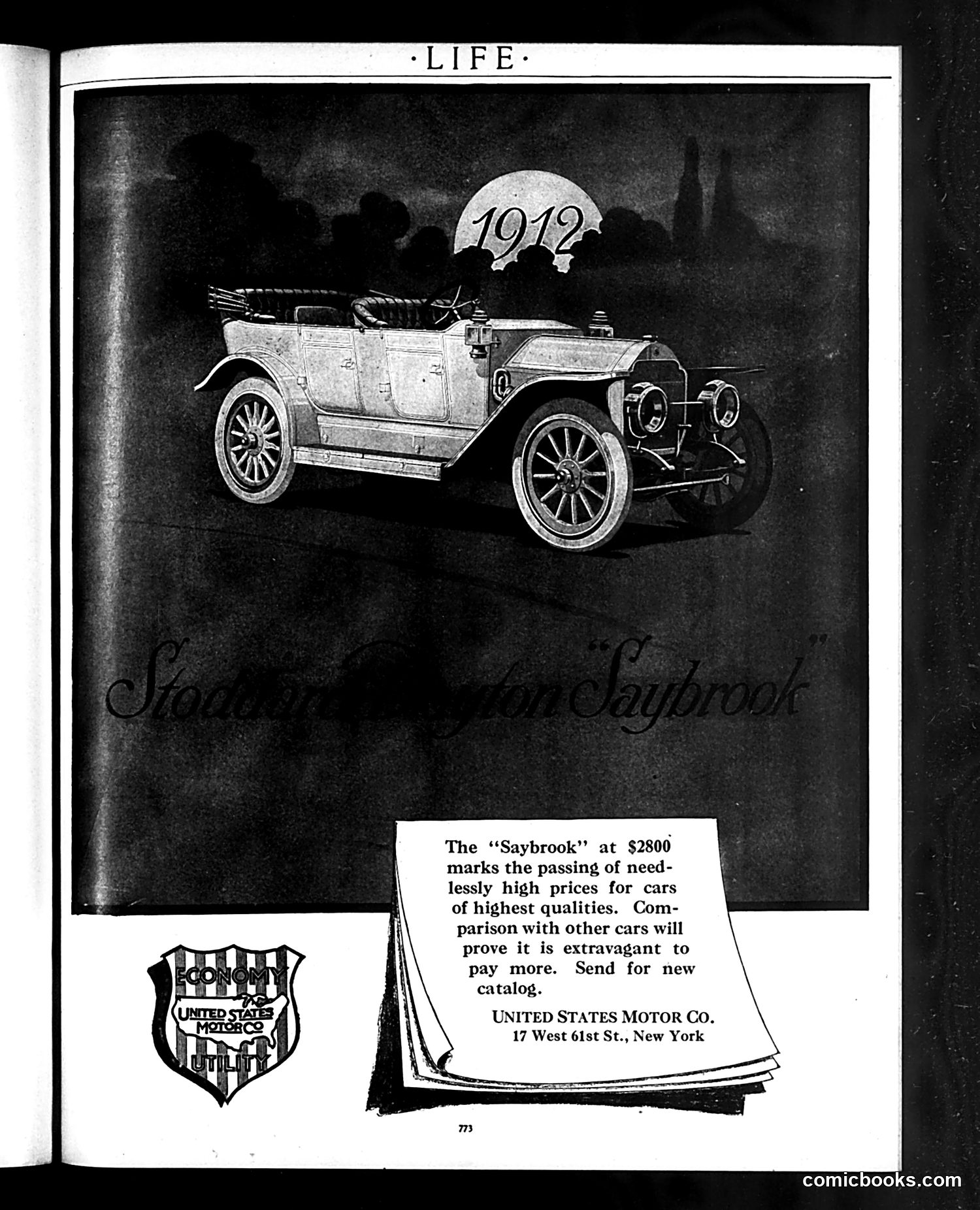
This is primarily an **advertisement**, not a political cartoon. It features a 1912 automobile called the "Saybrook" manufactured by United States Motor Co. The ad's satire is **commercial rather than political**: it mocks competitors by claiming the Saybrook offers luxury quality at $2,800—positioning this price as surprisingly *low* for such high-quality craftsmanship. The tagline "marks the passing of needlessly high prices" suggests rival automakers were overcharging consumers. The illustrated car is rendered in the detailed technical style typical of early automotive advertising. The United States Motor Co. shield logo appears at bottom left. This reflects the competitive early American automobile market, where manufacturers battled for customers by claiming superior value.
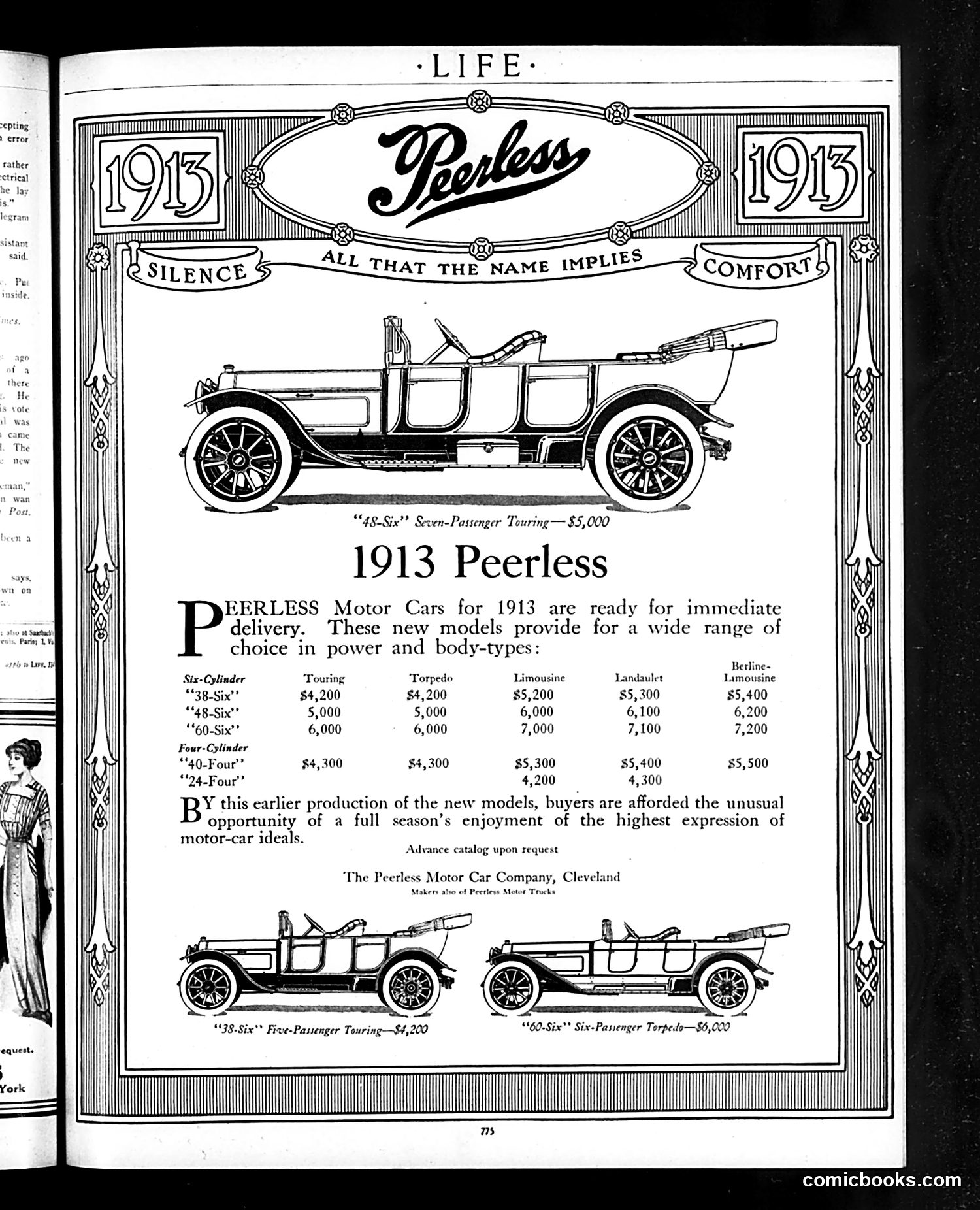
This page is primarily **a full-page advertisement**, not satire or political commentary. It advertises the 1913 Peerless automobile from Cleveland, Ohio. **Content:** The ad features three line-drawn automobiles showcasing different body styles (touring, torpedo, limousine, landaulet). A pricing table lists six-cylinder and four-cylinder models ranging from $4,200 to $7,200. **Context for modern readers:** This represents early automotive marketing when cars were luxury goods for the wealthy. The tagline "Silence, Comfort" and phrase about "highest expression of motor-car ideals" highlight features that distinguished quality vehicles then. The variety of body-type options reflects that cars were still semi-custom purchases. The decorative border and typography are typical of *Life* magazine's 1913 advertising aesthetic—elegant, formal design befitting a luxury product marketed to affluent readers.
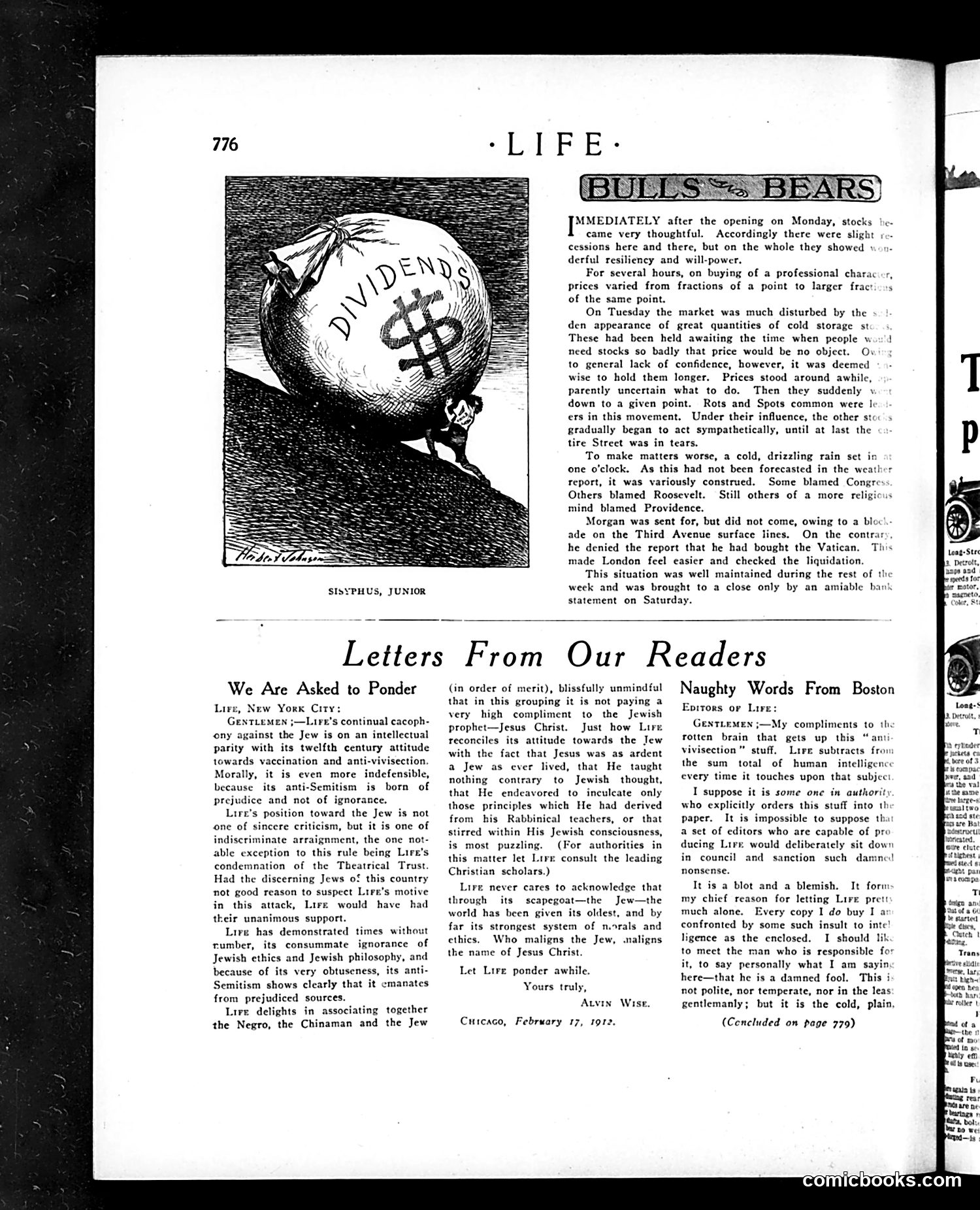
**The Cartoon ("Sisyphus, Junior"):** This political cartoon depicts a figure (likely representing the stock market or financial system) straining to push a large sphere labeled "DIVIDENDS" with a dollar sign uphill. The reference to Sisyphus—the mythological figure condemned to eternally roll a boulder uphill—suggests the futility and cyclical nature of financial struggle. **The Context:** The accompanying article describes stock market turbulence in early 1912, with prices fluctuating wildly. The cartoon satirizes how investors perpetually chase dividends in an exhausting, ultimately futile effort. The "cold storage stocks" suddenly released and market panic suggest artificial market manipulation and speculation. **The Satire:** The cartoon mocks both the stock market's inherent instability and investors' doomed persistence in trying to profit from it. By invoking Sisyphus, *Life* implies that financial markets are fundamentally rigged or irrational—endless toil with no real progress. **Note:** The page also contains reader letters criticizing *Life*'s anti-Semitic editorial stance, indicating contemporary pushback against the magazine's documented prejudice.
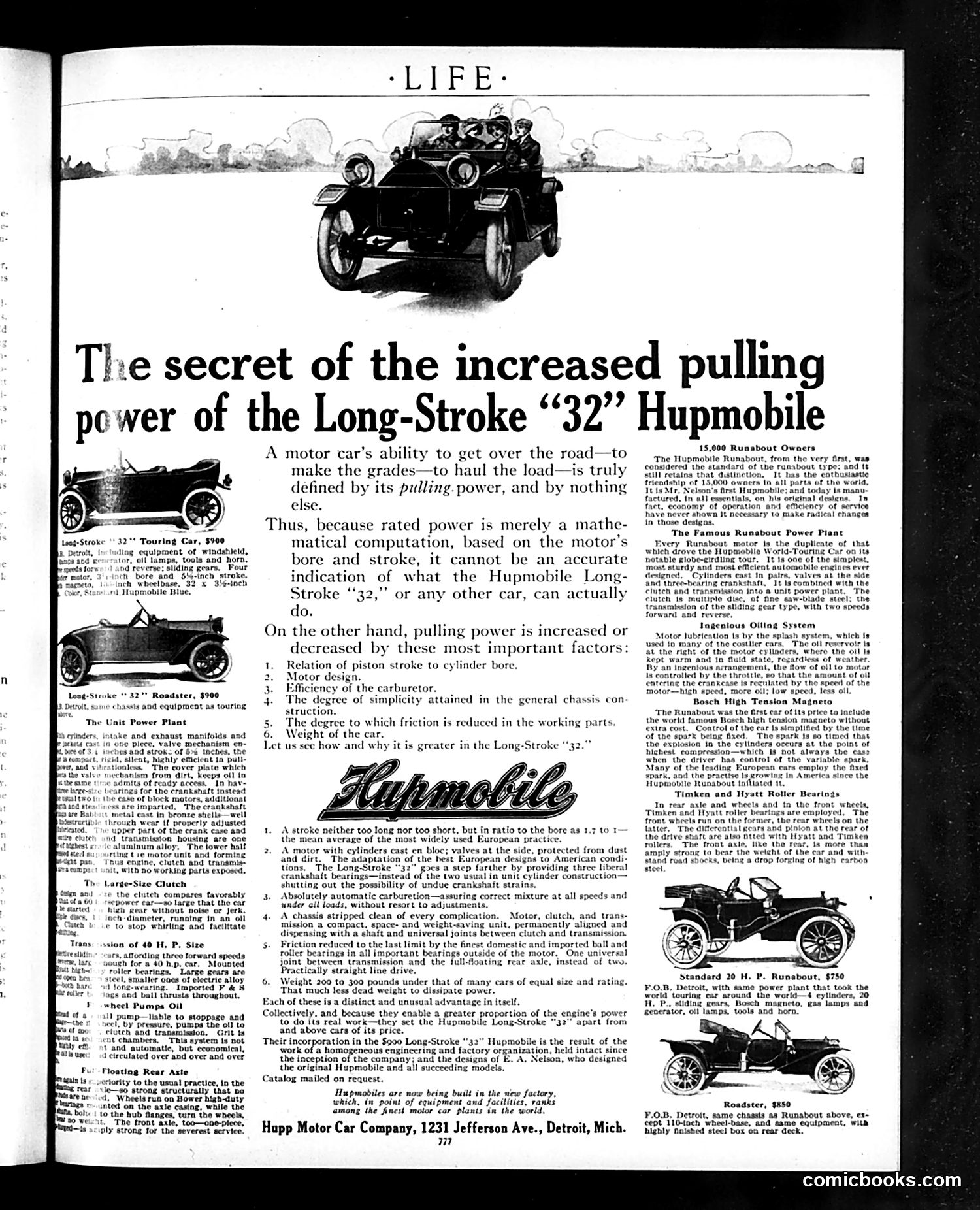
This page is primarily a **product advertisement**, not political satire. It promotes the Hupmobile Long-Stroke "32" automobile, emphasizing its superior "pulling power" compared to competitors. The advertisement argues that actual pulling power—a car's ability to climb grades and haul loads—matters more than rated horsepower. It lists six technical factors explaining why the Hupmobile excels: optimal stroke-to-bore ratio, motor design, carburetor efficiency, chassis simplicity, reduced friction, and weight. The three car illustrations show different models (Touring Car at $988, Roadster at $900) to display the vehicle from various angles. This represents early automotive marketing strategy: using technical specifications and comparative claims to establish superiority during the competitive early motorcar era. There is no political cartoon or social satire present—it's straightforward commercial advertising from the Hupp Motor Car Company of Detroit.
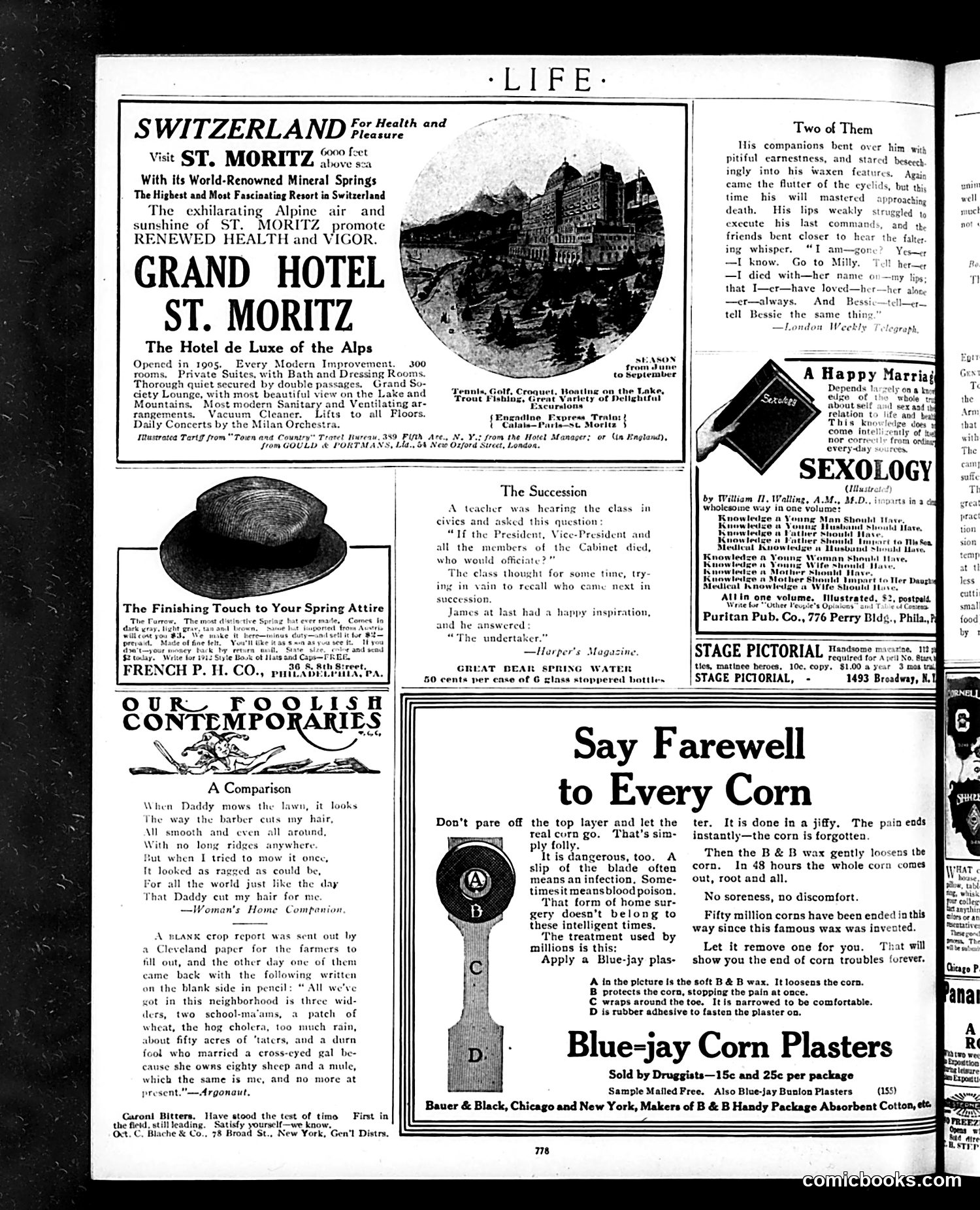
This page is primarily **advertisements and light humor columns**, not political satire. The content includes: **Main Features:** - A luxury Swiss hotel ad (Grand Hotel St. Moritz) - A comic section titled "Our Foolish Contemporaries" featuring two brief humorous anecdotes: one comparing a father's lawn-mowing to his daughter's failed attempt, and another where a civics student answers "the undertaker" when asked who would succeed if the President and Cabinet died **Context:** The civics joke relies on early-20th-century American knowledge of presidential succession. The humor is gentle—poking fun at a student's absurd but logical answer rather than making a political point. **Advertising:** The remaining page space is filled with advertisements for spring fashion, corn plasters, books on sexology, and theatrical magazines—typical of *Life* magazine's mixed content model during this era. This is **not satirical commentary** but rather light entertainment and commercial content typical of American magazines circa 1910s-1920s.
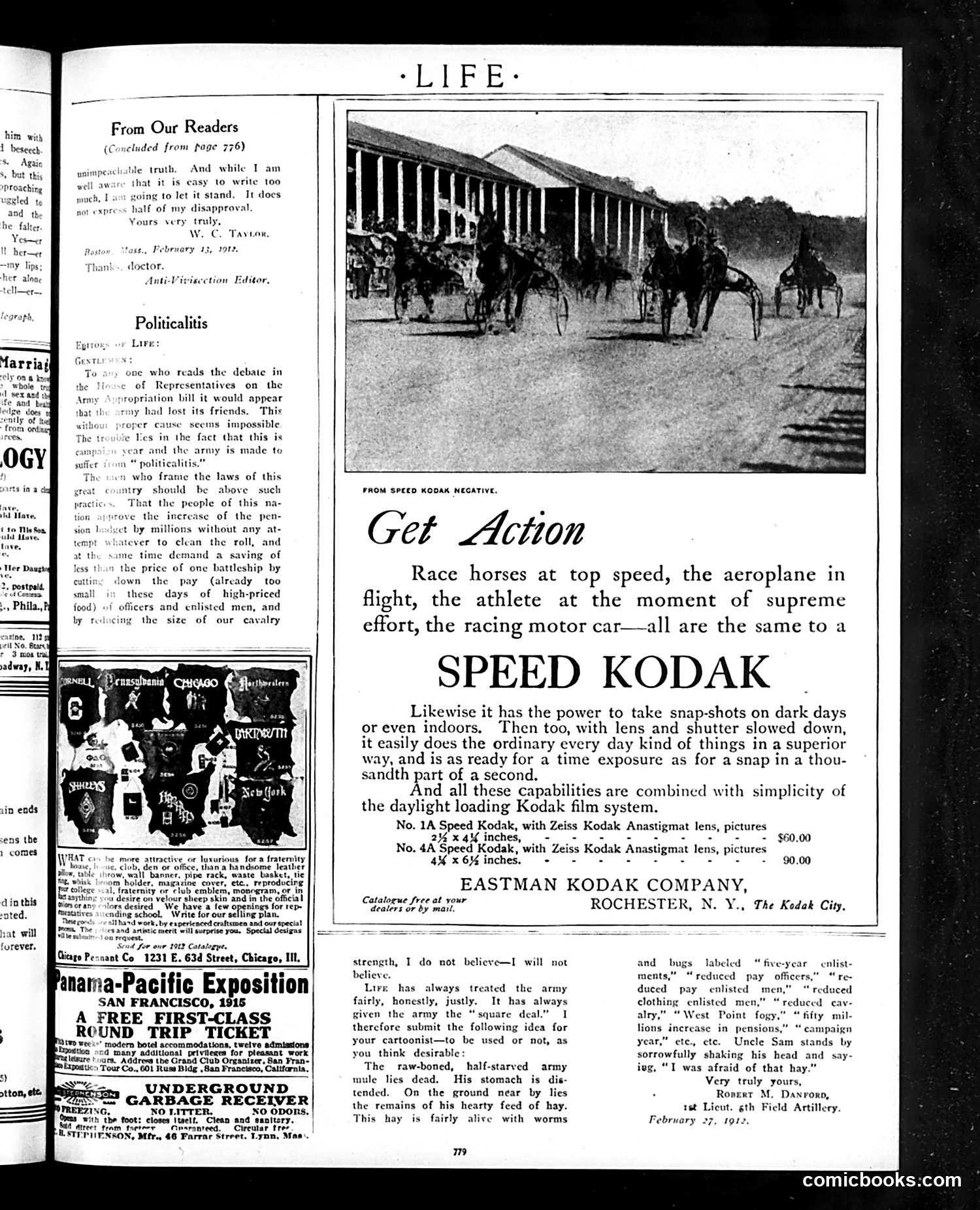
This page contains reader letters and a Kodak advertisement rather than political cartoons. The notable content is the "Politicalitis" letter, which critiques Congressional debate over Army appropriations. The writer argues that lawmakers suffer from "politicalitis"—prioritizing politics over military welfare—as evidenced by their simultaneous refusal to fund the Army adequately while demanding reduced cavalry pay and pension cuts. The letter's proposed cartoon concept depicts an emaciated Army mule dead from starvation, surrounded by worm-infested hay, symbolizing how Congress starves military resources while making budget cuts elsewhere. This reflects 1912-era tension between fiscal conservatism and military preparedness, likely during a period of Congressional debate over defense spending and military reform.
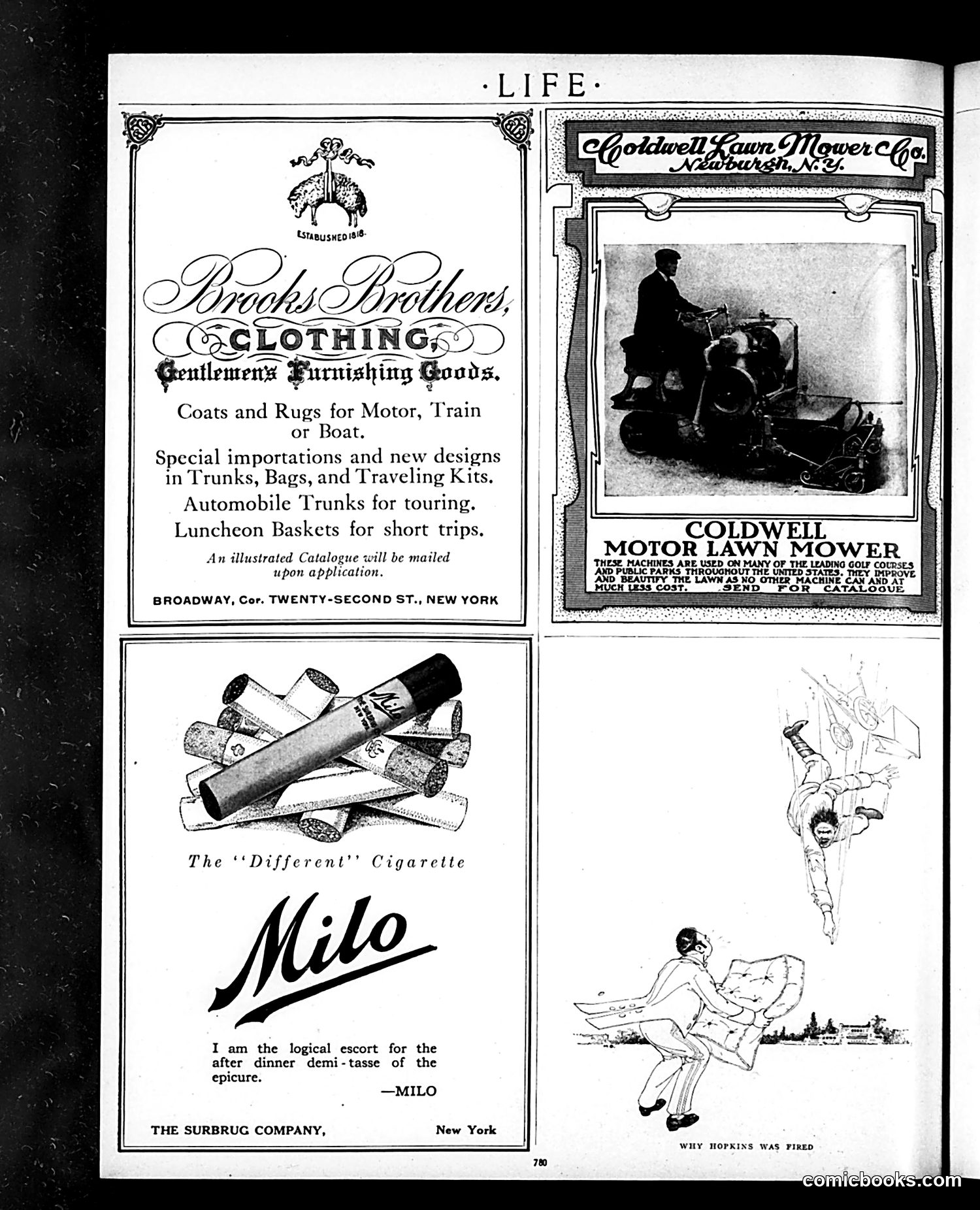
This is primarily a **advertising page** from Life magazine, featuring four distinct advertisements rather than editorial content or political cartoons. The page includes: 1. **Brooks Brothers** clothing ad (upper left) - advertising gentlemen's furnishings and travel goods 2. **Coldwell Motor Lawn Mower** ad (upper right) - showing the machine in use, marketed to golf courses 3. **Milo Cigarettes** ad (lower left) - depicting cigarettes as a sophisticated "after dinner" accessory, with the product personified as an "escort" for refined occasions 4. **"Why Hopkins Was Fired"** illustration (lower right) - a small cartoon showing what appears to be a comedic scene, though the specific reference is unclear without additional context The ads collectively reflect **early 20th-century consumer culture** targeting affluent men: leisure travel, mechanized lawn care, and tobacco consumption presented as marks of sophistication. The Hopkins cartoon's meaning cannot be determined from the visible image alone.
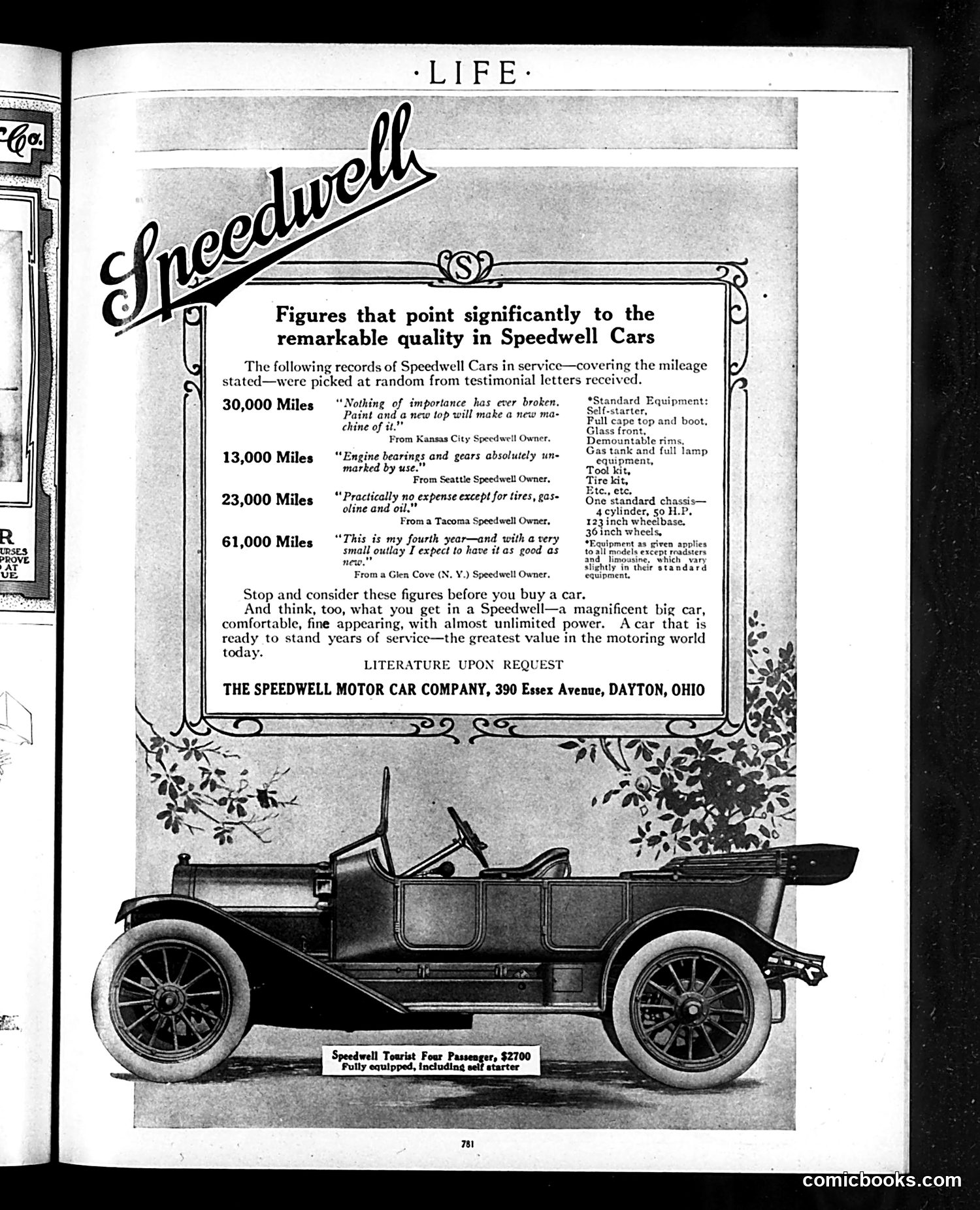
This page is a straightforward **automobile advertisement** for Speedwell Motor Cars, not a political cartoon or satirical content. The "Speedwell" branding and decorative header occupy the upper portion, followed by testimonial quotes from car owners claiming exceptional durability (30,000 to 61,000 miles with minimal wear). These customer endorsements highlight reliability—engine bearings "unmarked by use," minimal maintenance costs beyond tires and oil. The lower half displays a side-view illustration of the Speedwell Tourist Four Passenger vehicle, priced at $2,700 fully equipped with self-starter. The appeal is straightforward marketing: durability, value, and years of service. This represents typical early automotive advertising strategy—leveraging owner testimonials to build consumer confidence in a product category still proving itself to the American public. There is no satirical commentary, political reference, or caricature present on this page.
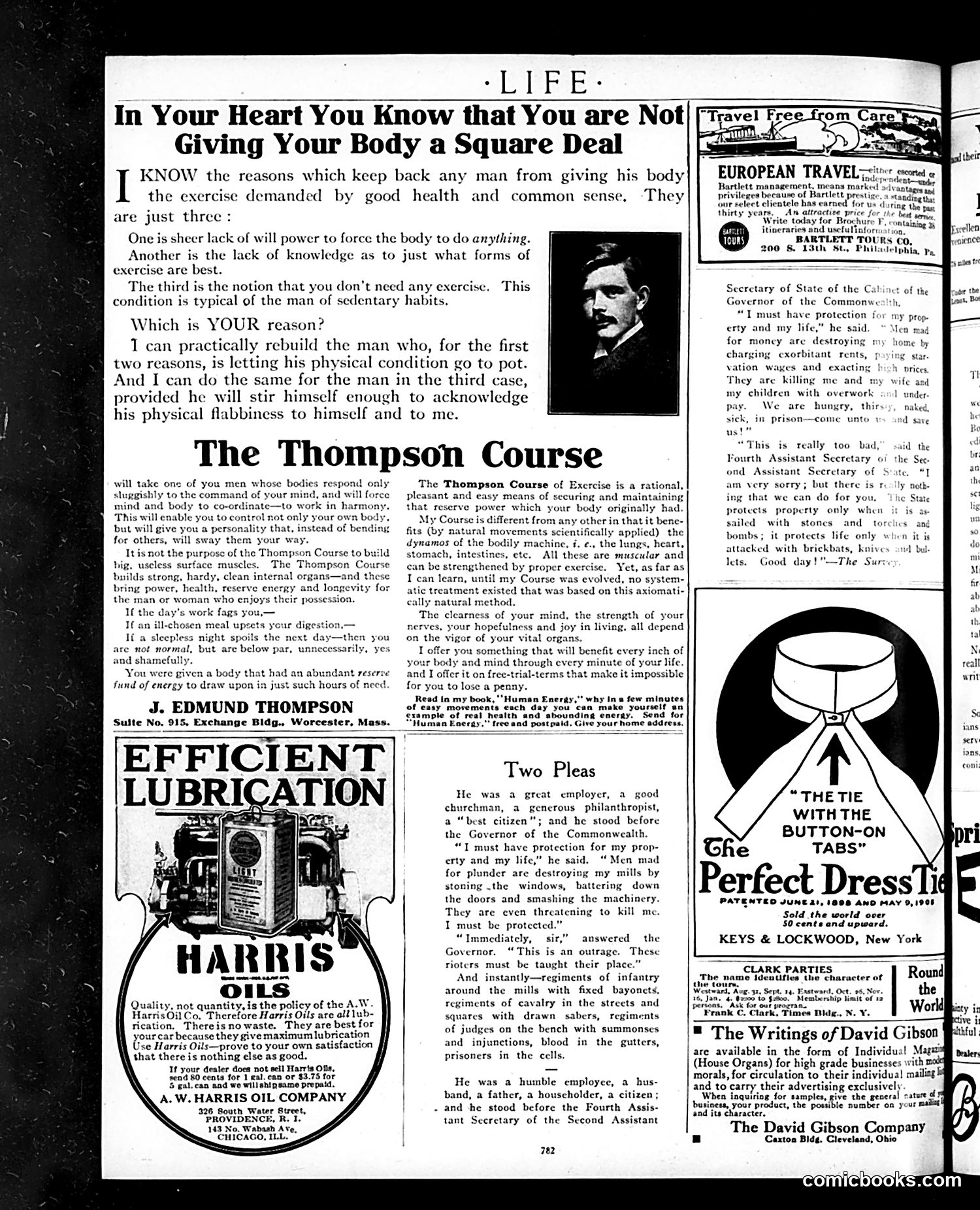
This page primarily features **advertisements and self-help content** rather than political satire. The main elements are: **"The Thompson Course"** - A physical fitness promotion by J. Edmund Thompson, playing on early 20th-century health anxiety. The text addresses three reasons men avoid exercise: lack of willpower, ignorance about proper exercise, and believing exercise unnecessary. Thompson promises to "rebuild" men through his system, appealing to contemporary concerns about sedentary lifestyles and masculine vigor. **"Two Pleas"** section (bottom) - A short narrative contrasting two appeals to the Governor: one from a wealthy industrialist seeking military protection against labor unrest (strikers destroying mill property), versus an implied plea from workers. The passage suggests class conflict—highlighting how power protects property owners while workers' concerns go unheard. **Side advertisements** include Harris Oils and The Perfect Dress Tie, typical period commercial content. The satire is subtle: the juxtaposition of the industrialist's successful plea for armed protection against the (implied) workers' unmet needs critiques unequal political access.
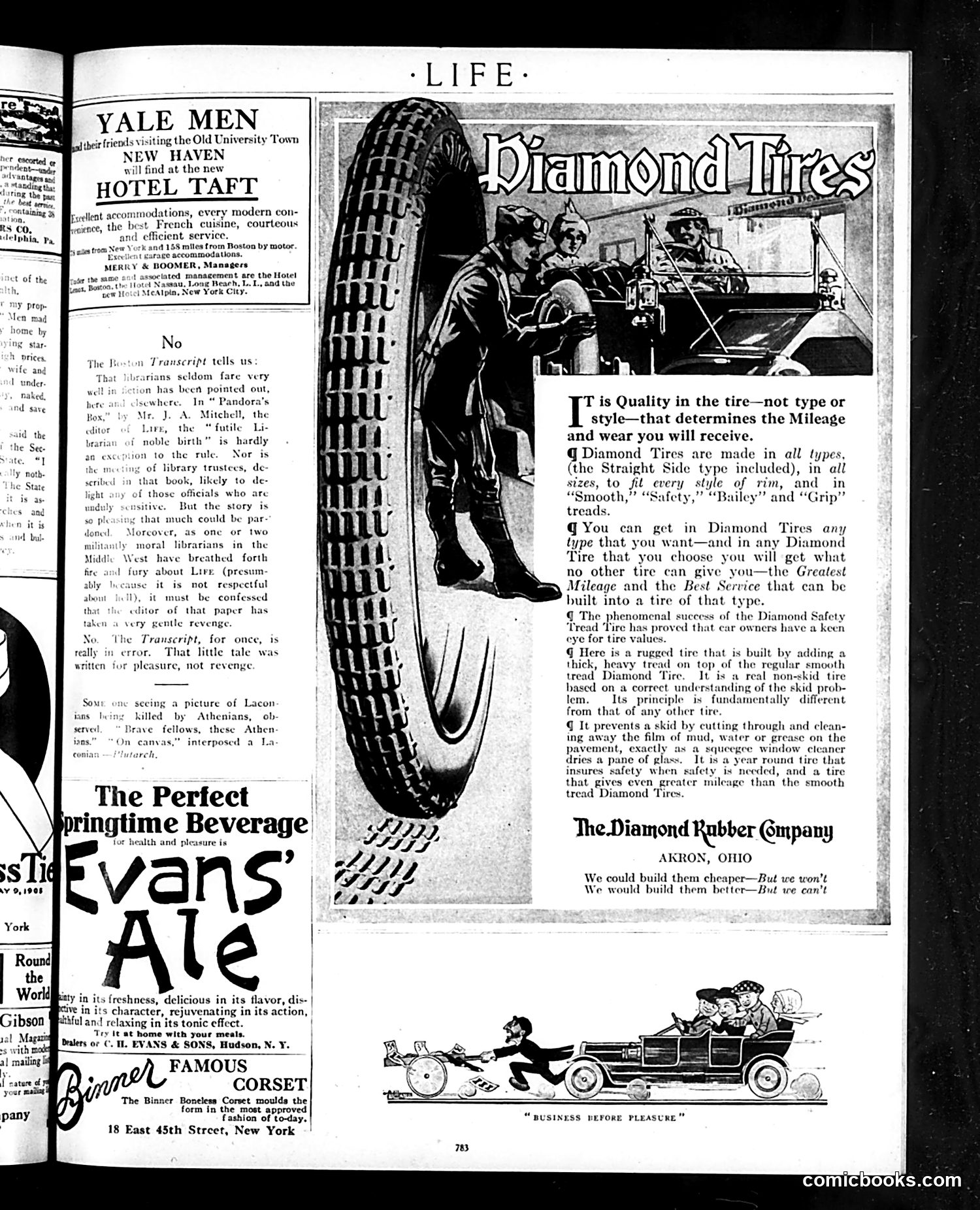
This page is primarily **advertising**, not political satire. The main content consists of three ads: 1. **Hotel Taft** (New Haven) — a luxury hotel advertisement targeting Yale alumni 2. **Evans' Ale** — a springtime beverage ad 3. **Diamond Tires** (Akron, Ohio) — the dominant ad, featuring a large tire illustration and workers, emphasizing quality and safety features like the "Safety Tread" The text snippets on the left appear to be magazine editorial content discussing literary matters (references to *Pandora's Box* and *Lire* magazine), unrelated to the ads. At the bottom, a cartoon labeled **"Business Before Pleasure"** shows a figure in a car, which likely illustrates the tire ad's message about reliability for practical use. The **tagline** "We could build them cheaper—But we won't / We would build them better—But we can't" is a competitive positioning statement emphasizing Diamond's quality-to-cost ratio. This is a typical early 20th-century magazine layout mixing editorial content with full-page advertisements.
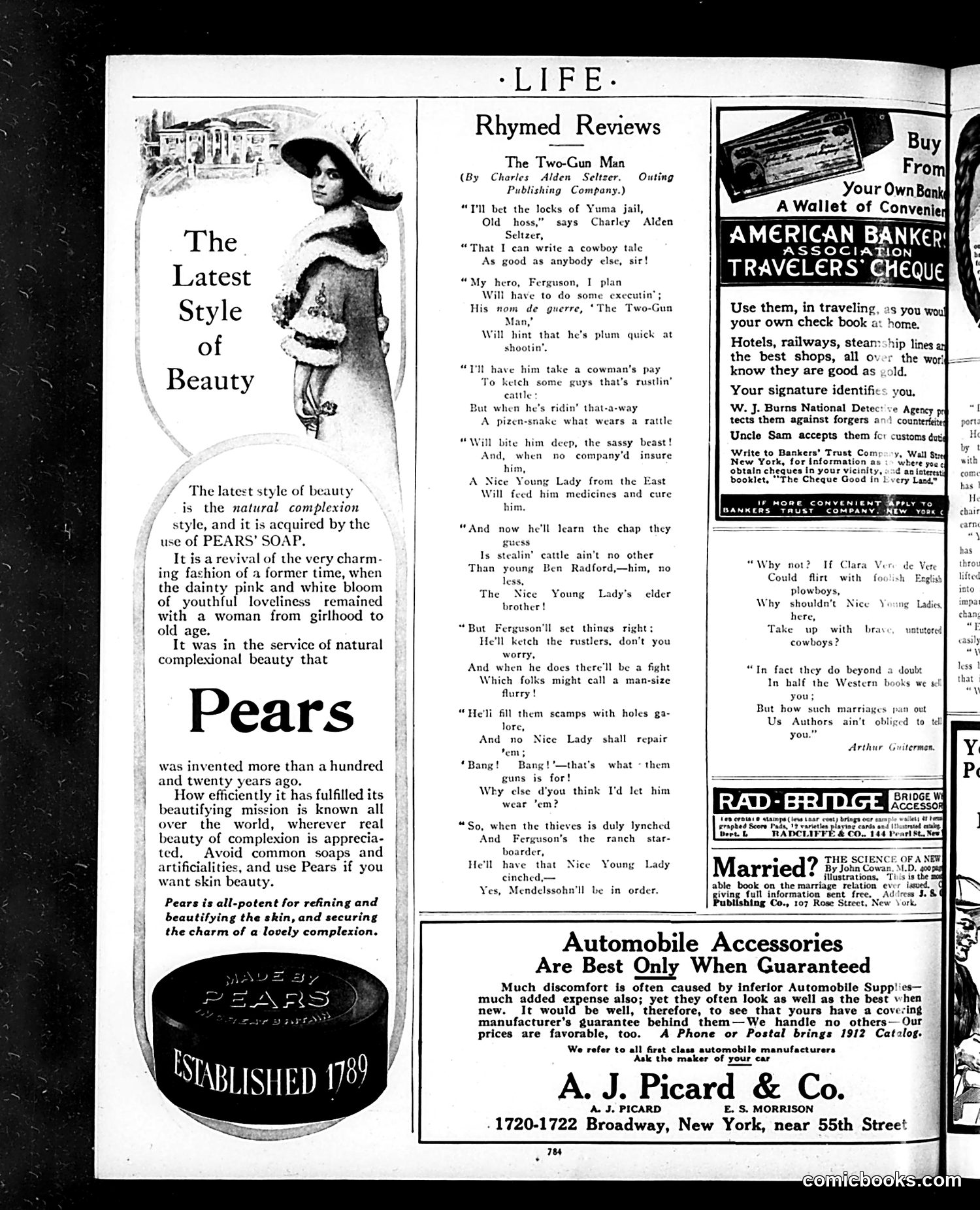
This page features a humorous verse review of Charles Alden Seltzer's Western novel *The Two-Gun Man*. The satirist (Arthur Guiterman) mocks the formulaic conventions of pulp Western fiction through Seltzer's own mock-confident voice. The joke targets predictable plot elements: a trigger-happy hero named Ferguson, a convenient snakebite requiring rescue by a "Nice Young Lady from the East," her brother as the villain (cattle rustler), a climactic gun battle, and inevitable romantic resolution. The reviewer lampoons the genre's reliance on gunplay ("Bang! Bang!—that's what them guns is for!") and the contrived romantic subplot. The parenthetical dig at "Clara Ver" (likely Clara Barton) references incongruous romances in Western literature—the satirist questions why such stories always pair refined Eastern women with rough cowboys. This reflects Life magazine's sophisticated urban audience mocking mass-market Western pulp fiction as mechanically formulaic and unconvincing.
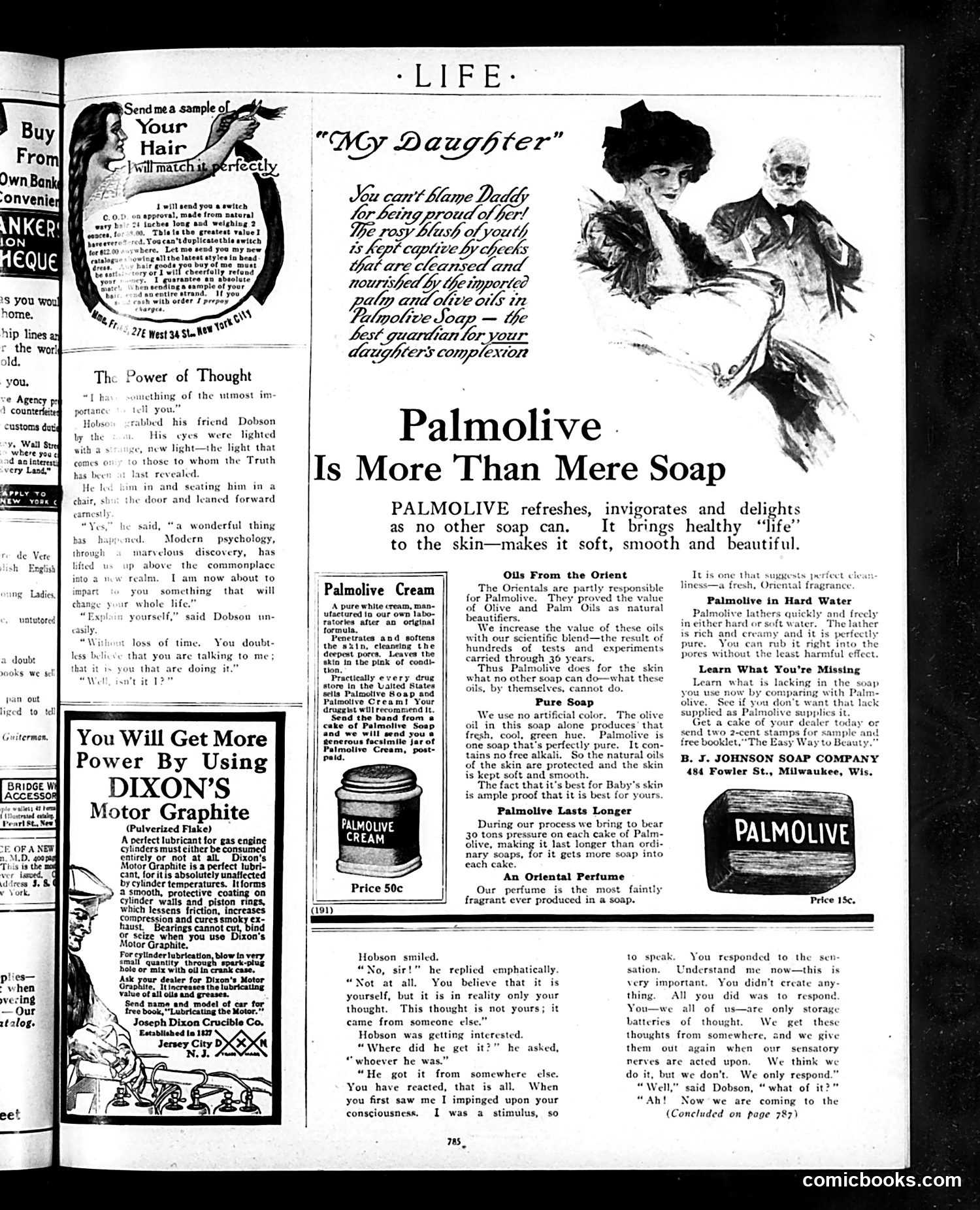
This page is primarily **advertising**, not political satire. The dominant content is a large Palmolive soap advertisement featuring an idealized young woman ("My Daughter") with copy about maintaining youthful complexion using their product containing olive and palm oils. The smaller text piece, "The Power of Thought," appears to be a philosophical dialogue between characters Dobson and Hobson discussing perception and reality—likely arguing that thoughts shape experience. This is unrelated satire about idealism versus materialism. Additional ads promote Dixon's Motor Graphite lubricant and other products typical of 1910s-era Life magazine. **No identifiable political figures or events** appear on this page. The "My Daughter" copy reflects period attitudes about women's appearance and beauty standards, but isn't satirizing specific public figures. The page represents mainstream commercial and philosophical content of the era rather than political commentary.
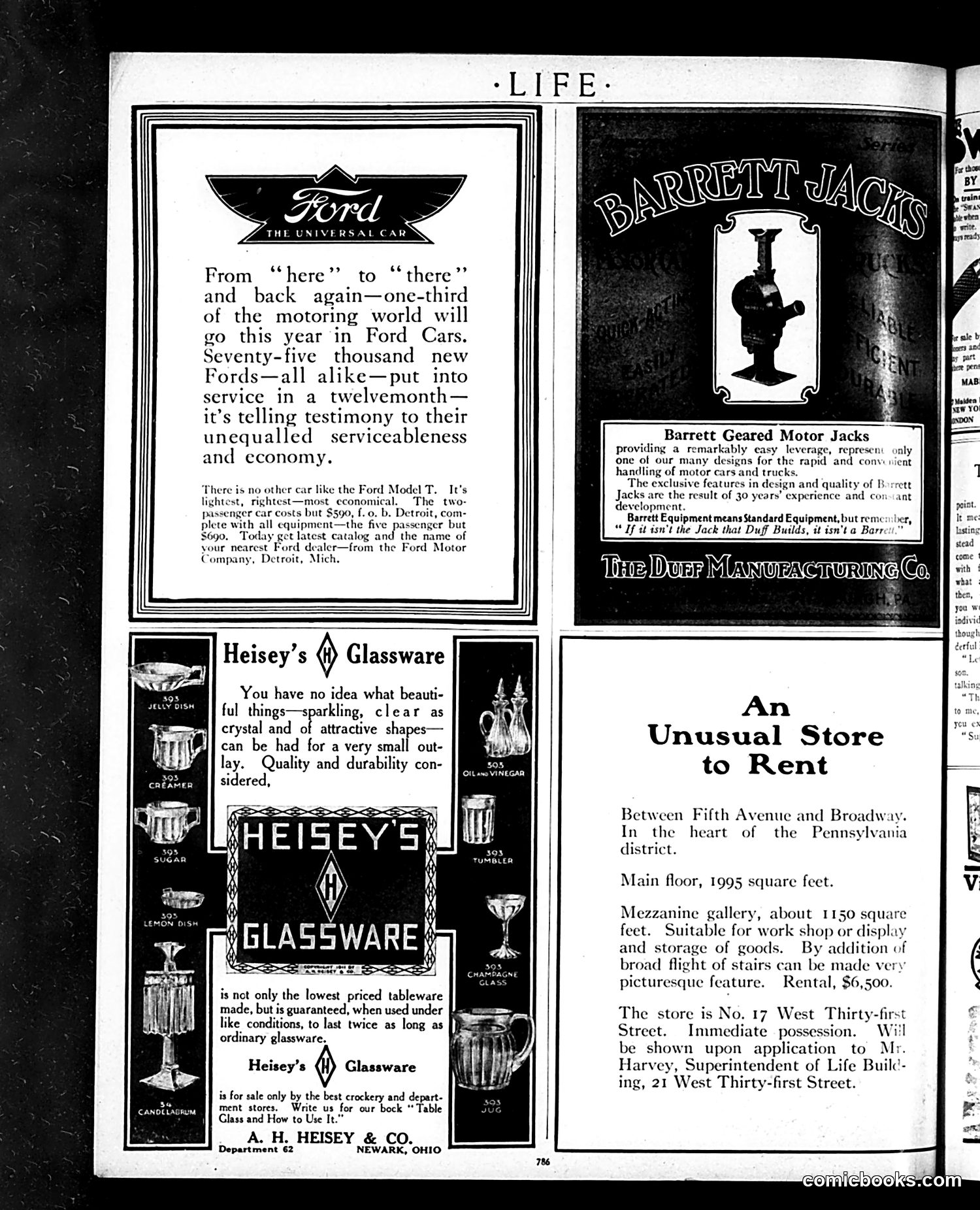
This page is primarily **advertising**, not editorial content or satire. It contains four product advertisements typical of a 1910s-era Life magazine: 1. **Ford Model T** - Promotes the newly mass-produced automobile, emphasizing its affordability ($590), standardization, and reliability for ordinary consumers. 2. **Barrett Jacks** - Industrial motor jacks marketed with a humorous boast: "If it isn't the Jack that Duff Builds, it isn't a Barrett" (appears to reference a competitor or brand distinction). 3. **Heisey Glassware** - Highlights affordable, durable tableware as an alternative to expensive crystal, marketed to cost-conscious households. 4. **Commercial Real Estate** - A store rental listing in Manhattan, targeting business operators. No political satire or caricature is present. The page reflects early 20th-century American consumer culture and commercial advertising trends, emphasizing value, standardization, and mass production as selling points to a growing middle class.
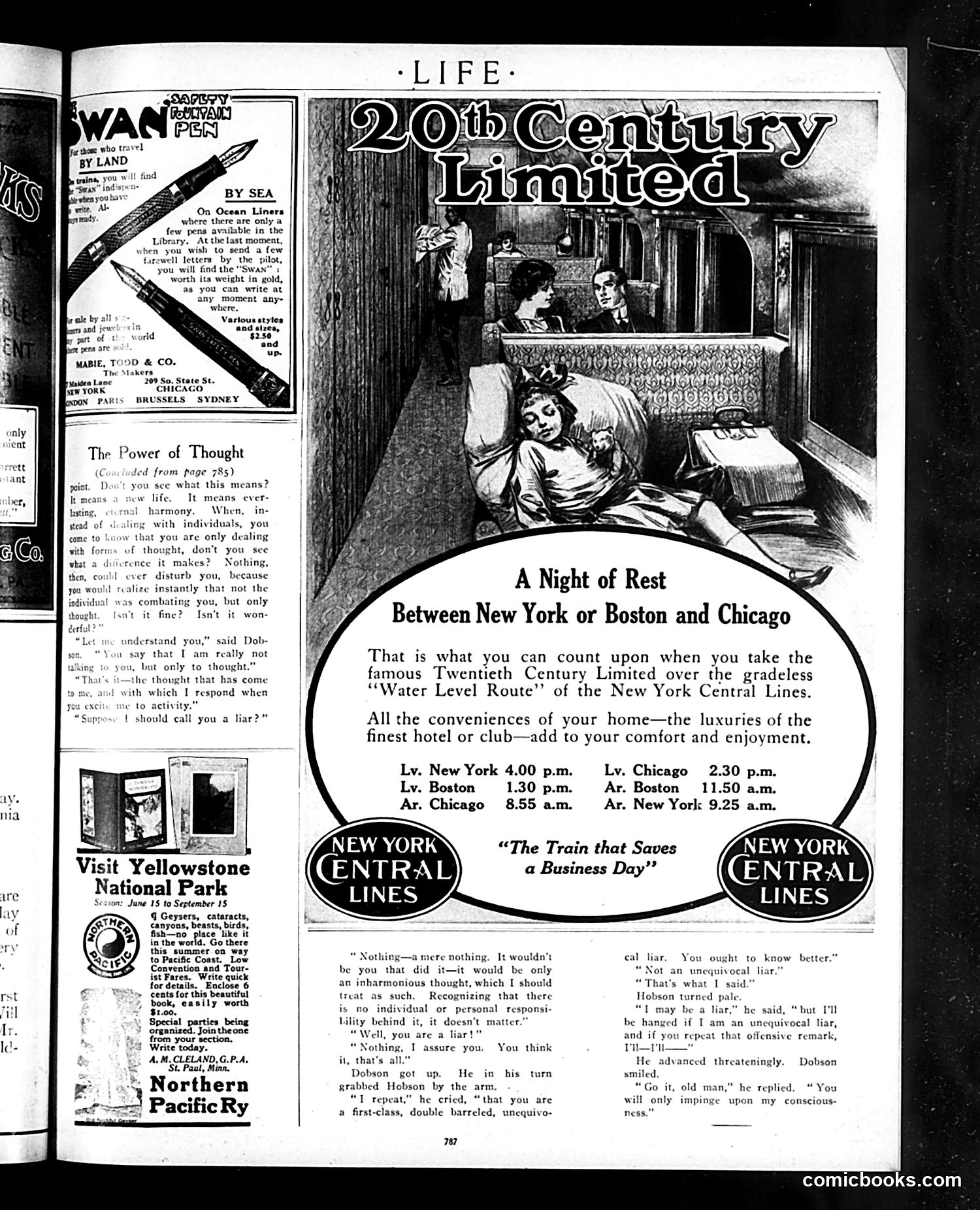
This page is primarily **advertising and serialized fiction**, not political satire. The main content is a continuation of a story called "The Power of Thought" (from page 785), depicting a philosophical debate between two men—Dobson and Hobson—about whether thoughts or individuals cause problems. Hobson argues that insults are "merely thoughts" and thus harmless; Dobson responds by calling him a liar and threatening him, illustrating the absurdity of Hobson's idealistic position. The joke is that **Hobson's philosophy collapses when personally insulted**—his detachment vanishes when confronted directly. The page also features prominent **advertisements**: the New York Central Railroad's "Twentieth Century Limited" train service and the Northern Pacific Railway's Yellowstone National Park tourism promotion—typical early-20th-century luxury travel marketing aimed at affluent readers. There is no political cartoon or satirical commentary on political events visible here. It's a literary and commercial page typical of Life magazine's mixed content format.
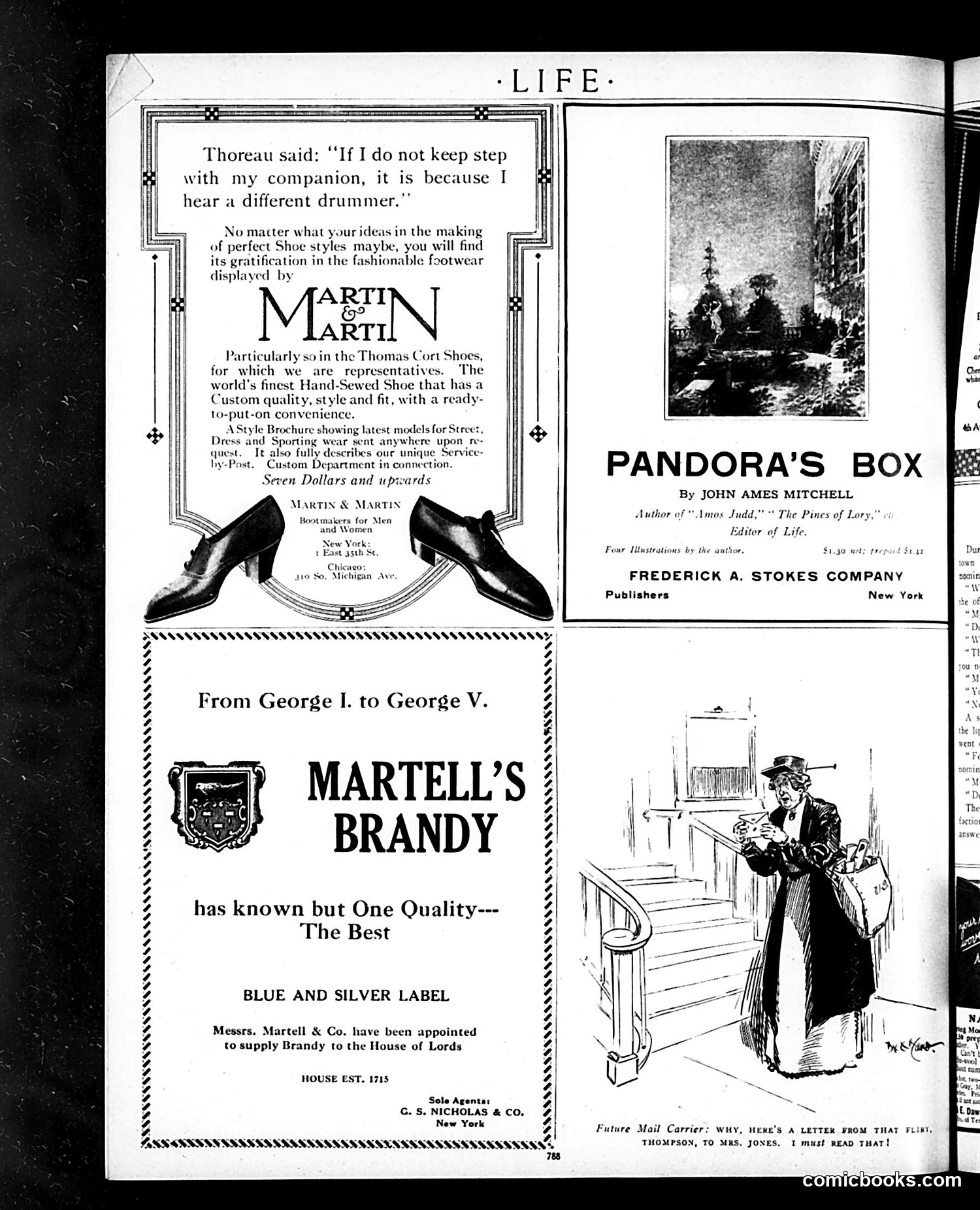
This is primarily an **advertising page** with minimal satirical content. The layout features three distinct advertisements: 1. **Martin & Marti shoes**: Uses a Thoreau quote about "hearing a different drummer" to market custom footwear, ironically suggesting individuality while promoting conformity to fashionable styles. 2. **Martell's Brandy**: A prestige liquor ad emphasizing centuries of tradition ("From George I to George V") and royal patronage by the House of Lords, trading on British institutional authority. 3. **Pandora's Box** (book announcement): John Ames Mitchell's novel, published by Frederick A. Stokes Company, illustrated with a domestic scene of a mailman delivering correspondence. The only discernible joke appears in the small cartoon caption about a "Future Mail Carrier" finding a scandalous letter—a mild commentary on postal worker curiosity or marital intrigue, typical of early 20th-century humor. The page prioritizes commercial promotion over satire.
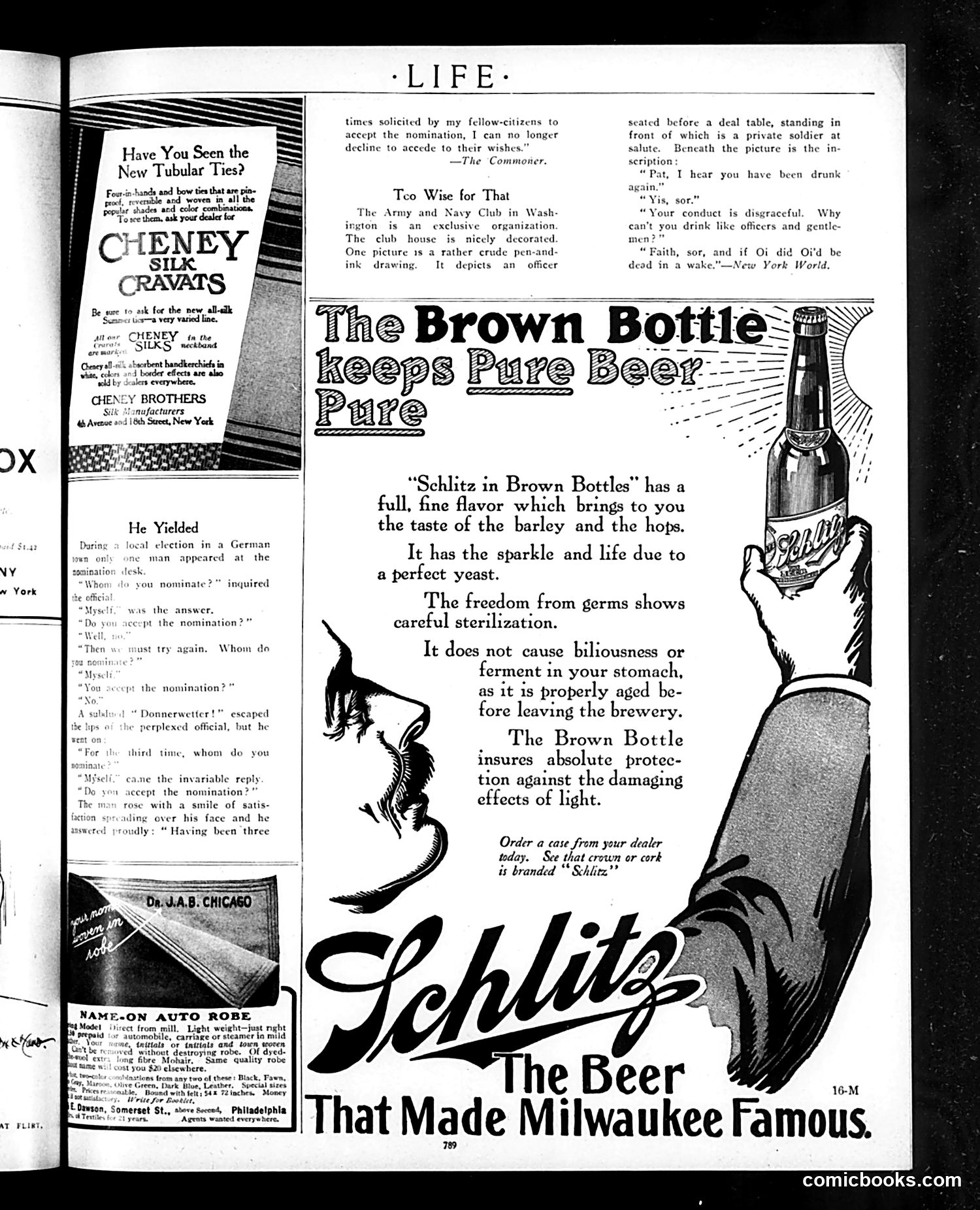
This page contains two distinct pieces of satirical humor: **"Too Wise for That"** (center-left): A short joke about the Army and Navy Club in Washington. An officer's crude pen-and-ink drawing depicts a private soldier being disciplined for drinking. The humor lies in the officer's hypocrisy—he criticizes the soldier for not drinking "like officers and gentlemen," implying officers drink considerably. The joke satirizes class double standards and military hierarchy, where the same behavior is acceptable for officers but disgraceful for enlisted men. **Commercial Advertisements**: The page is dominated by product ads—Cheney Silk Cravats, a "Name-On Auto Robe," and prominently, Schlitz Beer ("The Beer That Made Milwaukee Famous"). These advertisements are presented alongside the editorial humor, typical of Life's format during this era (likely early 1900s-1910s). The Schlitz ad emphasizes the brown bottle's protective qualities and purity claims, reflecting contemporary concerns about food and beverage safety. The page demonstrates Life's blend of satirical commentary and commercial content.
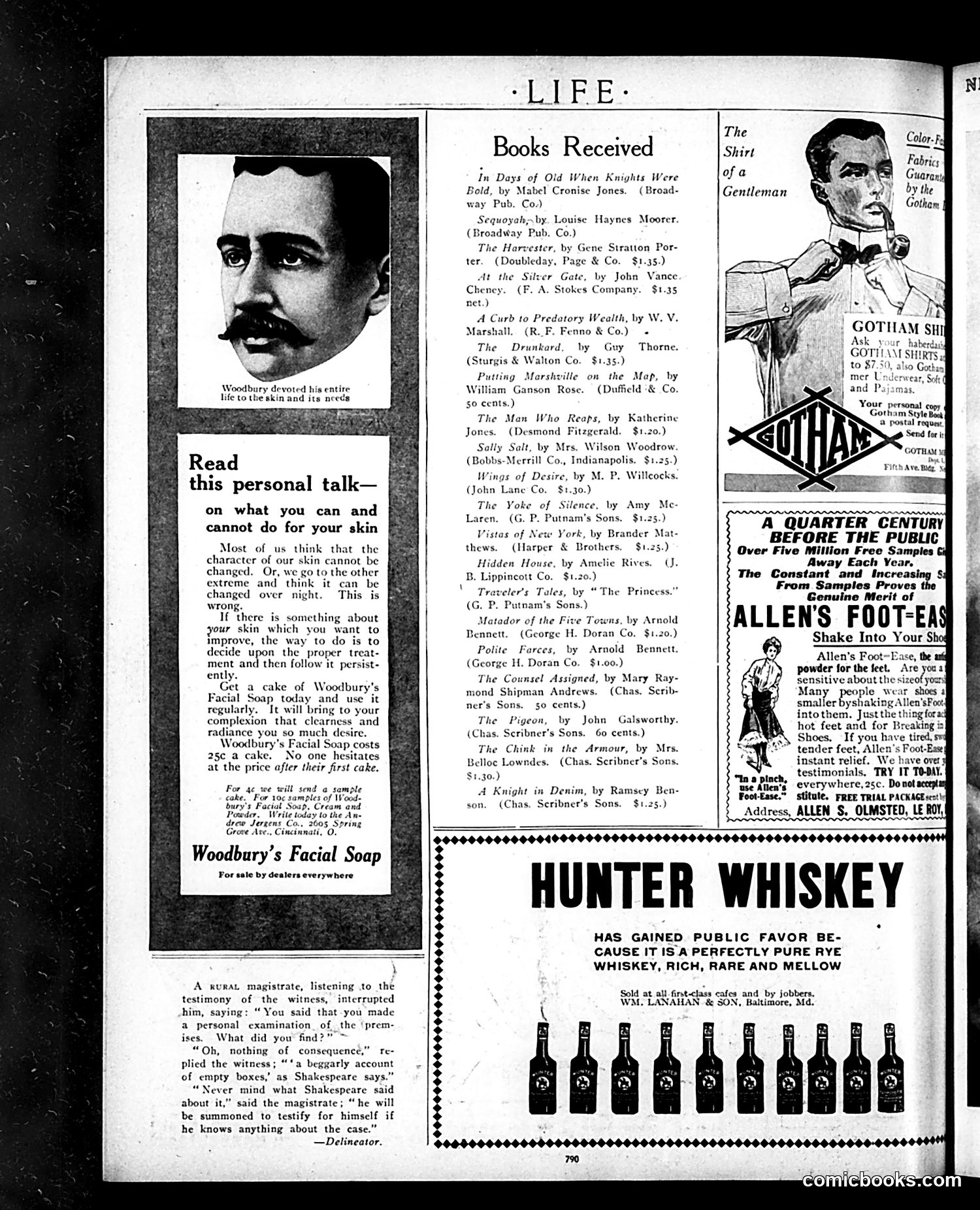
This page is primarily **advertising and book listings**, not political satire. The main content includes: **Woodbury's Facial Soap advertisement** (left): Features a man with a prominent mustache endorsing the soap's skincare claims. The pitch emphasizes that skin improvement requires persistent treatment—a practical consumer message rather than satire. **Small humor piece** (bottom left): A magistrate interrupts a witness citing Shakespeare, telling him Shakespeare will be "summoned to testify" if needed. This is mild courtroom humor about legal procedure, not political commentary. **Books Received**: A standard literary listing of contemporary novels and non-fiction. **Product advertisements**: Allen's Foot-Ease powder and Hunter Whiskey occupy the right side—straightforward period advertising. **Context**: This appears to be a regular Life magazine issue mixing humor, literature coverage, and consumer advertising. There is no identifiable political cartoon or significant satire on this particular page. The content reflects early 20th-century magazine conventions combining entertainment with commercial promotion.