
Life, 1912-04-11 · page 18 of 46
Life — April 11, 1912 — page 18: what you’re looking at
What you’re looking at
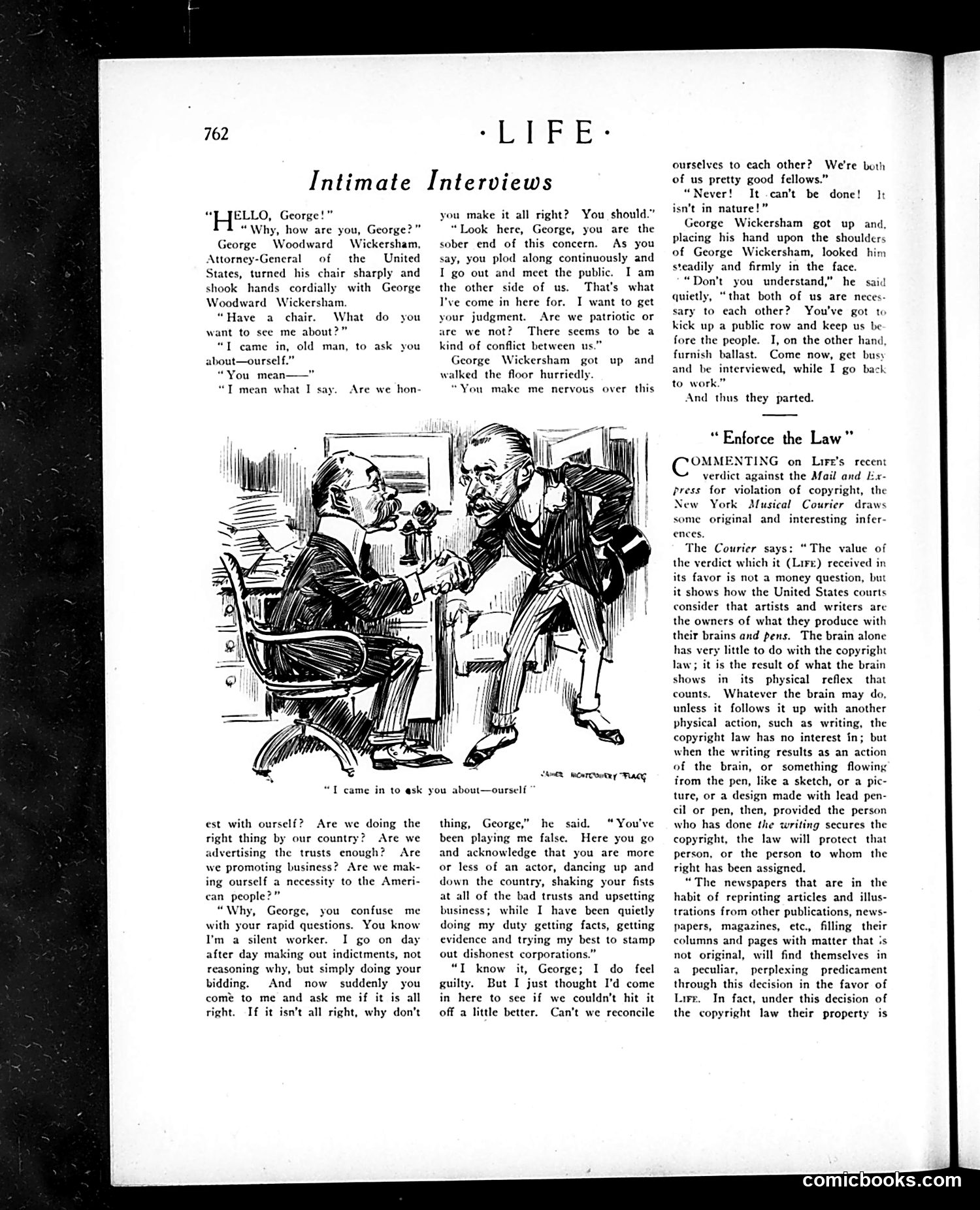
## The Cartoon: "Intimate Interviews" This cartoon depicts Attorney-General **George Wickersham** interviewing himself—a visual pun on his full name appearing twice. The satire critiques the apparent contradiction in his public role: one "Wickersham" aggressively prosecutes trusts and performs theatrical denunciations before the public, while the other quietly handles legal indictments behind the scenes. The cartoon mocks their inability to "reconcile" these two personas, suggesting Wickersham presents a populist anti-trust crusade while potentially enabling corporate interests. The dialogue implies his public trust-busting theater masks less aggressive actual enforcement. This reflects early 20th-century Progressive Era skepticism about whether government trust prosecution was genuine reform or political performance. ## "Enforce the Law" Section This brief commentary on a recent court verdict (Lire v. Mail and Express) regarding copyright protection argues that intellectual property laws only protect work when ideas manifest in physical form—writing, sketching, or design. It advocates stronger legal protection for creators and criticizes newspapers reprinting others' content without compensation.
📄 Transcribed text from this page (OCR, searchable)
Machine-transcribed from the original scan — historical spelling and the odd misread are preserved.
“LE Intimate Interviews LLO, George!” “Why, how are you, George?” George Woodward Wickersham, Attorney-General of the United States, turned his chair sharply and shook hands cordially with George Woodward Wickersham, “Have a chair. What do want to see me about?” “I came in, old man, to ask you about—ourself.” “You mean—”" “T mean what I say. you Are we hon- you make it all right? You should.” “Look here, George, you are the sober end of this concern. As you say, you plod along continuously and I go out and meet the public. I am the other side of us. That's what I've come in here for. I want to get your judgment. Are we patriotic or are we not? There seems to be a kind of conflict between us.” George Wickersham got up walked the floor hurriedly. “You make me nervous over this and AMR WOaTCOWRY TRACE “TL came in to esk you about—ourself ” est with ourself? Are we doing the right thing by our country? Are we advertising the trusts enoug! Are we promoting business? Are we mak- ing ourself a necessity to the Ameri- can people?” “Why, George, you confuse me with your rapid questions. You know I'm a silent worker. I go on day after day making out indictments, not reasoning why, but simply doing your bidding. And now suddenly you comé to me and ask me if it is all right. If it isn’t all right, why don’t thing, George,” he said. “You've been playing me false. Here you go and acknowledge that you are more or less of an actor, dancing up and down the country, shaking your fists at all of the bad trusts and upsetting business; while I have been quietly doing my duty getting facts, getting evidence and trying my best to stamp out dishonest corporations.” “I know it, George; I do feel guilty, But I just thought I'd come in here to see if we couldn't hit it off a little better. Can't we reconcile ourselves to cach other? We're both of us pretty good fellows.” “Never! It can’t be done! It isn’t in nature!” George Wickersham got up and, placing his hand upon the shoulders of George Wickersham, looked him teadily and firmly in the face. “Don’t you understand,” he said quietly, “that both of us are neces- sary to each other? You've got to kick up a public row and keep us be fore the people. I, on the other hand, furnish ballast. Come now, get busy and be interviewed, while I go back to work.” And thus they parted. “Enforce the Law” OMMENTING on Lirt’s recent verdict against the Mail and - press for violation of copyright, the New York Musical Courier draws some original and interesting infer- ences. The Courier says: “The value of the verdict which it (Lire) received in its favor is not a money question, but it shows how the United States courts consider that artists and writers are the owners of what they produce with their brains and pens. The brain alone has very little to do with the copyright law; it is the result of what the brain shows in its physical reflex that counts. Whatever the brain may do, unless it follows it up with another physical action, such as writing, the copyright law has no interest in; but when the writing results as an action of the brain, or something flowing irom the pen, like a sketch, or a pic- ture, or a design made with lead pen- cil or pen, then, provided the person who has done the writing secures the copyright, the law will protect that person, or the person to whom the right has been assigned. “The newspapers that are in the habit of reprinting articles and illus- trations from other publications, news- papers, magazines, etc., filling their columns and pages with matter that is not original, will find themselves in a peculiar, perplexing predicament through this decision in the favor of Lire. In fact, under this decision of the copyright law their property is comicbooks.com