
Life, 1912-04-11 · page 20 of 46
Life — April 11, 1912 — page 20: what you’re looking at
What you’re looking at
This page contains three distinct pieces of satire from *Life* magazine (likely early 1900s): **"Leaves from the Diary of an Explorer"**: A man seeking a wife examines a young woman as if she's a scientific specimen. The joke is that despite her education and pleasant appearance, she lacks original thought—she merely recites lessons, has a forced smile from "mental culture" courses, and has outsourced all decisions (clothing, thinking) to others. The satire criticizes how women of that era were trained to be decorative rather than intellectually independent. He ultimately gives up, unable to find her authentic self beneath the "tricks she has been taught." **"His Honor at Stake"**: A young man in debt argues it's logical to marry quickly—staying engaged longer only worsens his finances. Dark humor about courtship and debt. **"The Pankhursts"**: A criticism of the famous suffragist family (Emmeline and daughters Christabel and Sylvia), describing them as "mischievous" and "bad," opposing their militant tactics (vandalism: "broken glass") while grudgingly acknowledging women deserve voting rights—but "not through such leaders."
📄 Transcribed text from this page (OCR, searchable)
Machine-transcribed from the original scan — historical spelling and the odd misread are preserved.
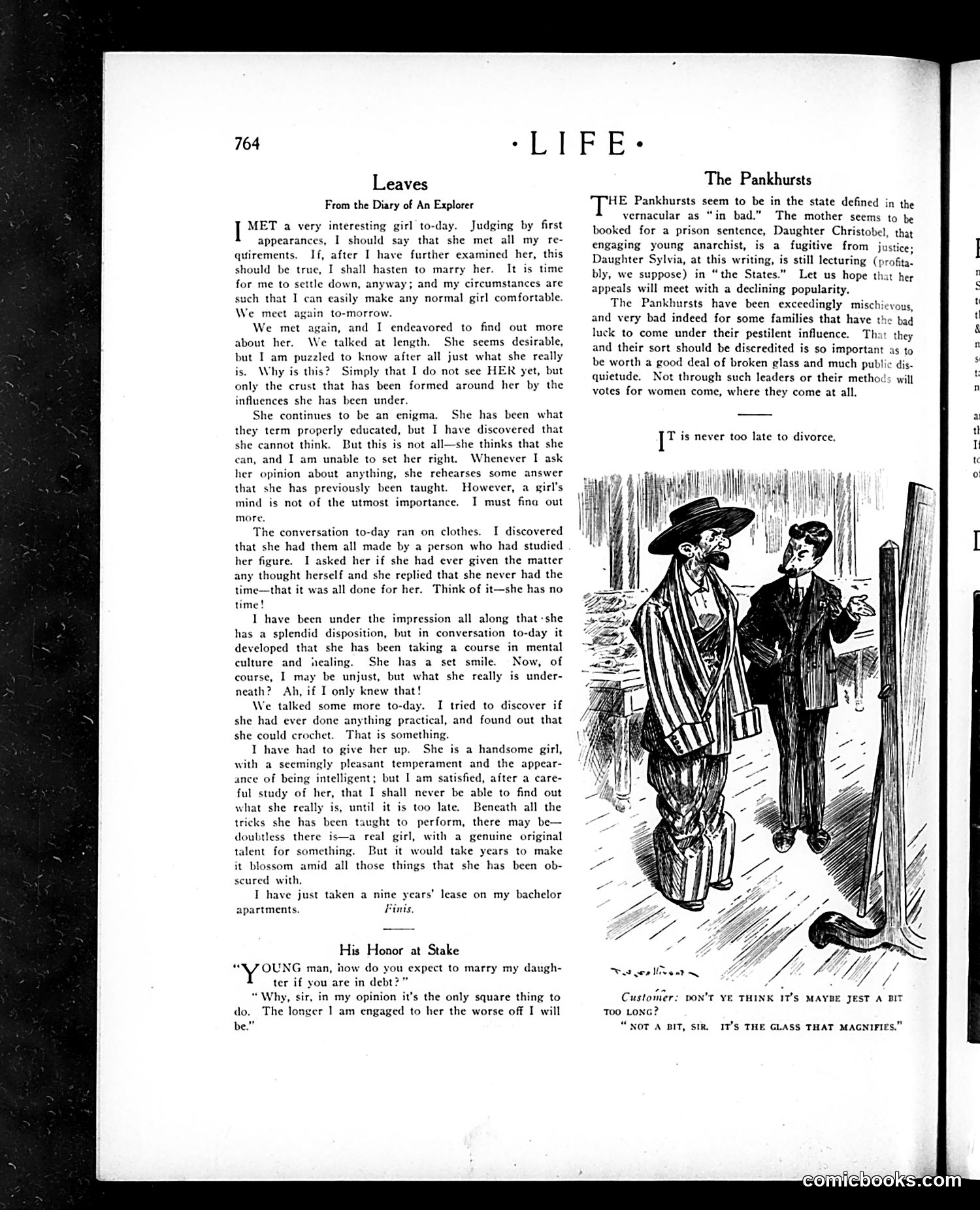
“LIFE: Leaves From the Diary of An Explorer MET a very interesting girl to-day. Judging by first appearances, I should say that she met all my re- quirements. If, after I have further examined her, this should be true, I shall hasten to marry her. It is time for me to settle down, anyway; and my circumstances are such that I can easily make any normal girl comfortable. We meet again to-morrow. We met again, and I endeavored to find out more about her. We talked at length. She seems desirable, but I am puzzled to know after all just what she really is. Why is this? Simply that I do not see HER yet, but only the crust that has been formed around her by the influences she has been under. She continues to be an enigma. She has been what they term properly educated, but I have discovered that she cannot think. But this is not all—she thinks that she can, and I am unable to set her right. Whenever I ask her opinion about anything, she rehearses some answer that she has previously been taught. However, a girl's mind is not of the utmost importance. I must fina out more. The conversation to-day ran on clothes. I discovered that she had them all made by a person who had studied her figure. I asked her if she had ever given the matter any thought herself and she replied that she never had the time—that it was all done for her. Think of it—she has no time! I have been under the impression all along that -she has a splendid disposition, but in conversation to-day it developed that she has been taking a course in mental culture and healing. She has a set smile. Now, of course, I may be unjust, but what she really is under- neath? Ah, if I only knew that! We talked some more to-day. I tried to discover if she had ever done anything practical, and found out that she could crochet. That is something. I have had to give her up. She is a handsome girl, with a seemingly pleasant temperament and the appear- ance of being intelligent; but I am satisfied, after a care- ful study of her, that I shall never be able to find out what she really is, until it is too late. Beneath all the tricks she has been taught to perform, there may be— doubtless there is—a real girl, with a genuine original talent for something. But it would take years to make it blossom amid all those things that she has been ob- scured with, I have just taken a nine years’ lease on my bachelor apartments, Finis. His Honor at Stake « OUNG man, how do you expect to marry my daugh- ter if you are in debt?” “Why, sir, in my opinion it’s the only square thing to do. The longer 1 am engaged to her the worse off I will be.” The Pankhursts THe Pankhursts seem to be in the state defined in the vernacular as “in bad.” The mother seems to be booked for a prison sentence, Daughter Christobel, that engaging young anarchist, is a fugitive from justice; Daughter Sylvia, at this writing, is still lecturing (profita- bly, we suppose) in “the States.” Let us hope that her appeals will meet with a declining popularity, The Pankhursts have been exceedingly mischievous, and very bad indeed for some families that have the bad luck to come under their pestilent influence. That they and their sort should be discredited is so important as to be worth a good deal of broken glass and much public dis- quietude. Not through such leaders or their methods will votes for women come, where they come at all. I" is never too late to divorce,