
Life, 1912-04-11 · page 10 of 46
Life — April 11, 1912 — page 10: what you’re looking at
What you’re looking at
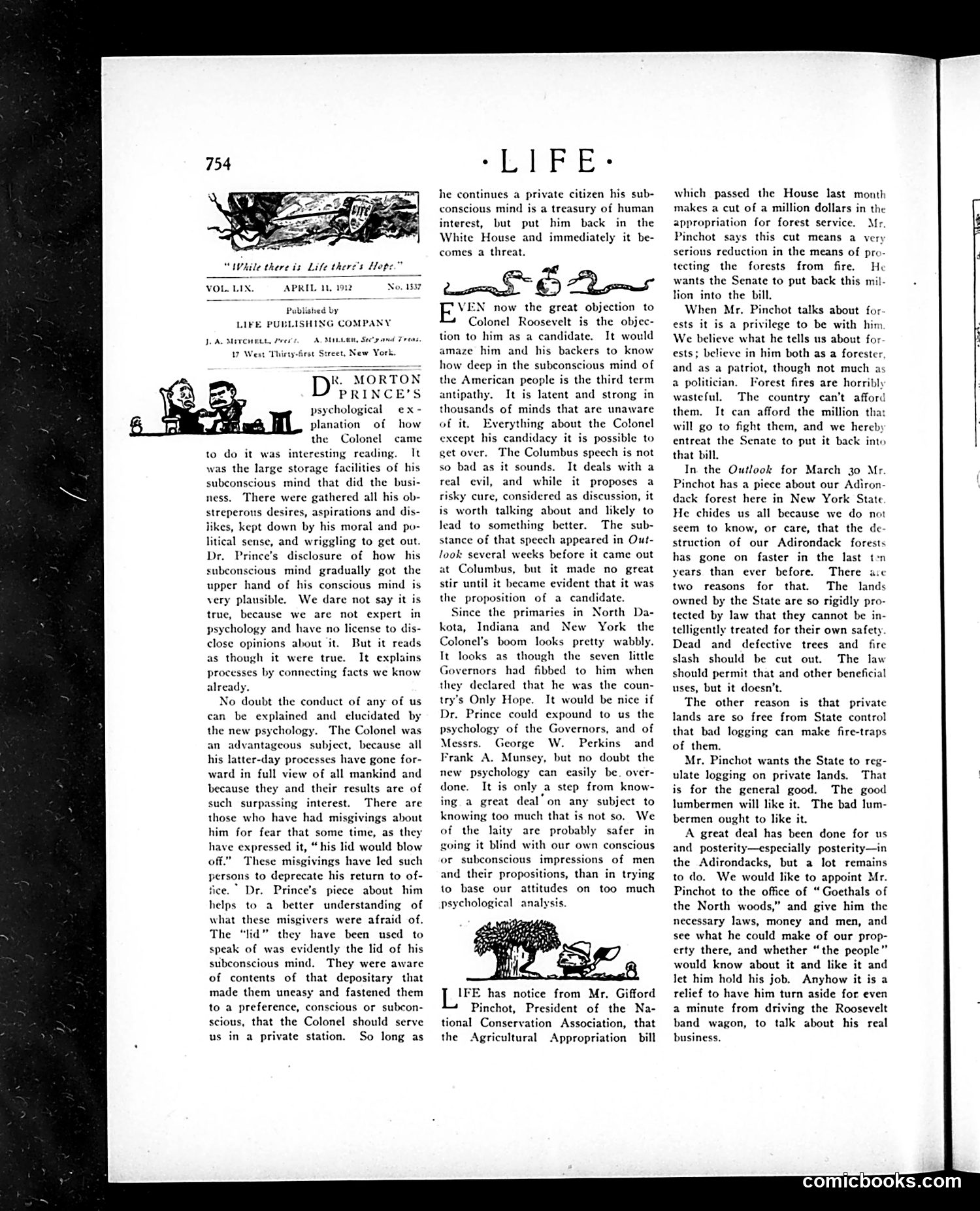
The page features **Dr. Morton Prince's psychological essay** titled "Life's Psychological Problems: How the Colonel Came to Do It." The accompanying illustration shows a man's head in profile with visible brain imagery, depicting Prince's analysis of Colonel Roosevelt's subconscious mind. The text discusses **Theodore Roosevelt's third-term candidacy**, examining his psychological motivations. Prince argues Roosevelt's actions stem from subconscious drives rather than conscious reasoning—suggesting the Colonel's supporters are unaware of deeper psychological forces influencing his decision to run. The piece satirizes both Roosevelt's ambitions and the era's newfound fascination with Freudian psychology, using pseudo-scientific analysis to mock political motivation while simultaneously poking fun at psychological determinism itself.
📄 Transcribed text from this page (OCR, searchable)
Machine-transcribed from the original scan — historical spelling and the odd misread are preserved.
“While there is Life there's He, APRIL 11, 1912 LIFE PUBLISHING COMPANY AL MILL ett, Ste’ ant Treas reet, New York. JA. Mrvenent. Pre 17 West Thirty-tirst S D* MORTON PRINCE’S psychological ex - planation of how the Colonel came to do it was interesting reading. It was the large storage facilities of his subconscious mind that did the busi- ness. There were gathered all his ob- streperous desires, aspirations and dis- likes, kept down by his moral and po- litical sense, and wriggling to get out. Dr. Prince's disclosure of how his subconscious mind gradually got the upper hand of his conscious mind is very plausible. We dare not say it is true, because we are not expert in psychology and have no license to dis- close opinions about it. But it reads as though it were true. It explains processes by connecting facts we know already, No doubt the conduct of any of us can be explained and elucidated by the new psychology. The Colonel was. an advantageous subject, because all his latter-day processes have gone for- ward in full view of all mankind and because they and their results are of such surpassing interest. There are those who have had misgivings about him for fear that some time, as they have expressed it, “his lid would blow off.” These misgivings have led such persons to deprecate his return to of- fice.’ Dr. Prince’s piece about him helps to a better understanding of what these misgivers were afraid of. The “lid” they have been used to speak of was evidently the lid of his subconscious mind. They were aware of contents of that depositary that made them uneasy and fastened them to a preference, conscious or subcon- scious, that the Colonel should serve us in a private station. So long as “leEsE he continues a private citizen his sub- conscious mind is a treasury of human interest, but put him back in the White House and immediately it be- comes a threat. cn 65 Dm VEN now the great objection to Colonel Roosevelt is the objec- tion to him as a candidate. It would amaze him and his backers to know how deep in the subconscious mind of the American people is the third term antipathy. It is latent and strong in thousands of minds that are unaware f it. Everything about the Colonel except his candidacy it is possible to get over. The Columbus speech is not so bad as it sounds. It deals with a real evil, and while it proposes a risky cure, considered as discussion, it is worth talking about and likely to lead to something better. The sub- stance of that speech appeared in Out- look several wecks before it came out at Columbus, but it made no great stir until it became evident that it was the proposition of a candidate. Since the primaries in North Da- kota, Indiana and New York the Colonel's boom looks pretty wabbly. It looks as though the seven little Governors had fibbed to him when they declared that he was the coun- try’s Only Hope. It would be nice if Dr. Prince could expound to us the psychology of the Governors, and of Messrs. George W. Perkins and nk Munsey, but no doubt the new psychology can easily be. over- done. It is only a step from know- ing a great deal’ on any subject to knowing too much that is not so. We of the laity are probably safer in going it blind with our own conscious or subconscious impressions of men and their propositions, than in trying to base our attitudes on too much psychological analysis IFE has notice from Mr. Gifford Pinchot, President of the Na- tional Conservation Association, that the Agricultural Appropriation bill which passed the House last month makes a cut of a million dollars in the appropriation for forest service. Mr, Pinchot says this cut means a very serious reduction in the means of pro- tecting the forests from fire. He wants the Senate to put back this mil- lion into the bill. When Mr. Pinchot talks about for ests it is a privilege to be with him. We believe what he tells us about for ests; believe in him both as a forester. and as a patriot, though not much as a politician. Forest fires are horribly wasteful. The country can’t afford them. It can afford the million th will go to fight them, and we hereby entreat the Senate to put it back into that bill. In the Outlook for March 30 Mr Pinchot has a piece about our Adiron- dack forest here in New York State He chides us all because we do not seem to know, or care, that the de struction of our Adirondack forests has gone on faster in the last ten years than ever before. There ace two reasons for that. The lands owned by the State are so rigidly pro- tected by law that they cannot be in- telligently treated for their own safety. Dead and defective trees and fire slash should be cut out. The law should permit that and other beneficial uses, but it doesn’t. The other reason is that private lands are so free from State control that bad logging can make fire-traps of them. Mr. Pinchot wants the State to reg- ulate logging on private lands. That is for the general good. The good lumbermen will like it. The bad lum- bermen ought to like it. A great deal has been done for us and posterity—especially posterity—in the Adirondacks, but a lot remains to do. We would like to appoint Mr. Pinchot to the office of “Goethals of the North woods,” and give him the necessary laws, money and men, and see what he could make of our prop- erty there, and whether “the people would know about it and like it and Jet him hold his job. Anyhow it is a relief to have him turn aside for even a minute from driving the Roosevelt band wagon, to talk about his real business. comicbooks.com