
Life, 1912-04-11 · page 28 of 46
Life — April 11, 1912 — page 28: what you’re looking at
What you’re looking at
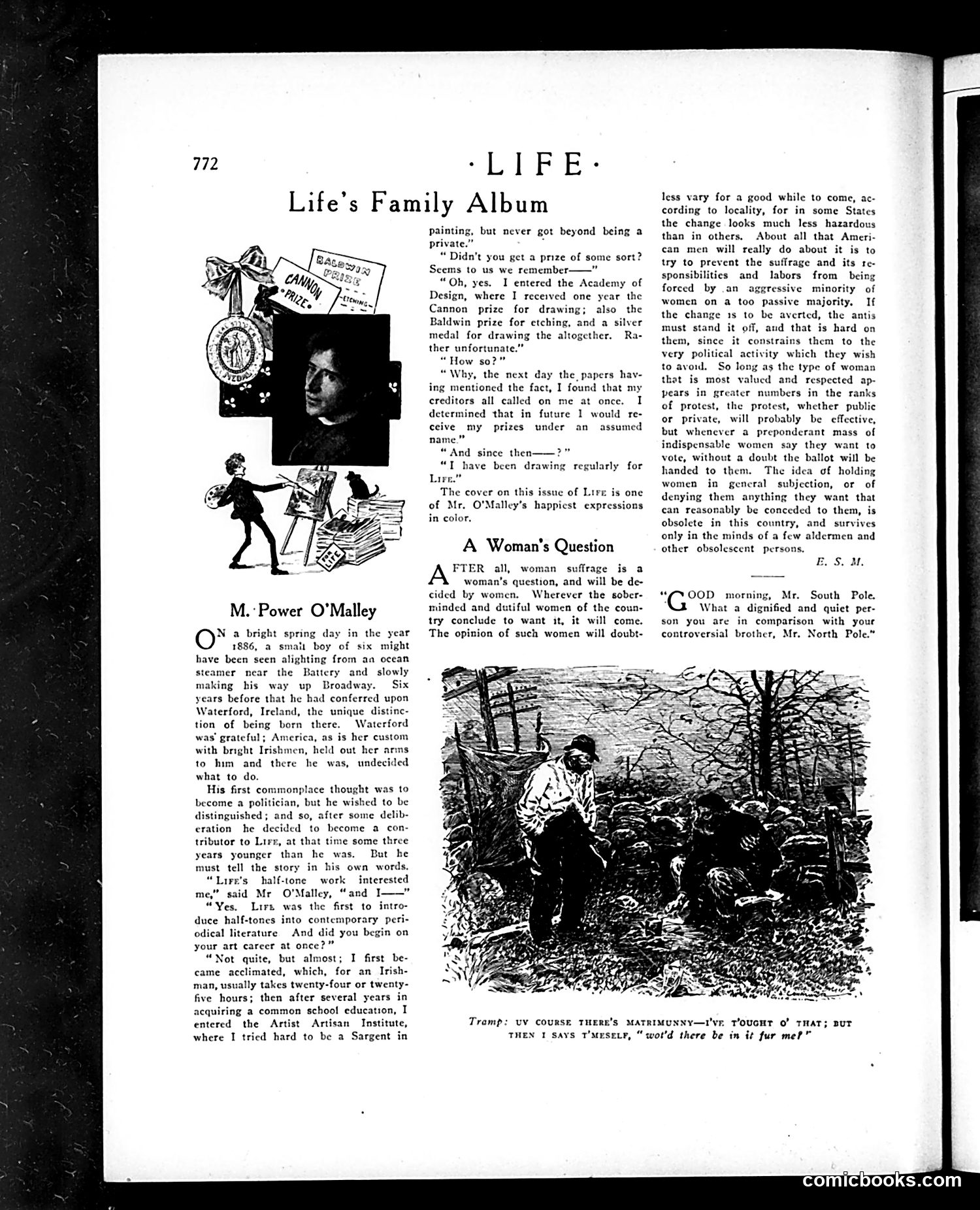
This page profiles **M. Power O'Malley**, an Irish-born artist and contributor to *Life* magazine. The biographical interview humorously describes O'Malley's journey from arriving in America in 1886, through art training, to becoming a cartoonist for *Life*. The satire lies in his deadpan anecdotes—particularly how winning prizes immediately summoned creditors, forcing him to accept future awards under assumed names. The second section, "A Woman's Question," addresses **women's suffrage**, then a contemporary political debate. The editorial argues that women themselves will decide the issue; male opposition cannot permanently prevent it. The argument is pragmatic rather than ideological: women's participation in protest movements suggests inevitable enfranchisement. The bottom illustration shows two personified **polar regions** debating matrimony, a visual pun unrelated to suffrage. These pieces reflect *Life*'s early editorial stance: supporting women's voting rights while depicting the suffrage debate as socially inevitable rather than radical.
📄 Transcribed text from this page (OCR, searchable)
Machine-transcribed from the original scan — historical spelling and the odd misread are preserved.
‘LIFE: Life’s Family Album M.: Power O'Malley ia bright spring day in the year 1886, a small boy of six might have been seen alighting from aa ocean steamer near the Battery and slowly making his way up Broadway. Six years before that he had conferred upon Waterford, Ireland, the unique distine- tion of being born there. Waterford was’ grateful; America, as is her custom with bright Irishmen, held out her arms to him and there he was, undecided what to do. His first commonplace thought was to become a politician, but he wished to be distinguished ; and so, after some delib- eration he decided to become a con- tributor to Lire, at that time some three years younger than he was. But he must tell the story in his own words. “Live's half-tone work interested me,” said Mr O'Malley, “and I ” “Yes. Lire was the first to intro- duce half-toncs into contemporary peri- odical literature And did you begin on your art career at once?” “Not quite, but almost; I first be- came acclimated, which, for an Irish- man, usually takes twenty-four or twenty- five hours; then after several years in acquiring a common schoo! education, I entered the Artist Artisan Institute, where I tried hard to be a Sargent in painting, but never got beyond being a private.” . “ Didn't you get a prize of some sort? Seems to us we remember. “Oh, yes. I entered the Academy of Design, where I received one year the Cannon prize for drawing; also the Baldwin prize for etching, and a silver medal for drawing the altogether. Ra- ther unfortunate. “ How 0?” “Why, the next day the, papers hav- ing mentioned the fact, I found that my creditors all called on me at once. I determined that in future 1 would re- ceive my prizes under an assumed name.” nd since then——?” “T have been drawing Lire.” The cover on this issue of Lire is one of Mr, O'Malley's happicst expressions in color, A Woman's Question ER all, regularly for woman suffrage is a woman's question, and will be de- cided by women. Wherever the sober- minded and dutiful women of the coun- try conclude to want it, it will come. The opinion of such women will doubt- less vary for a good while to come, ac- cording to locality, for in some States the change looks much less hazardous than in others, About all that Ameri- can men will really do about it is to try to prevent the suffrage and its re- sponsibilities and labors from being forced by .an aggressive minority of women on a too passive majority, If the change 1s to be averted, the antis must stand it off, and that is hard on them, since it constrains them to the very political activity which they wish to avoid. So long as the type of woman that is most valucd and respected ap- pears in greater numbers in the ranks of protest, the protest, whether public or private, will probably be effective, but whenever a preponderant mass of indispensable women say they want to vote, without a doubt the ballot will be handed to them. The idea of holding women in gene subjection, or of denying them anything they want that can reasonably be conceded to them, is obsolete in this country, and survives only in the minds of a few aldermen and other obsolescent persons, Ss. “(OOD morning, Mr. South Pole. What a dignified and quiet per- son you are in comparison with your controversial brother, Mr. North Pole.” Tromp: UV COURSE THERE'S MATRIMUNNY—I'vr, TOUGHT 0’ THAT; BUT THEN I Says T'mersetr, “wot’d there be in it fur me?” comicbooks.com