
Life, 1912-04-11 · page 23 of 46
Life — April 11, 1912 — page 23: what you’re looking at
What you’re looking at
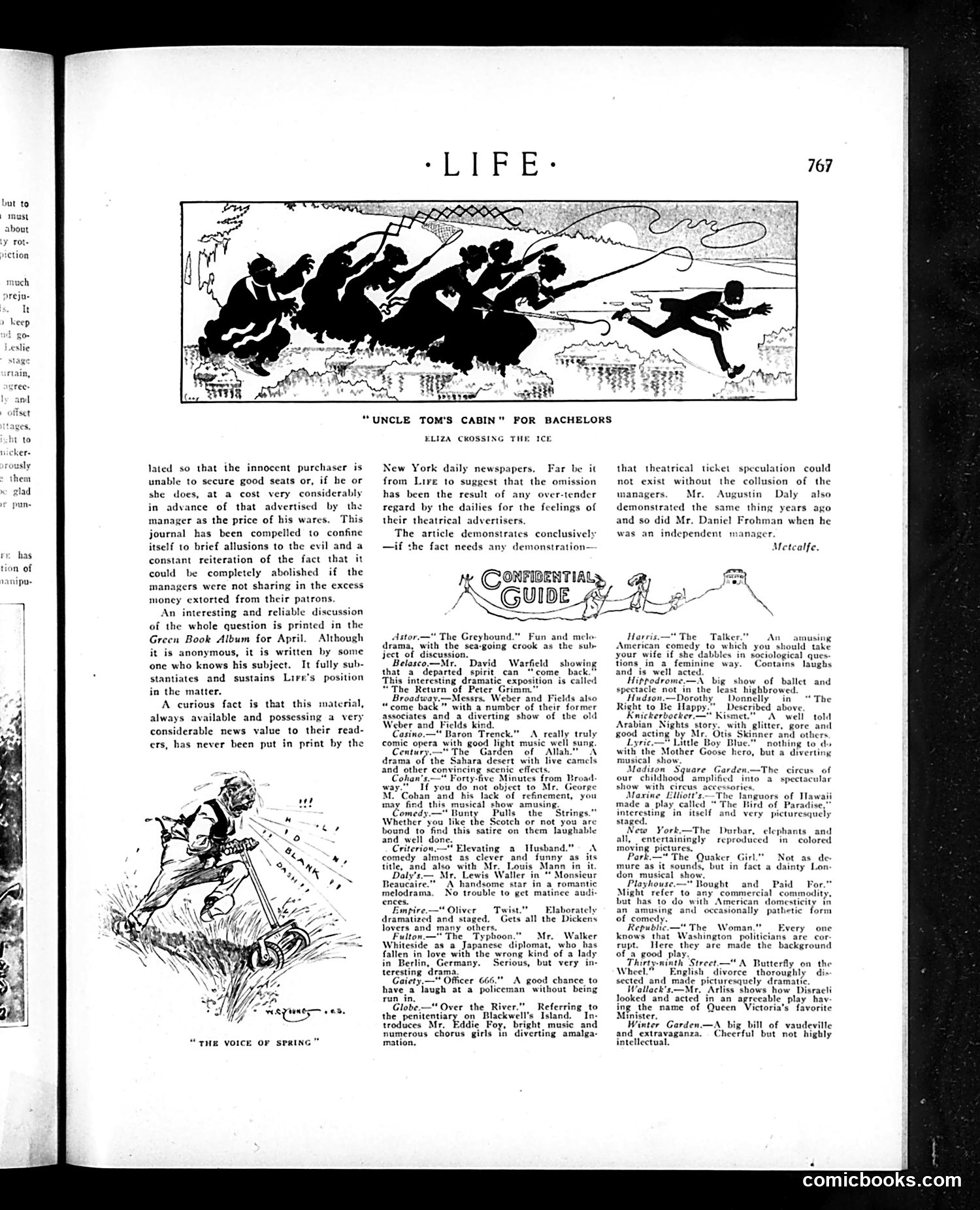
The top illustration, titled "Uncle Tom's Cabin for Bachelors—Eliza Crossing the Ice," is a silhouette cartoon satirizing theatrical ticket speculation. It depicts a woman (Eliza, the famous character fleeing slavery) pursued across ice by men in top hats—likely representing theater managers and speculators profiting from ticket sales. The page's main text criticizes how theater managers collude with ticket speculators to artificially inflate prices beyond advertised rates, making seats unaffordable for ordinary patrons. Life magazine argues this corrupt practice could not exist without managerial complicity, citing past managers like Augustin Daly and Daniel Frohman who exposed the scheme. The bottom section is a theater guide ("Confidential Guide") reviewing current Broadway productions, a regular Life feature. **The satire's point**: Theater managers—depicted as pursuing hunters—prey on innocent patrons just as Eliza was hunted, but through financial exploitation rather than slavery.
📄 Transcribed text from this page (OCR, searchable)
Machine-transcribed from the original scan — historical spelling and the odd misread are preserved.
ut to | must about y rot viction much rej It » keep 1 g0- eslie rain, gree “UNCLE TOM'S CABIN" FOR BACHELORS lated so that the innocent purchaser is unable to secure good seats or, if he or she does, at a cost very considerably in advance of that advertised by the manager as the price of his wares. This journal has been compelled to confine itself to brief allusions to the evil and a constant reiteration of the fact that it could be completely abolished if the managers were not sharing in the excess money extorted from their patrons. An interesting and reliable discussion of the whole question is printed in the Green Book Album for April. Although it is anonymous, it is written by some one who knows his subject. It fully sub- stantiates and sustains Lire’s position in the matter. A curious fact is that this material, always available and possessing a very considerable news value to their read- crs, has never been put in print by the “THE VOICE OF SPRING” ELIZA CKOSSING THE ICE New York daily newspapers. Far be it from Lire to suggest that the omission has been the result of any over-tender regard by the dailies for the feelings of their theatrical advertisers. The article demonstrates conclusively —if the fact needs any demonstration— ne CONFIDENTIAL that theatrical ticket speculation could not exist without the collusion of the managers. Mr. Augustin Daly also demonstrated the same thing years ago and so did Mr. Daniel Frohman when he was an independent manager. Metcalfe. Astor.—* The Greyhound.” Fun and melo- drama, with the seagoing crook as the sub- ject of discussion. Belasco.—Mr. “David Warfield showing that a departed spirit, can “come back.” This interesting dramatic exposition is called “The Return of Peter Grimm.” Broadway.—Messrs. Weber and Fields also “come back” with a number of their former associates and a diverting show of the old Weber and Fields kind. Casino.—" Baron Trenck.” A. really truly comic opera with good light music well sung Century." The Garden of Allah.” drama of the Sahara desert with live camels, g scenic effects. Cohan’s.—" Forty-five Minutes from Ti "If you do not object to Mr. George . Cohan and his lack of refinement, you find this musical show amusing. Comedy.—" Bunty Pulls the Strings.” Whether you like the Scotch or not you are bound to find this satire on them laughable and well done. Criterion.—" Elevating a Wusband.” A comedy almost as clever and funny as its title, and also with Mr, Louis Mann in it Daly’s.— Mr. Lewis Waller in " Mo Beaucaire.” A’ handsome star in a romantic melodrama. No trouble to get matinee audi- ences. Empire.—" Oliver | Twist.” Elaborately dramatized and staged. Gets all the Dickens lovers and many others. 7 yphoon.” Mr. Walker Whiteside as a Japanese diplomat, who has fallen in love with the wrong kind of a lady in Berlin, Germany. Serious, but very in- teresting drama. Gaiety,—" Officer 666."" A good chance to have a iaugh at a policeman without being run in, Globe.—"" Over the River." Referring to the penitentiary on Blackwell's Island. — In- troduces Mr. Eddie Foy, bright. music and numerous chorus girls in diverting amalga- mation. Horris.—" The Talker.” An amusing American comedy to which you should take your wife if she dabbles in sociological ques tions in a feminine way. Contains laughs and is well acted, Hippodrome.—X big show of ballet and spectacle not in the least highbrowed. Hudson.—Dorothy, Donnelly in“ The Right to Be Happy.” Described above Knickerbocker." Kismet.” A well told Arabian Nights ‘story. with glitter, gore and good acting by Mr. Otis Skinner and others Lyric.—" Little Boy Blue.” nothing to d» with the Mother Goose hero, but a diverting musical show Madison Square Garden.—The circus of our childhood amplified spectacular show with circus accessories Maxine Elliott's guors of Hawaii made a play called “ dof Paradise,” interesting in itself and very picturesquely staged. New York.—The Durbar, elephants. and all, entertainingly reproduced in colored moving pictures. Park.—* The Quaker Girl.” Not as. de- mure as it sounds, but in fact a dainty Lon: don musical show. Playhouse.—" Bought and Paid For. Might refer to any commercial commodity, but has to do with American domesticity in an amusing and occasionally pathetic for of comedy. —"The Woman.” Politicians Here they are made the backgroun a good play, Thirty-ninth Street—" A Butterfly on the Wheel.” English divorce thoroughly dis sected and made picturesquely dramatic. Wallack’s.—Mr. Arliss shows how Disraeli Jooked and ‘acted in an agreeable, play hav ing the name of Queen Victoria's favorite Minister. Winter Garden.—A big bill of vaudeville and extravaganza. Cheerful but not highly intellectual. comicbooks. com