
Life, 1912-04-11 · page 26 of 46
Life — April 11, 1912 — page 26: what you’re looking at
What you’re looking at
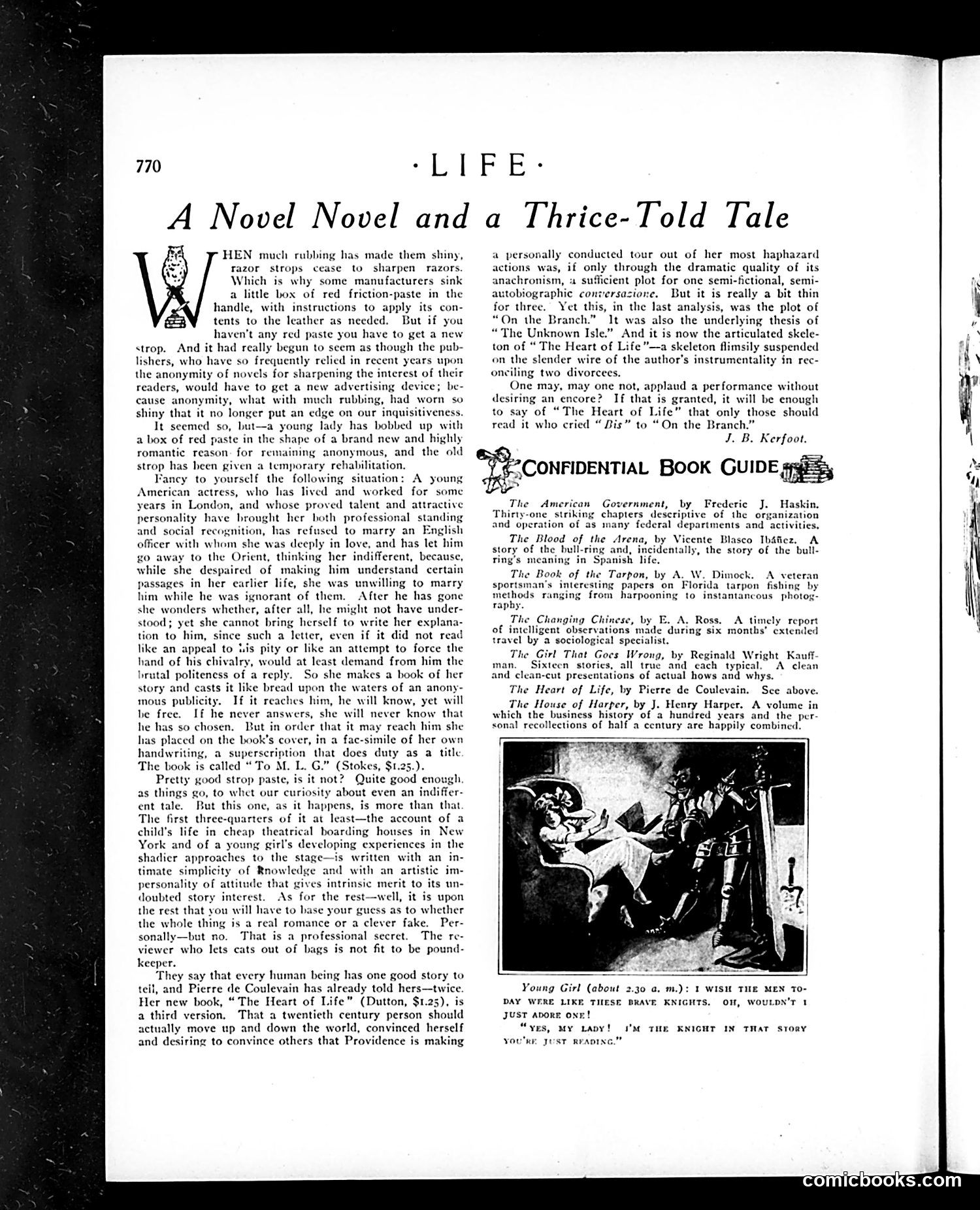
This page reviews three books while satirizing publishing trends. The main article critiques the overuse of **anonymous publication as a marketing gimmick**—comparing it to a worn-out razor strop that's lost its edge through excessive use. The featured book, "To M. L. G." (anonymous), uses a romantic premise to justify anonymity: an American actress publishes her story unsigned, hoping her English lover will recognize himself and understand her past without her directly explaining it. The reviewer finds this ploy clever enough to generate interest, though somewhat manipulative. The page also mocks **Pierre de Coulevain**, an author rehashing her own story for the third time in "The Heart of Life," criticizing her for pretending divine providence orchestrates her mundane life—an absurdly self-important conceit for a modern person. The cartoon caption (partially visible) appears to reference theatrical melodrama, supporting the page's broader theme: publishing relies heavily on manufactured intrigue rather than genuine literary merit.
📄 Transcribed text from this page (OCR, searchable)
Machine-transcribed from the original scan — historical spelling and the odd misread are preserved.
770 -LIFE- A Novel Novel and a Thrice-Told Tale HEN much rubbing has made them shiny, razor strops cease to sharpen razors. Which is why some manufacturers sink a little box of red friction-paste in the handle, with instructions to apply its con- tents to the leather as needed. But if you haven't any red paste you have to get a new strop. And it had really begun to seem as though the pub- lishers, who have so frequently relied in recent years upon the anonymity of novels for sharpening the interest of their readers, would have to get a new advertising device; be- cause anonymity, what with much rubbing, had worn so shiny that it no longer put an edge on our inquisitiveness. It seemed so, but—a young lady has bobbed up with a box of red paste in the shape of a brand new and highly romantic reason. for remaining anonymous, and the old strop has heen given a temporary rehabilitation. Fancy to yourself the following situation: A young American actress, who has lived and worked for some years in London, and whose proved talent and attractive personality have brought her both professional standing and social recognition, has refused to marry an English officer with whom she was deeply in love, and has let him go away to the Orient, thinking her indifferent, because, while she despaired of making him understand certain passages in her earlier life, she was unwilling to marry him while he was ignorant of them. After he has gone she wonders whether, after all, he might not have under- stood; yet she cannot bring herself to write her explana- tion to him, since such a letter, even if it did not read like an appeal to tis pity or like an attempt to force the hand of his chivalry, would at least demand from him the brutal politeness of a reply. So she makes a book of her story and casts it like bread upon the waters of an anony- mous publicity. If it reaches him, he will know, yet will he free. If he never answers, she will never know that he has so chosen. But in order that it may reach him she has placed on the book's cover, in a fac-simile of her own handwriting, a superscription that does duty as a title The book is called “To M. L. G.” (Stokes, $1.25.). Pretty good strop paste, is it not? Quite good enough: as things go, to whet our curiosity about even an indiffer- ent tale. But this one, as it happens, is more than that The first three-quarters of it at least—the account of a child’s life in cheap theatrical boarding houses in New York and of a young girl’s developing experiences in the shadier approaches to the stage—is written with an in- timate simplicity of Rnowledge and with an artistic im- personality of attitude that gives intrinsic merit to its un- doubted story interest. As for the rest—well, it is upon the rest that you will have to base your guess as to whether the whole thing is a real romance or a clever fake. Per- sonally—but no. That is a professional secret. The re- viewer who lets cats out of bags is not fit to be pound- keeper. They say that every human being has one good story to teil, and Pierre de Coulevain has already told hers—twice. Her new book, “The Heart of Life” (Dutton, $1.25), is a third version, That a twentieth century person should actually move up and down the world, convinced herself and desiring to convince others that Providence is making a personally conducted tour out of her most haphazard actions was, if only through the dramatic quality of its anachronism, « sufficient plot for one semi-fictional, semi- autobiographic conversazione. But it is really a bit thin for three. Yet this, in the last analysis, was the plot of “On the Branch.” It was also the underlying thesis of “The Unknown Isle.” And it is now the articulated skele- ton of “ The Heart of Life”—a skeleton flimsily suspended on the slender wire of the author's instrumentality in rec- onciling two divorcee: One may, may one not, applaud a performance without desiring an encore? If that is granted, it will be enough to say of “The Heart of Life” that only those should read it who cried “ Bis” to “On the Branch.’ J. B. Kerfoot. *CONFIDENTIAL BOOK GUIDE gies, The American Government, by Frederic J. Haskin. Thirty-one striking chapters descriptive of the organization and operation of as many federal departments and activities. The Blood of the Arena, by Vicente Blasco Thaticz. A story of the bull-ring and, incidentally, the story of the bull- ring’s meaning in Spanish life. The Book of the Tarpon, by A.W. Dimock. A veteran sportsman’s interesting papers on Florida tarpon fishing by methods ranging from harpooning to instantancous photog raphy. The Changing Chinese, by E. A, Ross. A timely report of intelligent observations made during six months’ extended travel by a sociological specialist. The Girl That Gocs Wrong, by Reginald Wright. Kauff man. Sixteen stories, all true and each typical. A clean and clean-cut presentations of actual hows and whys. The Heart of Life, by Pierre de Coulevain. Sce above. The House of Harper, by J. Henry Harper. A volume in which the business history of a hundred years and the per- sonal recollections of half a century are happily combined. f Young Girl (about 2.30 a, m.): 1 WISH THE MEN T0- DAY WERE LIKE THESE DRAVE KNIGHTS, O1f, WOULDN'T 1 JUST AborE oxr! “yes, MY LaDy! 1M THE KNIGHT IN THAT STORY YOU'RE JUST READING.” Comicbooks.com