
Life, 1912-04-11 · page 16 of 46
Life — April 11, 1912 — page 16: what you’re looking at
What you’re looking at
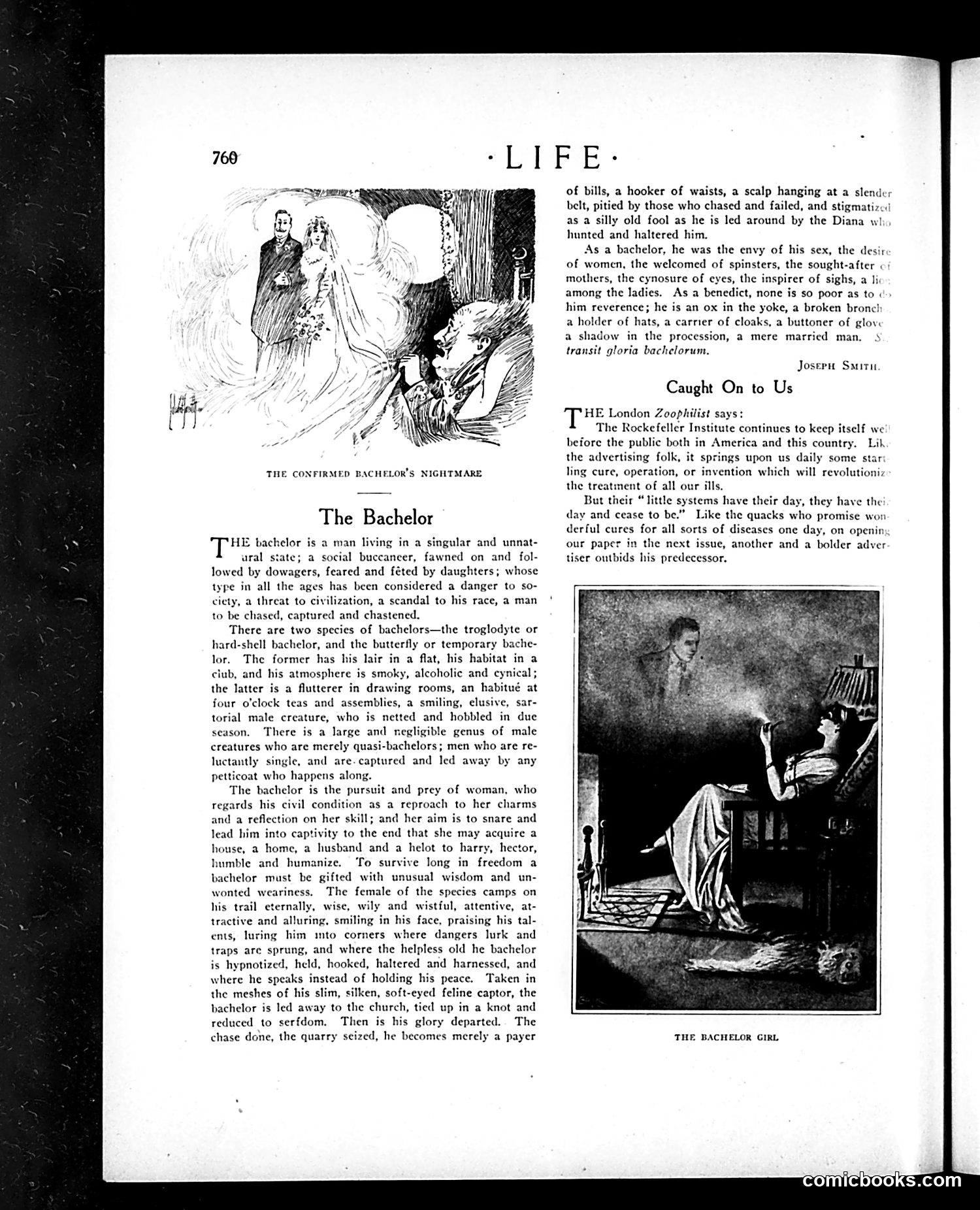
This page satirizes bachelors as social threats, using exaggerated gender warfare rhetoric. The text describes unmarried men as "dangers to society" hunted by women seeking marriage, property, and domesticity. It distinguishes between "hard-shell" bachelors (clubmen living in smoky flats) and "butterfly" bachelors (drawing-room socialites), treating bachelorhood as a temporary, doomed state. The accompanying illustration titled "THE CONFIRMED BACHELOR'S NIGHTMARE" depicts a specter or ghostly vision—likely representing marriage or domesticity—materializing before a horrified man, literalizing the text's predatory framing of women's marital pursuit. The satire mocks both bachelors' self-importance and women's supposed schemes, presenting marriage as the bachelor's downfall: from "envy of his sex" to mere "payer of bills" and "ox in the yoke." The Latin epigraph *transit gloria bachelorum* ("the glory of bachelors passes away") emphasizes this mock-tragic tone.
📄 Transcribed text from this page (OCR, searchable)
Machine-transcribed from the original scan — historical spelling and the odd misread are preserved.
+ LTE * THE CONFIRMED BACHELOR'S NIGHTMARE The Bachelor HE bachelor is a man living in a singular and unnat- ural state; a social buccancer, fawned on and fol- lowed by dowagers, feared and féted by daughters; whose type in all the ages been considered a danger to so- cicty, a threat to civilization, a scandal to his race, a man to be chased, captured and chastened. There are two species of bachelors—the troglodyte or hard-shell bachelor, and the butterfly or temporary bache- lor, The former has his lair in a flat, his habitat in a ciub, and his atmosphere is smoky, alcoholic and cynical; the latter is a flutterer in drawing rooms, an habitué at four o'clock teas and assemblies, a smiling, elusive, sar- torial male creature, who is netted and hobbled in due season. There is a large and negligible genus of male creatures who are merely quasi-bachelors; men who are re- luctantly single, and are. captured and led away by any petticoat who happens along. The bachelor is the pursuit and prey of woman, who regards his civil condition as a reproach to her charms and a reflection on her skill; and her aim is to snare and lead him into captivity to the end that she may acquire a house, a home, a husband and a helot to harry, hector, humble and humanize. To survive long in freedom a bachelor must be gifted with unusual wisdom and un- wonted weariness, The female of the species camps on his trail eternally, wis vily and wistful, attentive, at- tractive and alluring, smiling in his face, praising his tal- ents, luring him into corners where dangers lurk and traps are sprung, and where the helpless old he bachelor is hypnotized, held, hooked, haltered and harnessed, and where he speaks instead of holding his peace. Taken in the meshes of his slim, silken, soft-eyed feline captor, the bachelor is led away to the church, tied up in a knot and reduced to serfdom. Then is his glory departed. The chase done, the quarry seized, he becomes merely a payer of bills, a hooker of waists, a scalp hanging at a slender belt, pitied by those who chased and failed, and stigmatized as a silly old fool as he is led around by the Diana wl hunted and haltered him. As a bachelor, he was the envy of his sex, the desir of women, the welcomed of spinsters, the sought-after « mothers, the cynosure of eyes, the inspirer of sighs, a li: among the ladies. As a benedict, none is so poor as to « him reverence; he is an ox in the yoke, a broken bron: a holder of hats, a carrier of cloaks, a buttoner of glov: a shadow in the procession, a mere married man. transit gloria bachelorum. Joseru Sait Caught On to Us HE London Zoophilist says: The Rockefeller Institute continues to keep itself we before the public both in America and this country. Lik the advertising folk, it springs upon us daily some star ling cure, operation, or invention which will revolutioniz the treatment of all our ills. But their “little systems have their day, they have the day and cease to be.” Like the quacks who promise won derful cures for all sorts of diseases one day, on openin our paper in the next issue, another and a bolder adver tiser outbids his predecessor. THE BACHELOR GIRL