
Life, 1912-04-11 · page 33 of 46
Life — April 11, 1912 — page 33: what you’re looking at
What you’re looking at
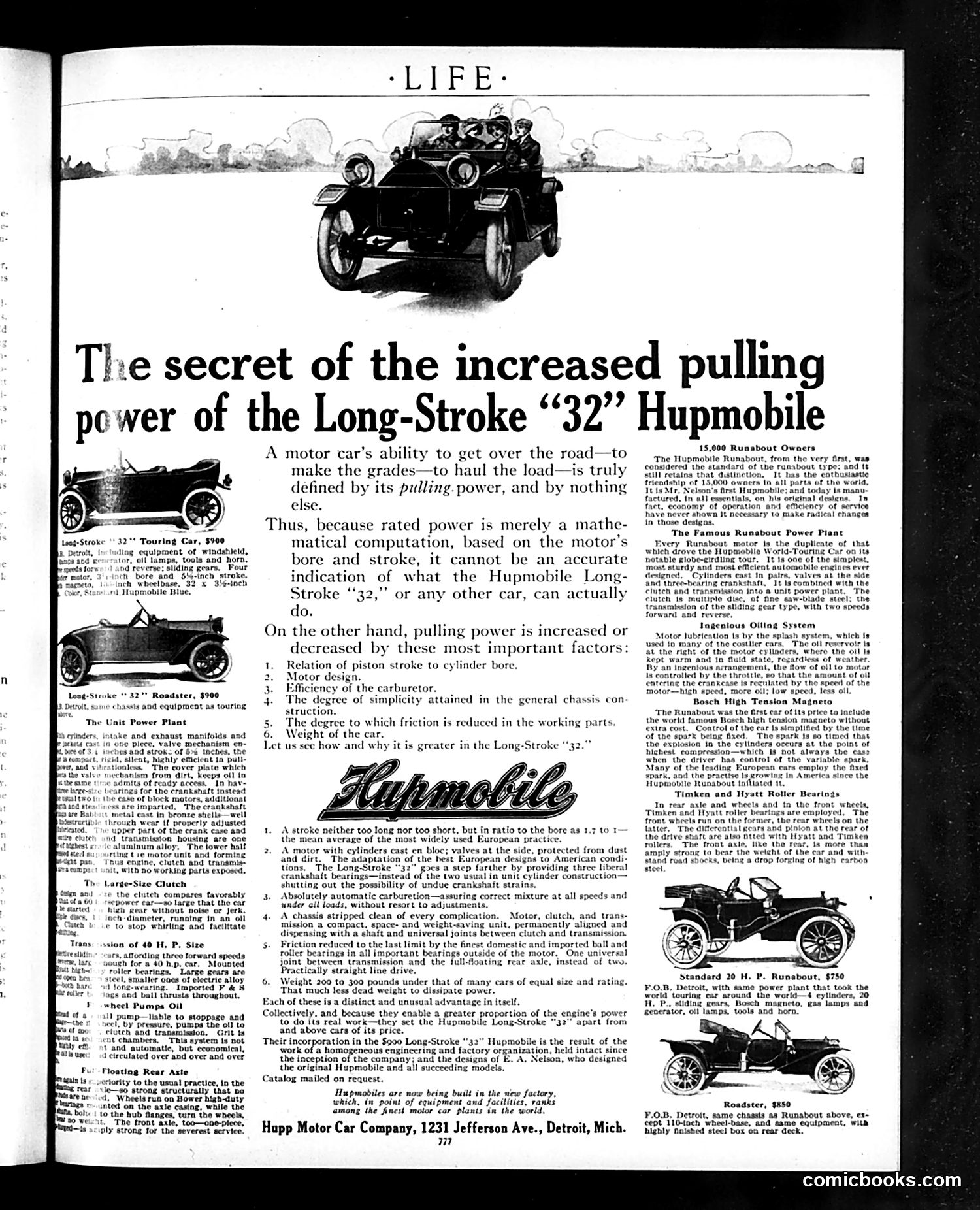
This page is primarily a **product advertisement**, not political satire. It promotes the Hupmobile Long-Stroke "32" automobile, emphasizing its superior "pulling power" compared to competitors. The advertisement argues that actual pulling power—a car's ability to climb grades and haul loads—matters more than rated horsepower. It lists six technical factors explaining why the Hupmobile excels: optimal stroke-to-bore ratio, motor design, carburetor efficiency, chassis simplicity, reduced friction, and weight. The three car illustrations show different models (Touring Car at $988, Roadster at $900) to display the vehicle from various angles. This represents early automotive marketing strategy: using technical specifications and comparative claims to establish superiority during the competitive early motorcar era. There is no political cartoon or social satire present—it's straightforward commercial advertising from the Hupp Motor Car Company of Detroit.
📄 Transcribed text from this page (OCR, searchable)
Machine-transcribed from the original scan — historical spelling and the odd misread are preserved.
Loat-Ste 2 Decruit, The ertinders peketa 2 peoare of 3 4 ws eompact. fever, aod vite teat. ™ daten anit eas of 8 60 we narted .e secret of the increased pulling power of the Long-Stroke “32” Hupmobile 32°? Touring Ci ment of windshield, pa, tools and horn, Four woke "327 Roadster, $900 ino ehasals and equipment as touring Unit Power Plant intake and exhaust manifolds and 8 one plece, valve mechanism en~ inches and stroks of 6>y Inches, the fiaid, silent, highly eMcient ta pull- tionlesk. "The cover plate which mechanism from dirt, Keeps oll 19 ts of ready access. “In hav 2 for the crankshaft instead case of block motors, additional ess are imparted, ‘The crankshaft {metal cast in bronze shelle—well through wear if properly adjusted DRT part of the erank case and id transmission housing are one caluminum alloy, ‘The lower half rt unit and forming Thug engine, cluteh and transmis- nit, WIth no Working parts exposed. Large-Size Clutch © the eluteh compares favorably reepower car—ao large that the car high gear without poise or Jerk, neh diameter, running In an oli © to stop whirling and facilitate ssion of 40 H. P. Size ars, affording three forwand speeds vough for a 40 hp. car. Mounted roller bearings. Large gears are steel, smaller ones of electric alloy long-wearing. Imported F & 3 igs abd ball thrusts throughout. wheel Pumps Ol ull pump—Hiable to stoppage and heel, by Pressure, pumps the oll to ciuteh and transmisdon. Grit ts ‘nt chambers. This system is not t and automatic, but economical, 1 circulated over and over and over Floating Rear Axte fority to the usual practice, 1n the ‘le—so strong structurally that po <i. Wheels run on Bower high-duty unted on the axte casing, while the to the hub flanges, turn the wheels, t. The front axle, too—one-plece, ply strong for the severest service. A motor car's ability to get over the road—to make the grades—to haul the load—is truly defined by its pulling. power, and by nothing else. Thus, because rated power is merely a mathe- matical computation, based on the motor’s bore and stroke, it cannot be an accurate indication of what the Hupmobile Long- or any other car, can actually Stroke ‘'32,” do. On the other hand, pulling power is increased or decreased by these most important factors Relation of piston stroke to cylinder bore. Motor design. Efficiency of the carburetor. The degree of simplicity attained in the general chassis con- struction. 5. The degree to which friction is reduced in the working parts. &. Weight of the car. Let us see how and why it is greater in the Long-Stroke “32. 1. A stroke neither too long nor too short, but in ratio to the bore as 1.7 to 1— the mean average of the most widely used European practice. A motor with cylinders cast en bloc; valves at the side, protected from dust and dirt. The adaptati the hest European designs to American condi- tions. The Long-Stroke goes a step farther by providing three liberal crankshaft bearings—instead of the two usual in unit cylinder construction— shutting out the possibility of undue crankshaft strains. 3. Absolutely automatic carburetion—assuring correct mixture at all speeds and under all loads, without resort to adjustments. A chassis stripped clean of every complication. Motor, clutch, and trans. mission a compact, space- and weight-saving unit, permanently ‘aligned and pensing with a shaft and universal joints between clutch and transmission. Friction reduced to the last limit by the finest domestic and imported ball and roller bearings in all important bearings outside of the motor. One universal joint between transmission and the full-foating rear axle, instead of two. Practically straight line drive. Weight 200 to 300 pounds under that of many cars of equal That much less dead weight to dissipate powe: Each of these is a distinct and unusual advantage in itself. Collectively, and because they enable a greater proportion of the engine's power to do its real work—they set the Hupmobile Long-Stroke "32" apart from and above cars of its price. Their incorporation in the $900 Long-Stroke "32" Hupmobile is the result of the work of a homogeneous engineering and factory organization, held intact since the inception of the company; and the designs of E. A. Nelson, who designed the original Hupmobile and ail succeeding models. Catalog mailed on request. Hupmobiles are now being built in the new factory, which, in point of equipment and facilities, ranks among the finest motor car plants in the world. Hupp Motor Car Company, 1231 Jefferson Ave., Detroit, Mich. mm ze and rating. 15,000 Runabout Owners ‘The Hupmobile Runabout, from the very first, was considered the standard of the runabout type: and tt still retains dastinction, It has the enthusiastic friendship of 15,000 owners in all parts of the world, Itis Mr, Nelson's first Hupmobile; and today 1s manu- factured, 1n all essentials, on his original designs, Im fact, economy of operation and eMciency of service have never shown It necessary to make radical changes in those designs, The Famous Runabout Power Plant Every Runabout motor ts the duplicate of that which drove the Hupmobile World-Touring Car on Its notable globe-girdling tour. It 18 one of the simplest, sturdy and most eMcient automobile engines ever dera cast In pairs, valves at the side crankshaft, It is combined with the nsmission into’a unit power plant. ‘The ple disc, of fine saw-blade steel: the mission of the sliding gear type, with two speeds forward and reverse, Ingentous Oiling Motor lubrication I by the splash system, which ie ny’ of the castiler ears, ‘The oll reservoir Is ‘of the motor cylinders, whero the oll It tess of we 5 we of oll to throttle, so that the amount ring the crankcase Ia reculated by the apeest of th motor—high speed, more oil; low spced, less oll. Bosch High Tension Magneto ‘The Runabout was the frst car of Its price to include world famous Bosch high tension magneto without cost. Control of the car ts simplified by the time of the spark being fixed. ‘The spark ts #0 timed that the explosion 10 the cylinders occurs at the point of highest compression—which 1s not always the cas? when the driver has control of the vai spark. Many of the leading European cara employ the fixed spark, and the practise ts growing In America since the Hupmiobile Runabout tnfliated tt Timken aad Hyatt Roller Bearings In rear axle and whcels and tn the front wheels, ‘Timken and Hyatt roller bearings are employed. The front wheels run on the former, the rear wheels on the latter. The differential gears a nat the Fear of the drive shaft are also Ntted with Hyatt and Timken rollers. The front axle, like the rear, 1s more than amply strong to bear the weight of the car and with- stand road shocks, belng a drop forging of high ear steel Standard 20 H. P. Runabout, $750 F.0.B, Detroit, with sume power plant that took the world ‘touring car around the world—4 cylinders, 20 H. P., allding gears, Bosch magneto, gas lamps and Reverator, oll lamps, tools and horn. Roadster, $850 F.0.B. Detroit, same chassis as Runabout above, ex~ cept 110-och wheel-base, and same equipment, with highly finished steel box on rear deck. comicbooks.com