
Life, 1912-04-11 · page 22 of 46
Life — April 11, 1912 — page 22: what you’re looking at
What you’re looking at
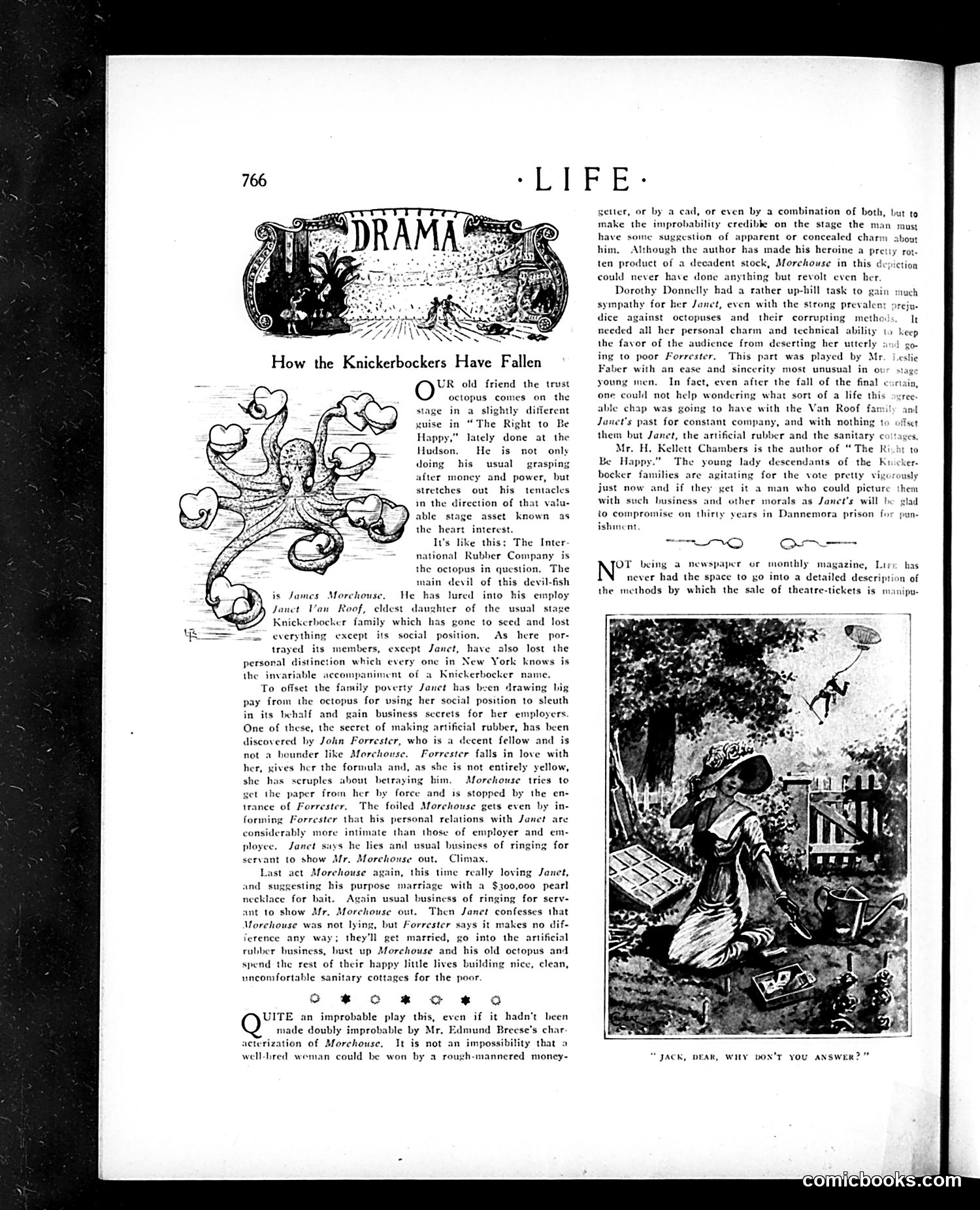
This page reviews a Broadway play featuring a familiar Progressive-era villain: the **trust octopus**—a corporate monopoly (here, the International Rubber Company) personified as a predatory creature. The octopus's human agent, **James Morehouse**, exploits a desperate socialite, **Janet Van Roof**, from an impoverished Knickerbocker family. She uses her aristocratic name to spy for the company. The plot involves a love triangle: honest inventor John Forrester offers her redemption through marriage, but Morehouse blackmails her with false intimacy claims. The reviewer critiques the production's implausibility—arguing that actor Edmund Breese fails to make the villainous Morehouse charming enough to believably seduce anyone. The satire targets both **corporate corruption** and **old money decay**: the Knickerbocker family's social pretension masks financial ruin, making them vulnerable to exploitation. The happy ending—marriage and fighting the monopoly—reflects Progressive idealism about defeating big business through virtue and honest enterprise.
📄 Transcribed text from this page (OCR, searchable)
Machine-transcribed from the original scan — historical spelling and the odd misread are preserved.
-LIFE- UR old friend the trust octopus comes on the stage in a slightly different guise in “The Right to Be Happy,” lately done at the Hudson. He is not only doing his usual grasping after money and power, but stretches out his tentacles in the direction of that valu- able stage asset known as the heart interest. IV's like this: The Inter national Rubber Company is the octopus in question, The in devil of this devil-fish is James Morchouse. He has lured into his employ Janct Van Roof, eldest daughter of the usual stage Knickerbocker family which has gone to seed and lost everything except its social position, As here por trayed its members, except Janct, have also lost the personal distinction which every one in New York knows is the invariable accompaniment of a Knickerbocker name. To offset the family poverty Janet has been drawing big pay from the octopus for using her social position to sleuth in its behalf and gain business secrets for her employers. One of these, the secret of making artificial rubber, has been discovered by John Forrester, who is a decent fellow and is not a hounder like Morcho' Forrester falls in love with her, gives her the formula and, as she is not entirely yellow, she has scruples about betraying him. Morchouse tries to t the paper from her by force and is stopped by the en- trance of Forrester, The foiled Morchouse gets even by in- forming Forrester that his personal relations with Jonct are considerably more intimate than those of employer and em- ployee. Janct says he lies and usual business of ringing for servant to show Mr, Morchouse out, Climax. Last act Morchouse again, this time really loving Janet, and suggesting his purpose marriage with a $300,000 pearl necklace for bait. Again usual business of ringing for serv- ant to show Mr, Morchouse out. Then Janet confesses that Morchouse was not lying, but Forrester says it makes no dif- ference any way; they'll get married, go into the artificial rubber business, bust up Morchouse and his old octopus and spend the rest of their happy little lives building nice, clean, uncomfortable sanitary cottages for the poor o *£ © * O29 € 6 UITE an improbable play this, even if it hadn't been Q made doubly improbable by Mr. Edmund Breese’s char acterization of Morchouse. It is not an impossibility that a well-bred weman could be won by a rough-mannered money- getter, or by a cad, or even by a combination of both, bat to make the improbability credibke on the stage the man sus, have some suggestion of apparent or concealed charm about him, Although the author has made his heroine a prety ro ten product of a decadent stock, Morchouse in this depiction could never have done anything but revolt even her. Dorothy Donnelly had a rather up-hill task to gain much sympathy for her Janet, even with the strong prevalent prejue dice against octopuses and their corrupting methc It needed all her personal charm and technical ability to keep the favor of the audience from deserting her utterly 1 ing to poor Forrester. This part was played by Mr Faber with an ease and sincerity most unusual in ot young men, In fact, even after the fall of the final « one could not help wondering what sort of a life this oxree. able chap was going to have with the Van Roof far Janet's past for constant company, and with nothing to offset them but Janet, the artificial rubber and the sanitary cottages, Mr. H, Kellett Chambers is the author of “The Ri-ht to Be Happy.” The young lady descendants of the Kuicker- bocker fi ating for the vote pretty vigorously just now and if they get it a man who could picture th with such business and other morals as Janet's will he glad to compromise on thirty years in Dannemora prison for pune lies are aj ish TO on OT being a newspaper or monthly magazine, Ly never had the space to xo into a detailed description of the methods by which the sale of theatre-tickets is-manipu- “JACK, DEAR, WILY DON'T you ANSWER?”