
A complete issue · 80 pages · 1912
Life — April 4, 1912
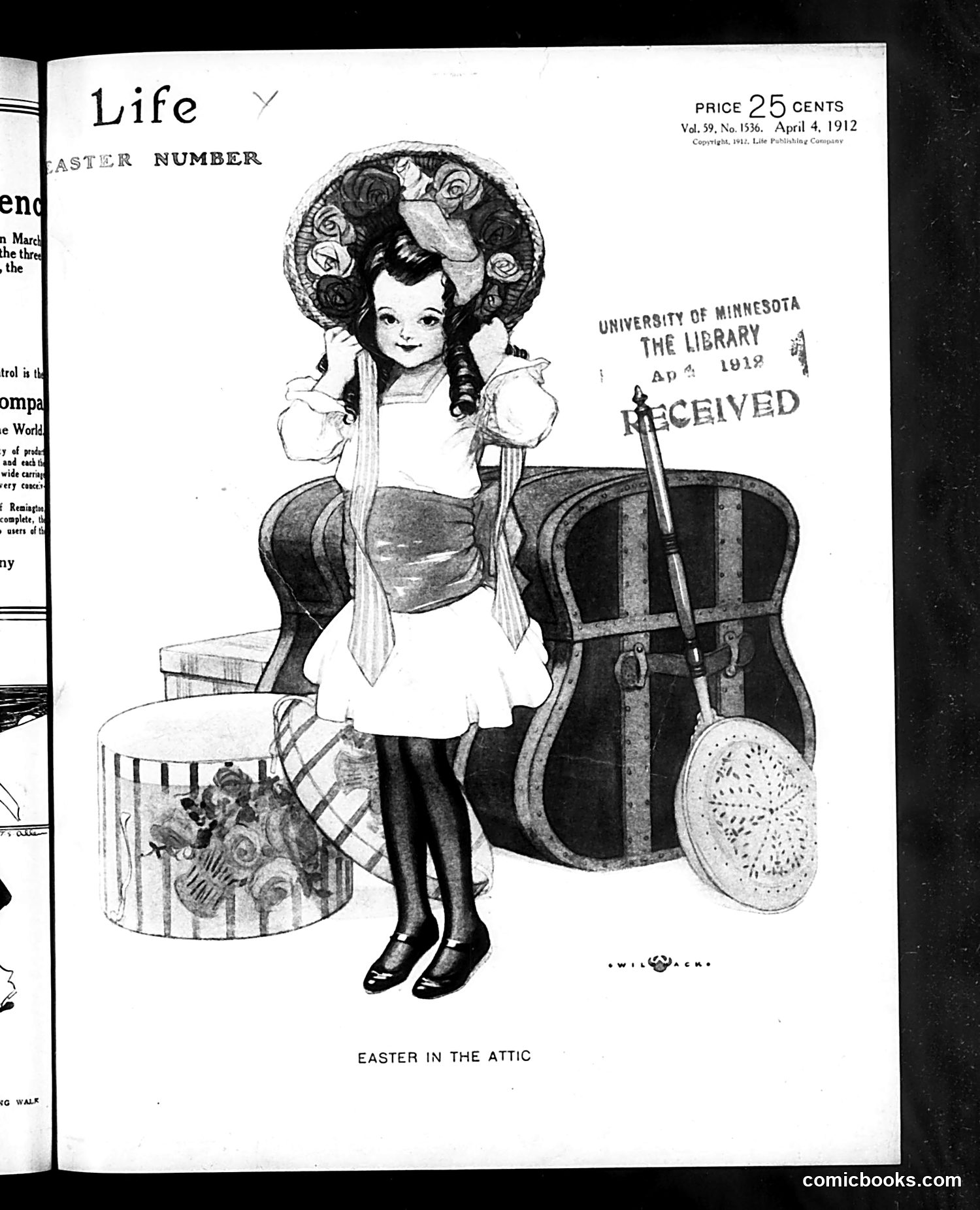
This is Life magazine's Easter Number from April 4, 1912. The illustration titled "Easter in the Attic" shows a fashionable young woman posing among discarded items—a steamer trunk, old hat box, and vintage baggage. The satire likely plays on the tradition of "attic treasures": people rediscovering old Easter bonnets and finery stored away. The woman's elaborate, oversized hat decorated with feathers and ribbons exemplifies the extravagant millinery fashion of the Edwardian era. The joke appears to mock either the vanity of women's fashion, the absurd size of contemporary hats, or society's tendency to resurrect and recycle old clothing trends seasonally. The cluttered attic setting emphasizes the disposability and cyclical nature of fashion.
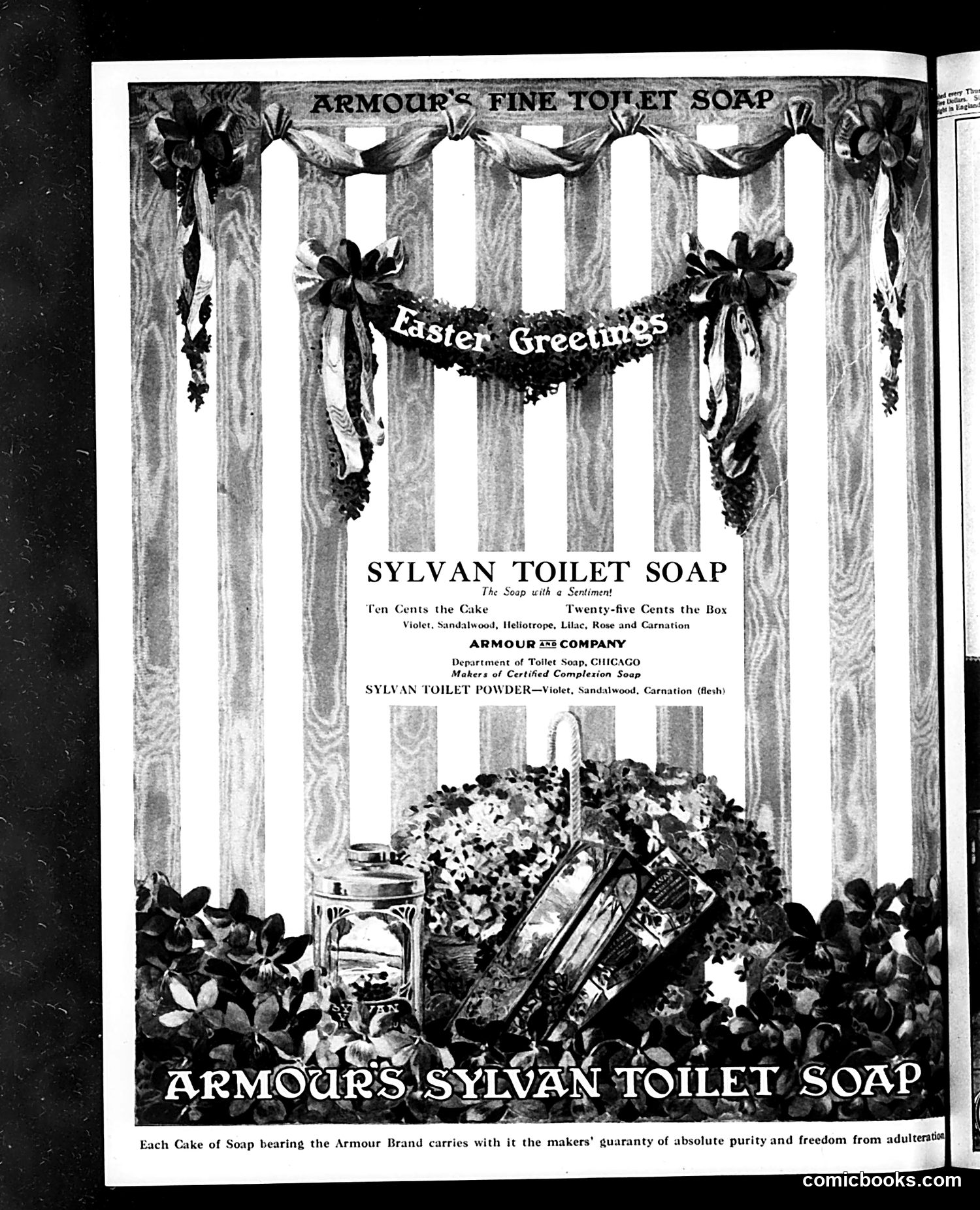
This page is **primarily an advertisement**, not satirical content. It's a full-page Easter ad for Armour's Sylvan Toilet Soap, featuring decorative striped curtains, floral garlands, and Easter greetings imagery. The ad promotes two Armour soap products: - **Sylvan Toilet Soap** (ten cents per cake, twenty-five cents per box) — scented with violet, sandalwood, heliotrope, lilac, rose, and carnation - **Sylvan Toilet Powder** — featuring the same florals plus a "Rich" variant The bottom text guarantees "absolute purity and freedom from adulteration." The layout emphasizes luxury and femininity through its ornamental design with flowers and ribbons, typical of early 20th-century cosmetic advertising. There is no political satire or social commentary present on this page — it's straightforward commercial marketing.
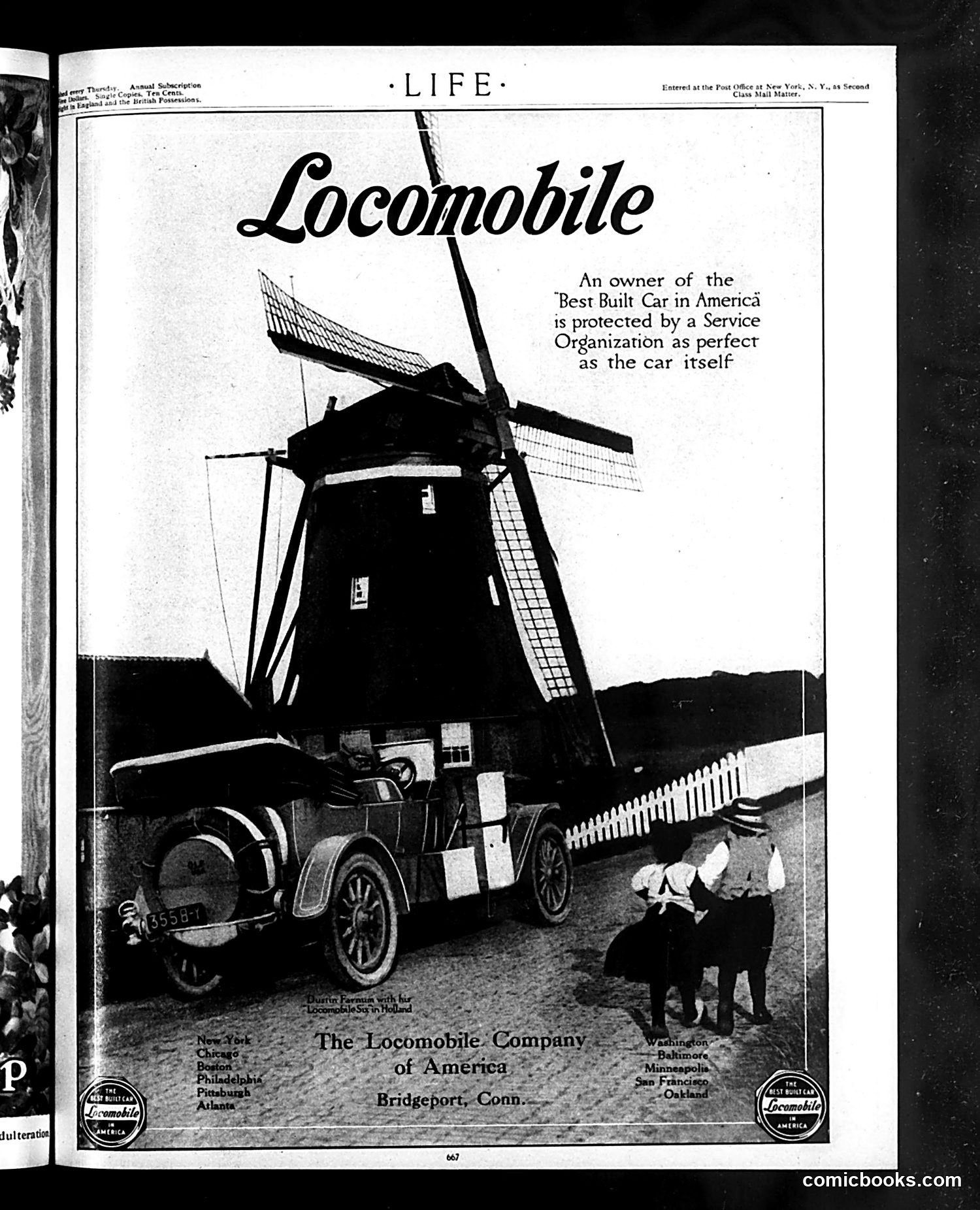
This is primarily a **product advertisement**, not political satire. The page promotes the Locomobile automobile, manufactured in Bridgeport, Connecticut, with offices in major American cities. The advertisement's central image shows a Locomobile positioned incongruously in front of a Dutch windmill—a romantic, Old World setting that contrasts with modern automotive technology. This juxtaposition likely appeals to wealthy consumers by suggesting the car combines European sophistication with American engineering. The tagline claims owners receive service organization protection "as perfect as the car itself," emphasizing reliability and customer support. The silhouettes of well-dressed figures suggest an affluent target market. This appears to be early-twentieth-century luxury automotive marketing rather than satirical commentary.
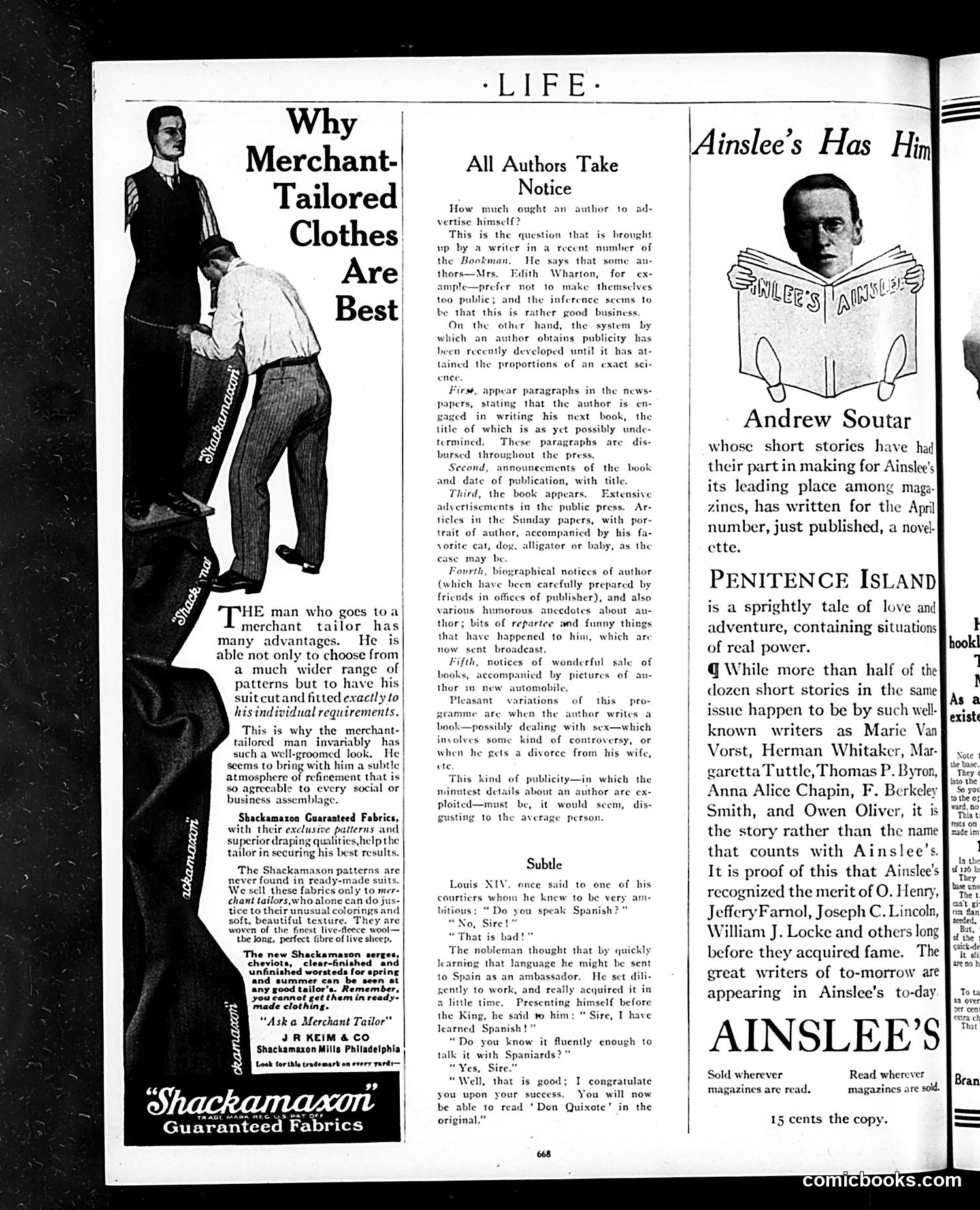
This page contains **advertising rather than political satire**. The left side features a Shackamaxon Fabrics advertisement for merchant-tailored clothing, showing a tailor fitting a well-dressed man. The copy emphasizes the superiority of custom tailoring over ready-made suits. The right side advertises **Ainslee's Magazine**, featuring Andrew Soutar's short story "Penitence Island" described as a "sprightly tale of love and adventure." The advertisement notes that Ainslee's publishes stories by well-known writers including Marie Van Vorst, Herman Whitaker, and others. The center column discusses author publicity practices—how much exposure authors should receive and various promotional methods used by publishers. This is primarily **commercial content**, not satirical commentary.
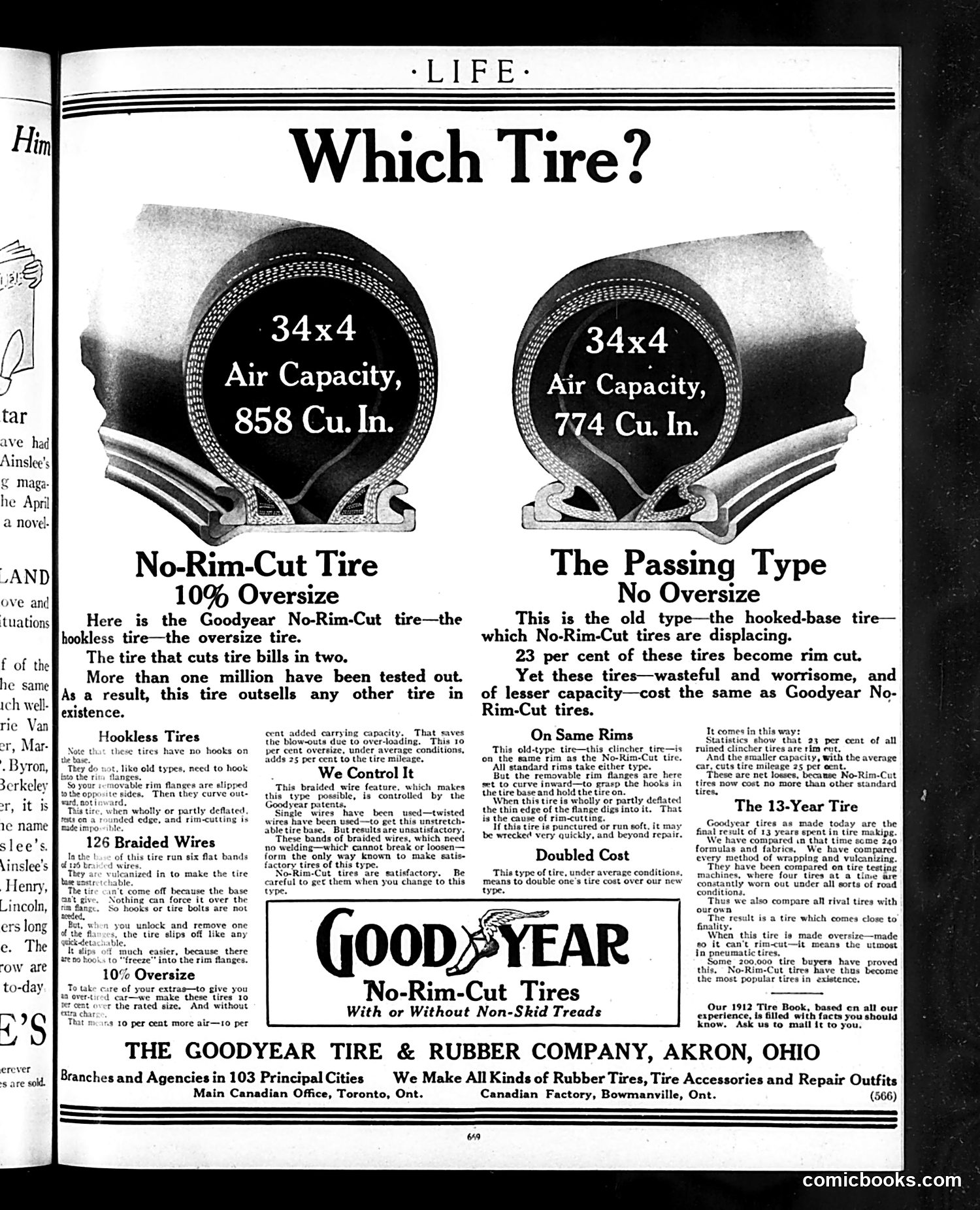
This is **not a cartoon or satire page**—it's a straightforward **advertisement for Goodyear tires**, published in *Life* magazine. The page compares two tire types: 1. **No-Rim-Cut Tire** (left): Goodyear's newer innovation with 10% larger capacity (858 cu. in.), designed to prevent rim-cutting failures 2. **The Passing Type** (right): The older hooked-base tire design with smaller capacity (774 cu. in.), which the ad claims suffers rim-cutting problems in 23% of cases The advertisement's message is straightforward marketing: Goodyear's new technology solves a common tire problem that competitors' products don't address. The visual comparison and technical specifications were typical advertising strategies of this era, using factual claims rather than humor or satire to persuade readers.
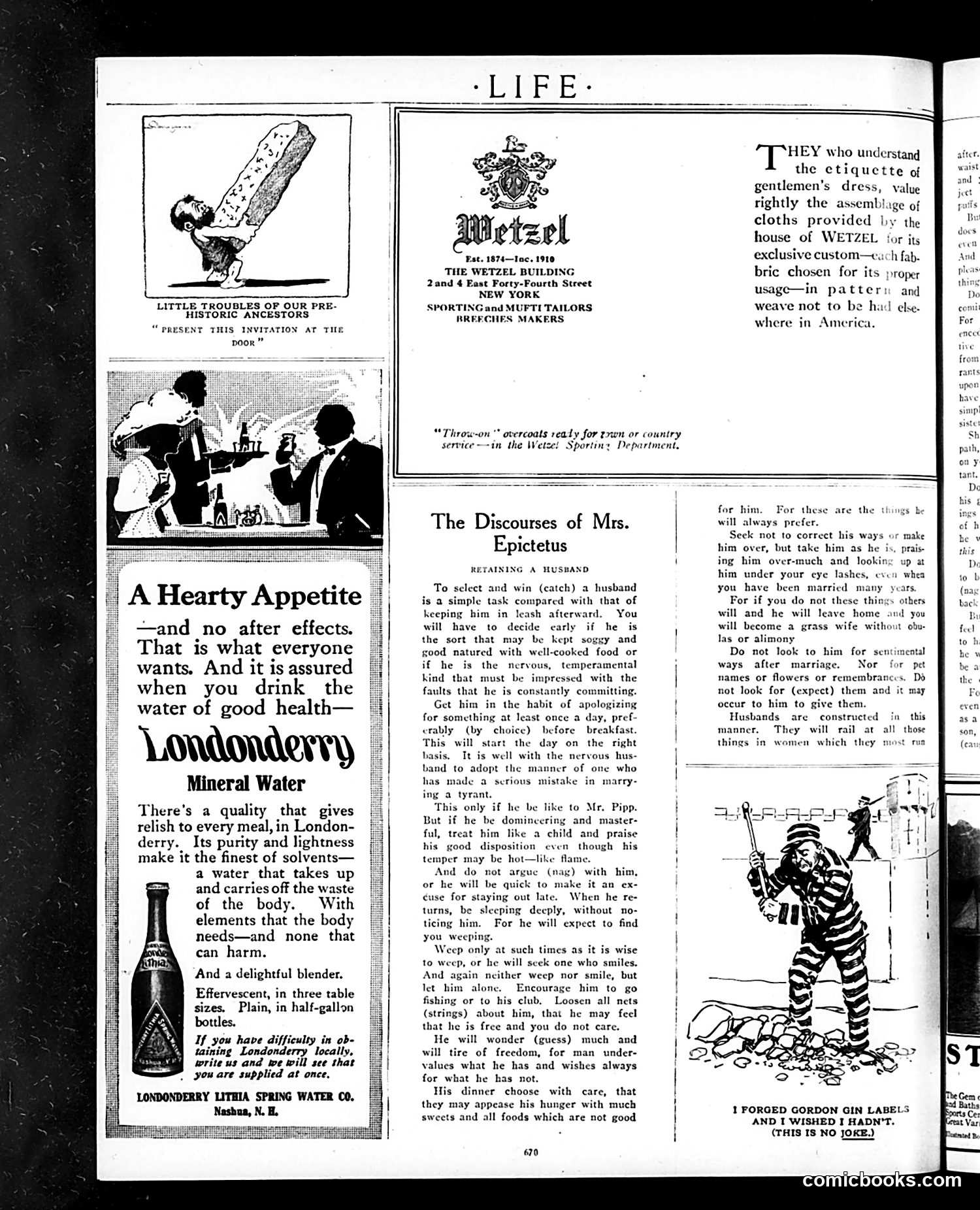
This page is primarily **advertising and advice columns** rather than political satire. The top-left cartoon shows a figure struggling with a large log labeled "LIFE IS TROUBLESOME OF OUR PRE-HISTORIC ANCESTORS"—a humorous comment on ancestral hardship, presented as an invitation to "present this invitation at the door." The main content includes: - A **Wetzel Bros. clothing advertisement** emphasizing exclusive sporting tailors - A **Londonderry Mineral Water ad** promoting digestive health - **"The Discourses of Mrs. Epictetus,"** advice to husbands about selecting and managing wives without being tyrannical - A cartoon showing a figure in **zebra-striped clothing** (unclear reference) with text about forged gin labels The page reflects early 20th-century concerns: gentlemen's fashion, digestive remedies, and marital advice. No specific political satire is evident.
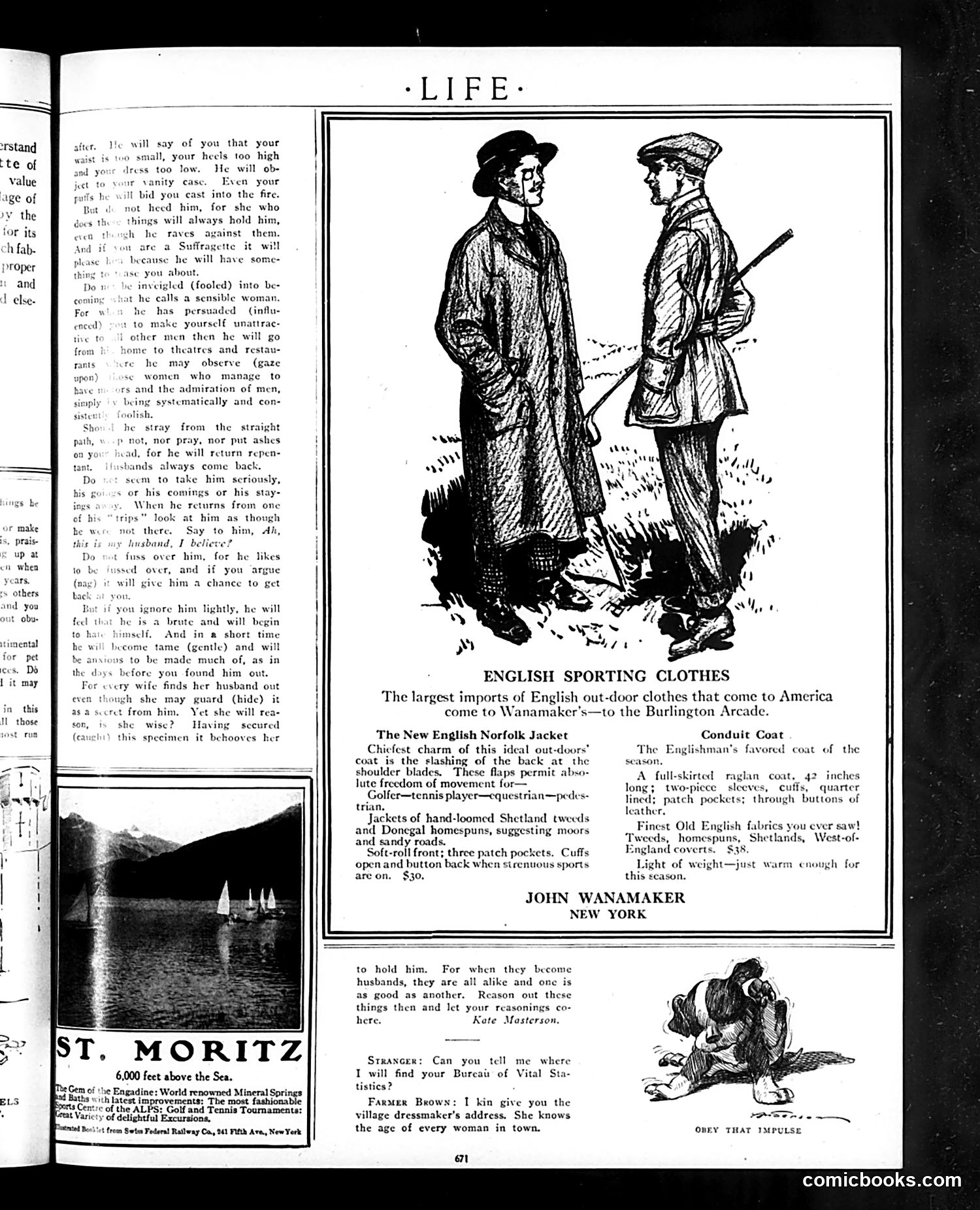
This page is primarily **advertising** rather than political satire. The central illustration shows two men in English sporting attire—one wearing a Norfolk jacket, the other a Conduit coat—discussing outdoor clothing. The advertisement is for **John Wanamaker** (New York department store) promoting "English Sporting Clothes," emphasizing imports from England available at their Burlington Arcade. The text details jacket specifications and prices ($18-$36). A secondary ad promotes **St. Moritz** as a luxury Swiss destination. At the bottom right, a small cartoon shows an "obey that impulse" message, likely encouraging spontaneous shopping. The page reflects early 20th-century American aspirations toward British fashion and leisured lifestyles among affluent consumers.
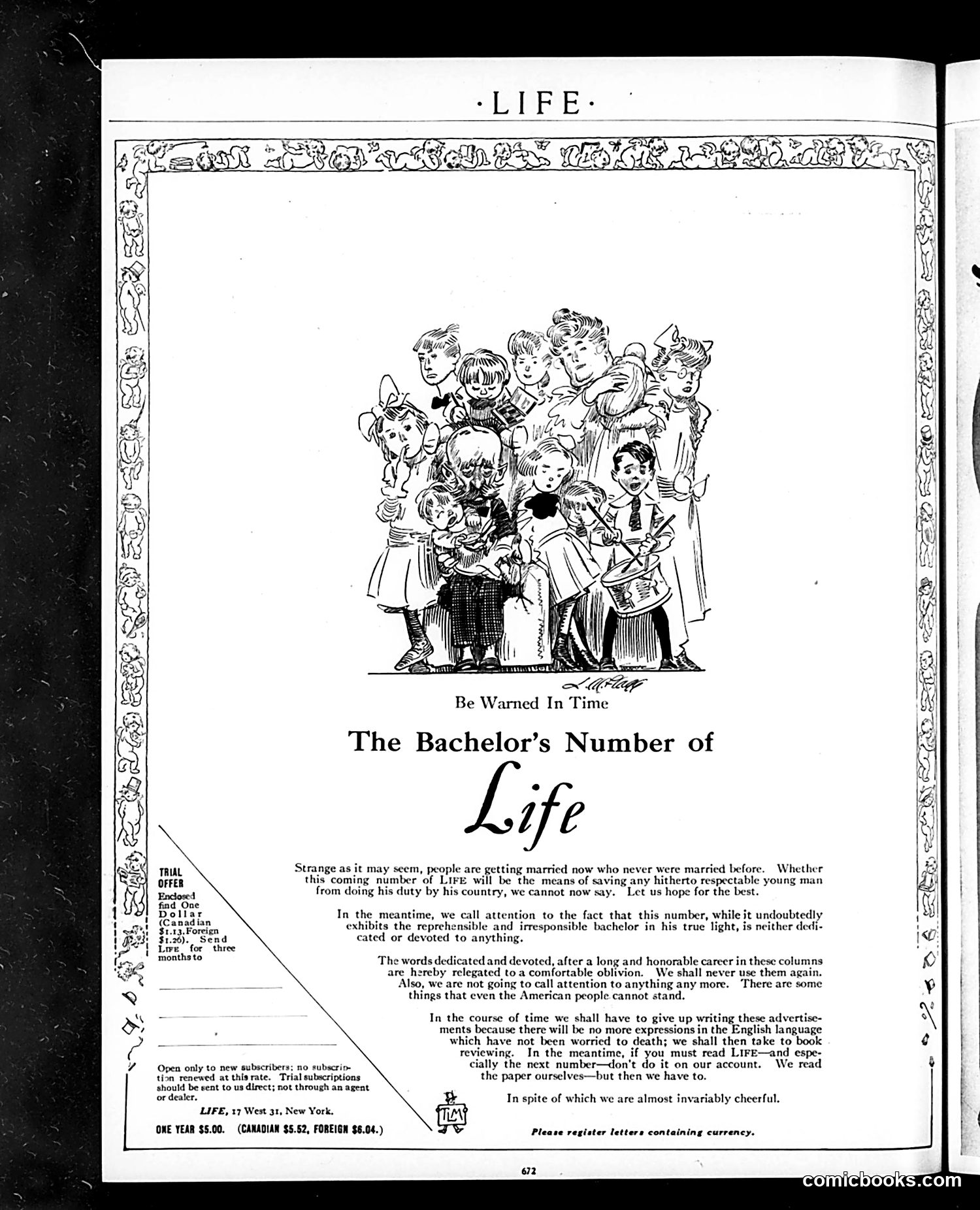
This is a title page and editorial announcement for a special issue of Life magazine focused on bachelors. The central illustration shows a group of children of various ages arranged together, captioned "Be Warned In Time." The editorial text humorously announces that Life is retiring its long-running bachelor advertisements, claiming the magazine will no longer feature "the reprehensible and irresponsible bachelor in his true light." The editors express relief at ending this content, stating they're giving up writing such advertisements because "there will be no more experience in the English language which have not been worried to death." The satire suggests bachelors have been a recurring satirical subject in Life's pages, and this "final" bachelor issue marks the end of that running gag or commentary on unmarried men.
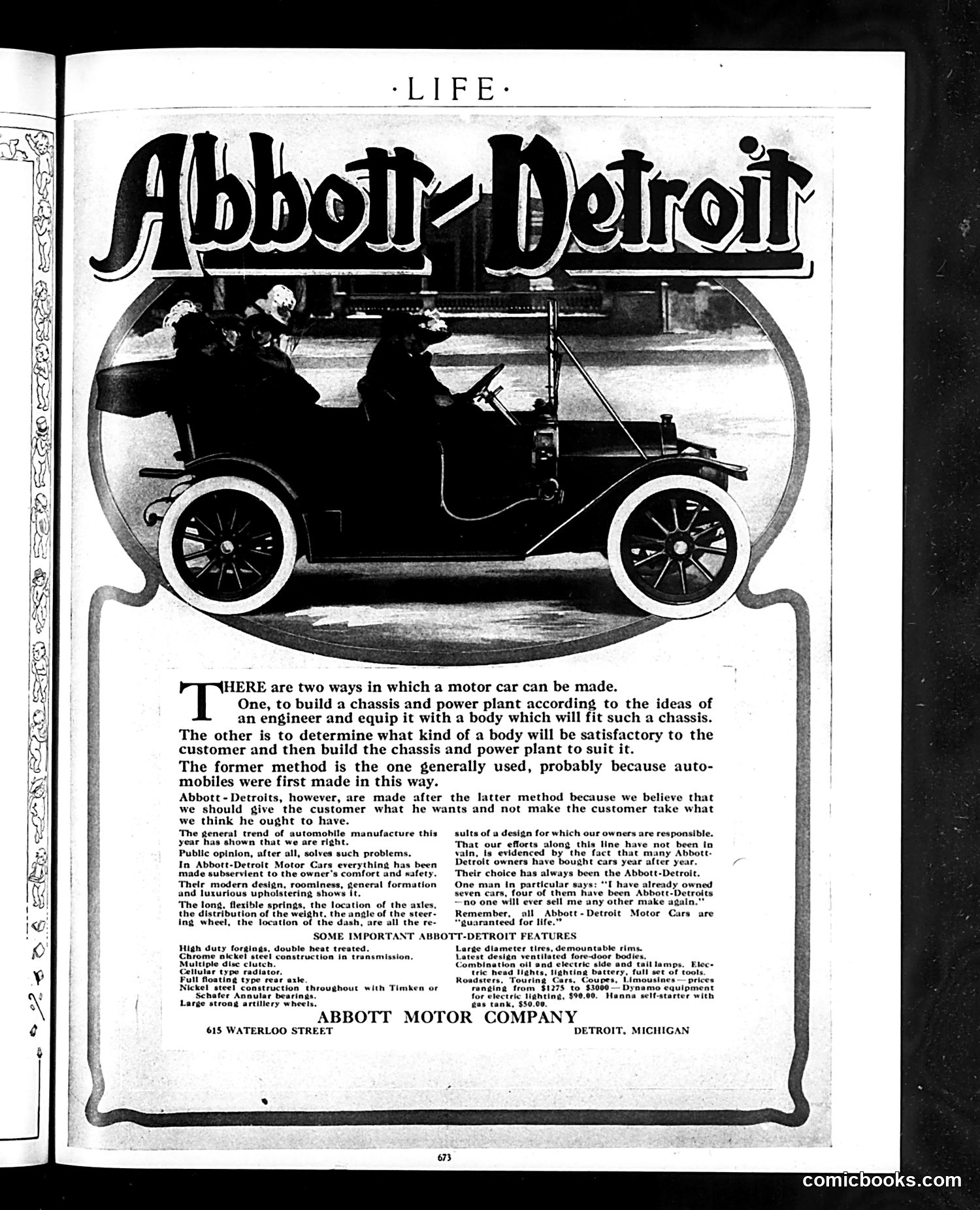
This is a **product advertisement**, not political satire. The Abbott Motor Company of Detroit is promoting their automobiles to Life magazine readers. The ad illustrates two manufacturing philosophies: building a chassis first then adding a body, versus designing the body first to match customer preferences. Abbott claims to use the latter approach, which they argue better serves the customer. The accompanying text emphasizes quality features—chrome construction, flexible springs, electric lighting—and includes a customer testimonial praising Abbott cars' reliability. There is **no cartoon or political commentary** on this page. It's a straightforward early-1900s automotive advertisement emphasizing engineering quality and customer-focused design to distinguish Abbott vehicles in a competitive market.
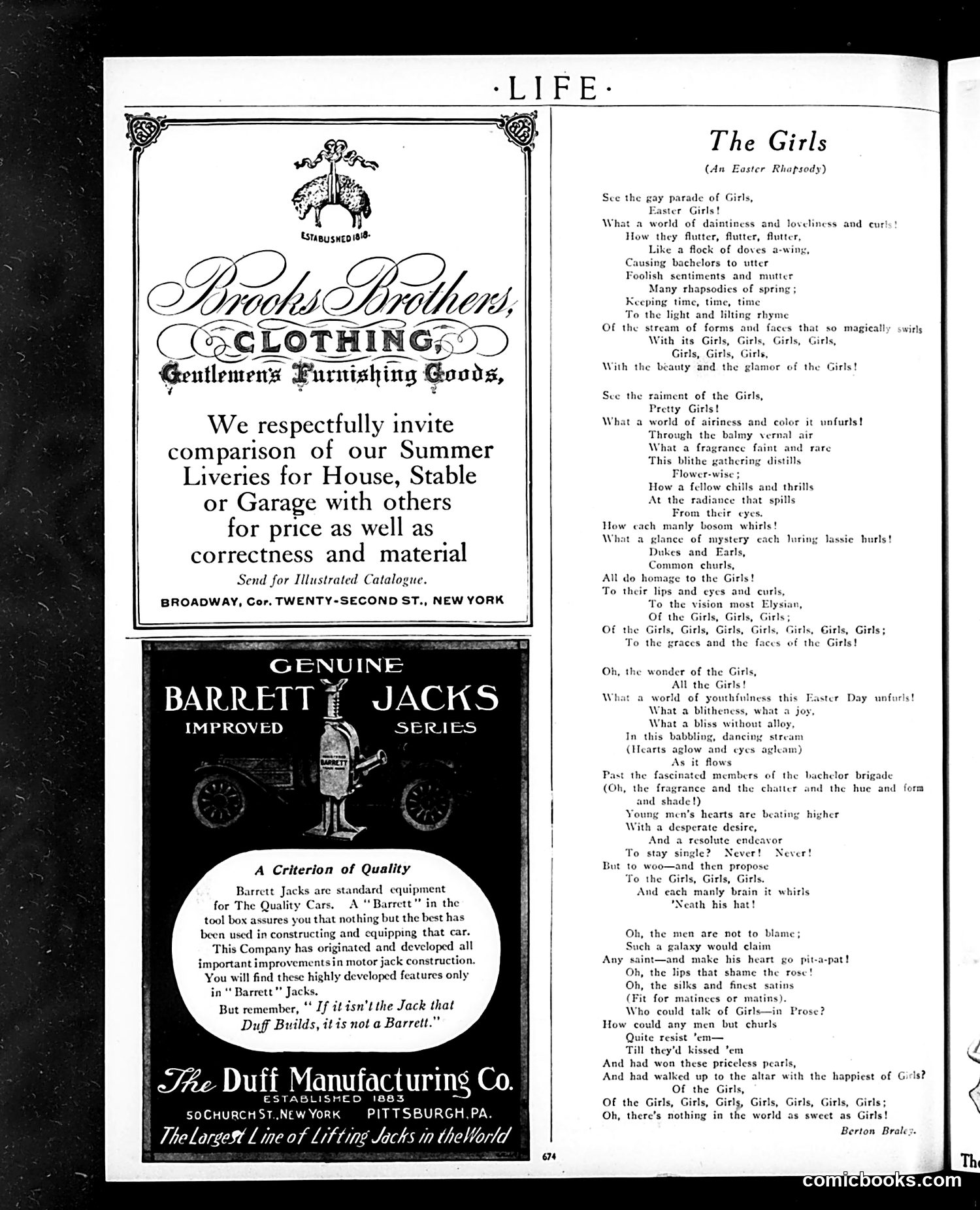
This page consists primarily of **advertisements** rather than satirical cartoons. The left side features ads for Brooks Brothers clothing, Barrett jacks (lifting equipment), and Duff Manufacturing Company's motor jacks. The right side is a **poem titled "The Girls (An Easter Rhapsody)"** by Breton Braley, celebrating young women in lyrical, flowery language. The poem praises girls' beauty, charm, and grace while playfully noting that they captivate men and inspire romantic devotion ("Young men's hearts are beating higher / With a desperate desire"). There is no political satire visible on this page. The content reflects early-20th-century gender stereotypes and romanticized views of femininity typical of the era, but presents these as straightforward celebration rather than satirical commentary.
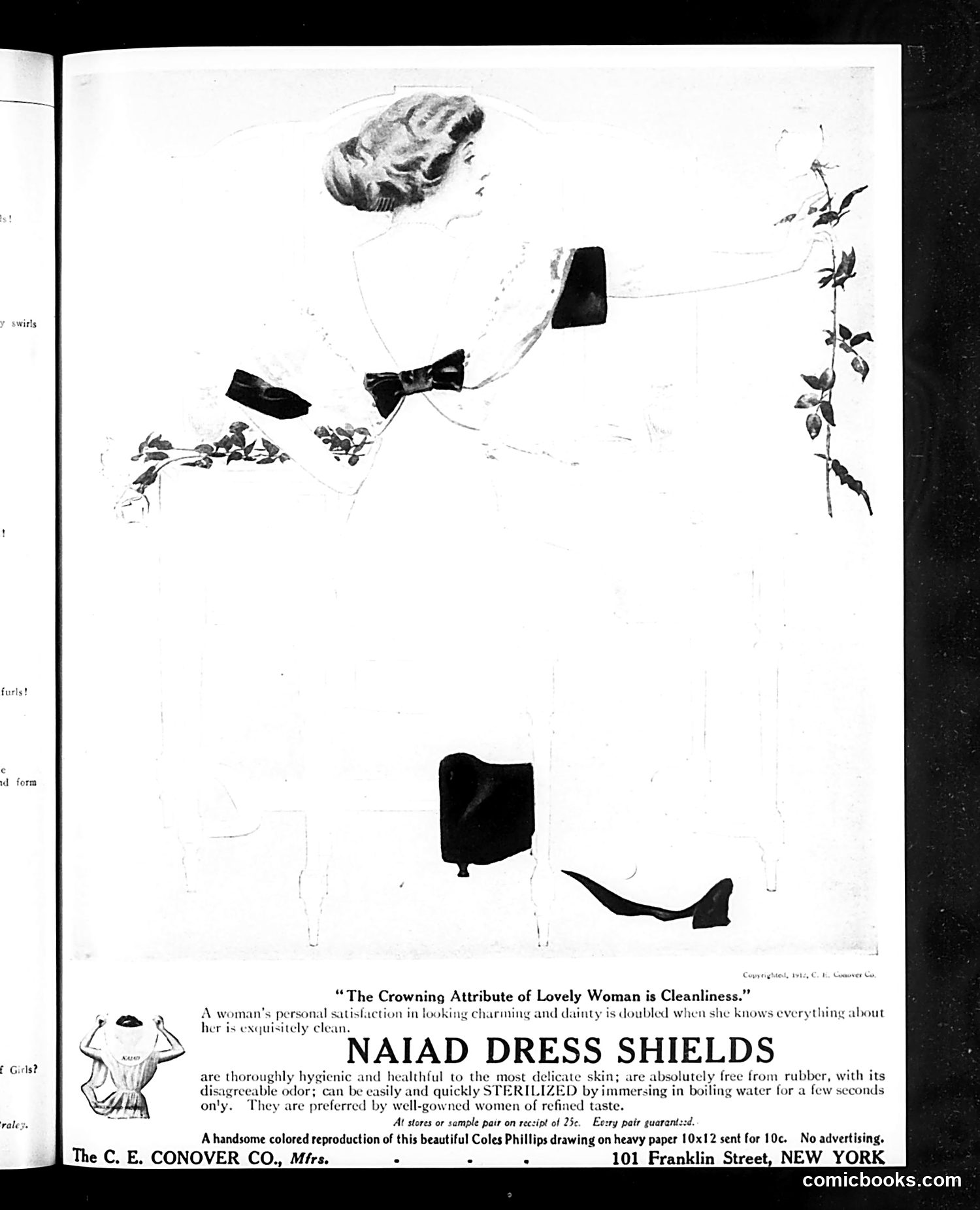
This page is primarily a **product advertisement** for Naiad Dress Shields, not political satire. The top features a sketch of a woman's head in profile and various clothing items (gloves, bow tie, shoes). The advertisement promotes dress shields—protective garments worn under clothing to prevent sweat stains. The headline quotes "The Crowning Attribute of Lovely Woman is Cleanliness," reflecting early 20th-century advertising's focus on female hygiene and propriety. Key selling points include: rubber-free construction (avoiding odor), sterilization capability through boiling, and affordability (10 cents for a sample pair). The small illustration showing a woman in undergarments reinforces the product's intimate nature. This represents typical early 1900s advertising rhetoric linking cleanliness to feminine virtue and social acceptability.
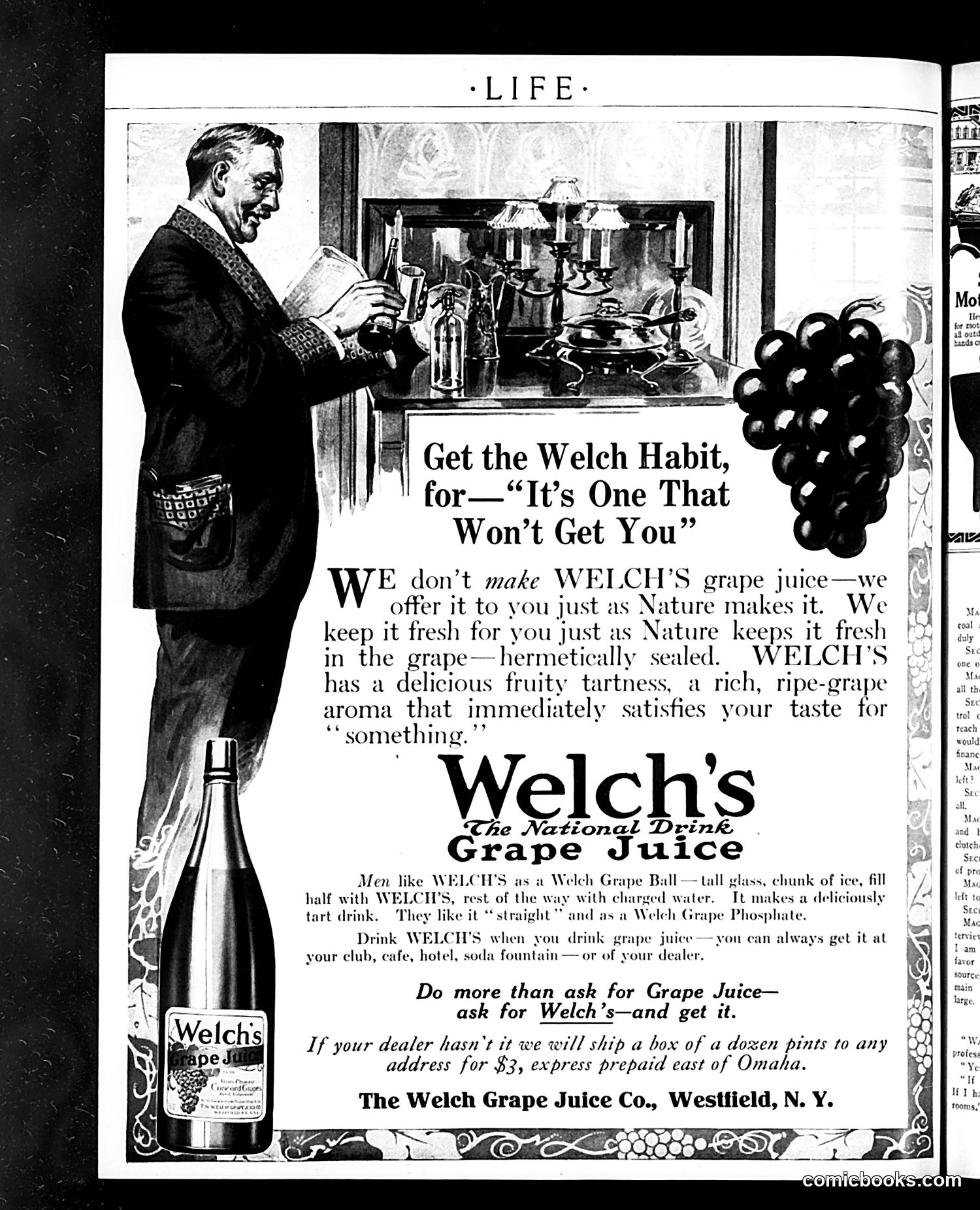
This page is primarily a **product advertisement** for Welch's Grape Juice, not political satire or a cartoon. The ad features a well-dressed man in formal attire examining a bottle of Welch's grape juice in what appears to be an upscale dining setting. The headline "Get the Welch Habit, for—'It's One That Won't Get You'" plays on contemporary concerns about addiction and habit-forming substances, likely referencing alcohol prohibition (in effect 1920-1933). The ad's key selling point emphasizes that Welch's is a natural, non-alcoholic alternative to wine—"fresh" and "hermetically sealed," appealing to health-conscious consumers and those avoiding alcohol for moral or legal reasons. The text mentions serving it as a "Welch Grape Ball" cocktail substitute. This reflects early 20th-century marketing responding to Prohibition-era sensibilities.
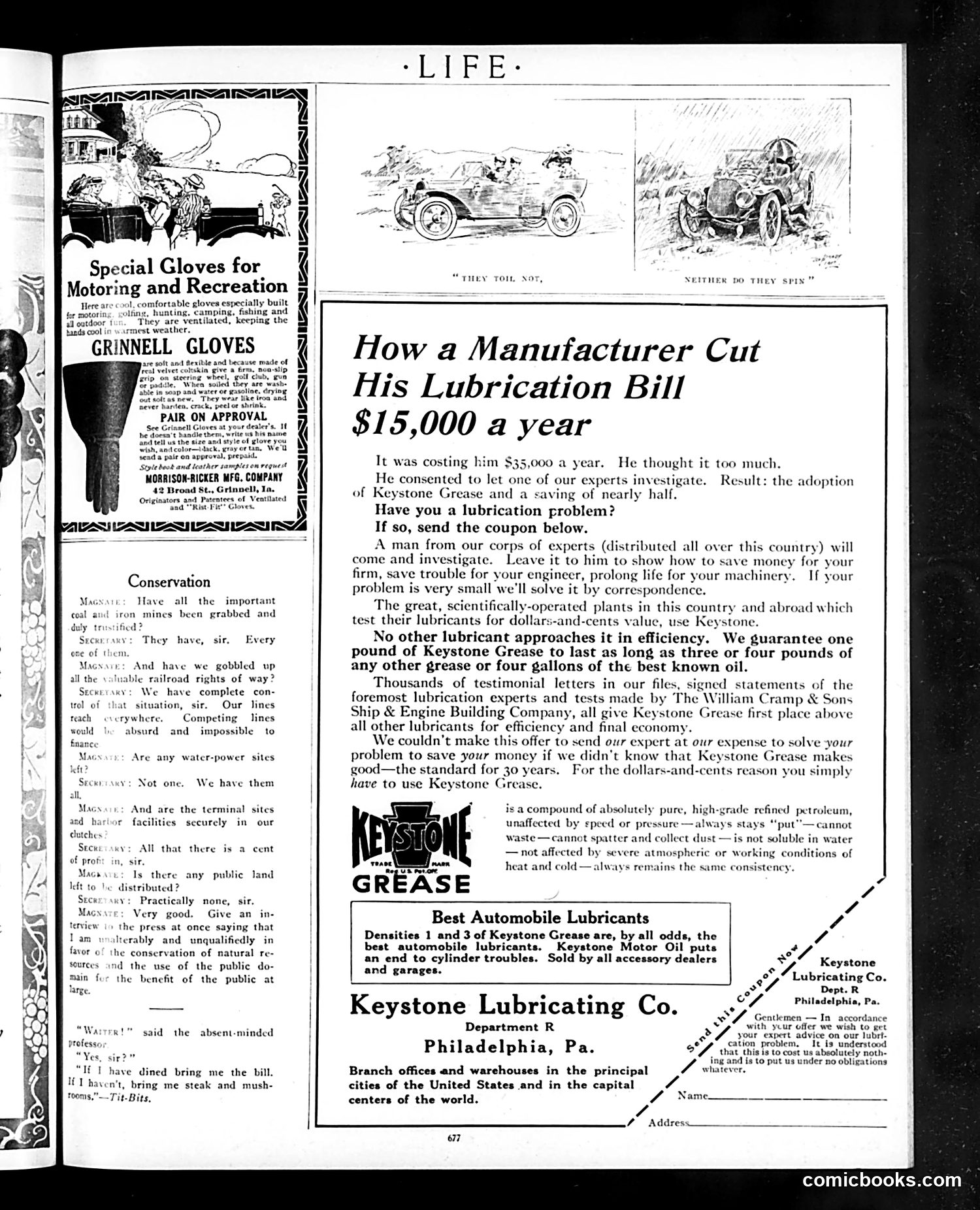
This page is primarily **advertising**, not satire or political commentary. The left column features a Grinnell Gloves advertisement for motorist and recreational gloves, and a "Conservation" dialogue—a Q&A format about railroad and water-power site acquisition that appears to be either advertorial content or light corporate messaging rather than satire. The main content is a Keystone Lubricating Company advertisement, headlined "How a Manufacturer Cut His Lubrication Bill $15,000 a year." It uses a case-study format to promote Keystone Grease as a cost-saving industrial lubricant, claiming superior efficiency compared to competitors. Two small automotive sketches at the top ("They Toil, Not" and "Neither Do They Spin") accompany the advertisements but appear decorative rather than satirical.
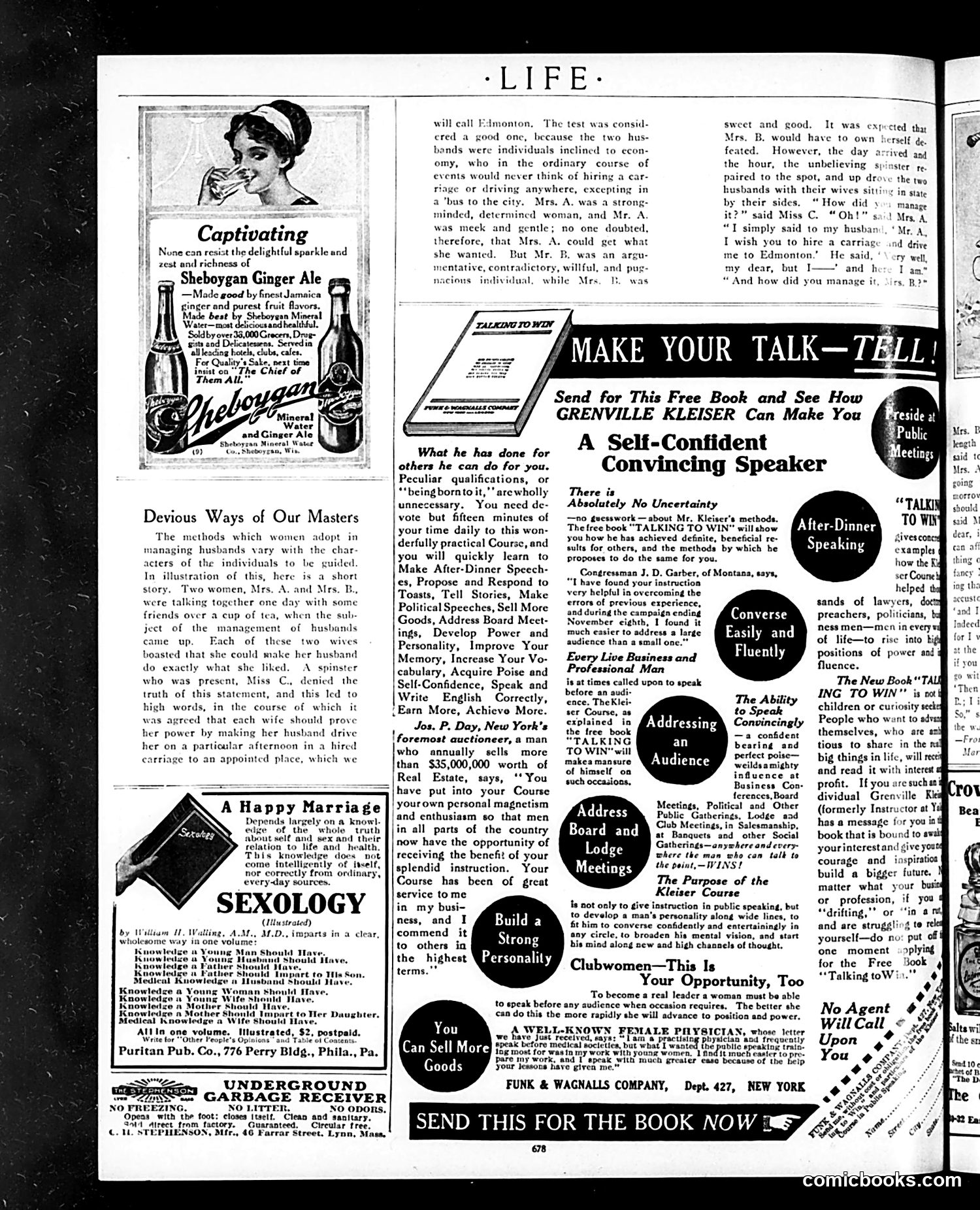
This page is primarily **advertising and self-help content** rather than political satire or comics. The main elements include: 1. **Sheboygan Ginger Ale advertisement** (top left) - a beverage product ad 2. **"Devious Ways of Our Masters"** - a short story about marital dynamics, where women manage husbands through indirect tactics 3. Multiple **self-improvement ads** promoting public speaking courses, personality development, and salesmanship training via mail-order books from Funk & Wagnalls Company 4. A **"Sexology"** book advertisement by William H. Walling, M.D. 5. An **Underground Garbage Receiver** ad (bottom) The satirical element appears subtle: the story about women manipulating husbands contrasts with ads promising readers (implicitly male) how to gain confidence and authority through courses. The overall tone suggests early 20th-century anxieties about personal improvement and social positioning.
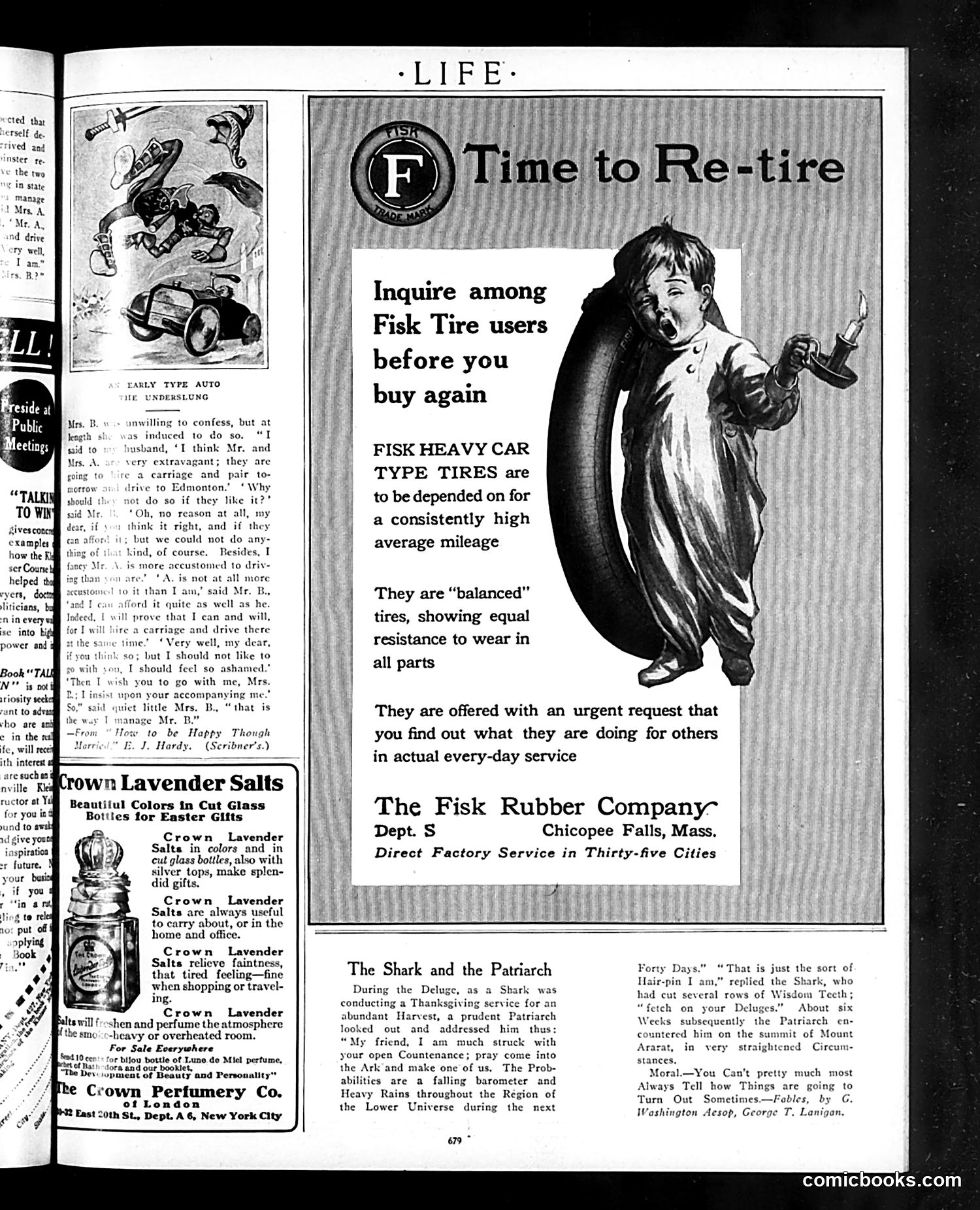
This page is primarily **advertising** with a small fable at the bottom. The main content includes: **Fisk Tire Advertisement**: A large ad featuring a cherubic child figure, promoting Fisk Heavy Car Type Tires. The ad urges readers to "inquire among Fisk Tire users before you buy again," emphasizing balanced wear and durability—typical early automotive advertising appealing to practical concerns about tire longevity. **"The Shark and the Patriarch"**: A brief fable (bottom) satirizing false civility and opportunism. A shark, conducting a "Thanksgiving service," invites a Patriarch into the ark by flattering him. The Patriarch later discovers the shark has been eating his livestock—a moral tale about trusting outward appearances and polite behavior from those with hidden self-interest. **Left side**: An "Early Type Auto" cartoon and text about marital disagreement over extravagant carriage expenses, plus ads for Crown Lavender Salts perfume products. The page reflects early 20th-century concerns: automobile expense, consumer products, and moral lessons through animal fables.
This is not a cartoon or satirical content—it's a **straightforward automobile advertisement** for the Packard Motor Car Company of Detroit, likely from the 1910s-1920s era based on the typography and design style. The ad promotes the Packard "Six" as a luxury vehicle, emphasizing its resale value ("best cash asset"), performance (60 mph acceleration in 30 seconds), maneuverability (tight turning radius), smooth ride, and reliability. The small illustration shows a well-dressed man in formal attire, representing the affluent target demographic. There is no political satire or social commentary here—it's simply a period advertisement highlighting engineering features and durability to attract wealthy buyers. The phrase "Ask the man who owns one" was apparently Packard's marketing slogan, appealing to testimonials from satisfied customers.
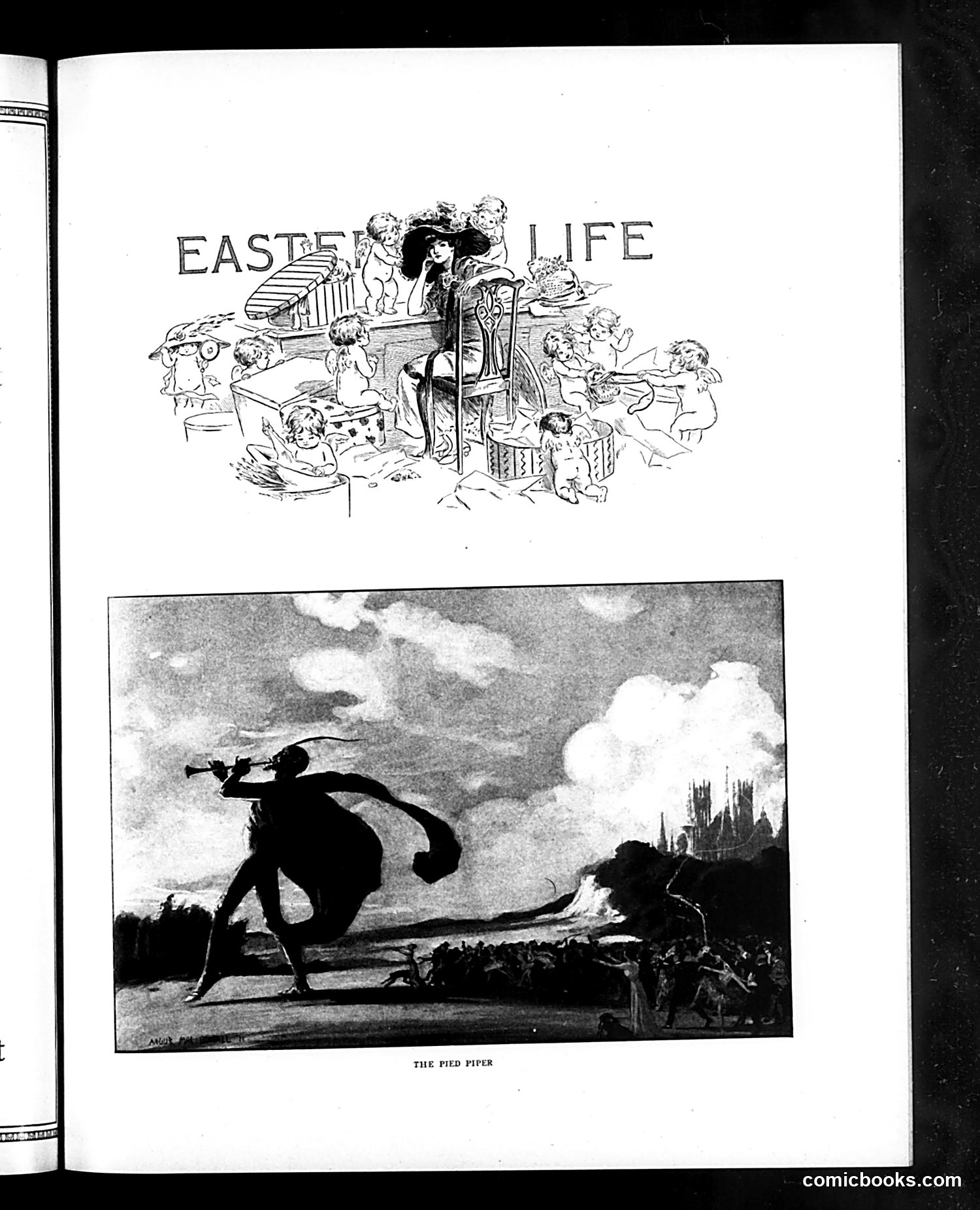
This page features an illustration titled "The Pied Piper" at the bottom—a silhouetted figure playing a pipe while leading children toward a distant medieval city. The top decorative header reads "EASTER LIFE" with cherubs and holiday imagery. The cartoon appears to be a satirical reference to the classic Pied Piper legend, where a mysterious musician leads children away, never to return. In early 20th-century American satire, such imagery often commented on social dangers—potentially referencing how certain ideologies, leaders, or institutions (represented by the "piper") dangerously attracted or misled youth and populations. Without additional context or visible text identifying the specific piper figure, the exact political target remains unclear, though the ominous tone suggests social criticism rather than lighthearted Easter humor.
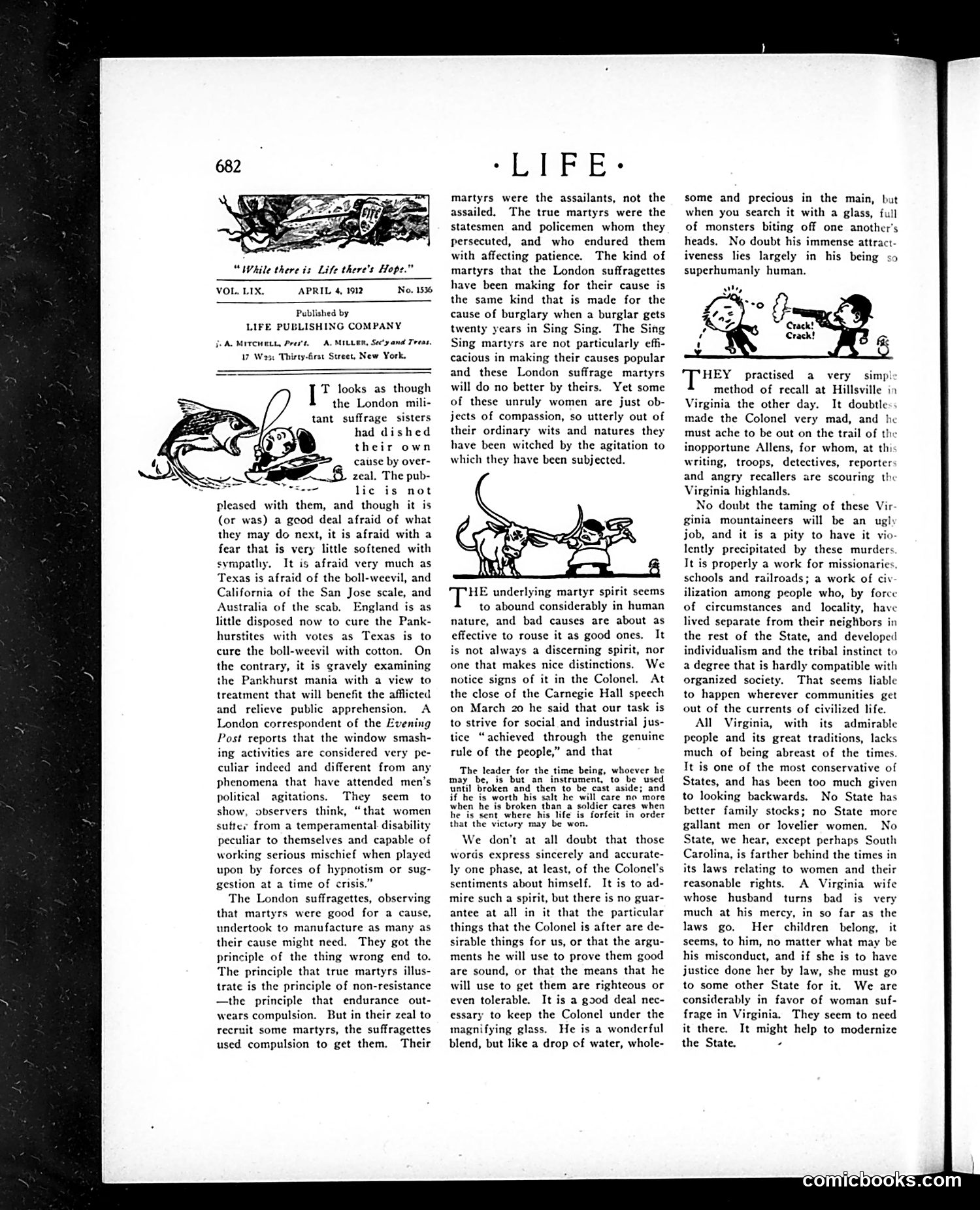
This page critiques British militant suffragettes (likely the Pankhurst movement) for their window-smashing campaigns. The cartoons show figures being struck or knocked about—visualizing the magazine's argument that these activists have undermined their own cause. The editorial contends that suffragettes misunderstood martyrdom. True martyrs practice *non-resistance*, but these women used *compulsion* against police and officials—making those officials the real victims, not the activists themselves. The comparison to Sing Sing prisoners suggests their "martyrdom" discredits rather than advances their cause. The text also references "the Colonel" (appears to be Theodore Roosevelt, based on context), praising his rhetoric about sacrifice while warning that noble-sounding principles don't guarantee righteous goals. The overall message: good intentions don't justify harmful methods, and public sympathy won't follow coercion.
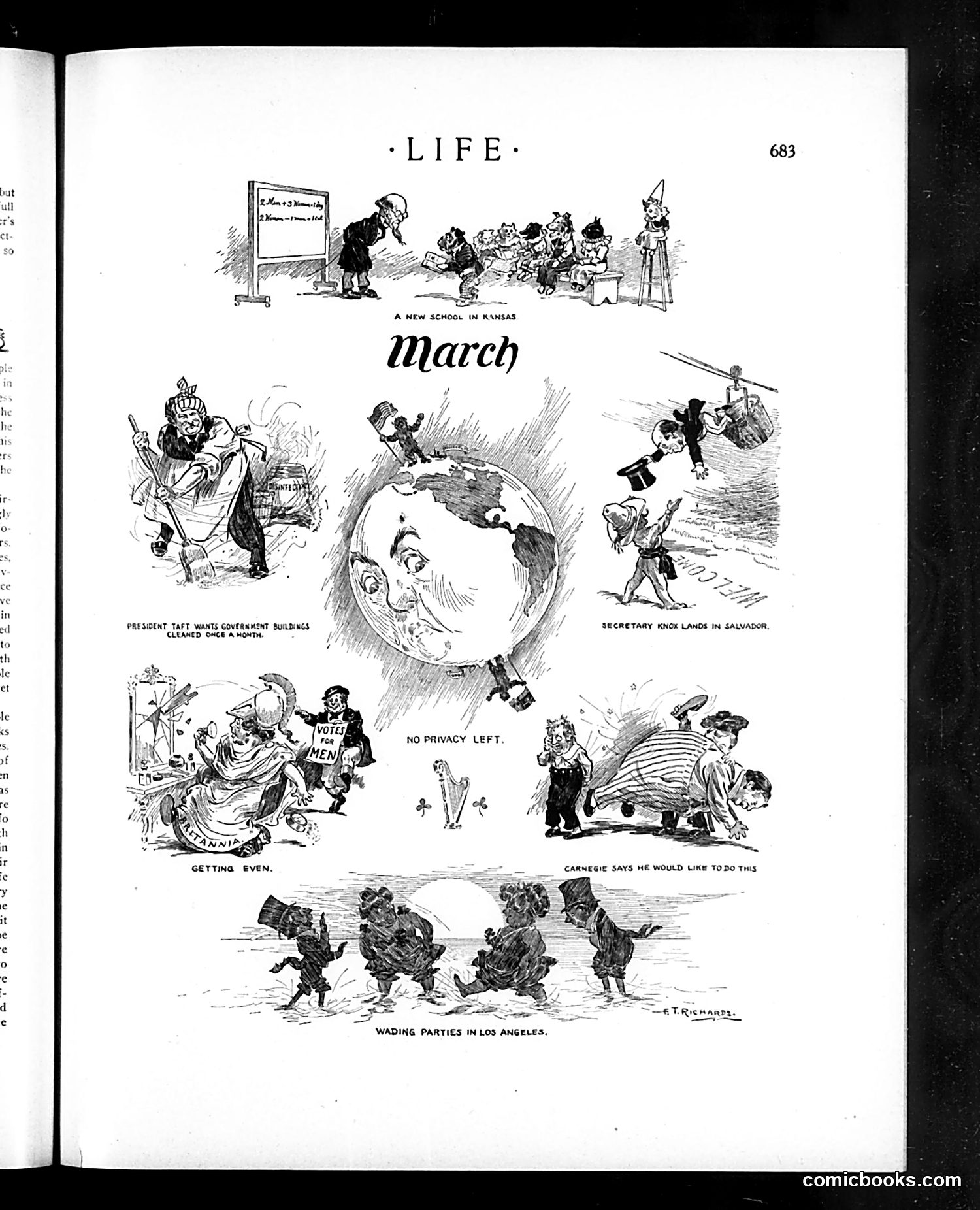
This page satirizes early 1910s political and social events. The central large face likely represents a political figure facing scrutiny ("No Privacy Left"). **Top left**: President Taft's directive to clean government buildings monthly is mocked as inadequate—suggesting government corruption requires more than superficial cleaning. **Top right**: "Secretary Knox Lands in Salvador" references Secretary of State Philander Knox's diplomatic mission, depicted chaotically. **Bottom**: "Wading Parties in Los Angeles" shows people in water, likely satirizing California's water scarcity or drought conditions affecting the region. The overall theme appears to be governmental ineffectiveness and administrative absurdities of the Taft administration, combined with contemporary regional crises. The cartoonist uses exaggeration and visual metaphor to mock both federal politics and local hardships.
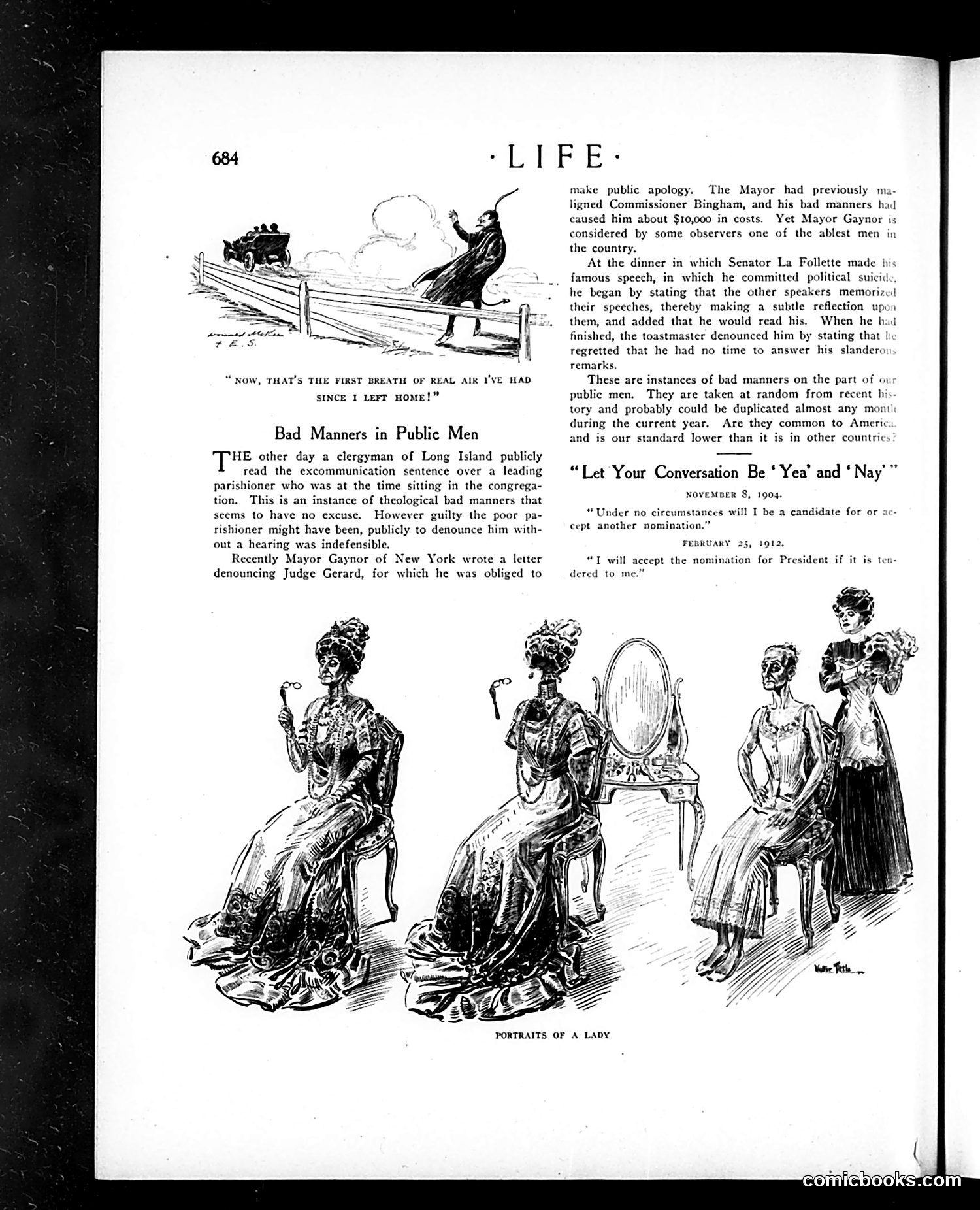
This page satirizes bad manners among prominent public figures. The top cartoon shows a man (likely a politician) escaping stuffy social conventions, captioned "the first breath of real air I've had since I left home!" The article documents three examples of public rudeness: a clergyman publicly excommunicating a parishioner, New York Mayor Gaynor writing insulting letters requiring apologies and costing him $10,000, and Senator La Follette making veiled insults at a dinner before being publicly denounced by the toastmaster. The bottom illustration, titled "Portraits of a Lady," satirizes political flip-flopping through a woman viewing herself in mirrors—showing different reflections. The dated quotes (November 1904 vs. February 1912) contrast contradictory statements about presidential candidacy, likely referencing Theodore Roosevelt's shifting position on seeking another term, illustrating hypocrisy masked by refined manners.
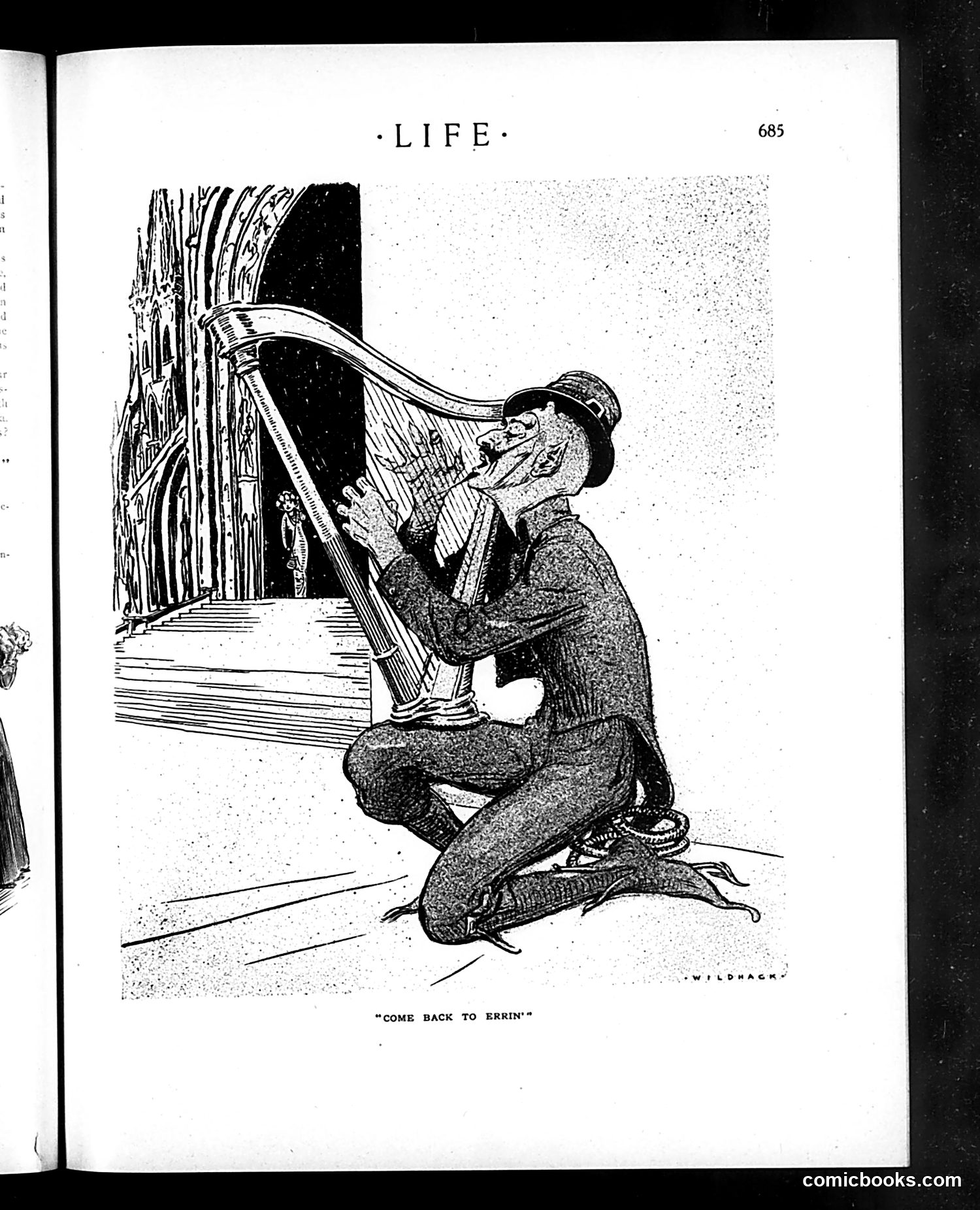
This cartoon by Cesare Maccioni depicts a caricatured figure (appearing to be Irish, based on the exaggerated features and hat) kneeling before a Gothic cathedral doorway, gazing upward. The caption reads "Come Back to Errin" (likely "Erin," the poetic name for Ireland). The satire appears to target Irish-American nostalgia or emigration themes popular in early 20th-century American humor. The figure's supplicant posture and emotional gesture suggest either homesickness or religious sentiment—possibly mocking romantic idealizations of Ireland held by diaspora communities. Without additional context about specific contemporary events, the precise political target remains unclear, though it likely commented on Irish-American identity or attitudes toward homeland.
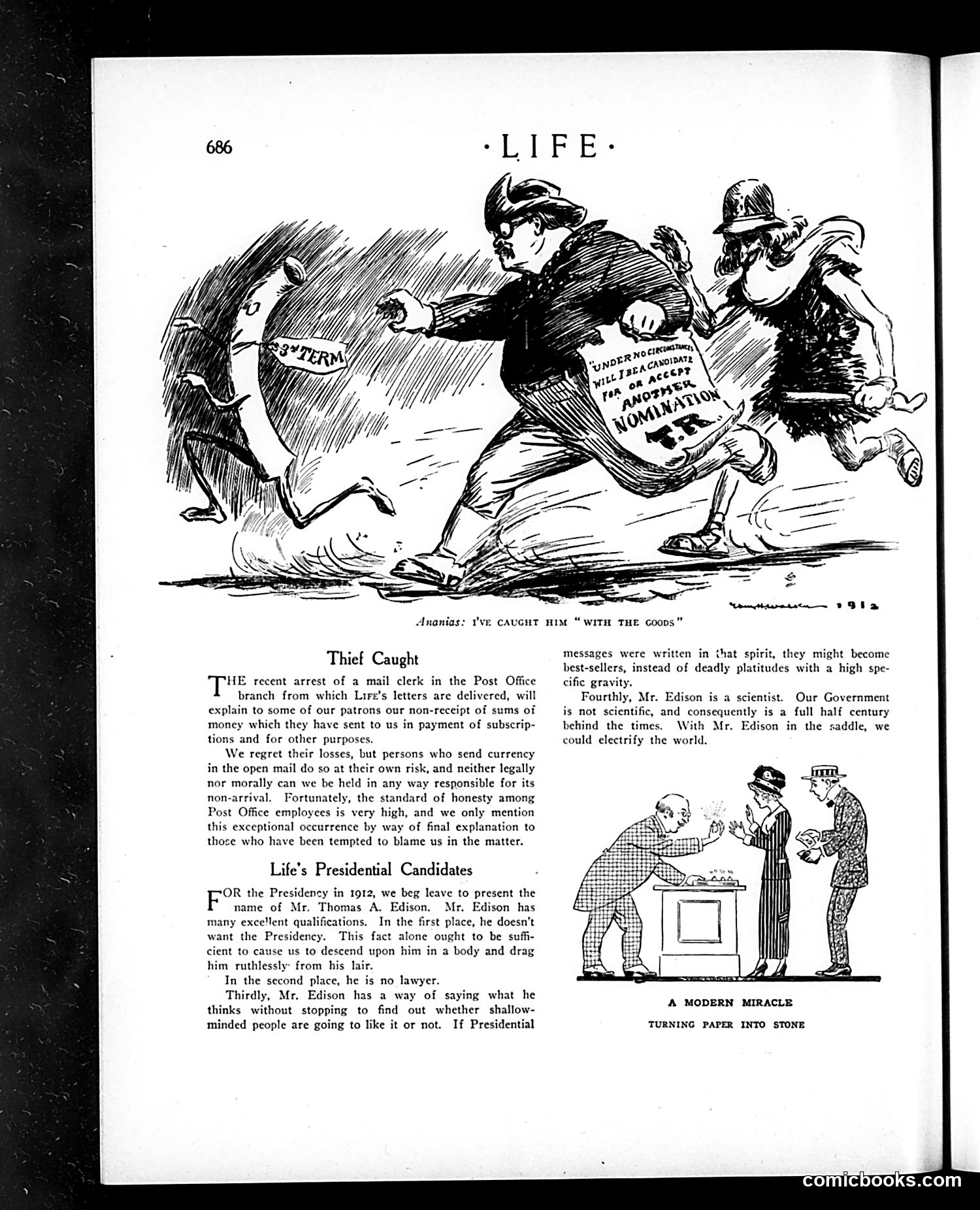
**Top Cartoon:** References a recent Post Office mail clerk theft affecting *Life* magazine's subscription payments. The figure labeled "Ananias" (biblical liar) catches a thief "with the goods"—satirizing the postal employee caught stealing currency sent through mail. **"Life's Presidential Candidates":** A humorous endorsement of Thomas A. Edison for the 1912 presidency. The satire lists his "qualifications": he *doesn't* want the job (rare for politicians), he's not a lawyer (implying distrust of lawyers in government), he speaks his mind bluntly, and he's a scientist—contrasting with the magazine's view that government is unscientific and outdated. The joke "electrify the world" puns on Edison's electrical innovations. **Bottom Cartoon:** "A Modern Miracle—Turning Paper into Stone" likely satirizes government bureaucracy's ability to make paperwork seem permanent or immovable, though the exact reference is unclear without additional context.
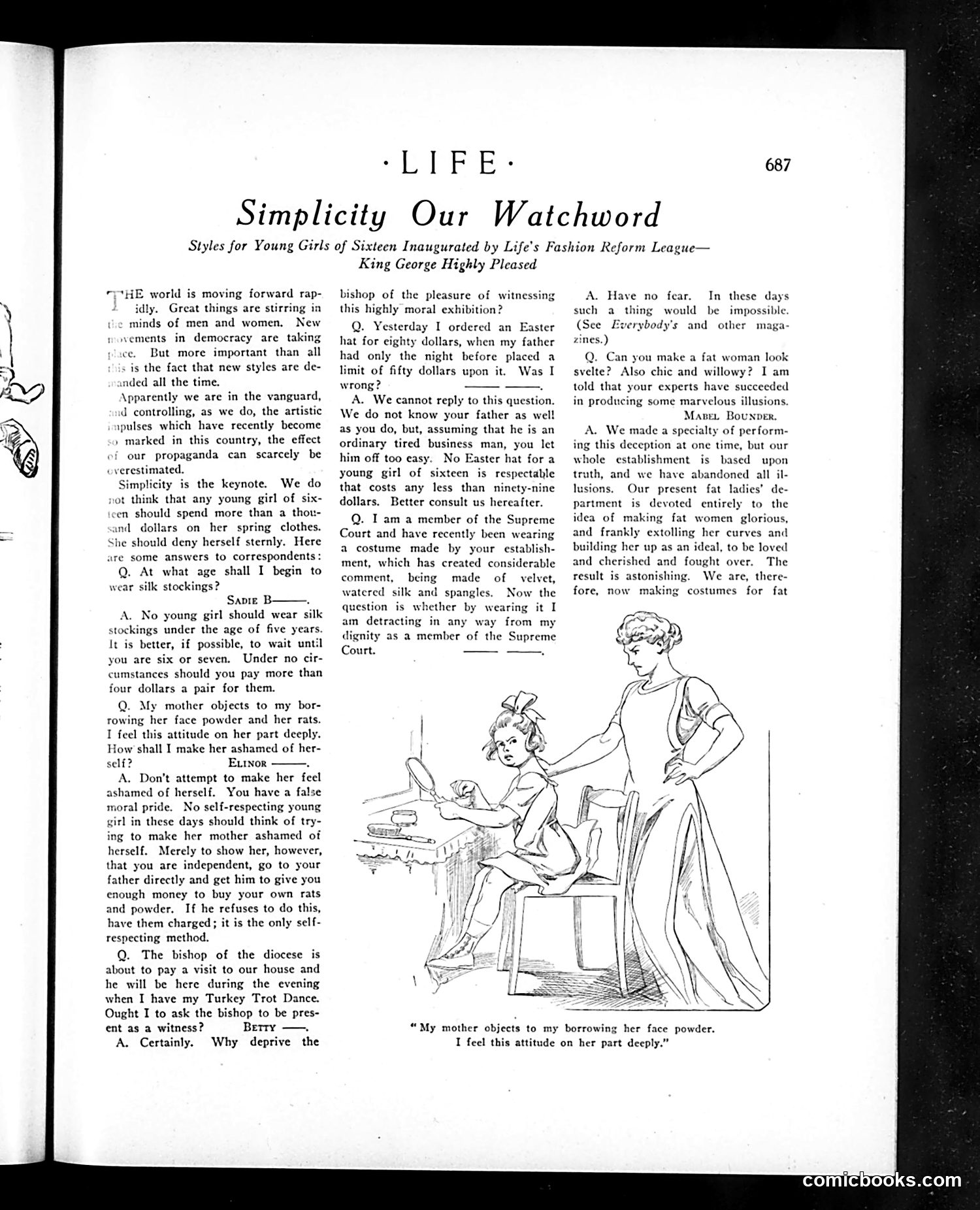
This is satirical advice column humor from Life magazine's "Fashion Reform League." The satire mocks both excessive consumer spending by wealthy young women and their disrespect toward parental authority. The column presents absurdly indulgent "advice" as if it were sensible: a sixteen-year-old should spend $1,000 on spring clothes, $99 minimum on Easter hats, and $4 per pair on silk stockings. When a girl's father sets a $50 hat budget, the advice ridicules him for being too lenient. The illustration shows a young woman applying cosmetics while an older woman (presumably her mother) watches disapprovingly—visualizing the included question about borrowing face powder without permission. The satire targets Gilded Age excess and the emerging "New Woman" figure who demanded financial independence from fathers. References to the "Turkey Trot Dance" (a scandalous modern dance) and a Supreme Court justice wearing spangles amplify the mockery of contemporary social upheaval. The humor relies on exaggeration to critique both youth rebellion and parental anxiety about changing social norms.
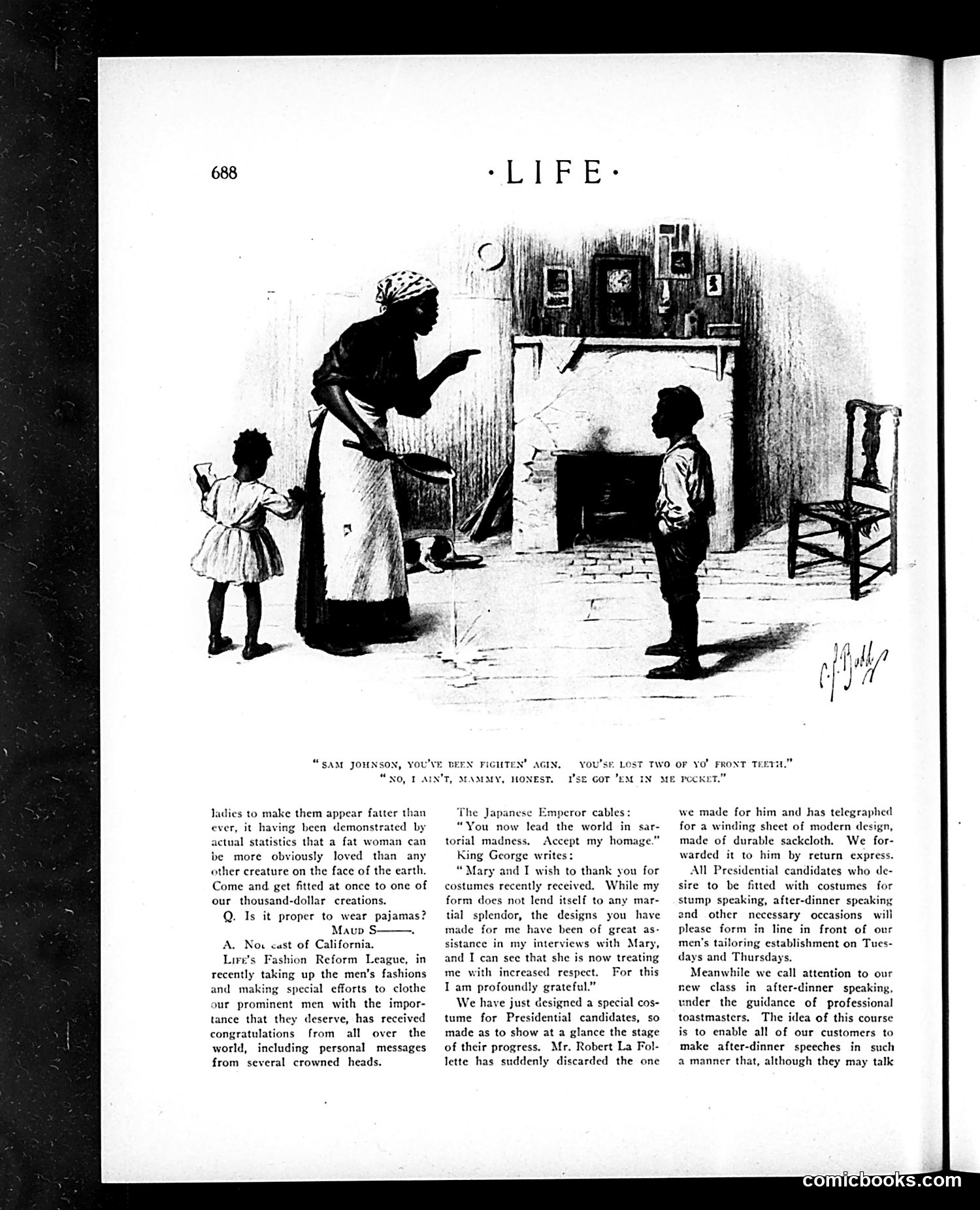
This satirical piece mocks men's fashion reform and political ambition. The cartoon depicts a mother scolding a boy ("Sam Johnson") about losing his front teeth, while text discusses Life magazine's "Fashion Reform League" promoting elaborate costumes for prominent men. The satire targets two things: (1) absurd fashion pretensions—the league supposedly receives congratulations from royalty (Japan's Emperor, King George) for dressing men impressively; (2) Presidential candidates' vanity. Politician Robert La Follette is ridiculed for discarding his custom "costume" and requesting a "winding sheet" (burial shroud) of sackcloth—suggesting his political prospects are dead. The joke: politicians are fashion-obsessed peacocks requiring special wardrobes to appear credible. The domestic scene with the boy undercuts this pretension, emphasizing that real life concerns are mundane, not theatrical.
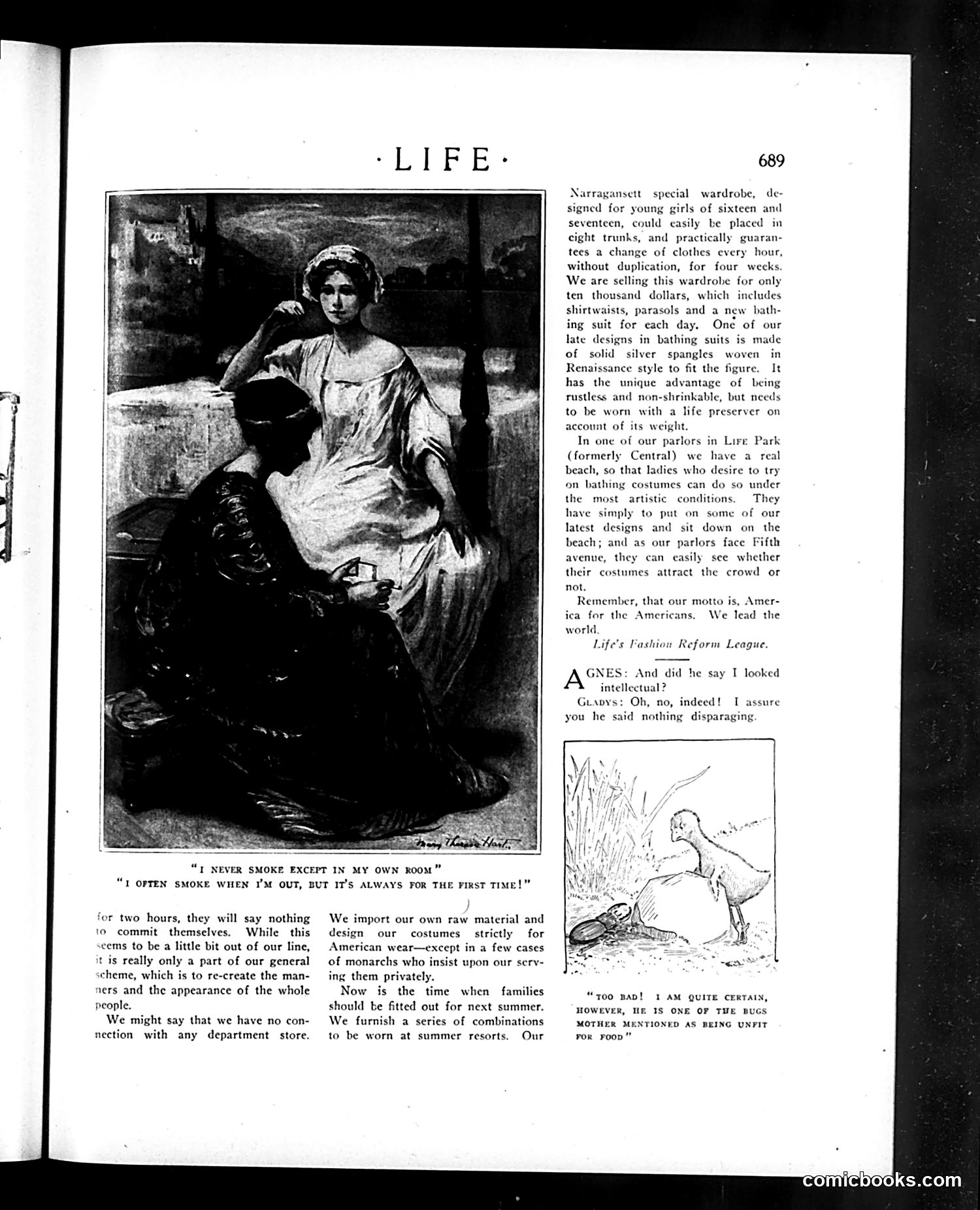
This page satirizes the fashion industry's excess and pretension, particularly targeting wealthy consumers. The main article describes an absurdly expensive "Narragansett wardrobe" for teenage girls costing $10,000, featuring impractical items like a bathing suit made of solid silver spangles that requires a life preserver due to its weight. The satire mocks both the designer's grandiose claims ("America for the Americans. We lead the world") and the vanity of wealthy families seeking elaborate summer resort wardrobes. The page includes two separate comic dialogues: one about smoking etiquette (a social hypocrisy joke) and another about insects, unrelated to the fashion content. The central image shows a woman in classical dress, likely representing "Fashion" or artistic taste being courted by wealth/commerce, reinforcing the critique that fashion design has become disconnected from practicality and serves only the ultra-wealthy.
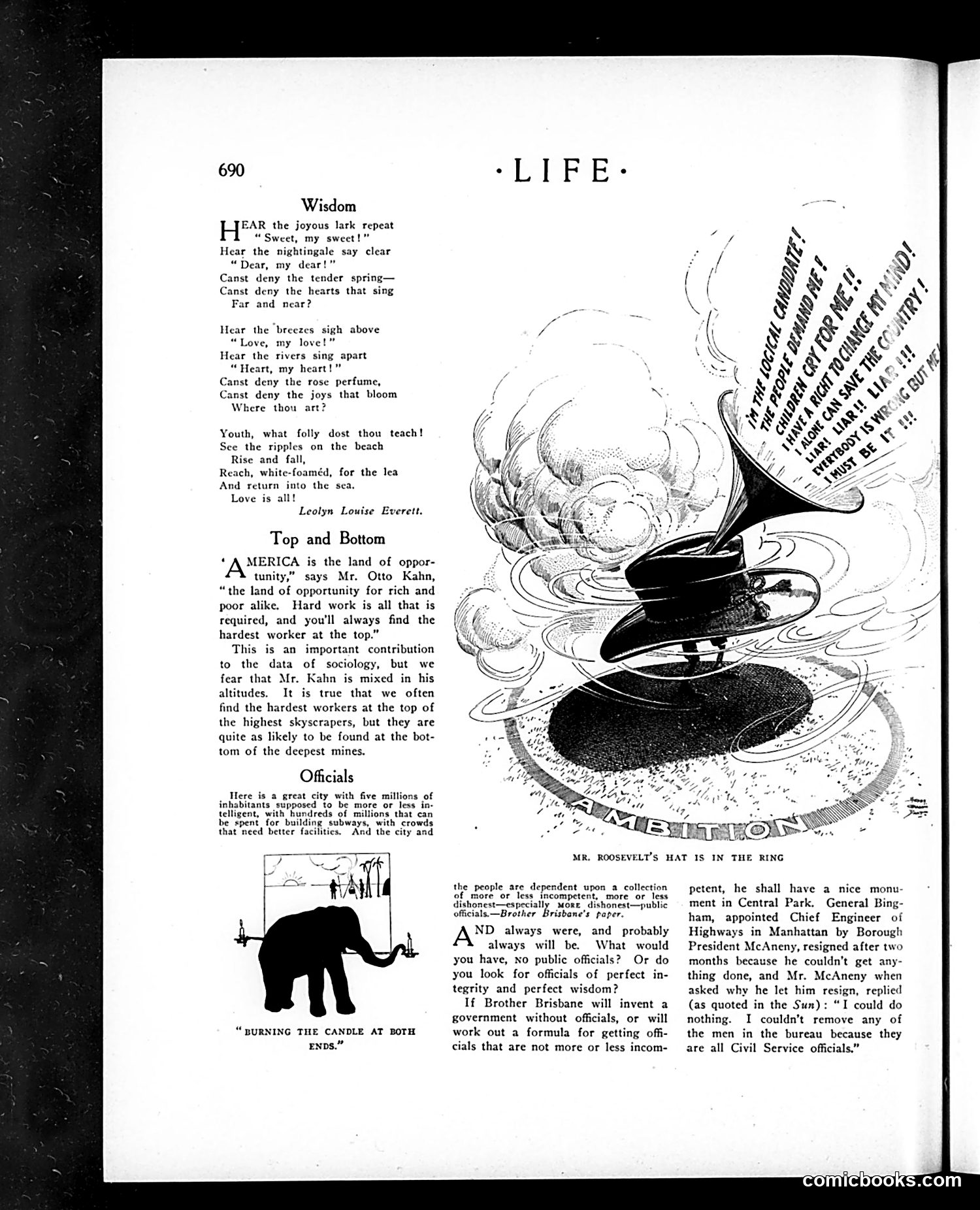
This page contains two satirical pieces critiquing American institutions: **"Top and Bottom"** mocks millionaire Otto Kahn's claim that America rewards hard work equally. Life's editors sardonically note that while the hardest workers may indeed reach the "top" of skyscrapers, they're equally likely found at the "bottom" of mines—undercutting Kahn's optimistic meritocracy argument by highlighting wealth disparity and dangerous labor conditions. **"Officials"** attacks New York City's corrupt or incompetent bureaucracy. The piece quotes Arthur Brisbane (a Hearst editor) criticizing dishonest public officials, then responds cynically that reform is impossible. The example of General Bingham resigning as Chief Engineer because he couldn't remove Civil Service employees illustrates bureaucratic paralysis—even appointees can't fix systemic dysfunction. The cartoon "Mr. Roosevelt's Hat Is in the Ring" appears to reference Theodore Roosevelt's political ambitions, though specific context isn't entirely clear from this excerpt. Together, these pieces express Progressive Era frustration with both corporate robber barons and urban government incompetence.
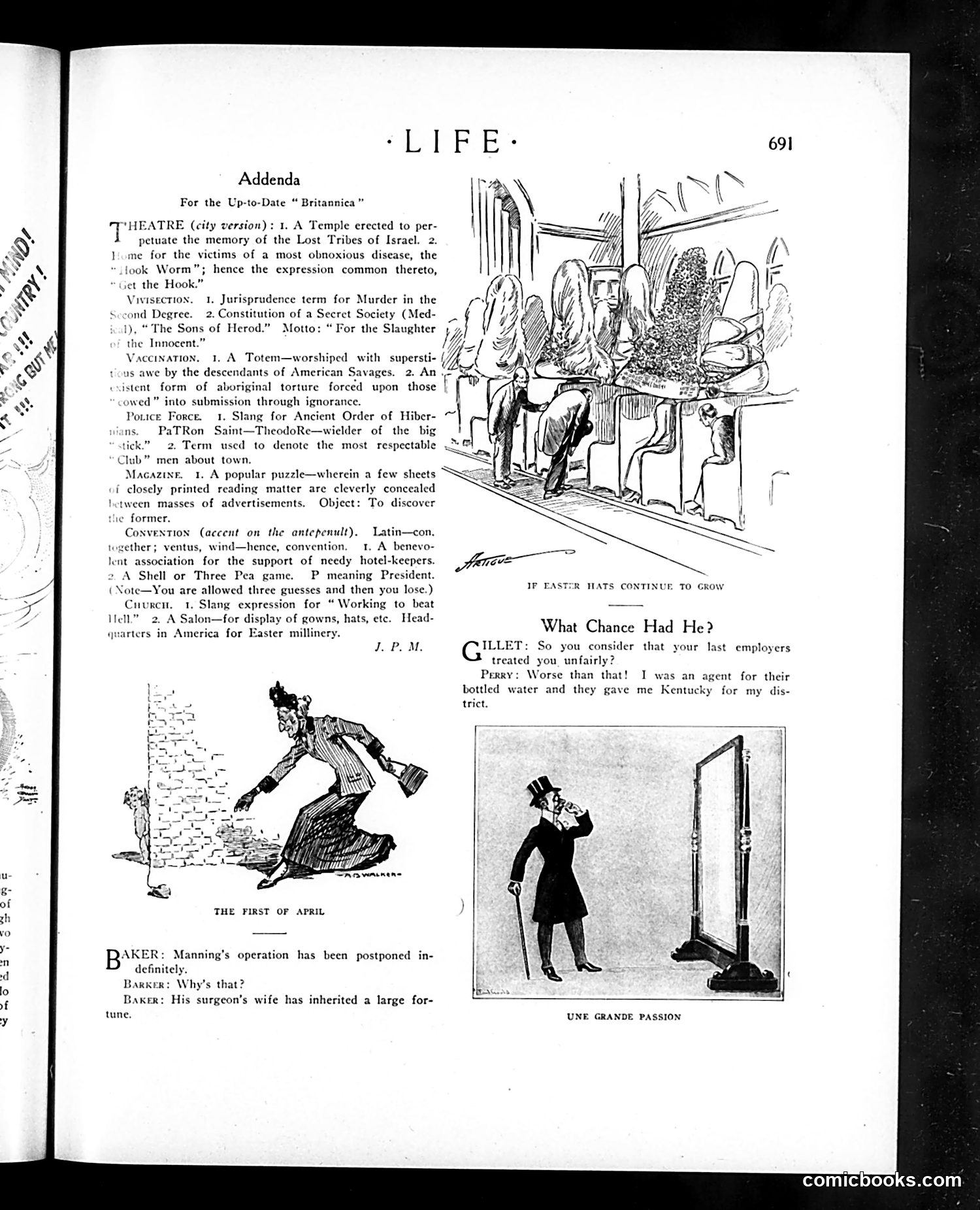
This page contains satirical dictionary definitions mocking contemporary American institutions and the "First of April" humor section. The **"Addenda for the Up-to-Date Britannica"** offers mock definitions attacking: - **Theatre**: A temple for the "Lost Tribes of Israel" (likely referencing poor Jewish theater attendance or stereotypes) - **Vivisection/Vaccination**: Anti-scientific mockery, linking medical advancement to "aboriginal torture" - **Police Force**: An ethnic jab at Irish officers ("Ancient Order of Hibernians"), with "Theodore" likely referencing Theodore Roosevelt - **Magazine**: Self-deprecating joke about ads overwhelming content - **Church**: Satirizing Easter hat fashion over spiritual purpose The **"What Chance Had He?"** cartoon shows a man confronting his mirror reflection—a visual pun about self-recognition or vanity. The accompanying dialogue involves Perry, a water-bottling agent sent to Kentucky, implying he received an unfair, undesirable assignment. The **"First of April"** cartoon depicts April Fools' pranks (a brick wall surprise). Overall, the page ridicules religious hypocrisy, xenophobia, anti-scientific attitudes, and commercialism—typical early 1900s *Life* magazine satire.
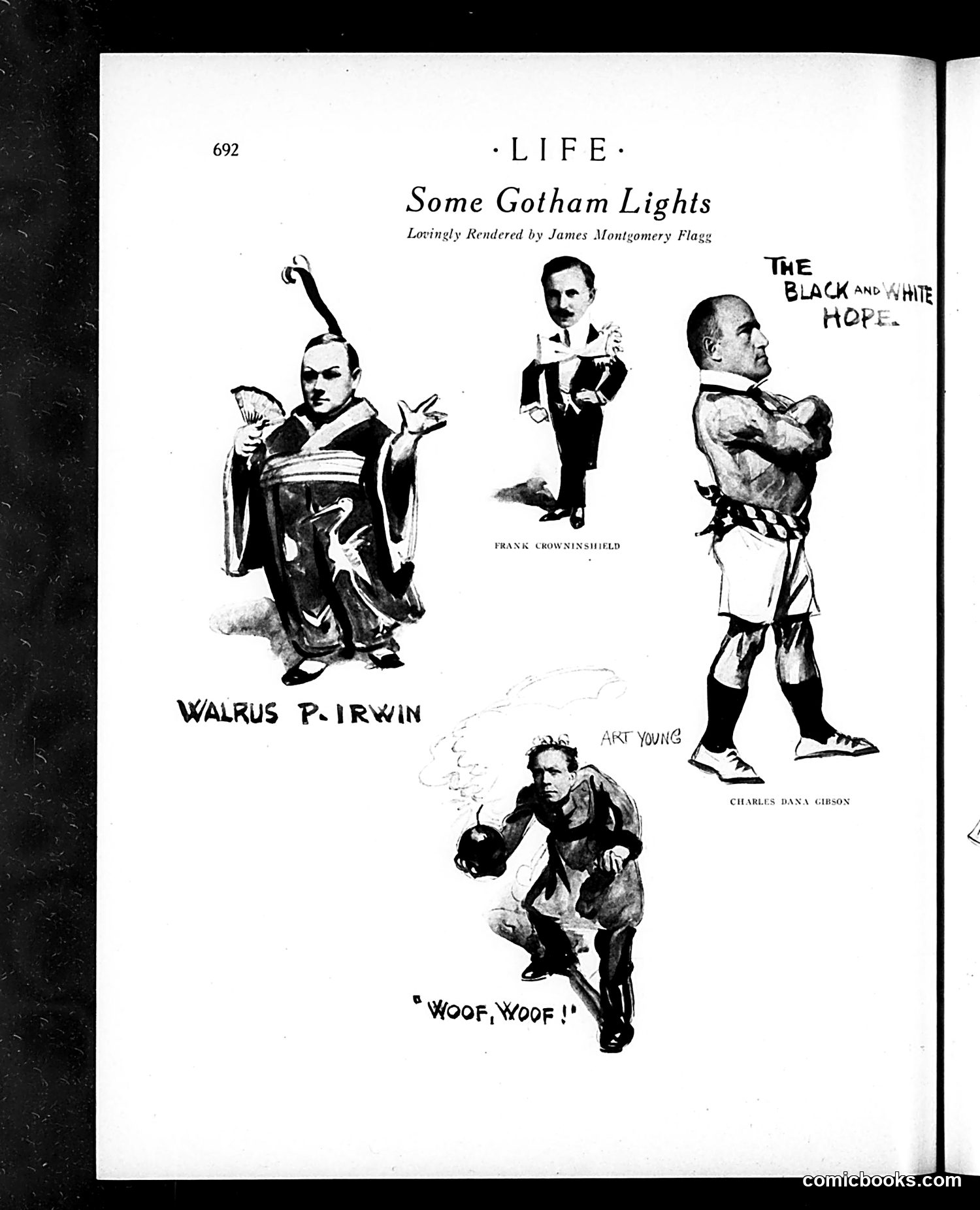
This page features caricatures of four prominent New York figures, rendered by renowned illustrator James Montgomery Flagg. The subjects are identified as Walrus P. Irwin, Frank Crowninshield, Charles Dana Gibson, and Art Young. The cartoon's title, "The Black and White Hope," appears to reference boxing terminology (the "Great White Hope" was contemporary boxing parlance). The exaggerated physical caricatures—particularly Irwin's elaborate costume and Gibson's athletic pose—suggest these were public personalities whose appearances or behaviors were subjects of satirical commentary in early 20th-century New York society. The bottom figure's caption "Woof, Woof!" adds comedic absurdity. Without additional historical context, the specific satirical points about these individuals remain unclear, though their prominence in *Life* suggests they were recognizable figures to contemporary readers familiar with New York's social and artistic circles.
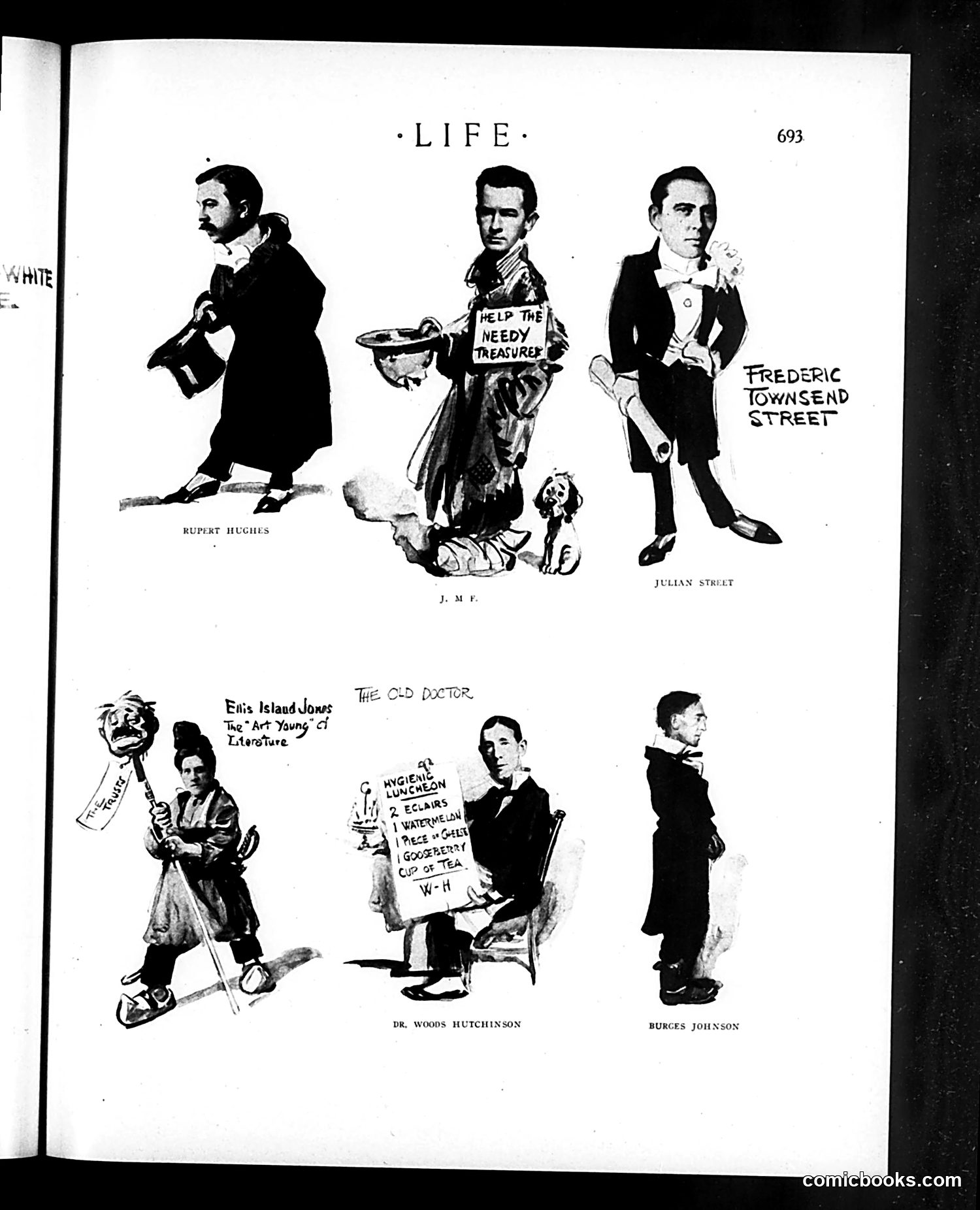
This Life magazine page features caricatures of six prominent American figures, likely from the early 1900s. The top row shows Rupert Hughes (holding a money bag), J.M.F. (labeled "Help the Needy Treasure"), and Julian Street. The bottom row depicts Ellis Island Jones, "The Old Doctor" (Dr. Woods Hutchinson, shown with a hygiene menu listing items like "luncheon" and "watermelon"), and Burges Johnson. The satire appears to target these public figures' various professions and reputations—Hughes as wealthy, the middle figure as charitable, Street as a writer, Jones regarding immigration policy, Hutchinson as a health/hygiene advocate, and Johnson in an unspecified role. Without additional context, the specific satirical points remain partially unclear, though the caricatures suggest mockery of their public personas.
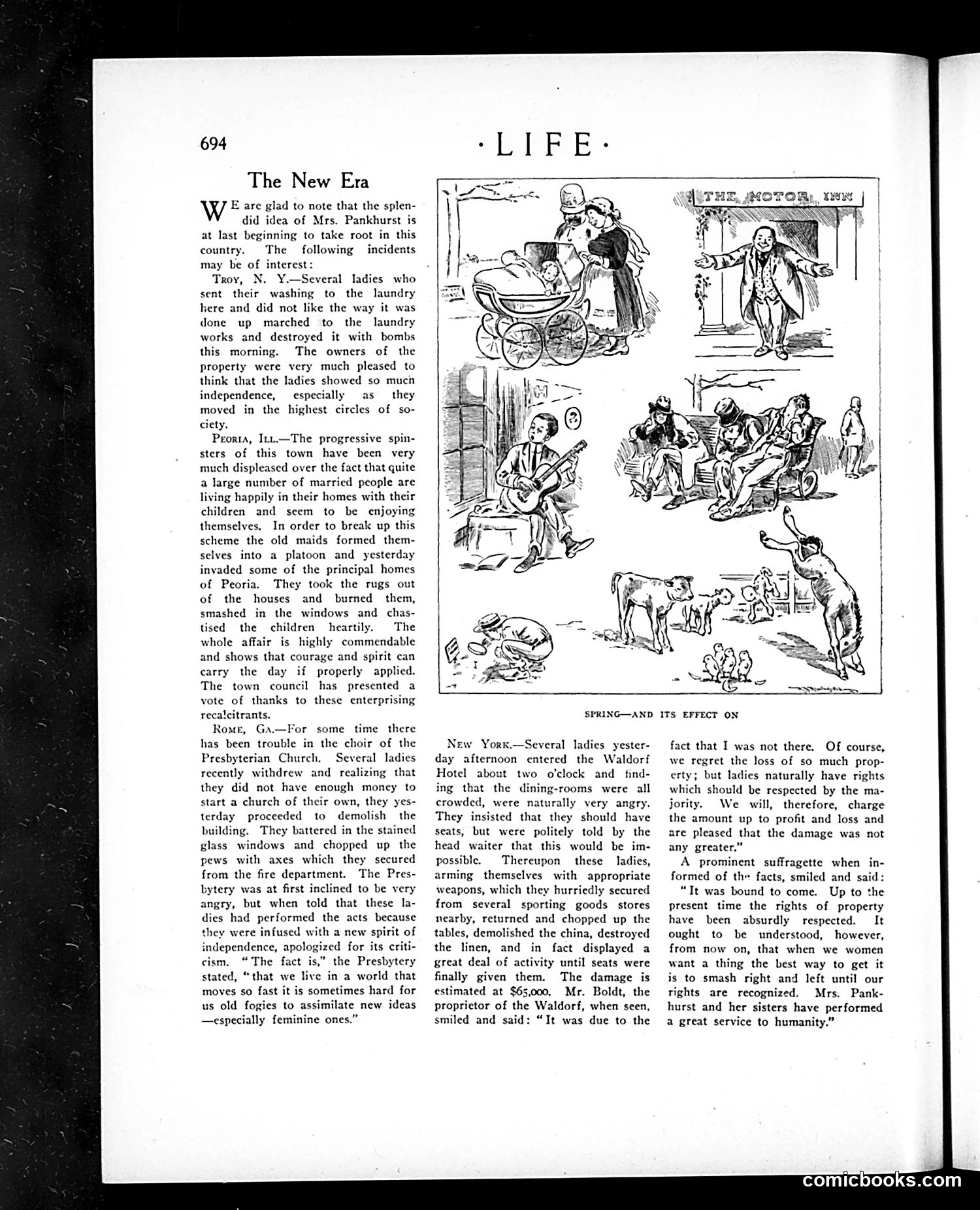
This is **satirical mockery of the suffragette movement**, specifically referencing **Emmeline Pankhurst**, the famous British women's rights activist known for militant direct-action tactics. The page presents fake news stories from American towns where women have adopted Pankhurst's destructive methods—bombing laundries, ransacking homes, demolishing churches, and smashing hotel furniture—to demand basic rights. The satire's bite: property owners and civic leaders *praise* these violent acts as expressions of feminine independence, and the damage is treated as acceptable collateral damage. The accompanying cartoon illustrations show chaotic domestic scenes: women with weapons, destroyed property, and general mayhem. **The joke for 1910s readers**: The piece ridicules both militant suffragettes (portrayed as irrational and destructive) *and* the weakness of men who capitulate to demands when faced with property destruction. It's hostile satire attacking the suffrage movement as dangerous mob behavior disguised as progressive politics.
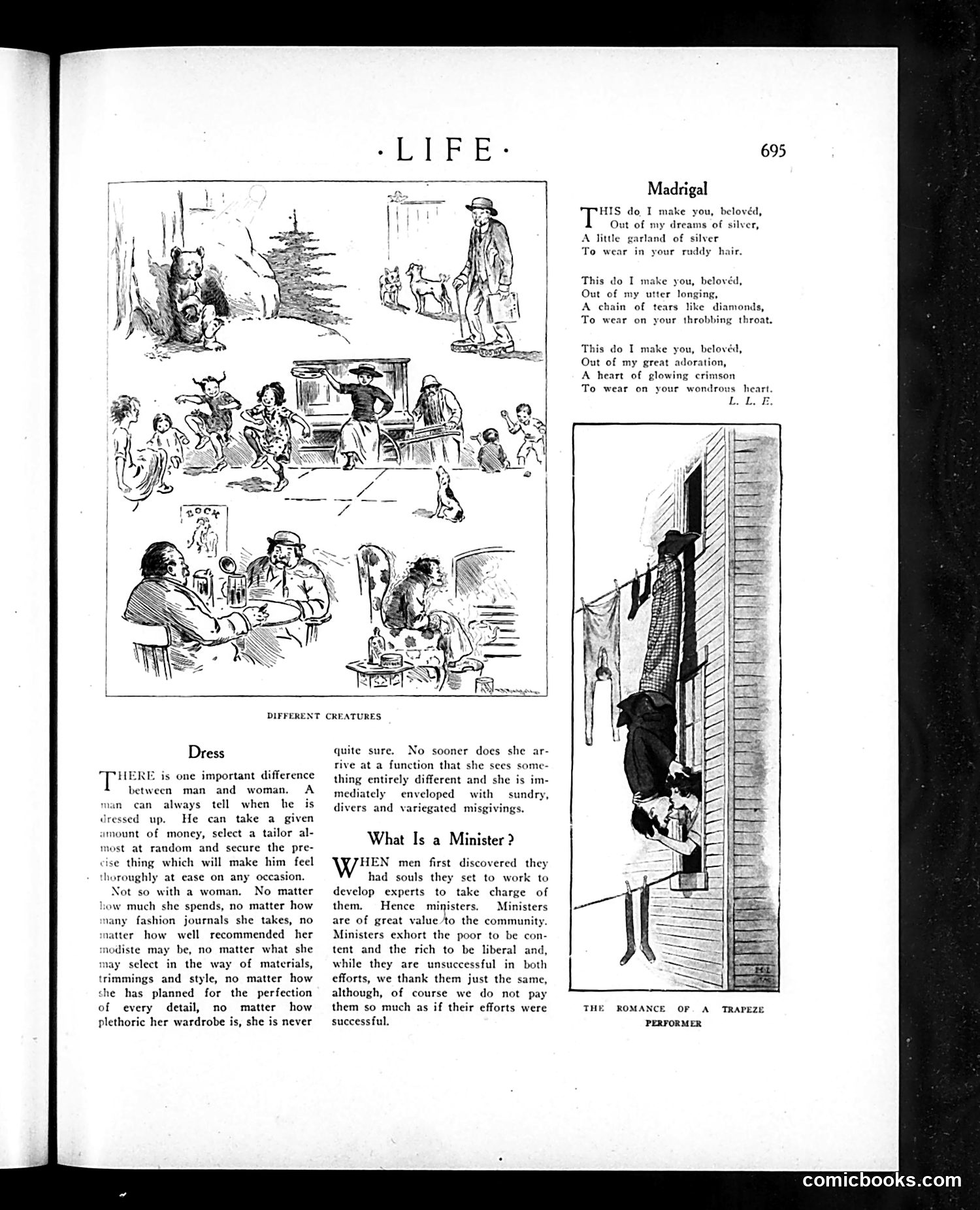
This page contains three distinct pieces of social commentary: **"Different Creatures"** satirizes gender differences in fashion. The text argues that men can dress appropriately for any occasion by simply hiring a tailor, while women—despite spending lavishly on clothes, consulting fashion magazines, and planning meticulously—remain perpetually uncertain about their appearance. The satire targets women's anxiety about fashion conformity and suggests the impossibility of their achieving satisfaction. **"What Is a Minister?"** mocks organized religion's social function. It argues ministers exist to manage souls and to encourage the poor toward contentment while exhorting the rich toward generosity—efforts the author notes are unsuccessful. Yet society undervalues ministers, paying them as though their efforts *were* successful. The satire critiques both religious hypocrisy and society's begrudging support of clergy. **"Madrigal"** is a romantic poem about fashioning gifts from emotion. The accompanying illustrations show various social scenes and "The Romance of a Trapeze Performer"—a figure climbing outside a building, likely illustrating theatrical or precarious life.
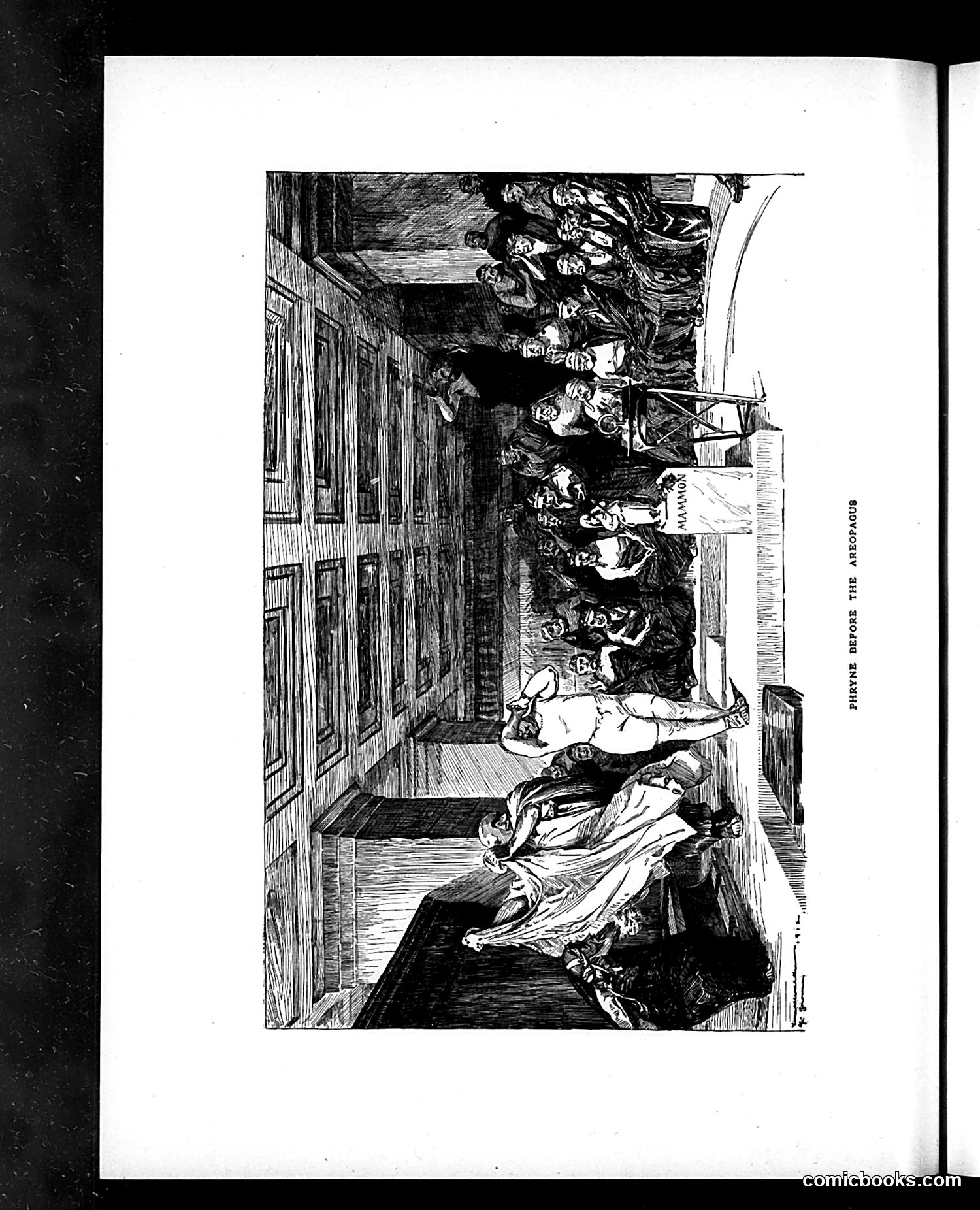
This is a classical history engraving titled "Phryne Before the Areopagus," depicting an ancient Greek legal scene. The image shows a woman (Phryne, a famous Athenian courtesan from the 4th century BCE) standing trial before the Areopagus (Athens's highest court). According to legend, her defense attorney won her acquittal by dramatically disrobing her to reveal her beauty, arguing the gods wouldn't allow such perfection to perish. The satirical application to Life magazine's 19th-century American context remains unclear from the image alone—the cartoon likely comments on contemporary legal, moral, or social issues through this classical reference, but specific targets aren't visible here. The choice of this particular historical scene suggests commentary on justice, beauty, gender, or courtroom drama in the magazine's era.
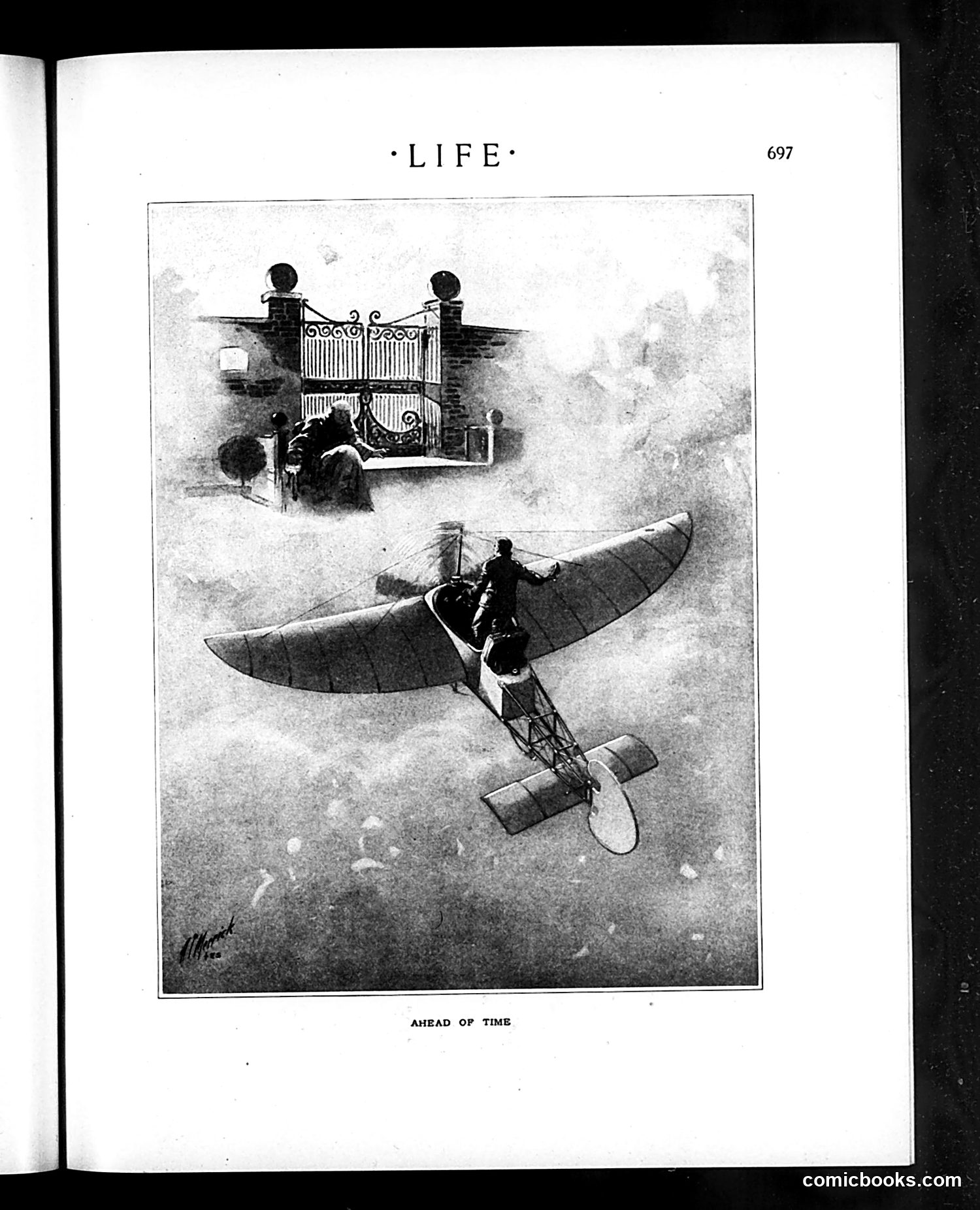
This satirical illustration contrasts two scenes: an ornate gate or entrance structure (top) with what appears to be an early flying machine (bottom). The caption "Ahead of Time" suggests commentary on technological progress or innovation. The flying device—featuring wings, propellers, and basic framework—appears to reference early aviation experiments, likely from the early 1900s. The juxtaposition implies satire about futuristic aspirations: while society builds grand, stationary structures representing tradition or establishment, inventors pursue impractical or premature technological dreams. The signature appears to be "Ilfeld" or similar. Without additional context about *Life* magazine's publication date, the specific historical moment or figures remain unclear, though the imagery suggests commentary on progress versus convention.
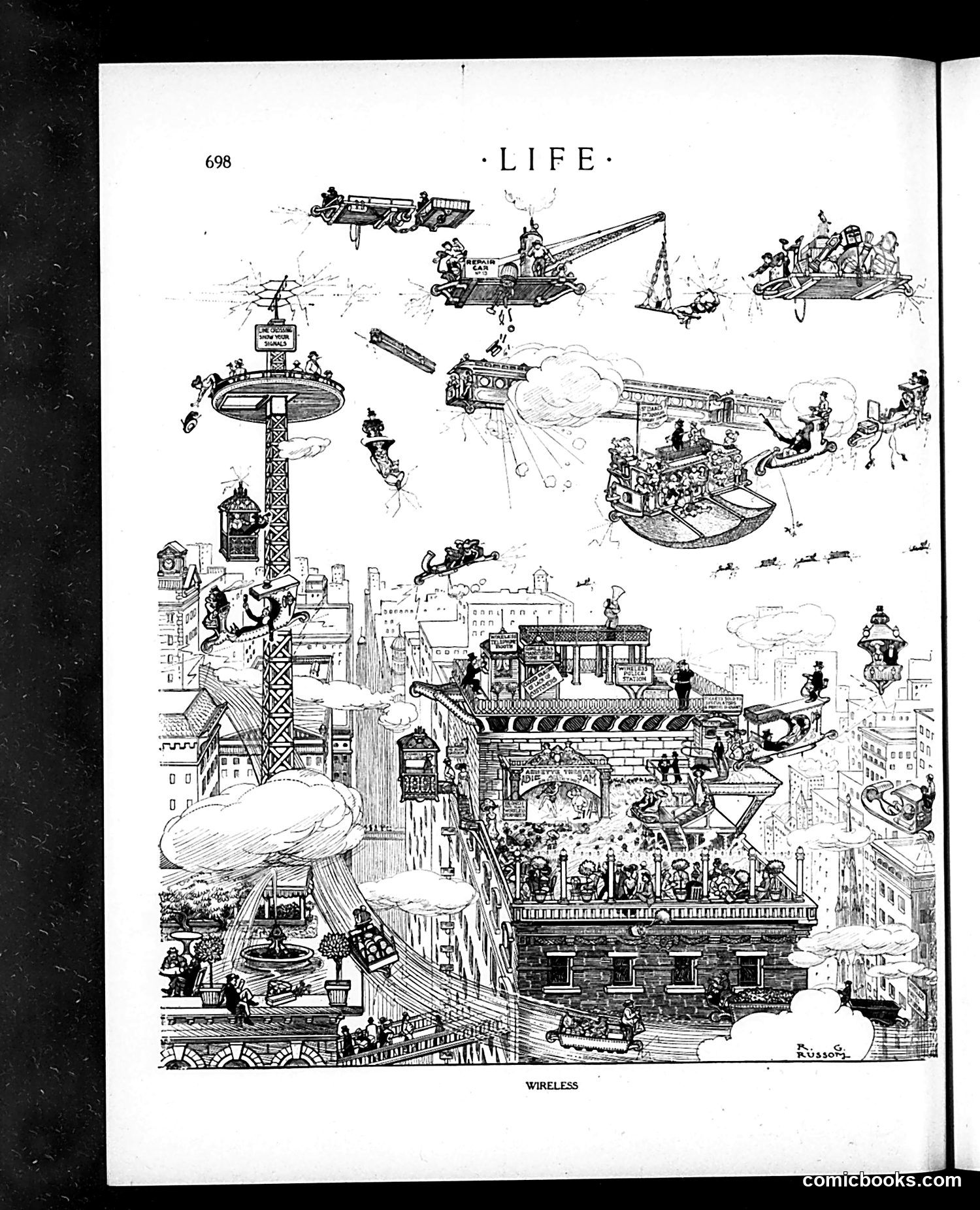
This is a single satirical illustration titled "Wireless" from *Life* magazine (page 698). The image depicts a fantastical, heavily mechanized futuristic cityscape filled with flying devices, airships, and elaborate contraptions hovering above and integrated into tall buildings. The cartoon appears to satirize early 20th-century optimism about wireless technology and technological progress. The chaotic proliferation of aerial vehicles and mechanical devices—stacked precariously and operating simultaneously—suggests anxiety about unchecked technological development and urban congestion. The crowded, densely-packed composition emphasizes sensory overload. Rather than celebrating "wireless" innovation, the satire seems to mock the impractical utopianism of technological enthusiasts and the potentially chaotic consequences of rapid mechanization in cities. The artist's signature reads "Kussoil" [or similar].
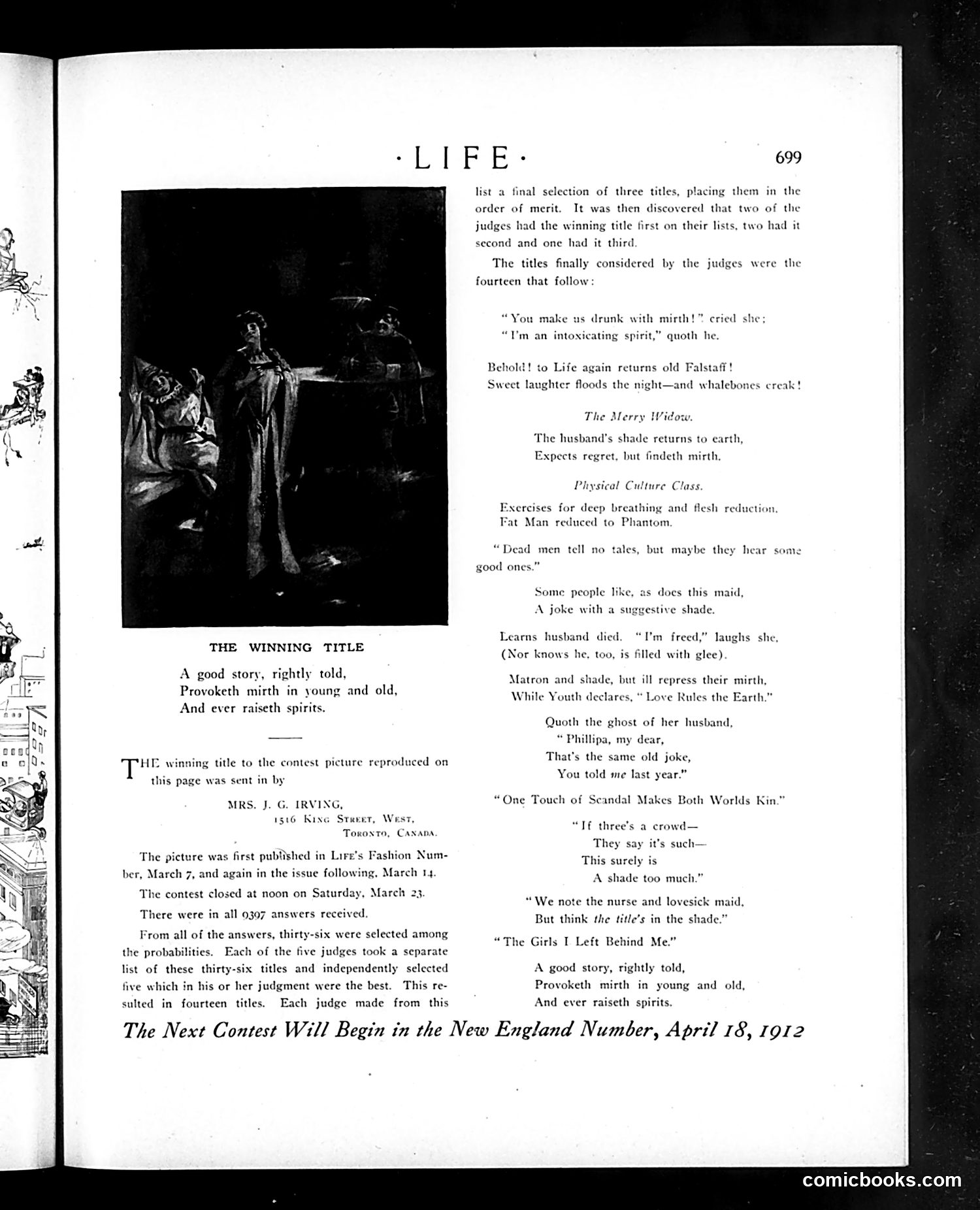
This page announces the winning entry in *Life* magazine's caption contest for a cartoon image (reproduced on the page). The winning caption, submitted by Mrs. J. G. Irving of Toronto, was selected from 9,307 total entries. The cartoon depicts what appears to be a ghostly or spectral figure (likely a husband's shade/spirit) encountering a widow or woman. The winning caption plays on this supernatural premise with suggestive humor about intoxication and marital situations. The page also lists fourteen finalist captions considered by five judges, revealing period attitudes toward humor: many reference death, remarriage, infidelity, and female sexuality with dark comedy. References to "Falstaff" and "The Merry Widow" suggest classical literary and theatrical allusions familiar to educated readers. The announcement notes the next contest will begin April 18, 1912, in the New England edition—this was a regular feature of *Life* magazine's engagement with readers.
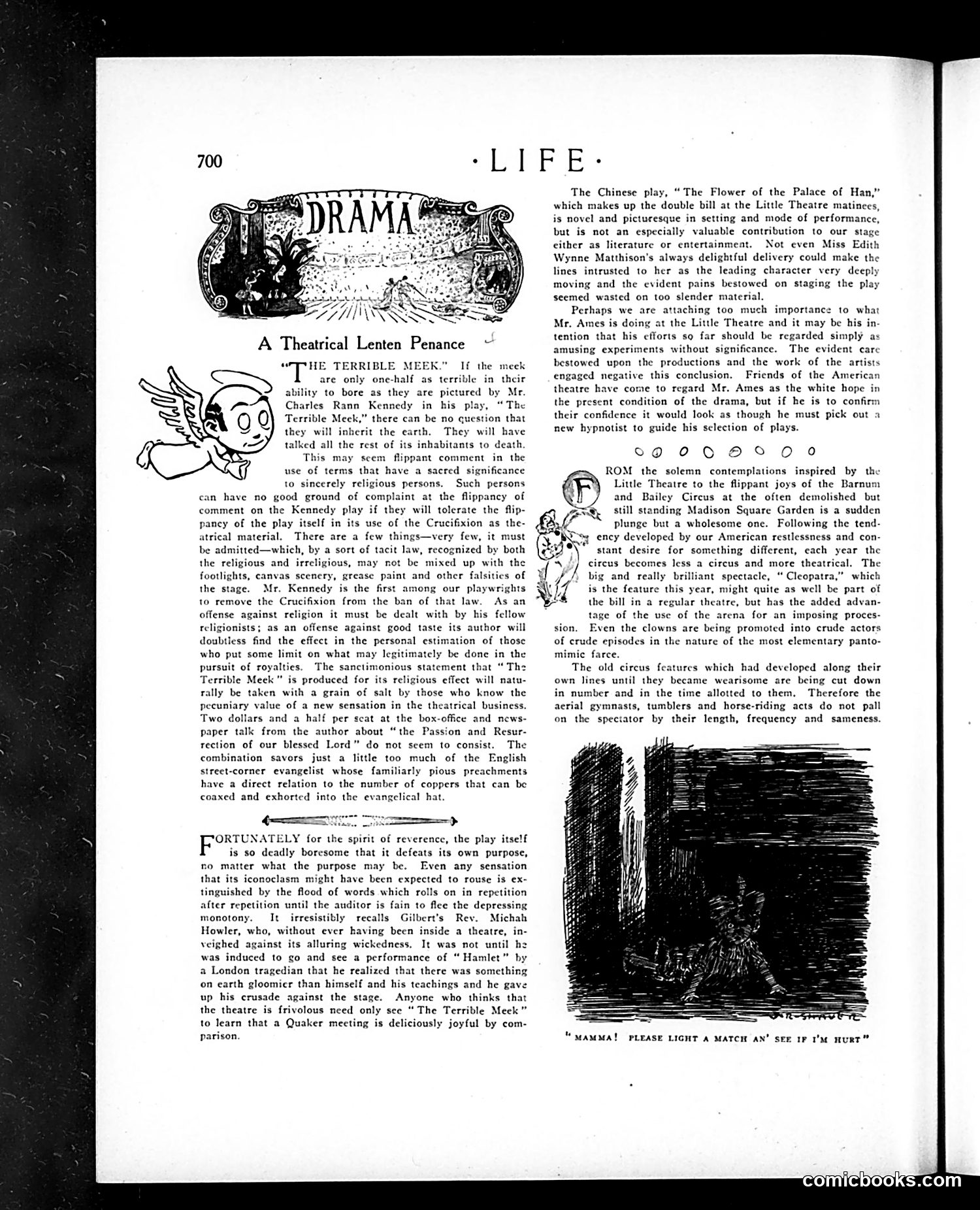
This page reviews two theatrical productions at the Little Theatre. The main article critiques Charles Rann Kennedy's play **"The Terrible Meek,"** which apparently dramatizes the Crucifixion. The critic attacks Kennedy on two fronts: 1. **Sacrilege**: Using Christ's Passion as theatrical material violates an unspoken cultural taboo, though the critic notes Kennedy's religious justifications seem suspiciously commercial ("two dollars and a half per seat"). 2. **Boredom**: The play is relentlessly tedious—so dull it defeats any sensational effect. The critic compares it unfavorably to a Quaker meeting, referencing Gilbert's character Rev. Michah Howler as a parallel to Kennedy's gloomy moralizing. The small cartoon depicts a child-like devil figure, likely illustrating the "Terrible Meek" concept or religious themes discussed. A secondary review dismisses the Chinese play "Flower of the Palace of Han" as visually novel but dramatically weak, even with actress Edith Wynne Matthison's talent. The satire targets Kennedy's apparent mixing of profit-seeking with religious pretension.
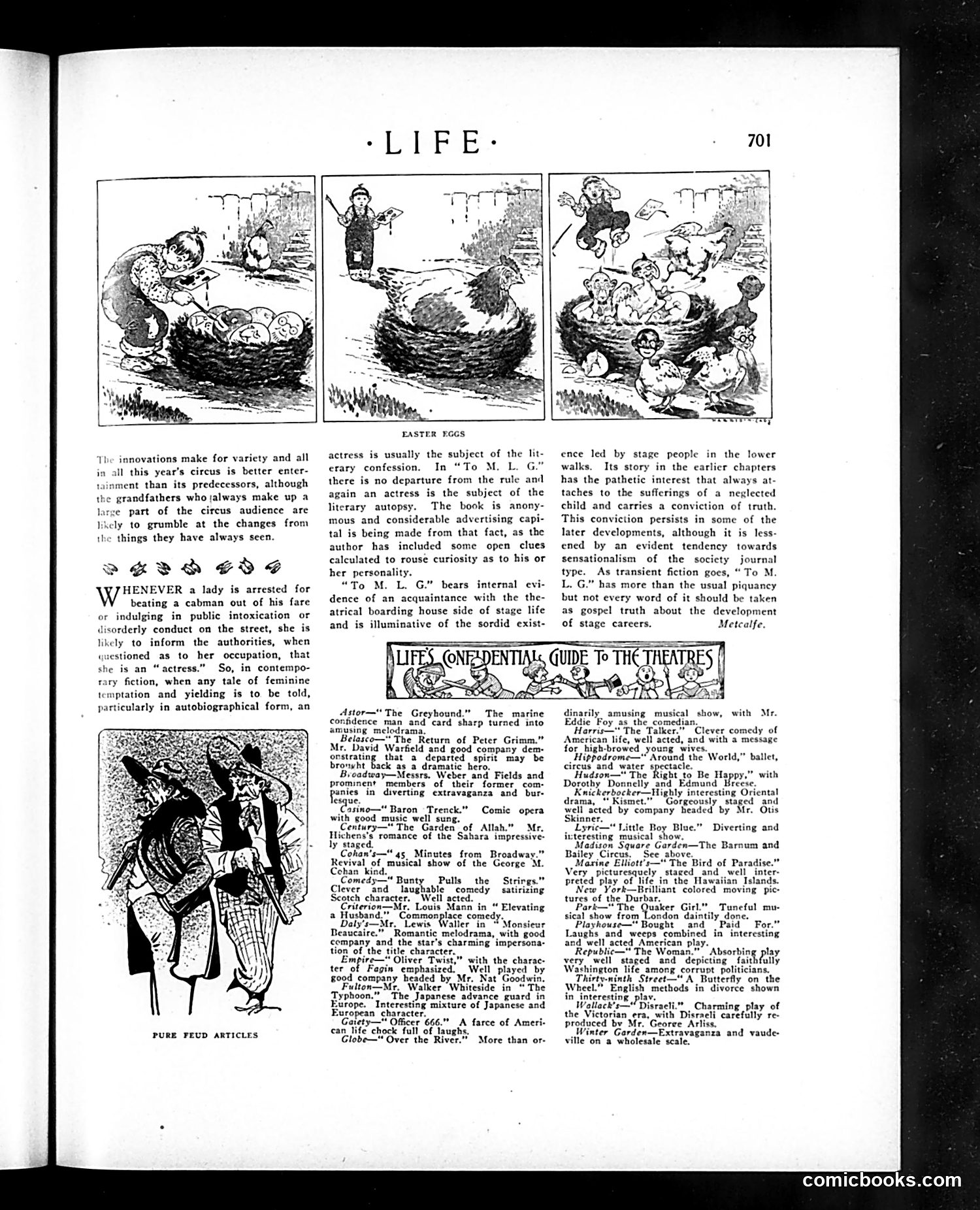
This page combines theatrical reviews with satirical social commentary. The three "Easter Eggs" cartoons at top appear to depict a humorous sequence, though details are unclear from the image quality. The main text critiques a contemporary anonymous novel titled "To M. L. G." about an actress. The satire targets a literary convention of the era: whenever women in fiction or real life (arrested women, for instance) needed moral credibility or explanation, they claimed to be "actresses"—implying the profession carried associations with loose morality and deception. The author notes this book follows that tired pattern while claiming insider knowledge of theatrical boarding-house life. Below is a section listing current Broadway productions, offering brief critical commentary on shows ranging from melodramas to comedies, many featuring well-known performers of the period (Nat Goodwin, Otis Skinner, etc.). The page satirizes both literary pretension and theatrical industry conventions of early 20th-century America.
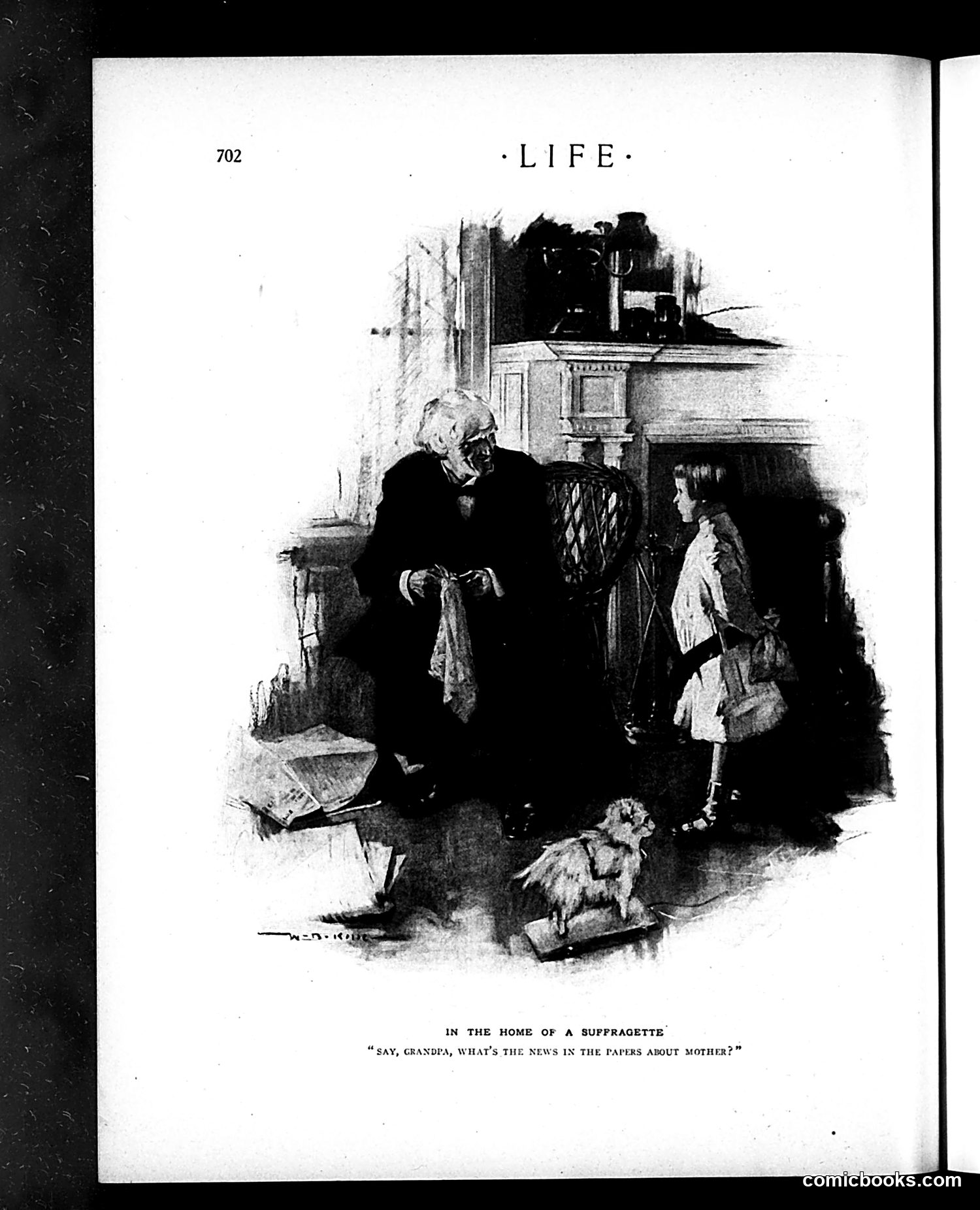
This satirical cartoon mocks women's suffrage advocates by depicting a domestic scene where a young child asks an elderly grandfather about the mother's news in the papers. The implication is cutting: the mother is apparently notable enough for newspaper coverage, suggesting she's involved in public activism rather than attending to her home and family duties. The humor targets the suffragette movement—women advocating for voting rights—by portraying their activism as neglectful of domestic responsibilities. The grandfather, child, and dog present a scene of domestic ordinariness disrupted by the mother's absence. The cartoon reflects anti-suffrage sentiment common in early 20th-century America, suggesting that women pursuing political rights abandons their "natural" domestic role, a common rhetorical attack against the movement.
This article addresses supporters of Theodore Roosevelt who feel betrayed by his political flip-flopping. Roosevelt had pledged not to run for president again, but appears to have reversed course (likely referring to his 1912 comeback attempt). Life's editor sympathizes with disappointed Roosevelt admirers but argues his behavior was inevitable. The piece attributes Roosevelt's actions to his outsized ego—an "intrusive factor" fed by years of flattery from admirers who convinced him he was "The Only One" and indispensable to the nation. Rather than condemn Roosevelt, the writer suggests his supporters should accept his contradiction philosophically: his ego drove his decision, but "Destiny" will manage the consequences. The tone is gently satirical—excusing Roosevelt's ethical inconsistency as a product of his narcissism while suggesting his admirers need consoling for their lost faith in him.
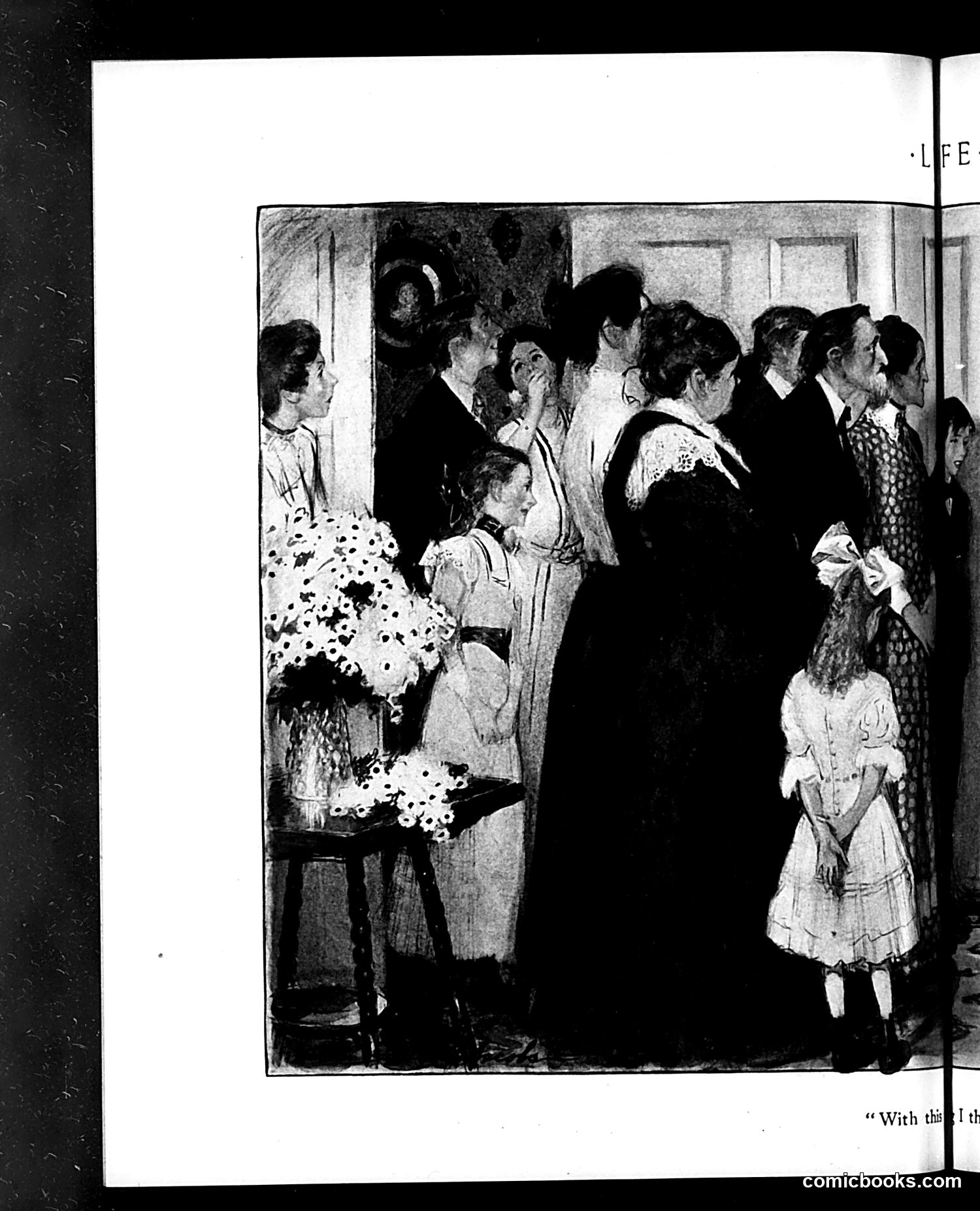
The OCR text is largely illegible, rendering no clear context. However, the image shows a black and white illustration of a formal social gathering—likely an early 20th-century interior scene with well-dressed men and women, including children, gathered around flowers on a table. The page header reads "LIFE," confirming this is from the satirical magazine. Without legible caption text, I cannot definitively identify the specific figures, event, or satirical point. The scene appears to depict some kind of formal reception or social event, possibly poking fun at upper-class social conventions or etiquette of the era. The partial caption visible begins "With this I th..." but cuts off. **I cannot responsibly interpret the intended satire or identify specific references without readable text.**
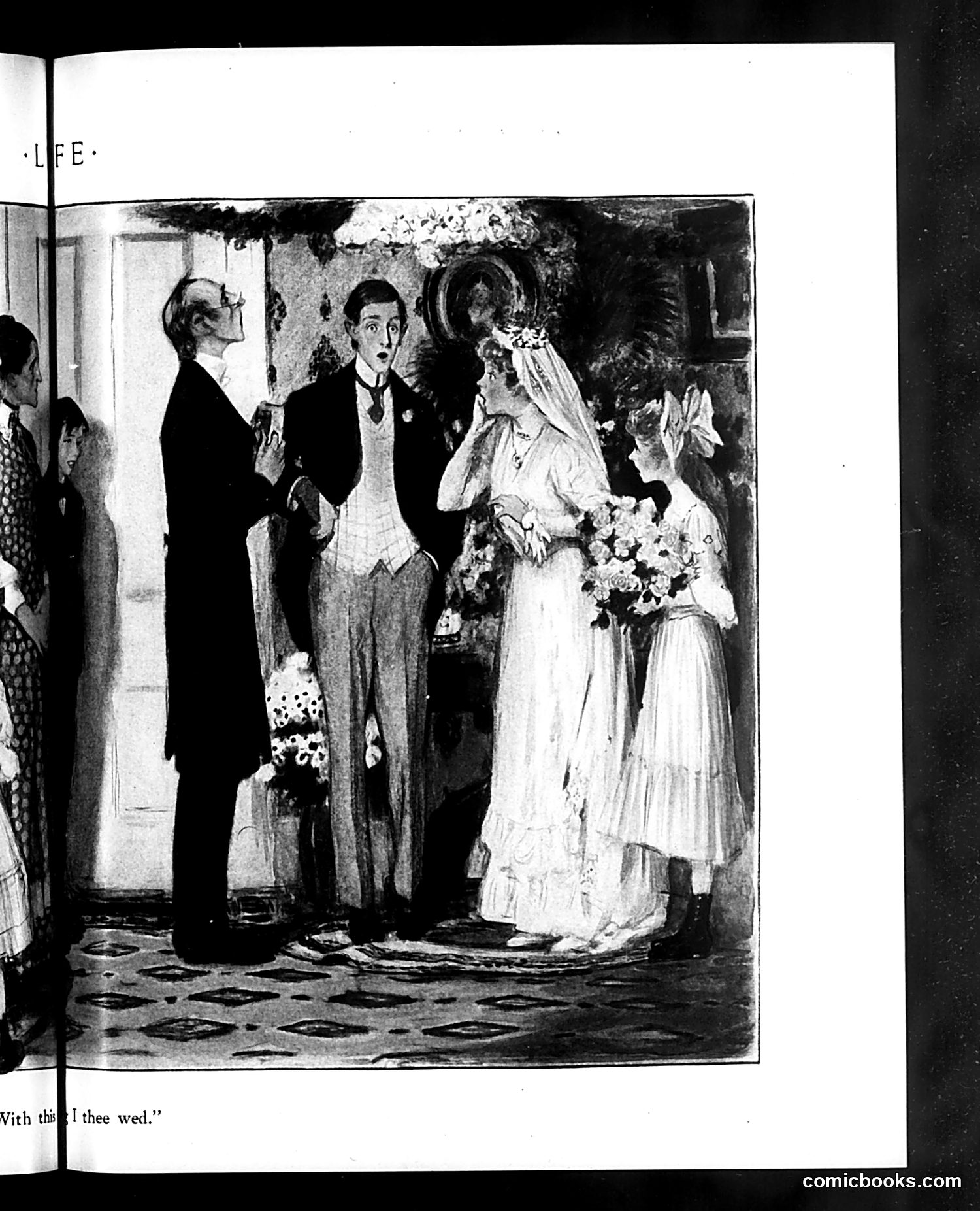
This appears to be a satirical illustration of a wedding ceremony. The image shows a bride in white with flowers and an elaborate hat, facing a groom in formal attire. Several other figures observe the scene. The caption "With this I thee wed" is a play on traditional wedding vows ("With this ring I thee wed"), suggesting the humor involves what the groom is actually pledging to give the bride—likely something other than a ring, though the OCR text is incomplete and doesn't reveal the specific joke. The satirical point likely critiques either marriage itself, gender relations, or what husbands actually "give" their wives in matrimony. Without the full caption, the precise target of the satire remains unclear, though the formal wedding setting suggests commentary on matrimonial expectations versus reality.
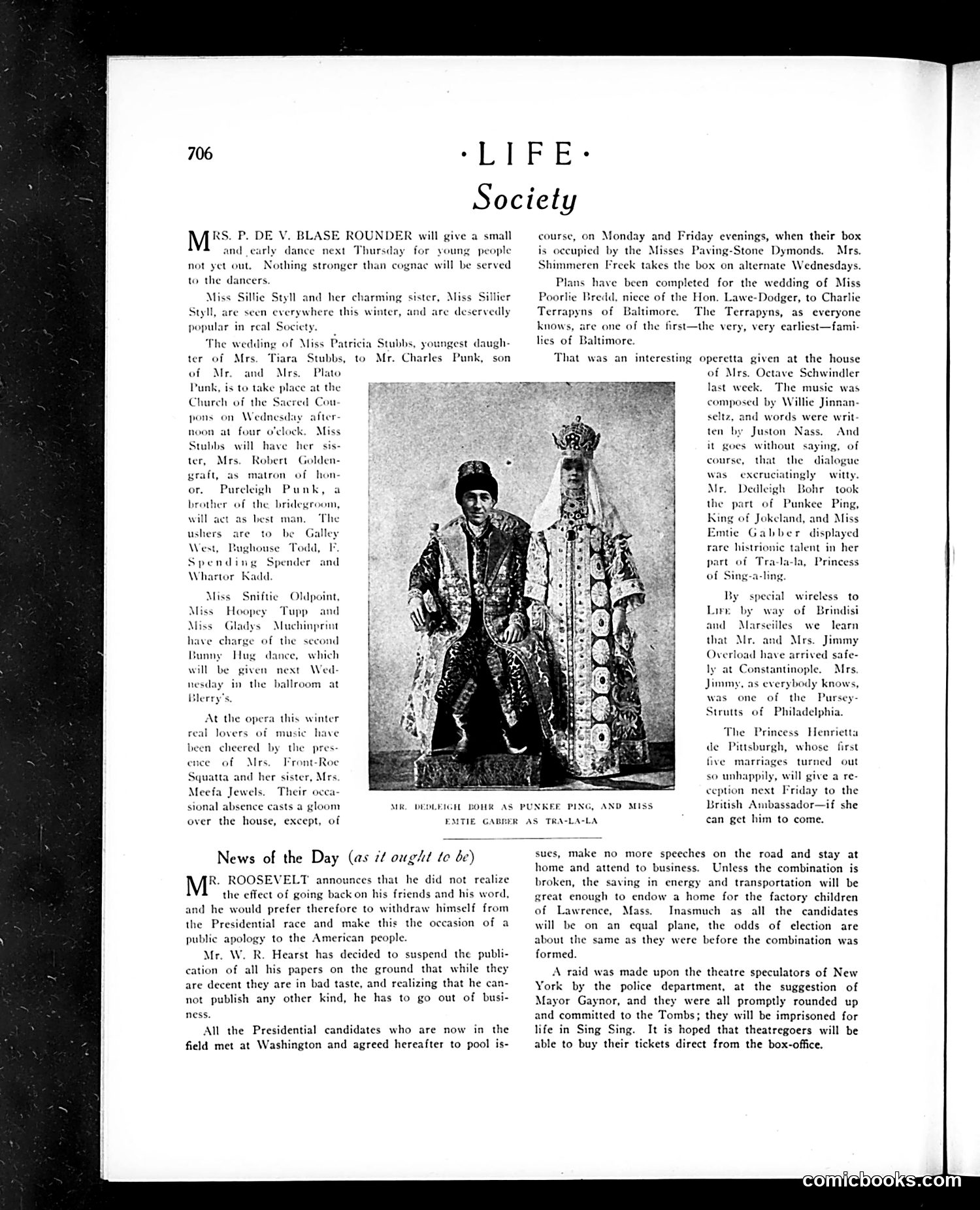
This page contains **satirical "News of the Day"** mocking prominent political and social figures of the era. **Key satire targets:** 1. **Theodore Roosevelt** — Life ridicules him for withdrawing from the Presidential race, sarcastically suggesting he's apologizing to the American people for breaking his word to friends. 2. **William Randolph Hearst** — Mocked for suspending his newspapers, with Life joking that since his papers are "in bad taste" and he can't publish anything else, he must shut down. 3. **Presidential candidates** — Satirized for agreeing to "pool issues" and stop campaigning, with Life sarcastically praising this as energy-saving. 4. **Theater ticket scalpers** — Criticized for price-gouging in New York, with Mayor Gaynor ordering police raids. The accompanying photograph shows performers in an operetta, illustrating the society section above. The satire employs deadpan humor: Life presents absurd political positions as if they're genuine news, exposing hypocrisy and foolishness through mock-earnest reporting.
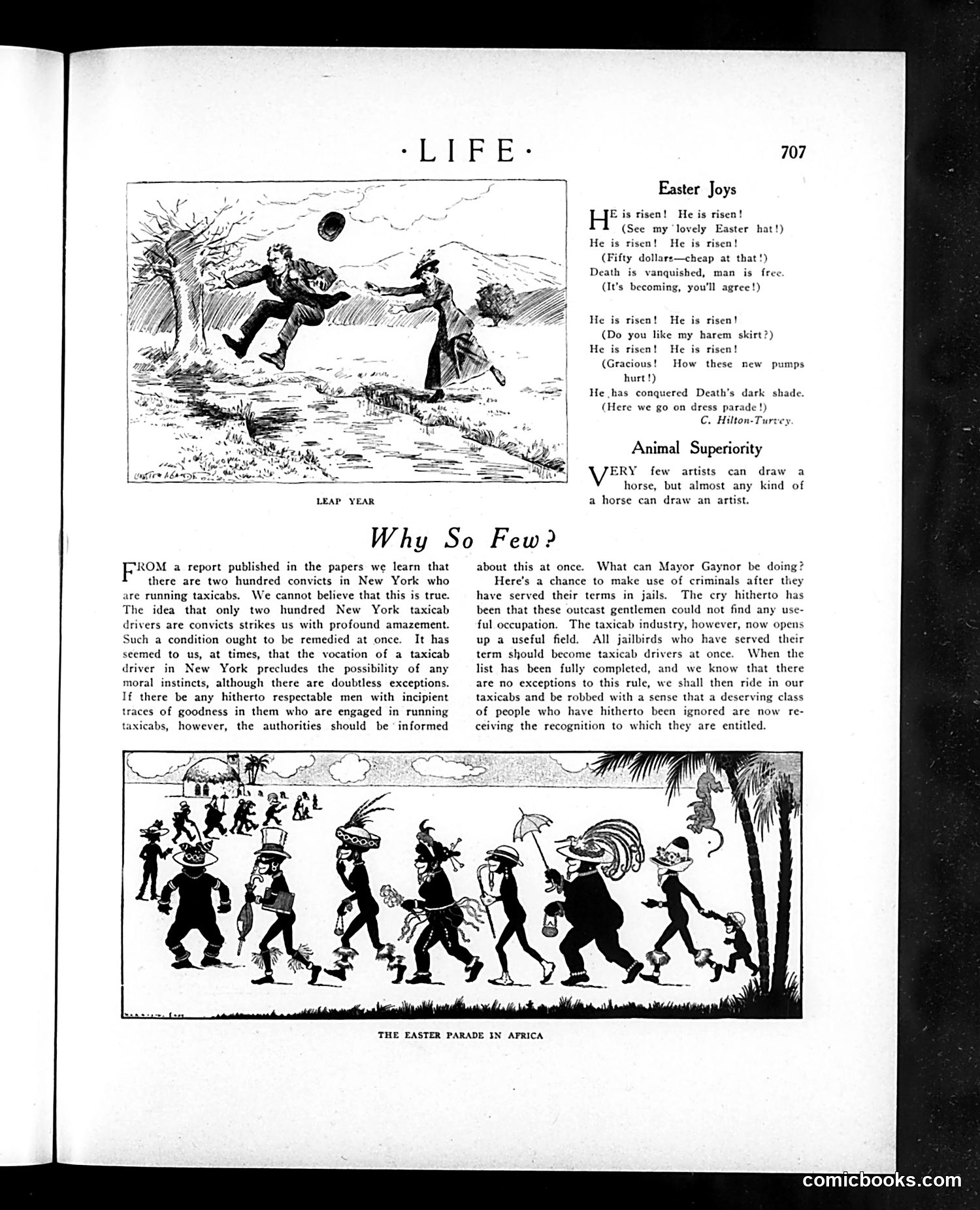
**"Easter Joys"** mocks materialism in Easter celebrations. The poem sarcastically highlights how Easter religious significance is overshadowed by fashion concerns—new hats, harem skirts, pumps—with prices and vanity repeatedly interrupting religious declarations ("He is risen!"). **"Why So Few?"** satirizes New York City taxi drivers. A report claimed only 200 of NYC's cabbies were convicts; Life responds with mock outrage that the number is *too low*, sarcastically suggesting the profession attracts criminals and proposing all released convicts become taxi drivers. The joke implies NYC cabdrivers are already so dishonest/criminal that filling the profession with ex-convicts would be appropriate—a dark commentary on the taxi industry's reputation for exploitation and lawlessness. **"Animal Superiority"** is a brief quip: horses can draw artists better than most artists can draw horses—a visual pun on artistic competence. **"The Easter Parade in Africa"** (illustration) depicts what appears to be a minstrelsy-style caricature parade, likely satirizing European colonial presence or stereotypical representations of African peoples during Easter celebrations.
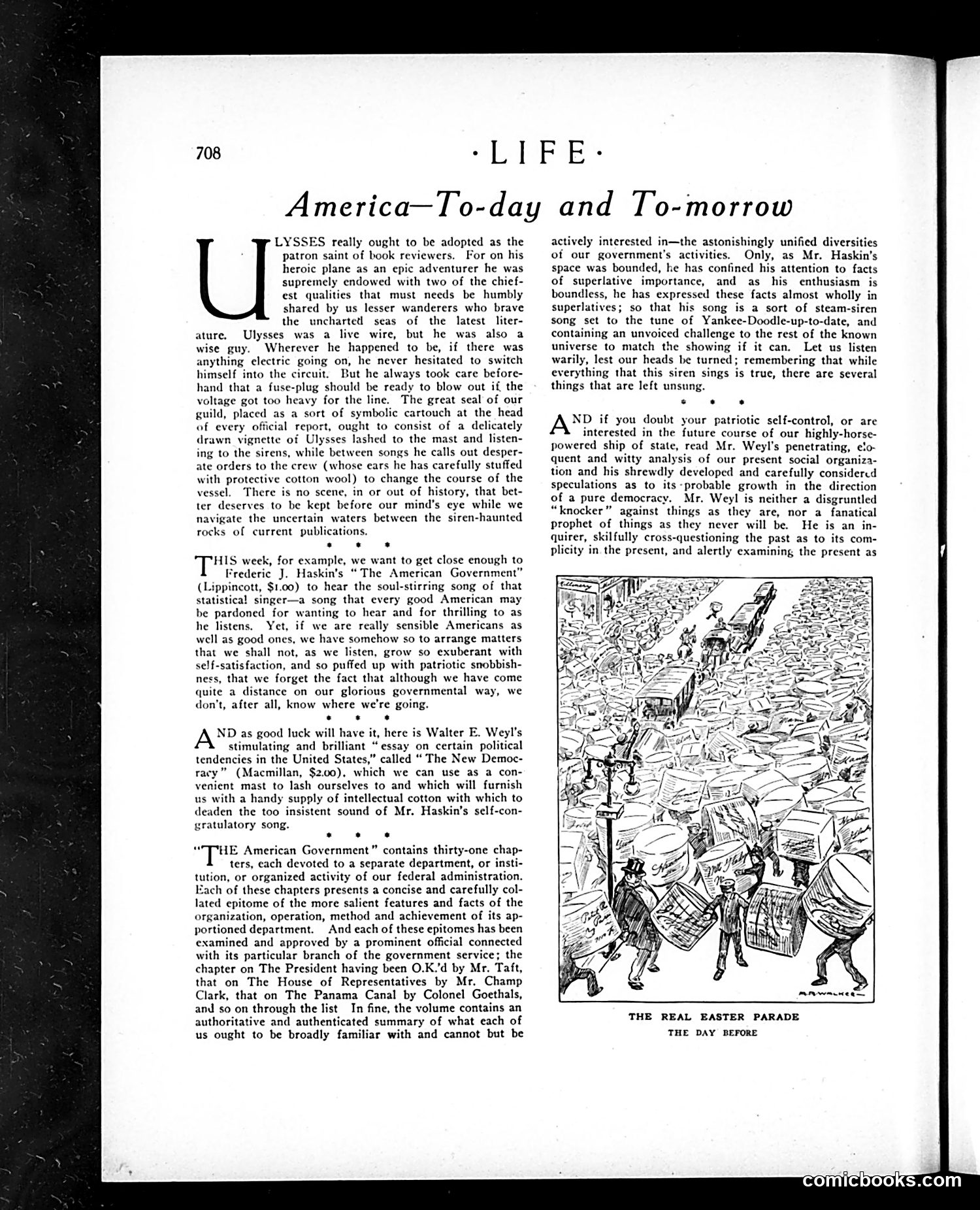
This page reviews two books about American government and politics. The accompanying cartoon, titled "The Real Easter Parade the Day Before," depicts what appears to be a chaotic street scene with numerous figures and animals in disarray. The text uses the metaphor of Ulysses tied to the mast to frame how readers should approach patriotic literature: with both engagement and critical distance. It recommends Frederic Haskin's "The American Government" as an informative guide to federal administration (endorsed by President Taft and other officials), while suggesting Walter Weyl's "The New Democracy" serves as intellectual "cotton wool"—protective skepticism against Haskin's over-enthusiastic patriotic tone. The satire suggests Americans should learn about their government but resist uncritical self-congratulation about American superiority. The cartoon likely illustrates this tension between celebratory patriotism and underlying social chaos.
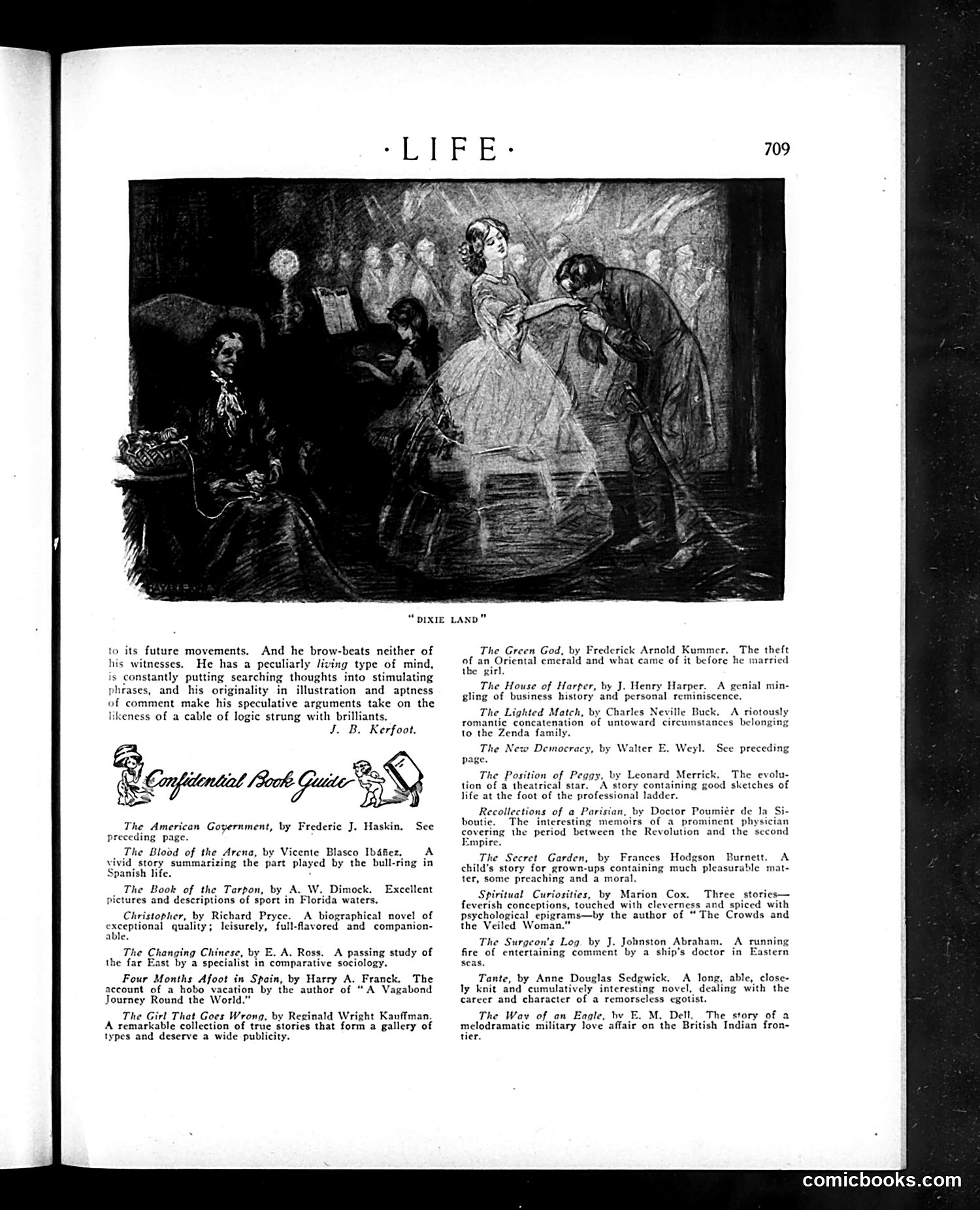
This page is primarily a **book review section**, not a political cartoon. The illustration titled "Dixie Land" appears to depict a **Southern antebellum social scene**—likely a ball or formal gathering with wealthy figures in period dress. The woman in the center wears an elaborate gown; men in dark formal wear surround her. The satire is implicit rather than explicit: Life was a **progressive satirical magazine**, and the romanticized imagery of the pre-Civil War South ("Dixie") would have carried ironic weight for contemporary readers who recognized the magazine's social commentary stance. The nostalgic "Dixie Land" framing likely critiques or satirizes Lost Cause mythology—the tendency to romanticize the antebellum South. The page's main content consists of brief reviews of contemporary books (1910s era), reflecting Life's role as a cultural arbiter. The juxtaposition of Southern romanticism with progressive-era literature reviews suggests the magazine's broader cultural positioning.
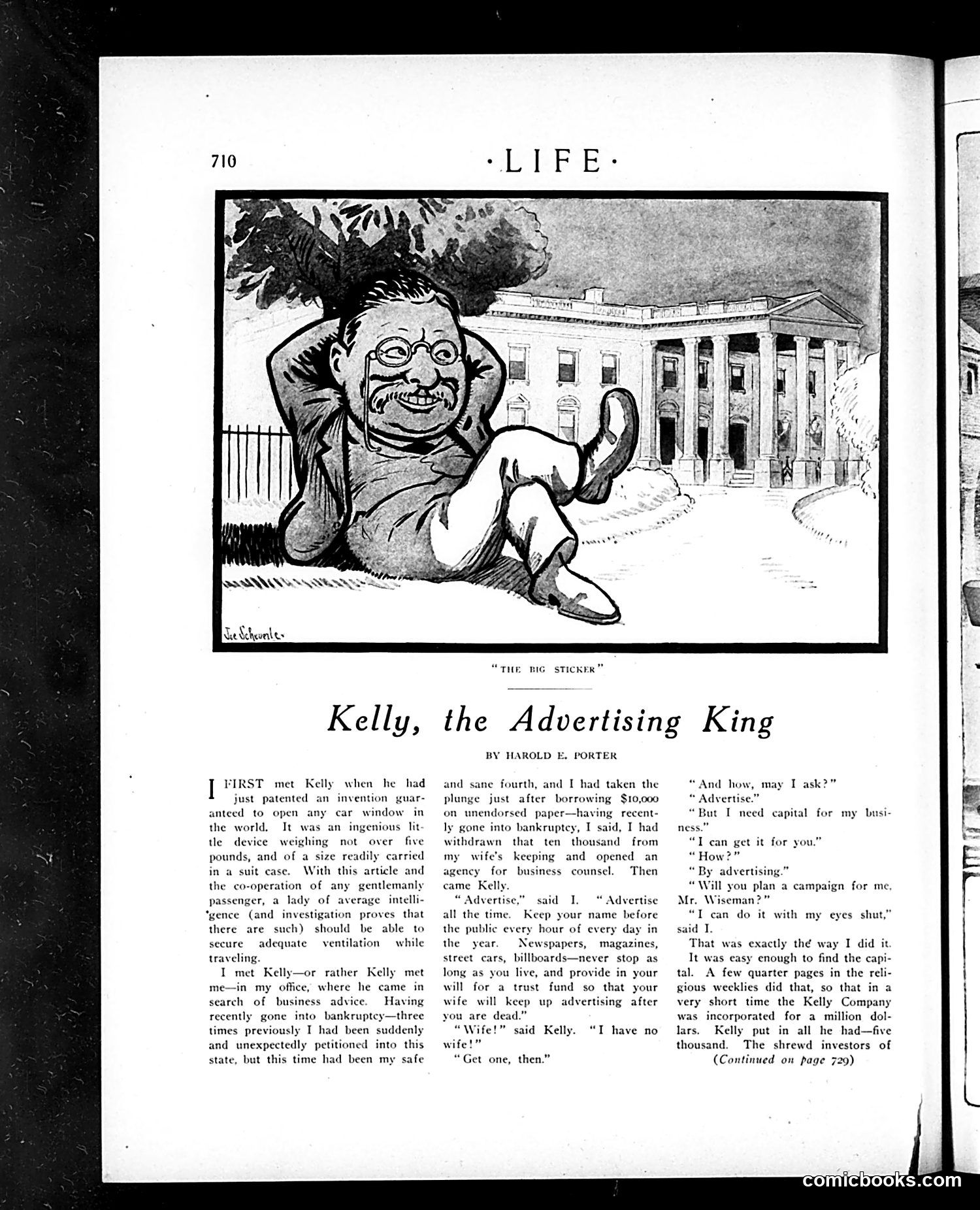
This satirical story by Harold E. Porter mocks the era's obsession with advertising as a cure-all for business problems. The cartoon shows a grotesque caricatured figure ("The Big Sticker") outside the White House, visually emphasizing the absurdity. The satire centers on a business advisor's ridiculous counsel: advertise constantly, everywhere, even after death via trust funds. Kelly, a bankruptcy-prone entrepreneur, takes this literally. The joke escalates when the advisor helps Kelly raise capital by placing ads in religious magazines—cynically exploiting moral publications for profit. Kelly's company is incorporated at inflated value despite his meager $5,000 investment, satirizing how easily gullible investors can be duped through hype. The underlying critique: aggressive advertising and speculative investing were creating bubbles of worthless companies, with shrewd promoters profiting while ordinary investors lost money. This reflects early 20th-century anxieties about commercialism's growing influence.
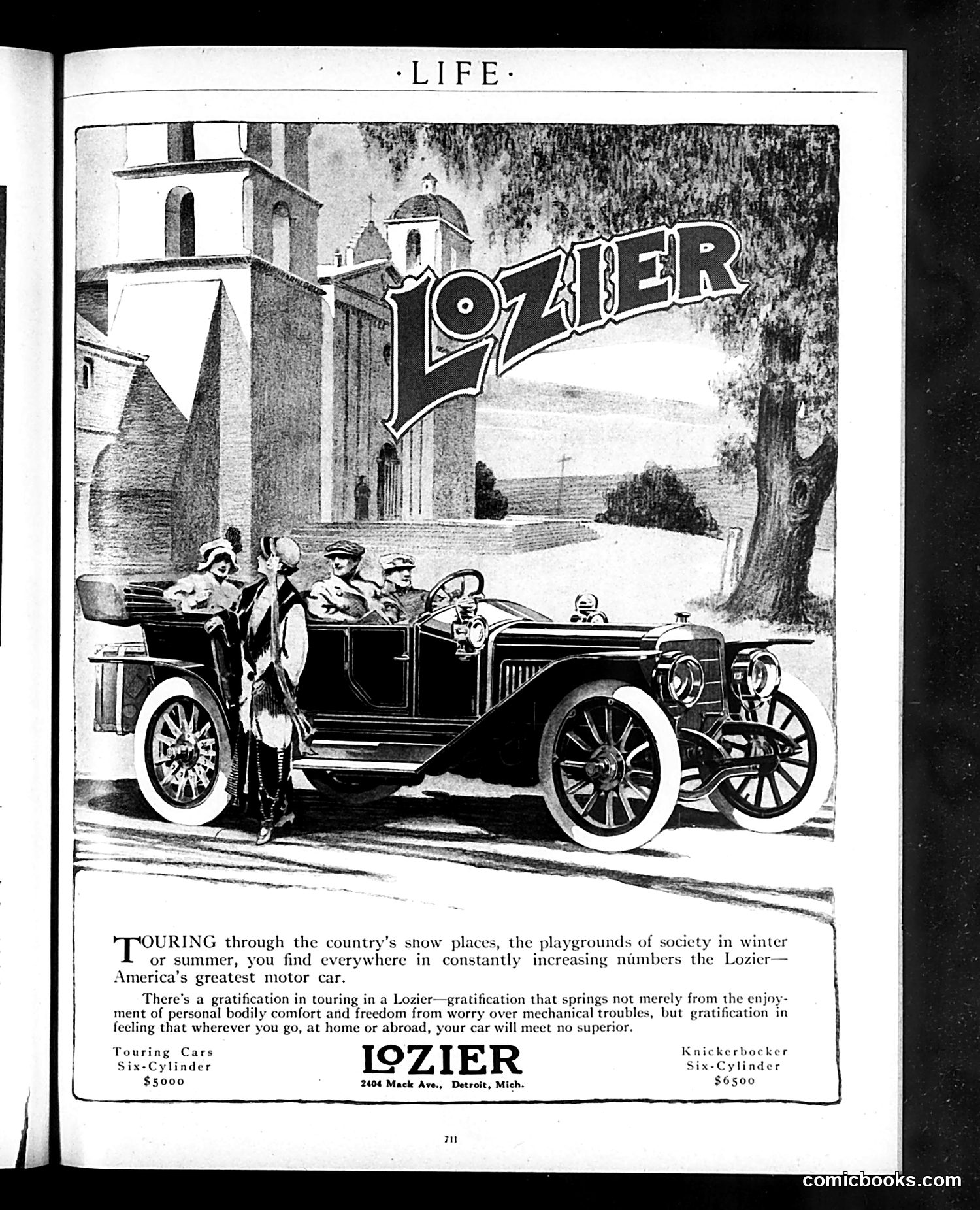
This is a **car advertisement**, not political satire. It promotes the Lozier automobile, manufactured in Detroit, Michigan. The image shows well-dressed passengers in a 1910s-era touring car positioned before a picturesque mission church, emphasizing leisure and refinement. The ad targets wealthy consumers ("playgrounds of society") by associating the vehicle with social status and travel to scenic destinations. The text's key sales pitch is that owning a Lozier provides not just mechanical reliability and comfort, but **social superiority**—the gratification of driving "a car will meet no superior." This appeals to early-20th-century aspirational buyers who equated luxury automobiles with class distinction. Two models are advertised: the Touring Car ($5,000) and the Knickerbocker Six-Cylinder ($6,500)—both premium prices for the era.
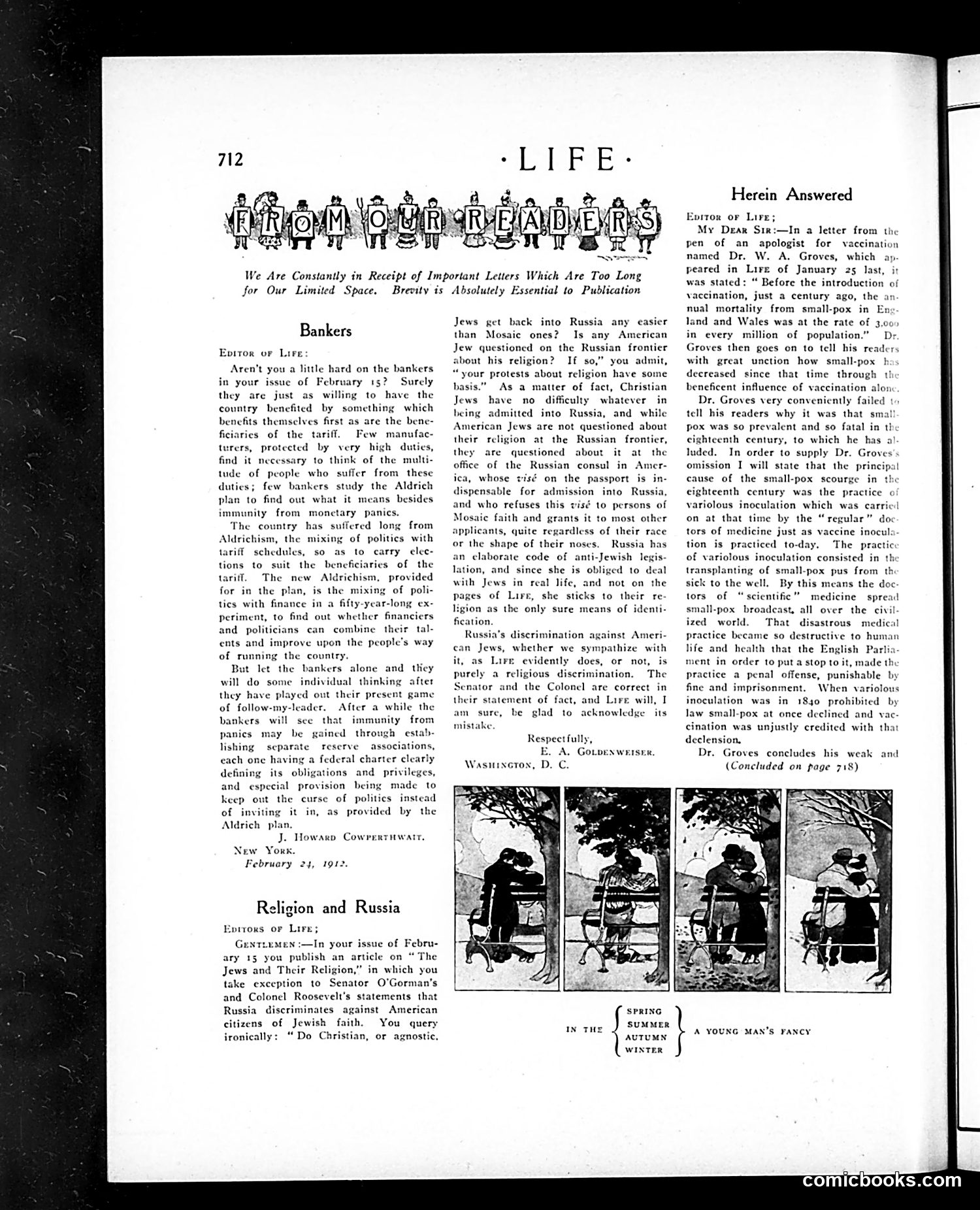
This page contains three reader-response letters debating contemporary policy issues: **"Bankers"** critiques the Aldrich Plan (a proposed banking reform), arguing bankers pursue self-interest over public welfare. The writer sarcastically compares bankers' immunity from "monetary panics" to manufacturers' tariff protection, both benefiting the few while harming the many. He proposes separate bank associations with federal charters instead. **"Religion and Russia"** disputes Life's previous article denying religious discrimination against American Jews in Russia. The letter-writer rebuts Life's rhetorical questions, providing evidence that Russia's consul office systematically denies visas to Jews while granting them to Christians—demonstrating explicit religious discrimination. **"Herein Answered"** (partially visible) addresses vaccination claims made by "Dr. W. A. Groves" in a prior issue, challenging statistics about smallpox mortality rates. The four silhouette photographs below appear unrelated—showing figures in seasonal settings—likely illustrating an article titled "A Young Man's Fancy" (in spring, summer, autumn, winter).
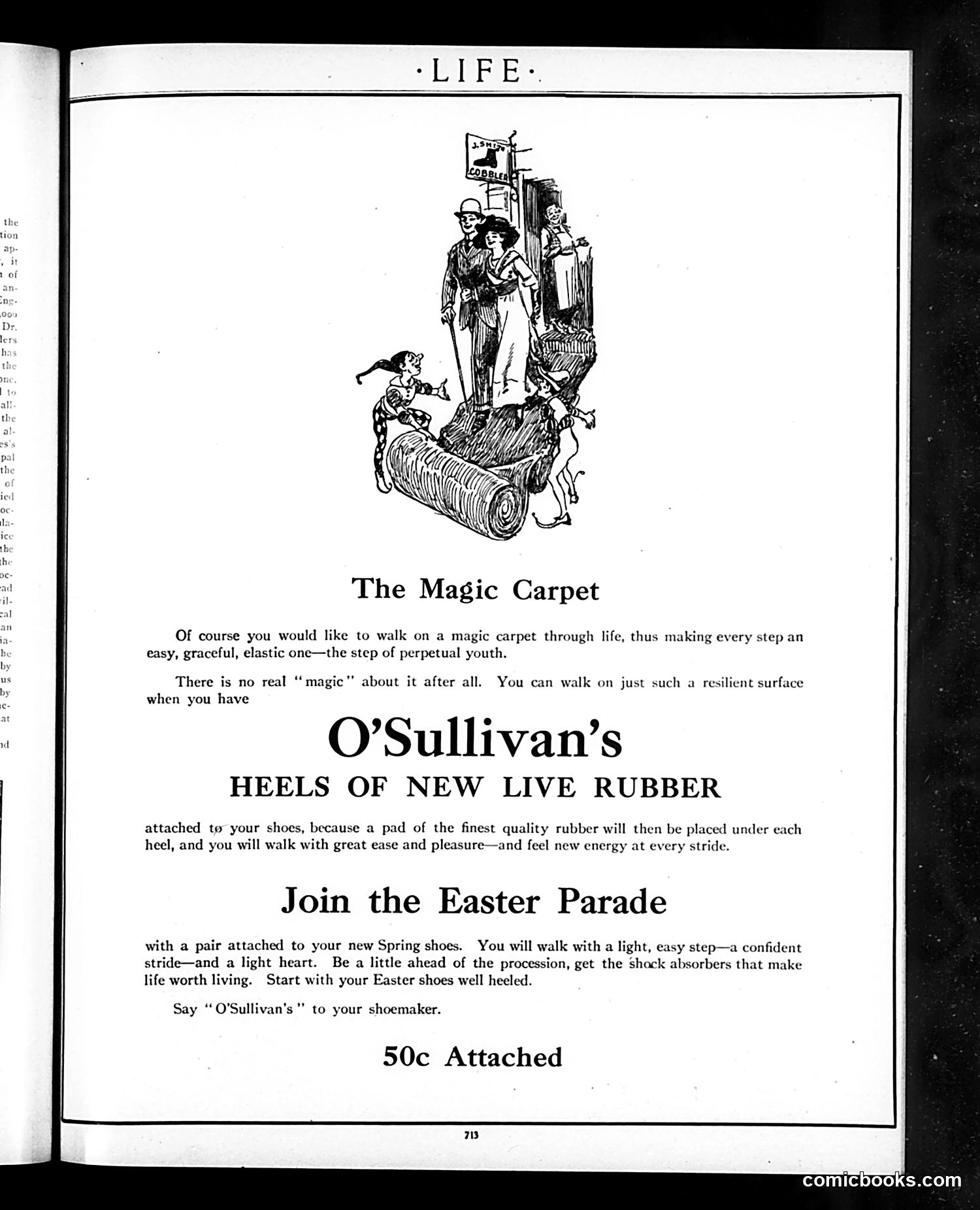
This is primarily a **product advertisement**, not political satire. The page promotes O'Sullivan's brand rubber heels, priced at 50 cents. The "magic carpet" is a metaphor: just as a magic carpet would make travel effortless, O'Sullivan's rubber heels promise to make walking easy and youthful. The illustration shows figures standing on a rolled carpet (resembling a magic carpet) to visualize this concept. The ad uses **Easter timing** as a marketing hook, encouraging readers to wear the heeled shoes in the Easter Parade—a real social tradition where people displayed new spring fashions. The language emphasizes comfort ("easy," "graceful," "elastic") and renewed vigor ("feel new energy," "perpetual youth"), selling the product through aspirational lifestyle messaging. This reflects early 20th-century advertising that blended whimsy with product benefits.
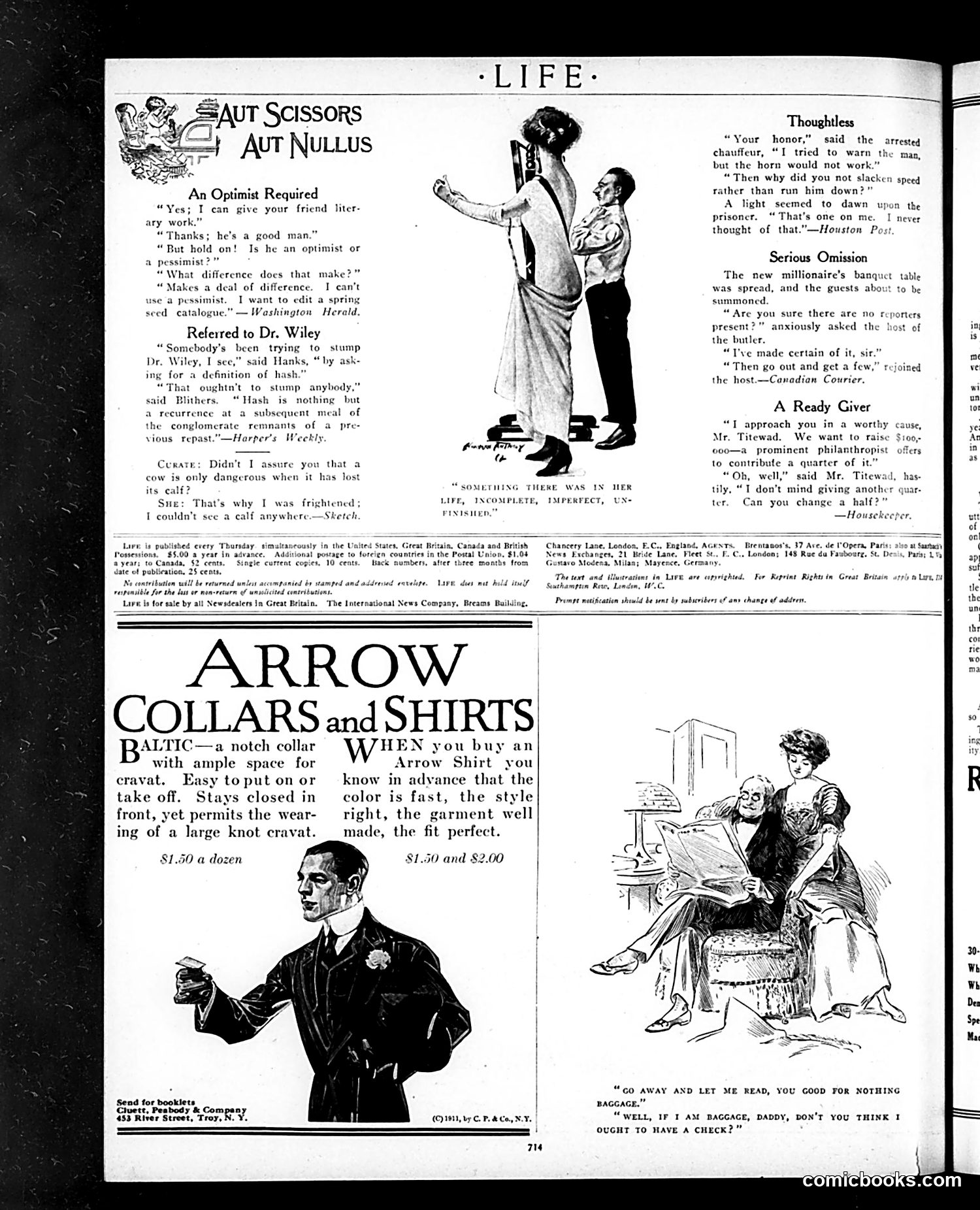
This page from *Life* magazine contains several short satirical jokes typical of early 20th-century American humor, plus advertising. The comic sketches mock various social types: an optimist editor rejecting a pessimist (Washington Herald reference), a joke about Dr. Wiley (likely the food safety reformer) and hash, and a curate's misunderstanding about dangerous cows. These are gentle, class-conscious humor targeting educated readers. The main cartoon shows a wealthy man refusing to contribute to charity, then haggling over changing a half-dollar—satirizing stingy rich people who claim poverty when solicited for donations. The lower right illustration depicts a child calling herself "baggage" and demanding a check tag, a family humor joke playing on the word "baggage." The Arrow Collars advertisement dominates the lower half—a major brand advertisement emphasizing quality and ease of use, typical of *Life*'s revenue model. The page reflects turn-of-the-century American attitudes toward wealth, propriety, and consumer goods.
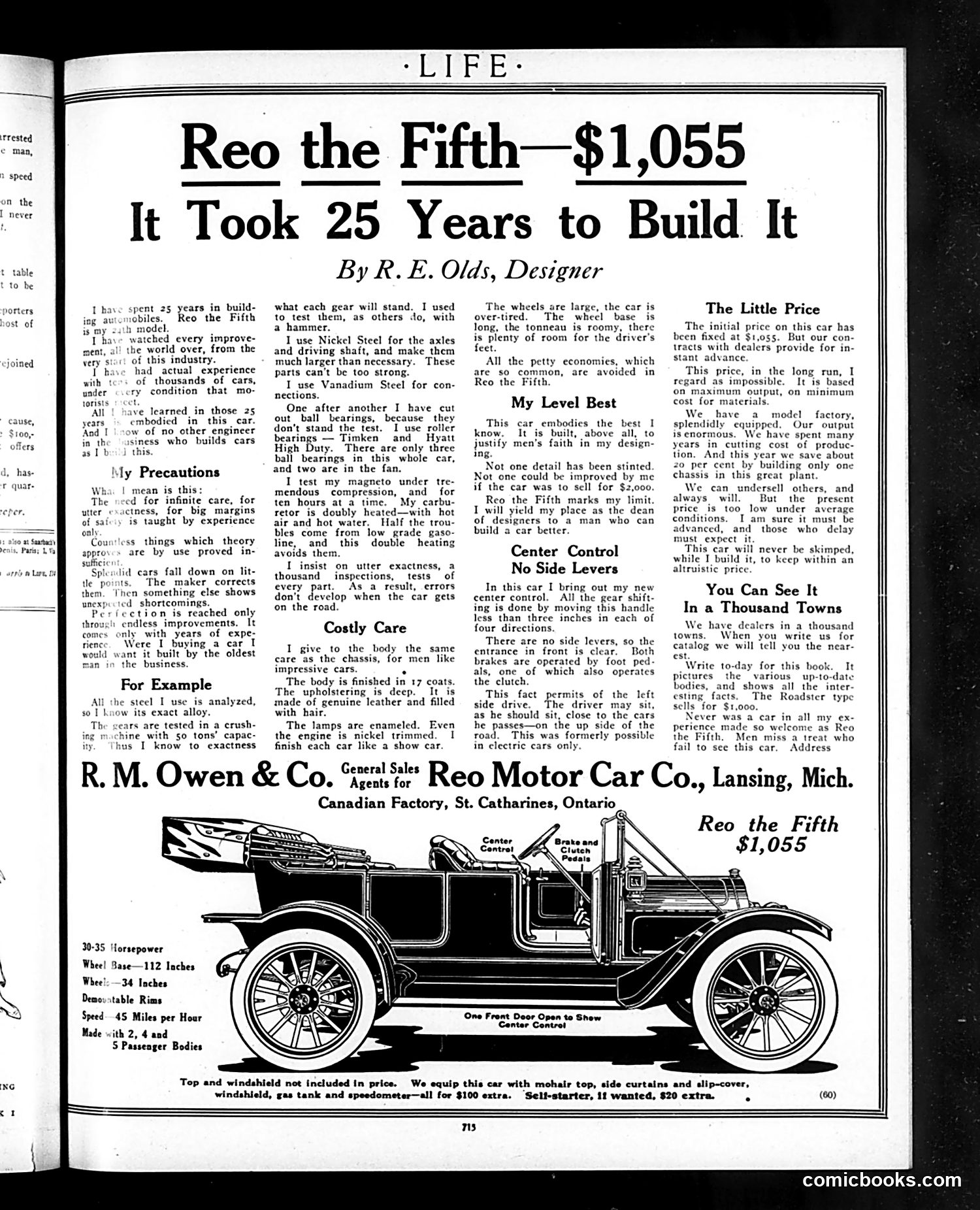
This is **not a cartoon or satire**—it's a straightforward automobile advertisement from Life magazine's advertising section. **Content:** R.E. Olds, the designer and founder of the Reo Motor Car Company, personally endorses the Reo the Fifth, priced at $1,055. This appears to be a premium car marketed on engineering excellence rather than price. **The pitch:** Olds emphasizes his 25 years of automotive experience, meticulous quality control (analyzing steel alloys, testing gears under crushing machines, 17-coat body finishes), and innovative features like center control steering instead of side levers. He positions the car as the culmination of his expertise—"my limit"—claiming no detail has been compromised despite the moderate price. **Historical context:** This reflects early 1900s automobile marketing, where manufacturers differentiated cars through engineering credentials and craftsmanship rather than mass-production efficiency (which Henry Ford was pioneering simultaneously). The price and specifications suggest a middle-to-upper-class vehicle for the era.
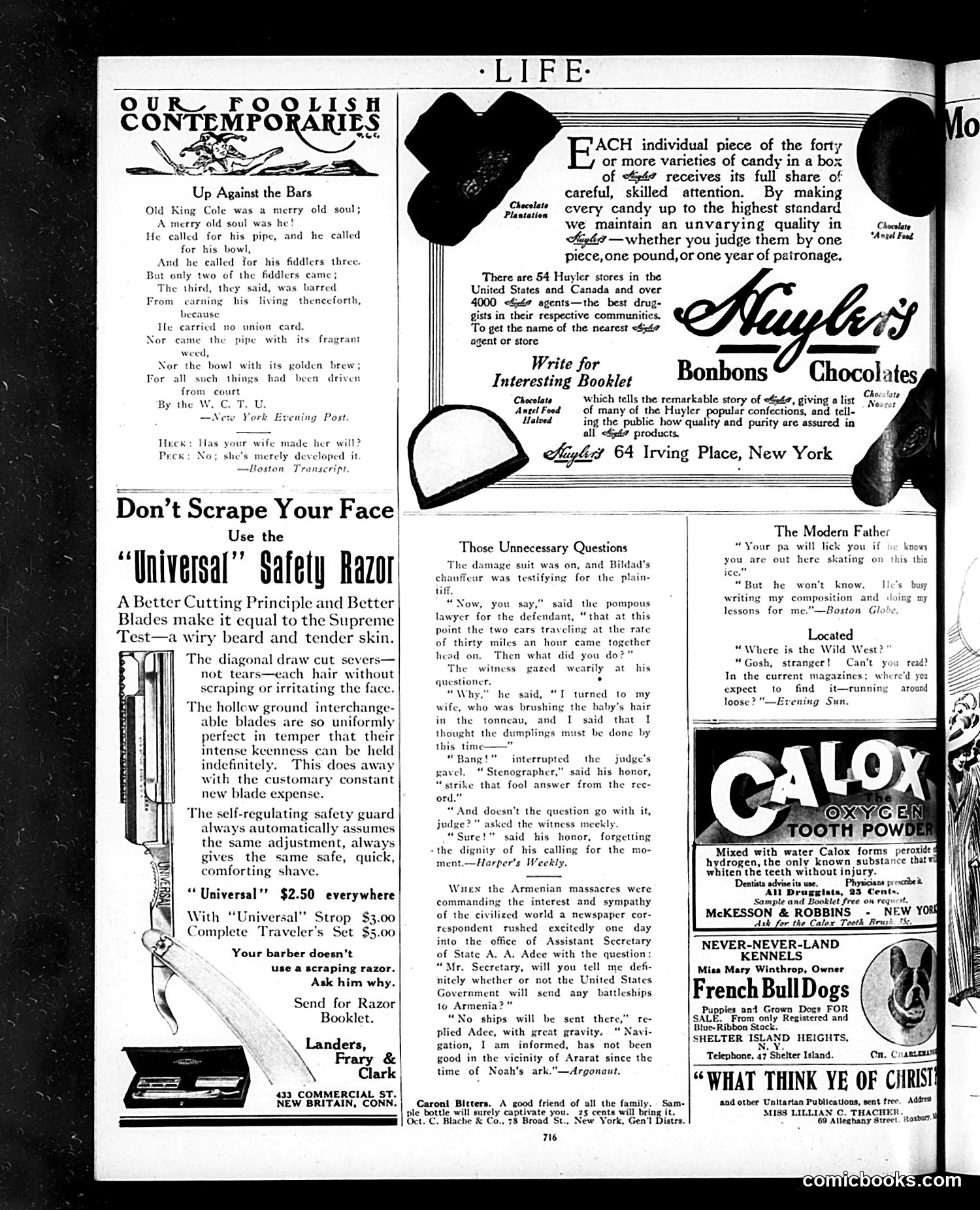
This page from Life magazine is primarily an **advertising compilation** rather than political satire. The major content includes: **"Up Against the Bars"** (top left): A satirical poem about Old King Cole where the third fiddler cannot perform because he lacks a union card. This mocks union requirements—suggesting excessive labor protectionism prevents work completion. **The Huyler's chocolate advertisement** (center) dominates the page, promoting their quality confections and retail network. **"Don't Scrape Your Face"** (left side): An advertisement for the "Universal" Safety Razor emphasizing superior blade technology. **"Those Unnecessary Questions"** (right): A brief humorous anecdote about a court case where witness testimony includes an absurd question that the judge paradoxically orders struck while admitting questions typically "go with" testimony—mocking legal absurdities. The remaining content comprises product advertisements (Calox tooth powder, French Bulldog kennels, religious publications). The page reflects early 20th-century American consumer culture and satirizes labor unions and legal procedures, but is primarily commercial in nature.
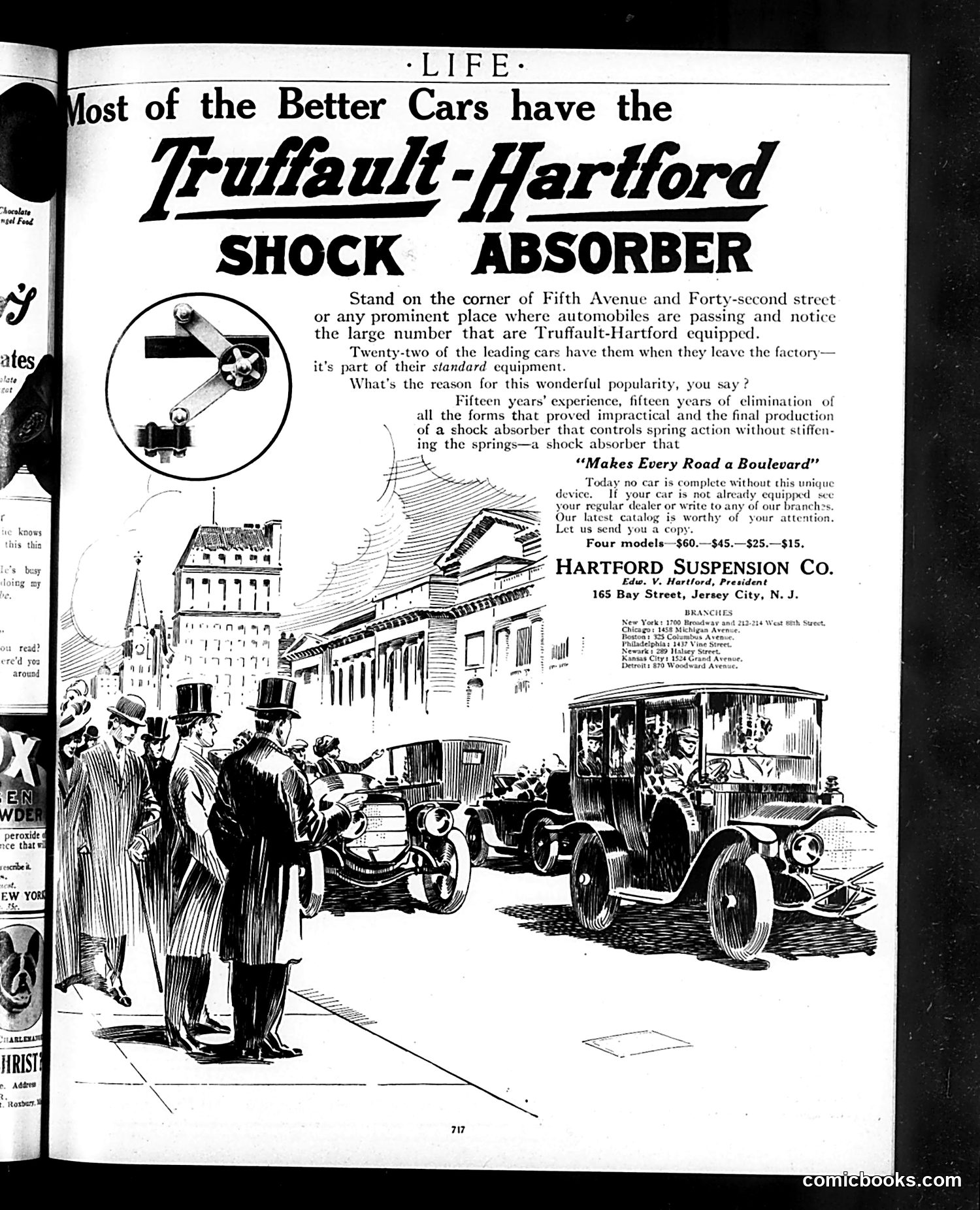
This is a **automobile advertisement**, not political satire. The page promotes the Truffault-Hartford shock absorber as a standard feature in quality cars. The illustration depicts well-dressed gentlemen (likely businessmen or car owners) standing on a city street corner—specifically Fifth Avenue and 42nd Street in New York—observing passing automobiles. The image serves as a sales pitch: if you stand at this prominent location, you'll notice how many "better cars" feature this suspension technology. The ad emphasizes that the shock absorber has 15 years of development history and is now standard equipment on 22 leading car models. The tagline "Makes Every Road a Boulevard" suggests the smoother ride quality. Pricing information ($60–$15 for four models) and contact details for Hartford Suspension Co. (Jersey City, NJ) appear at bottom. **For modern readers**: This reflects early 1920s automotive marketing—shock absorbers were still a competitive feature worth advertising prominently, and brand visibility at major city intersections was considered evidence of popularity.
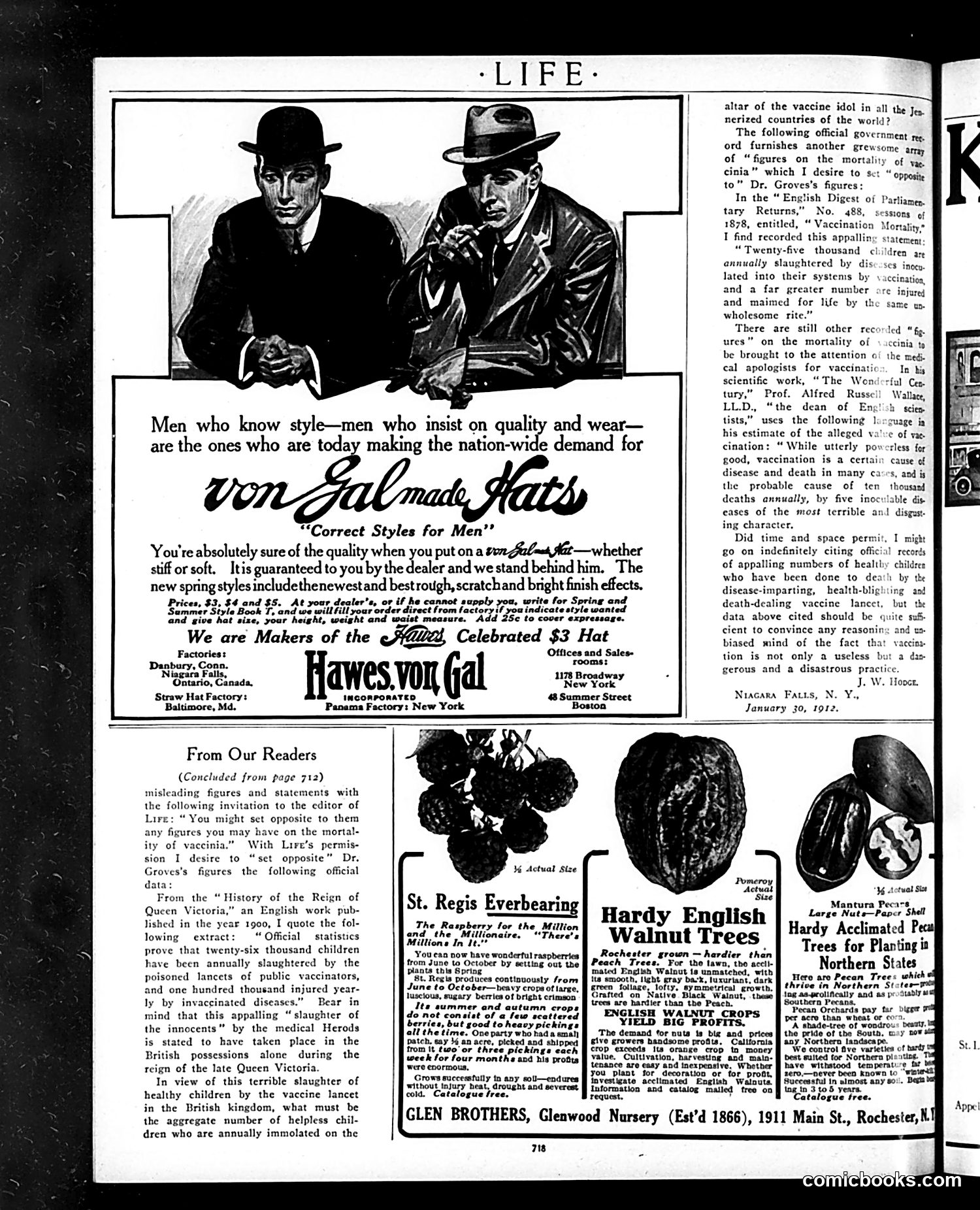
This page contains a **debate on vaccination safety** disguised as a letters-to-editor section. A reader challenges Life magazine's earlier pro-vaccination stance, citing alarming (though unverified) British government statistics claiming 25,000 children die annually from vaccination and that vaccines cause disease rather than prevent it. The reader invokes authority figures like naturalist Alfred Russel Wallace to argue vaccination is "useless" and "disastrous." **Historical context**: This reflects genuine early-20th-century anti-vaccination sentiment that persisted despite vaccination's documented success against smallpox. Vaccine skeptics cherry-picked statistics and quoted scientists selectively to oppose public health measures. The **irony**: This debate appears alongside a hat advertisement—mundane commercial content contrasting sharply with claims of mass child death, highlighting how misinformation circulated freely in period magazines.
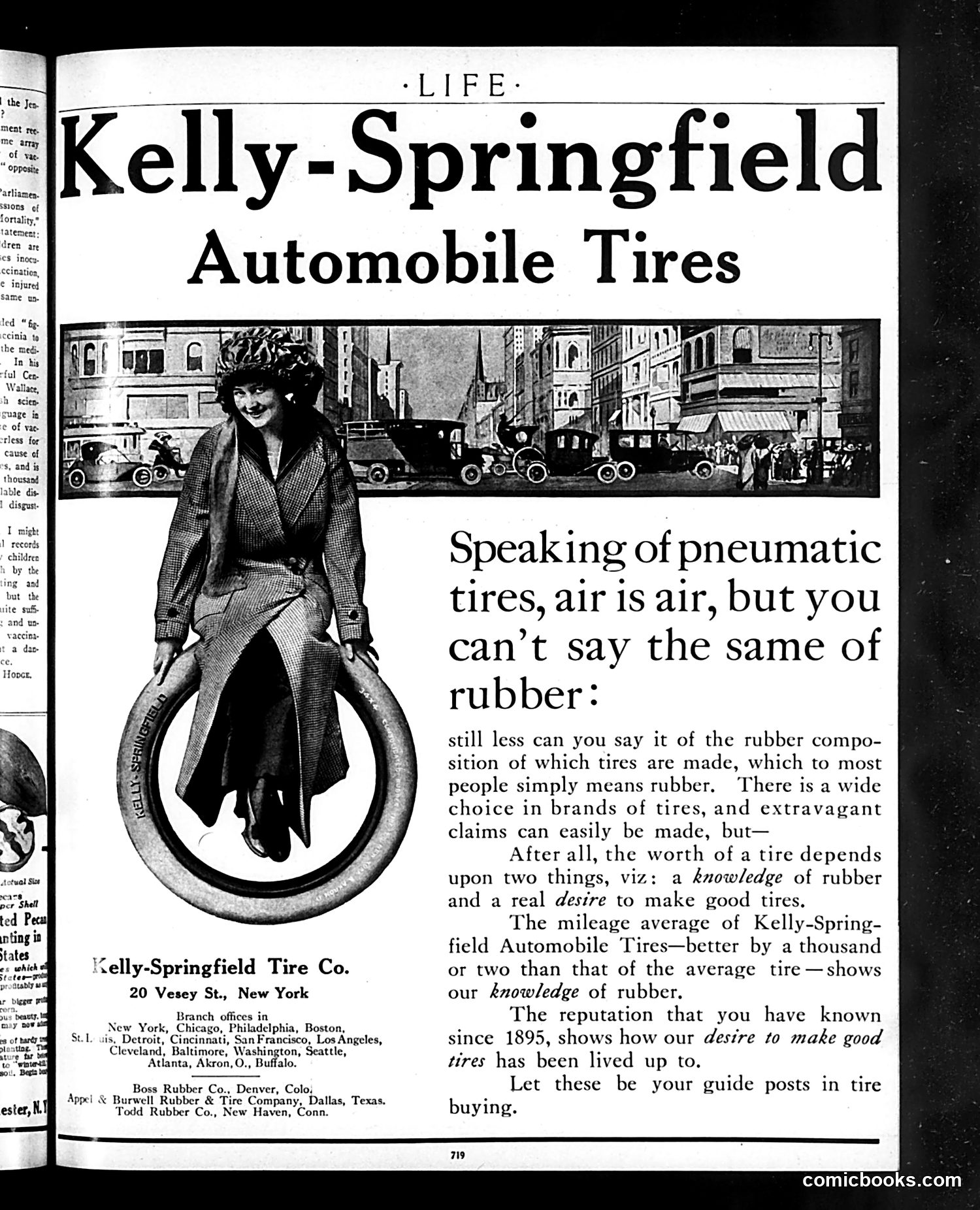
This is primarily a **product advertisement**, not political satire. The page promotes Kelly-Springfield tires, a real company established in 1895. The image features a stylized woman in 1920s attire seated on a large tire—a common advertising motif of the era that combined glamour with the product. The cityscape background emphasizes modernity and urban sophistication. The text's opening—"air is air, but you can't say the same of rubber"—is a clever wordplay comparing pneumatic (air-filled) tires. The advertisement argues that while tire brands use similar air, Kelly-Springfield's superior rubber *composition* and manufacturing knowledge (emphasized in italics) justify their premium positioning. The claim of "a thousand or two" better mileage distinguishes them from competitors. This represents early 20th-century advertising strategy: establishing brand prestige through implied technical superiority rather than explicit competitor attacks.
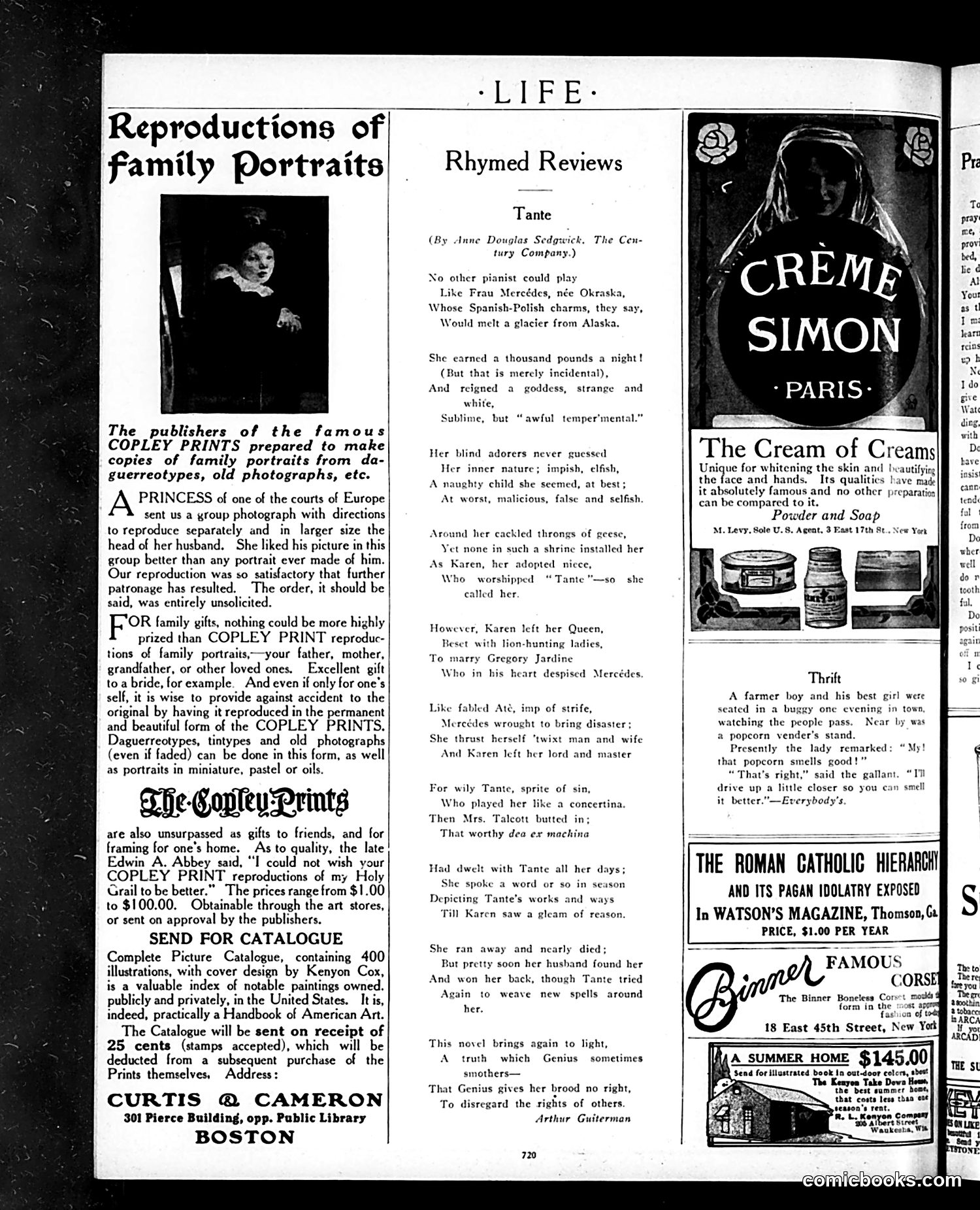
This page is primarily **advertising and literary content**, not political satire. The main sections are: 1. **Copley Prints advertisement** (left): Promotes reproduction services for family portraits from old photographs and daguerreotypes—a practical commercial service for preserving family images. 2. **"Tante" book review** (center): A rhymed review by Arthur Guiterman of Anne Douglas Sedgwick's novel. The poem summarizes the plot: a temperamental concert pianist manipulates her adopted niece Karen's marriage through emotional scheming, until a sensible older woman (Mrs. Talcott) intervenes with reason. The moral, stated plainly: genius doesn't grant the right to harm others. 3. **Crème Simon advertisement** (right): A French cosmetic product for skin whitening and facial care. There is **no political cartoon or satire** on this page. It represents typical *Life* magazine content from the early 20th century: consumer goods advertising mixed with literary reviews and self-improvement products.
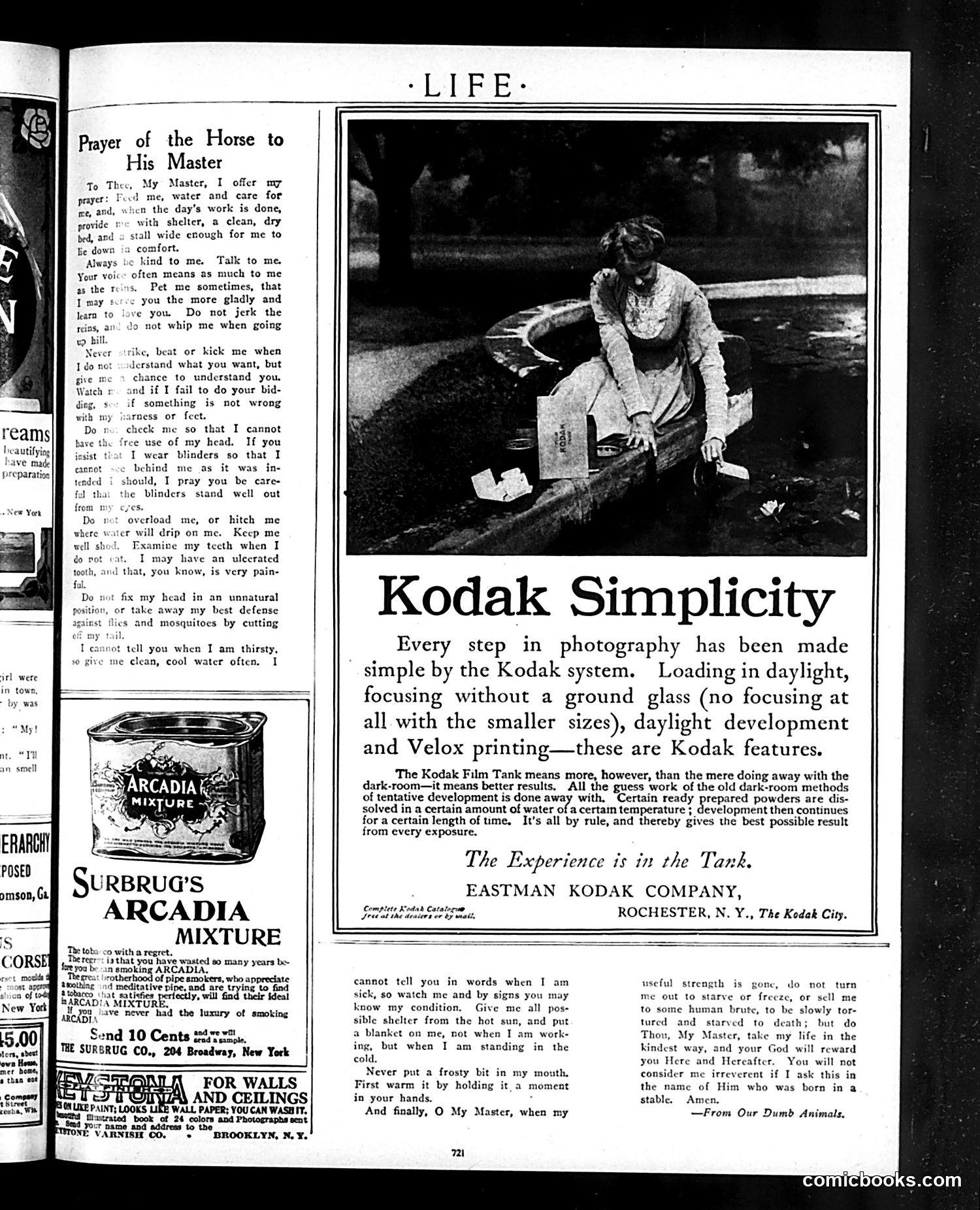
This page contains **not a cartoon but a sentimental animal-welfare piece**: "Prayer of the Horse to His Master." Written from a horse's perspective, it's a plea for humane treatment—requesting adequate food, water, shelter, kind handling, proper veterinary care, and a merciful death rather than abandonment or sale to cruel owners. The piece reflects **early 20th-century animal-rights activism**, attributing human emotions and moral reasoning to animals to appeal to readers' conscience. The religious framing (prayer, biblical references) was typical rhetoric for Progressive Era reform movements. The surrounding **advertisements** (Surbrugh's Arcadia tobacco mixture, Kodak cameras, Estona wall paint) are incidental. **For modern readers**: This represents a historical moment when animal welfare became a middle-class moral concern, expressed through sentimental anthropomorphism rather than scientific argument. The horse's "voice" was a persuasive rhetorical device common to 1910s-era advocacy journalism.
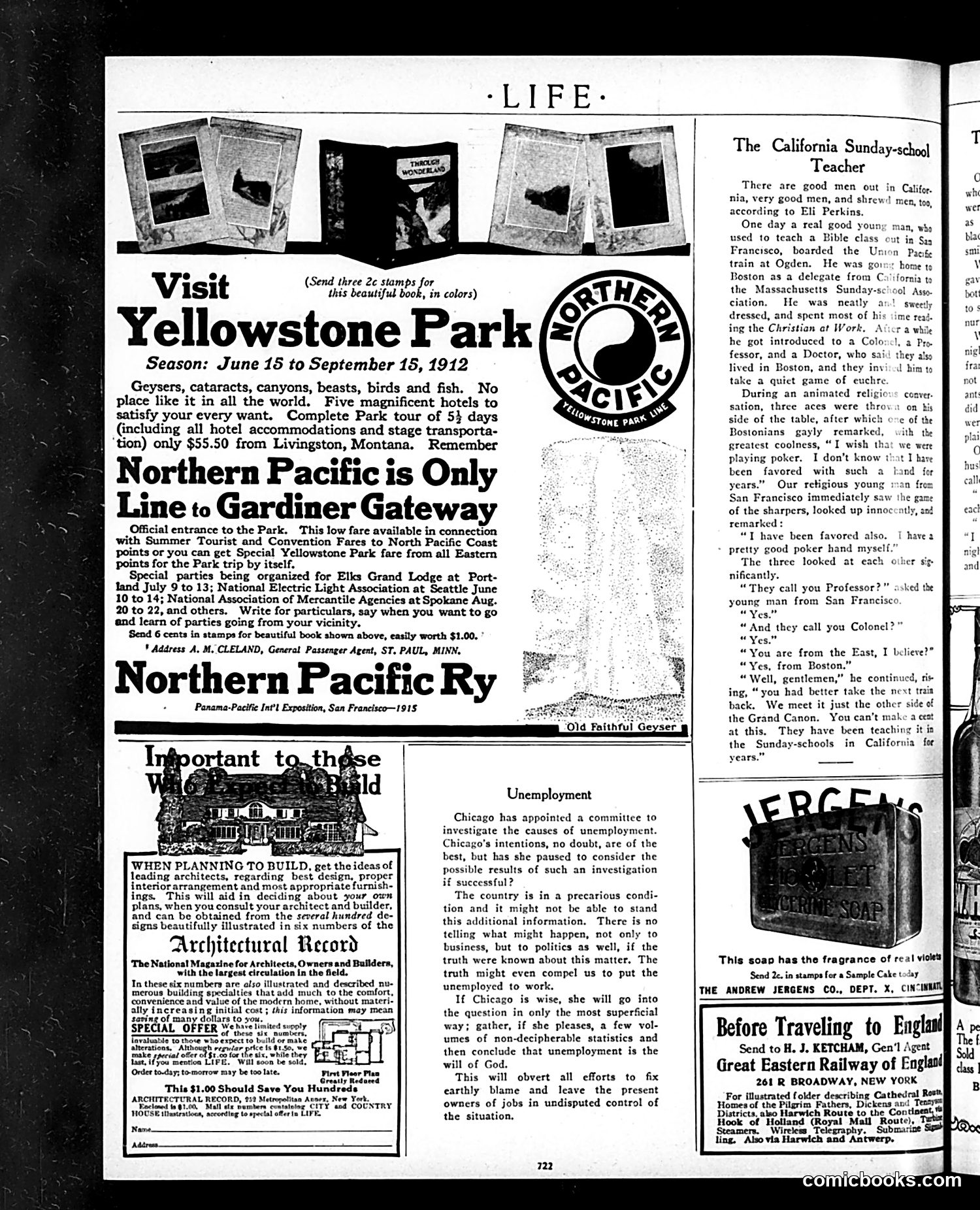
This page contains a satirical story about a California Sunday-school teacher that mocks Protestant earnestness and naïveté. The narrative describes a religiously upright young Bible instructor from San Francisco who encounters two sophisticated men (a Professor and a Colonel from Boston) on a train. During conversation, the three casually throw down aces while discussing religion. The Californian, innocent of the implication that they're skilled gamblers ("sharpers"), remarks he's also had good poker luck. The satire works on multiple levels: it mocks the San Francisco teacher's obliviousness to being swindled, suggests that respectable-seeming Easterners are actually con artists, and implies Western naïveté versus Eastern sophistication. The humor derives from the young man's complete failure to recognize he's been marked by professionals. The page is primarily advertising (Yellowstone Park, Northern Pacific Railway, architectural publications), with this brief fiction piece serving as filler content typical of *Life* magazine's format.
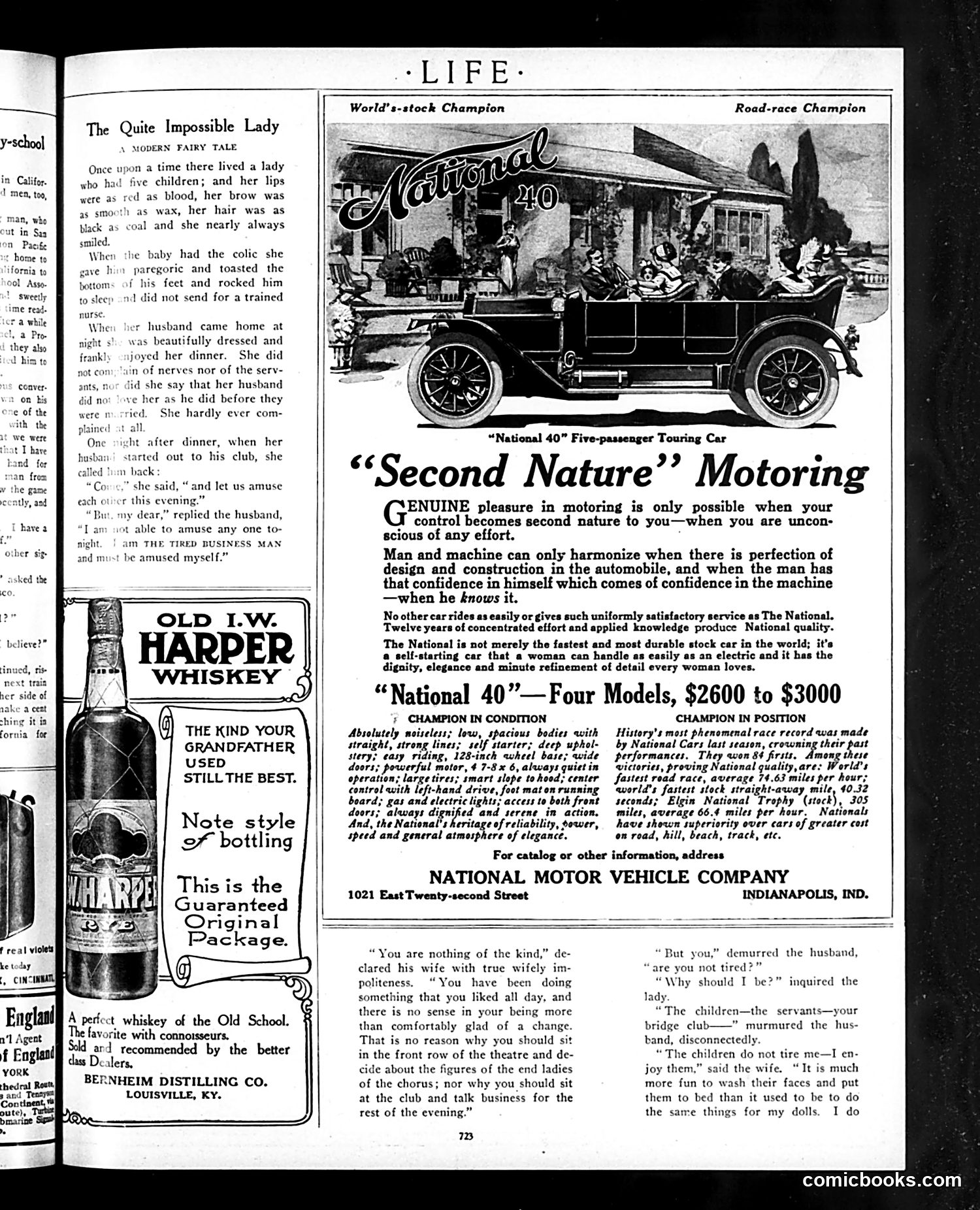
This page contains a satirical short story titled "The Quite Impossible Lady: A Modern Fairy Tale" alongside period advertisements. **The Satire:** The story mocks idealized Victorian notions of wifely perfection. It describes a woman with flawless appearance who never complains, manages five children without hired help, and maintains composure through domestic chaos. The humor emerges when her husband—"the tired business man"—refuses her request for evening entertainment, claiming *he* needs amusement instead. The satire targets both the impossible standards imposed on women and the self-centered entitlement of husbands who expect wives to manage everything while remaining cheerful servants. **Historical Context:** This reflects early 20th-century anxieties about gender roles and marriage. The "tired business man" was a stock figure in period humor, often portrayed as exhausted by work yet oblivious to his wife's labor. **Advertisements:** The page includes ads for Harper Whiskey and the National 40 automobile—luxury goods marketed to affluent men, reinforcing the page's class assumptions about who reads Life magazine.
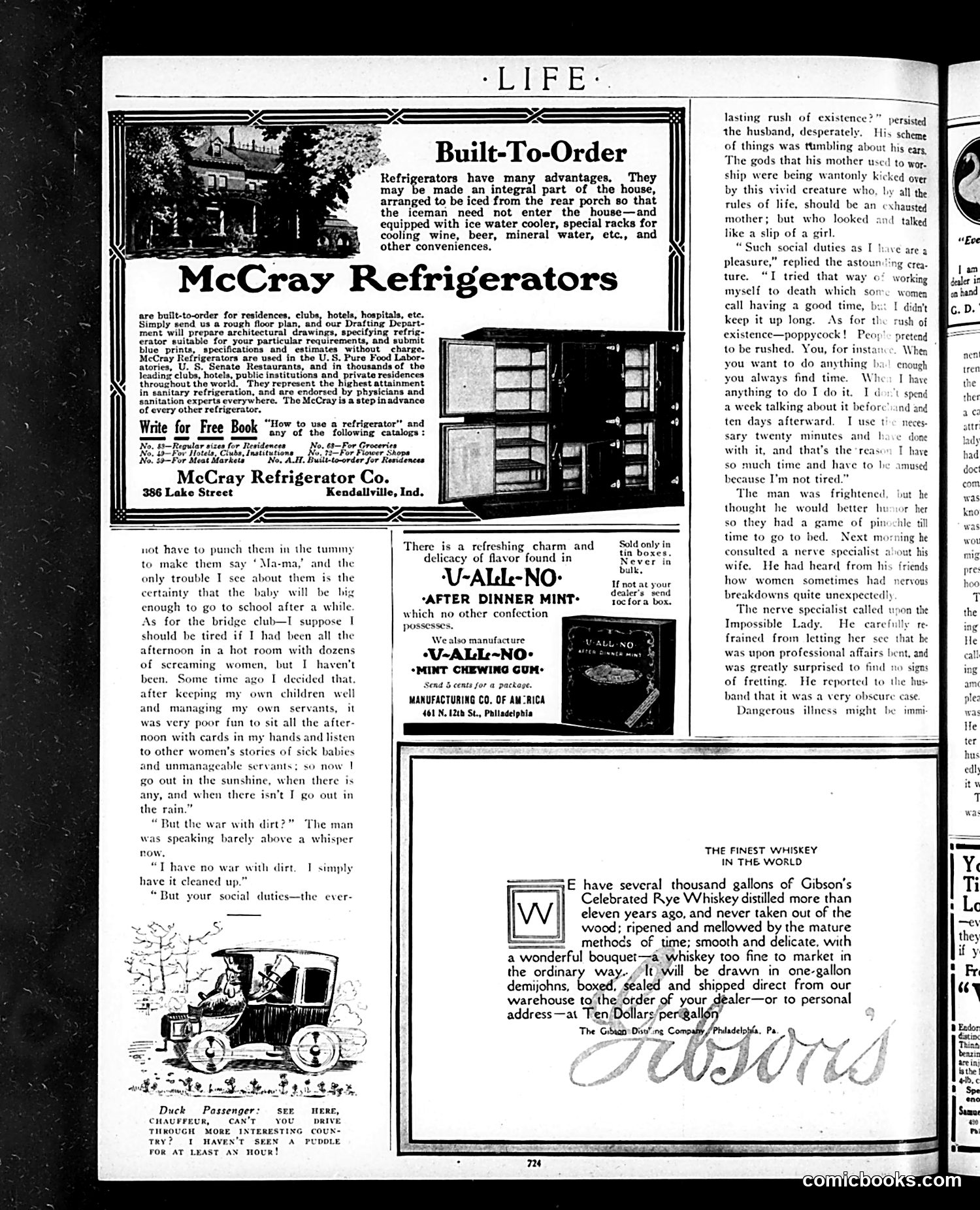
This page contains mostly **advertisements** interspersed with what appears to be **serialized fiction** about marriage and social expectations. The main cartoon/illustration shows a car labeled "Duck Passenger" with a humorous caption about a chauffeur and passengers, though the joke's specifics are unclear from this image quality. The dominant narrative concerns a **husband-wife conflict** over the wife's rejection of traditional feminine exhaustion. The wife challenges her husband's assumption that she should be tired from social duties and housekeeping, arguing instead that she accomplishes tasks efficiently and isn't perpetually "rushed." When he consults a nerve specialist, expecting to confirm her hysteria, the doctor finds nothing wrong. **The satire targets**: Traditional gender expectations that assumed women should be naturally fatigued and neurotic; the husband's assumption that his wife's energy and independence indicate illness; the era's medical tendency to pathologize women's non-conformity. This reflects 1920s debates about women's roles post-suffrage, mocking both rigid domesticity and male anxiety about independent women.
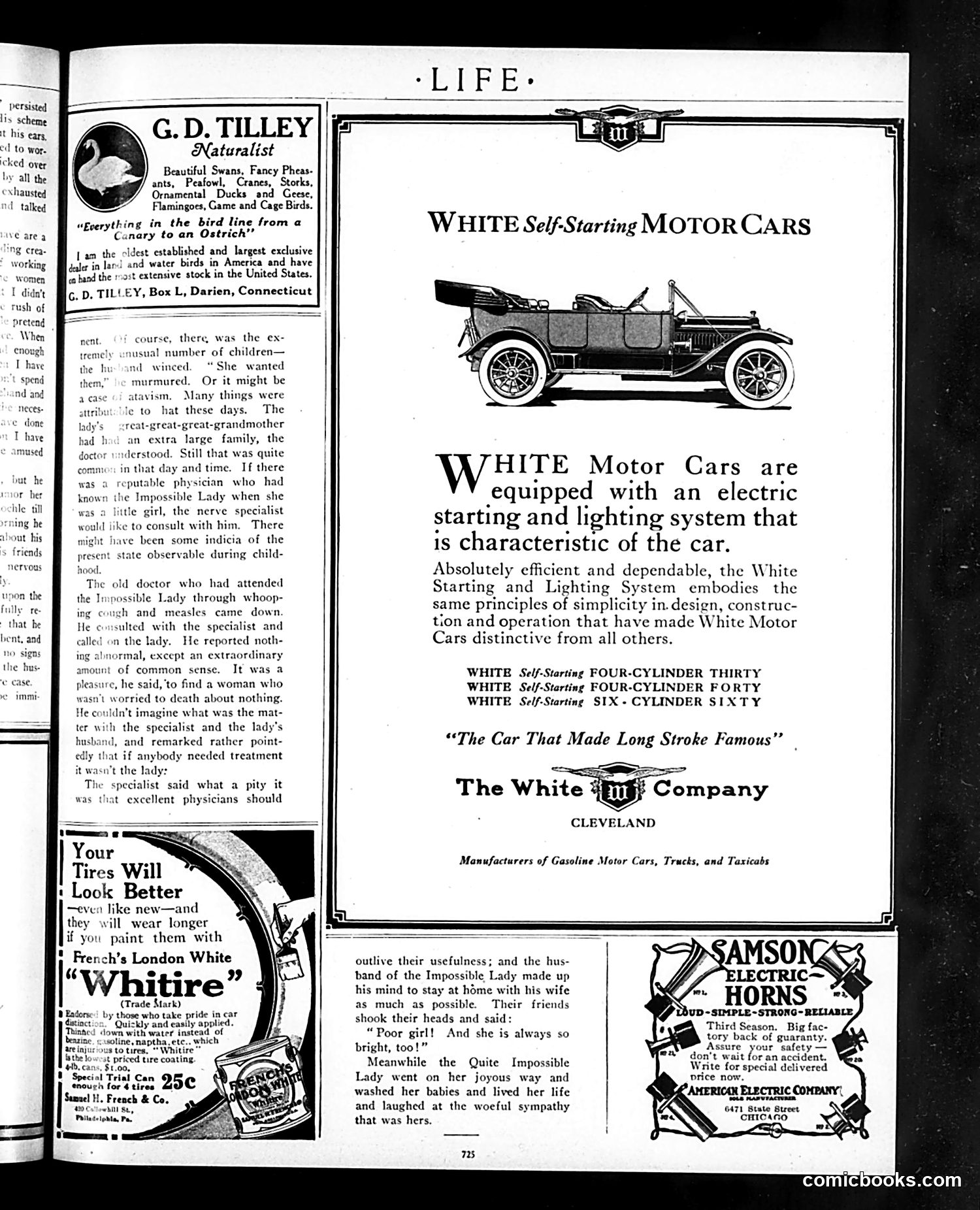
This page is primarily **advertising**, not satire or political commentary. It contains three unrelated commercial advertisements: 1. **G.D. Tilley (Naturalist)**: A small ad offering ornamental birds and waterfowl for sale from Connecticut. 2. **White Self-Starting Motor Cars**: The dominant advertisement promoting White automobiles manufactured in Cleveland, highlighting their electric starting and lighting system—a significant technological innovation for the era. Three models are listed: Four-Cylinder Thirty, Four-Cylinder Forty, and Six-Cylinder Sixty. 3. **Supporting ads**: French's London White "Whitire" tire paint and Samson Electric Horns. The page also contains **editorial content**—a narrative story about an "Impossible Lady" with many children and her interactions with doctors and specialists, illustrating attitudes toward large families and women's health in this period. The advertisements reflect early 20th-century American consumer goods and automotive technology advances.
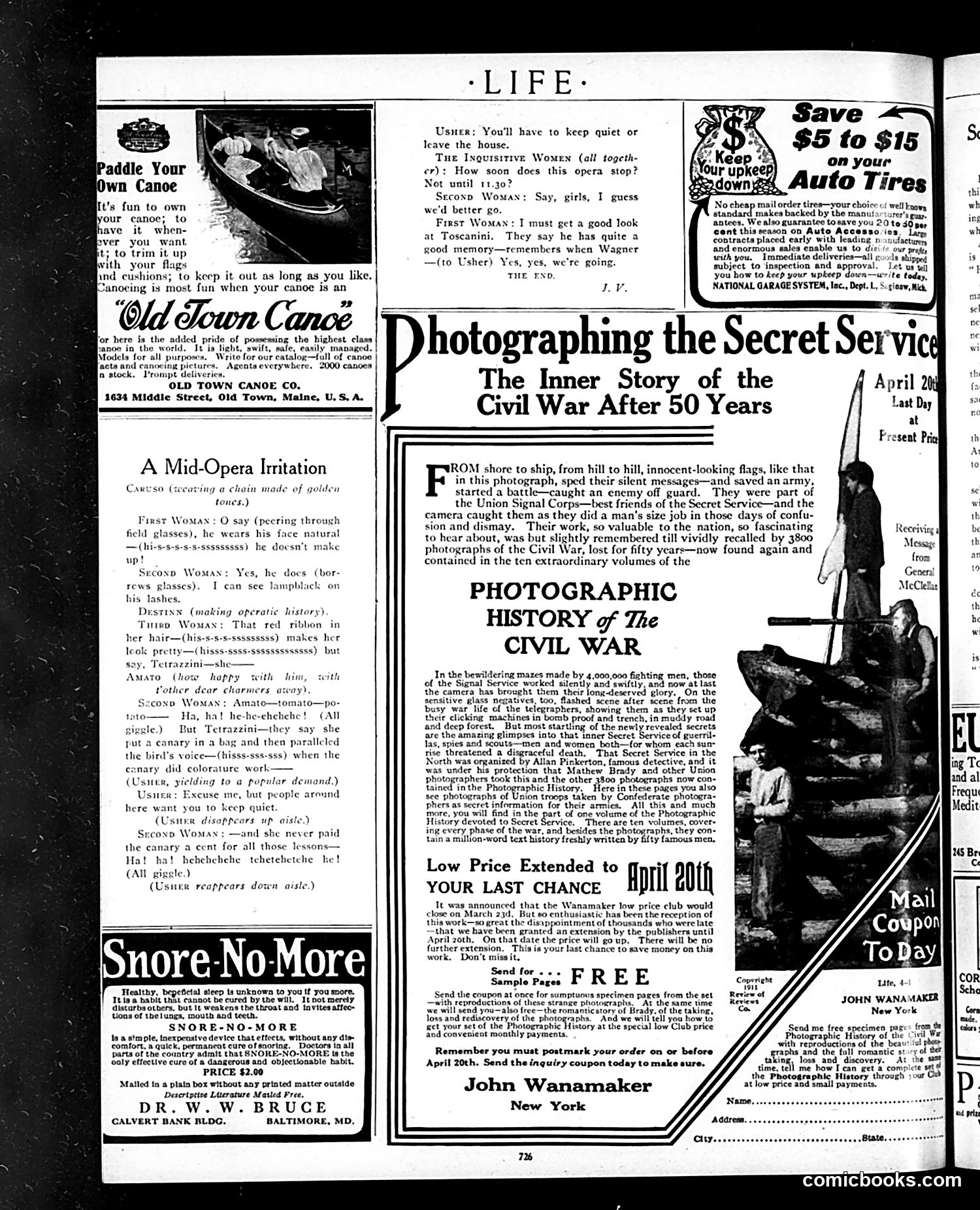
This page contains a brief comedic sketch satirizing opera-goers' behavior. Three inquisitive women attending an opera (likely Toscanini conducting) interrupt the performance with trivial gossip—asking when it ends, discussing the conductor's memory, and gossiping about Tetrazzini (a famous opera singer). One woman mentions Tetrazzini placing a canary in a bag to enhance her vocal performance, a reference to a well-known anecdote about the singer. The satire targets wealthy society women's shallow engagement with high culture—they attend prestigious performances but remain distracted and gossipy rather than respectfully attentive. The sketch mocks their pretentiousness and the absurd legends surrounding famous performers. The page also features substantial advertising (canoes, auto tires, and a mail-order Civil War photography book), typical of *Life* magazine's format.
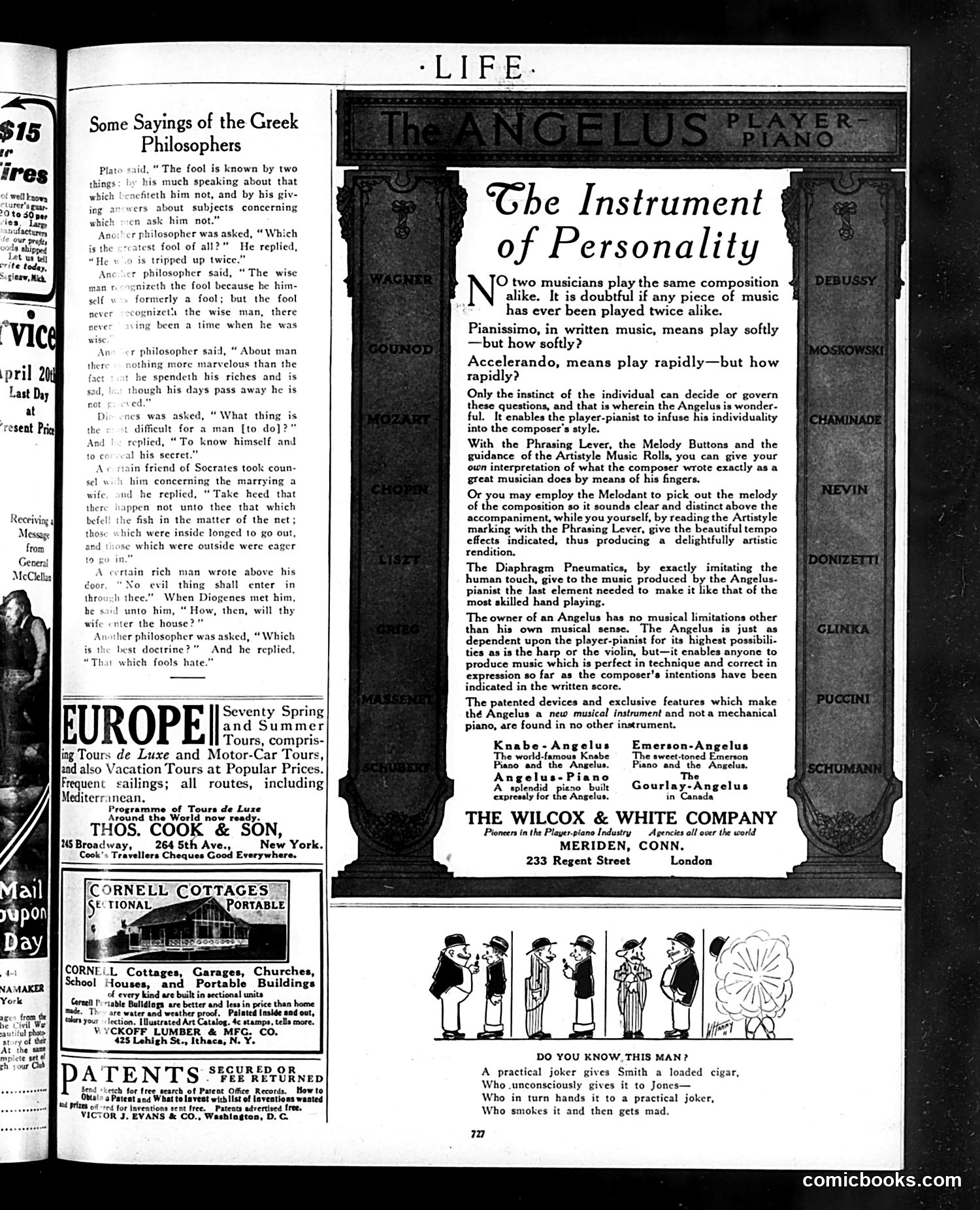
This page is primarily **advertising and product promotion**, not political satire. **Left side:** Reprints classical Greek philosophical sayings attributed to Plato, Aristotle, and Socrates—aphorisms about wisdom, foolishness, and self-knowledge. This appears to be cultural/educational filler content typical of Life magazine. **Center/Right:** Large advertisement for the **Angelus Player Piano**—a mechanical piano marketed as allowing non-musicians to perform with artistic expression and personal interpretation. The copy emphasizes that different players could infuse individuality into compositions through special features like "Phrasing Levers" and "Melody Buttons." **Bottom:** A "Do You Know This Man?" joke about a loaded cigar being passed between practical jokers. **Additional ads:** Travel tours (Thomas Cook), portable buildings (Cornell Cottages), and patent services. This is primarily a commercial publication page rather than political commentary or satire requiring historical context.
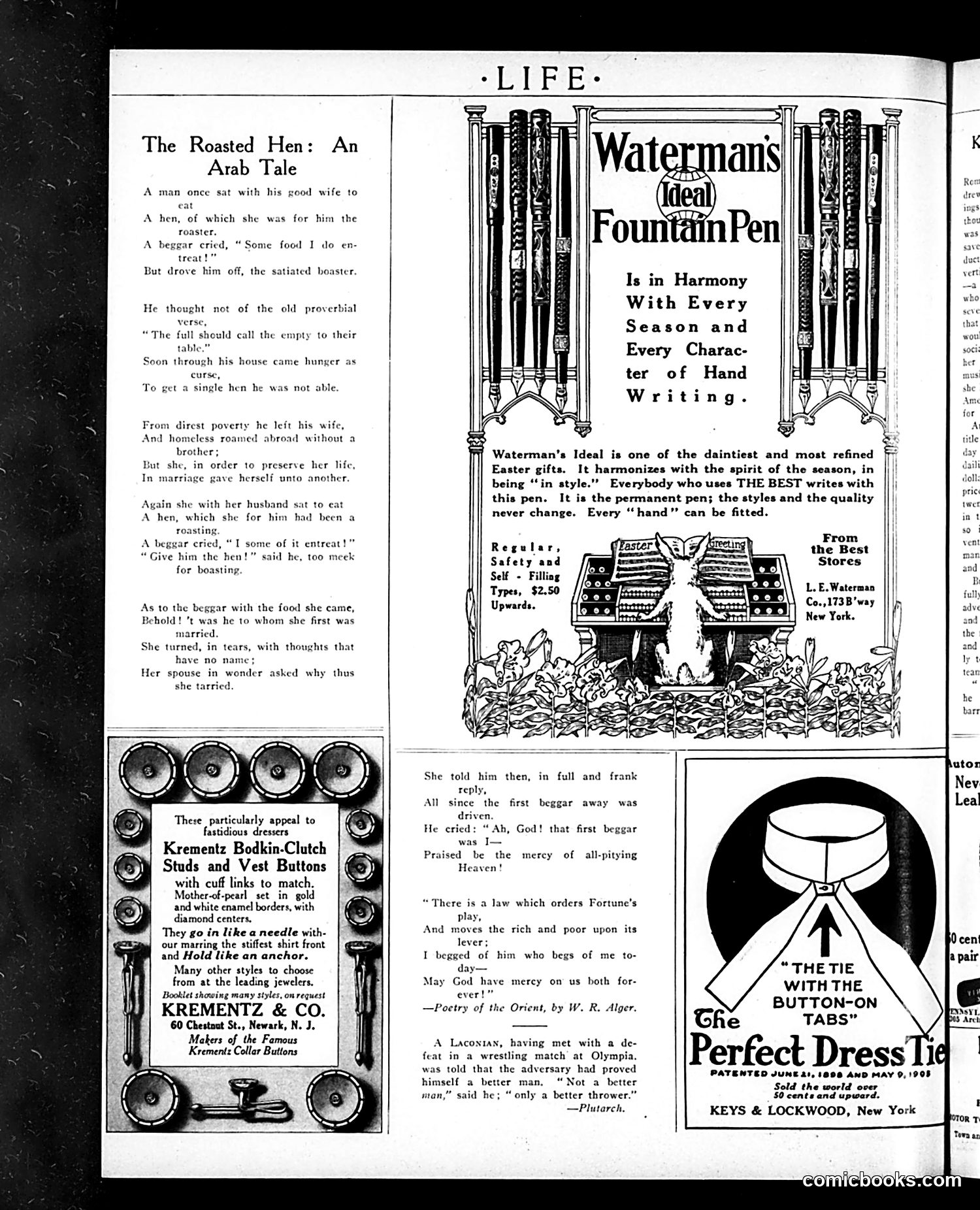
This page presents a morality poem illustrating karmic justice and the consequences of selfishness. A wealthy man refuses food to a hungry beggar; poverty later forces him to abandon his wife, who remarries. Years later, when the man himself becomes a beggar, he encounters his ex-wife—who now gives him food. He recognizes her and realizes the beggar he spurned was himself, understanding that Fortune's wheel turns for rich and poor alike. The tale exemplifies Oriental wisdom literature popular in early 20th-century American magazines, teaching that cruelty toward the poor invites future suffering. It's paired with advertisements for luxury goods (Waterman fountain pens, Krementz jewelry buttons, dress ties)—the irony unexamined by the editors—creating an inadvertent contrast between the poem's ascetic message and consumer materialism.
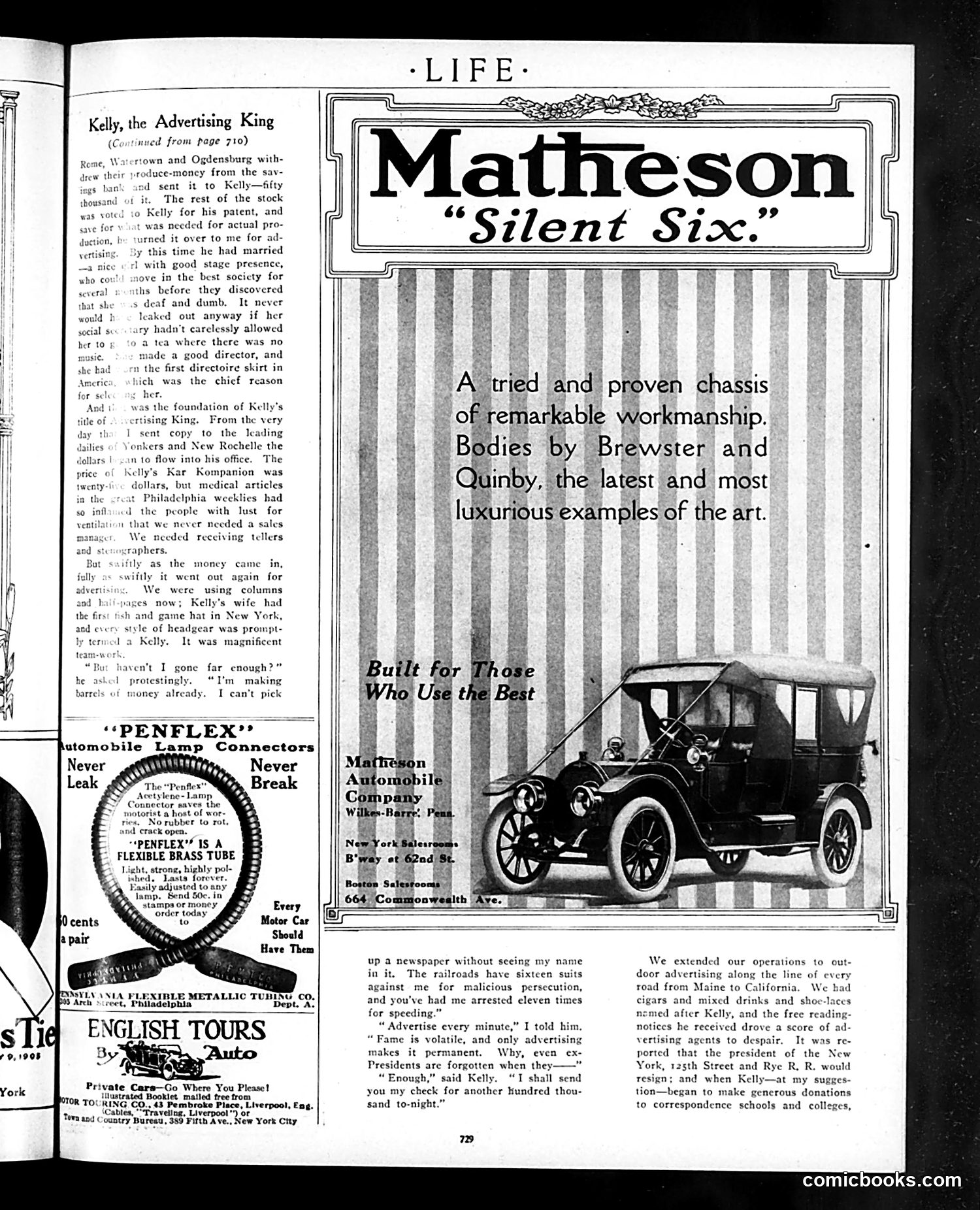
This page presents a serialized narrative (continued from page 710) about a fictional character named Kelly and his wife's rise to commercial prominence through aggressive advertising. The main text describes how Kelly—apparently an inventor or businessman—built wealth through patent sales and reinvestment, then married a woman of "good stage presence" from high society. The story satirizes early 1900s advertising excess: Kelly's name becomes ubiquitous through relentless promotion of products bearing his name (hats, cigars, shoes). The narrative mocks both Kelly's escalating ambition ("Haven't I gone far enough?") and the narrator's cynical philosophy that "fame is volatile" and requires constant advertising. The surrounding advertisements (Penflex tubing, English tours, Matheson automobiles) are period-appropriate commercial content, not satire. The satire targets the emerging advertising industry's power to manufacture celebrity and commercialize identity itself—a genuinely novel concern in the early 1900s.
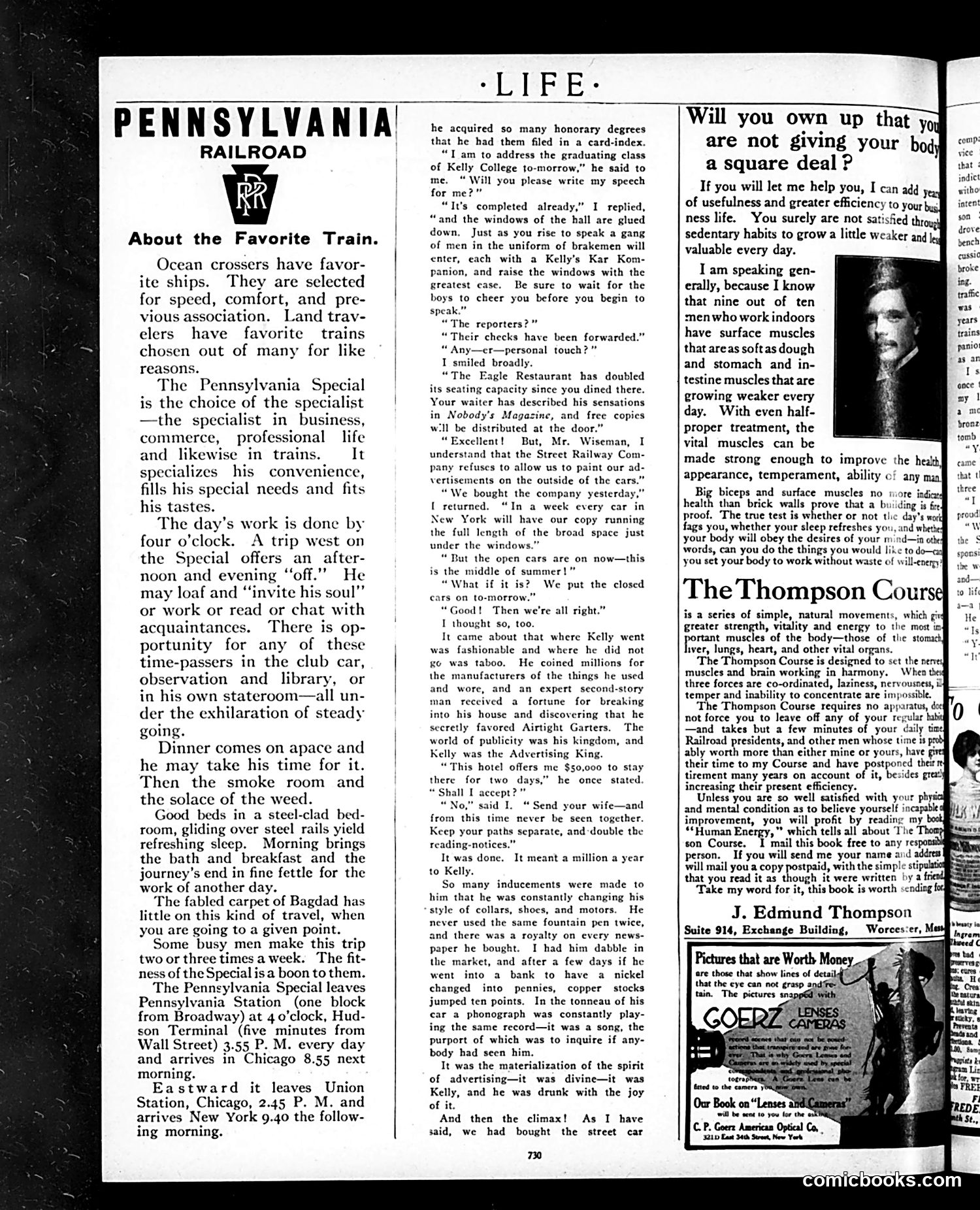
This is primarily **advertising and promotional content**, not satire. The left column promotes the Pennsylvania Railroad's "Pennsylvania Special" train service—emphasizing luxury, efficiency, and comfort for busy businessmen traveling between New York and Chicago. The right column contains a **humorous anecdote about an advertising executive named Kelly**. The story illustrates Kelly's remarkable power to make anything fashionable simply by using or endorsing it. The joke builds through escalating examples: his choice of restaurant becomes popular, his preferred garters become valuable, even his wife's hotel stay generates publicity. The punchline suggests Kelly's wife should travel *separately* from him to double the advertising value of their journey. The broader satire here is about **turn-of-the-century consumer culture and celebrity endorsement**—how a famous figure's mere association with products or places could drive commercial success. This reflects early 20th-century anxieties about manufactured taste and the emerging power of publicity and advertising to shape public behavior.
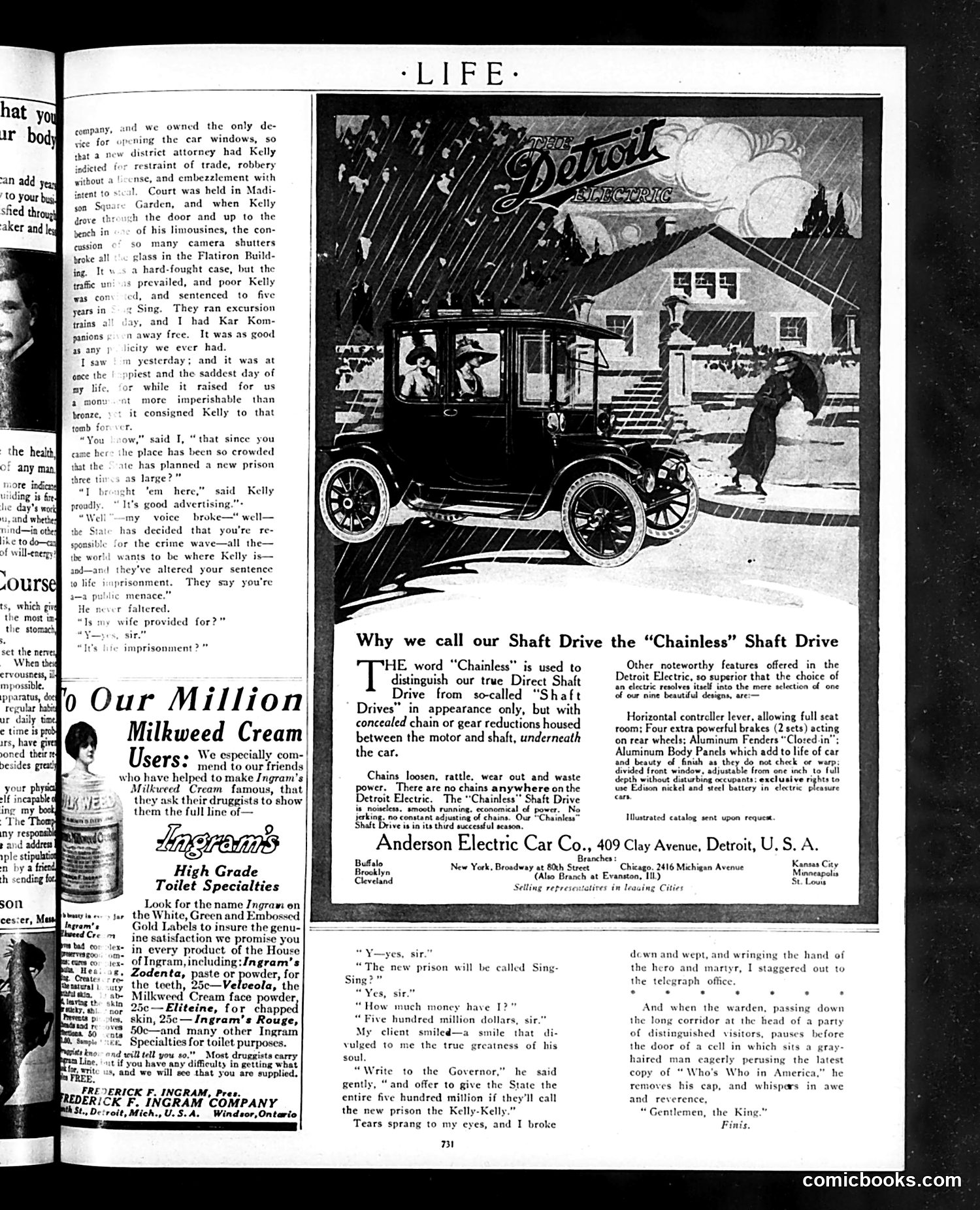
This page contains a serialized story about a character named Kelly who was convicted of crime-wave-related charges. The narrative describes Kelly's trial at Madison Square Garden, his five-year sentence to Sing Sing prison, and a conversation where a warden reveals the state plans to build a new, larger prison and has named it after Kelly—treating him as a celebrity criminal. Kelly's response—that it's "good advertising"—satirizes how sensational crime coverage and public fascination with notorious criminals can paradoxically glorify lawbreakers. The page is primarily **advertising**, featuring promotions for Ingram's Milkweed Cream toiletries, a large advertisement for the Anderson Electric Car's "Chainless" shaft drive, and other period products. The Kelly story appears to be background filler between ads, typical of Life magazine's format mixing editorial content with commercial content.
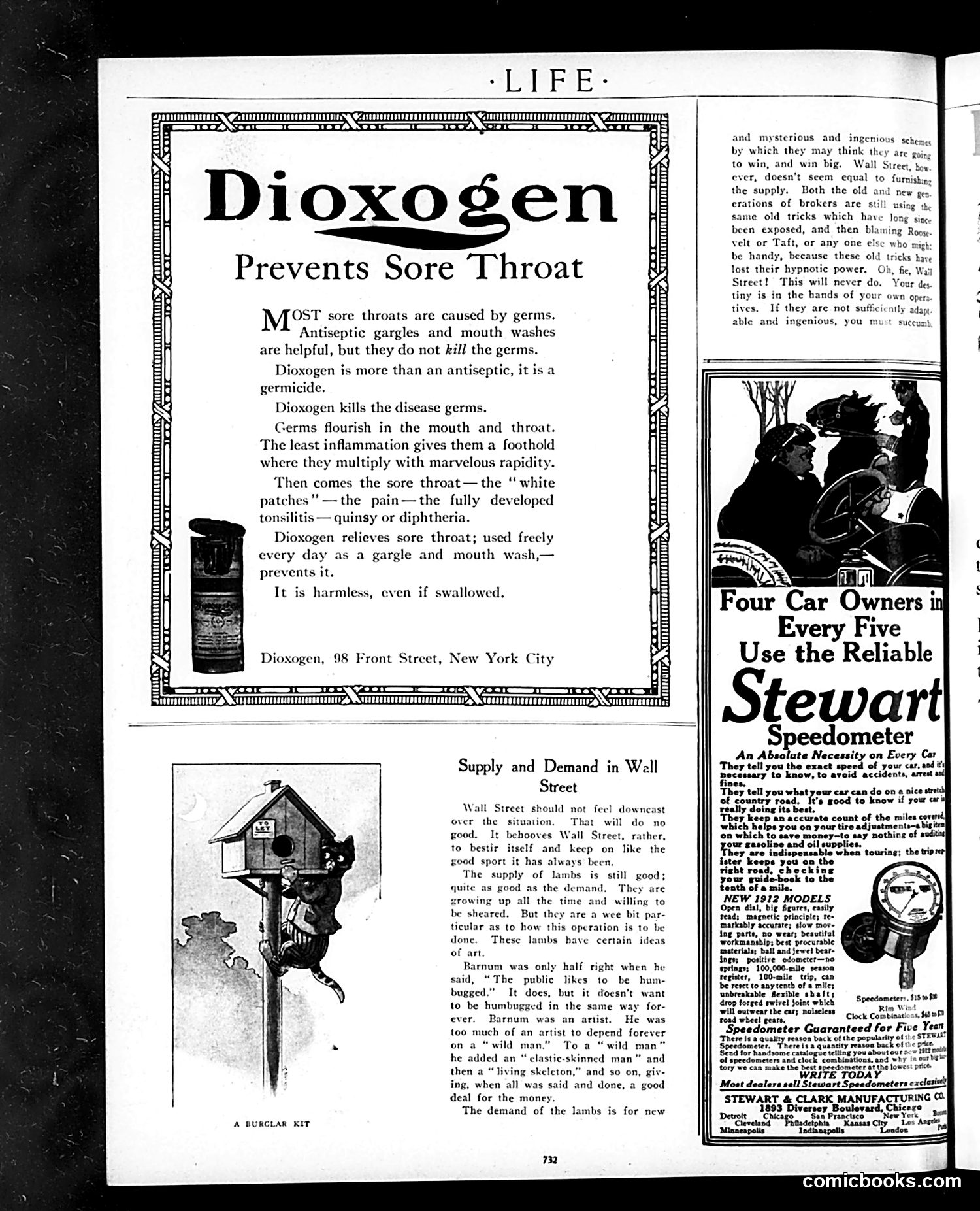
This Life magazine page contains two distinct pieces of satire: **Top Section - "Supply and Demand in Well Street":** The cartoon critiques Wall Street investors as naive "lambs" being systematically "sheared" (fleeced) by con artists. The text sarcastically compares Wall Street operators to P.T. Barnum, suggesting they use outdated manipulation tactics. The point: despite exposés of fraud schemes, investors remain gullible and willing victims. The "burglar kit" illustration (bottom left) reinforces this—depicting crime/theft as entertainment, mocking how predictable and theatrical the schemes have become. **Social Context:** This reflects early 1900s Progressive Era skepticism of Wall Street, following various financial scandals. References to "Roosevelt or Taft" (presidents) indicate contemporary frustration with inability to stop corruption despite political reform efforts. The page is otherwise dominated by period product advertisements (Dioxogen antiseptic gargle, Stewart speedometer), typical of Life magazine's format.
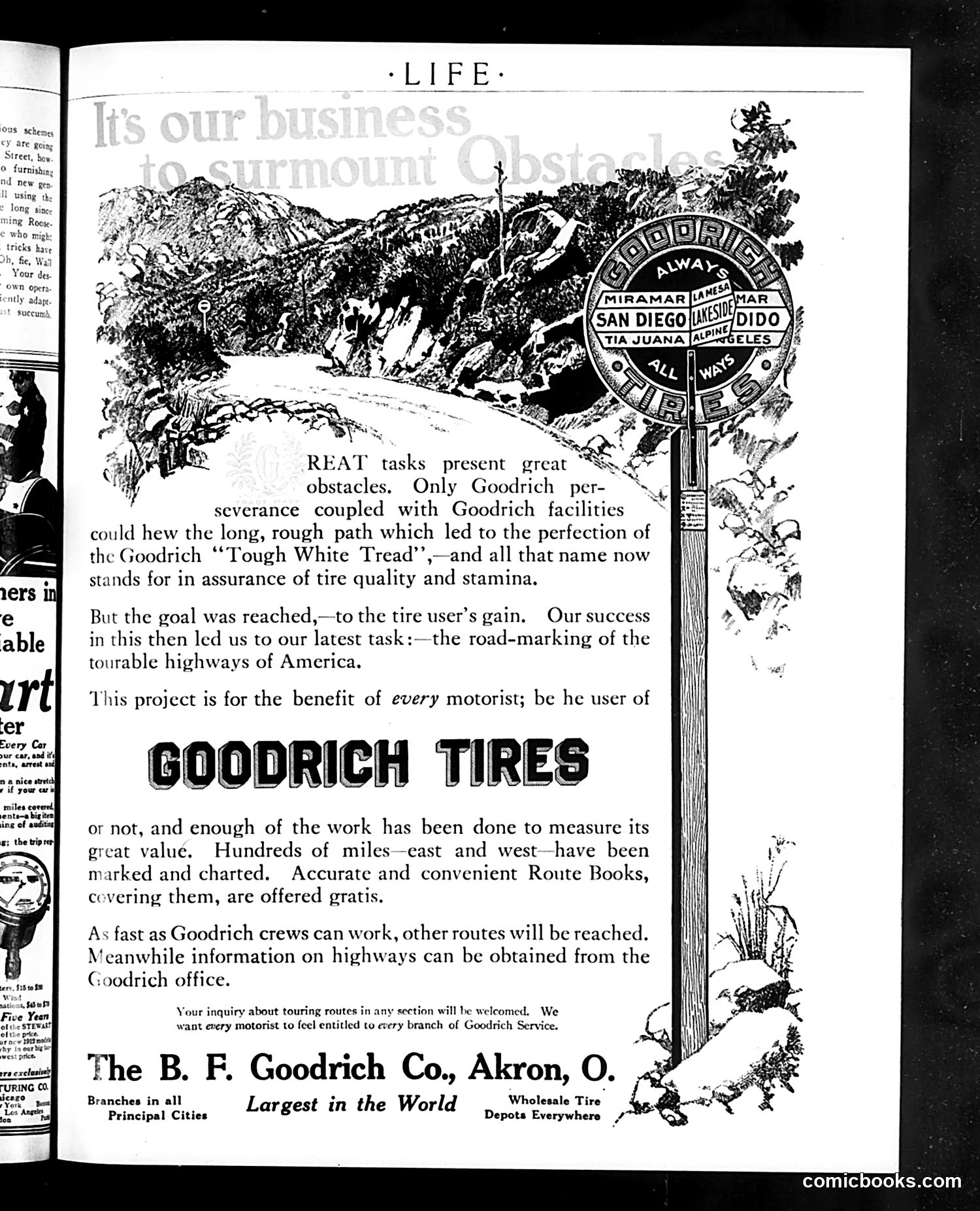
This is a **full-page advertisement** for B.F. Goodrich Tires, not a political cartoon. The ad claims Goodrich's accomplishment in developing their "Tough White Tread" tire through perseverance and superior facilities. It then pivots to a secondary claim: that Goodrich has undertaken **road-marking of American highways** as a public service benefit to all motorists, regardless of whether they buy Goodrich tires. The company offers free Route Books covering the marked highways and promises that more routes will be completed. The illustration shows a scenic mountain road with a Goodrich service sign marking routes to various destinations (San Diego, Los Angeles, etc.). **The pitch**: Goodrich presents itself as a civic-minded corporation investing in national infrastructure. This was likely an early example of corporate highway marking—before standardized federal road signs existed—positioning the tire company as a trusted guide for American motorists.
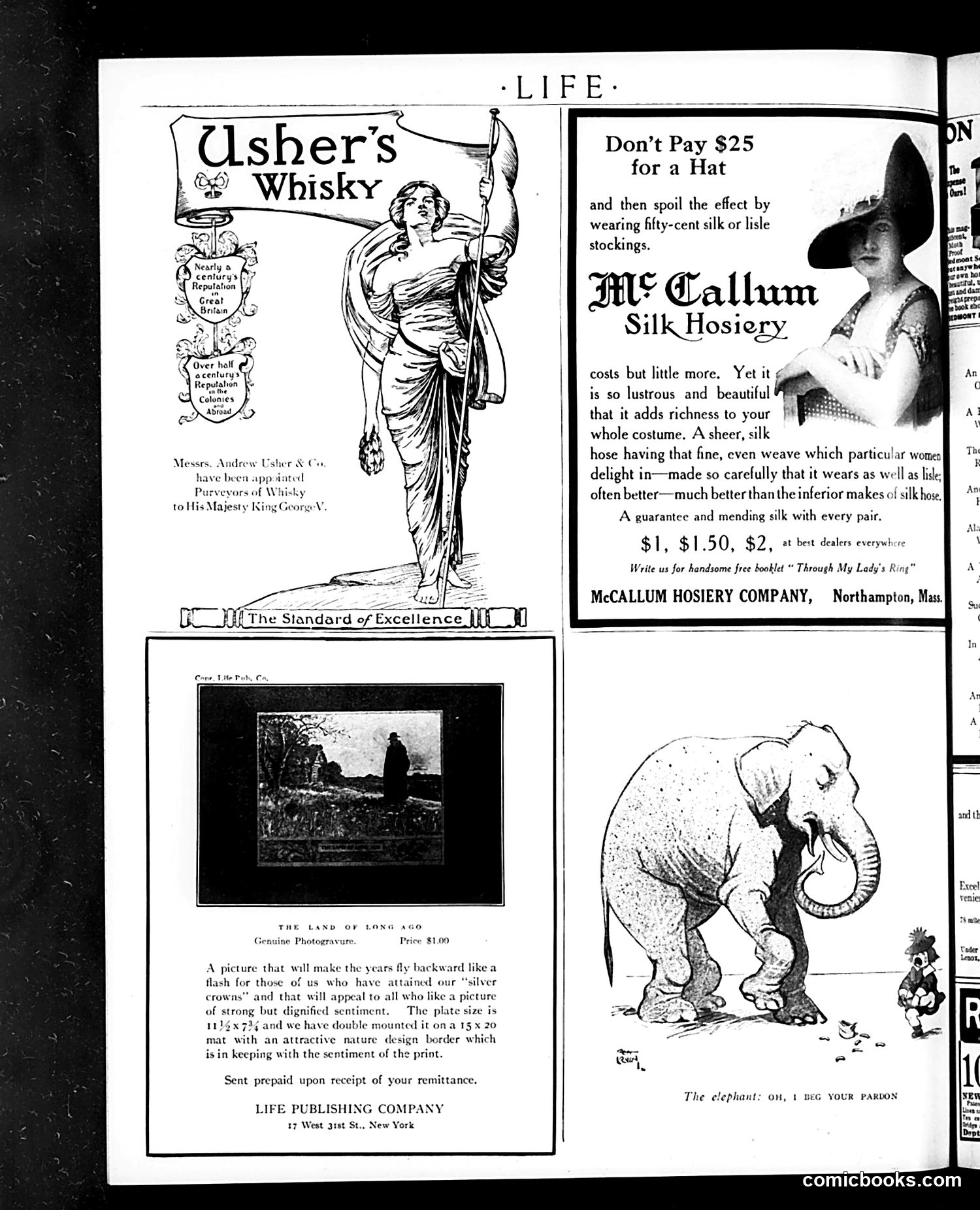
This page is primarily **advertising**, not political satire. It contains three distinct ads: 1. **Usher's Whisky** (left): A classical allegorical figure promotes whisky as "The Standard of Excellence," noting it holds a royal warrant from King George V. 2. **McCallum Silk Hosiery** (top right): A satirical consumer-advice ad warning women not to waste money on expensive hats ($25) while wearing cheap stockings. The joke is about coordinating one's entire outfit—quality matters throughout, not just in headline pieces. 3. **"The Land of Long Ago" photograph** (bottom): A nostalgic photogravure print for sale, marketed to older readers and sentimentalists. 4. **Elephant cartoon** (bottom right): A small humorous illustration with caption "The elephant: oh, I beg your pardon"—likely a gentle joke about the animal's size or clumsiness, though context is unclear without surrounding material. The page reflects early 20th-century consumer culture and advertising rhetoric rather than political commentary.
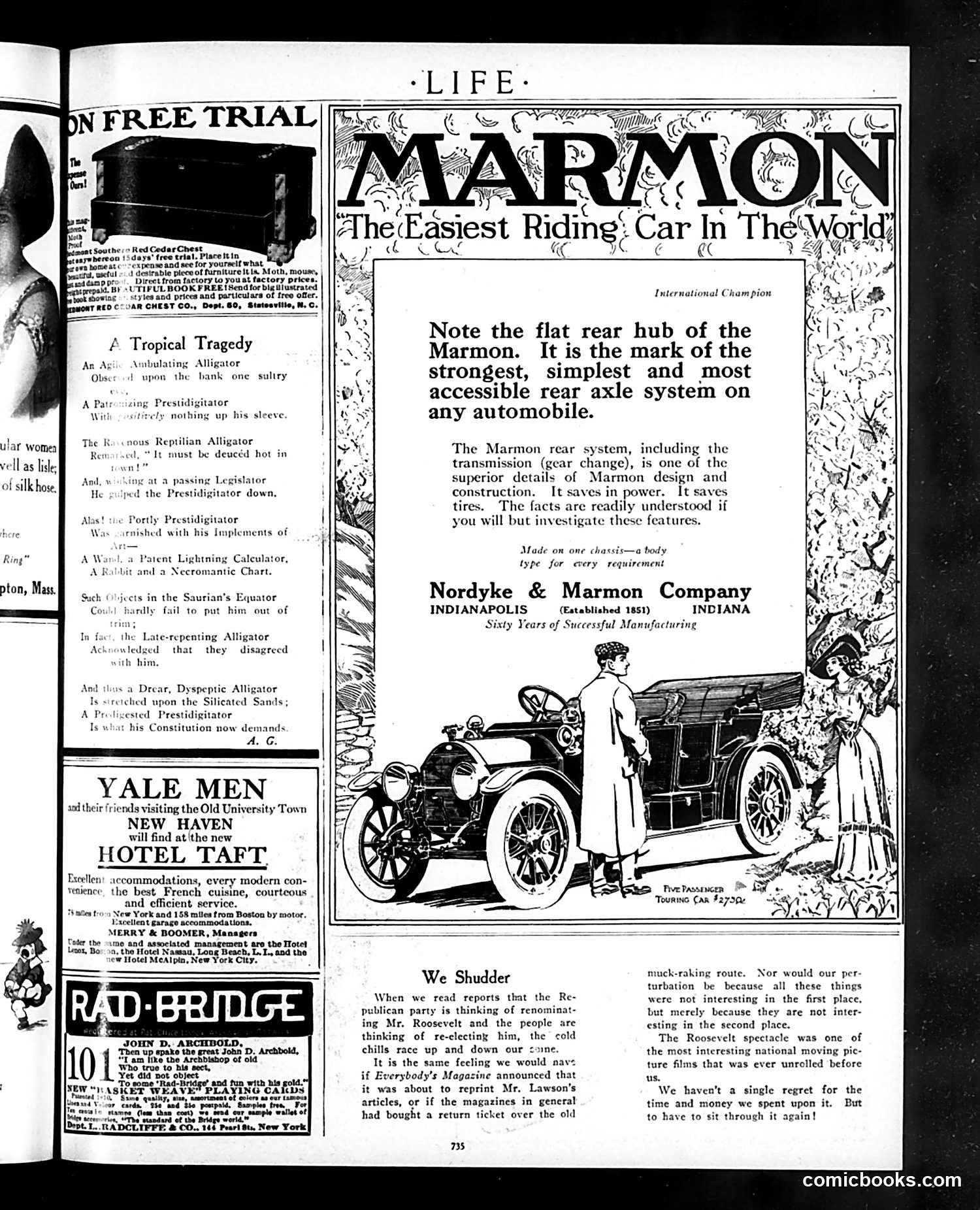
This page is primarily **advertising and editorial content** rather than political cartooning. The main feature is a Marmon automobile advertisement highlighting the car's rear axle system as "the strongest, simplest and most accessible" on any automobile. The left side contains a whimsical poem titled "A Tropical Tragedy" about various anthropomorphized alligators and a "Prestidigitator" (magician)—lighthearted, nonsensical verse typical of Life's humorous filler content. The brief editorial piece "We Shudder" expresses anxiety about the possibility of Theodore Roosevelt's renomination and re-election, comparing the prospect to having to re-watch an already-seen spectacle. The author regrets having invested time following Roosevelt's presidency but dreads experiencing it again. This reflects early 1910s political anxieties surrounding Roosevelt's political future. The page also includes hotel and other product advertisements typical of the era.
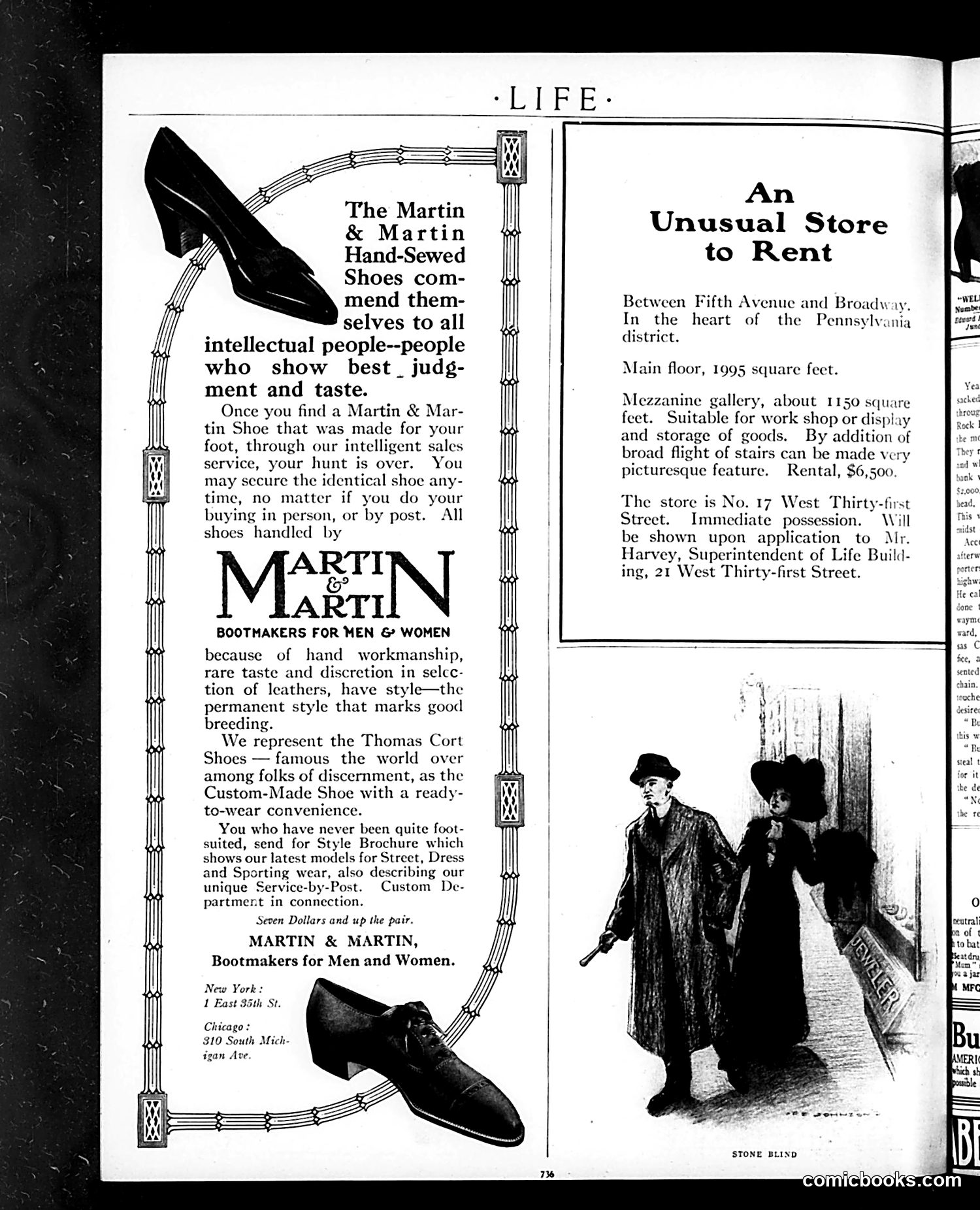
This page contains two unrelated advertisements typical of Life magazine's content. On the left is a Martin & Martin bootmakers ad targeting affluent, educated consumers, emphasizing hand-sewn craftsmanship and "good breeding"—reflecting early 20th-century class consciousness about luxury footwear as a marker of taste and social status. On the right is a commercial real estate listing for retail space in Manhattan's Pennsylvania district (near Penn Station), offering 1,995 square feet suitable for a workshop or shop display. The illustration labeled "Stone Blind" appears to show two figures on a street, likely depicting a social scene, though without additional context its satirical meaning remains unclear. There is no evident political commentary on this particular page—it functions primarily as a magazine revenue vehicle through advertisements and classifieds.
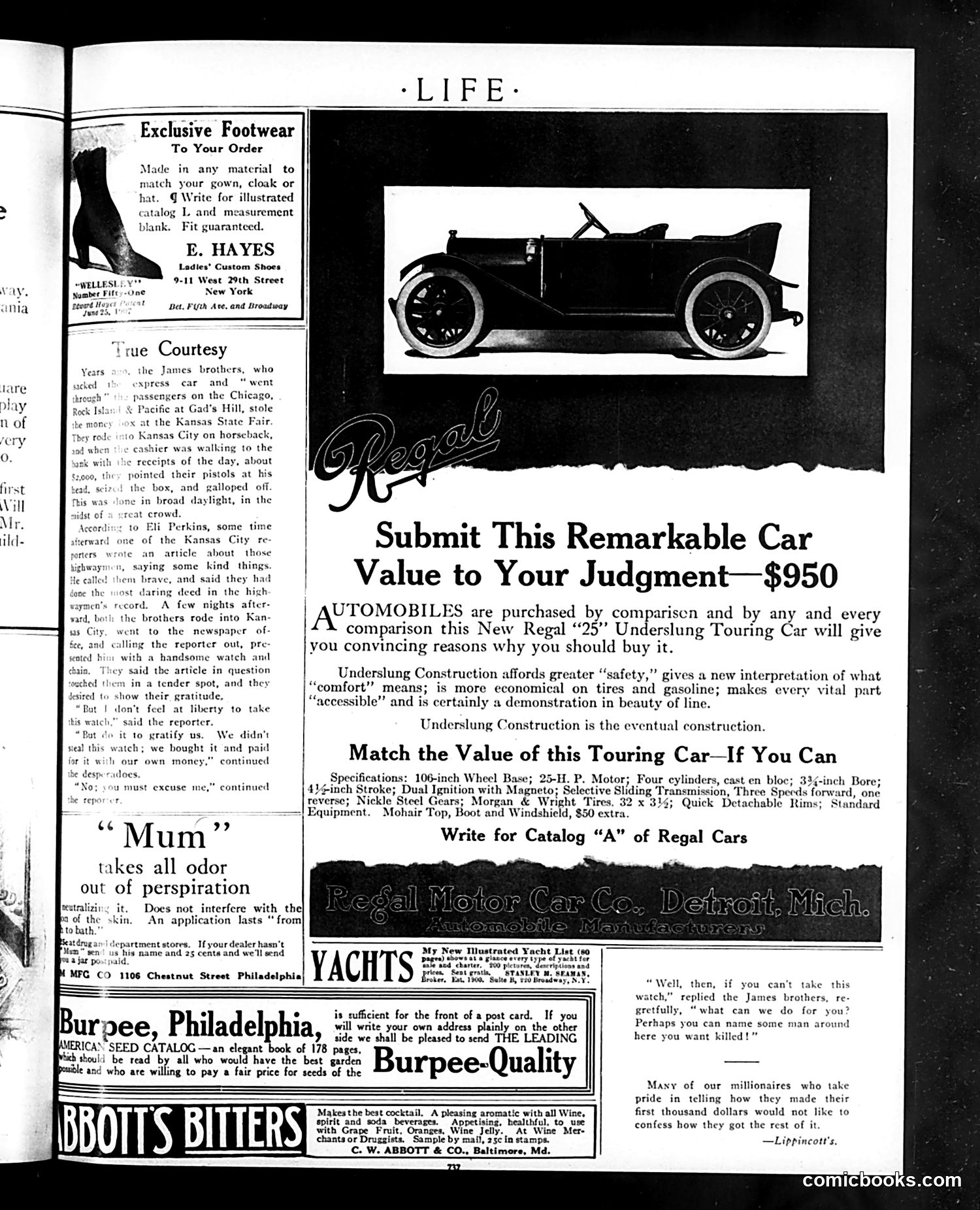
This page is primarily **advertising**, not political satire. The dominant content is a full-page automobile advertisement for the Regal "25" Touring Car priced at $950. The one narrative section titled **"True Courtesy"** recounts a historical anecdote about the James brothers (apparent outlaws from Kansas City). After robbing a passenger, they later reward a newspaper reporter for writing a favorable article about their robbery with a stolen watch. When the reporter declines, they humorously offer to kill someone for him instead—suggesting that for criminals, violence is their natural "currency" of gratitude. The joke satirizes how desperadoes demonstrate "courtesy": they operate within their own brutal moral code, viewing murder as a casual favor equivalent to a gift. The page also contains smaller advertisements for custom shoes, a deodorant called "Mum," seed catalogs, and bitters—typical of the magazine's mixed advertising-and-editorial format from the early 20th century.
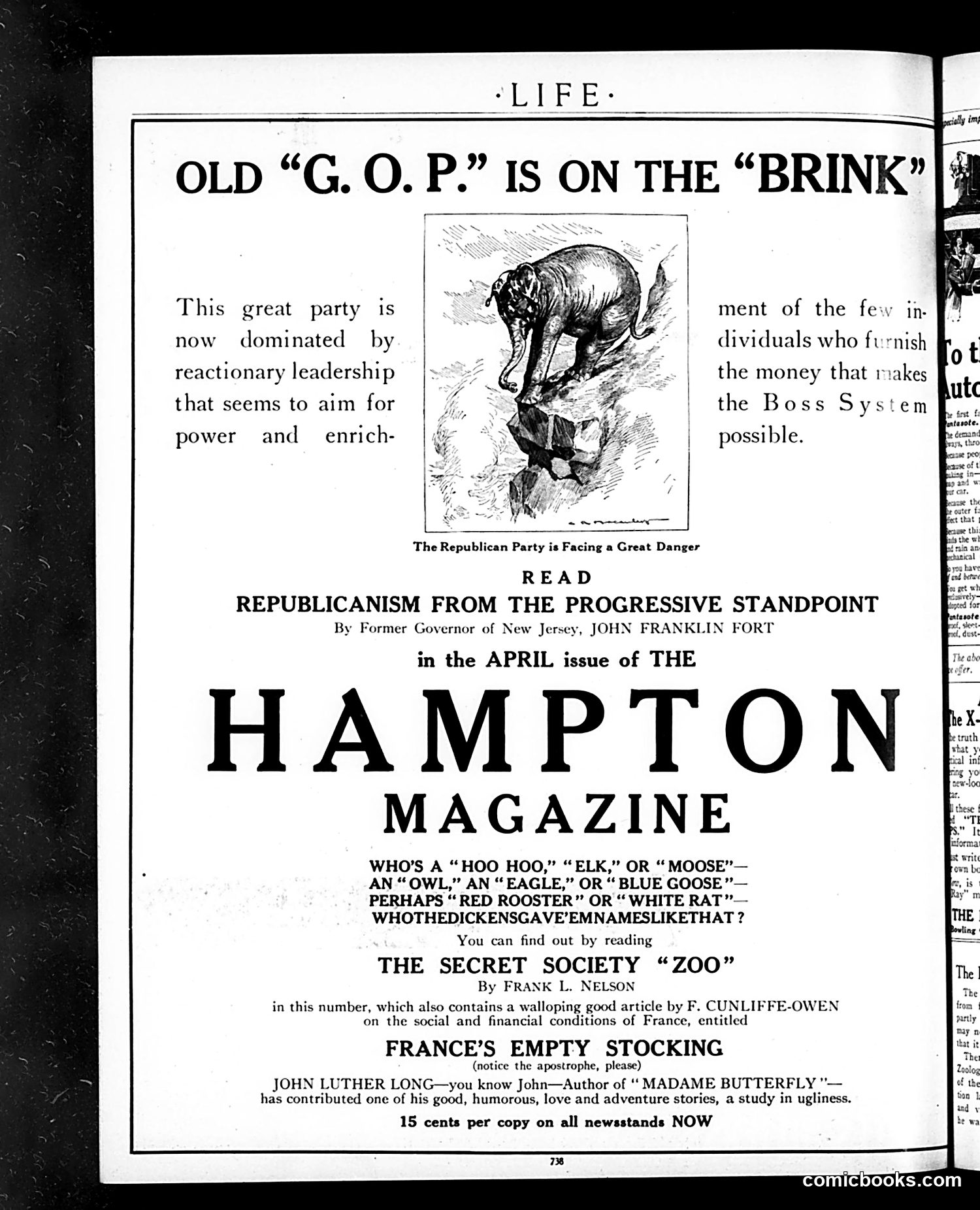
This is primarily an **advertisement for Hampton Magazine's April issue**, not a standalone political cartoon, though it uses satirical imagery to make a political argument. The central image shows an **elephant teetering on a cliff edge**—the Republican Party's symbol in precarious danger. The accompanying text charges that the GOP is "dominated by reactionary leadership" seeking "power and enrichment," controlled by wealthy individuals who perpetuate the "Boss System." The page promotes an article by **John Franklin Fort** (former New Jersey governor), offering a "Progressive" critique of the Republican Party from within. This reflects the **Progressive/Bull Moose split** of the early 1910s, when reformers challenged traditional Republican leadership. Below are advertisements for other Hampton Magazine articles, including one humorously titled "The Secret Society 'Zoo'"—using animal nicknames to satirize fraternal organizations. The satire targets **Republican establishment corruption** through the vulnerable elephant image, appealing to Progressive-minded readers disgusted with party machine politics.
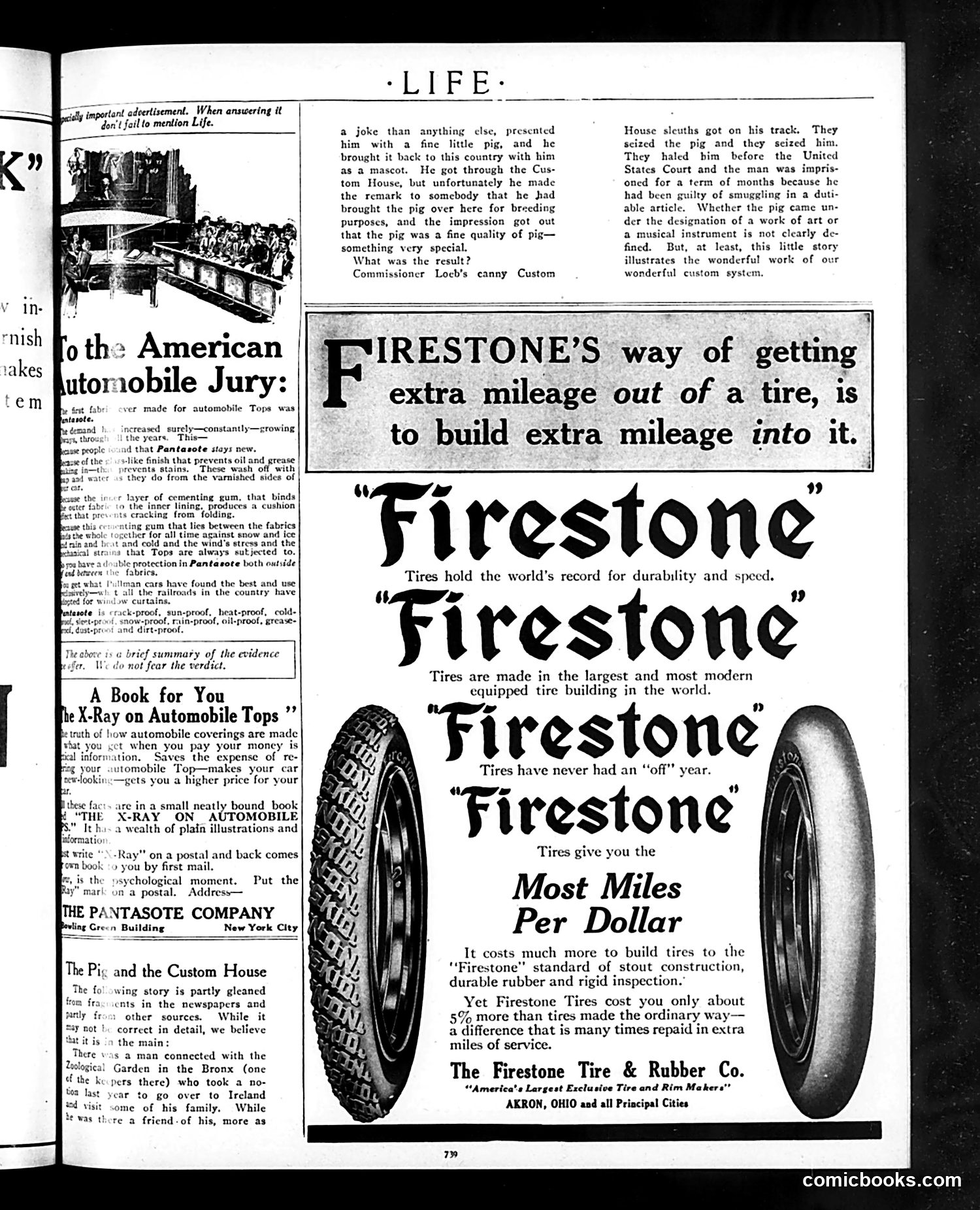
This page contains a satirical article about U.S. Customs enforcement alongside a Firestone tire advertisement. **The Satire ("The Pig and the Custom House"):** The article mocks bureaucratic absurdity. A man brought a pig into the country as a mascot. When he casually mentioned it was for breeding purposes, Customs Commissioner Loch seized both the pig and the man, prosecuting him for smuggling a "dutiable article." The satire lies in the ambiguity: was the pig art, a musical instrument, or livestock? The piece ridicules how rigid, literal-minded enforcement of customs law produces ridiculous outcomes—the man faced imprisonment over a pet pig, illustrating the "wonderful work of our wonderful custom system" (clearly sarcastic). **Context:** This reflects early 20th-century American frustration with overzealous government bureaucracy and Prohibition-era Customs enforcement, which often seemed arbitrary and comic in its strictness. The rest of the page is a Firestone tire advertisement claiming durability and value.
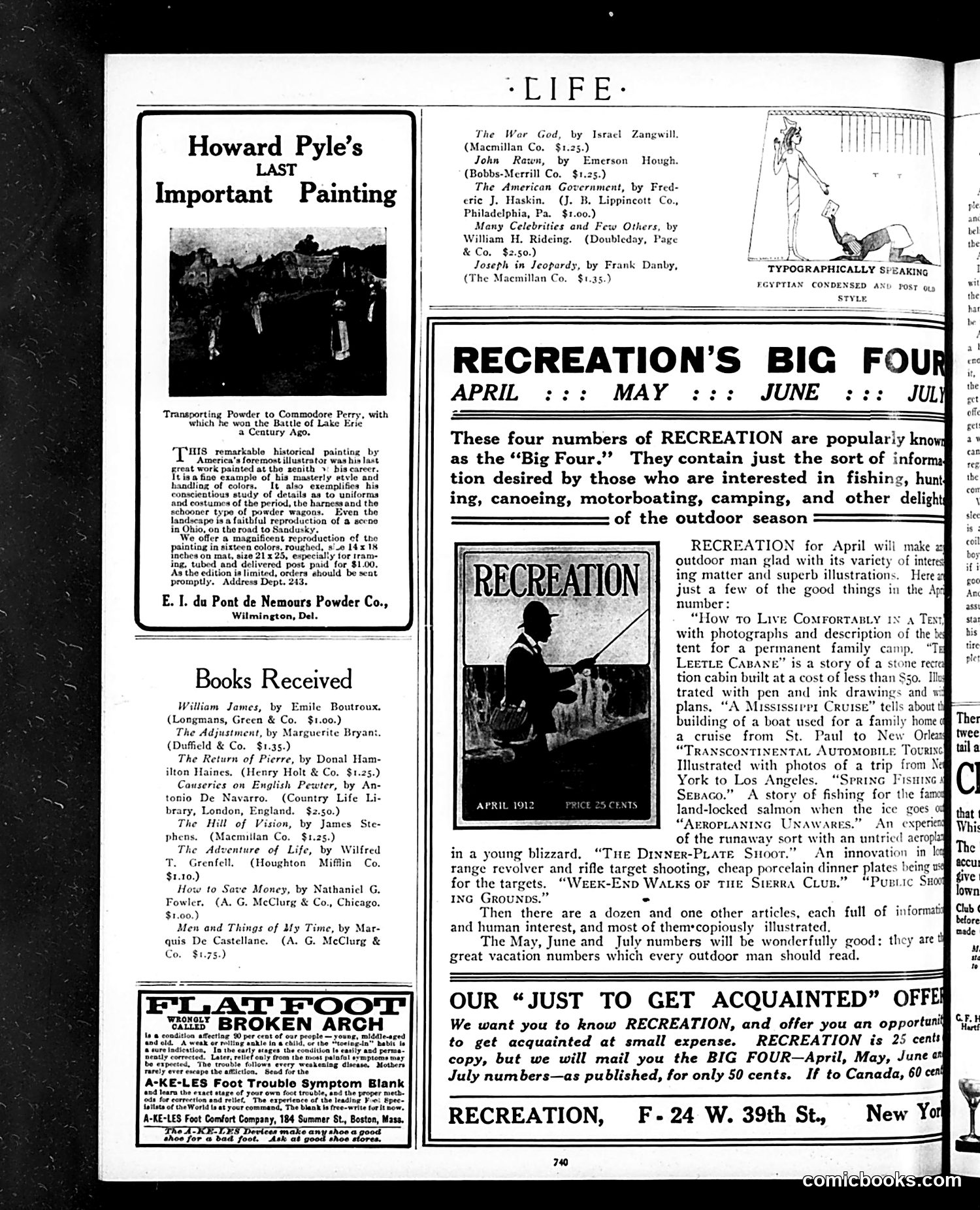
This page is primarily **advertisements and book reviews**, not political satire. The main content includes: 1. **Howard Pyle painting advertisement**: Promotes a reproduction of illustrator Howard Pyle's final historical painting depicting the War of 1812—specifically powder transport to Commodore Perry before the Battle of Lake Erie. Du Pont de Nemours is selling color reproductions. 2. **Books Received section**: Lists recently published books with titles and publishers—standard literary notices. 3. **Recreation Magazine advertisement**: The dominant feature promotes "Recreation's Big Four"—April-July issues targeting outdoor enthusiasts interested in fishing, hunting, camping, and motorboating. Articles mentioned include tent camping, boat building, automobile touring, and target shooting. 4. **Miscellaneous ads**: Including foot care products and other services. This appears to be a standard early-1900s magazine page mixing editorial content with advertising—there is **no political cartoon or satire present**.
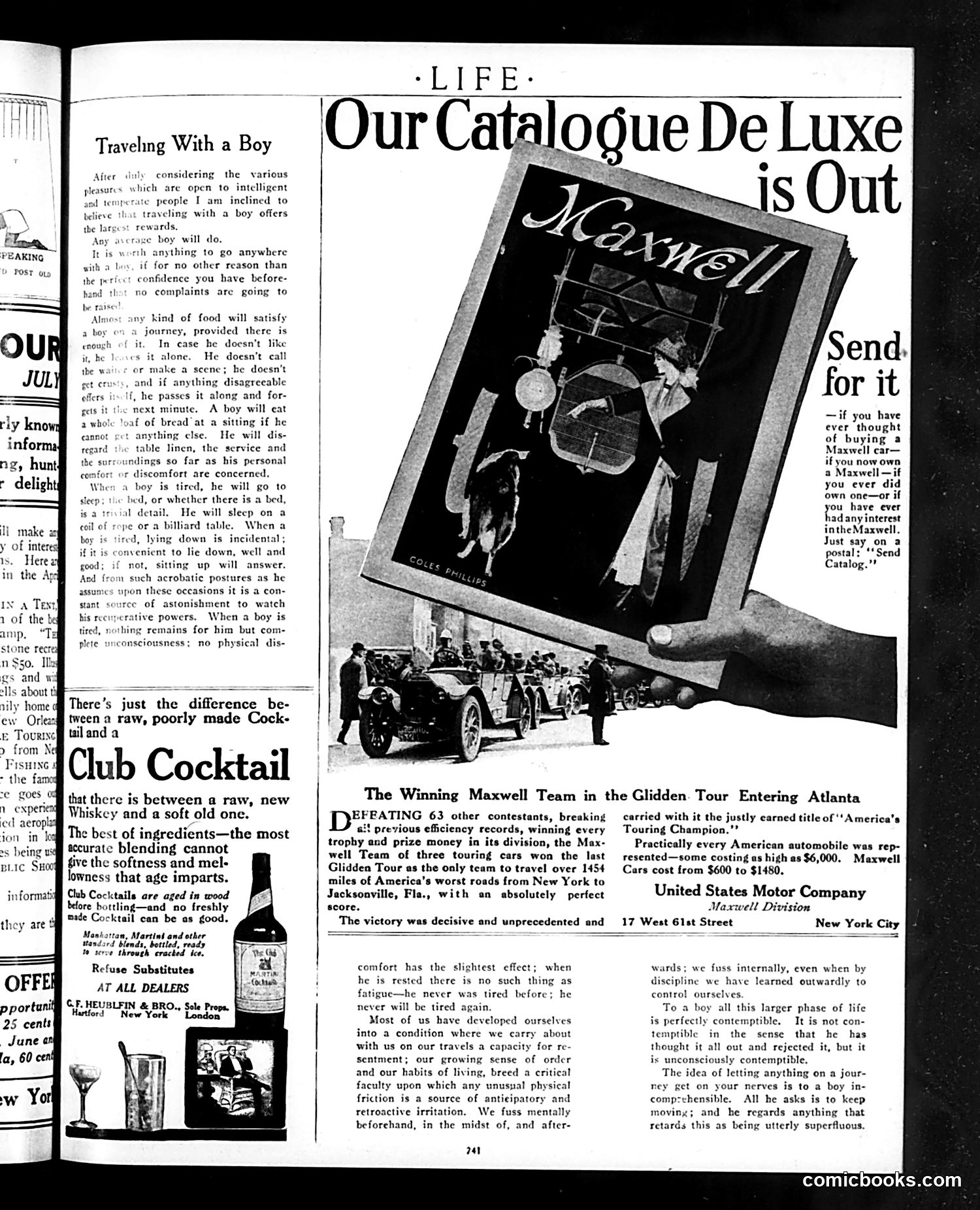
This page contains three distinct pieces: **"Traveling With a Boy"** (left column): An essay praising boys as ideal travel companions. The author argues boys are uncomplaining, adaptable, eat anything, sleep anywhere, and don't fuss over discomfort—contrasting them with adults who develop irritability and resentment during travel. It's a nostalgic commentary on childhood resilience versus adult neuroses. **Maxwell automobile advertisement** (right, dominant): Shows the "Winning Maxwell Team" in the Glidden Tour, a prestigious 1454-mile automobile reliability race from New York to Jacksonville, Florida. Maxwell won against 63 competitors with a "perfect score." The ad emphasizes affordability ($600-$1480) versus competitors costing up to $6,000, positioning Maxwell as the practical choice for everyday Americans. **Club Cocktail advertisement** (lower left): Markets aged cocktails, comparing them to aged whiskey—implying quality through time and proper preparation. The page reflects 1920s American values: admiration for youthful simplicity, automobile competition as proof of quality, and consumer product marketing.
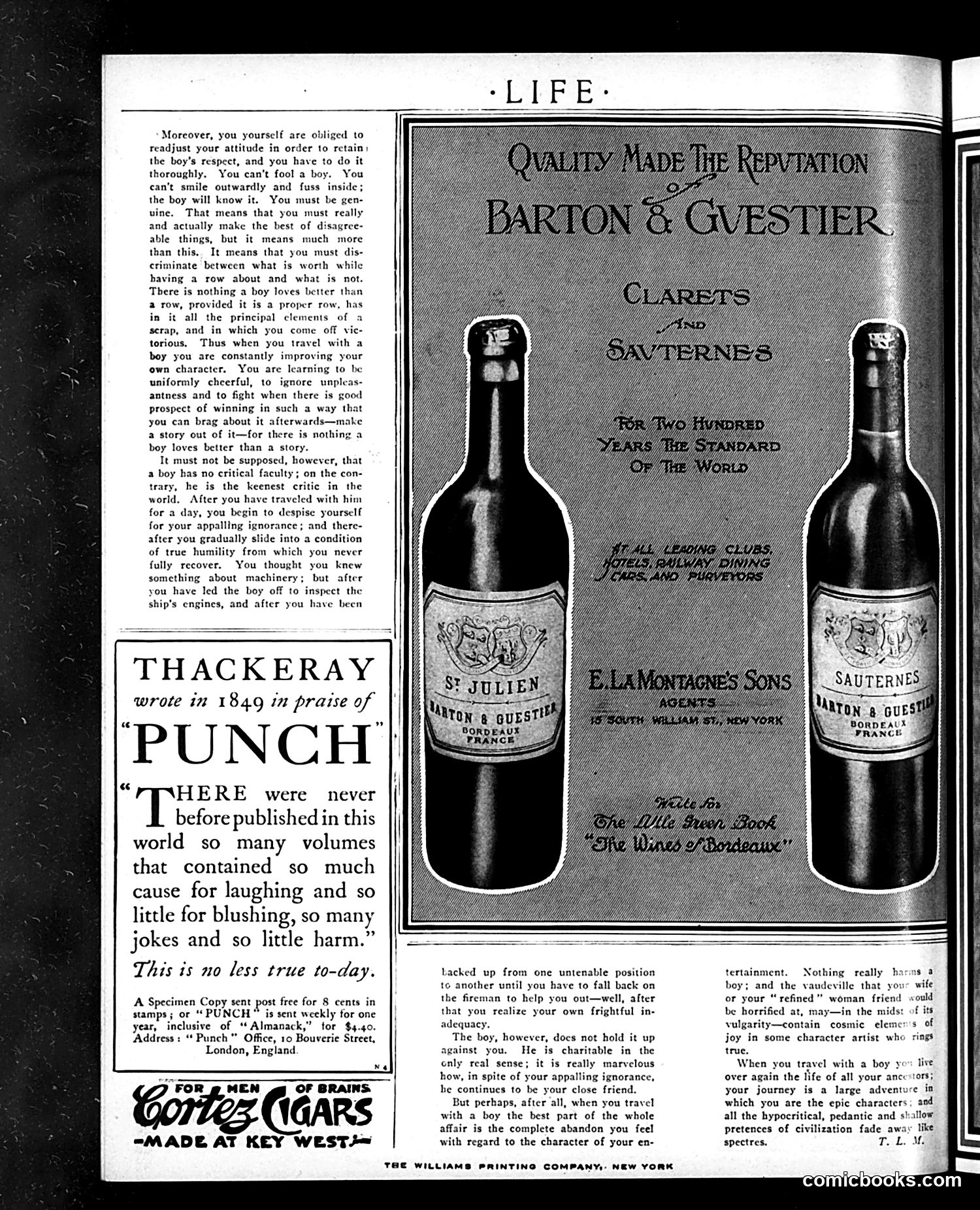
This page is primarily **advertising and editorial promotion**, not political satire. The main content is a **wine advertisement** for Barton & Guestier Clarets and Sauternes, positioned as "the standard of the world for two hundred years," with agents listed in New York. The left column contains **advice literature** about traveling with boys—emphasizing character-building, authenticity, and learning humility from a child's keen observations. This reflects early 20th-century attitudes about masculine self-improvement and pedagogy. Below is a **promotion for *Punch* magazine**, quoting Thackeray's 1849 praise of the publication as containing "so much cause for laughing and so little for blushing." At bottom is an advertisement for **Cortez Cigars** (made in Key West). The page contains **no political cartoons or satire**—it's a commercial publication page mixing lifestyle advice with advertisements, typical of *Life*'s format as a general-interest illustrated magazine.
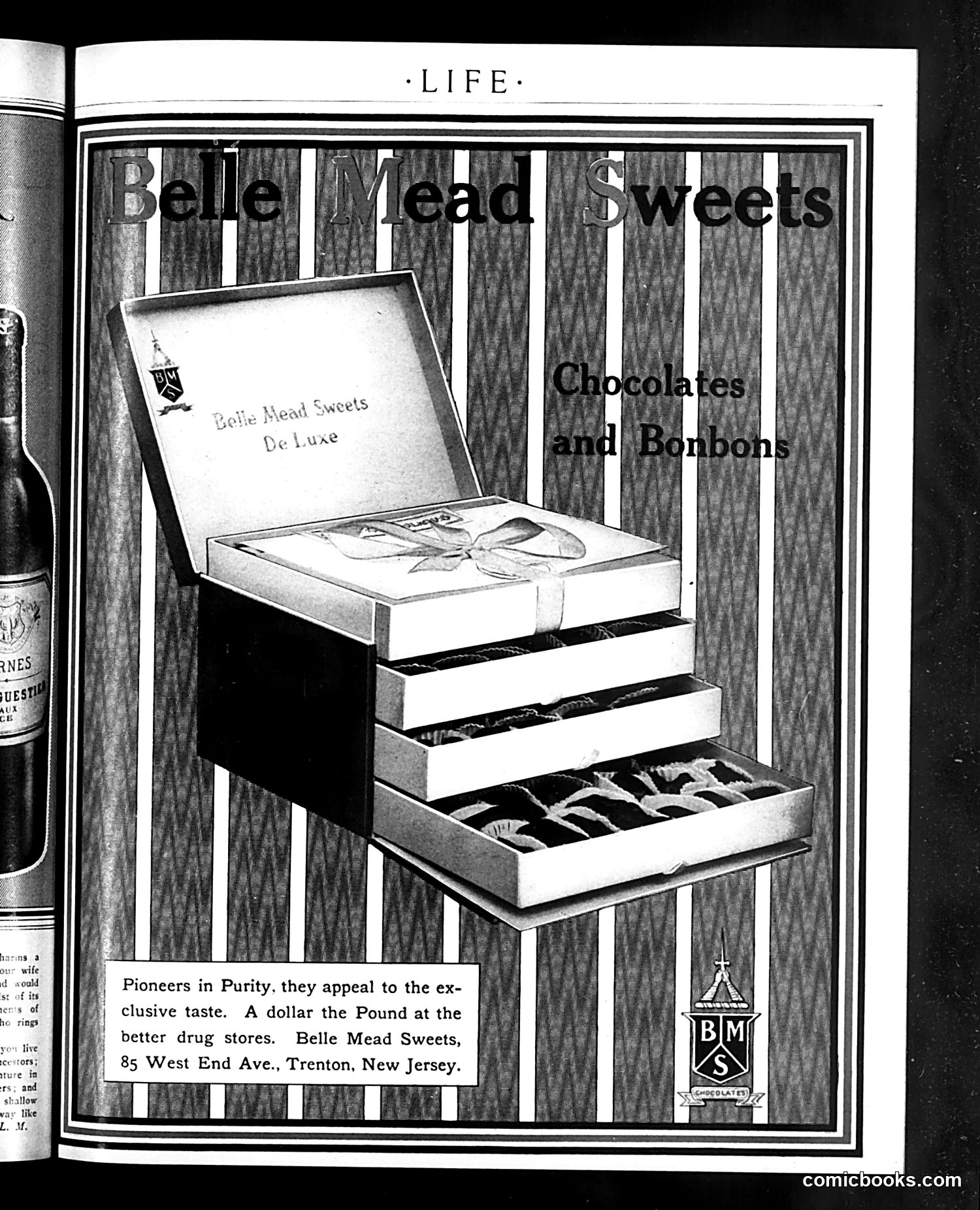
This is a **product advertisement**, not political satire. It promotes Belle Mead Sweets, a candy company from Trenton, New Jersey, selling "Chocolates and Bonbons." The ad emphasizes luxury positioning: the product is displayed in an elegant multi-drawer box with a ribbon, positioned against a striped wallpaper background. The marketing copy claims they are "Pioneers in Purity" appealing to "the exclusive taste," priced at "a dollar the pound" at drugstores. For a modern reader: this reflects early-20th-century marketing that positioned candy as a refined, upscale gift item (note the premium packaging). The emphasis on "purity" likely referenced contemporary anxieties about food safety and manufacturing standards. The placement in "better drug stores" suggests confectionery was sold through pharmacy channels, not dedicated candy shops.
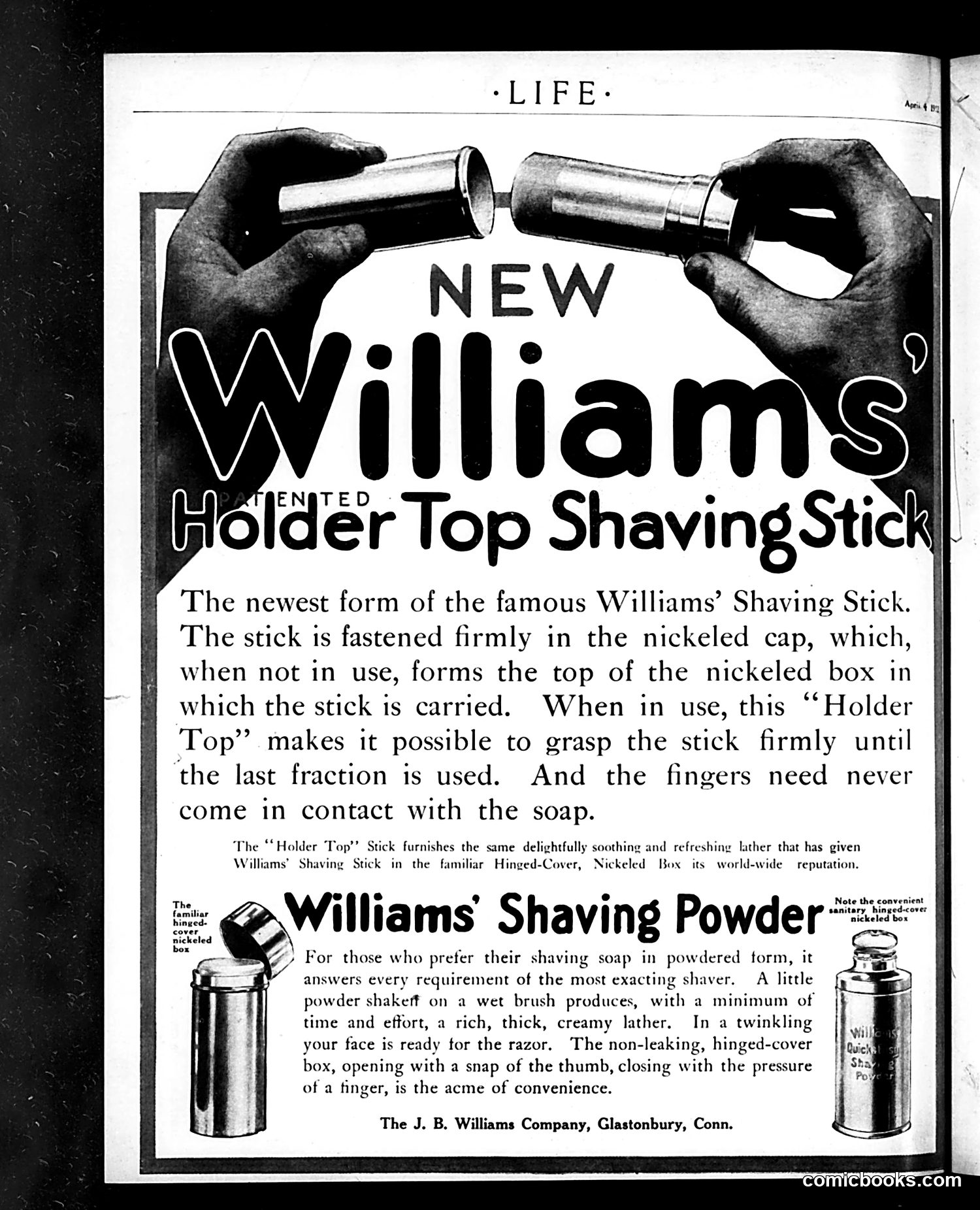
This is **not a cartoon or satire**—it's a straightforward advertisement for Williams' Shaving products. The page features two product promotions for The J.B. Williams Company (based in Glastonbury, Connecticut). The top half advertises the "Holder Top Shaving Stick," showing two hands demonstrating how the nickeled cap allows users to grip the soap stick firmly until completely used, preventing fingers from touching the soap directly. The innovation emphasized is hygiene and convenience. The bottom half promotes Williams' Shaving Powder, marketed as an alternative for those preferring powdered soap. It highlights the non-leaking hinged-cover box design and emphasizes the quick, easy lather production. For modern readers: this reflects early 20th-century concerns with hygiene and product convenience, featuring practical innovations (the grip mechanism, the snap-closure box) as selling points rather than luxury or status.