
Life, 1912-04-04 · page 44 of 80
Life — April 4, 1912 — page 44: what you’re looking at
What you’re looking at
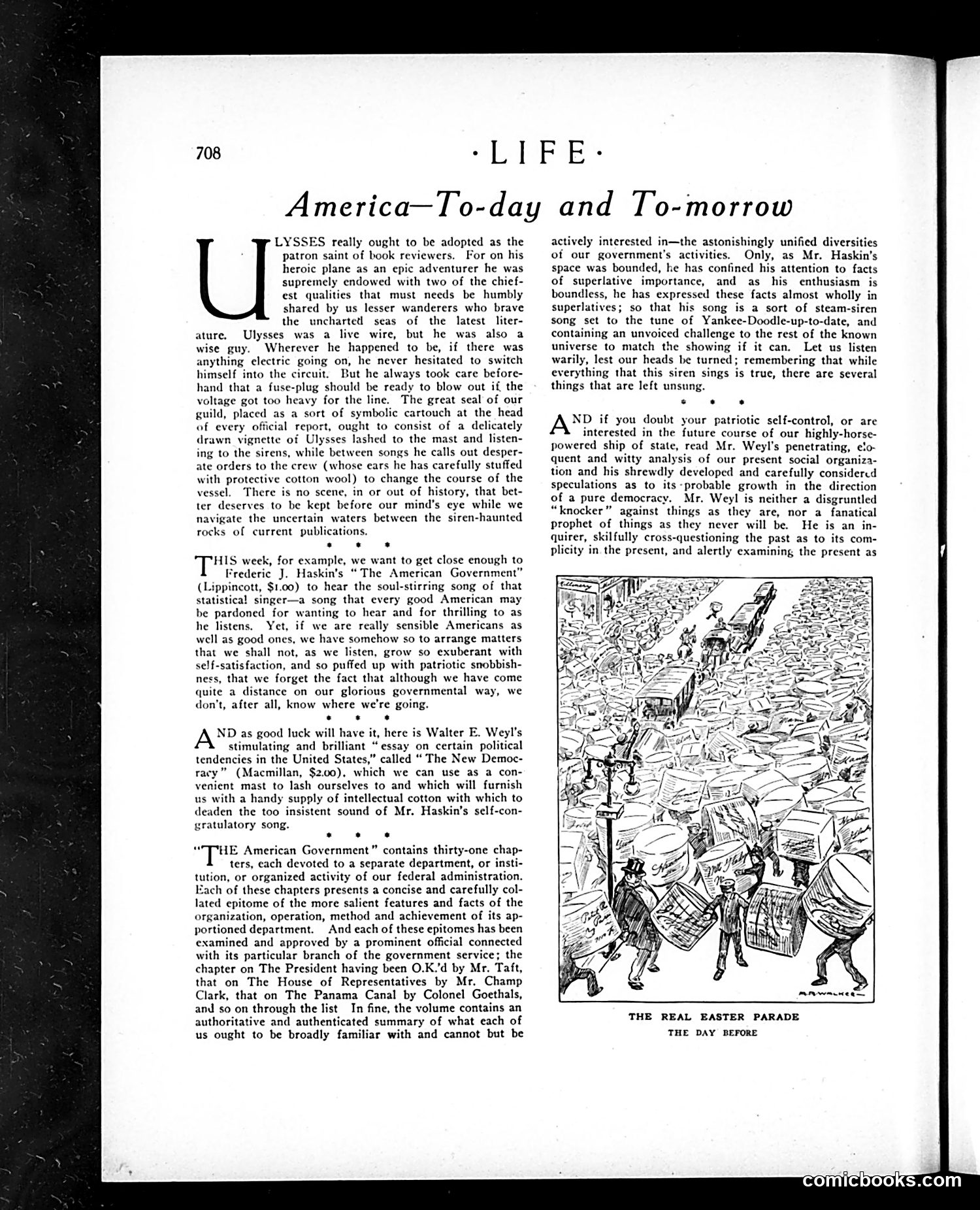
This page reviews two books about American government and politics. The accompanying cartoon, titled "The Real Easter Parade the Day Before," depicts what appears to be a chaotic street scene with numerous figures and animals in disarray. The text uses the metaphor of Ulysses tied to the mast to frame how readers should approach patriotic literature: with both engagement and critical distance. It recommends Frederic Haskin's "The American Government" as an informative guide to federal administration (endorsed by President Taft and other officials), while suggesting Walter Weyl's "The New Democracy" serves as intellectual "cotton wool"—protective skepticism against Haskin's over-enthusiastic patriotic tone. The satire suggests Americans should learn about their government but resist uncritical self-congratulation about American superiority. The cartoon likely illustrates this tension between celebratory patriotism and underlying social chaos.
📄 Transcribed text from this page (OCR, searchable)
Machine-transcribed from the original scan — historical spelling and the odd misread are preserved.
a St 2 America—To-day and To-morrow LYSSES really ought to be adopted as the patron saint of book reviewers. For on his heroic plane as an epic adventurer he was supremely endowed with two of the chief- est qualities that must needs be humbly shared by us lesser wanderers who brave the uncharted seas of the latest liter- ature, Ulysses. was a live wire, but he was also a wise guy. Wherever he happened to be, if there was anything electric going on, he never hesitated to switch himself into the circuit. But he always took care before- hand that a fuse-plug should be ready to blow out if the voltage got too heavy for the line. The great seal of our guild, placed as a sort of symbolic cartouch at the head of every official report, ought to consist of a delicately drawn vignette of Ulysses lashed to the mast and listen- ing to the sirens, while between songs he calls out desper- ate orders to the crew (whose ears he has carefully stuffed with protective cotton wool) to change the course of the vessel. There is no scene, in or out of history, that bet- ter deserves to be kept before our mind’s eye while we navigate the uncertain waters between the siren-haunted rocks of current publications. s 8 8 HIS week, for example, we want to get close enough to Frederic J. Haskin’s “The American Government” (Lippincott, $1.00) to hear the soul-stirring song of that statistical singer—a song that every good American may be pardoned for wanting to hear and for thrilling to as he listens. Yet, if we are really sensible Americans as well as good ones, we have somehow so to arrange matters that we shall not, as we listen, grow so exuberant with self-satisfaction, and so puffed up with patriotic snobbish- ness, that we forget the fact that although we have come quite a distance on our glorious governmental way, we don't, after all, know where we're going. e 8 ¢@ A ND as good luck will have it, here is Walter E. Weyl's stimulating and brilliant “essay on certain political tendencies in the United States,” called “ The New Democ- racy” (Macmillan, $2.00), which we can use as a con- venient mast to lash ourselves to and which will furnish us with a handy supply of intellectual cotton with which to deaden the too insistent sound of Mr. Haskin’s self-con- gratulatory song. * 6 6 “CHE American Government” contains thirty-one chap- ters, cach devoted to a separate department, or insti- tution, or organized activity of our federal administration. Each of these chapters presents a concise and carefully col- lated epitome of the more salient features and facts of the organization, operation, method and achievement of its ap- portioned department. And each of these epitomes has been examined and approved by a prominent official connected with its particular branch of the government service; the chapter on The President having been O.K.’d by Mr. Taft, that on The House of Representatives by Mr. Champ Clark, that on The Panama Canal by Colonel Goethals, and so on through the list In fine, the volume contains an authoritative and authenticated summary of what cach of us ought to be broadly familiar with and cannot but be actively interested in—the astonishingly unified diversities of our government’s activities. Only, as Mr. Haskin’s space was bounded, he has confined his attention to facts of superlative importance, and as his enthusiasm is boundless, he has expressed these facts almost wholly in superlatives; so that his song is a sort of steam-siren song set to the tune of Yankee-Doodle-up-to-date, and containing an unvoiced challenge to the rest of the known universe to match the showing if it can. Let us listen warily, lest our heads be turned; remembering that while everything that this siren sings is true, there are several things that are left unsung. es ee ¢ A ND if you doubt your patriotic self-control, or are interested in the future course of our highly-horse- powered ship of state, read Mr. Weyl’s penetrating, e!o- quent and witty analysis of our present social organiza- tion and his shrewdly developed and carefully considered speculations as to its-probable growth in the direction of a pure democracy. Mr. Weyl is neither a disgruntled “knocker” against things as they are, nor a fanatical prophet of things as they never will be. He is an in- quirer, skilfully cross-questioning the past as to its com- plicity in the present, and alertly examining the present as THE REAL EASTER PARADE THE DAY BEFORE