
Life, 1912-04-04 · page 36 of 80
Life — April 4, 1912 — page 36: what you’re looking at
What you’re looking at
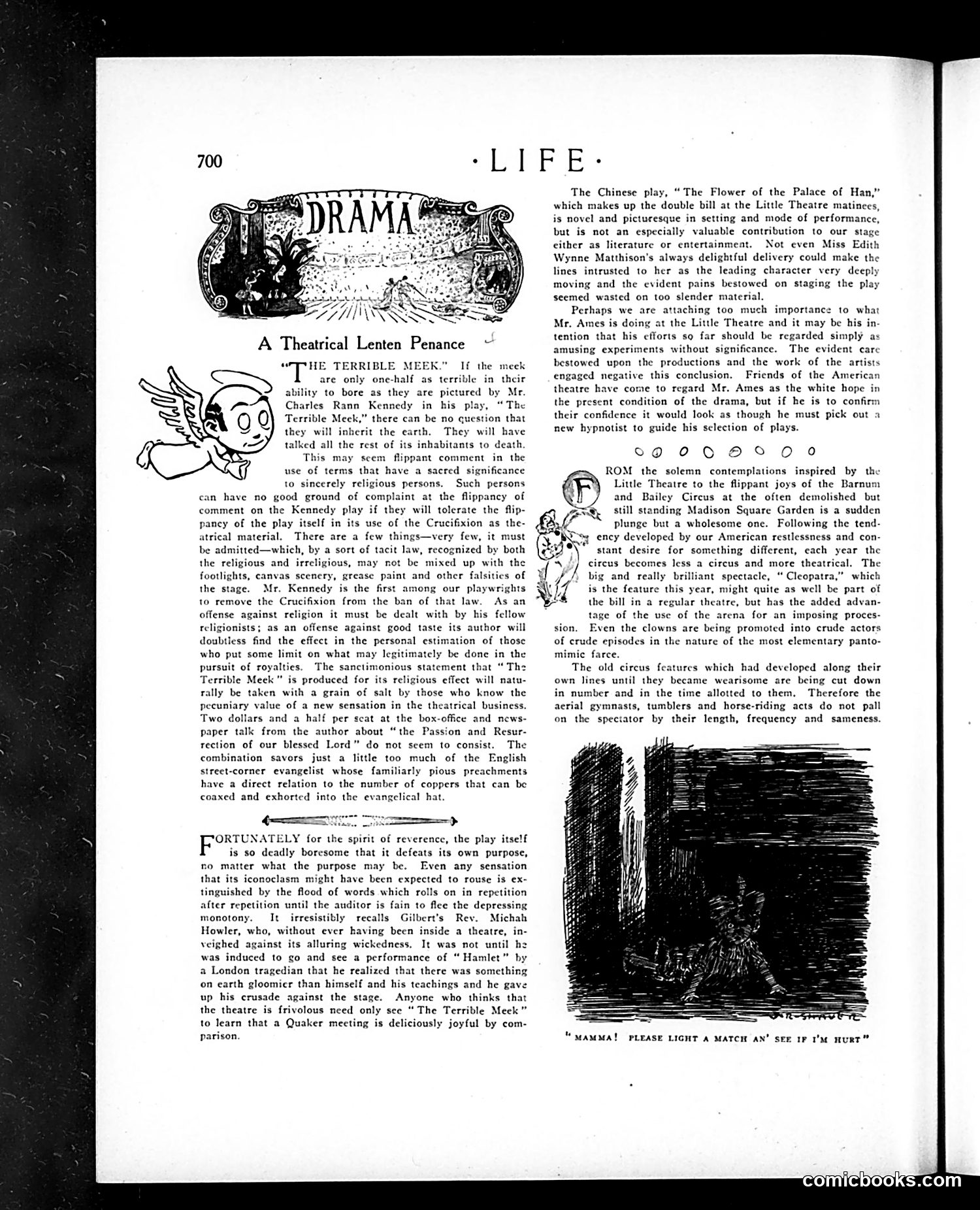
This page reviews two theatrical productions at the Little Theatre. The main article critiques Charles Rann Kennedy's play **"The Terrible Meek,"** which apparently dramatizes the Crucifixion. The critic attacks Kennedy on two fronts: 1. **Sacrilege**: Using Christ's Passion as theatrical material violates an unspoken cultural taboo, though the critic notes Kennedy's religious justifications seem suspiciously commercial ("two dollars and a half per seat"). 2. **Boredom**: The play is relentlessly tedious—so dull it defeats any sensational effect. The critic compares it unfavorably to a Quaker meeting, referencing Gilbert's character Rev. Michah Howler as a parallel to Kennedy's gloomy moralizing. The small cartoon depicts a child-like devil figure, likely illustrating the "Terrible Meek" concept or religious themes discussed. A secondary review dismisses the Chinese play "Flower of the Palace of Han" as visually novel but dramatically weak, even with actress Edith Wynne Matthison's talent. The satire targets Kennedy's apparent mixing of profit-seeking with religious pretension.
📄 Transcribed text from this page (OCR, searchable)
Machine-transcribed from the original scan — historical spelling and the odd misread are preserved.
LTP Es A Theatrical Lenten Penance “PPHE TERRIBLE MEEK.” If the meek are only one-half as terrible in their ability to bore as they are pictured by Mr. Charles Rann Kennedy in his pl The Terrible Meck,” there can be no question that they will inherit the earth. They will have talked all the rest of its inhabitants to death. This may scem flippant comment in the use of terms that have a sacred significance to sincerely religious persons. Such persons can have no good ground of complaint at the flippancy of comment on the Kennedy play if they will tolerate the flip~ pancy of the play itself in its use of the Crucifixion as the- atrical material. There are a few things—very few, it must be admitted—which, by a sort of tacit law, recognized by both the religious and irrcligious, may not be mixed up with the footlights, canvas scenery, grease paint and other falsities of the stage. Mr. Kennedy is the first among our playwrights to remove the Crucifixion from the ban of that law. As an offense against religion it must be dealt with by his fellow religionists; as an offense against good taste its author will doubtless find the effect in the personal estimation of those who put some limit on what may le; ly be done in the pursuit of royalties. The sanctimonious statement that “Th Terrible Meek" is produced for its religious effect will natu- rally be taken with a grain of salt by those who know the pecuniary value of a new sensation in the theatrical business. Two dollars and a half per scat at the box-office and news- paper talk from the author about “the Passion and Resur- rection of our blessed Lord” do not seem to consist. The combination savors just a little too much of the English street-corner evangelist whose familiarly pious preachments have a direct relation to the number of coppers that can be coaxed and exhorted into the evangelical hat. ——_==IZ_ I ————=) ORTUNATELY for the spirit of reverence, the play itself is so deadly boresome that it defeats its own purpose, no matter what the purpose may be. Even any sensation that its iconoclasm might have been expected to rouse is ex- tinguished by the flood of words which rolls on in repetition after repetition until the auditor is fain to flee the depressing monotony. It irresistibly recalls Gilbert's Rev. Michah Howler, who, without ever having been inside a theatre, in- veighed against its alluring wickedness, It was not until he was induced to go and see a performance of “Hamlet” by a London tragedian that he realized that there was something on earth gloomicr than himself and his teachings and he gave up his crusade against the stage. Anyone who thinks that the theatre is frivolous need only see “The Terrible Meck” to learn that a Quaker meeting is deliciously joyful by com- parison. & 2 C32 { \ The Chinese play, “The Flower of the Palace of Han,” which makes up the double bill at the Little Theatre matinces, is novel and picturesque in setting and mode of performance, but is not an especially valuable contribution to our stage cither as literature or entertainment. Not even Miss Edith Wynne Matthison’s always delightful delivery could make the lines intrusted to her as the leading character very deeply moving and the evident pains bestowed on staging the play seemed wasted on too slender material. Perhaps we are attaching too much importance to what Mr. Ames is doing at the Little Theatre and it may be his in- tention that his efforts so far should be regarded simply as amusing experiments without significance. The evident carc bestowed upon the productions and the work of the artists engaged negative this conclusion. Friends of the American theatre have come to regard Mr. Ames as the white hope in the present condition of the drama, but if he is to confirm their confidence it would look as though he must pick out 2 new hypnotist to guide his sclection of plays. 200080 o ROM the solemn contemplations inspired by the Little Theatre to the flippant joys of the Barnum and Bailey Circus at the often demolished but still standing Madison Square Garden is a sudden plunge but a wholesome one. Following the tend- Axe ency developed by our American restlessness and con- (a) las W stant desire for something different, each year the circus becomes less a circus and more theatrical. The big and really brilliant spectacle, “ Cleopatra,” which is the feature this year, might quite as well be part of the bill in a regular theatre, but has the added advan- tay i ge of the use of the arena for an imposing proces- Even the clowns are being promoted into crude actors of crude episodes in the nature of the most elementary panto- mimic farce. The old circus features which had developed along their own lines until they became wearisome are being cut down in number and in the time allotted to them, Therefore the aerial gymnasts, tumblers and horse-riding acts do not pall on the spectator by their length, frequency and sameness. sion, “MAMMA! PLEASE LIGHT A MATCH AN’ SEE IP xe HURT”