
Life, 1912-04-04 · page 48 of 80
Life — April 4, 1912 — page 48: what you’re looking at
What you’re looking at
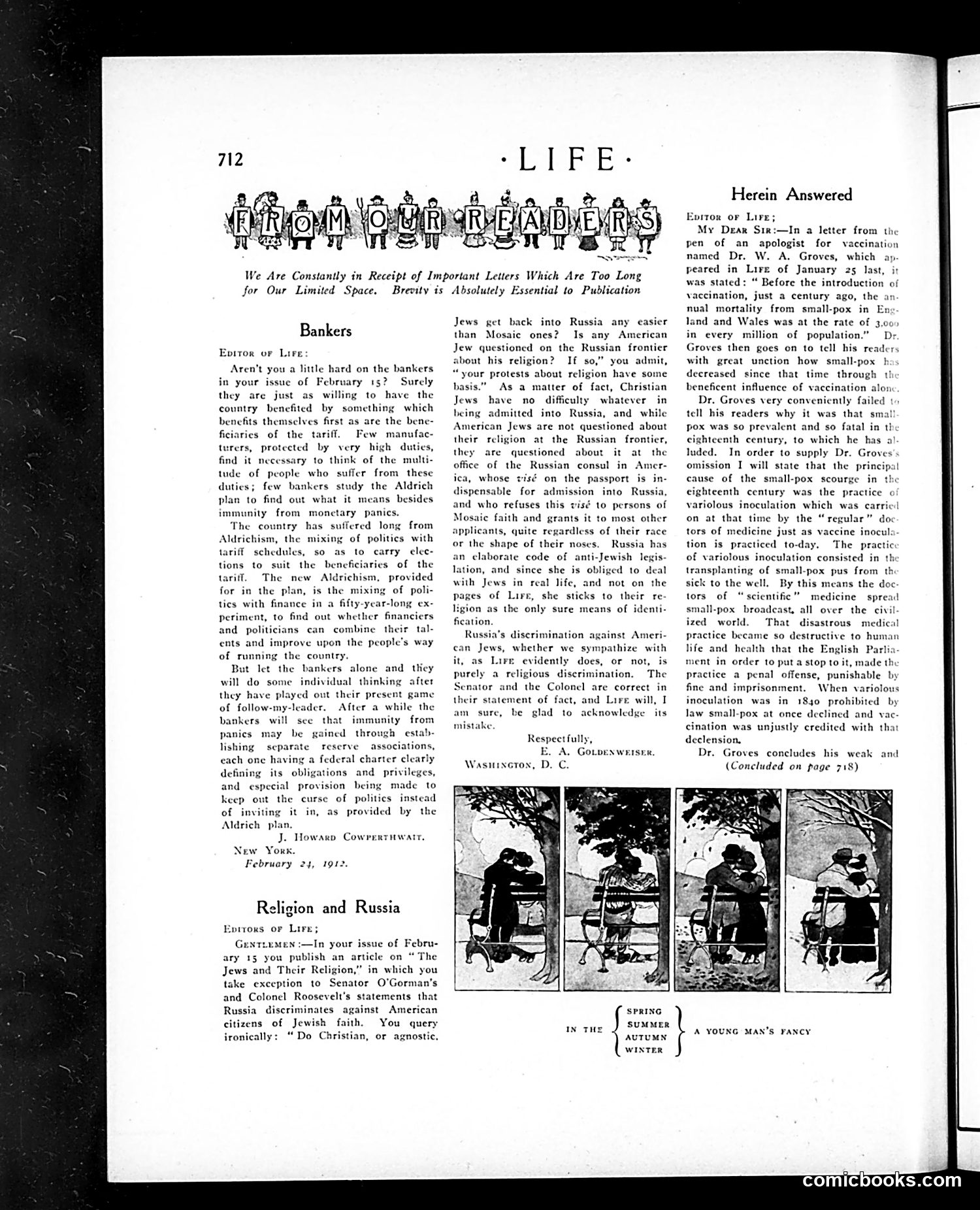
This page contains three reader-response letters debating contemporary policy issues: **"Bankers"** critiques the Aldrich Plan (a proposed banking reform), arguing bankers pursue self-interest over public welfare. The writer sarcastically compares bankers' immunity from "monetary panics" to manufacturers' tariff protection, both benefiting the few while harming the many. He proposes separate bank associations with federal charters instead. **"Religion and Russia"** disputes Life's previous article denying religious discrimination against American Jews in Russia. The letter-writer rebuts Life's rhetorical questions, providing evidence that Russia's consul office systematically denies visas to Jews while granting them to Christians—demonstrating explicit religious discrimination. **"Herein Answered"** (partially visible) addresses vaccination claims made by "Dr. W. A. Groves" in a prior issue, challenging statistics about smallpox mortality rates. The four silhouette photographs below appear unrelated—showing figures in seasonal settings—likely illustrating an article titled "A Young Man's Fancy" (in spring, summer, autumn, winter).
📄 Transcribed text from this page (OCR, searchable)
Machine-transcribed from the original scan — historical spelling and the odd misread are preserved.
We Are Constantly in Receipt of Important Letters Which Are Too Long for Our Limited Space. Bankers Epiror or Lire: ittle hard on the bankers pruary 15? Surely they are just as willing to have the country benefited by something which benefits themselves first as are the ben ficiaries of the tariff. Few manufac- turers, protected by very high duties, find it necessary to think of the multi- tude of people who suffer from these duties; few bankers study the Aldrich plan to find out what it means besides immunity from monetary panics. The country has suffered long from Aldrichism, the mixing of politics with tariff schedules, so as to carry elee- tions to suit the beneficiaries of the tariff. The Aldrichism, provided for in the plan, is the mixing of poli- tics with finance in a fifty-year-long ex- periment, to find out whether financiers and politicians can combine their tal- ents and improve upon the people's way of running the country. But let the bankers alone and tlicy will do some individual thinking after they have played out their present game of follow-my-leader. After a while the bankers will sce that immunity fro: panies may be gained through estal- lishing separate associations, ach one having a federal charter clearly defining its obligations and_ privileges, and especial provision being keep out the curse of politics instead of inviting it in, as provided by the Aldrich plan. J. Howano Cowrrrtnwatr. New York. February 24, Aren't you a in your issue of new reserve made to 1912. Religion and Russia Eprroxs oF Lire; Gextiuaten :—In your issue of Febru- ary 15 you publish an article on “The Jews and Their Religion,” in which you take exception to Senator O'Gorman’s and Colonel Roosevelt's statements that Russia discriminates against American citizens of Jewish faith. You query ironically: “Do Christian, or agnostic, Brevity is Absolutely Essential to Publication Jews get back into Russia any easier than Mosaic ones? Is any American Jew questioned on the Russian frontier about his religion? If so,” you admit, “your protests about religion have some basis.” As a matter of fact, Christian Jews have no difficulty whatever in heing admitted into Russia, and while American Jews are not questioned about their religion at the Russian frontier, they are questioned about it at the office of the Russian consul in Amer- ica, whose visé on the passport is in- dispensable for admission into Russia, and who refuses this visé to persons of Mosaic faith and grants it to most other applicants, quite regardless of their race or the shape of their noses. an elaborate code of anti-Jewish legis- lation, and since she is obliged to deal with Jews in real life, and not on the pages of Lire, she sticks to their re ion as the only sure means of identi- fication Russia's discrimination against Ameri- Russia has can Jews, whether we sympathize with it, as Lire evidently does, or not, is purely a religious discrimination. The Senator and the Colonel are correct in their statement of fact, and Lire will, I am sure, be glad to acknowledge its mistake Respectfully, E. A. Goupexwersre. Wasuttxetox, D SPRING SUMMER AUTUMN WINTER IN THE Herein Answered Eprtor oF Lire; My Dear Sir:—In a letter from the pen of an apologist for vaccination named Dr. W. A. Groves, which ap- peared in Lire of January 25 last, ir was stated: “ Before the introduction of vaccination, just a century ago, the ar nual mortality from small-pox in En land and Wales was at the rate of 3.00 in every million of population.” Dr Groves then goes on to tell his reader with great unction how small-pox | decreased since that time through beneficent influence of vaccination alon Dr. Groves very conveniently failed tell his readers why it was that smal pox was so prevalent and so fatal in ti cightcenth century, to which he has a luded. In order to supply Dr. Groves's omission I will state that the princip: cause of the small-pox scourge in. the cighteenth century was the practice ¢ variolous inoculation which was carr on at that time by the “regular” doc tors of medicine just as vaccine inocul tion is practiced to-day, The practic of variolous inoculation consisted in th transplanting of small-pox pus from th sick to the well. By this means the doc tors of “scientific” medicine spread small-pox broadcast, all over the civil ized world. That disastrous medical practice became so destructive to human life and health that the English Parti ment in order to puta stop to it, made th: practice a penal offense, punishable by fine and imprisonment. When variolous inoculation was in 1840 prohibited by law small-pox at once declined and vac- cination was unjustly credited with that declension, Dr. Groves concludes his weak (Concluded on page 718) A YOUNG MAN’S FANCY comicbooks.com