
Life, 1912-04-04 · page 45 of 80
Life — April 4, 1912 — page 45: what you’re looking at
What you’re looking at
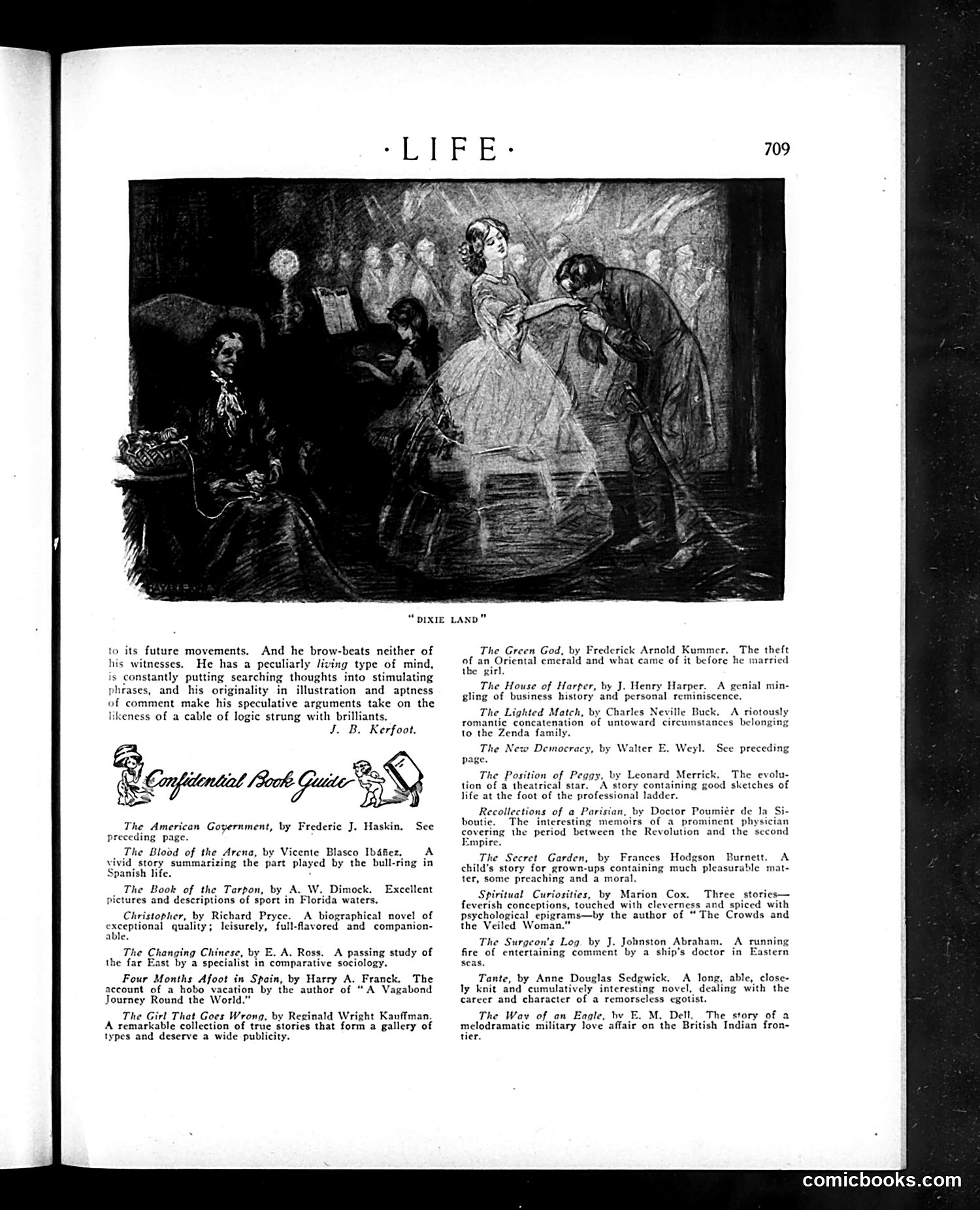
This page is primarily a **book review section**, not a political cartoon. The illustration titled "Dixie Land" appears to depict a **Southern antebellum social scene**—likely a ball or formal gathering with wealthy figures in period dress. The woman in the center wears an elaborate gown; men in dark formal wear surround her. The satire is implicit rather than explicit: Life was a **progressive satirical magazine**, and the romanticized imagery of the pre-Civil War South ("Dixie") would have carried ironic weight for contemporary readers who recognized the magazine's social commentary stance. The nostalgic "Dixie Land" framing likely critiques or satirizes Lost Cause mythology—the tendency to romanticize the antebellum South. The page's main content consists of brief reviews of contemporary books (1910s era), reflecting Life's role as a cultural arbiter. The juxtaposition of Southern romanticism with progressive-era literature reviews suggests the magazine's broader cultural positioning.
📄 Transcribed text from this page (OCR, searchable)
Machine-transcribed from the original scan — historical spelling and the odd misread are preserved.
“DIXIE LAND” to its future movements. And he brow-beats neither of his witnesses. He has a peculiarly living type of mind, is constantly putting searching thoughts into stimulating phrases, and his originality in illustration and aptness of comment make his speculative arguments take on the likeness of a cable of logic strung with brilliants. J. B. Kerfoot. The American Goyernment, by Frederic J. Haskin, See preceding page. The Blood of the Arcna, by Vicente Blasco Ibéfez, A ivid story summarizing the part played by the bull-ring in Spanish life. The Book of the Tarpon, by A. W. Dimock. pictures and descriptions of sport in Florida waters. Christopher, by Richard Pryce. A biographical novel of exceptional quality; leisurely, full-flavored and companion- able. The Changing Chinese, by E. A. Ross. A passing study of the far East by a specialist in comparative sociology. Four Months Afoot in Spain, by Harry A. Franck. The account of a hobo vacation by the author of “A Vagabond Journey Round the World.” The Girl That Goes Wrong, by Reginald Wright Kauffman. A remarkable collection of true stories that form a gallery of types and deserve a wide publicity. Excellent The Green God, by Frederick Arnold Kummer. The theft of an Oriental emerald and what came of it before he married the girl. The House of Harper, by J. Henry Harper. A ge gling of business history’ and personal reminiscence. The Lighted Match, by Charles Neville Buck, A riotously romantic concatenation of untoward circumstances belonging to the Zenda family. The New Democracy, by Walter E. page. The Position of Peggy, vy Leonard Merrick. The evolu: tion of a theatrical star. A story containing good sketches of life at the foot of the professional ladder. min- Weyl. Sce preceding Recollections of a Parisian, by Doctor Poumiér de boutie. The interesting memoirs of a prominent physician covering the period between the Revolution and the second Empire. The Secret Garden, by Frances Hodgson Burnett. child's story for grown-ups containing much pleasurable ms ter, some preaching and a moral. tual Curiosities, by Marion Cox. Three stories— verish conceptions, totiched with cleverness and spiced with psychological epigrams—by the author of “The Crowds and the Veiled Woman. The Surgeon's Log. by J. Johnston Abraham. A running fire of entertaining comment by a ship's doctor in Eastern seas. Tante, by Anne Douglas Sedgwick. A long, able, close- ly knit and cumulatively interesting novel, dealing with the career and character of a remorseless egotist. The Way of an Engle, by E. M, Dell, The story of a melodramatic military love affair ‘on the British Indian fron- tier. comicbooks.com