
Life, 1912-04-04 · page 64 of 80
Life — April 4, 1912 — page 64: what you’re looking at
What you’re looking at
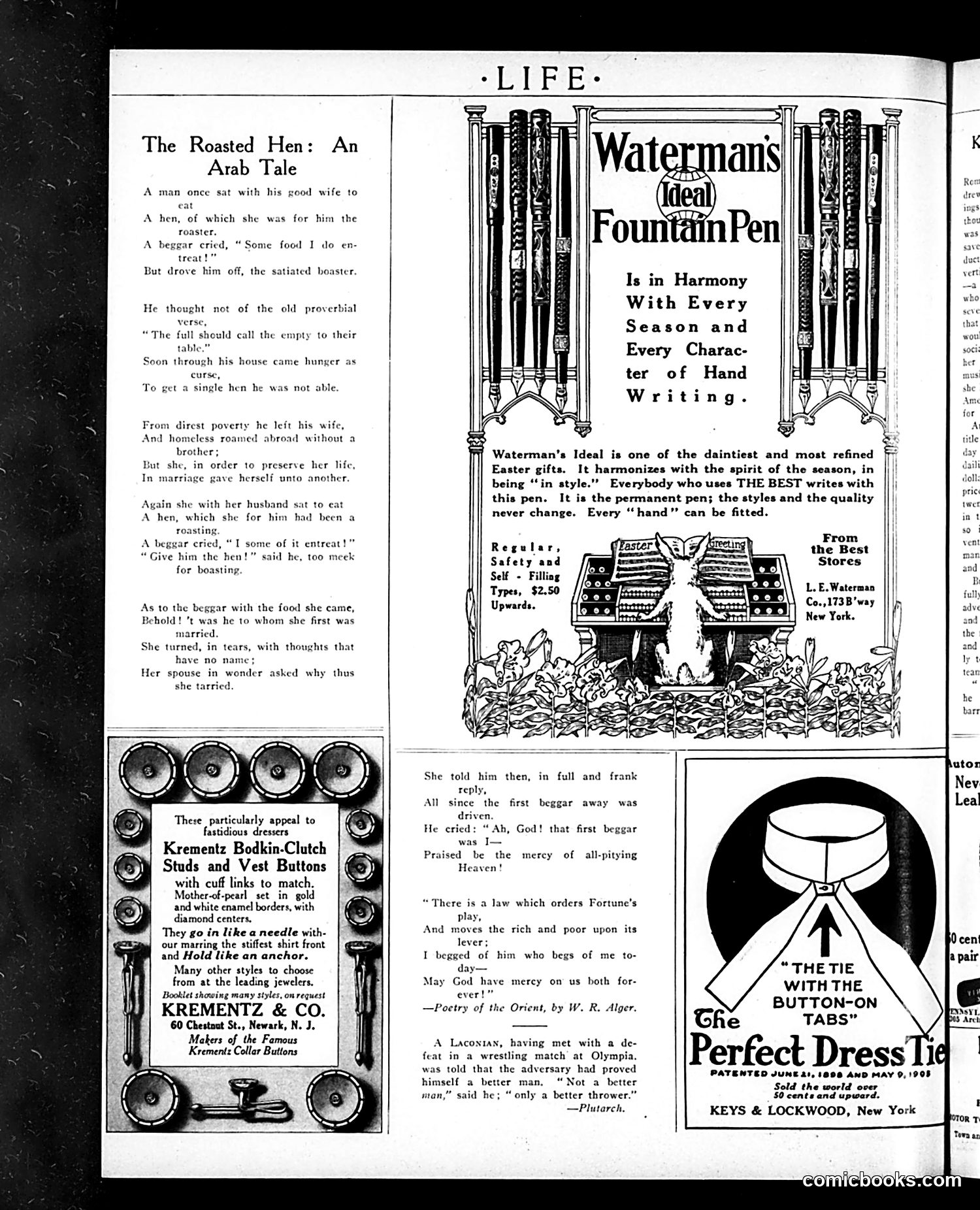
This page presents a morality poem illustrating karmic justice and the consequences of selfishness. A wealthy man refuses food to a hungry beggar; poverty later forces him to abandon his wife, who remarries. Years later, when the man himself becomes a beggar, he encounters his ex-wife—who now gives him food. He recognizes her and realizes the beggar he spurned was himself, understanding that Fortune's wheel turns for rich and poor alike. The tale exemplifies Oriental wisdom literature popular in early 20th-century American magazines, teaching that cruelty toward the poor invites future suffering. It's paired with advertisements for luxury goods (Waterman fountain pens, Krementz jewelry buttons, dress ties)—the irony unexamined by the editors—creating an inadvertent contrast between the poem's ascetic message and consumer materialism.
📄 Transcribed text from this page (OCR, searchable)
Machine-transcribed from the original scan — historical spelling and the odd misread are preserved.
The Roasted Hen: An Arab Tale A man once sat with his good wife to eat A hen, of which she was for him the roaster. A beggar cried, “Some food I do en- treat!" But drove him off, the satiated boaster. He thought not of the old proverbial “The full should call the empty to their table,” Soon through his house came hunger as curse, To get a single hen he was not able. From direst poverty he left his wife, And homeless roamed abroad without a brother; But she, in order to preserve her life, In marriage gave herself unto another. Again she with her husband sat to cat A hen, which she for him had been a roasting. A beggar cried, “I some of it entreat!” “Give him the hen!" said he, too meek for boasting As to the beggar with the food she came, Behold! "t was he to whom she first was married. She turned, in tears, with thoughts that have no name; Her spouse in wonder asked why thus she tarried. These particularly appeal to fastidious dressers Krementz Bodkin-Clutch Studs and Vest Buttons with cuff links to match. Mother-of-pearl set in gold and white enamel borders, with diamond centers, They go in like a needle with- our marring the stiffest shirt front and Hold like an anchor. Many other styles to choose from at the leading jewelers, Booklet showing many styles, on request KREMENTZ & CO. 60 Chestaut St., Newark, N. J. Makers of the Famous Krementz Collar Buttons EL IO Sean)... baa hemenae Regular, Safety and Self - Filling Types, $2.50 Upwards. Is in Harmony With Every Season and Every Charac- ter of Hand Writing. Waterman's Ideal is one of the daintiest and most refined Easter gifts. It harmonizes with the spirit of the season, in being ‘‘in style.” Everybody who uses THE BEST writes with this pen. It is the permanent pen; the styles and the quality never change. Every “hand” can be fitted. From the Best Stores L. E. Waterman Co.,173B’way New York. She told him then, in full and frank reply, All since the first beggar away was driven, He cried: “Ab, God! that first: beggar as I— Praised be the mercy of all-pitying Heaven! “There is a law which orders Fortune's P And moves the rich and poor upon its lever; I begged of him who begs of me to- day— May God have mercy on us both for- ever!" —Poetry of the Orient, by W. R. Alger. A Lacosiax, having met with a de- feat in a wrestling match at Olympia. was told that the adversary had proved himself a better man, “Not a_ better man,” said he; “only a better thrower.” —Plutarch. “THETIE WITH THE BUTTON-ON Gfie PATENTED June ai Sold ¢i 50 cents and upward. KEYS & LOCKWOOD, New York