
Life, 1912-04-04 · page 18 of 80
Life — April 4, 1912 — page 18: what you’re looking at
What you’re looking at
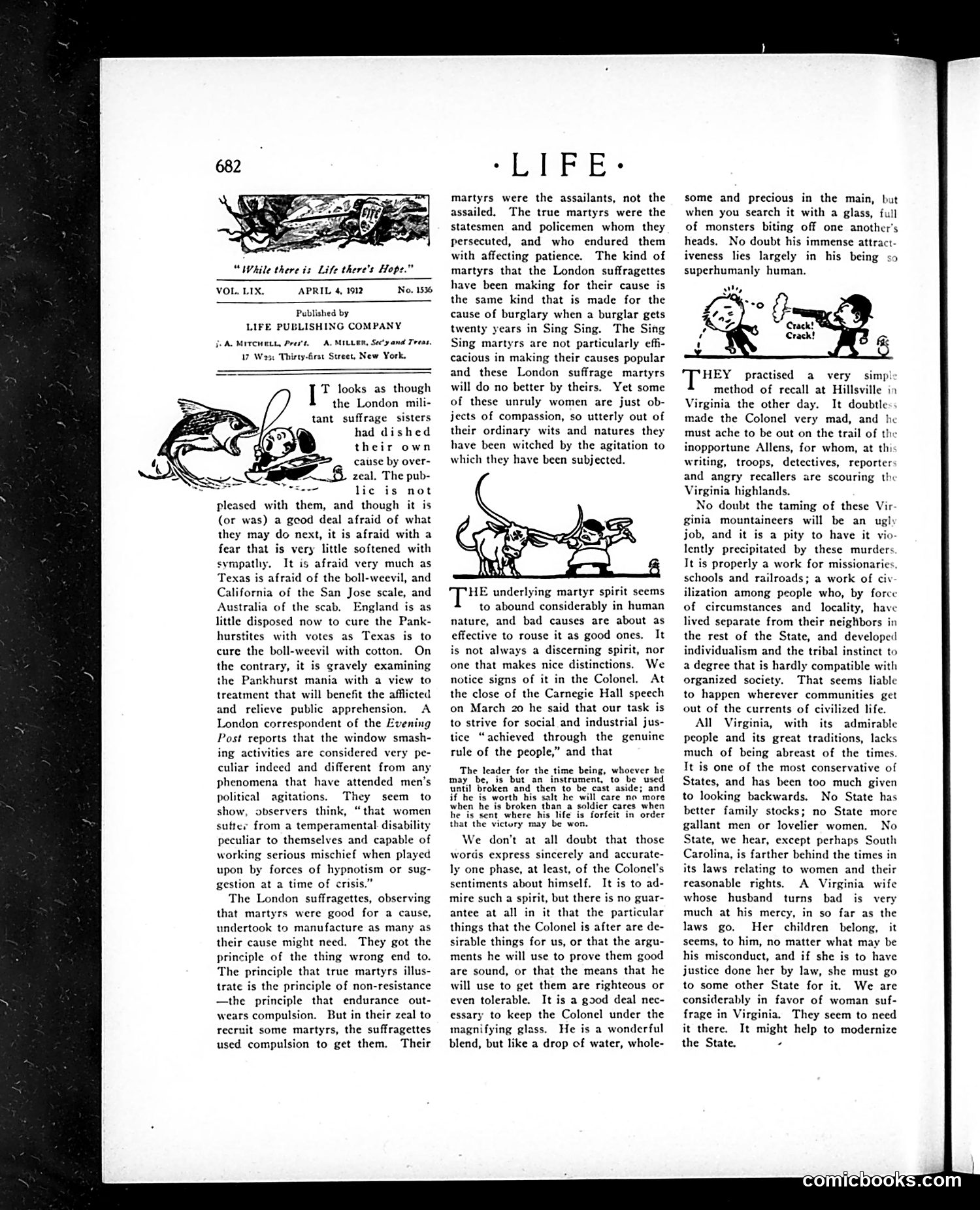
This page critiques British militant suffragettes (likely the Pankhurst movement) for their window-smashing campaigns. The cartoons show figures being struck or knocked about—visualizing the magazine's argument that these activists have undermined their own cause. The editorial contends that suffragettes misunderstood martyrdom. True martyrs practice *non-resistance*, but these women used *compulsion* against police and officials—making those officials the real victims, not the activists themselves. The comparison to Sing Sing prisoners suggests their "martyrdom" discredits rather than advances their cause. The text also references "the Colonel" (appears to be Theodore Roosevelt, based on context), praising his rhetoric about sacrifice while warning that noble-sounding principles don't guarantee righteous goals. The overall message: good intentions don't justify harmful methods, and public sympathy won't follow coercion.
📄 Transcribed text from this page (OCR, searchable)
Machine-transcribed from the original scan — historical spelling and the odd misread are preserved.
“While there iz Life there's Ho, APRIL 4, 1912 VOL. LIX. No, 1536 Published by LIFE PUBLISHING COMPANY jo A. Mirren ent, Pri A. MILLER, See’ 17 Wes. Thirty-first Street, New York. T looks as though the London mili- tant suffrage sisters had dished their own cause by over- FS zeal. The pub- aad lic is not pleased with them, and though it is (or was) a geod deal afraid of what they may do next, it is afraid with a fear that is very little softened with sympathy, It is afraid very much as Texas is afraid of the boll-weevil, and California of the San Jose scale, and Australia of the scab, England is as little disposed now to cure the Pank- hurstites with votes as Texas is to cure the boll-weevil with cotton. On the contrary, it is gravely examining the Pankhurst mania with a view to treatment that will benefit the afflicted and relieve public apprehension. A London correspondent of the Evening Post reports that the window smash- ing activities are considered very p culiar indeed and different from any phenomena that have attended men’s political agitations. They seem to show, observers think, “that women sufter from a temperamental disability peculiar to themselves and capable of working serious mischief when played upon by forces of hypnotism or sug- gestion at a time of crisis.’ The London suffragettes, observing that martyrs were good for a cause, undertook to manufacture as many as their cause might need. They got the principle of the thing wrong end to. The principle that true martyrs illus- trate is the principle of non-resistance —the principle that endurance out- wears compulsion. But in their zeal to recruit some martyrs, the suffragettes used compulsion to get them. Their = PAE martyrs were the assailants, not the assailed. The true martyrs were the statesmen and policemen whom they persecuted, and who endured them with affecting patience. The kind of martyrs that the London suffragettes have been making for their cause is the same kind that is made for the cause of burglary when a burglar gets twenty years in Sing Sing. The Sing Sing martyrs are not particularly effi- cacious in making their causes popular and these London suffrage martyrs will do no better by theirs. Yet some of these unruly women are just ob- jects of compassion, so utterly out of their ordinary wits and natures they have been witched by the agitation to which they have been subjected. underlying martyr spirit seems to abound considerably in human nature, and bad causes are about as effective to rouse it as good ones. It is not always a discerning spirit, nor one that makes nice distinctions. We notice signs of it in the Colonel. At the close of the Carnegie Hall speech on March 20 he said that our task is to strive for social and industrial jus- tice “achieved through the genuine rule of the people,” and that The leader for the time being, whoever he may be, is but an instrument, to be used until broken and then to be cast aside if he is worth his salt he will care no when he is broken than a soldier cares when he is sent where his life is forfeit in order that the victory may be won. We don’t at all doubt that those words express sincerely and accurate- ly one phase, at least, of the Colonel’s sentiments about himself, It is to ad- mire such a spirit, but there is no guar- antee at all in it that the particular things that the Colonel is after are de- sirable things for us, or that the argu- ments he will use to prove them good are sound, or that the means that he will use to get them are righteous or even tolerable. It is a good deal nec- essary to keep the Colonel under the magnifying glass. He is a wonderful blend, but like a drop of water, whole- some and precious in the main, but when you search it with a glass, full of monsters biting off one another's heads. No doubt his immense attract- iveness lies largely in his being superhumanly human. HEY practised a very simp! method of recall at Hillsville in Virginia the other day. It doubtless made the Colonel very mad, and must ache to be out on the trail of th inopportune Allens, for whom, at thi writing, troops, detectives, reporters and angry recallers are scouring th: Virginia highlands. No doubt the taming of these Vir ginia mountaineers will be an ugly job, and it is a pity to have it vio- lently precipitated by these murders It is properly a work for missionaries. schools and railroads; a work of civ ilization among people who, by force of circumstances and locality, have lived separate from their neighbors in the rest of the State, and developed individualism and the tribal instinct to a degree that is hardly compatible with organized society. That seems liable to happen wherever communities get out of the currents of civilized life. All| Virginia, with its admirable people and its great traditions, lacks much of being abreast of the times. It is one of the most conservative of States, and has been too much given to looking backwards. No State has better family stocks; no State more gallant men or lovelier women. No State, we hear, except perhaps South Carolina, is farther behind the times in its laws relating to women and their reasonable rights. A Virginia wife whose husband turns bad is very much at his mercy, in so far as the laws go, Her children belong, it seems, to him, no matter what may be his misconduct, and if she is to have justice done her by law, she must go to some other State for it. We are considerably in favor of woman suf- frage in Virginia. They seem to need it there. It might help to modernize the State. -