
A complete issue · 44 pages · 1912
Life — February 15, 1912
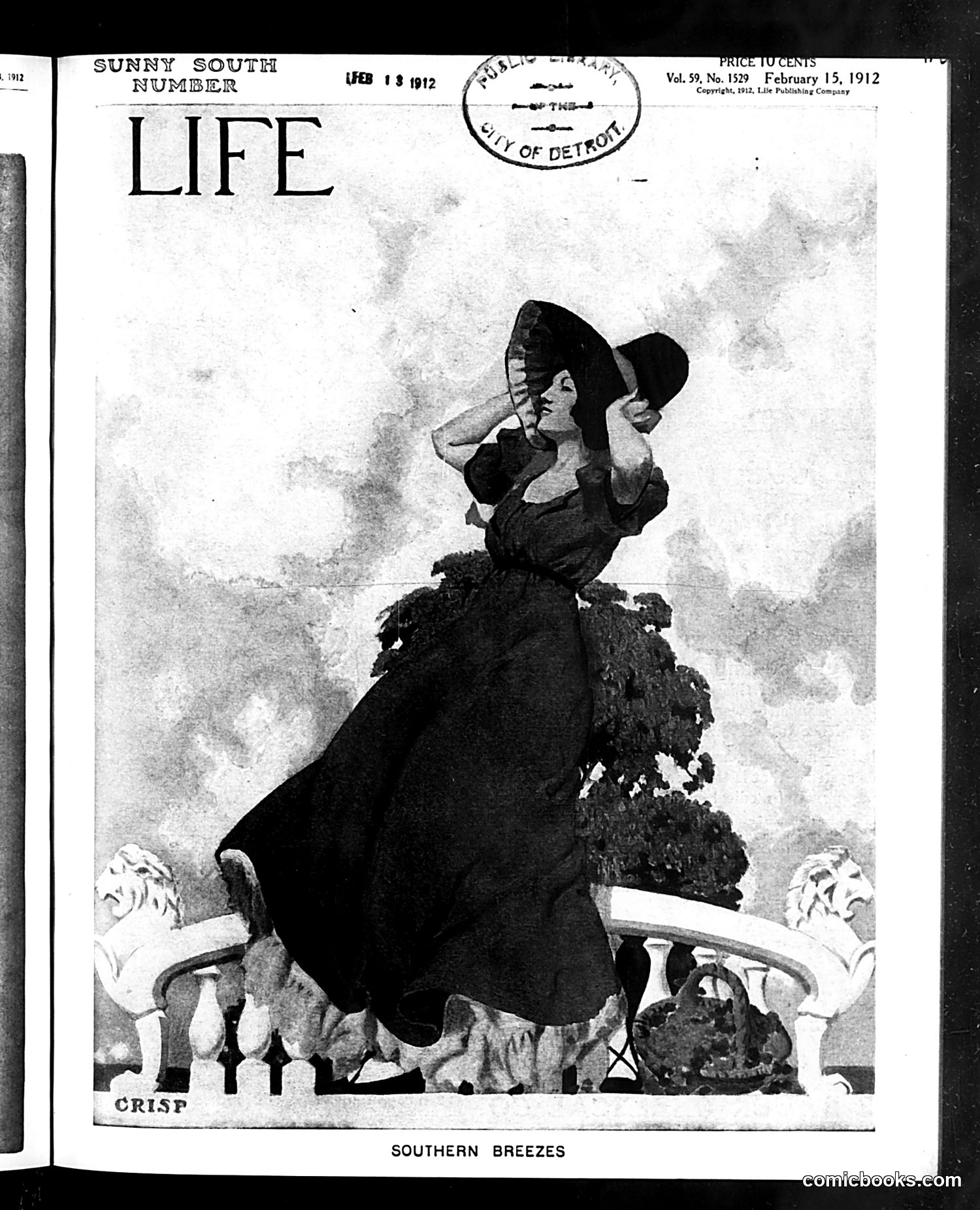
This illustration by Crisp depicts a woman on a balcony being blown about by strong wind, her skirt billowing dramatically. The title "Southern Breezes" suggests a humorous commentary on weather in the American South. The image plays on the visual comedy of a woman struggling to maintain her dignity and modesty against powerful wind forces—a common theme in early 20th-century humor. Her elaborate hat, dark coat, and the ornate balcony railing suggest an upper-class setting. Without additional context from the magazine's text, the specific satirical target remains unclear, though it may reference Southern weather patterns or regional stereotypes popular in contemporary satire. The humor relies primarily on the physical comedy of the scenario rather than explicit political commentary.

This page is **primarily an advertisement**, not satire or political commentary. It promotes Sanatogen, a commercial "food-tonic" product. The ad claims 15,000 physicians endorse Sanatogen by listing testimonials from named medical figures (Sir Gilbert Parker, Prof. Thomas B. Stillman, John Burroughs, and others). The central illustration shows a distinguished man in formal dress presenting the product. The framing as physician-endorsed represents **turn-of-the-century marketing strategy**: appealing to medical authority to sell patent medicines. The product promised to restore "nerve strength" and energy to "exhausted" people—vague health claims typical of that era's largely unregulated supplement industry. This reflects pre-FDA standards when such promotional claims faced minimal scrutiny.
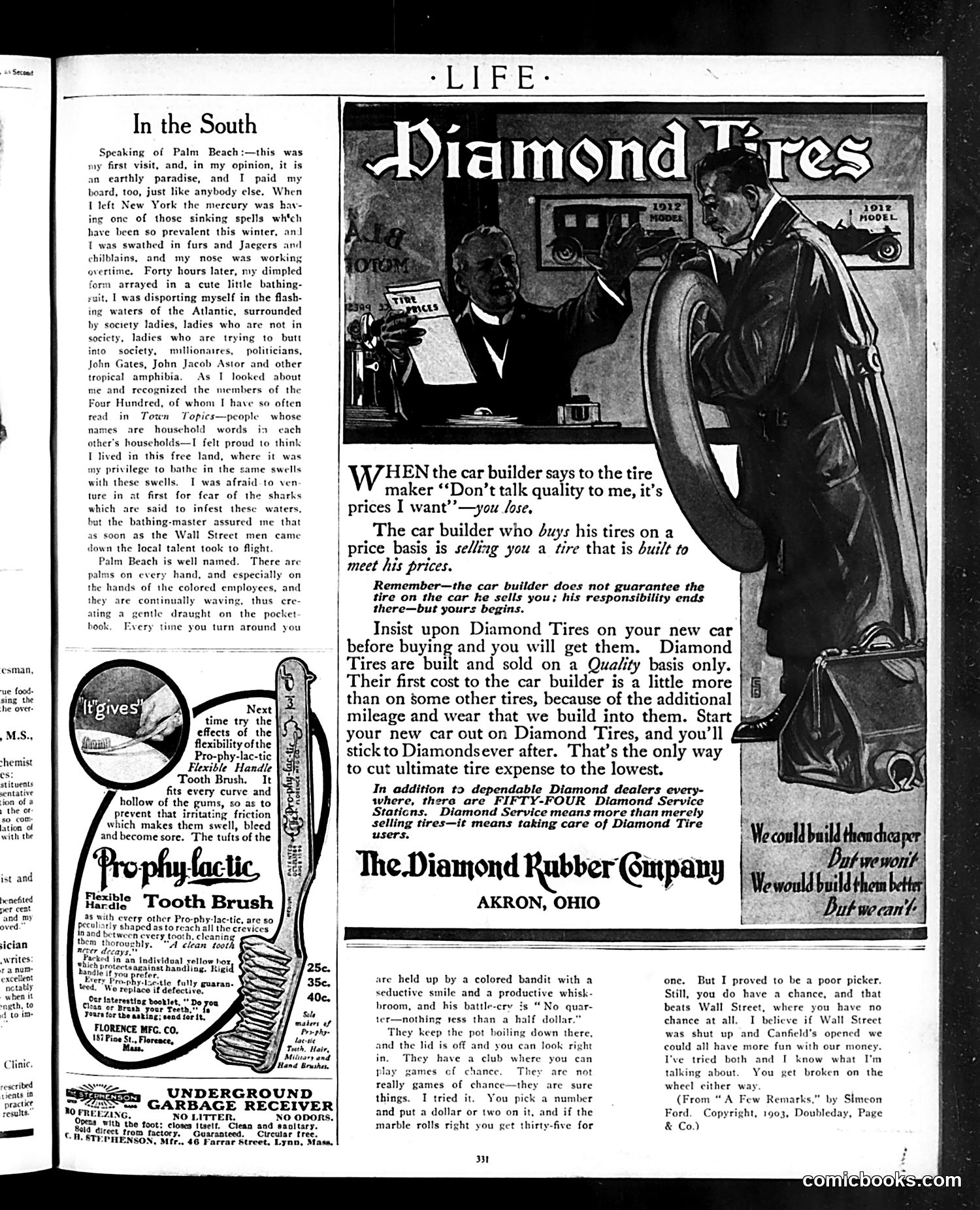
This page is primarily **advertising, not political satire**. The dominant content is a Diamond Tires advertisement (center-right) featuring an elegant figure in formal dress, alongside smaller ads for Prophylactic Tooth Brush and Underground Garbage Receiver. The left column contains a personal essay titled "In the South" by what appears to be a society writer describing a visit to Palm Beach—an account of wealthy social circles, swimming in the Atlantic, and observations about exclusive society. The advertisements employ typical early-1910s marketing appeals: the tire ad emphasizes quality and value to car builders, while the toothbrush ad uses humor about dental care. There is no political cartoon or satire present on this page. It represents standard magazine content mixing editorial material with commercial advertising from this era.
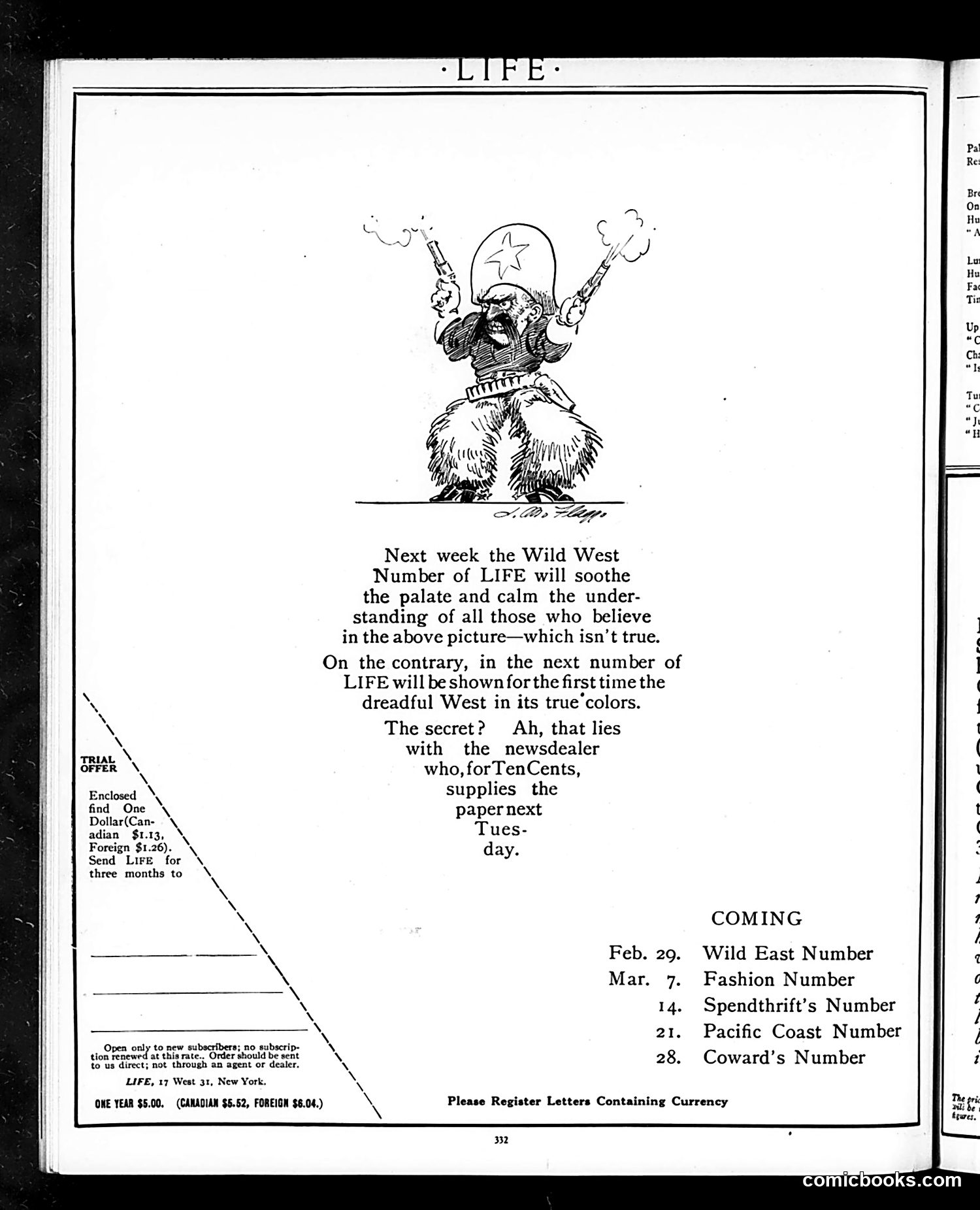
This page is primarily an advertisement for *Life* magazine's upcoming "Wild West Number." The cartoon depicts a caricatured figure in cowboy/frontier attire firing pistols in celebration, wearing a star-emblazoned hat. The accompanying text promises that next week's issue will present "the Wild West in its true colors"—implying the previous cartoon (shown above) was an inaccurate, sanitized romantic depiction. The ad uses humor to suggest that *Life's* upcoming Wild West issue will provide authentic, possibly debunking or satirical coverage of Western mythology. The page also includes subscription trial offers and upcoming special issues (Fashion Number, Pacific Coast Number, etc.). This is primarily commercial content exploiting contemporary interest in Western imagery and frontier nostalgia, rather than political satire.
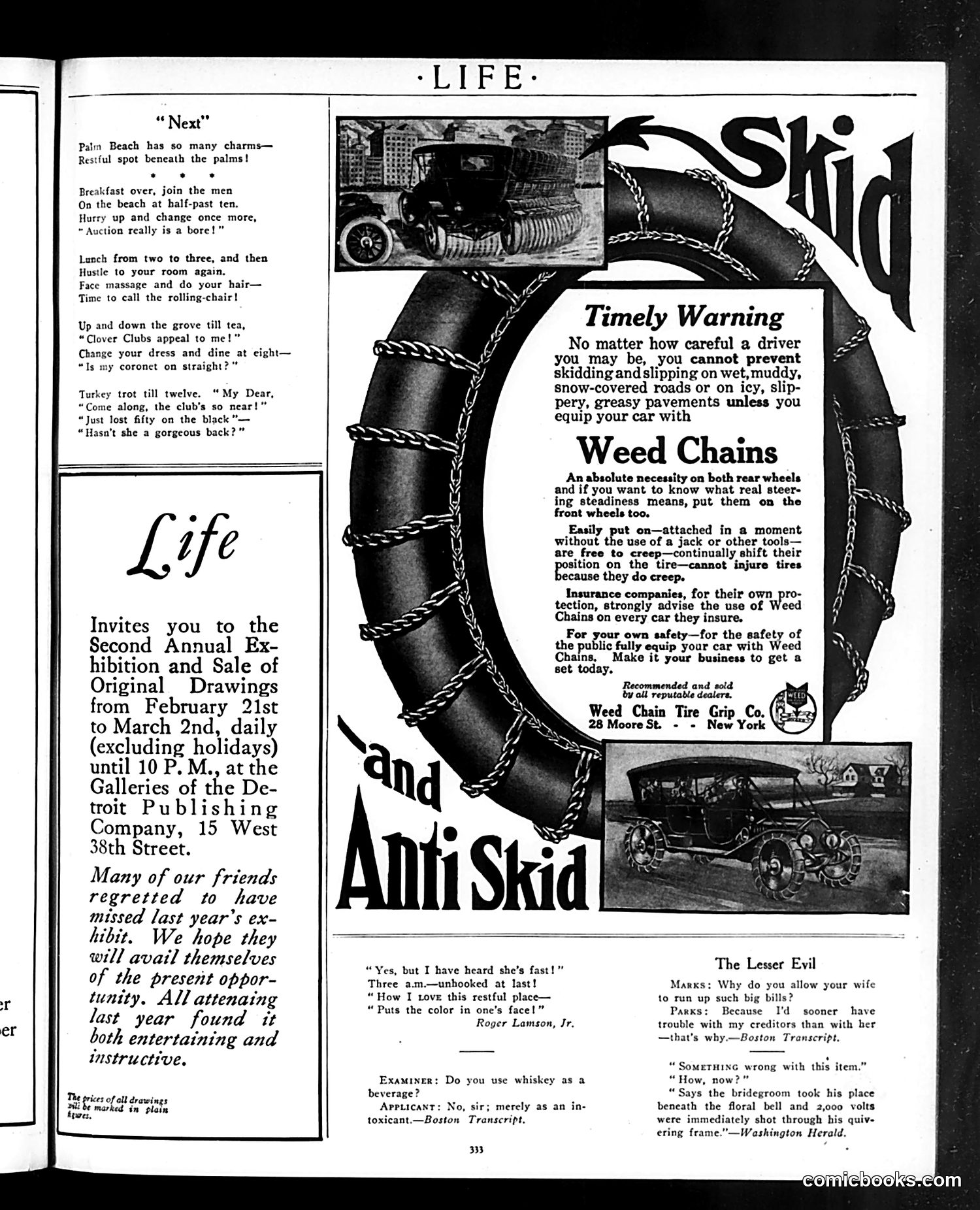
This page contains **primarily advertising and announcements**, not political satire. The dominant content is a **Weed Chain Tire Grip Company advertisement** featuring a large tire wrapped in chains. The "Timely Warning" emphasizes that chains are essential safety equipment for winter driving on muddy or icy roads—a practical concern for early automotive era vehicles with poor traction. The left column announces **Life magazine's Second Annual Exhibition of Original Drawings** at the Detroit Publishing Company galleries (February 21-March 2), inviting readers to attend. Small humorous snippets appear at the bottom ("The Lesser Evil," an examiner/applicant exchange about whiskey), representing typical satirical filler common to Life magazine. The page reflects early 20th-century automotive safety concerns and magazine advertising practices rather than political commentary.
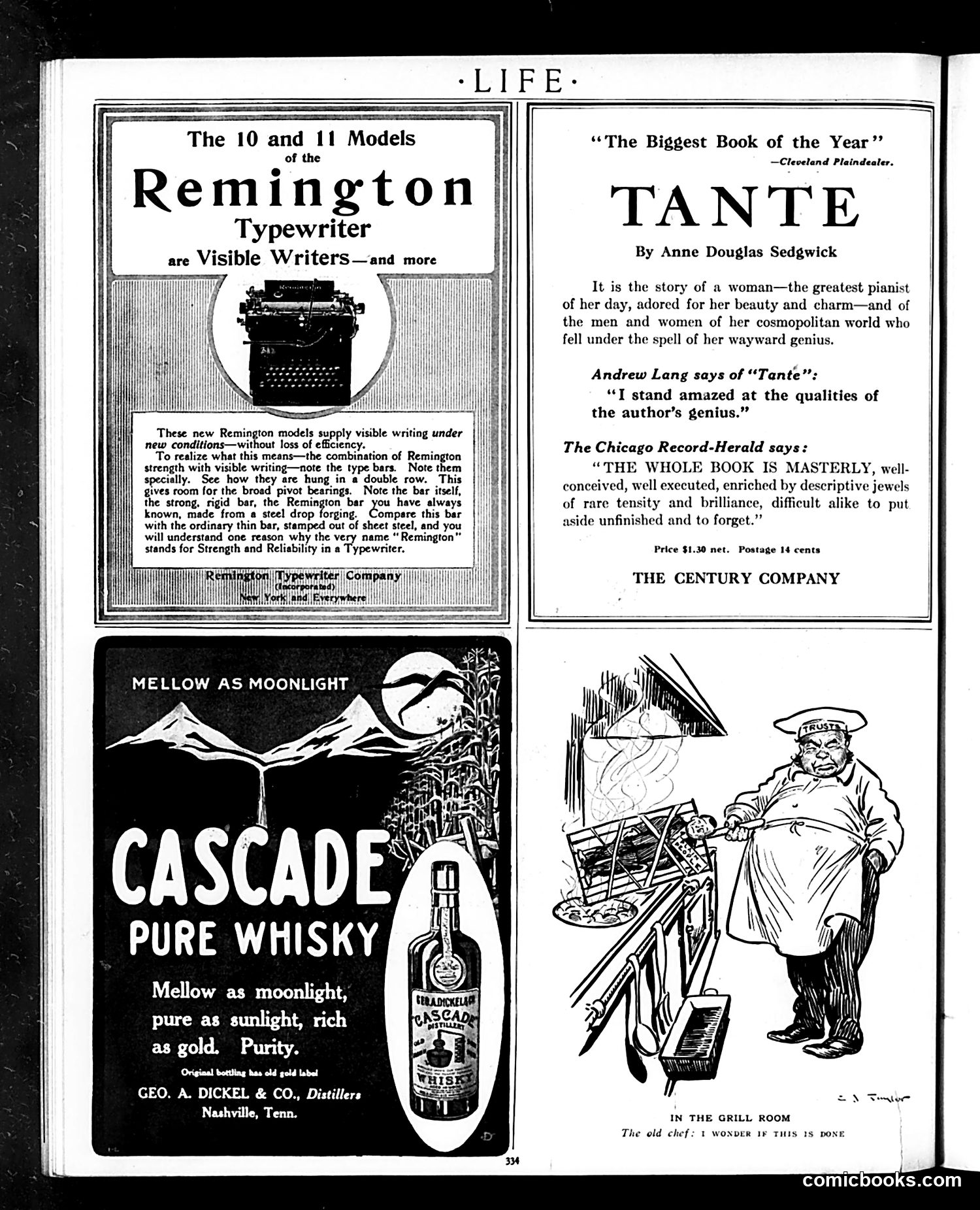
This Life magazine page is primarily **advertising and book promotion** rather than political satire. The top left features a **Remington Typewriter ad** highlighting the "10 and 11 Models" as "Visible Writers," emphasizing the mechanical innovation of visible writing compared to older machines. The top right promotes **"Tanté" by Anne Douglas Sedgwick** as "The Biggest Book of the Year," describing it as a novel about a renowned pianist woman and her cosmopolitan circle. Publisher endorsements praise the author's "genius." The bottom left advertises **Cascade Pure Whisky** from Nashville, using poetic language ("mellow as moonlight, pure as sunlight"). The bottom right cartoon titled **"In the Grill Room"** shows a portly chef or cook with the caption "The old chef: I wonder if this is done"—apparently a visual joke about kitchen uncertainty.
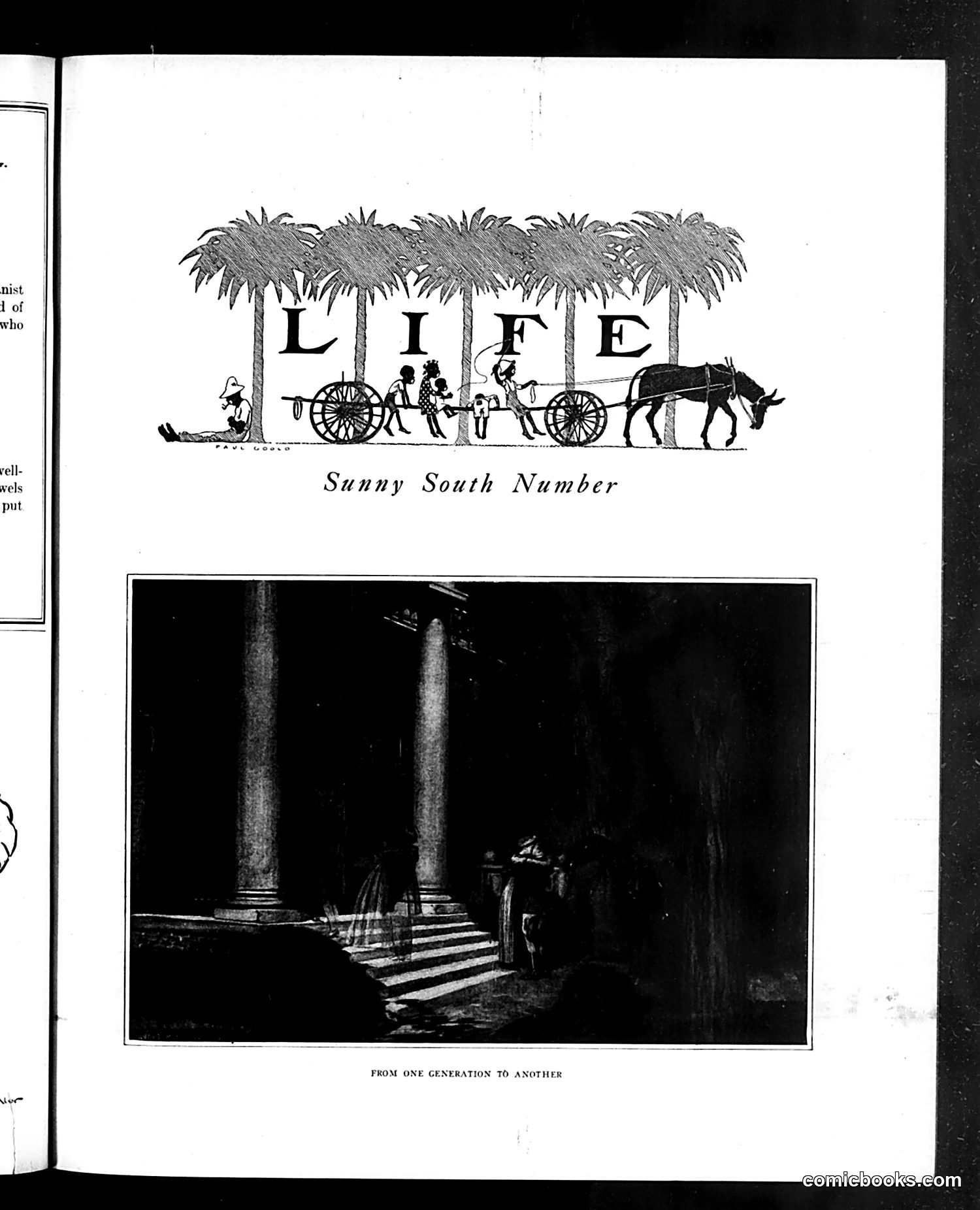
This is a title page for "Life" magazine's "Sunny South Number" issue. The top illustration depicts a romanticized Southern scene with palm trees, leisurely figures in carriages pulled by a horse, suggesting wealth and leisure. The photograph below, captioned "FROM ONE GENERATION TO ANOTHER," shows classical columns in dramatic lighting, likely referencing Southern plantation architecture or grand public buildings. The juxtaposition appears satirical: the decorative header celebrates an idealized, romanticized "Sunny South," while the darker photograph below suggests something more austere or troubling underlying that pleasant image. This likely critiques the disconnect between the South's wealthy, leisured public image and realities of its social/economic structure, though the specific satirical point requires additional context about when this issue was published.
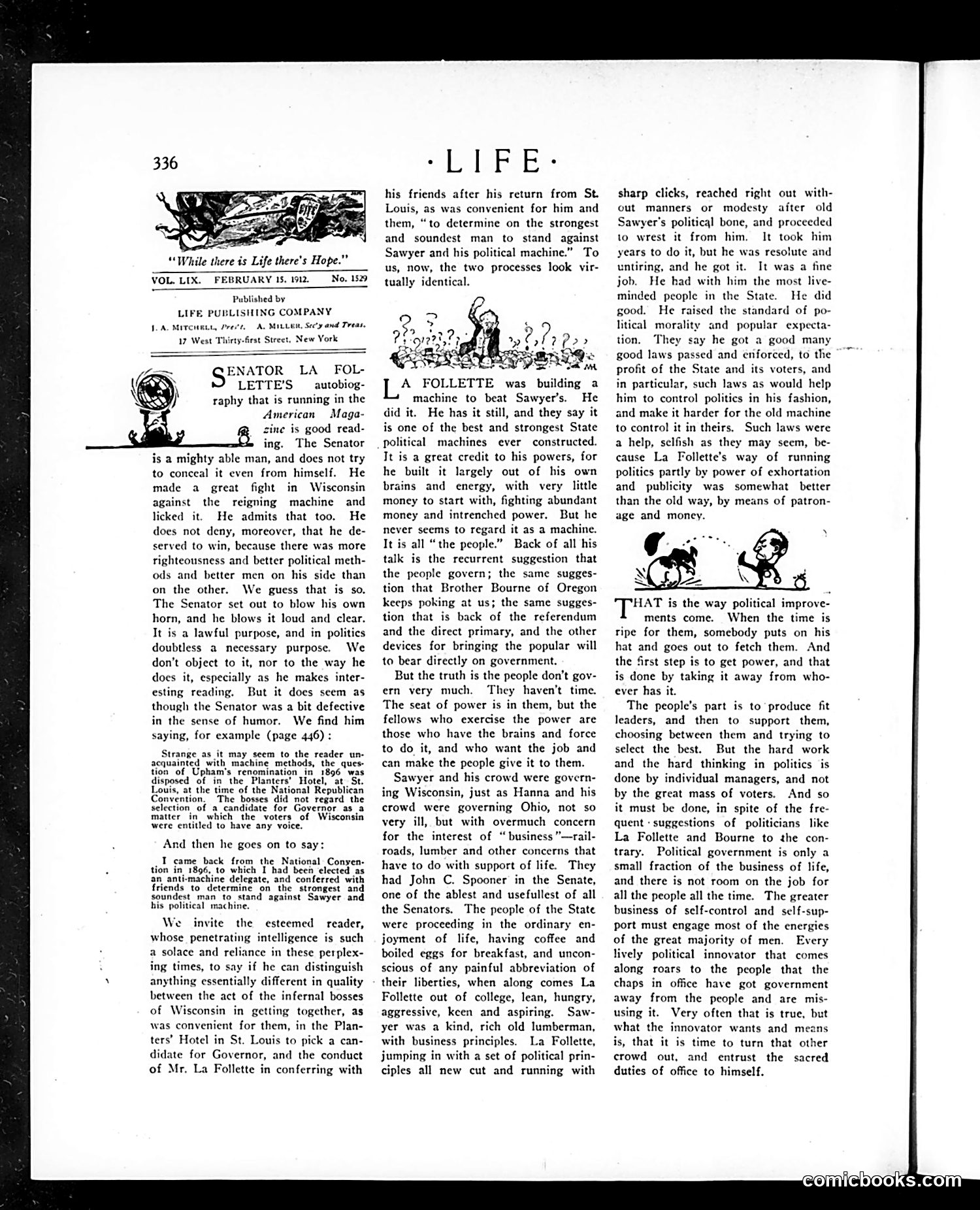
This page criticizes **Senator La Follette** (a prominent Wisconsin Progressive politician) through text and cartoons. The article defends La Follette as a "mighty able man" who fought against political machines, but argues his machine for beating opponent Sawyer was equally powerful. The central point: La Follette built an effective political organization using his own "brains and energy" rather than money, which ironically made him *as dominant* as the traditional machines he opposed. The cartoon (bottom right) illustrates how political improvements occur—through competition and voter choice, not by replacing one machine with another. The piece suggests reformers often become the very thing they fight against, a recurring theme in Progressive Era satire.
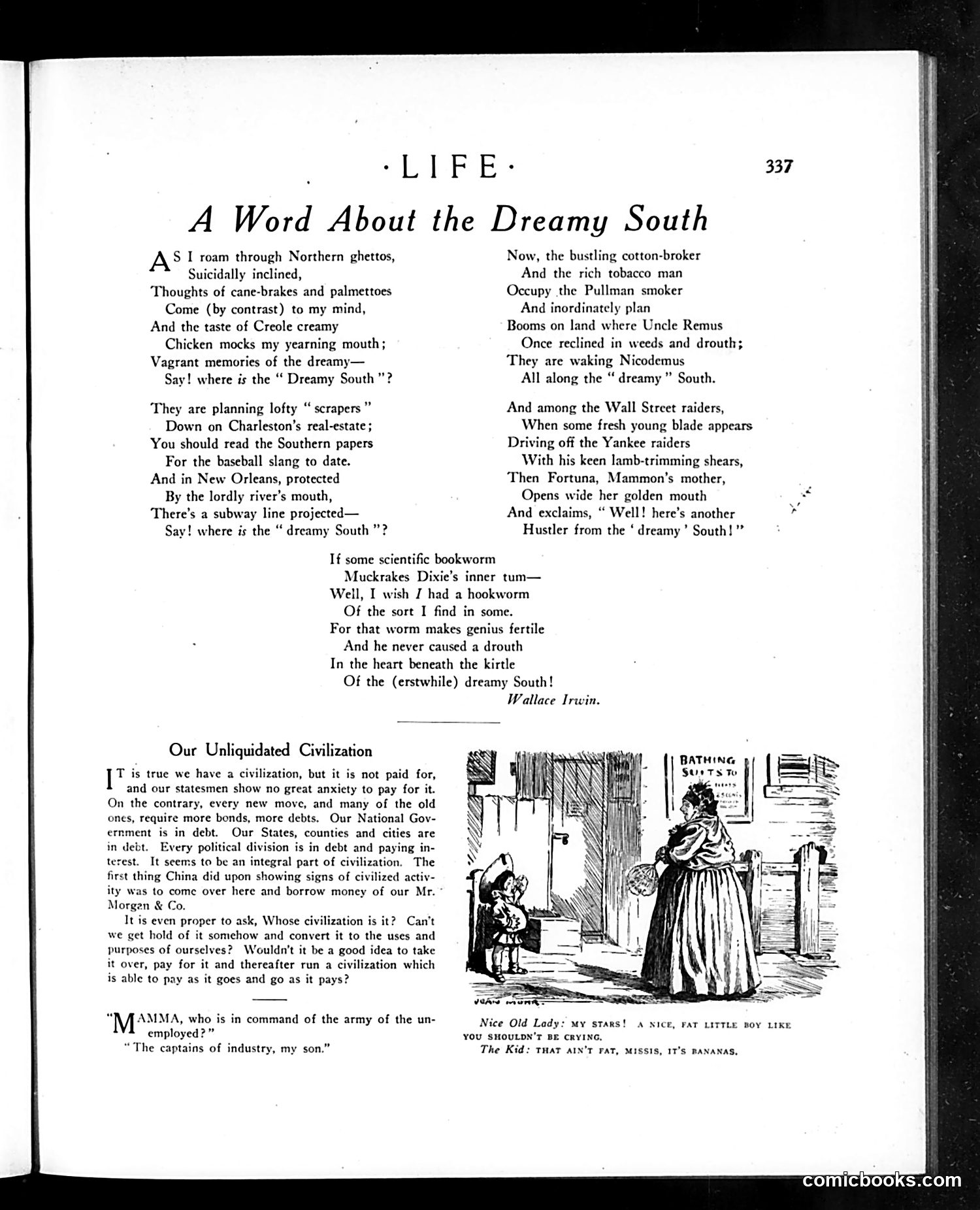
This page contains two distinct pieces: **"A Word About the Dreamy South"** — A poem by Wallace Irwin satirizing the romanticized Old South. It mocks the contrast between nostalgic imagery (cane-brakes, palmettoes, Charleston) and modern reality: "bustling cotton-broker," subway lines, and Wall Street activity replacing the antebellum fantasy. The "dreamy South" is portrayed as a myth that wealthy industrialists now exploit. **"Our Unliquidated Civilization"** — A satirical piece criticizing national debt and government spending. It questions whether American "civilization" is actually paid for, noting that states, cities, and the government are deeply indebted. The accompanying cartoon shows a woman scolding a hungry child for crying, offering "bananas" instead of real food—a visual metaphor for government offering empty promises instead of genuine financial responsibility. Both pieces critique economic illusion masking reality.
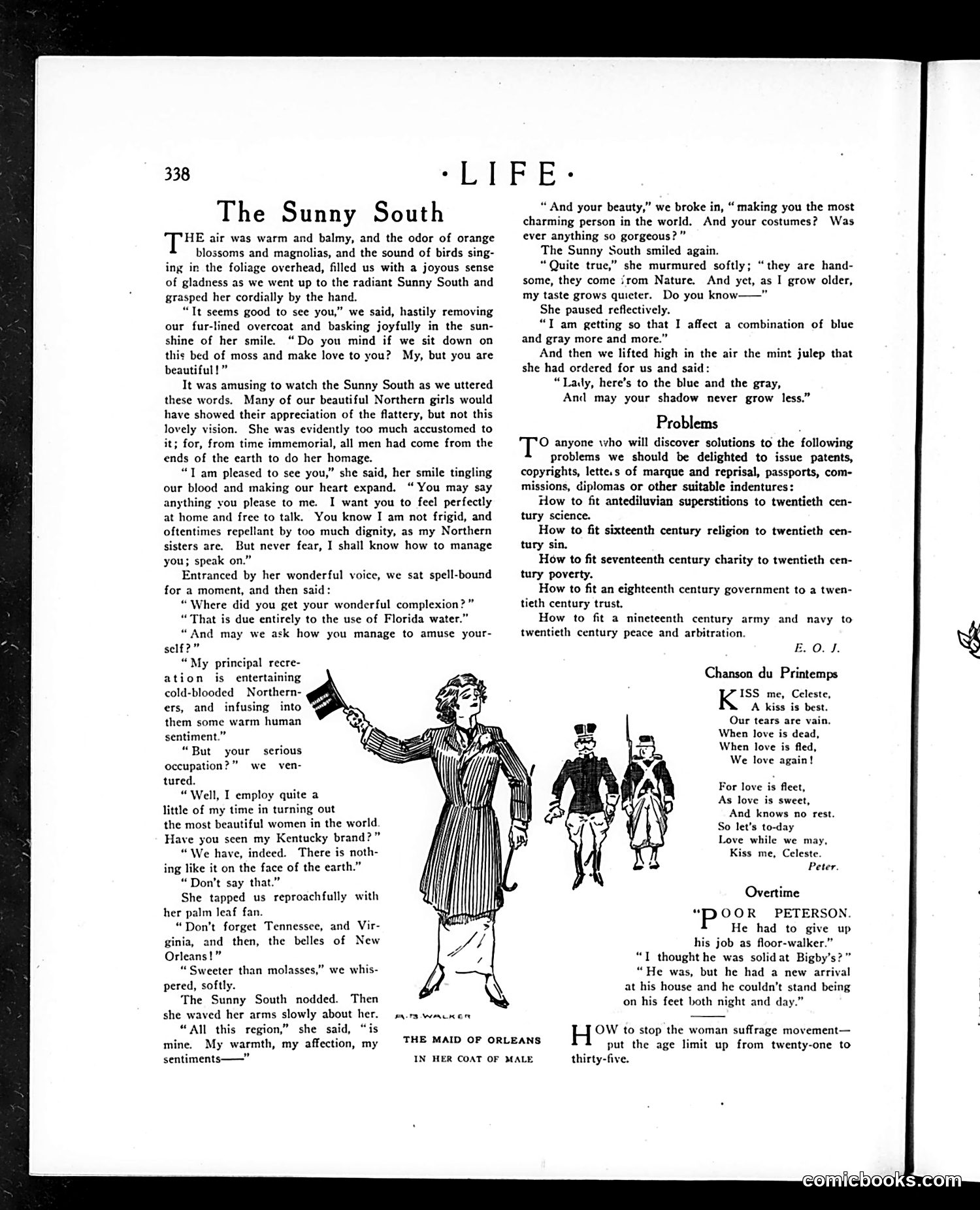
This page contains a short story titled "The Sunny South" depicting a conversation between Northern visitors and a Southern woman. The narrative satirizes Southern gentility and regional attitudes, with the woman defending Southern charm and customs against Northern criticism. The accompanying illustration labeled "The Maid of Orleans in Her Coat of Male" appears to show a woman in masculine military attire, likely referencing Joan of Arc. This seems a visual joke commenting on gender role expectations. Below are separate satirical pieces: "Problems" lists absurd patent/copyright requests (fitting antediluvian superstitions to modern science), "Chanson du Printemps" is romantic poetry, and "Overtime" briefly mocks a woman's employment situation—typical of Life magazine's mixed satirical content addressing gender, labor, and social conventions of the early 20th century.
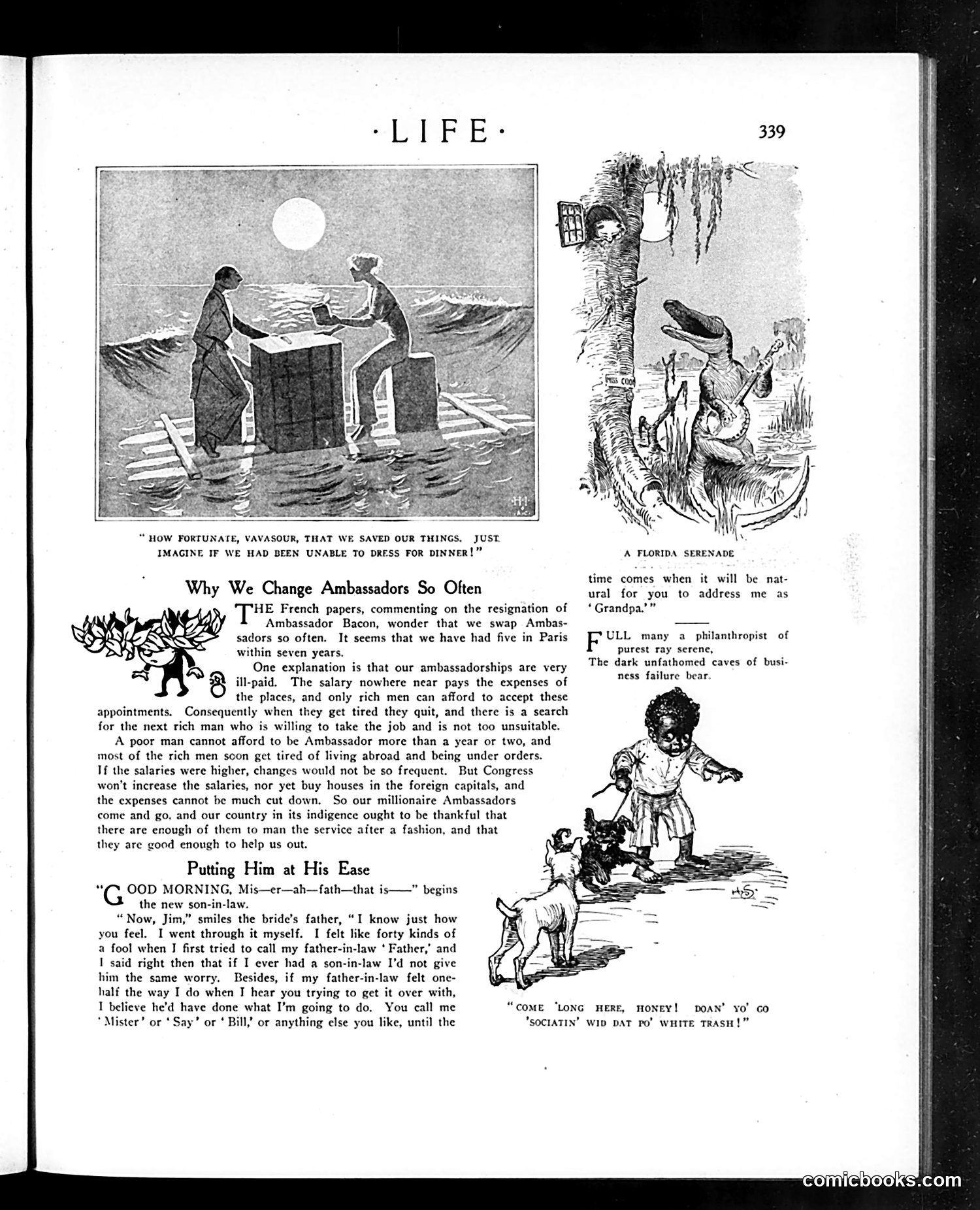
This Life magazine page contains two satirical pieces: **"Why We Change Ambassadors So Often"** critiques the U.S. diplomatic corps as a revolving door for wealthy appointees. The article argues that ambassadorships are poorly paid positions that only rich men can afford, leading them to tire of foreign assignments quickly. Congress won't increase salaries or fund proper housing, so ambassadors constantly rotate. The satire suggests this system leaves America dependent on the goodwill of wealthy dilettantes rather than career diplomats. **"Putting Him at His Ease"** is a humorous domestic scene where a new son-in-law anxiously meets his father-in-law, who reassures him that he needn't worry—the older man feels no anxiety himself. The accompanying sketches show casual family interactions meant to illustrate the comfort of their relationship.
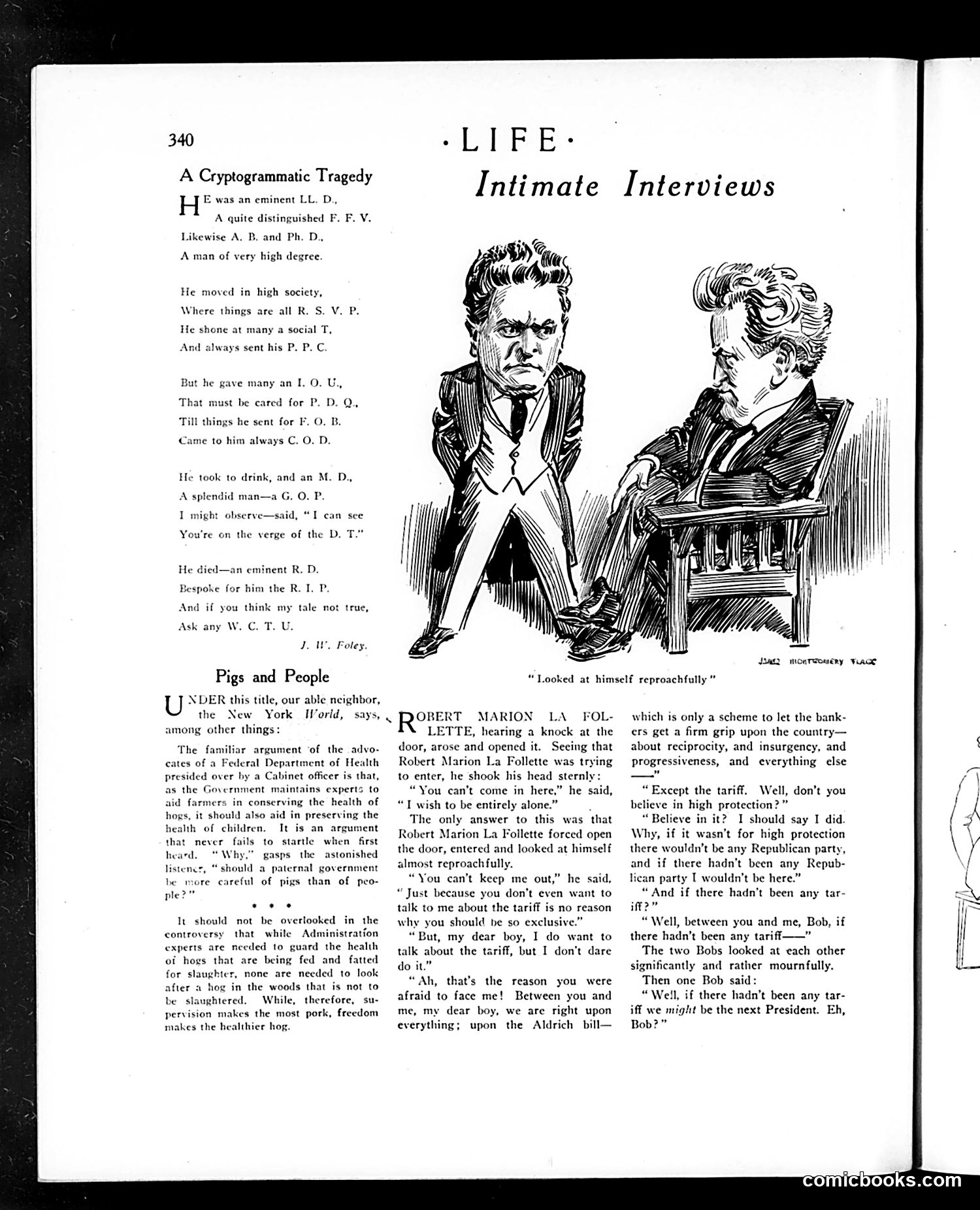
This Life magazine page satirizes bureaucratic acronyms and government complexity through two pieces: **"A Cryptogrammatic Tragedy"** (left) mocks an eminent official who accumulated numerous credentials (LL.D., A.B., Ph.D., M.D., etc.) and moved in elite circles, yet "gave many an I.O.U." The poem jabs at someone of high social standing whose actual character contradicted appearances—he died leaving debts unpaid. **"Pigs and People" / "Looked at himself reproachfully"** (right) depicts Robert Marion La Follette in conversation with another figure, discussing the tariff and Republican Party politics. La Follette was a prominent Progressive senator known for challenging party orthodoxy. The dialogue satirizes political posturing about protectionism and the actual power dynamics between political figures. Both pieces mock pretension: bureaucratic credentials obscuring incompetence, and political rhetoric masking self-interest.
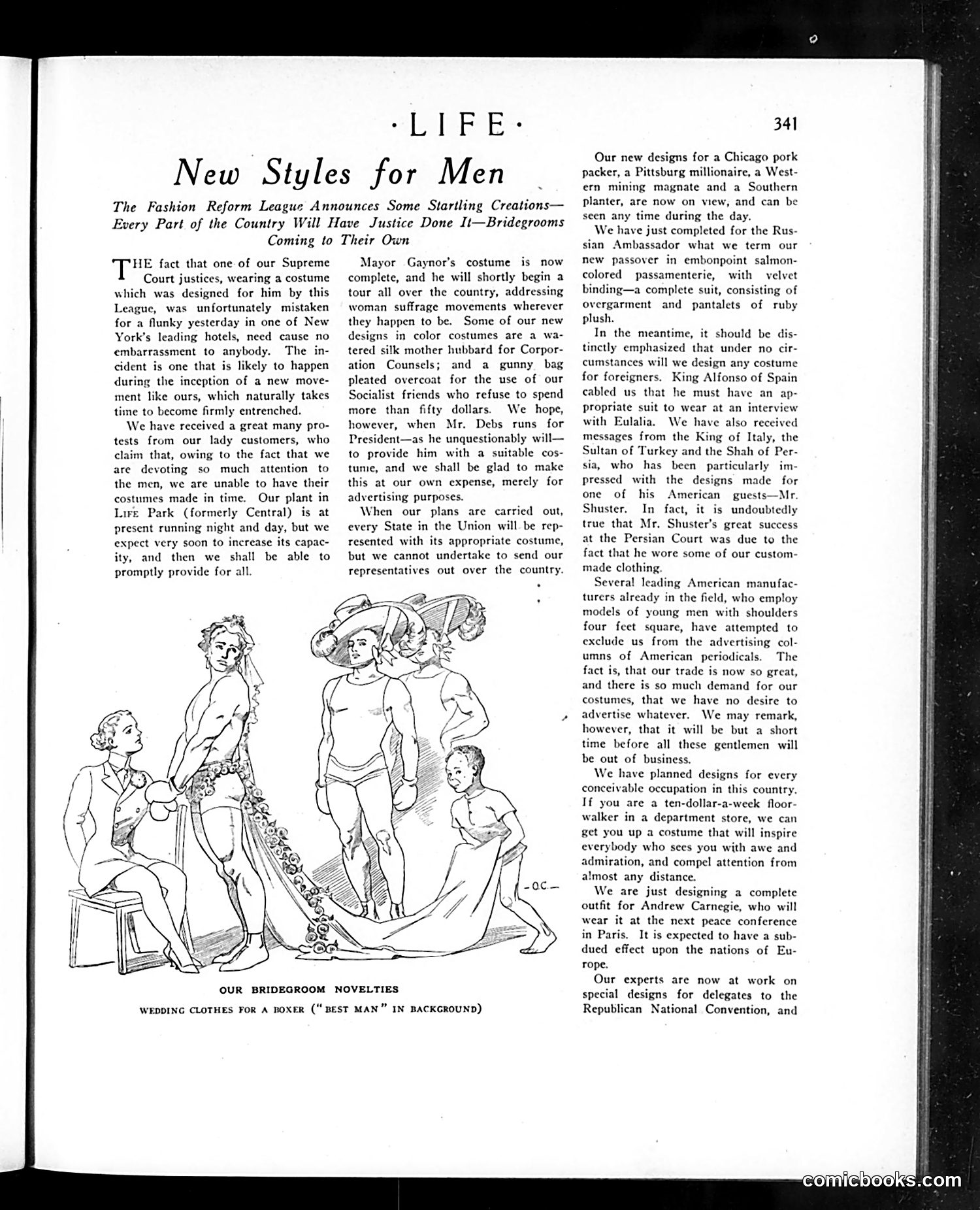
This page satirizes the Fashion Reform League's proposal to redesign men's clothing nationwide. The cartoon shows absurdly elaborate "bridegroom novelties"—wedding costumes featuring decorative elements, flowing fabrics, and ornamental designs typically associated with women's formal wear. The satire targets the reform movement's ambition to create costumes for every profession and social class. The text mocks this overreach, suggesting such impractical designs would be ridiculous for everyday occupations like floor-walkers in department stores. The joke relies on gender inversion: masculine clothing reimagined with excessive ornamentation and feminized silhouettes. By showing these outlandish designs as "best man" attire, Life ridicules the Fashion Reform League's earnest but apparently impractical costume proposals as absurdly unmanly and unmarketable.
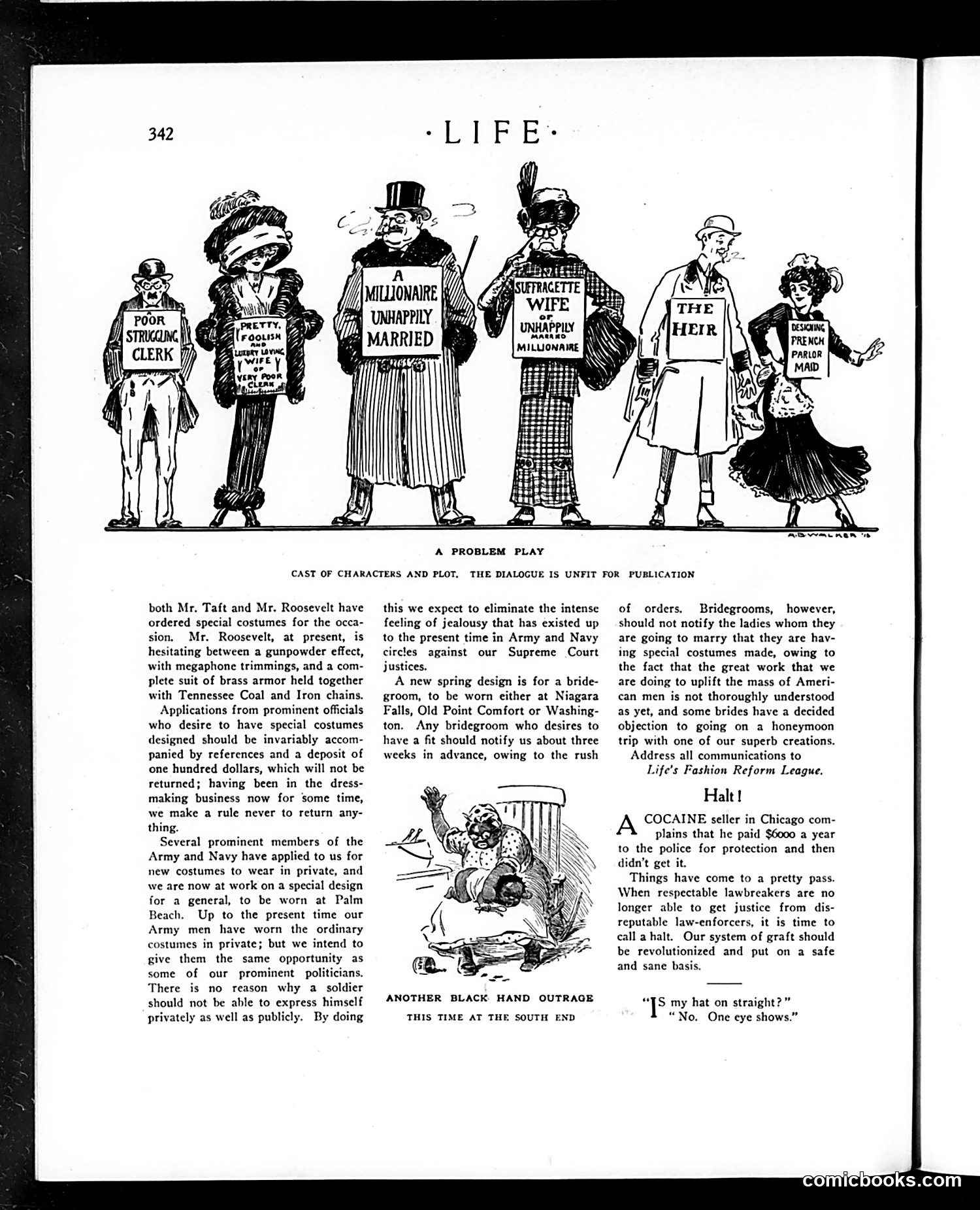
This cartoon satirizes social inequality and class conflict in early 20th-century America. The six figures represent different social positions: a "Poor Struggling Clerk," a "Private" (soldier), an unhappily married millionaire, a "Suffragette Wife of Unhappy Millionaire," "The Heir," and a "French Parlor Maid." The satire suggests that wealth doesn't ensure happiness—the millionaire and his suffragette wife are both miserable despite their money. The cartoon critiques both economic disparities and emerging women's rights activism (suffragettes), presenting them as sources of domestic discord rather than legitimate grievances. The caption notes the dialogue is "unfit for publication," implying scandalous or vulgar exchanges occur among these characters.
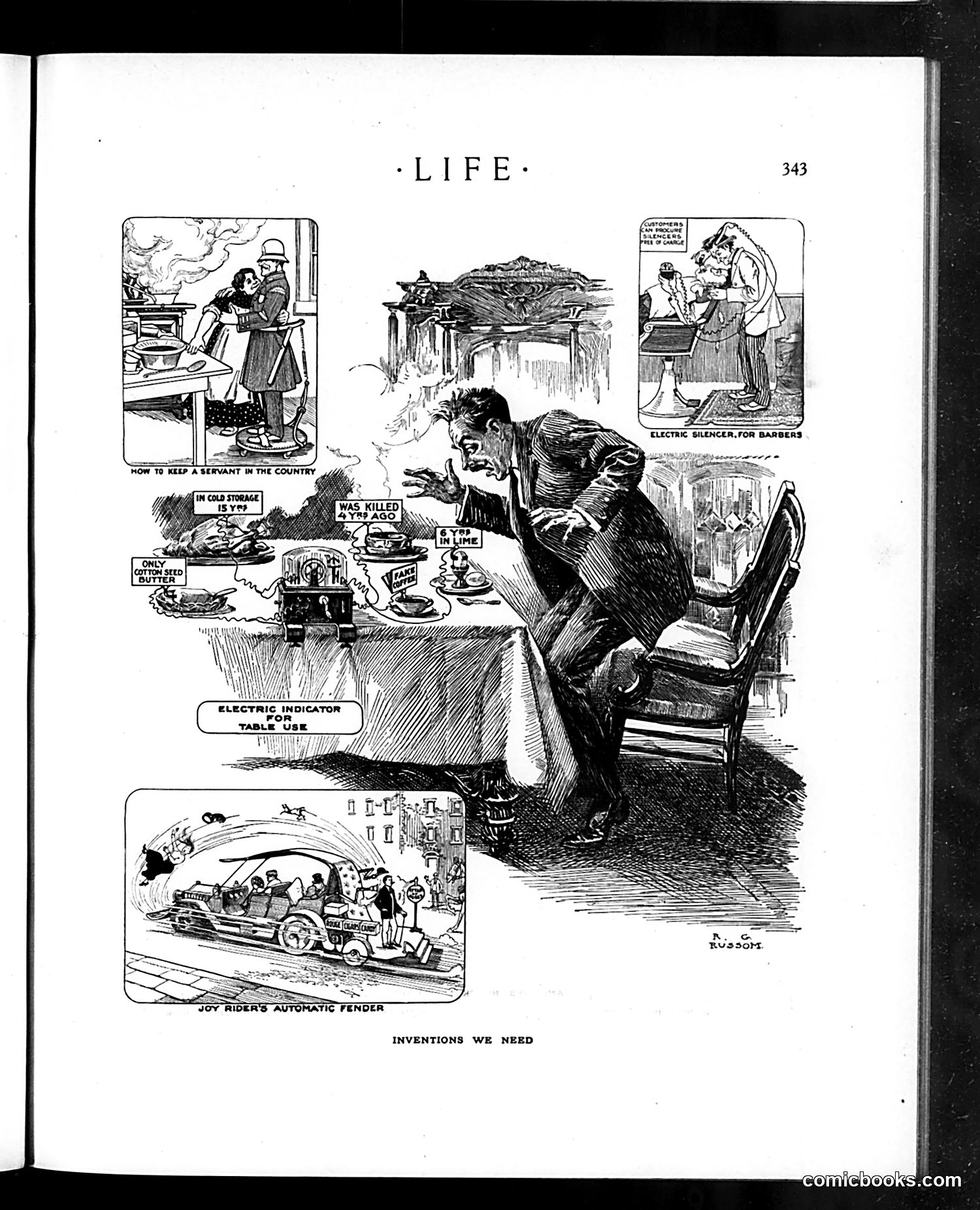
This page satirizes early 20th-century food safety and modern convenience problems through humorous "inventions." The central cartoon shows a man recoiling from spoiled food at a dinner table, surrounded by smaller vignettes depicting absurd solutions: - **"Cold Storage is You?"** - mocking inadequate food preservation - **"Was Killed a Year Ago"** and **"Buried in Lime"** - darkly joking about meat handling - **"Electric Indicator for Table Use"** - a device to detect spoiled food - **"Electric Sleighen for Barbers"** - an unclear convenience device - **"Joy Rider's Automatic Fender"** - a car safety invention The satire critiques both food safety failures of the era and society's obsession with electrical gadgetry as solutions. The grotesque diner's expression conveys horror at what he's eating—likely commentary on unsafe food production and storage practices before modern regulations.
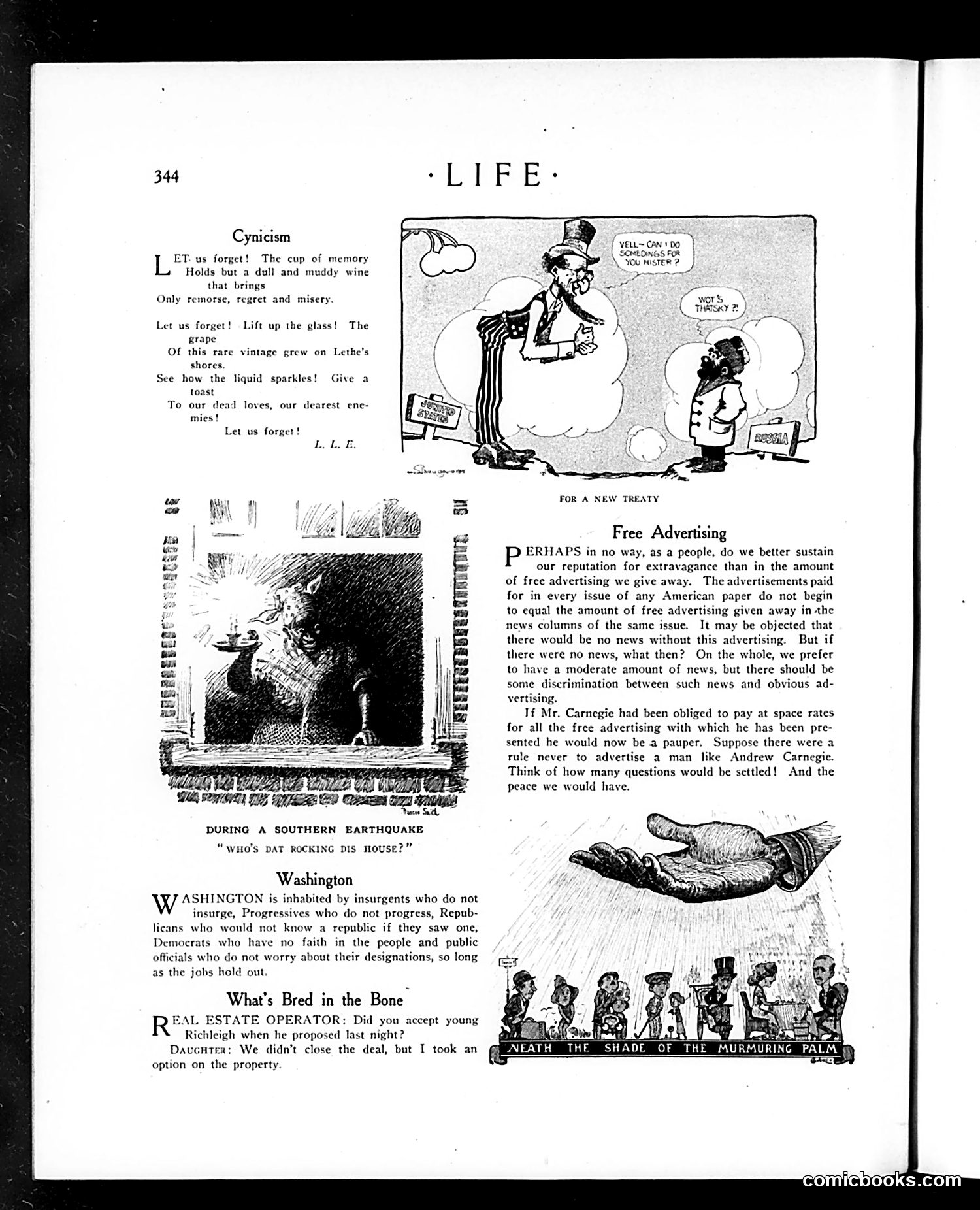
This page from *Life* magazine contains multiple satirical pieces targeting American politics and social hypocrisy circa early 1900s. The **"Washington" section** mocks the capital's political culture, describing inhabitants as fraudulent: insurgents who don't rebel, progressives without progress, republicans ignorant of republicanism, and democrats lacking faith in democracy. It's a scathing critique of political pretense and corruption. The **"Cynicism" poem** advocates forgetting past grievances and toasts to "dead loves" and "dearest enemies"—likely satirizing calls for reconciliation (possibly post-Civil War or after political conflicts) as mere escapism masking unresolved bitterness. The **earthquake cartoon** shows residents confused during tremors, one asking "who's dat rocking his house?"—a racial-stereotype humor piece. The **"Free Advertising" essay** criticizes newspapers for giving unpaid promotional coverage to wealthy industrialists like Andrew Carnegie, allowing them to dominate news columns without expense—a critique of media-wealth collusion. The **"What's Bred in the Bone"** joke satirizes treating marriage proposals as real estate transactions requiring negotiation and "options."
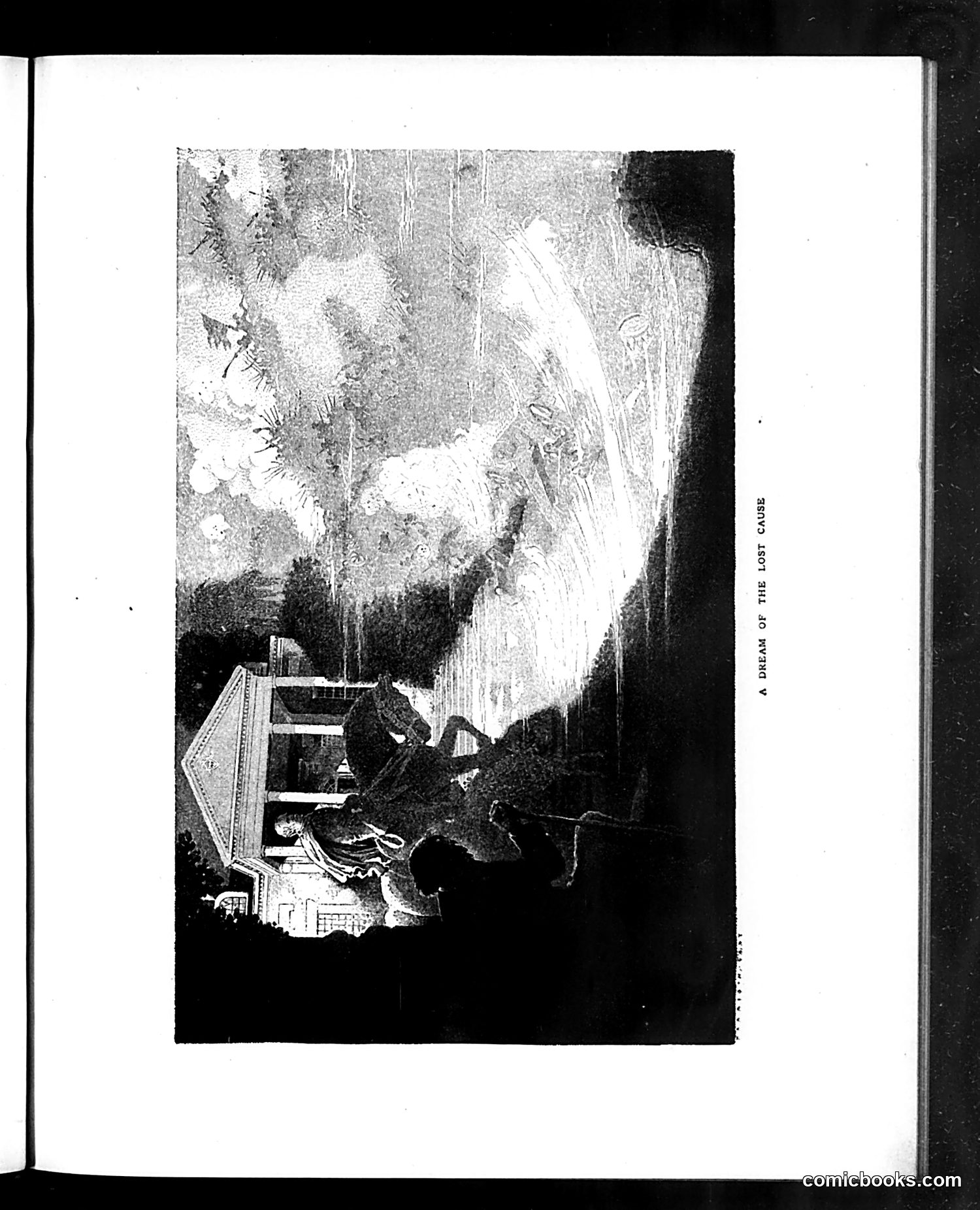
I can see this is a black and white illustration labeled "A DREAM OF THE LOST CAUSE" on the right margin. The image shows a dramatic nighttime scene with a figure sleeping or reclining in the foreground, while a ghostly or ethereal white form appears above in the darkness, possibly representing a dream or vision. However, the OCR text is largely illegible and doesn't provide clear context. Without readable accompanying text, I cannot confidently identify the specific political or social references, the figures depicted, or the satirical point intended. The title suggests this relates to "the Lost Cause" — likely the American South's post-Civil War mythology — but I cannot determine the exact nature of the satire from the image alone.
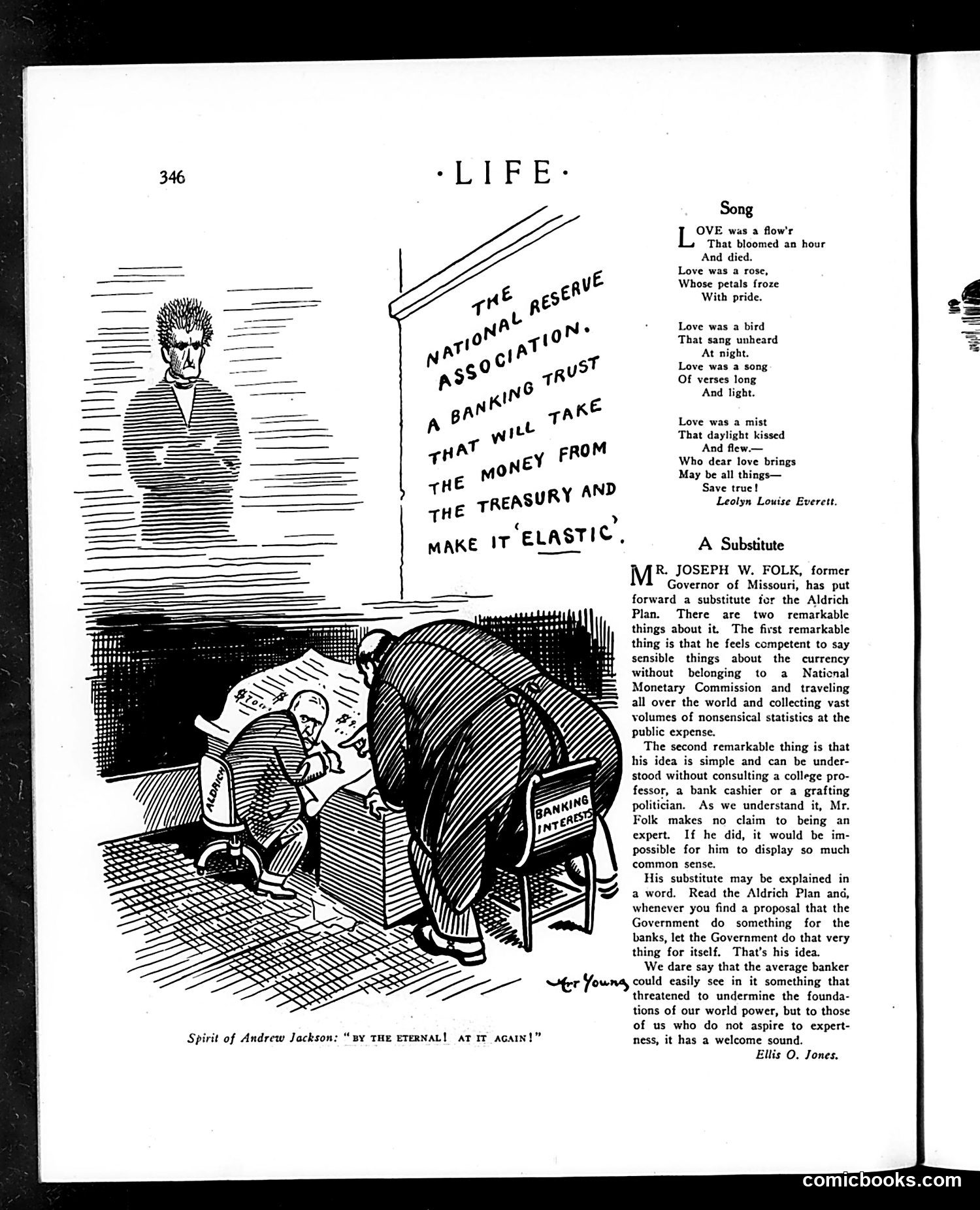
This 1910s-era *Life* magazine cartoon satirizes debates over banking reform. The main illustration shows Andrew Jackson's ghost (identified by the caption) confronting a bloated banker sitting atop a massive money chest labeled "Banking Interests." The cartoon references Joseph W. Folk's alternative to the **Aldrich Plan**—a proposed banking reform. Jackson, a historical figure famous for opposing centralized banking power, is invoked as validation of Folk's simpler approach: rather than letting banks dictate government monetary policy, the government should manage currency itself. The satire mocks the banking establishment's complexity and self-interest. The text argues Folk's proposal is refreshingly sensible because he's *not* an expert bureaucrat—he doesn't obfuscate with jargon. The caption "By the eternal! At it again!" suggests Jackson would recognize banks still manipulating government, just in updated form. The page also includes a sentimental poem about love (unrelated to the political content).
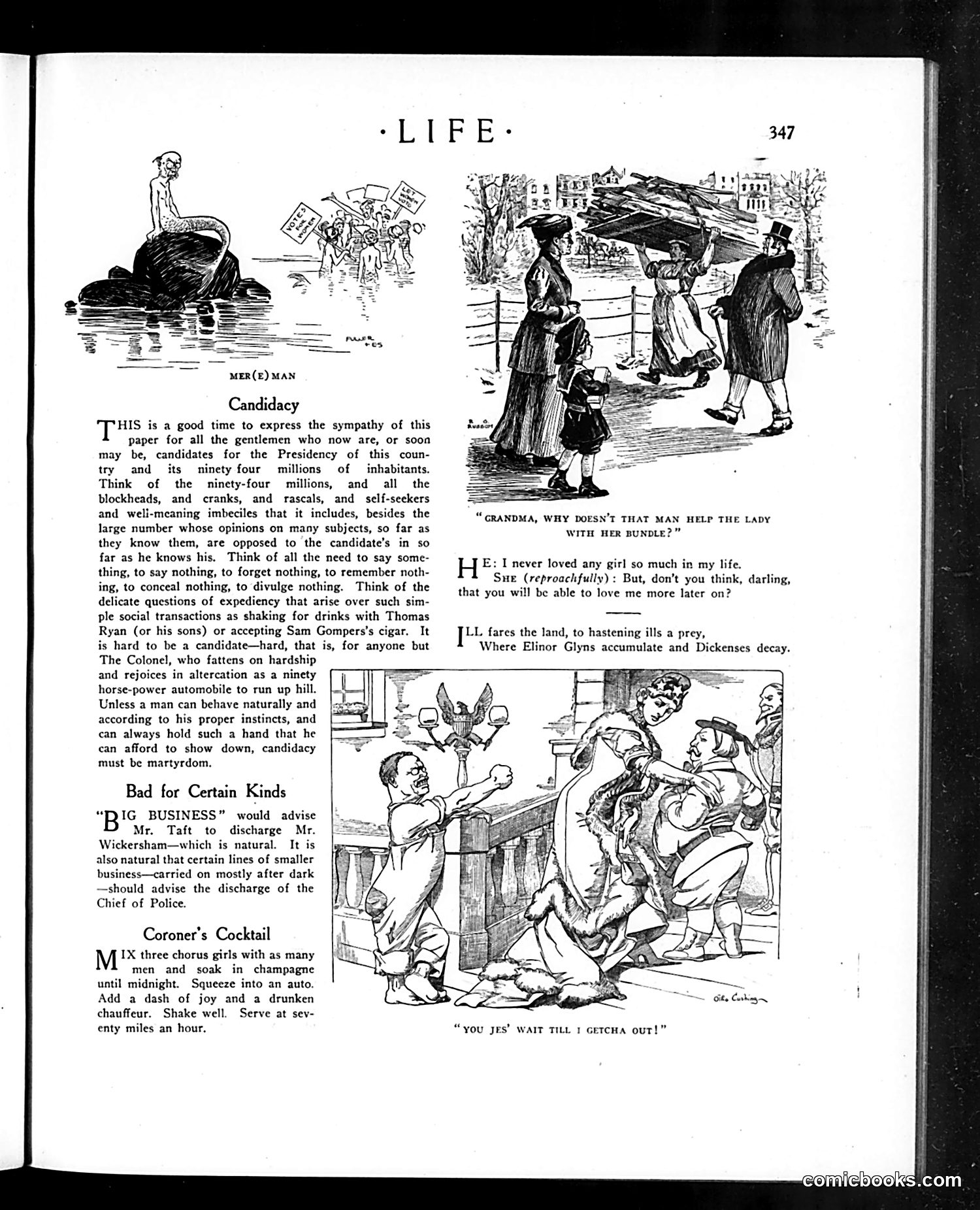
This page contains **satirical commentary on American politics and society**, circa early 1900s. **"Candidacy"** mocks presidential candidates by listing the impossible contradictions they face: managing ninety-four million citizens with conflicting views, navigating social obligations (shaking hands with wealthy industrialists like Thomas Ryan, accepting cigars from labor leader Sam Gompers), and maintaining perfect public behavior. The satire suggests candidacy is inherently martyrdom. **"Bad for Certain Kinds"** appears to reference **William Howard Taft** and his Attorney General **Wickersham**, suggesting "Big Business" wants Wickersham fired (likely regarding trust-busting), while simultaneously criminal enterprises want the Police Chief discharged—highlighting hypocrisy across social classes. The cartoons and jokes below address leisure, romance, and morality—including references to novelist **Elinor Glyn** (associated with risqué romance) and depicting wild automobile parties and romantic infidelity. These satirize modern urban excess and changing social mores of the Jazz Age.
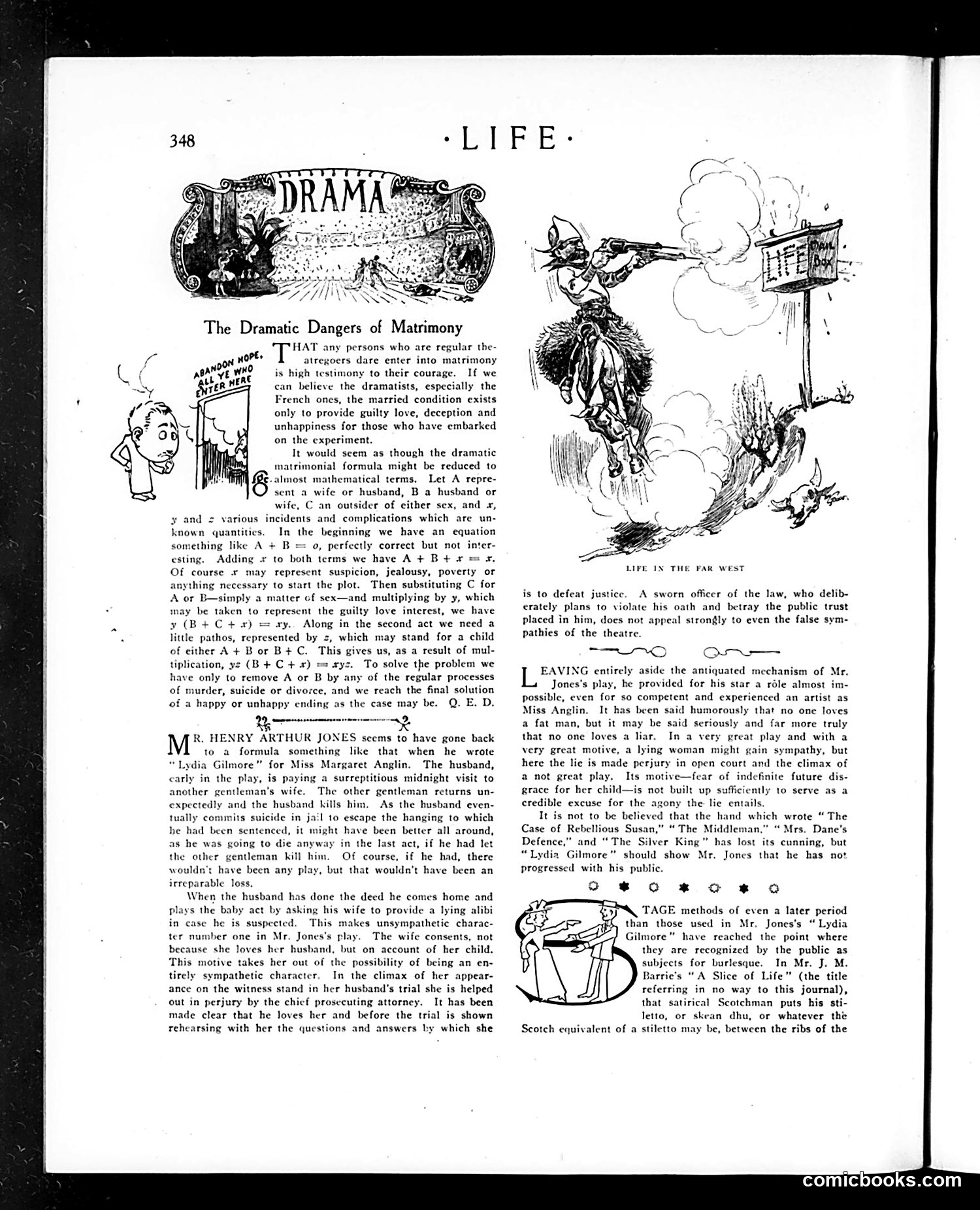
This page critiques the formulaic nature of French theatrical drama, particularly plays about marriage. The text argues that dramatists reduce marital plots to a mathematical equation: a wife (A) plus husband (B) plus an outside lover (C), multiplied by guilt and complications, inevitably resolved through murder, suicide, or divorce. The critique then focuses on Henry Arthur Jones's play "Lydia Gilmore," starring Margaret Anglin. The reviewer objects that the plot—involving a husband who kills a rival, then asks his wife to commit perjury to save him—creates deeply unsympathetic characters. A police officer who helps her commit perjury particularly offends. The fundamental problem: a lying woman cannot gain audience sympathy, even in a "great play with a great motive." Here, her lie becomes courtroom perjury for mere "indefinite future disgrace"—insufficient moral justification. The satire targets both hackneyed theatrical formulas and this specific play's failure of dramatic logic.
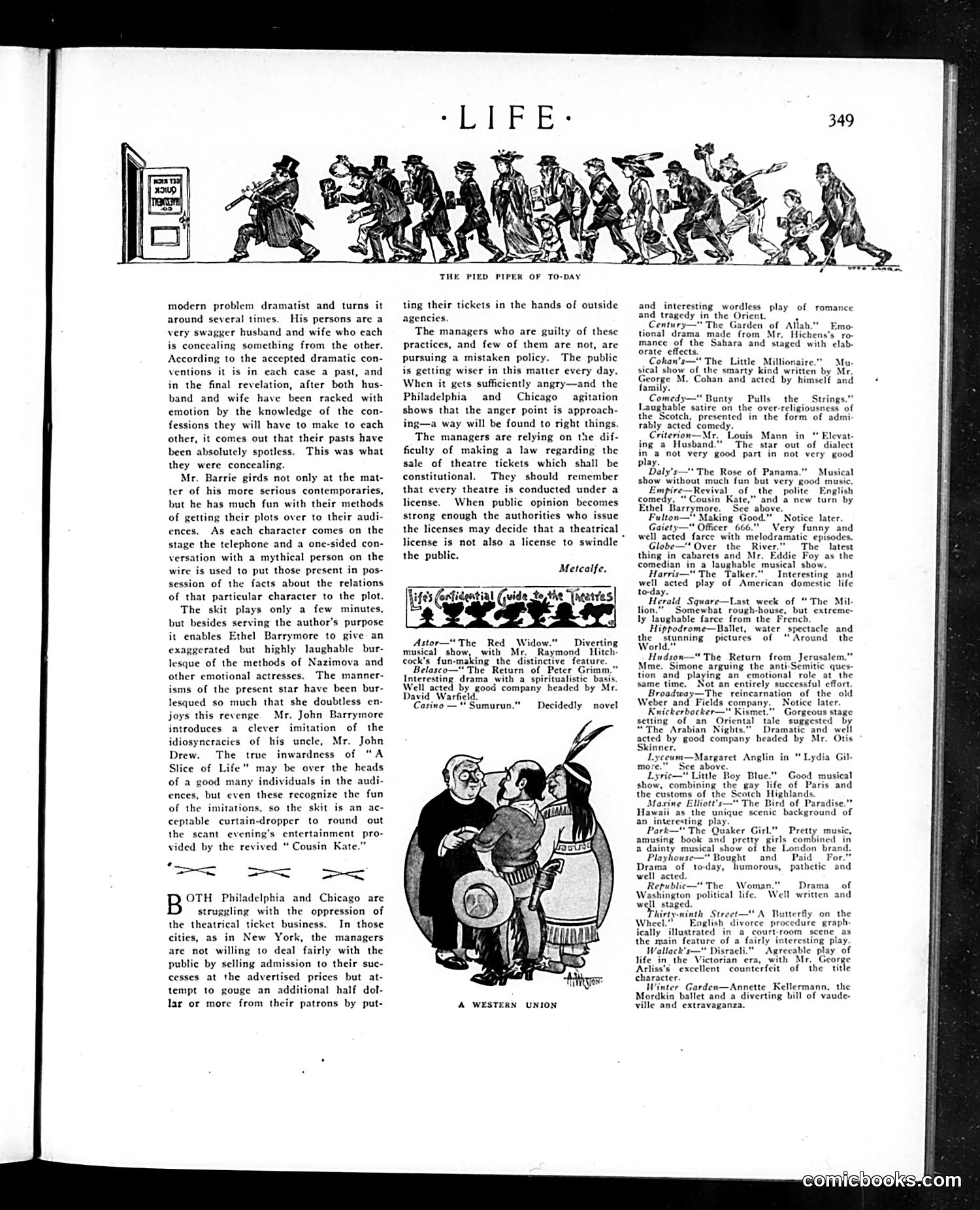
This page contains theater criticism and satire from an early 20th-century American magazine. The main cartoon—"The Pied Piper of To-Day"—appears at the top, depicting a procession of figures following someone, likely satirizing theatrical management or ticket-scalping practices. The text's primary focus is criticizing theater ticket scalping. Managers in Philadelphia and Chicago are selling tickets through outside agencies at inflated prices beyond advertised costs. The critic argues this is a "mistaken policy" that angers audiences and violates the public trust. He suggests theaters operate under city licenses, implying authorities could revoke these licenses if ticket fraud continues. The page also reviews current Broadway productions, including shows starring Ethel Barrymore and John Barrymore, praising their parodies of contemporary dramatic conventions and emotional acting styles. The satire targets theatrical management corruption and the power dynamics between public and corporate interests.
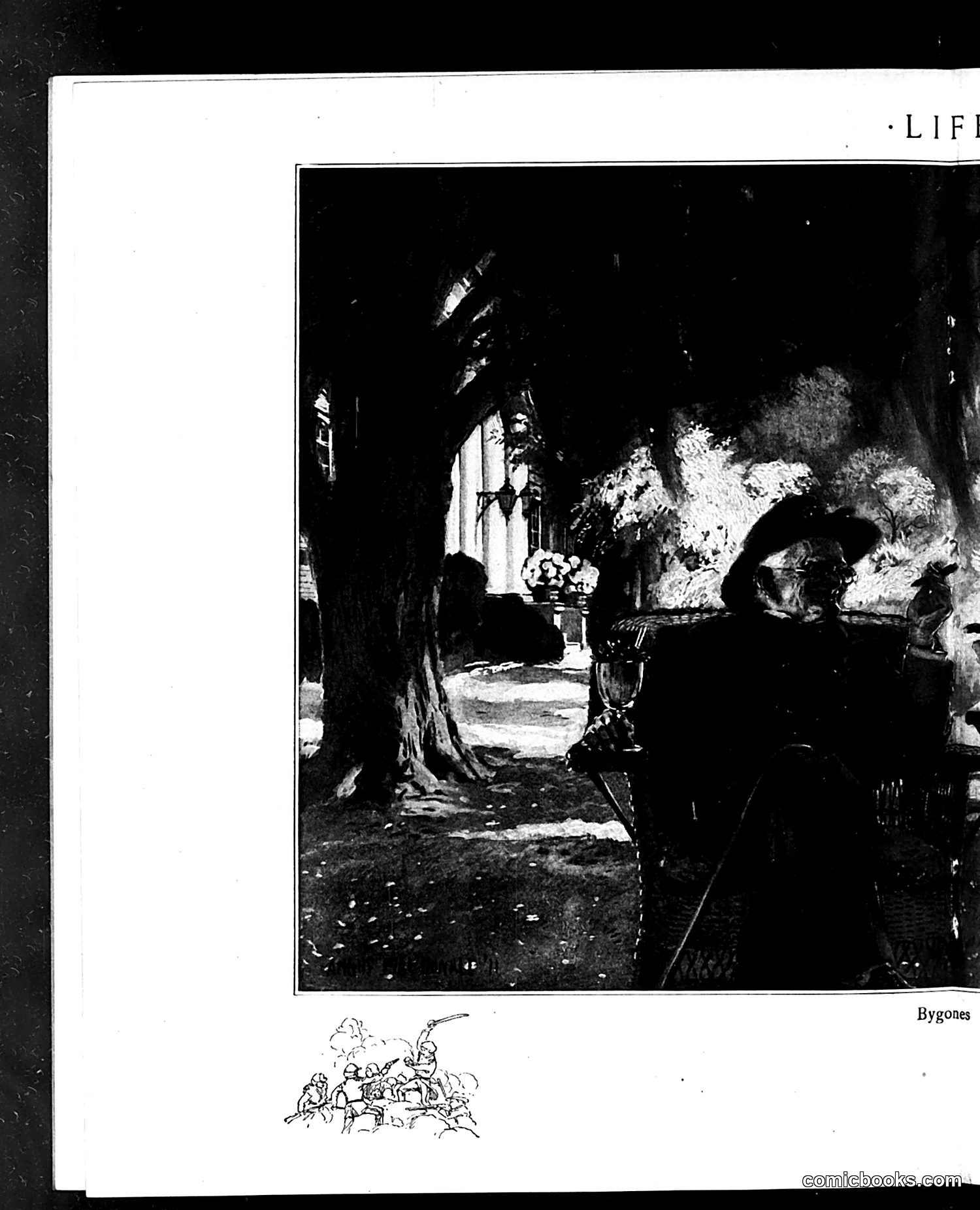
This page appears to be from LIFE magazine's "Bygones" section, which typically featured historical or nostalgic content. The image shows a dramatic black-and-white photograph of what appears to be a classical or theatrical scene—possibly depicting a historical moment or staged reconstruction. The scene shows figures in period costume within an archway or classical setting, with dramatic lighting creating strong contrasts between light and shadow. Without additional caption text visible on this particular page, the specific historical event or theatrical production being referenced is unclear. The small decorative illustration at the bottom appears to be a signature or section marker typical of LIFE's design elements from this era. The page's purpose seems educational or nostalgic rather than overtly satirical.
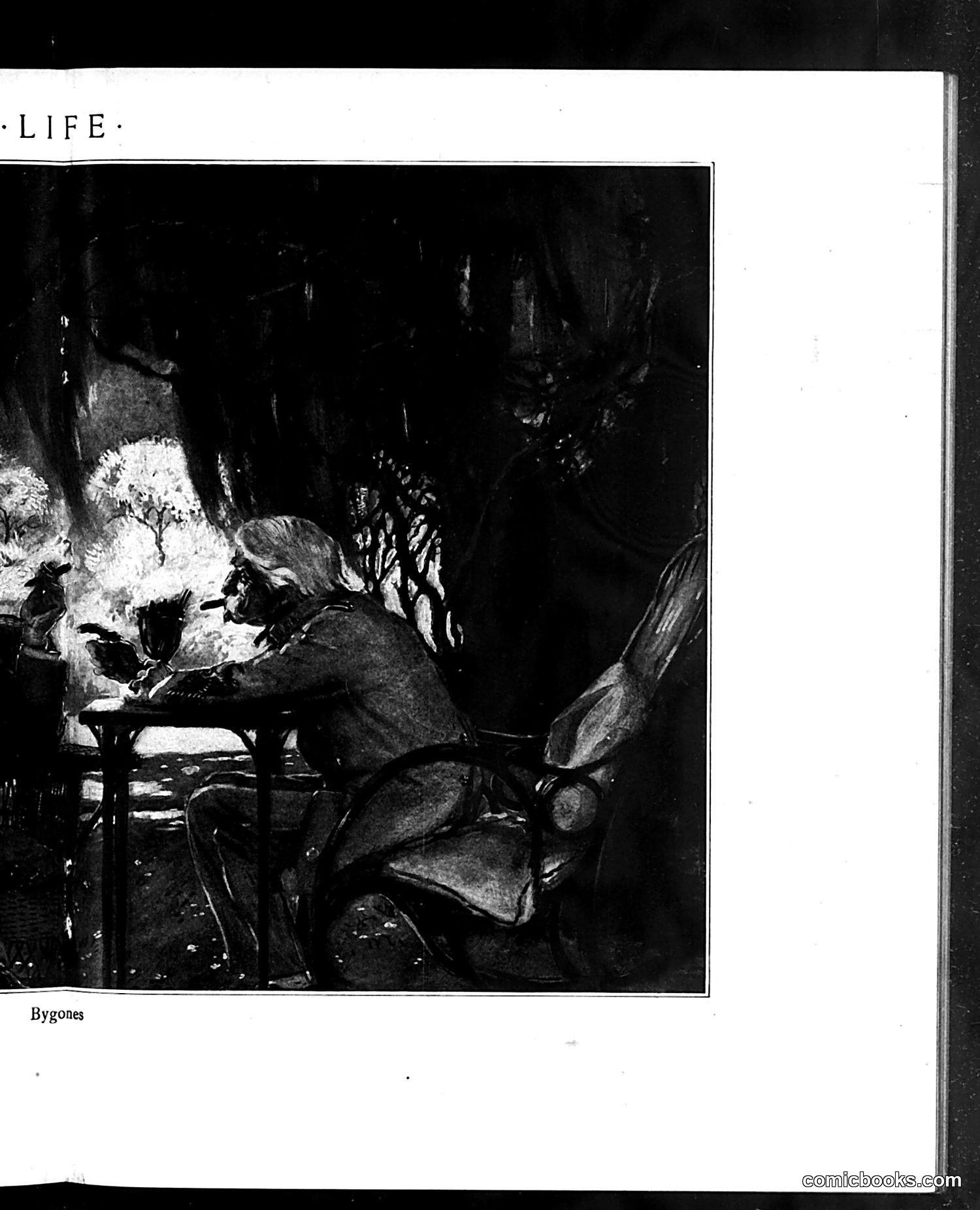
This page shows a black and white illustration titled "Bygones," depicting what appears to be a figure in dark clothing seated indoors near a window, with foliage visible outside. The image's stark, dramatic lighting and shadowy composition suggest a somber or melancholic mood. Without additional context or clearer OCR text, the specific political or social commentary is unclear. The title "Bygones" suggests reflection on past events or nostalgia, possibly satirizing sentimental longing or outdated attitudes. The figure's posture—seated, seemingly contemplative—may comment on passivity or dwelling on the past rather than engaging with present concerns. The illustration's style and publication in *Life* magazine indicates it was meant as social commentary, but the exact satirical target remains difficult to determine from this image alone.
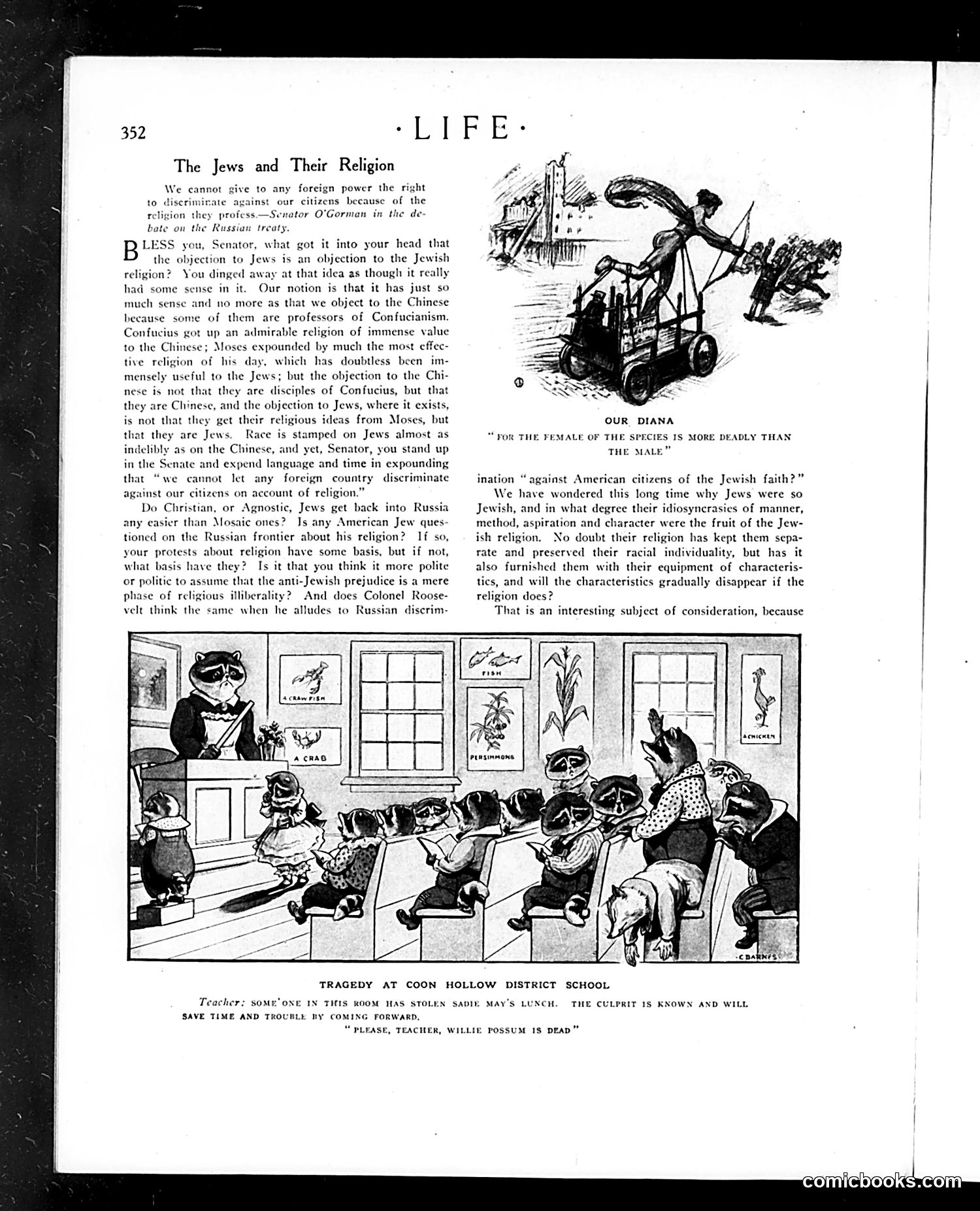
**Main Editorial:** This piece satirizes Senator O'Gorman's argument that opposition to Jews stems from religious prejudice. The author contends that anti-Jewish sentiment is actually racial/ethnic discrimination, not religious objection—comparing it to prejudice against Chinese people. The satire mocks the Senator for mischaracterizing the problem, suggesting that even converts to Christianity still face Russian discrimination, proving religion isn't the actual issue. **"Our Diana" Cartoon:** References Kipling's line about female aggression. The sketch shows a woman in a shooting/hunting pose, likely satirizing female militancy or the suffrage movement's assertiveness. **"Tragedy at Coon Hollow":** A classroom scene where children gather while a teacher addresses theft. The title and setting ("Coon Hollow") employ period racial stereotyping in dialect humor—common in early 20th-century American magazines but now recognized as offensive caricature.
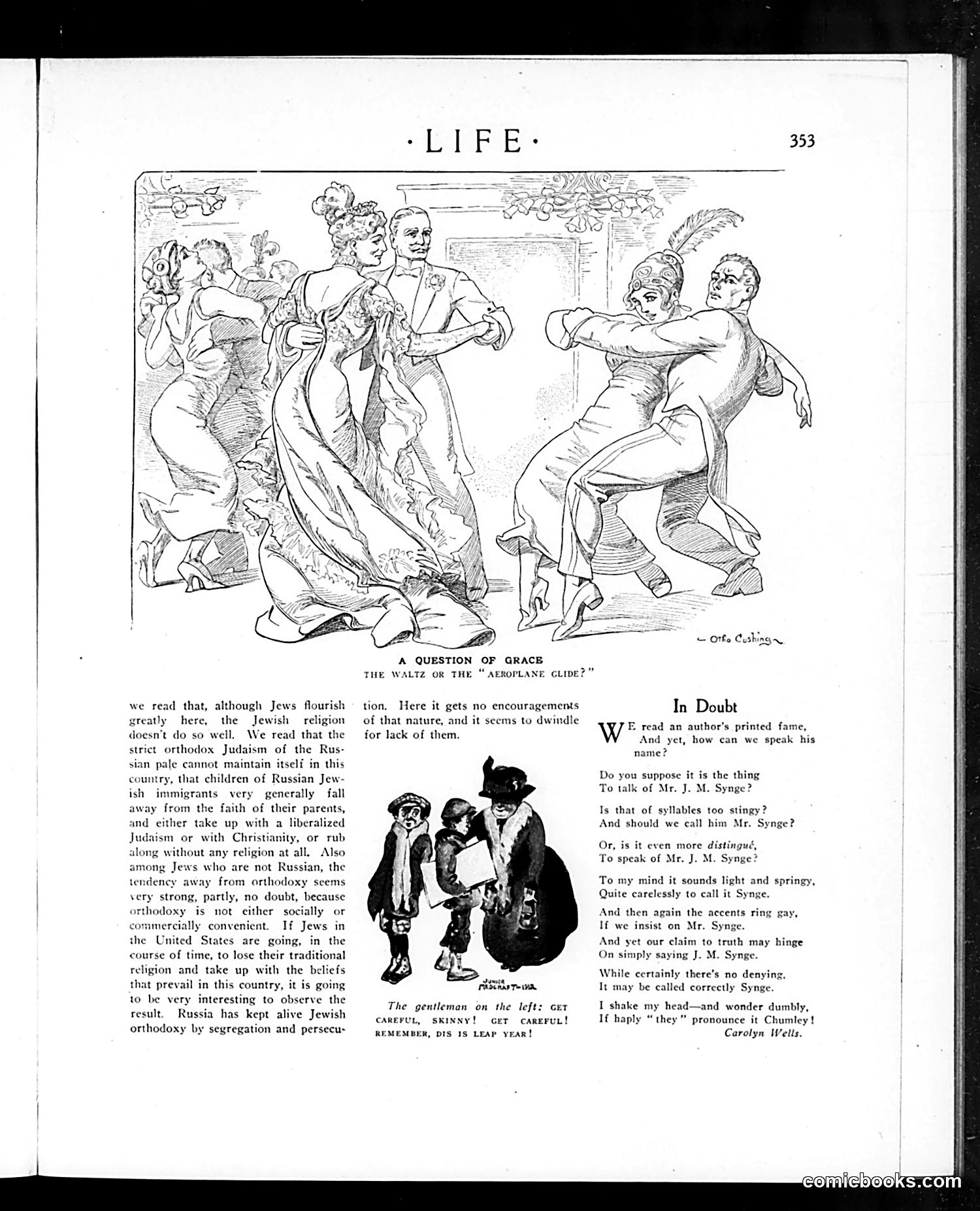
**Top Cartoon ("A Question of Grace"):** This satirizes social dancing etiquette. A well-dressed couple performs an awkward dance while others watch. The caption warns a thin man to "get careful" about dancing with women during a leap year—a reference to the tradition that women could propose to men in leap years. The joke mocks both the precariousness of social propriety and anxiety about gender role reversals. **Article (left column):** Discusses how Jewish immigrants to America are abandoning Orthodox Judaism, unlike in Russia where persecution maintained religious orthodoxy. The piece observes this assimilation trend with detached curiosity—treating religious erosion as a natural consequence of American freedom and commercial convenience. **"In Doubt" (right column):** A humorous poem by Carolyn Wells about pronunciation uncertainty regarding Irish playwright J. M. Synge's name. It plays on whether to use "Mr. Synge," "J. M. Synge," or just "Synge," treating his name's proper pronunciation as a social anxiety—a lighthearted riff on pretension.
This page is primarily a **book review section** titled "Confidential Book Guide," not a political cartoon. It reviews contemporary literature (circa 1910s), including works by George Bernard Shaw, J.M. Barrie, and others. The featured article discusses **Edward Gordon Craig**, described as a "Practical Idealist"—a theater director and designer. The text praises Craig as an uncomfortably visionary figure in theater who was underappreciated in his own country but whose influence eventually spread across Europe. He's characterized as someone who bridges the gap between impractical dreamers and practical businesspeople, able to see two opposing viewpoints simultaneously. The satire is gentle: the author humorously describes how society treats visionaries (with patronizing admiration) versus practical people (with grudging respect), positioning Craig as someone rare who combines both qualities effectively. This is **literary journalism**, not political satire or cartooning.
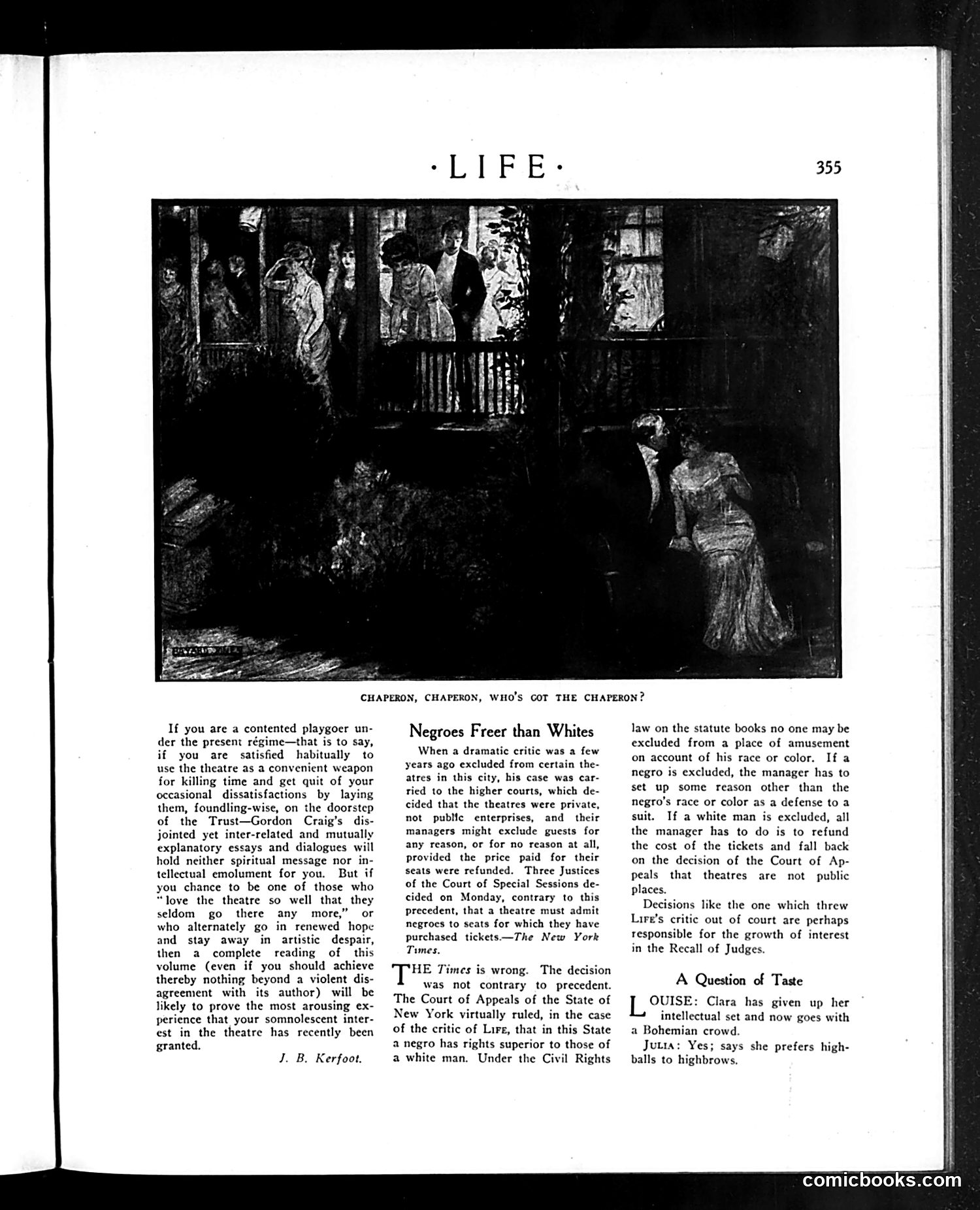
This page satirizes racial discrimination in New York theaters circa the early 1900s. The main article "Negroes Freer than Whites" discusses a court case where Black patrons were denied theater seats. Life's editorial position is bitter and ironic: while courts ruled theaters are "private" institutions (allowing them to exclude a white theater critic without refunding), the same courts granted Black patrons legal rights to purchase seats based on Civil Rights law. Life's satire highlights the absurdity: theaters can exclude whites arbitrarily but cannot exclude Black customers for racial reasons alone—making Black patrons technically have *superior* legal protections, though obviously not in practice. The author suggests this legal inconsistency fuels calls to recall judges. The cartoon at top ("Chaperon, Chaperon, Who's Got the Chaperon?") appears unrelated—a domestic social scene—suggesting this was a typical mixed-content magazine page combining theater criticism, satire, and lighter social commentary.
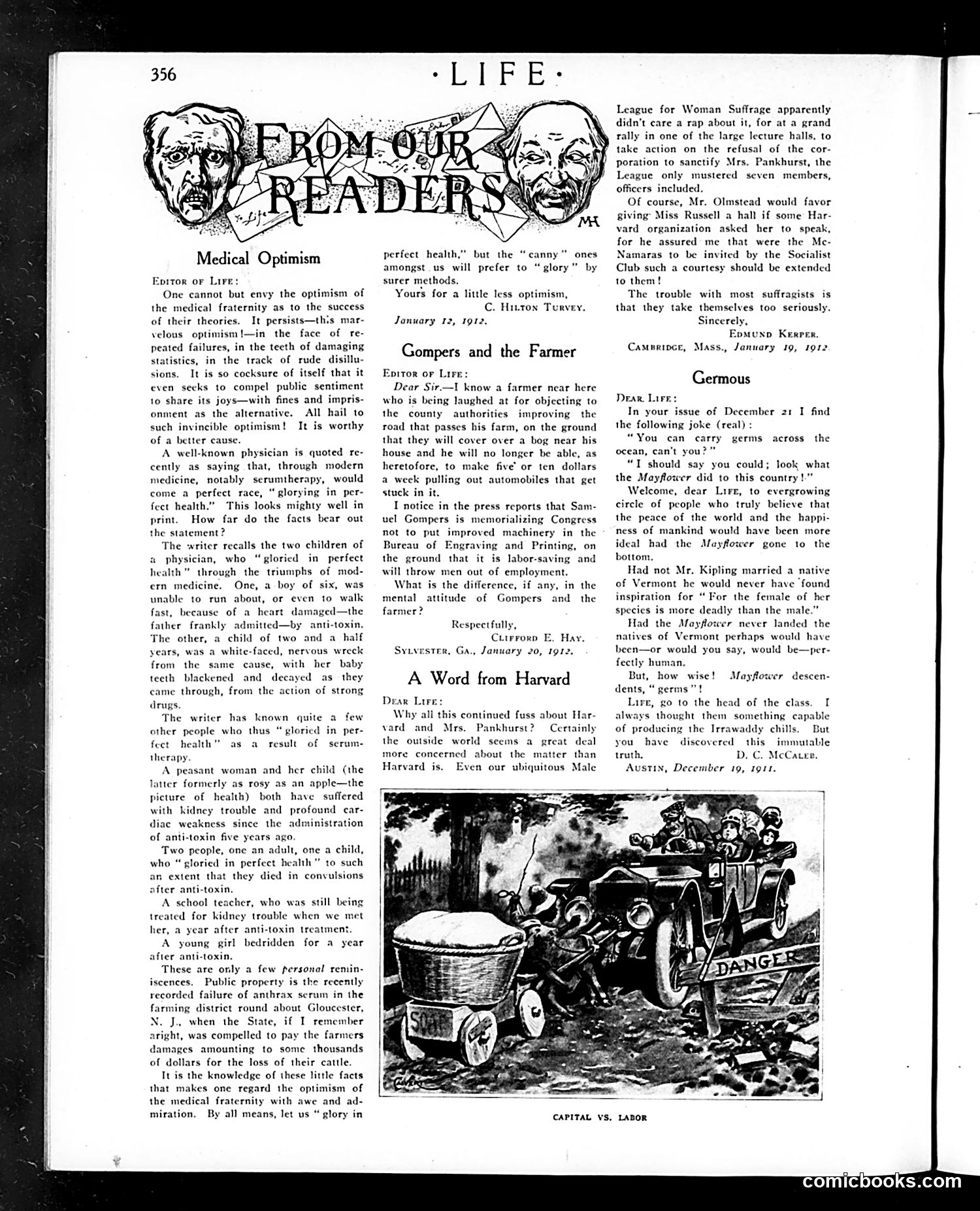
The cartoon titled "Capital vs. Labor" depicts a collision between two vehicles: one carrying wealthy capitalists or industrialists, and another representing labor/workers. The image illustrates the economic conflict between capital owners and working people—a major political tension of the 1912 era. This accompanies a letter from a farmer criticizing labor leader Samuel Gompers for opposing mechanization in government printing offices to protect jobs. The writer compares Gompers' stance to a farmer who profits from automobiles getting stuck in a bog, arguing both prioritize narrow self-interest over progress. The cartoon visualizes this ideological clash: capital pursues efficiency and profit through machines; labor resists displacement. This reflects early-20th-century debates about industrialization, mechanization, and workers' rights during a period of significant labor activism.
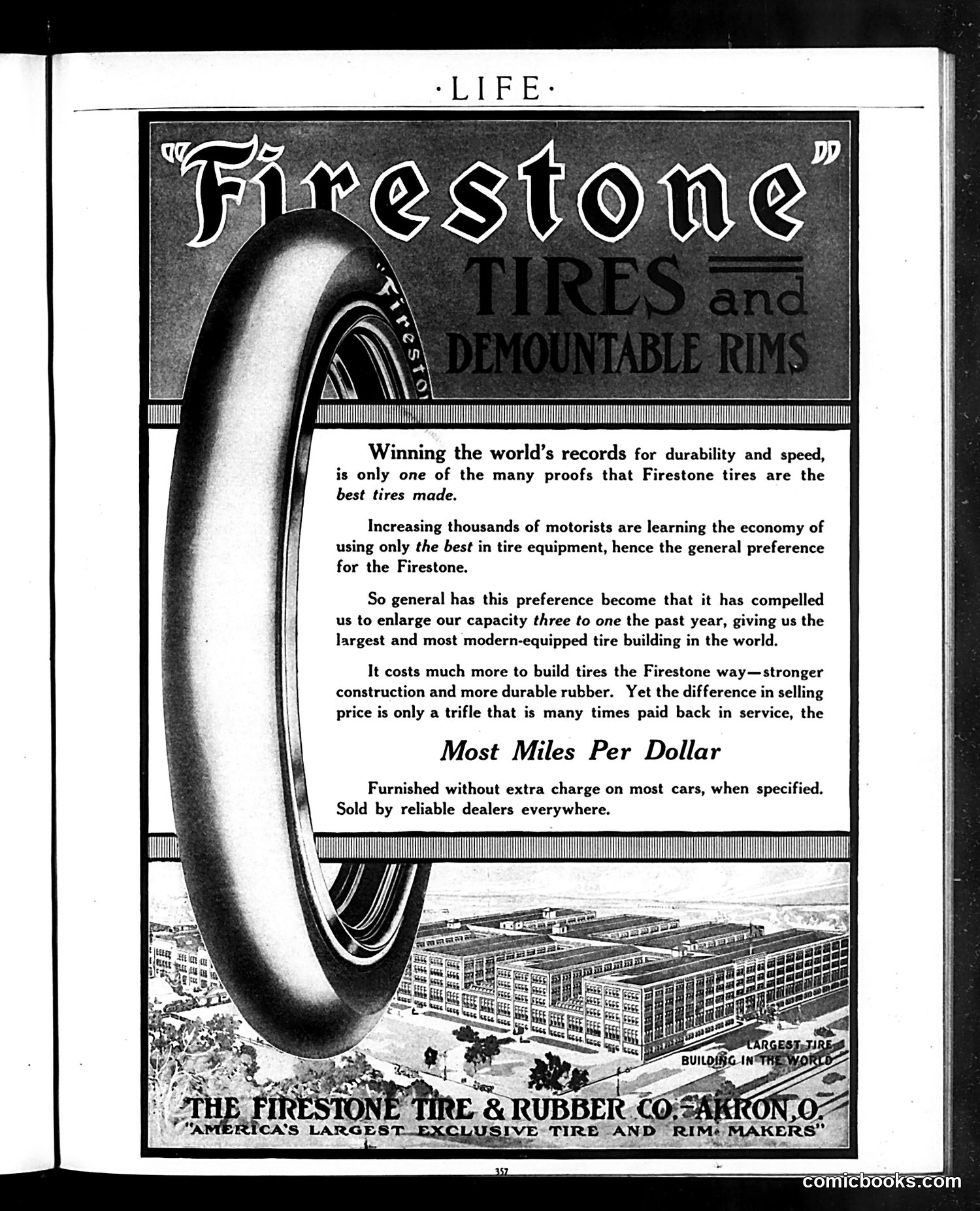
This is **not a cartoon or satire**—it's a straightforward **advertisement** for Firestone Tires and Demountable Rims, appearing in Life magazine. The page features a large photograph of a tire alongside text promoting Firestone's manufacturing superiority. Key claims include: winning durability/speed records, superior construction quality, and exceptional value ("Most Miles Per Dollar"). The advertisement emphasizes that Firestone's Akron, Ohio factory recently tripled capacity to meet demand, positioning the company as "America's largest exclusive tire and rim makers." The ad targets motorists concerned with economy and reliability, arguing that Firestone's higher-quality construction justifies its premium price through longer tire life. The aerial photograph of the massive factory building serves as visual proof of Firestone's industrial dominance and manufacturing prowess—a common advertising strategy in this era.
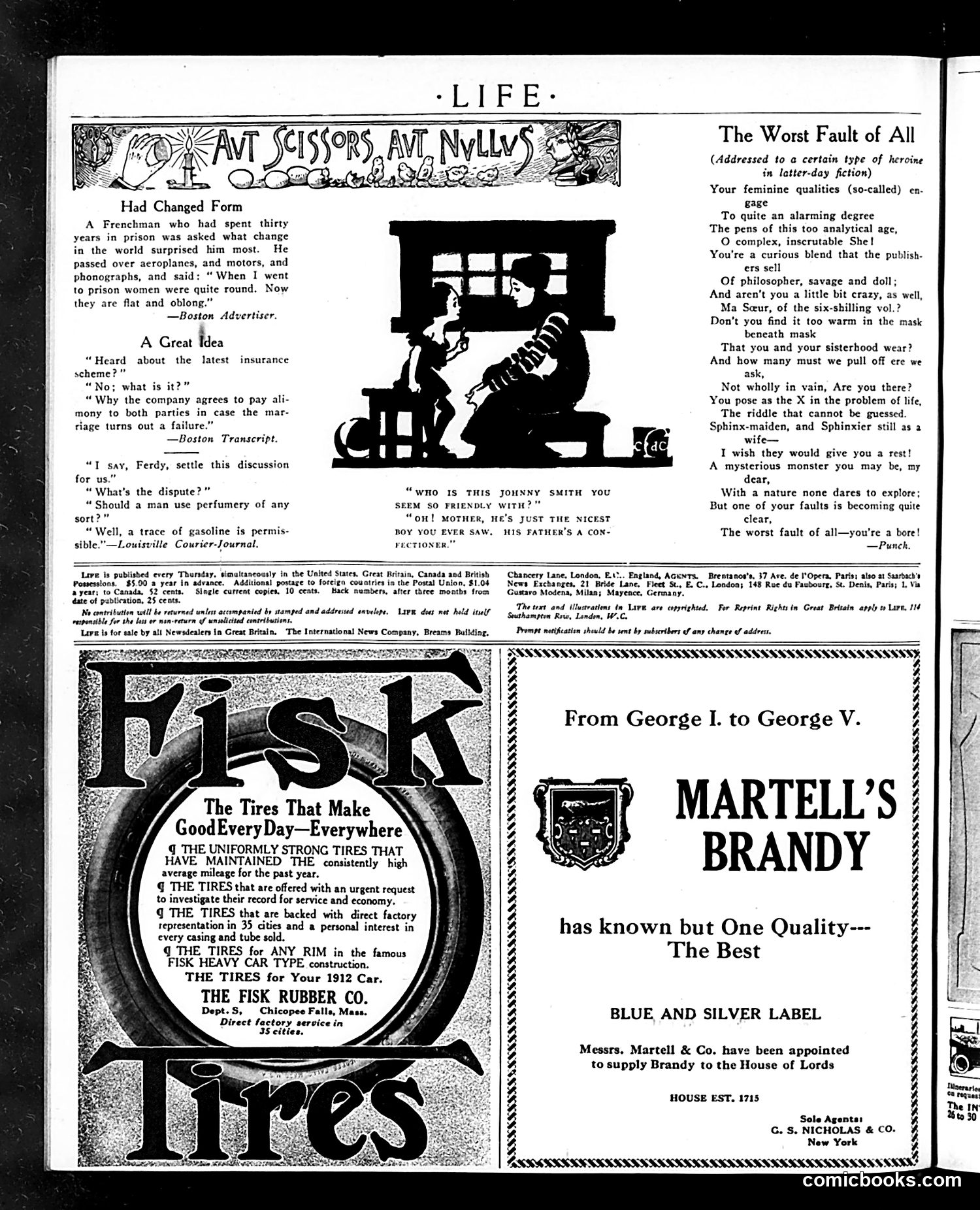
This page is primarily **a collection of short humor pieces and advertisements** rather than a political cartoon. The main content includes three brief satirical jokes: 1. **"Had Changed Form"**: A Frenchman remarks that women have changed from "quite round" to "flat and oblong" during his 30-year imprisonment—mockery of changing fashion silhouettes (likely the flapper look replacing Victorian curves). 2. **"A Great Idea"**: Satirizes modern insurance absurdity by imagining companies paying alimony to both spouses if marriage fails. 3. **"The Worst Fault of All"**: A poem criticizing fictional heroines who are portrayed as mysterious, complex "Sphinx" figures—only to conclude their real flaw is being "a bore." The central illustration shows a mundane domestic scene of two men discussing a boy, with dialogue about the boy's father being a "confectioner." The page also features period **advertisements** for Fisk Tires and Martell's Brandy. This was a typical Life magazine format: lightweight social satire mixed with commerce.
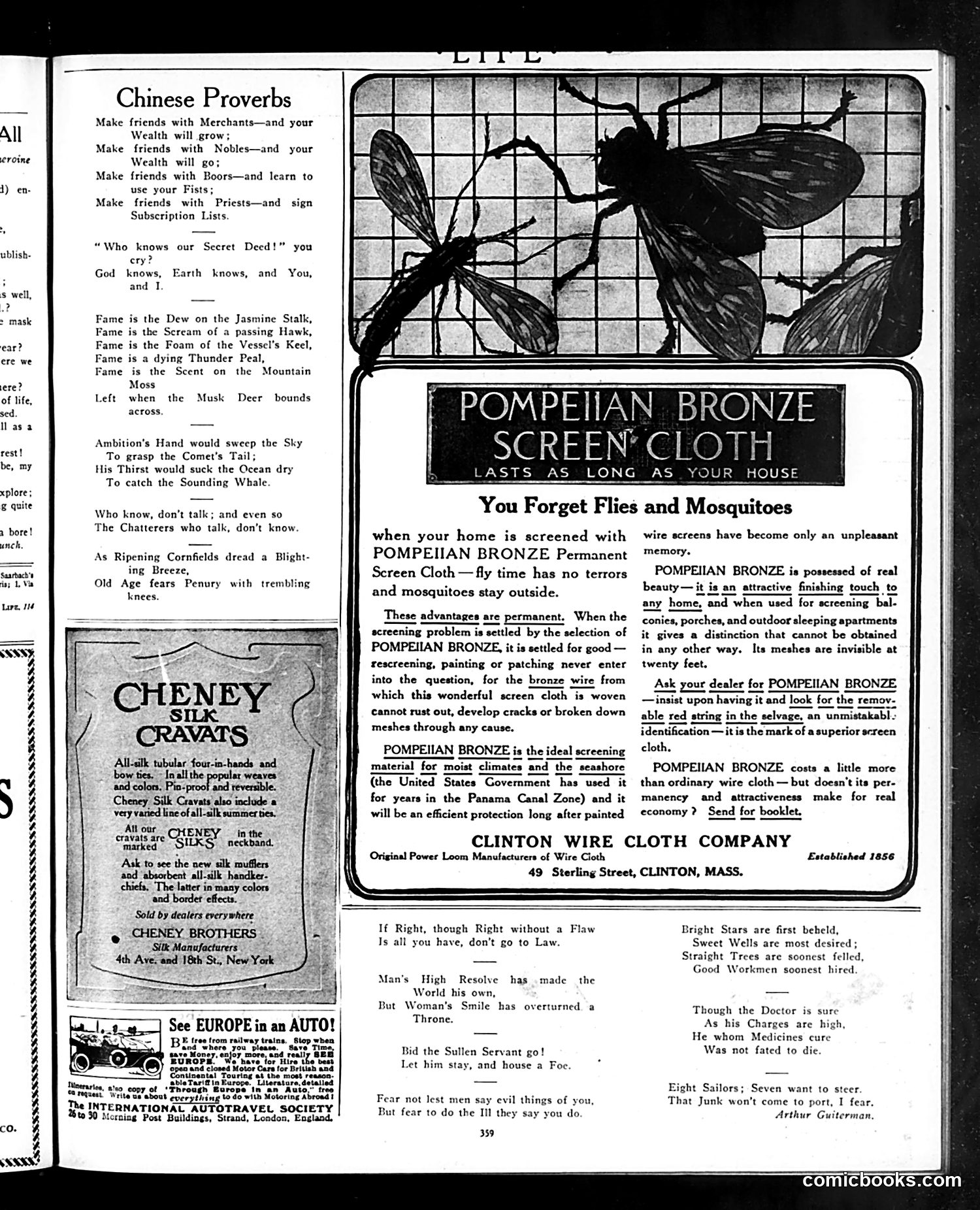
This page is primarily **advertising and poetry**, not political satire. The top section features **Chinese Proverbs** — philosophical verses about friendship, fame, and ambition presented as exotic wisdom. These reflect early 20th-century American fascination with Asian philosophy, though they're likely Western compositions rather than authentic proverbs. The illustrations show **decorative insects** (likely flies or mosquitoes) in an ornamental style, serving as visual accompaniment. The bulk of the page comprises **commercial advertisements**: Cheney Silk Cravats, Pompeiian Bronze Screen Cloth (emphasizing durability and permanence), and the International Autotravel Society. The advertisements stress practical benefits—permanent screening, quality silk goods, travel convenience—typical of the era's consumer culture. There is **no discernible political cartoon or satire** on this page; it represents Life magazine's blend of light cultural content with commercial promotion.
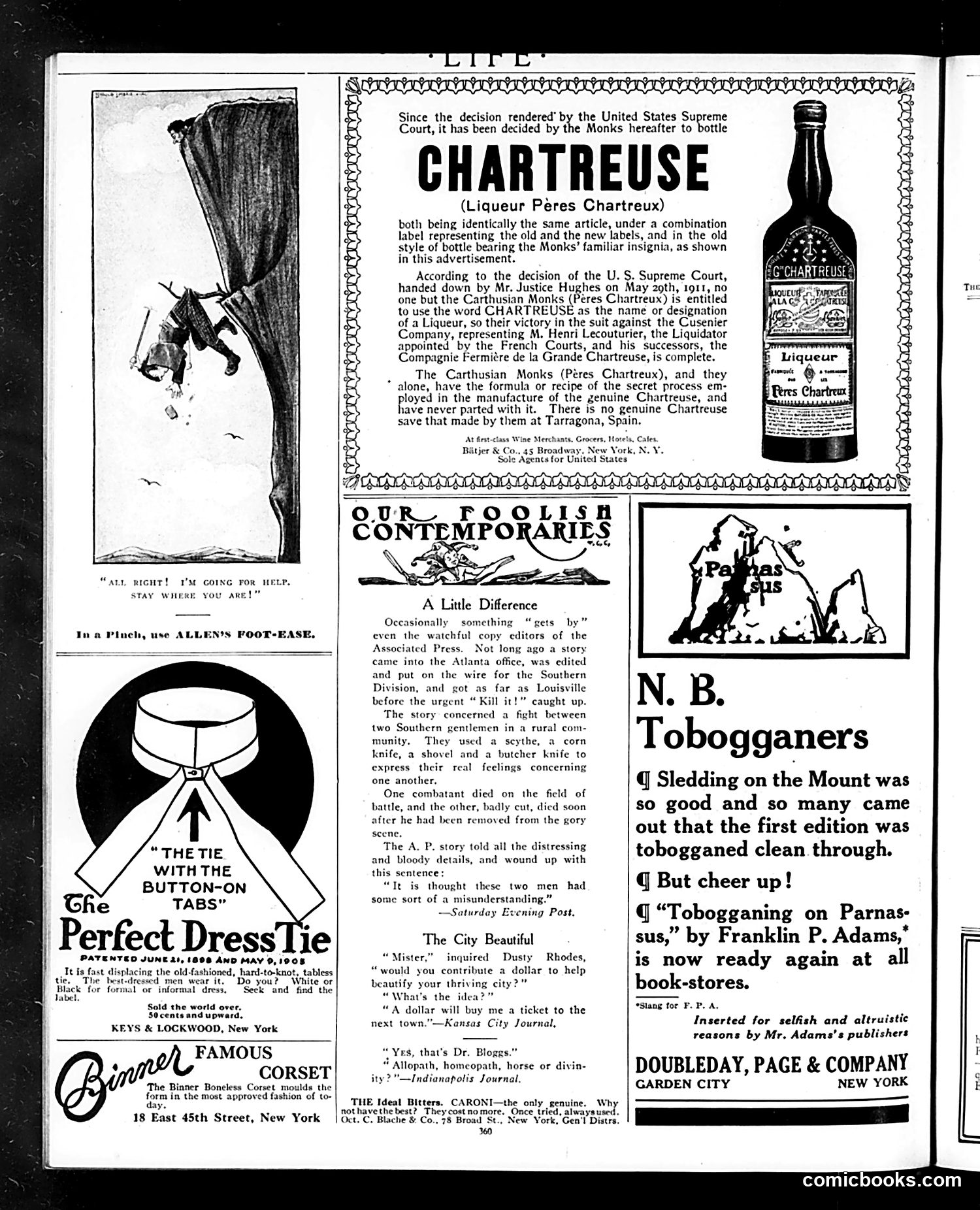
This page mixes advertisements with editorial content typical of Life magazine's satirical format. **Main Cartoon (left):** Shows a figure hanging from a parachute saying "All right! I'm going for help. Stay where you are!" This appears to be a visual joke about someone in distress calling for assistance—likely satirizing either aviation mishaps (parachutes were novel then) or a general comedic scenario about incompetent rescue attempts. **"Our Foolish Contemporaries" Section:** Reprints humorous errors from other newspapers, including an AP story about a rural Southern fight where two men killed each other with farm implements, yet the wire service concluded they had "some sort of a misunderstanding"—obvious absurdist satire of journalistic understatement. **Advertisements:** The page is dominated by product ads (Allen's Foot-Ease, Perfect Dress Tie, Binner Corset, Chartreuse liqueur) interspersed with content—typical of Life's revenue model. **Note on Chartreuse ad:** References a 1911 Supreme Court decision protecting the Carthusian Monks' exclusive right to use the name "Chartreuse" for their liqueur.
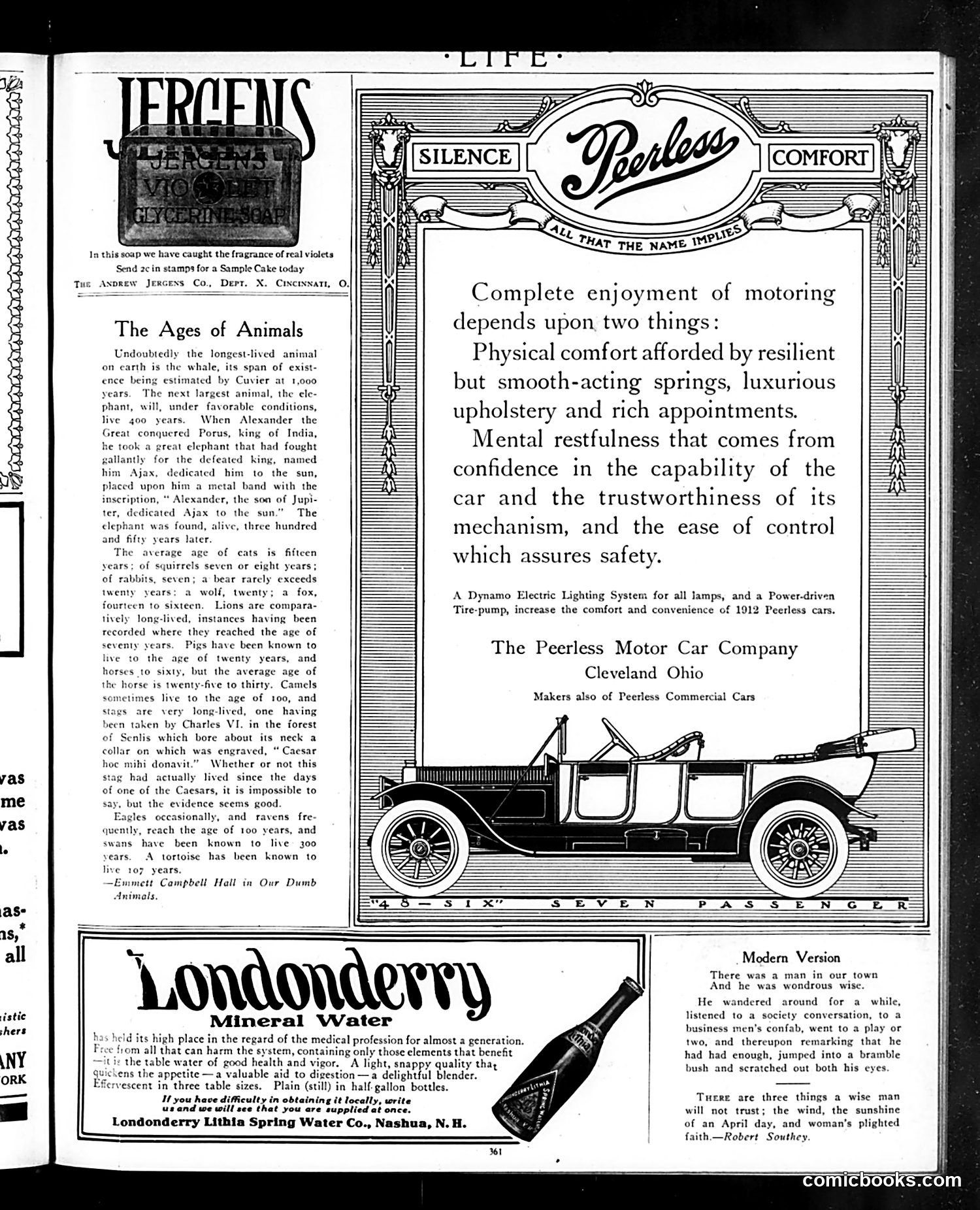
This page is primarily **advertisements and filler content** rather than satirical cartoons. The main ad features the **Peerless Motor Car** (1912), a luxury automobile marketed on comfort and reliability—targeting wealthy buyers seeking both physical ease and peace of mind. The detailed copy emphasizes springs, upholstery, and mechanical trustworthiness. The left column contains a serious essay, "The Ages of Animals," discussing animal lifespans (whales, elephants, tortoises, etc.)—educational filler typical of Life's content. At bottom, "Modern Version" presents a satirical **poem about a wise man** who avoids three things: wind, April sunshine, and women's faithfulness. This uses an old Robert Southey quote to gently mock male skepticism about romance—mild social satire. The remaining ads promote Jergens soap, Londonderry mineral water, and other consumer goods. **No political content or caricatures are present**—this is a standard commercial magazine page mixing advertising with light entertainment and educational pieces.
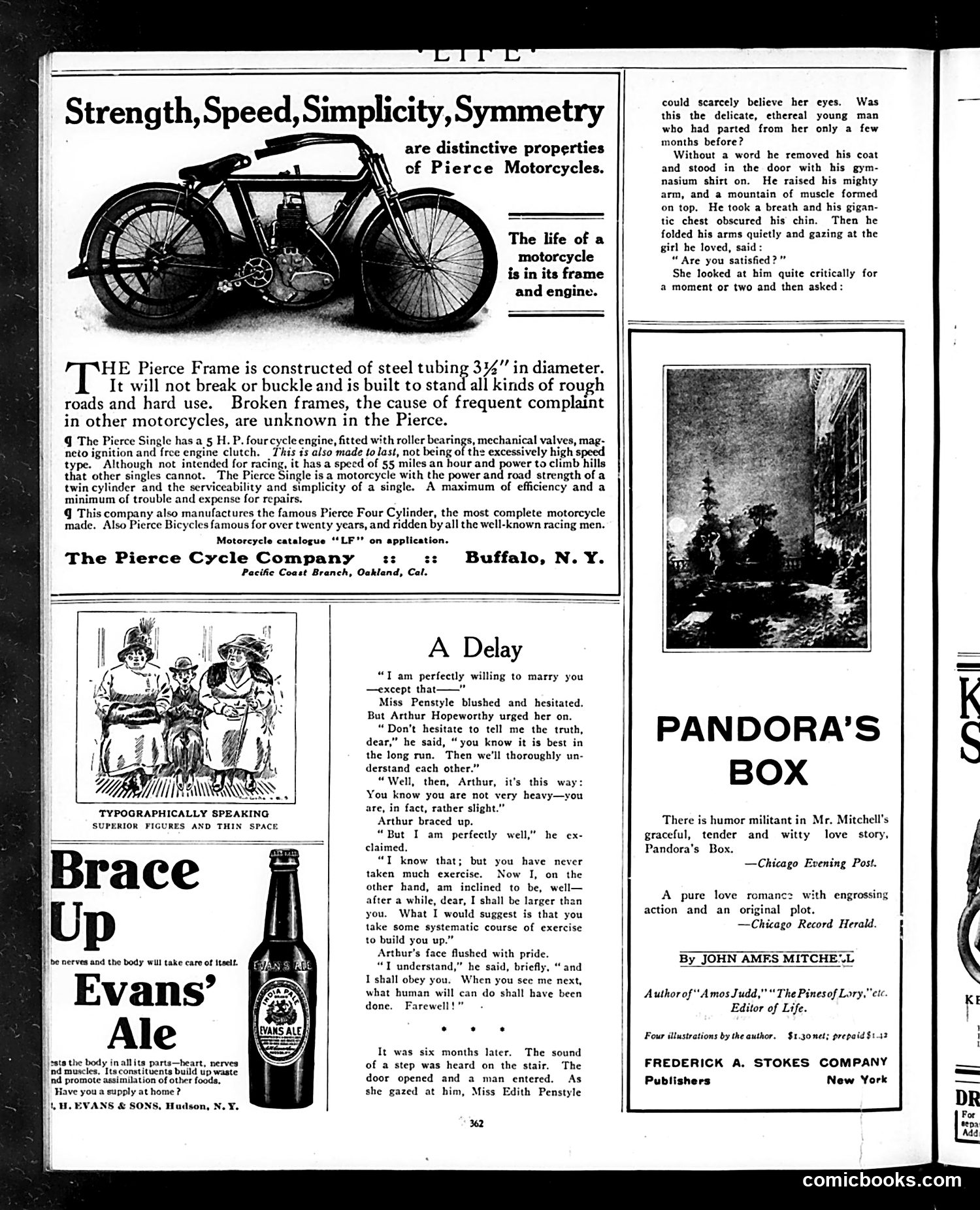
This page mixes advertising with serialized fiction. The dominant Pierce Motorcycle ad emphasizes engineering durability—"strength, speed, simplicity, symmetry"—targeting practical buyers concerned with reliability on poor roads. The cartoon "A Delay" satirizes turn-of-the-century gender dynamics and courtship. A woman (Miss Penstyle) agrees to marry Arthur Hopeworthy *conditionally*—he must exercise and build muscle, as she finds him insufficiently robust. The humor derives from her frank, almost bossy requirement that he physically transform himself before marriage. After six months of effort, he returns, presumably muscular. The joke reflects period anxieties about masculine vigor and female agency in mate selection. The accompanying Evans' Ale advertisement reinforces this theme, claiming the beverage builds strength and nerve. At bottom, an advertisement for John Ames Mitchell's novel "Pandora's Box" promotes it as romantic fiction with "engrossing action."
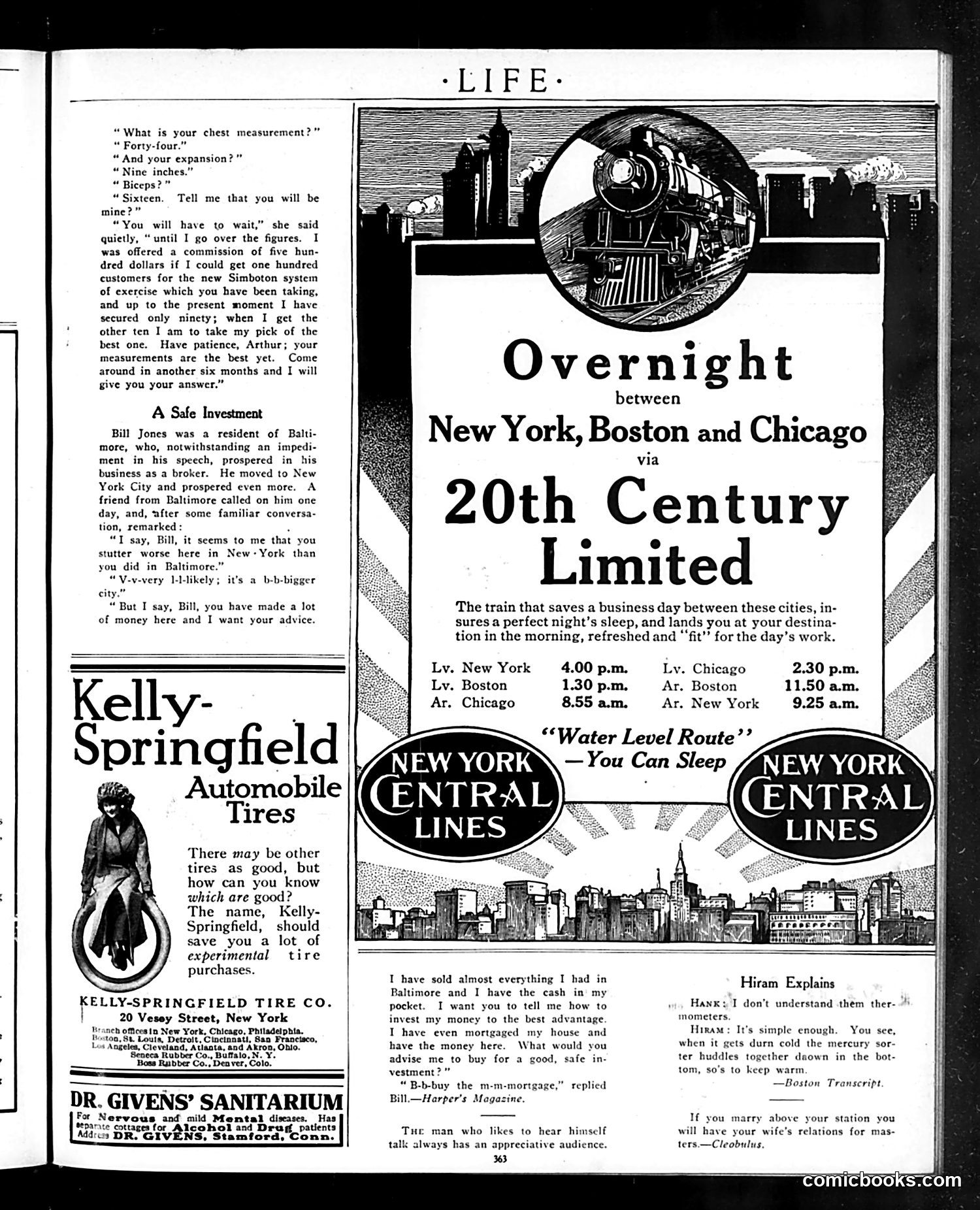
This page contains three distinct satirical pieces: **"A Safe Investment"** (top left): A joke about Bill Jones, a Baltimore broker with a stutter who prospers in New York. When a friend asks investment advice, Bill recommends buying "the m-m-mortgage"—a pun where his speech impediment makes it sound like he's endorsing the mortgage itself rather than sensible financial advice. The satire mocks both the stutter and suggests untrustworthy financial counsel. **"Overnight between New York, Boston and Chicago"** (center/right): A railroad advertisement for the 20th Century Limited train, emphasizing business efficiency and comfort—not satirical content, but period advertising. **The remaining shorts** (bottom): Brief humorous anecdotes about measuring chest expansion for romance, explaining thermometers, and marriage above one's station—light social commentary typical of Life's satirical humor. The page mixes genuine advertisements with satirical fiction, characteristic of Life magazine's format during this era.
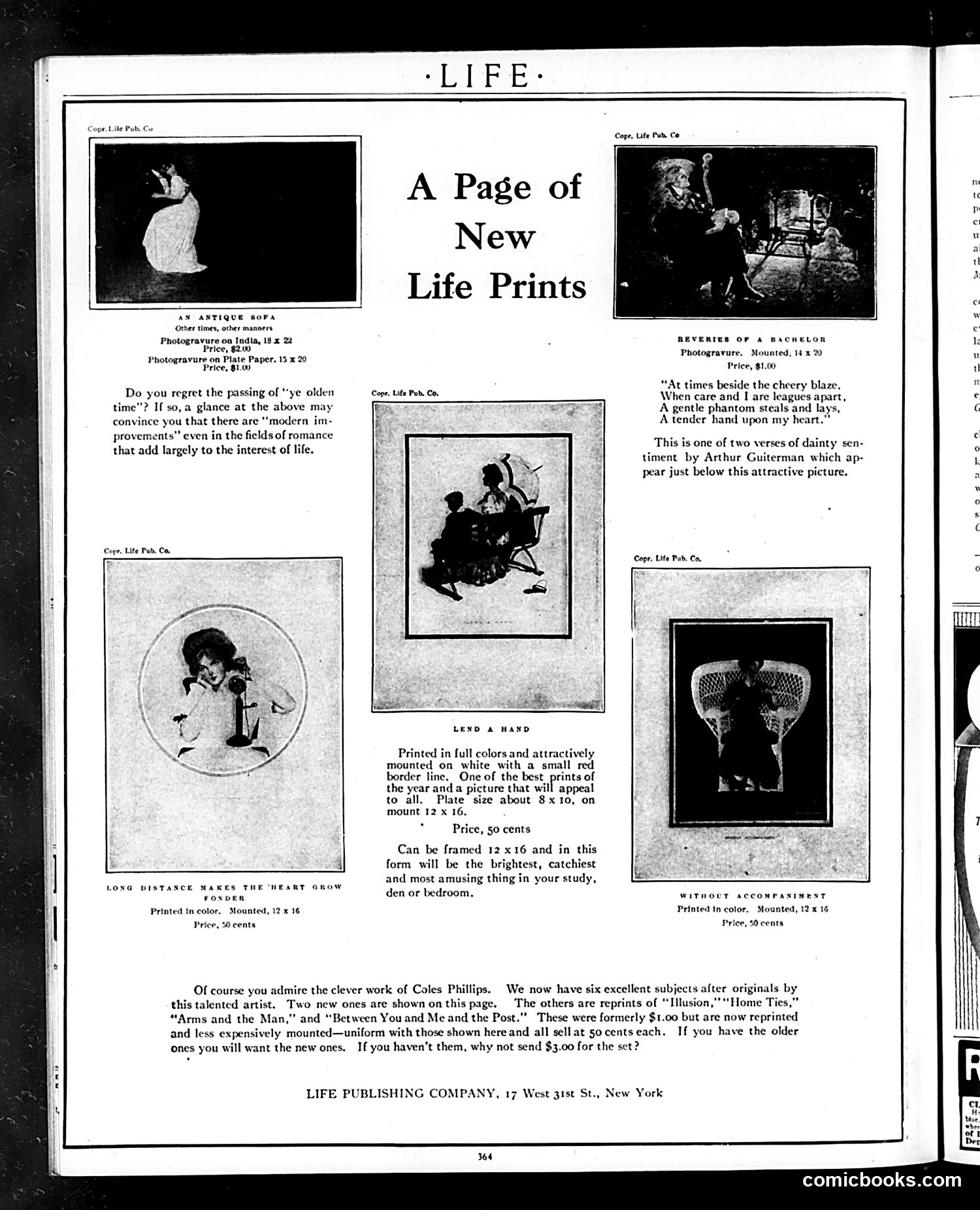
This is an advertisement for decorative art prints sold by Life Publishing Company, not political satire. The page showcases romantic, sentimental photogravure prints available for purchase—typical early 20th-century home décor items. The prints feature romantic imagery: "An Antique Sofa" (nostalgic couple), "Long Distance Makes the Heart Grow Fonder" (woman with telephone, referencing separation), "Lend a Hand" (silhouette scene), "Reveries of a Bachelor" (silhouetted figure), and "Without Accompaniment" (woman at piano). The text playfully argues that modern improvements—including romantic imagery and communication technology like long-distance telephone service—enhance romance, contrasting "ye olden time" with contemporary conveniences. Arthur Guiterman provides accompanying verse. The prints sold for 50 cents to $1.00, framed at 12x16 inches.
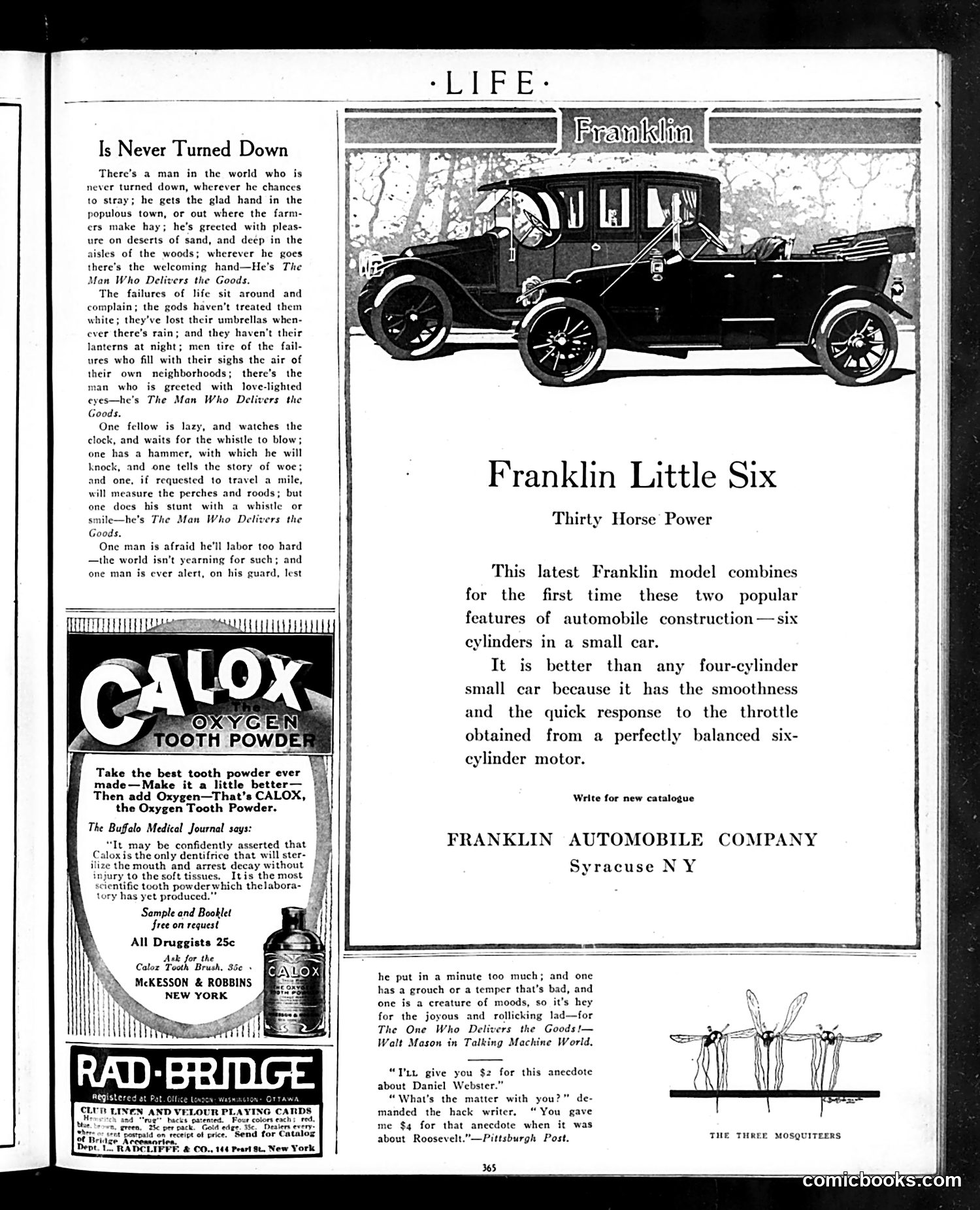
This page is primarily **advertising**, not political satire. The main content consists of three advertisements: 1. **"Is Never Turned Down"** (left): A inspirational poem by Walt Mason celebrating the "man who delivers the goods"—a work ethic message promoting reliability and hard work over laziness and complaining. It's motivational copy reflecting early 20th-century American values about industriousness. 2. **Franklin Little Six automobile** (center): An ad for a car featuring six cylinders in a compact model, emphasizing smoothness and throttle response. This represents genuine automotive innovation of the era. 3. **Calox Oxygen Tooth Powder** (lower left): A patent medicine ad claiming dental benefits, with a quote from a medical journal lending scientific credibility. 4. **Bottom right**: A brief humorous anecdote about a hack writer negotiating payment for stories—likely editorial filler rather than political commentary. The small illustration labeled "The Three Mosquiteers" appears unrelated decoration. This is a **commercial magazine page**, not satire or political content requiring historical context to understand.
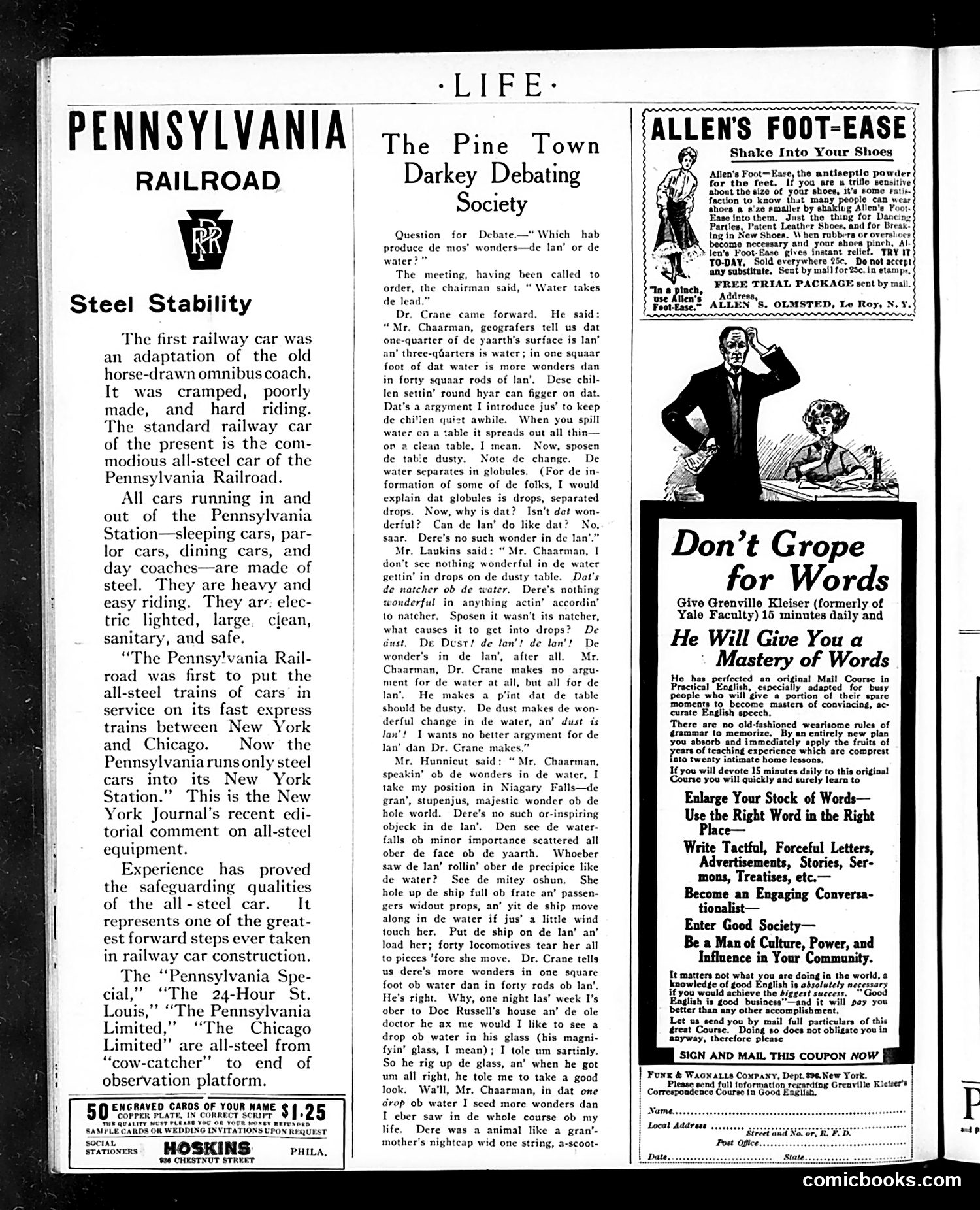
This is a racist dialect comedy sketch presented as a debate about whether land or water produces "de mos' wonders." Three Black speakers—Dr. Crane, Mr. Laukins, and Mr. Hunnicut—argue in exaggerated, phonetically misspelled dialect ("de lan'," "dat water") about natural phenomena. The "humor" relies entirely on **minstrelsy conventions**: caricatured Black speech patterns and intellectual pretensions. The sketch assumes readers will find Black people attempting serious philosophical debate inherently comic. References to Niagara Falls and water droplets on tables are the ostensible debate topics, but the actual "joke" is the racist portrayal itself. This represents early 20th-century *Life* magazine's casual racist content, typical of the era but deeply offensive today. The piece has no political point beyond entertainment through racial mockery.
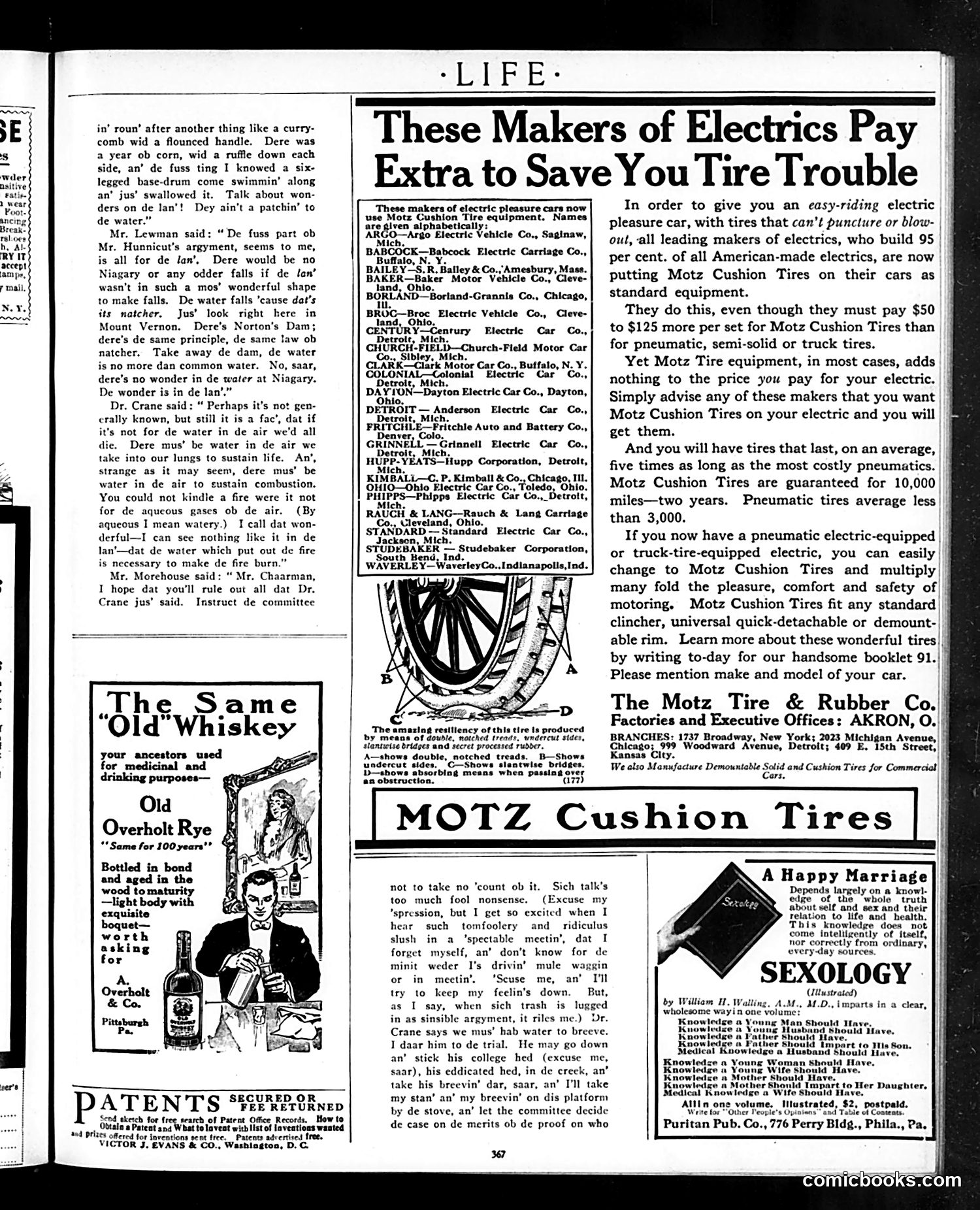
This page is primarily **advertising**, not political satire. The main content is a large advertisement for Motz Cushion Tires, promoted as superior equipment for electric vehicles. The ad lists major electric car manufacturers (Babcock, Baker, Studebaker, etc.) who allegedly use Motz tires as standard equipment. It argues these makers pay premium prices ($50-$125 more per set) for Motz tires specifically because they provide puncture-proof, blow-out-resistant tires—a significant concern for early 1900s vehicles. The technical diagrams show the tire's construction: double-notched tread and undercut sides designed for shock absorption. The **context**: This reflects the early automotive era when electric vehicles competed seriously with gasoline cars, and tire reliability was a major selling point. The ad essentially claims that prestigious manufacturers' endorsement proves Motz superiority. The other advertisements (Old Overholt Rye whiskey, a patent office notice) and the dialogue fragment about Niagara Falls are unrelated content filling the page.
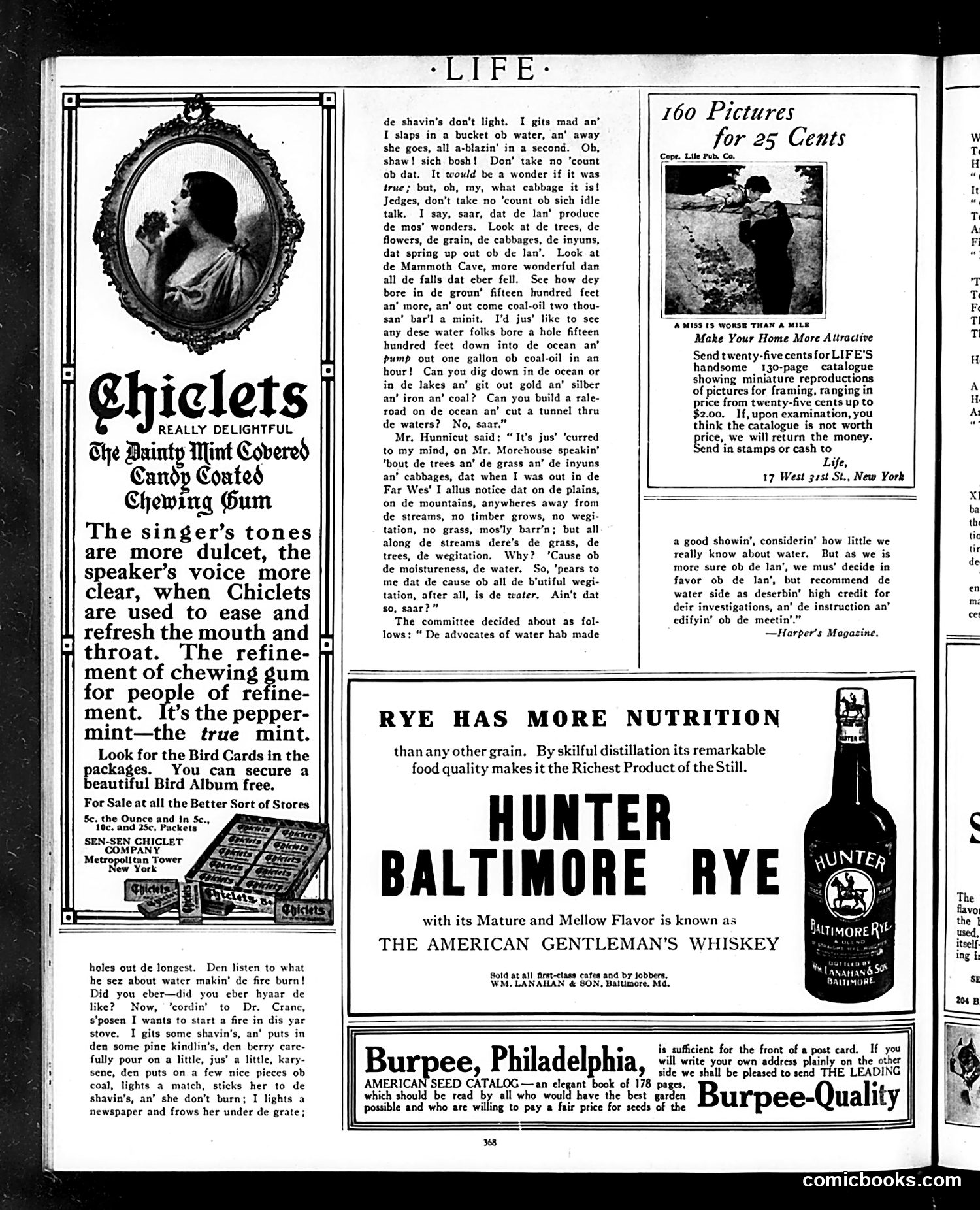
This page is primarily **advertisements** rather than political satire or commentary. The longest text passage appears to be a humorous dialect-heavy narrative (likely from *Harper's Magazine*, per the credit) depicting rural or working-class characters debating whether land or water has produced more wonders. The informal speech patterns and topics (coal oil from wells, western plains, the role of water in vegetation) suggest early-20th-century American frontier or agricultural concerns, but no specific political figures or events are referenced or caricatured. The left side features a **Chiclets gum advertisement** with an ornate framed portrait and marketing copy about refined taste. The page also contains ads for **Hunter Baltimore Rye whiskey**, a Life magazine picture catalog, and **Burpee seed catalog**—typical commercial content from this era of *Life* magazine.
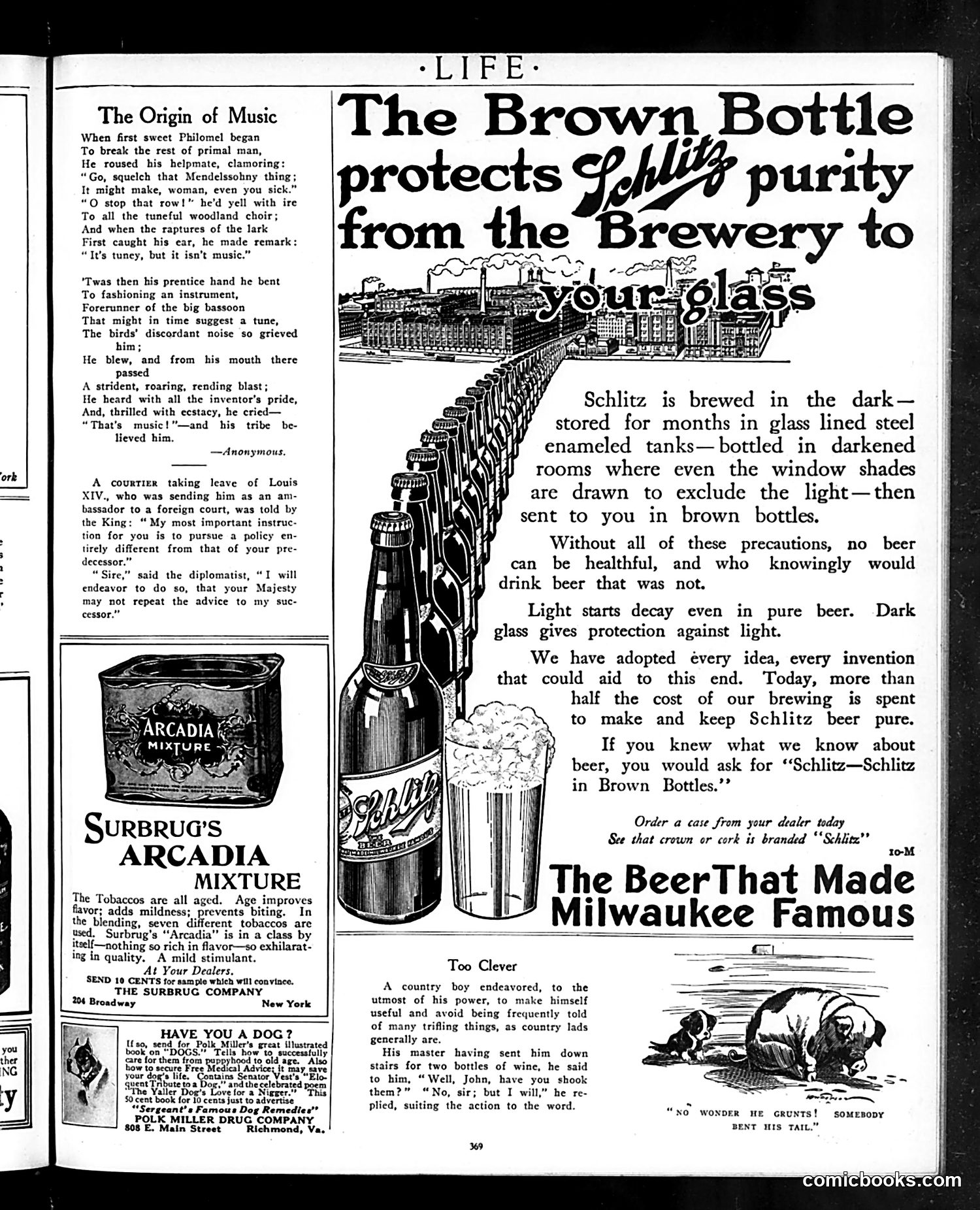
This page contains **primarily advertisements** with minimal satirical content. The main elements: **"The Origin of Music"** (top left): A humorous poem suggesting that man invented music to silence nature's sounds—birds annoyed him, so he created the bassoon as a louder alternative. The joke mocks both musical pretension and humanity's arrogance in "improving" nature. **Louis XIV anecdote**: A brief diplomatic joke about a courtier being told to differ from his predecessor—implying the predecessor's advice will only repeat endlessly. **"Too Clever"** (bottom right): A short joke about a country servant who, asked if he "shook" wine bottles, literally shakes them—a pun on misunderstanding instructions. The accompanying illustration shows a bent-tailed dog, the caption joking someone bent it. **Advertisements**: Most of the page promotes Schlitz beer (emphasizing brown bottles protect purity from light), Surbrug's tobacco mixture, and Polk Miller's dog remedies—typical early 20th-century product pitches with health claims. The satirical content is minimal; this is primarily an **advertising-heavy publication page**.
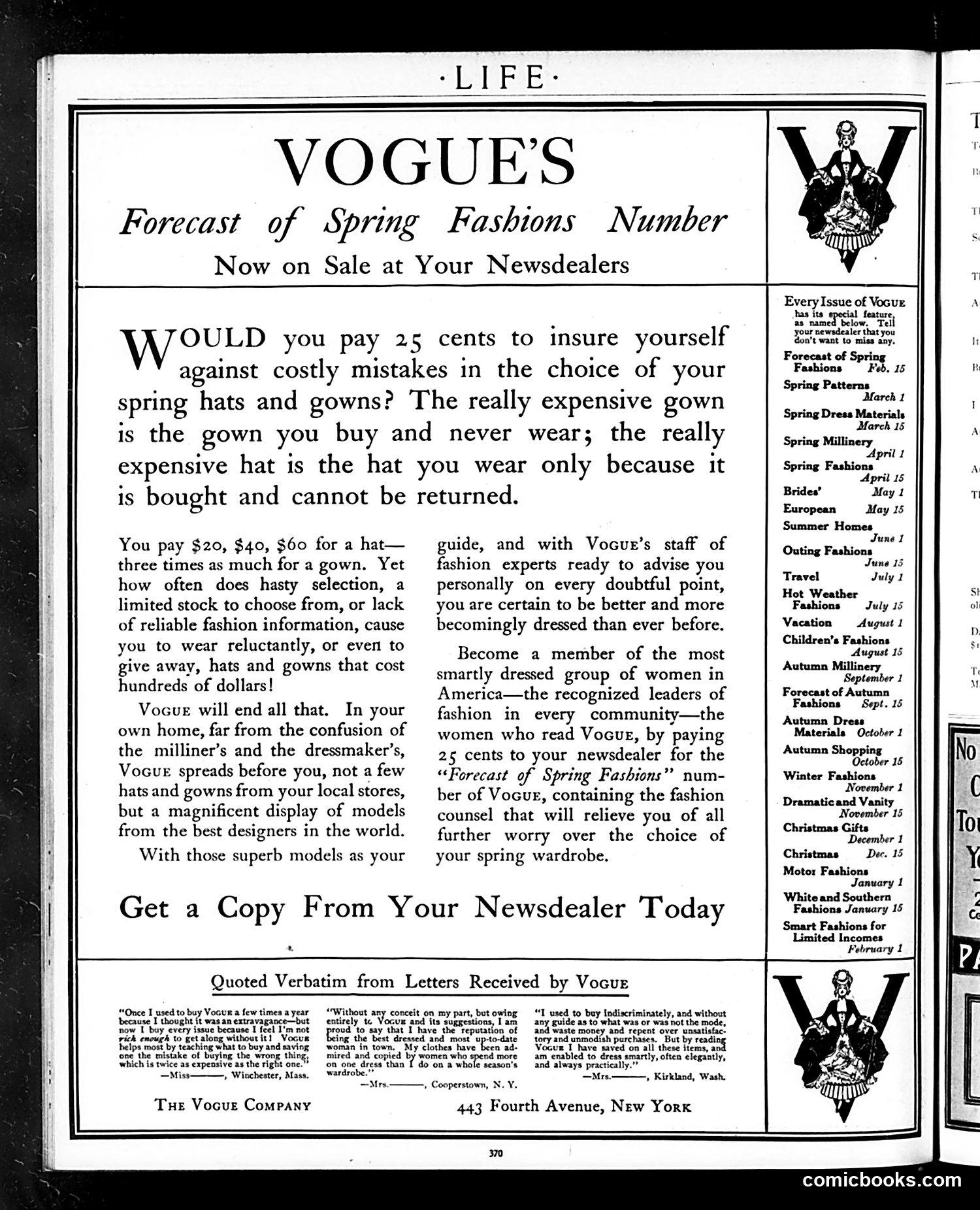
This is primarily a **Vogue magazine advertisement**, not a political cartoon. It promotes Vogue's "Forecast of Spring Fashions" issue to 1920s American women. The pitch appeals to middle-class anxieties about wasteful spending: women allegedly squander "hundreds of dollars" on hats and gowns they never wear due to poor choices. For 25 cents, Vogue promises to solve this through expert fashion guidance and curated designer models viewed at home—positioning the magazine as a practical investment rather than luxury. The testimonial letters (presented as authentic reader feedback) reinforce the sales pitch: one woman claims Vogue's advice made her "the best dressed...woman in town"; another says it prevents "unsatisfactory purchases." The sidebar lists upcoming themed issues (Spring Fashions, Summer Homes, Winter Fashions, etc.), showing Vogue's strategy of releasing specialized issues year-round to capture recurring purchases. There is no political satire here—this is straightforward consumer advertising from the early 20th century.
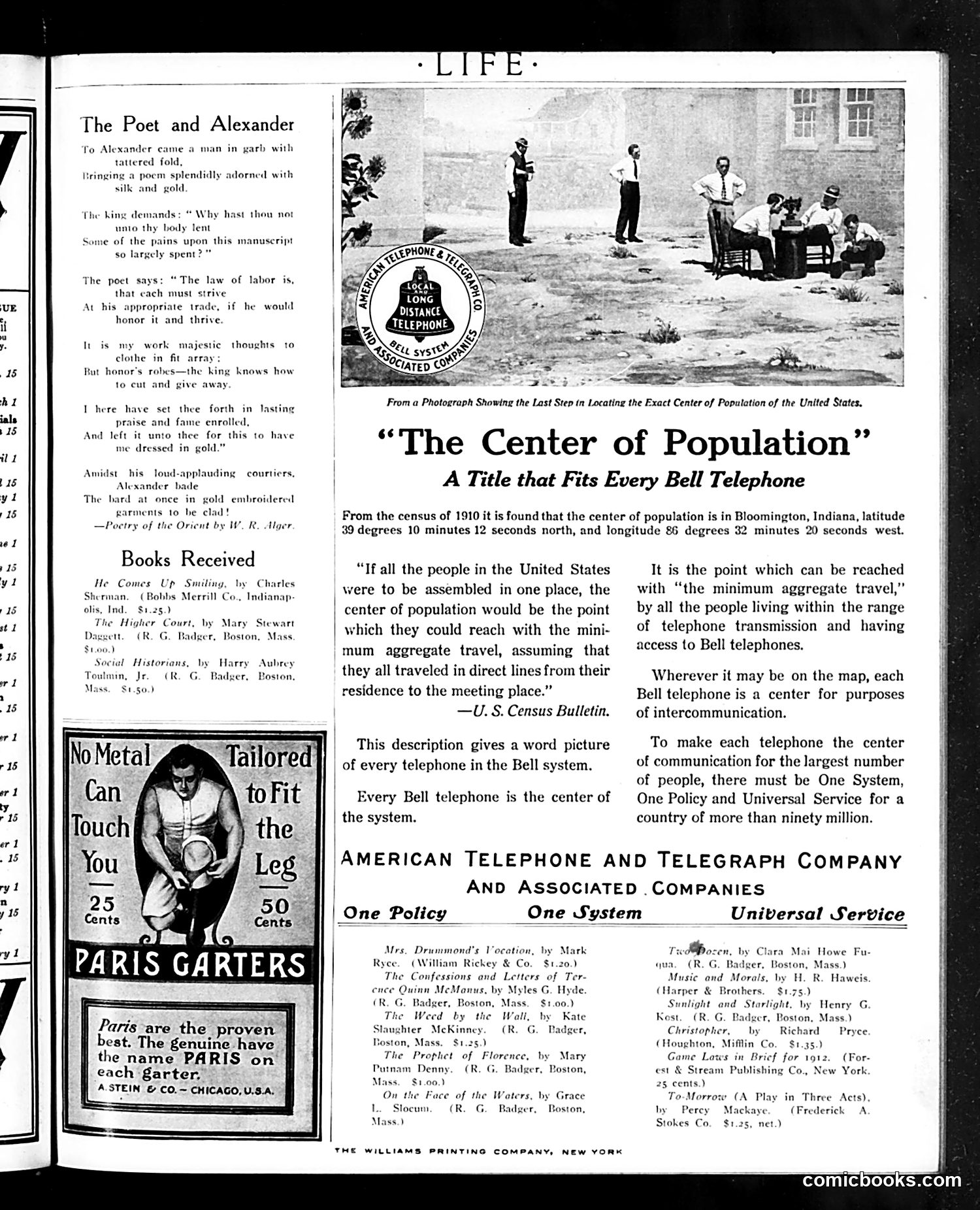
This page contains two distinct items: **The Poem**: A classical parable about a ragged poet who presents an ornately decorated manuscript to Alexander (the Great). The king criticizes the poet's poverty—why hasn't he enriched himself? The poet argues labor has its proper sphere: his job is composing noble thoughts; the king's is rewarding merit with gold and honors. Alexander, impressed, grants the poet fine clothes. **The Advertisement**: The Bell Telephone company uses the U.S. Census Bureau's concept of "center of population" (Bloomington, Indiana) as a metaphor for their service. Just as every citizen is equidistant from this theoretical center, every Bell telephone is equally "central" to the system. The pitch emphasizes universal access and "One System, One Policy"—corporate consolidation language designed to justify Bell's monopoly dominance. The juxtaposition suggests Life's editorial interest in both classical wisdom about merit and contemporary anxieties about concentrated corporate power.
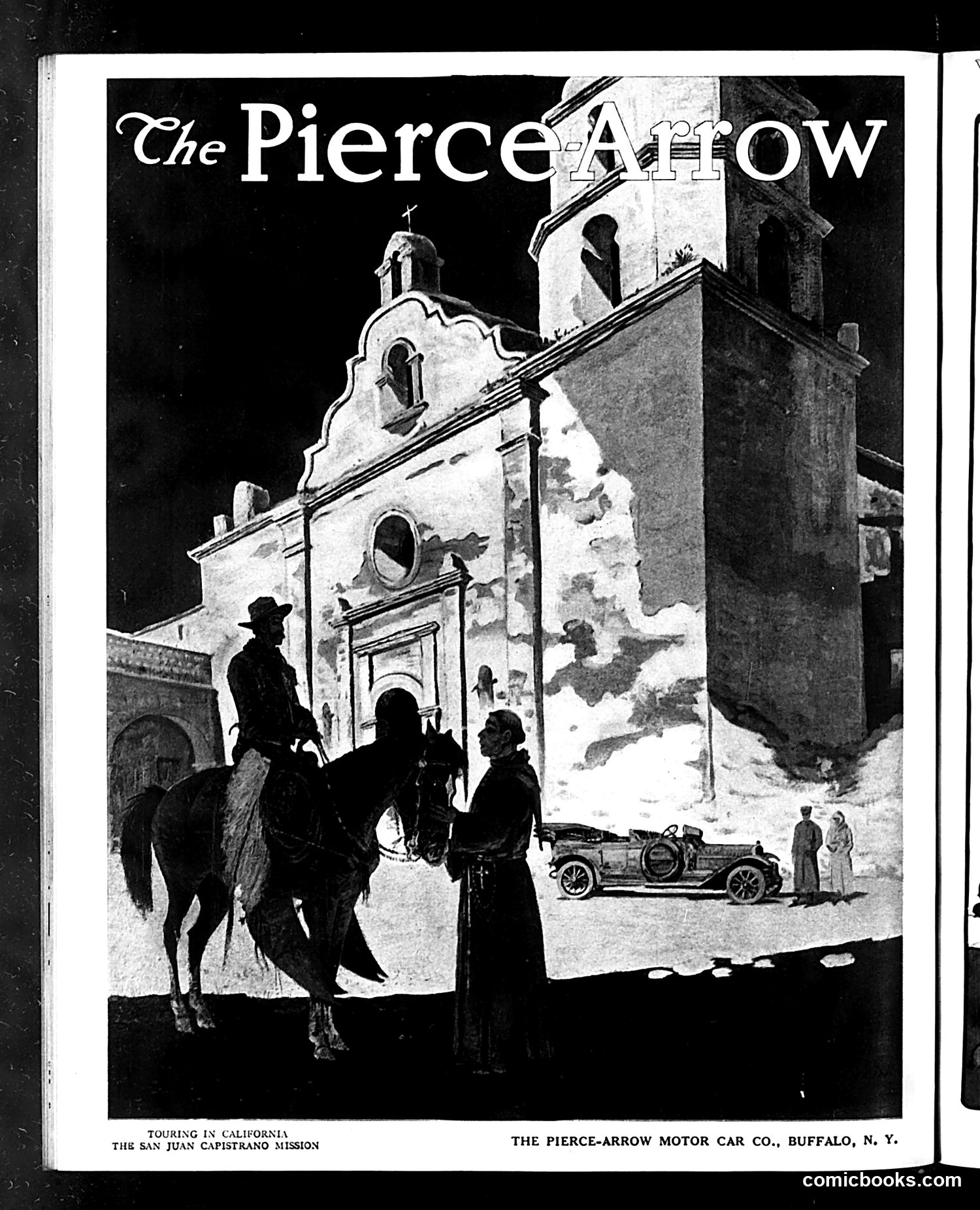
This appears to be a **magazine advertisement**, not a political cartoon. The page promotes the Pierce-Arrow Motor Car Company of Buffalo, New York. The image depicts a romanticized scene titled "Touring in California: The San Juan Capistrano Mission," contrasting old and new America. Silhouetted figures on horseback stand before a historic Spanish colonial mission church, while a Pierce-Arrow automobile sits prominently in the foreground with modern tourists beside it. The advertisement's message is clear: Pierce-Arrow automobiles enable cultured Americans to explore the nation's historical sites and scenic landscapes. It associates the car brand with leisure, sophistication, and access to California's romantic past—a common early-twentieth-century advertising strategy linking consumer products to aspirational lifestyles and cultural refinement.