
Life, 1912-02-15 · page 27 of 44
Life — February 15, 1912 — page 27: what you’re looking at
What you’re looking at
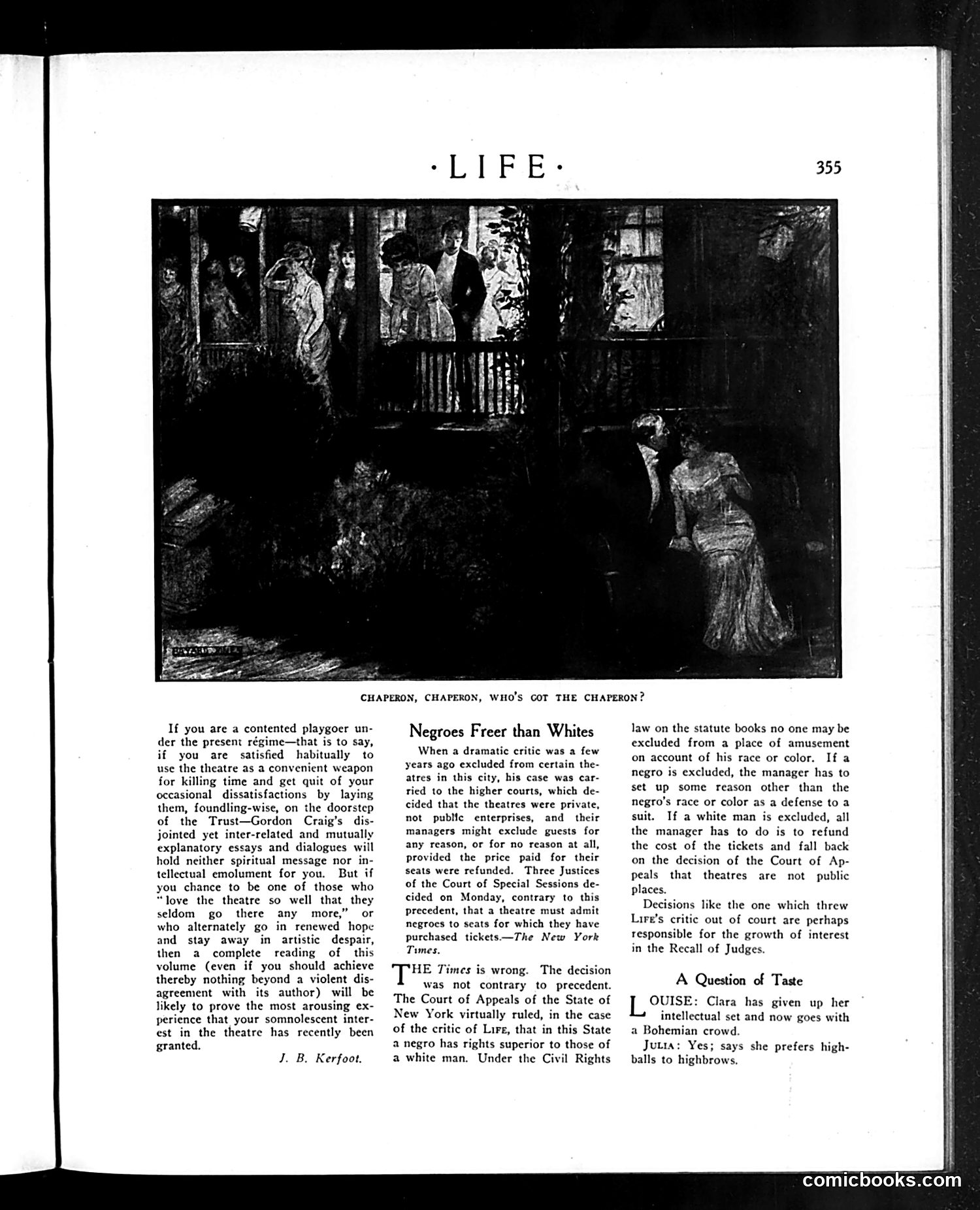
This page satirizes racial discrimination in New York theaters circa the early 1900s. The main article "Negroes Freer than Whites" discusses a court case where Black patrons were denied theater seats. Life's editorial position is bitter and ironic: while courts ruled theaters are "private" institutions (allowing them to exclude a white theater critic without refunding), the same courts granted Black patrons legal rights to purchase seats based on Civil Rights law. Life's satire highlights the absurdity: theaters can exclude whites arbitrarily but cannot exclude Black customers for racial reasons alone—making Black patrons technically have *superior* legal protections, though obviously not in practice. The author suggests this legal inconsistency fuels calls to recall judges. The cartoon at top ("Chaperon, Chaperon, Who's Got the Chaperon?") appears unrelated—a domestic social scene—suggesting this was a typical mixed-content magazine page combining theater criticism, satire, and lighter social commentary.
📄 Transcribed text from this page (OCR, searchable)
Machine-transcribed from the original scan — historical spelling and the odd misread are preserved.
CHAPERON, CHAPERON, WHO'S GOT THE CHAPERON? If you are a contented playgoer un- der the present régime—that is to say, if you are satisfied habitually to use the theatre as a convenient weapon for killing time and get quit of your occasional dissatisfactions by laying them, foundling-wise, on the doorstep of the Trust—Gordon Craig’s dis- jointed yet inter-related and mutually explanatory essays and dialogues will hold neither spiritual message nor in- tellectual emolument for you. But if you chance to be one of those who “love the theatre so well that they seldom go there any more,” or who alternately go in renewed hope and stay away in artistic despair, then a complete reading of this volume (even if you should achieve thereby nothing beyond a violent dis- agreement with its author) will be likely to prove the most arousing ex- perience that your somnolescent inter- est in the theatre has recently been granted. J. B. Kerfoot. Negroes Freer than Whites When a dramatic critic was a few years ago excluded from certain the- atres in this city, his case was car- ried to the higher courts, which de- cided that the theatres were private, not publle enterprises, and their managers might exclude guests for any reason, or for no reason at all, provided the price paid for their seats were refunded. Three Justices of the Court of Special Sessions de- cided on Monday, contrary to this precedent, that a theatre must admit negrocs to seats for which they have purchased tickets—The New York Times. HE Times is wrong. The decision was not contrary to precedent. The Court of Appeals of the State of New York virtually ruled, in the case of the critic of Lire, that in this State a negro has rights superior to those of a white man. Under the Civil Rights law on the statute books no one may be excluded from a place of amusement on account of his race or color. If a negro is excluded, the manager has to set up some reason other than the negro’s race or color as a defense to a suit. If a white man is excluded, all the manager has to do is to refund the cost of the tickets and fall back on the decision of the Court of Ap- peals that theatres are not public places. Decisions like the one which threw Lire’s critic out of court are perhaps responsible for the growth of interest in the Recall of Judges. A Question of Taste L SUE: Clara has given up her intellectual set and now goes with a Bohemian crowd. Jutta: Yes; says she prefers high- balls to highbrows. comicbooks.com