
Life, 1912-02-15 · page 20 of 44
Life — February 15, 1912 — page 20: what you’re looking at
What you’re looking at
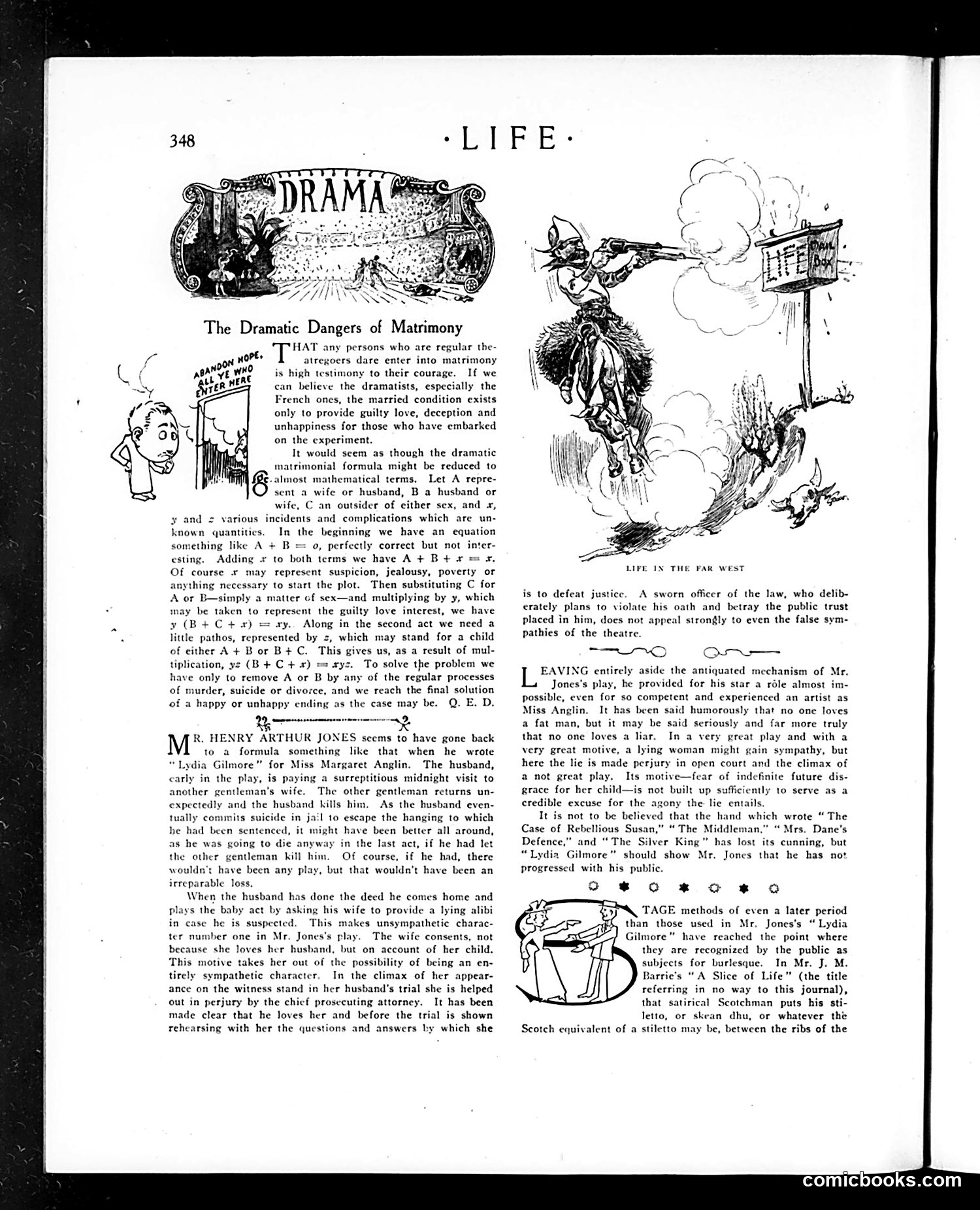
This page critiques the formulaic nature of French theatrical drama, particularly plays about marriage. The text argues that dramatists reduce marital plots to a mathematical equation: a wife (A) plus husband (B) plus an outside lover (C), multiplied by guilt and complications, inevitably resolved through murder, suicide, or divorce. The critique then focuses on Henry Arthur Jones's play "Lydia Gilmore," starring Margaret Anglin. The reviewer objects that the plot—involving a husband who kills a rival, then asks his wife to commit perjury to save him—creates deeply unsympathetic characters. A police officer who helps her commit perjury particularly offends. The fundamental problem: a lying woman cannot gain audience sympathy, even in a "great play with a great motive." Here, her lie becomes courtroom perjury for mere "indefinite future disgrace"—insufficient moral justification. The satire targets both hackneyed theatrical formulas and this specific play's failure of dramatic logic.
📄 Transcribed text from this page (OCR, searchable)
Machine-transcribed from the original scan — historical spelling and the odd misread are preserved.
The Dramatic Dangers of Matrimony “THAT any persons who are regular the pont HOPE atregocrs dare enter into matrimony we is high testimony to their courage. If we HESS can believe the dramatists, especially the French ones, the married condition exists only to provide guilty love, deception and unhappiness for those who have embarked on the experiment. It would scem as though the dramatic matrimonial formula might be reduced to Faioos mathematical terms. Let A repre- sent a wife or husband, B a husband or wife, C an outsider of either sex, and x, y and = various incidents and complications which are un- known quantities. In the beginning we have an equation something like A + B= 0, perfectly correct but not inter- esting. Adding « to both terms we have A + B+ x = 5. Of course x represent suspicion, jealousy, poverty or anything necessary to start the plot. Then substituting C for A or B—simply a matter of sex—and multiplying by y, which may be taken to represent the guilty love interest, we have y (B+ C++) = ay, Along in the second act we need a little pathos, represented by z, which may stand for a child of cither A+ B or B+ C. This gives us, as a result of mul- tiplication, yz (B+ C + *) == yz. To solve the problem we have only to remove A or B by any of the regular processes of murder, suicide or divorce, and we reach the final solution of a happy or unhappy ending as the case may be. Q. E. D, LS a 2 M* HENRY ARTHUR JO seems to have gone back to a formula something like that when he wrote dia Gilmore” for Miss Margaret Anglin. The husband, carly in the play, is paying a surreptitious midnight visit to another gentleman's wife. The other gentleman returns un- expectedly and the husband kills him. As the husband even- tually commits suicide in jail to escape the hanging to which he had been sentenced, it might have been better all around, as he was going to die anyway in the last act, if he had let the other gentleman kill him. Of course, if he had, there wouldn't have been any play, but that wouldn't have been an irreparable loss, When the husband has done the deed he comes home and plays the baby act by asking his wife to provide a lying alibi This makes unsympathetic charac- ter number one in Mr. Jones's The wife consents, not because she loves her husband, but on account of her child. This motive takes her out of the possibility of being an en- tirely sympathetic character, In the climax of her appear- ance on the witness stand in her husband's trial she is helped out in perjury by the chief prosecuting attorney. It has been made clear that he loves her and before the trial is shown rehearsing with her the questions and answers by which she in case he is suspected. LIFE IN THE PAR WEST is to defeat justice. A sworn officer of the law, who delib- erately plans to violate his oath and betray the public trust placed in him, docs not appeal strongly to even the false sym- pathies of the theatre. yo) ome AVING entirely aside the antiquated mechanism of Mr. Jones's play, he provided for his star a réle almost im- possible, even for so competent and experienced an artist as Miss Anglin. It has been said humorously that no one loves a fat man, but it may be said seriously and far more truly that no one loves a liar. In a very great play and with a very great motive, a lying woman might gain sympathy, but here the lie is made perjury in open court and the climax of a not great play, Its motive—fear of indefinite future dis- grace for her child—is not built up sufficiently to serve as a credible excuse for the agony the lie entails. It is not to be believed that the hand which wrote “The Case of Rebellious Susan,” “The Middleman,” “ Mrs. Dane's "and “The Silver King" has lost its cunning, but ydia Gilmore” should show Mr. Jones that he has not progressed with his public. o € O60 * Oo *# @ TAGE methods of even a later period than those used in Mr. Jones's “Lydia Gilmore” have reached the point where they are recognized by the public as subjects for burlesque. In Mr. J. M. Barrie's “A Slice of Life” (the title referring in no way to this journal), that satirical Scotchman puts his sti letto, or skean dhu, or whatever the Scotch equivalent of a stiletto may be, between the ribs of the comicbooks.com