
Life, 1912-02-15 · page 25 of 44
Life — February 15, 1912 — page 25: what you’re looking at
What you’re looking at
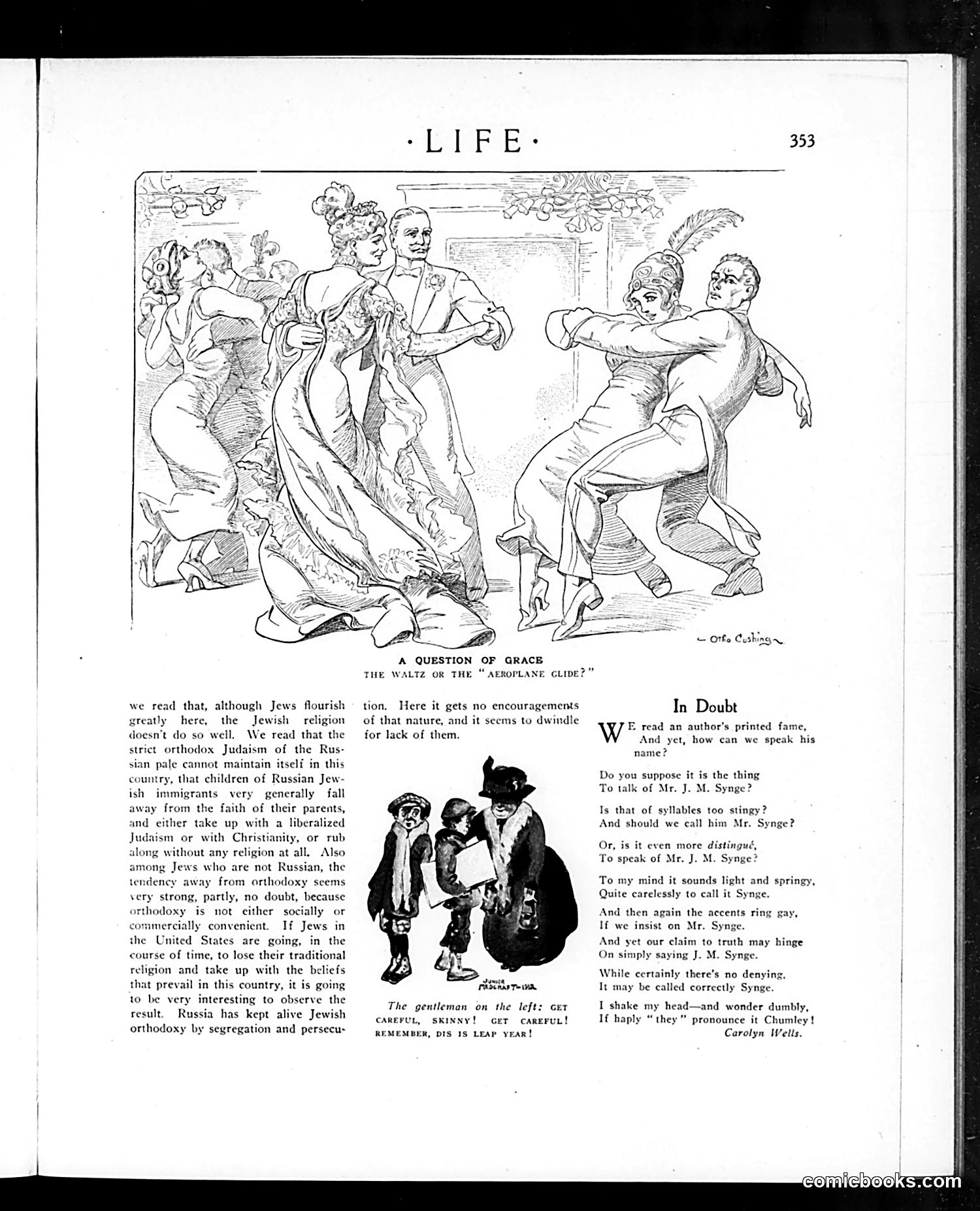
**Top Cartoon ("A Question of Grace"):** This satirizes social dancing etiquette. A well-dressed couple performs an awkward dance while others watch. The caption warns a thin man to "get careful" about dancing with women during a leap year—a reference to the tradition that women could propose to men in leap years. The joke mocks both the precariousness of social propriety and anxiety about gender role reversals. **Article (left column):** Discusses how Jewish immigrants to America are abandoning Orthodox Judaism, unlike in Russia where persecution maintained religious orthodoxy. The piece observes this assimilation trend with detached curiosity—treating religious erosion as a natural consequence of American freedom and commercial convenience. **"In Doubt" (right column):** A humorous poem by Carolyn Wells about pronunciation uncertainty regarding Irish playwright J. M. Synge's name. It plays on whether to use "Mr. Synge," "J. M. Synge," or just "Synge," treating his name's proper pronunciation as a social anxiety—a lighthearted riff on pretension.
📄 Transcribed text from this page (OCR, searchable)
Machine-transcribed from the original scan — historical spelling and the odd misread are preserved.
we read that, although Jews flourish greatly here, the Jewish religion doesn’t do so well. We read that the strict orthodox Judaism of the Rus- sian pale cannot maintain itself in this country, that children of Russian Jew- nmigrants very generally fall from the faith of their parents, and either take up with a liberalized Judaism or with Christianity, or rub along without any religion at all. Also among Jews who are not Russian, the tendency away from orthodoxy seems very strong, partly, no doubt, because orthodoxy is not either socially or mercially convenient. If Jews in the United States are going, in the course of time, to lose their traditional religion and take up with the beliefs that prevail in this country, it is going to be very interesting to observe the result. Russia has kept alive Jewish orthodoxy by segregation and persecu- ee A QUESTION OF GRACE THE WALTZ OR THE “AE! tion. Here it gets no encouragements of that nature, and it seems to dwindle for lack of them. owt Potro, The gentleman on the left: cet CAREFUL, SKINNY! GET caREFUL! REMEMBER, DIS 1S LEAP YEAR! PLANE. GLIDE?” In Doubt W* read an author's printed fame, And yet, how can we speak his name? Do you suppose it is the thing To talk of Mr. J. M. Synge? Is that of syllables too sting: And should we call him Mr. Synge? Or, is it even more distingué, To speak of Mr. J. M. Synge? To my mind it sounds light and springy, Quite carelessly to call it Synge. And then again the accents ring If we insist on Mr. Synge. And yet our claim to truth may hinge On simply saying J. M. Synge. While certainly there's no denying, It may be called correctly Synge. and wonder dumbly, pronounce it Chumley! Carolyn Wells.