
Life, 1912-02-15 · page 21 of 44
Life — February 15, 1912 — page 21: what you’re looking at
What you’re looking at
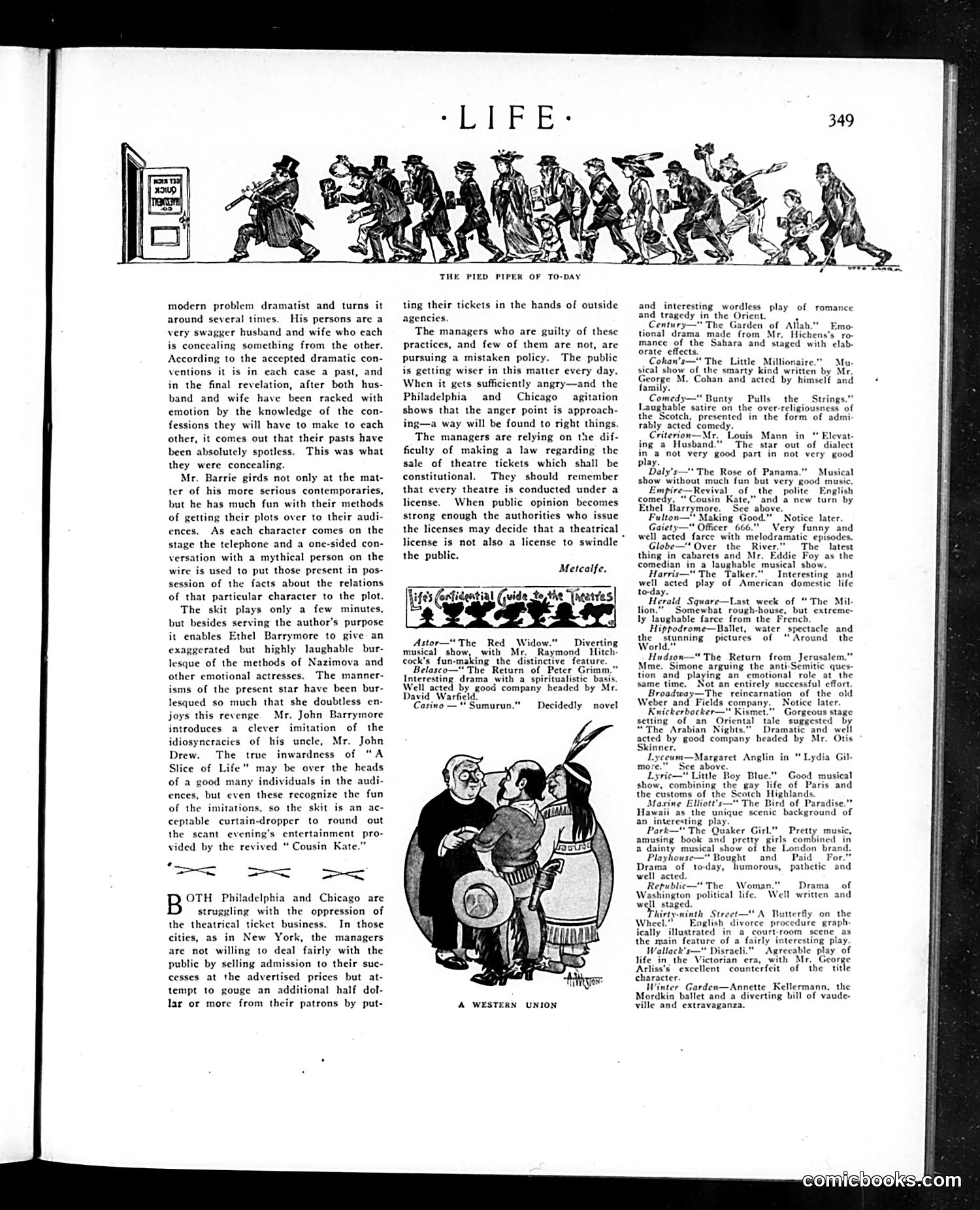
This page contains theater criticism and satire from an early 20th-century American magazine. The main cartoon—"The Pied Piper of To-Day"—appears at the top, depicting a procession of figures following someone, likely satirizing theatrical management or ticket-scalping practices. The text's primary focus is criticizing theater ticket scalping. Managers in Philadelphia and Chicago are selling tickets through outside agencies at inflated prices beyond advertised costs. The critic argues this is a "mistaken policy" that angers audiences and violates the public trust. He suggests theaters operate under city licenses, implying authorities could revoke these licenses if ticket fraud continues. The page also reviews current Broadway productions, including shows starring Ethel Barrymore and John Barrymore, praising their parodies of contemporary dramatic conventions and emotional acting styles. The satire targets theatrical management corruption and the power dynamics between public and corporate interests.
📄 Transcribed text from this page (OCR, searchable)
Machine-transcribed from the original scan — historical spelling and the odd misread are preserved.
modern problem dramatist and turns it around several times. His persons are a very swagger husband and wife who each is concealing something from the other. According to the accepted dramatic con- ventions it is in each case a past, and in the final revelation, after both hus- band and wife have been racked with emotion by the knowledge of the con- fessions they will have to make to each other, it comes out that their pasts have been absolutely spotless. This was what they were concealing. Mr. Barrie girds not only at the mat- ter of his more serious contemporaries, but he has much fun with their methods of getting their plots over to their audi- ences, As each character comes on the stage the telephone and a one-sided con- versation with a mythical person on the wire is used to put those present in pos- session of the facts about the relations of that particular character to the plot. The skit plays only a few minutes, but besides serving the author's purpose it enables Ethel Barrymore to give an exaggerated but highly laughable bur- lesque of the methods of Nazimova and other emotional actresses. The manner- isms of the present star have been bur- lesqued so much that she doubtless en- joys this revenge Mr. John Barrymore introduces a clever imitation of the idiosyncracics of his uncle, Mr. John Drew. The true inwardness of “A Slice of Life” may be over the heads of a good many individuals in the audi- ences, but even these recognize the fun of the imi ions, so the skit is an ac- ceptable curtain-dropper to round out the scant evening's entertainment pro- vided by the revived “ Cousin Kate.” a OTH Philadelphia and Chicago are struggling with the oppression of the theatrical ticket business. In those cities, as in New York, the managers are not willing to deal fairly with the public by selling admission to their suc- cesses at the advertised prices but at- tempt to gouge an additional half dol- lar or more from their patrons by put- >= THE PIED PIPER OF TO-DAY ting their tickets in the hands of outside agencies. The managers who are guilty of these practices, and few of them are not, are pursuing a mistaken policy. The public is getting wiser in this matter every day. When it gets sufficiently angry—and the Philadelphia and Chicago agitation shows that the anger point is approach- ing—a way will be found to right things The managers are relying on the dif- ficulty of making a law regarding the sale of theatre tickets which shall be constitutional. They should remember that every theatre is conducted under a license. When public opinion becomes strong enough the authorities who issue the licenses may decide that a theatrical license is not also a license to swindle the public. Metcalfe, Astor—“ The Red Widow.” —_Diverting musical show, with Mr. Raymond Hitch- cock’s fun-making the distinctive feature. Belasco—" The Return of Peter Grimm.” Interesting drama with a spiritualistic basis. Well acted by good company headed by Mr. David Warfield. Casino — * Sumurun Decidedly novel A WESTERN UNION and interesting wordless and tragedy in the Orient. : Century—* The Garden of Aliab."" Emo: tional drama made from Mr. Hichens’s. ro- mance of the Sahara and staged with elab- orate effects. , Cohan's—* The Little Millionaire.” Mu- cal show of the smarty kind written by Mr. George M. Cohan and acted by himself and family. Comedy—" Bunty Pulls the Strings Laughable satire on the over-religiousness of the Scotch. presented in the form of admi rably acted comedy. Criterion—Mr, Louis Mann in ** Elevat- ing a Husband.” The star out of dialect in a not very good part in not very good play. Daly's—" The Rose of Panama.” Musical show without much fun but very good music. Empire—Revival of the polite English comedy. “Cousin Kate," and a new turn by Ethel Barrymore. See above. Fulton—" Making Good.” Notice later. Gaiety— Officer 666." Very funny and well acted farce with melodramatic episodes. Globe—“ Over the River.” The latest thing in cabarets and Mr. Eddie Foy as the comedian in a laughable musical show. Harris—* The Talker.” Interesting and well acted play of American domestic life to-day. Herald Square—Last week of “The Mil- lion.” Somewhat rough-house, but extreme- ly laughable farce from the French. Hippodrome—Ballet, water spectacle and the ‘stunning pictures of “Around the World.” Hudson—" The Return from_Jerusalem.” Mme. Simone arguing the anti-Semitic ques: tion and playing an emotional role at_the same time. Not an entirely successful effort Broadway—The reincarnation of the old Weber and Fields company. Notice later. Knickerbocker—" Kismet.” Gorgeous stage setting of an Orie tale suggested by “The Arabian Nights.” Dramatic and well acted by good company headed by Mr. Otis Skinner. Lyceum—Margaret Anglin in “ ° bove. 3 tle Roy Blue." Good musical show, combining the gay life of Paris and the customs of the Scotch Highlands. Marine Eliiott's—" The Bird of Paradise."* Hawaii as the unique scenic background of an interesting play Park—" The Quaker C amusing book and pretty girls combined in a dainty musical show of the London brand, Playhouse—" Bought and Paid For.” Drama of today, humorous, pathetic and well acted. Republic—" The Woman, Washington political life. Well well staged. hirty-ninth Street—" A Thutterfly on the Wheel.” — English divorce procedure graph: ically ‘illustrated in a court-room scene as the main feature of a fairly interesting play. Wallack’s—“ Disracli.” Agreeable play of life in the Victorian era, with Mr. George Arliss's excellent counterfeit of the title character. Winter Garden—Annette Kellerman, the Mordkin ballet and a diverting bill of vaude- ville and extravaganza. play of romance Lydia Gil Pretty music, Drama of written and