
Life, 1912-02-15 · page 41 of 44
Life — February 15, 1912 — page 41: what you’re looking at
What you’re looking at
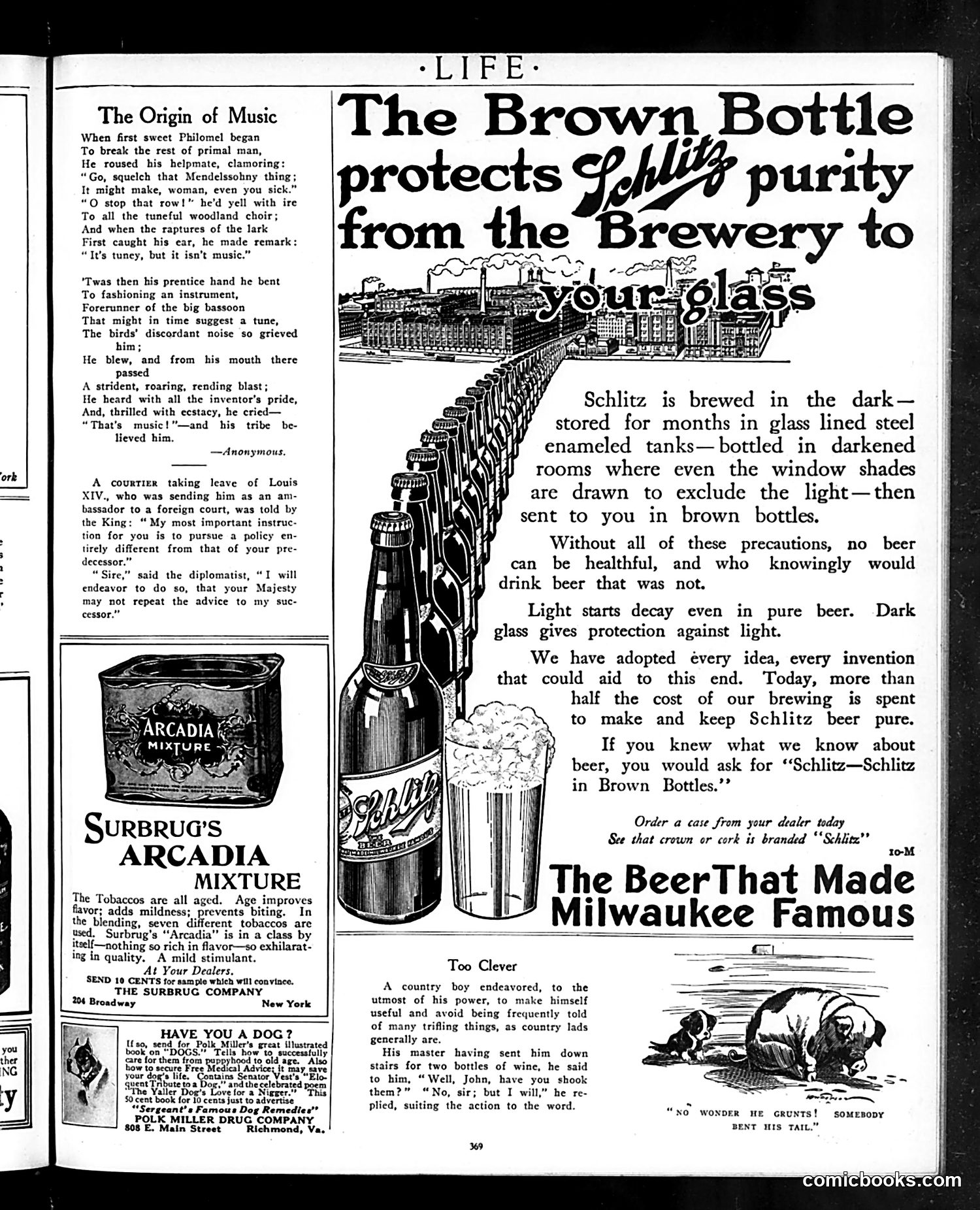
This page contains **primarily advertisements** with minimal satirical content. The main elements: **"The Origin of Music"** (top left): A humorous poem suggesting that man invented music to silence nature's sounds—birds annoyed him, so he created the bassoon as a louder alternative. The joke mocks both musical pretension and humanity's arrogance in "improving" nature. **Louis XIV anecdote**: A brief diplomatic joke about a courtier being told to differ from his predecessor—implying the predecessor's advice will only repeat endlessly. **"Too Clever"** (bottom right): A short joke about a country servant who, asked if he "shook" wine bottles, literally shakes them—a pun on misunderstanding instructions. The accompanying illustration shows a bent-tailed dog, the caption joking someone bent it. **Advertisements**: Most of the page promotes Schlitz beer (emphasizing brown bottles protect purity from light), Surbrug's tobacco mixture, and Polk Miller's dog remedies—typical early 20th-century product pitches with health claims. The satirical content is minimal; this is primarily an **advertising-heavy publication page**.
📄 Transcribed text from this page (OCR, searchable)
Machine-transcribed from the original scan — historical spelling and the odd misread are preserved.
SEVERE The Origin of Music When first sweet Philomel began To break the rest of primal man, He roused his helpmate, clamoring: “Go, squelch that Mendelssohny thing ; It might make, woman, even you sic “O stop that row!” he'd yell with ire To all the tuneful woodland choir; And when the raptures of the lark First caught his ear, he made remark: “Te’s tuney, but it isn’t music.” 'Twas then his prentice hand he bent To fashioning an instrument, Forerunner of the big bassoon That might in time suggest a tune, The birds’ discordant noise so grieved him; He blew, and from his mouth there passed A strident, roaring, rending blast; He heard with all the inventor's pride, And, thrilled with ecstacy, he cried— “That's music!"—and his tribe be- lieved him. —Anonymous. A courtier taking leave of Louis XIV., who was sending him as an am- bassador to a foreign court, was told by the King: “My most important instruc- tion for you is to pursue a policy en- tirely different from that of your pre- decessor.” “Sire,” said the diplomatist, “I will endeavor to do so, that your Majesty may not repeat the advice to my suc- SurBRUG’S ARCADIA MIXTURE The Tobaccos are all aged. Age improves favor; adds mildness; prevents biting. In the blending, seven dil ferent tobaccos are |. Surbrug's ‘‘Arcadia” is in a class by iteelf—nothing so rich in flavor—so exhilarat- ing in quality. A mild stimulant. At Your Dealers, SEND 10 CENTS for sample which will convince. THE SURBRUG COMPANY 206 Broadway Usp. sent or bale Mu wr send for Polk Miller's great illustrat book’ on “DOGS.” Tells ‘how t iy are for them from how to secure Pree bed: your dog’s life, tains ‘Senator Vests “Elo. >] sugar Patate ta Bos,” andthe slebrated poem 's Love fora Nigger.” This Sorcent book for fo cents jus to adverse, “Sergeant’s Famous Dog Remedies” POLK MILLER DRUG COMPANY 808 E. Main Street Richmond, Va. The Brown Bottle protects SMG p ahh from the B | Brewery to Schlitz is brewed in the dark— stored for months in glass lined steel enameled tanks—bottled in darkened rooms where even the window shades are drawn to exclude the light—then sent to you in brown bottles. Without all of these precautions, no beer can be healthful, and who knowingly would drink beer that was not. Light starts decay even in pure beer. Dark glass gives protection against light. We have adopted évery idea, every invention that could aid to this end. Today, more than half the cost of our brewing is spent to make and keep Schlitz beer pure. If you knew what we know about beer, you would ask for ‘‘Schlitz—Schlitz in Brown Bottles.’’ Order a case from your dealer today See that crown or cork is branded ‘‘Schlita’” The BeerThat Made Milwaukee Famous Too Clever A country boy endeavored, to the utmost of his power, to make himself useful and avoid being frequently told of many trifling things, as country lads generally are. His master having sent him down stairs for two bottles of wine, he said to him, “Well, John, have you shook them?" “No, sir; but I will,” he re- plied, suiting the action to the word. ty NO WONDER Me GRUNTS! somEBoDY BENT HIS TAIL.”