
Life, 1912-02-15 · page 26 of 44
Life — February 15, 1912 — page 26: what you’re looking at
What you’re looking at
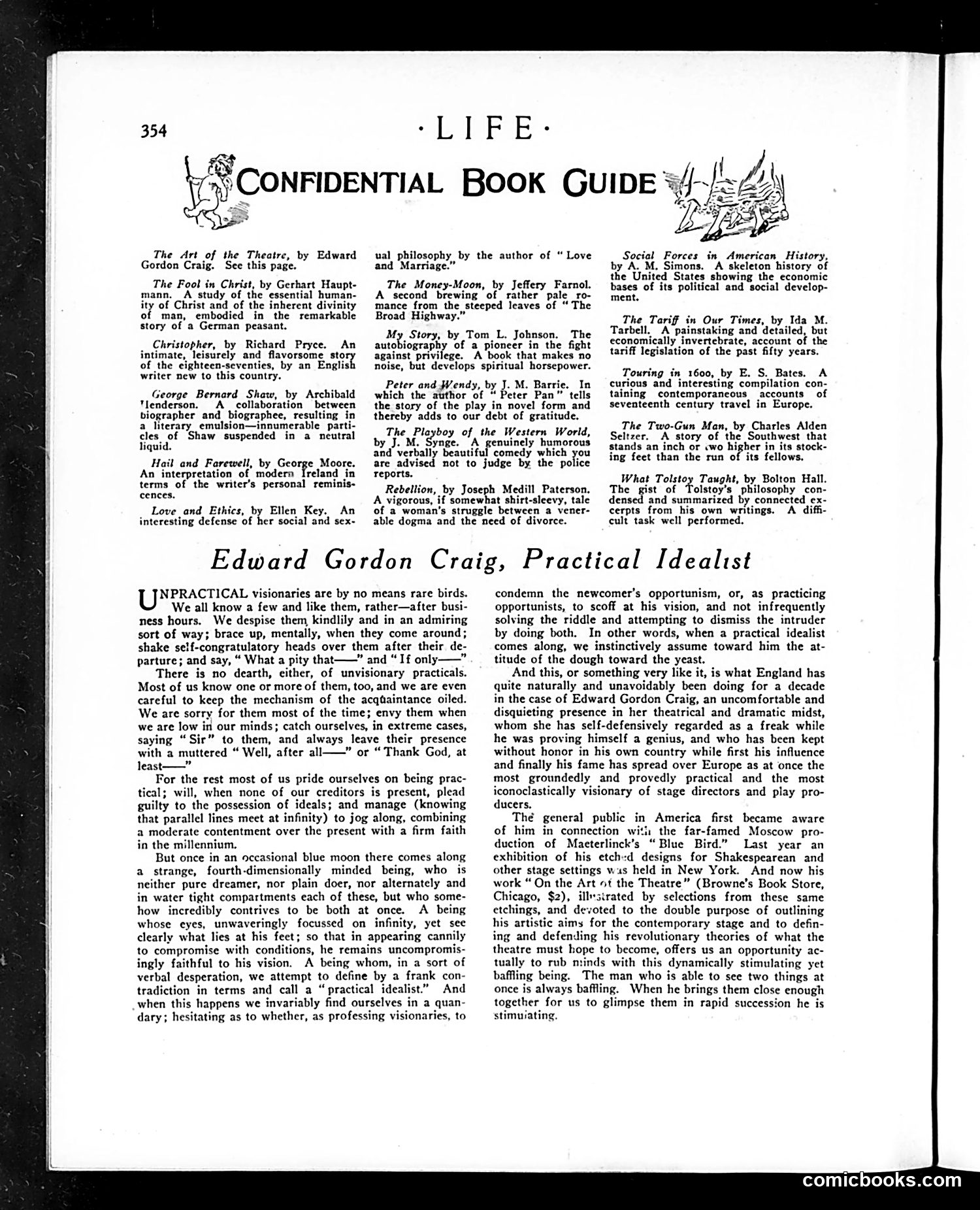
This page is primarily a **book review section** titled "Confidential Book Guide," not a political cartoon. It reviews contemporary literature (circa 1910s), including works by George Bernard Shaw, J.M. Barrie, and others. The featured article discusses **Edward Gordon Craig**, described as a "Practical Idealist"—a theater director and designer. The text praises Craig as an uncomfortably visionary figure in theater who was underappreciated in his own country but whose influence eventually spread across Europe. He's characterized as someone who bridges the gap between impractical dreamers and practical businesspeople, able to see two opposing viewpoints simultaneously. The satire is gentle: the author humorously describes how society treats visionaries (with patronizing admiration) versus practical people (with grudging respect), positioning Craig as someone rare who combines both qualities effectively. This is **literary journalism**, not political satire or cartooning.
📄 Transcribed text from this page (OCR, searchable)
Machine-transcribed from the original scan — historical spelling and the odd misread are preserved.
The Art of the Theatre, by Edward Gordon Craig. See this page. The Fool in Christ, by Gerhart Haupt- mann. A study of the essential hi ity of Christ and of the inherent di of man, embodied in the remarkable story of a German peasant. Christopher, by Richard Pryce. An intimate, leisurely and flavorsome sto: of the eighteen-seventies, by an Englis writer new to this country. George Bernard Shaw, by Archibald "lenderson. A collaboration between biographer and biographee, resulting in a literary emulsion—innumerable parti- cles of Shaw suspended in a neutral liquid. Hail and Farewell, by George 1 aloore: An interpretation of modern Ireland in terms of the writer’s personal reminis- cences. Love and Ethics, by Ellen Key. An interesting defense of her social and sex- LIFE * CONFIDENTIAL BOoK GUIDE ‘° ual philosophy, by the author of “ Love and Marriage.” The Money-Moon, by Jeffery Farnol. A second brewing ‘of rather pale ro- mance from the steeped leaves of “The Broad Highway.” a. Story, by Tom. L. Johnson. The autobiography of a pioneer in the fight against privilege. A book that makes no noise, but develops spiritual horsepower. Peter and Wendy, by J. M. Barrie. In which the author of “ Peter Pan” tells the story of the play in novel form and thereby adds to our debt of gratitude. The Fi? boy of, the Western World, by J. ynge. Ertl pirat td Sores and verbally beautiful comedy which are advised not to judge by the pol Nee reports. Rebellion, by Joseph Medill Paterson. A vigorous, if somewhat shirt-sleevy, tale ‘of a woman's struggle between a vener- able dogma and the need of divorce. Social Forces in American History, by A. M. Simons. A skeleton history of the United States showing the economic bases of its political and social develop- ment. The Tariff in Our Times, by Ida M. Tarbell. A painstaking and detailed, but economically invertebrate, account of the tariff legislation of the past fifty years. Touring in 1600, by E. S. Bates. A curious and interesting compilation con- taining contemporaneous accounts of seventeenth century travel in Europe. The Two-Gun Man, by Charles Alden Seltzer. A story of the Southwest that stands an inch or «wo higher in its stock- ing feet than the run of its fellows, What Tolstoy Taught, by Bolton Hall. The gist of Tolstoy's philosophy con- densed and summarized by connected ex- cerpts from his own writings. A diffi- cult task well performed. Edward Gordon Craig, Practical Idealist NPRACTICAL visionaries are by no means rare birds. We all know a few and like them, rather—after busi- ness hours. We despise them kindlily and in an admiring sort of way; brace up, mentally, when they come around; shake self-congratulatory heads over them after their de- parture; and say, “ What a pity that——” and “If only—” There is no dearth, either, of unvisionary practicals. Most of us know one or more of them, too, and we are even careful to keep the mechanism of the acqdaintance oiled. We are sorry for them most of the time; envy them when we are low in our minds; catch ourselves, in extreme cases, saying “Sir” to them, and always leave their presence with a muttered “ Well, after all——” or “Thank God, at least — For the rest most of us pride ourselves on being prac- tical; will, when none of our creditors is present, plead guilty to the possession of ideals; and manage (knowing that parallel lines meet at infinity) to jog along, combining a moderate contentment over the present with a firm faith in the millennium, But once in an occasional blue moon there comes along a strange, fourth-dimensionally minded being, who is neither pure dreamer, nor plain doer, nor alternately and in water tight compartments each of these, but who some- how incredibly contrives to be both at once. A being whose eyes, unwaveringly focussed on infinity, yet see clearly what lies at his feet; so that in appearing cannily to compromise with conditions, he remains uncompromis- ingly faithful to his vision. A being whom, in a sort of verbal desperation, we attempt to define by a frank con- tradiction in terms and call a “practical idealist.” And when this happens we invariably find ourselves in a quan- dary; hesitating as to whether, as professing visionaries, to condemn the newcomer’s opportunism, or, as practicing opportunists, to scoff at his vision, and not infrequently solving the riddle and attempting to dismiss the intruder by doing both. In other words, when a practical idealist comes along, we instinctively assume toward him the at- titude of the dough toward the yeast. And this, or something very like it, is what England has quite naturally and unavoidably been doing for a decade in the case of Edward Gordon Craig, an uncomfortable and disquieting presence in her theatrical and dramatic midst, whom she has self-defensively regarded as a freak while he was proving himself a genius, and who has been kept without honor in his own country while first his influence and finally his fame has spread over Europe as at once the most groundedly and provedly practical and the most iconoclastically visionary of stage directors and play pro- ducers, Thé general public in America first became aware of him in connection with the far-famed Moscow pro- duction of Maeterlinck’s “Blue Bird.” Last year an exhibition of his etch:d designs for Shakespearean and other stage settings wus held in New York. And now his work “On the Art ot the Theatre” (Browne's Book Store, Chicago, $2), illsirated by selections from these same etchings, and devoted to the double purpose of outlining his artistic aims for the contemporary stage and to defin- ing and defending his revolutionary theories of what the theatre must hope to become, offers us an opportunity ac- tually to rub minds with this dynamically stimulating yet baffling being. The man who is able to see two things at once is always baffling. When he brings them close enough together for us to glimpse them in rapid succession he is stimuiating. comicbooks.com