
Life, 1912-02-15 · page 28 of 44
Life — February 15, 1912 — page 28: what you’re looking at
What you’re looking at
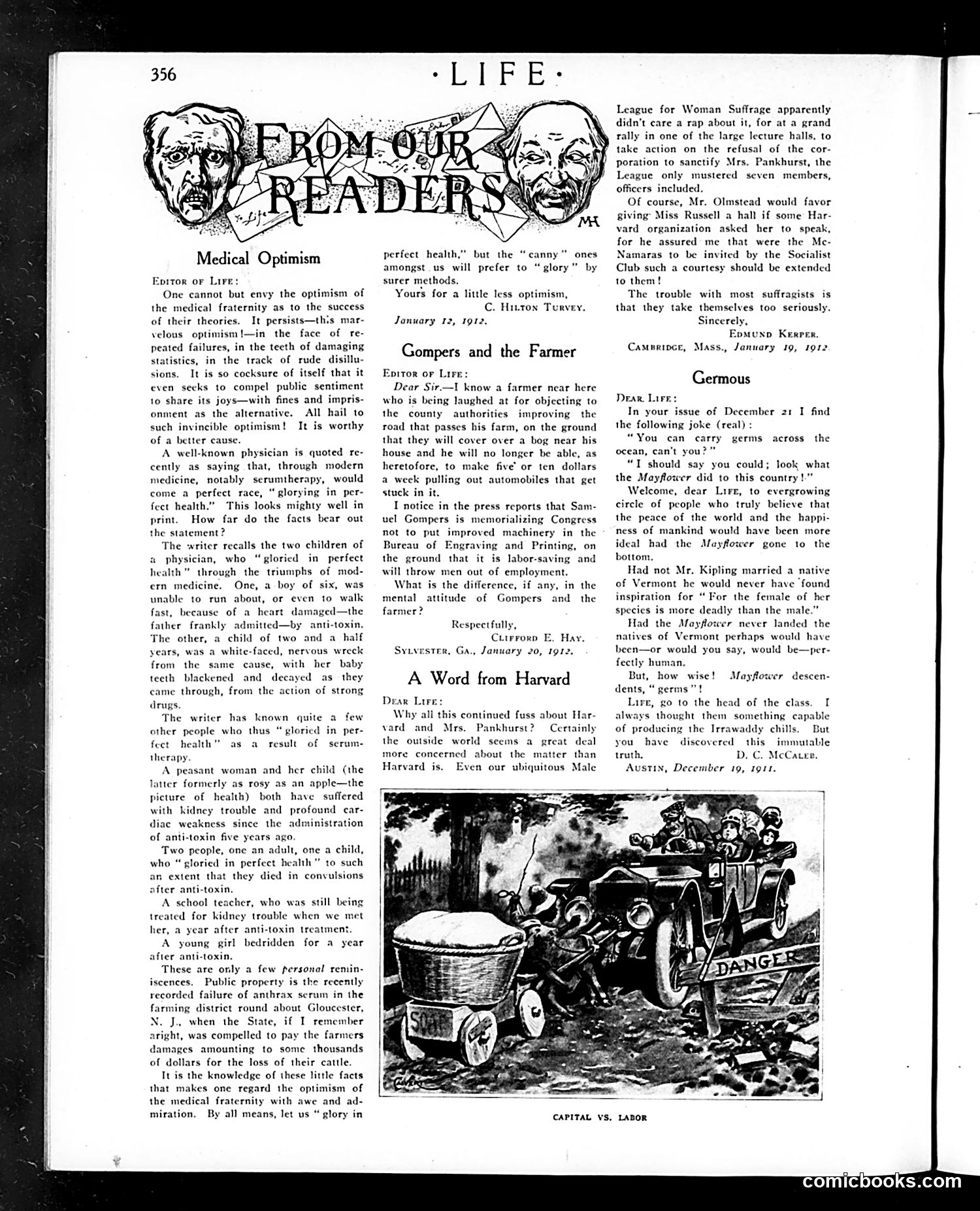
The cartoon titled "Capital vs. Labor" depicts a collision between two vehicles: one carrying wealthy capitalists or industrialists, and another representing labor/workers. The image illustrates the economic conflict between capital owners and working people—a major political tension of the 1912 era. This accompanies a letter from a farmer criticizing labor leader Samuel Gompers for opposing mechanization in government printing offices to protect jobs. The writer compares Gompers' stance to a farmer who profits from automobiles getting stuck in a bog, arguing both prioritize narrow self-interest over progress. The cartoon visualizes this ideological clash: capital pursues efficiency and profit through machines; labor resists displacement. This reflects early-20th-century debates about industrialization, mechanization, and workers' rights during a period of significant labor activism.
📄 Transcribed text from this page (OCR, searchable)
Machine-transcribed from the original scan — historical spelling and the odd misread are preserved.
ey Medical Optimism Eprtor oF Lire: One cannot but envy the optimism of the medical fraternity as to the success of their theories. It persists—this mar- velous optimism!—in the face peated failures, in the teeth of damaging statistics, in the track of rude disillu- sions. It is so cocksure of itself that it even secks to compel public sentiment to share its joys—with fines and impris- onment as the alternative, All hail to such invineible optimism! It is worthy of a better cause. A well-known physician is quoted re- cently as saying that, through modern medicine, notably serumtherapy, would come a perfect race, “glorying in per- fect health.” This looks mighty well in print. How far do the facts bear out the statement? The -writer recalls the two children of a physician, who “gloried in perfect health” through the triumphs of mod- em medicine. One, a boy of six, was unable to run about, or even to walk fast, because of a heart damaged—the father frankly admitted—by anti-toxin. The other, a child of two and a half a white-faced, nervous wreck from the cause, with her baby teeth blackened and decayed as they came through, from the action of strong drugs. The writer has known quite a few other people who thus “gloried in per- fect health" as a result. of therapy. A peasant woman and her child (the latter formerly as rosy as an apple—the picture of health) both suffered with kidney trouble and profound car- diac weakness since the administration of anti-toxin five years ago. Two people, one an adult, one a child, who “gloried in perfect health” to such extent that they died in convulsions after anti-toxin. A school teacher, who was still being treated for kidney trouble when we met her, a year after anti-toxin treatment A young girl bedridden for a year after anti-toxin. These are only a few personal remin- iscences. Public property is the recently recorded failure of anthrax scrum in the farming district round about Gloucester, J., when the State, if I remember aright, was compelled to pay the farmers damages amounting to some thousands of dollars for the loss of their cattle. It is the knowledge of these little facts that makes one regard the optimism of the medical fraternity with awe and ad- miration. By all means, let us “ glory in of re- years, same serum- have canny “ glory” perfect health,” but the “ amongst us will prefer to surer methods. Yours for a little less optimism, C. Hitox Turvey. 1912. ones by January Gompers and the Farmer Epitor oF Lire: Dear Sir—1 know a farmer near here who is being laughed at for objecting to the county authorities improving the road that passes his farm, on the ground that they will cover over a bog near his house and he will no longer be able, as heretofore, to make five’ or ten dollars a week pulling out automobiles that get stuck in it. I notice in the press reports that Sam- uel Gompers is memorializing Congress not to put improved machinery in the Bureau of Engraving and Printing, the ground that it is labor-saving will throw men out of employment. What is the difference, if any, in the mental attitude of Gompers and the farmer on and Respectfully, Cutrrorp E. Hay. Syvestre, Ga., January 20, 1912. A Word from Harvard Dear Liv: Why all this continued fuss about Har- vard and Mrs. Pankhurst? — Certainly the outside world seems a great deal more concerned about the matter than Harvard is. Even our ubiquitous Male League for Woman Suffrage apparently didn’t care a rap about it, for at a grand rally in one of the large lecture halls. to take action on the refusal of the cor- poration to sanctify Mrs. Pankhurst, the Le officers included. Of course, Mr. Olmstead would favor giving Miss Russell a hall if some Har- vard organization asked her to speak, for he assured me that were the Mc- Namaras to be invited by the Socialist Club such a courtesy should be extended to them! The trouble with most suffragists is that they take themselves too seriously. Sincerel ZoMUND Kerrer Camurivce, Mass., January 19, 1912 gue only mustered seven members, Germous Dear Lire In your issue of December 21 I find the following joke (real) : “You can carry germs ocean, can’t you?” “TI should say you could; look what the Mayflower did to this country !.” Welcome, dear Lire, to evergrowing circle of people who truly believe that the peace of the world and the happi- ness of mankind would have been more ideal had the Mayflower gone to the bottom. Had not Mr. Kipling married a native of Vermont he would never have ‘found inspiration for “For the female of her species is more deadly than the male.” Had the Mayflower never landed the natives of Vermont perhaps would have been—or would you say, would be—per- fectly human, But, how wise! dents, “ germs"! Lire, go to the head of the class. always thought them something capable of producing the Irrawaddy chills. But you have this immutable truth, D. C. McCatee. Austix, December 19, 1911. across the Mayflower descen- discovered CAPITAL VS. LABOR comicbooks.com