
Life, 1912-02-15 · page 8 of 44
Life — February 15, 1912 — page 8: what you’re looking at
What you’re looking at
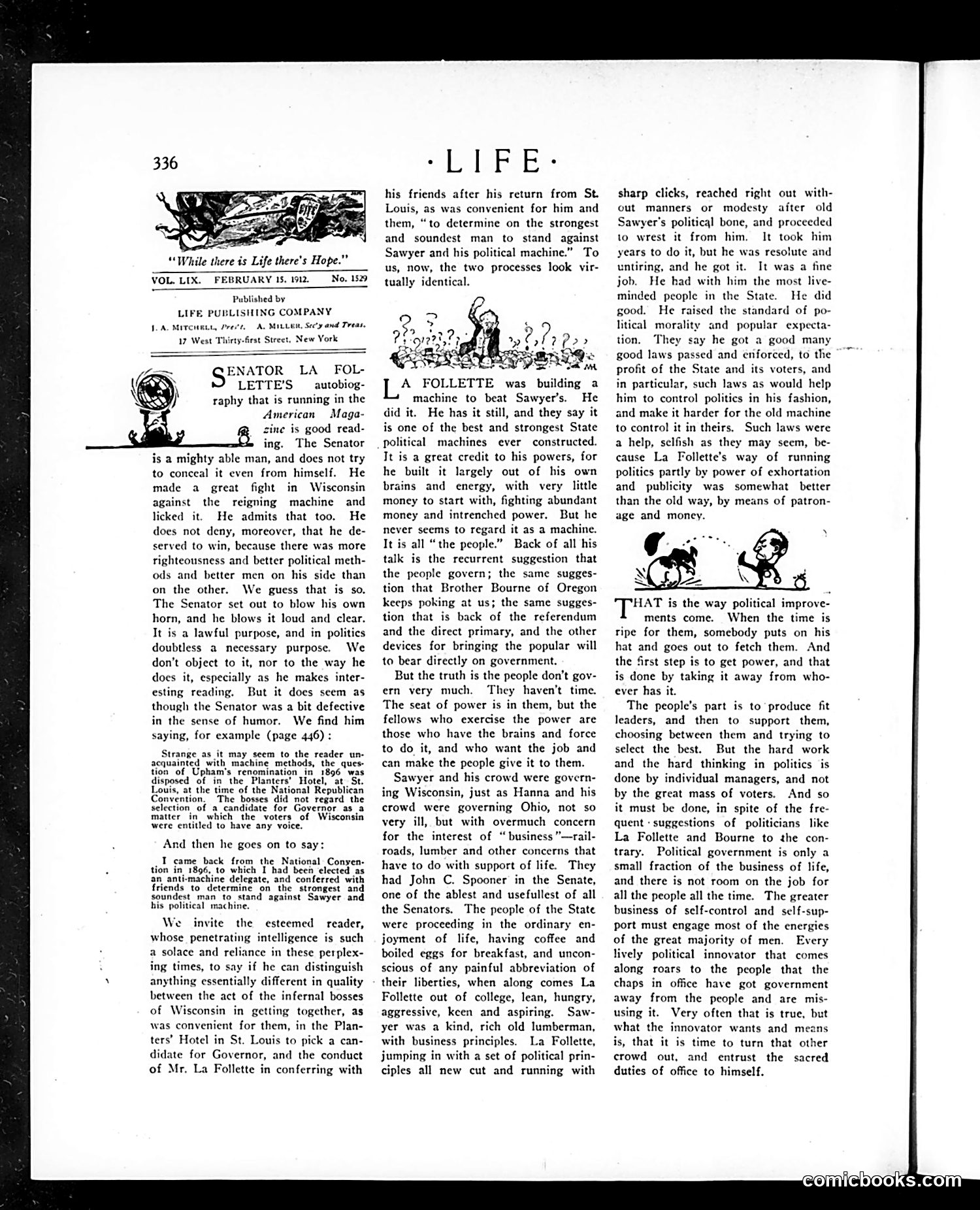
This page criticizes **Senator La Follette** (a prominent Wisconsin Progressive politician) through text and cartoons. The article defends La Follette as a "mighty able man" who fought against political machines, but argues his machine for beating opponent Sawyer was equally powerful. The central point: La Follette built an effective political organization using his own "brains and energy" rather than money, which ironically made him *as dominant* as the traditional machines he opposed. The cartoon (bottom right) illustrates how political improvements occur—through competition and voter choice, not by replacing one machine with another. The piece suggests reformers often become the very thing they fight against, a recurring theme in Progressive Era satire.
📄 Transcribed text from this page (OCR, searchable)
Machine-transcribed from the original scan — historical spelling and the odd misread are preserved.
“While there is Life there's Hope.” VOL. LIX. FEBRUARY 15. 1912.__No. 1529 Published by LIFE PUBLISHING COMPANY JA MITCHREL, Pret, A. MILLE: Sec’y and Treas, 17 West Thirty-first Street, New Vork NATOR LA FOL- LETTE’S _ autobiog- raphy that is running in the American Maga- ne is good read- ing. The Senator is a mighty able man, and does not try to conceal it even from himself. He made a great fight in Wisconsin against the reigning machine and licked it. He admits that too, He does not deny, moreover, that he de- served to win, because there was more righteousness and better political meth- ods and better men on his side than on the other. We guess that is so. The Senator set out to blow his own horn, and he blows it loud and clear. It is a lawful purpose, and in politics doubtless a necessary purpose. We don’t object to it, nor to the way he does it, especially as he makes inter- esting reading. But it does seem as though the Senator was a bit defective in the sense of humor. We find him saying, for example (page 446) : Strange as it may seem to the reader un- acquainted with machine methods, the ques- tion of Upham’s renomination in 1896 was dof in the Planters’ Hotel, at_ St. the time of the National Republican ation. The bosses did not regard the selection of a candidate for Governor as a matter in which the voters of Wisconsin were entitled to have any voice. Conv And then he goes on to say: T came back from the National Conyen- tion in, 1896, to which I had been elected as an antimachine delegate, and conferred with friends to determine on the strongest. and soundest man to stand against Sawyer and his political machine. We invite the esteemed reader, whose penetrating intelligence is such a solace and reliance in these perplex- ing times, to say if he can distinguish anything essentially different in quality between the act of the infernal bosses of Wisconsin in getting together, as was convenient for them, in the Plan- ters’ Hotel in St. Louis to pick a can- didate for Governor, and the conduct of Mr, La Follette in conferring with LIFE his friends after his return from St. Louis, as was convenient for him and them, “to determine on the strongest and soundest man to stand against Sawyer and his political machine.” To us, now, the two processes look vir- tually identical. A FOLLETTE was building a machine to beat Sawyer’s. He did it. He has it still, and they say it is one of the best and strongest State political machines ever constructed. Tt is a great credit to his powers, for he built it largely out of his own brains and energy, with very little money to start with, fighting abundant money and intrenched power. But he never seems to regard it as a machine. It is all “the people.” Back of all his talk is the recurrent suggestion that the people govern; the same sugges- tion that Brother Bourne of Oregon keeps poking at us; the same sugges- tion that is back of the referendum and the direct primary, and the other devices for bringing the popular will to bear directly on government. But the truth is the people don’t gov- ern very much. They haven't time. The seat of power is in them, but the fellows who exercise the power are those who have the brains and force to do it, and who want the job and can make the people give it to them. Sawyer and his crowd were govern- ing Wisconsin, just as Hanna and his crowd were governing Ohio, not so very ill, but with overmuch concern for the interest of “ business "—rail- roads, lumber and other concerns that have to do with support of life. They had John C. Spooner in the Senate, one of the ablest and usefullest of all the Senators. The people of the State were proceeding in the ordinary en- joyment of life, having coffee and boiled eggs for breakfast, and uncon- scious of any painful abbreviation of their liberties, when along comes La Follette out of college, lean, hungry, aggressive, keen and aspiring. Saw- yer was a kind, rich old lumberman, business principles. La Follette, jumping in with a set of political prin- ciples all new cut and running with sharp clicks, reached right out with- out manners or modesty after old Sawyer’s political bone, and proceeded to wrest it from him. It took him years to do it, but he was resolute and untiring, and he got it. It was a fine job. He had with him the most live- minded people in the State. He did good. He raised the standard of po- litical morality and popular expecta- tion. They say he got a good many good laws passed and enforced, to the profit of the State and its voters, and in particular, such laws as would help him to control politics in his fashion, and make it harder for the old machine to control it in theirs, Such laws were a help, selfish as they may seem, be- cause La Follette’s way of running politics partly by power of exhortation and publicity was somewhat better than the old way, by means of patron- age and money. HAT is the way political improve- ments come. When the time is ripe for them, somebody puts on his hat and goes out to fetch them. And the first step is to get power, and that is done by taking it away from who- ever has it. The people’s part is to produce fit leaders, and then to support them, choosing between them and trying to select the best. But the hard work and the hard thinking in politics is done by individual managers, and not by the great mass of voters. And so it must be done, in spite of the fre- quent - suggestions of politicians like La Follette and Bourne to the con- trary. Political government is only a small fraction of the business of life, and there is not room on the job for all the people all the time. The greater business of self-control and self-sup- port must engage most of the energies of the great majority of men. Every lively political innovator that comes along roars to the people that the chaps in office have got government away from the people and are mis- using it. Very often that is true, but what the innovator wants and m is, that it is time to turn that other crowd out, and entrust the sacred duties of office to himself.